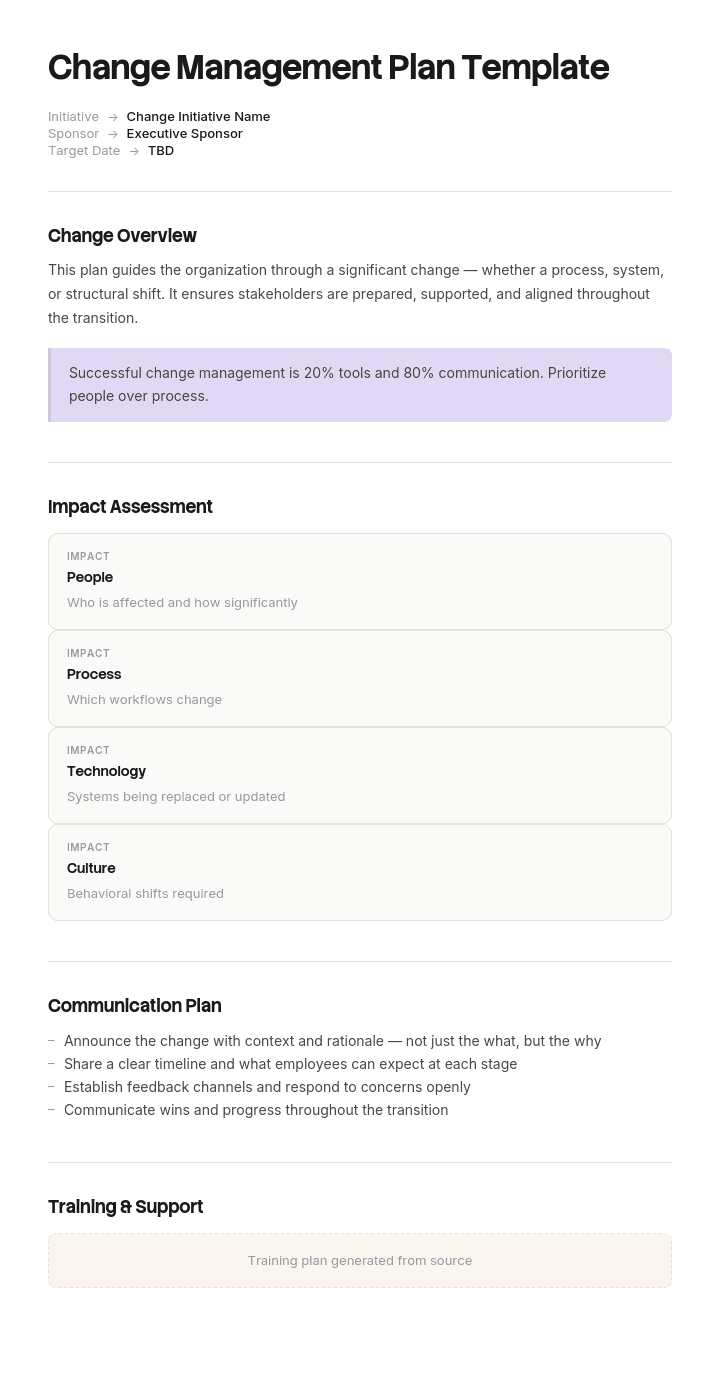
Use this template
Change is constant - new tools, restructures, mergers, process updates. The difference between successful change and failed change is almost always the plan. With Trupeer, you can save hours on change planning by starting with a ready-to-use change management plan template, customizing it with your brand identity, and turning the plan into video communications that bring leaders, managers and frontline teams along.
Systems go live on time and nobody uses them. That is the ordinary outcome of change management done as a project plan: the deliverables shipped, the training happened, and six weeks later half the team is back on the spreadsheet.
This free change management plan template is organised around the reason that happens. People do not adopt a change because it launched. They adopt it once five separate things are true for them, and each one needs a different intervention.
Download the change management plan template
Format | Best for |
|---|---|
Word (.docx) | The plan itself. Free download, no sign-up. What you circulate and get approved |
Excel (.xlsx) | Stakeholder matrix, impact assessment, change log and adoption tracking |
PowerPoint (.pptx) | The sponsor and steering group version, one slide per phase |
The approved baseline, and printing for workshops | |
Google Docs | Collaborative drafting with HR and project leads |
Free, editable, no watermark. Most teams need the Word plan and the Excel workbook together, since the stakeholder and impact analysis is tabular and the plan is narrative.
How to customize this template in Trupeer
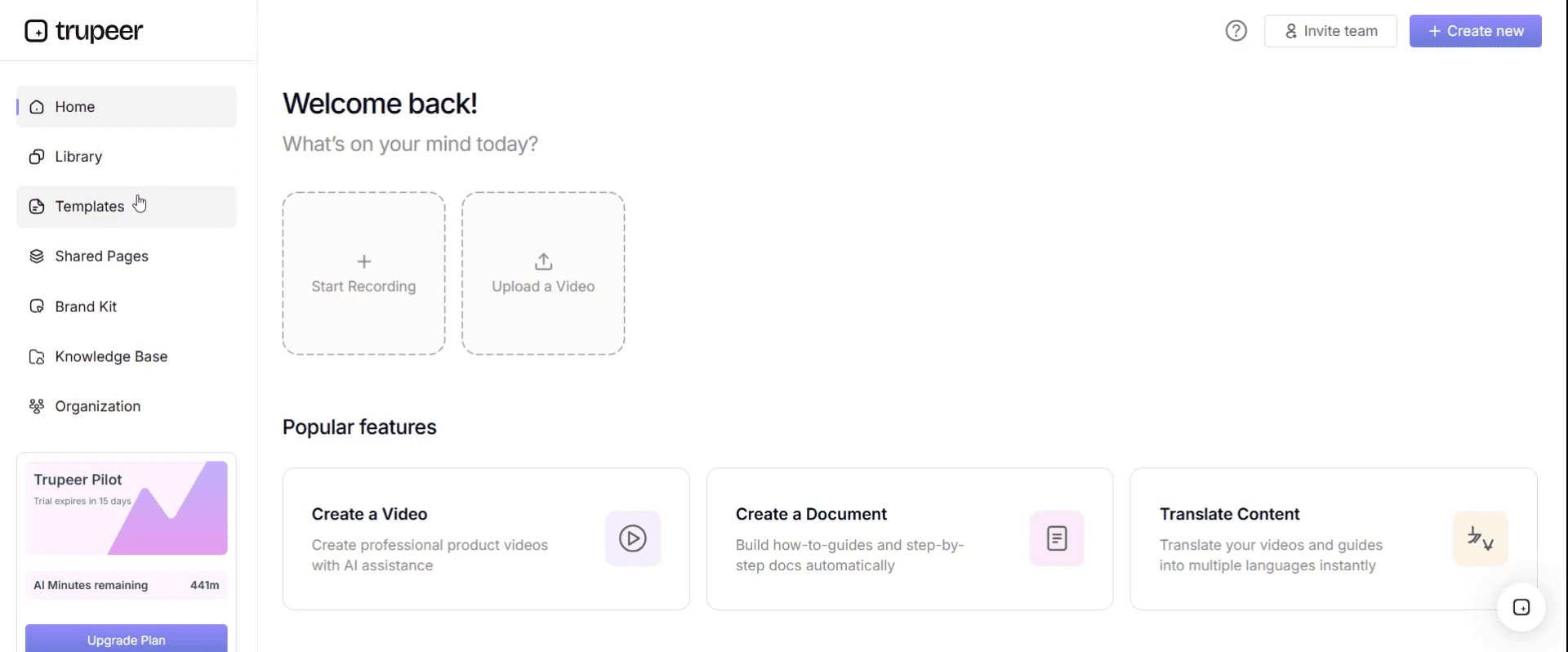
Step 1: Open the Templates Section
Go to the Templates section from the main navigation.
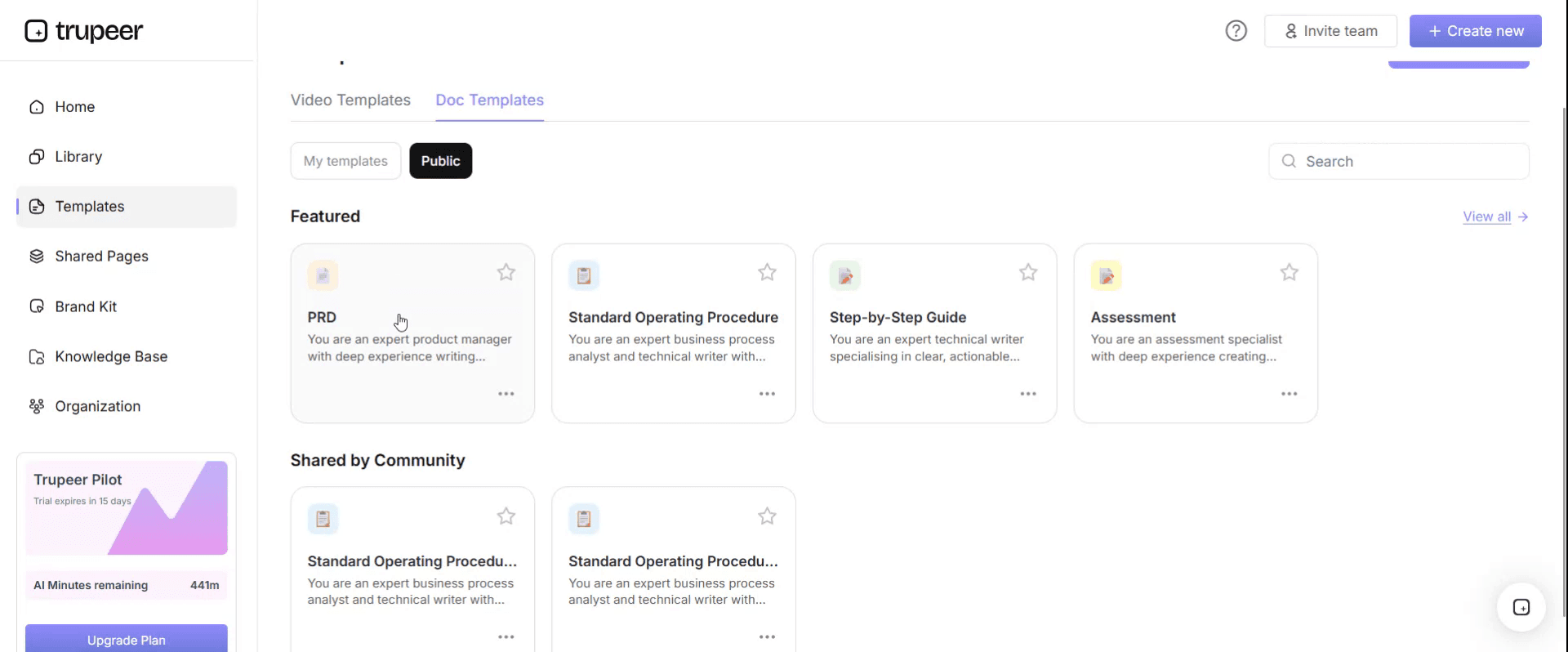
Step 2: Select and Open a Template
Click on any template you want to work with to open it.
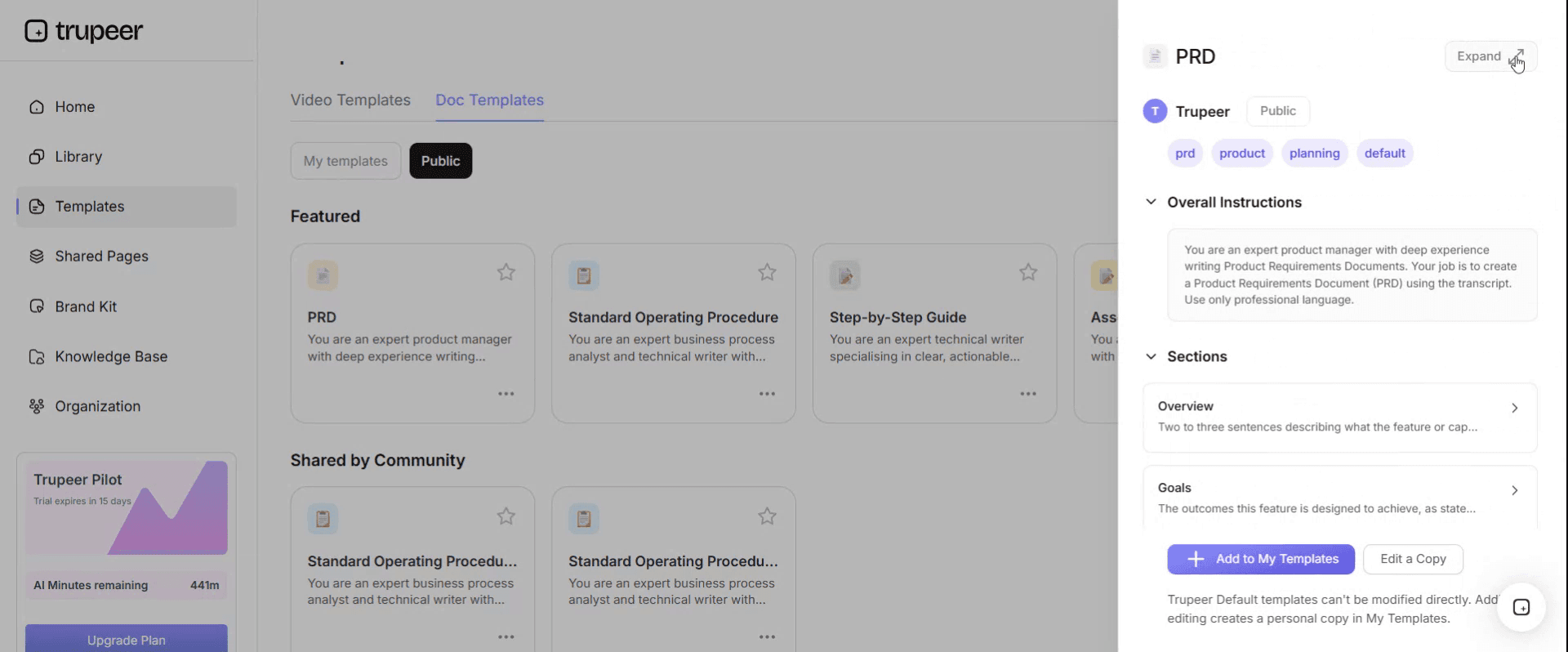
Step 3: Expand the Template View
If needed, expand the template view to see the full layout and details clearly.
Step 4: Edit the Template
Click on Edit to start modifying the selected template.
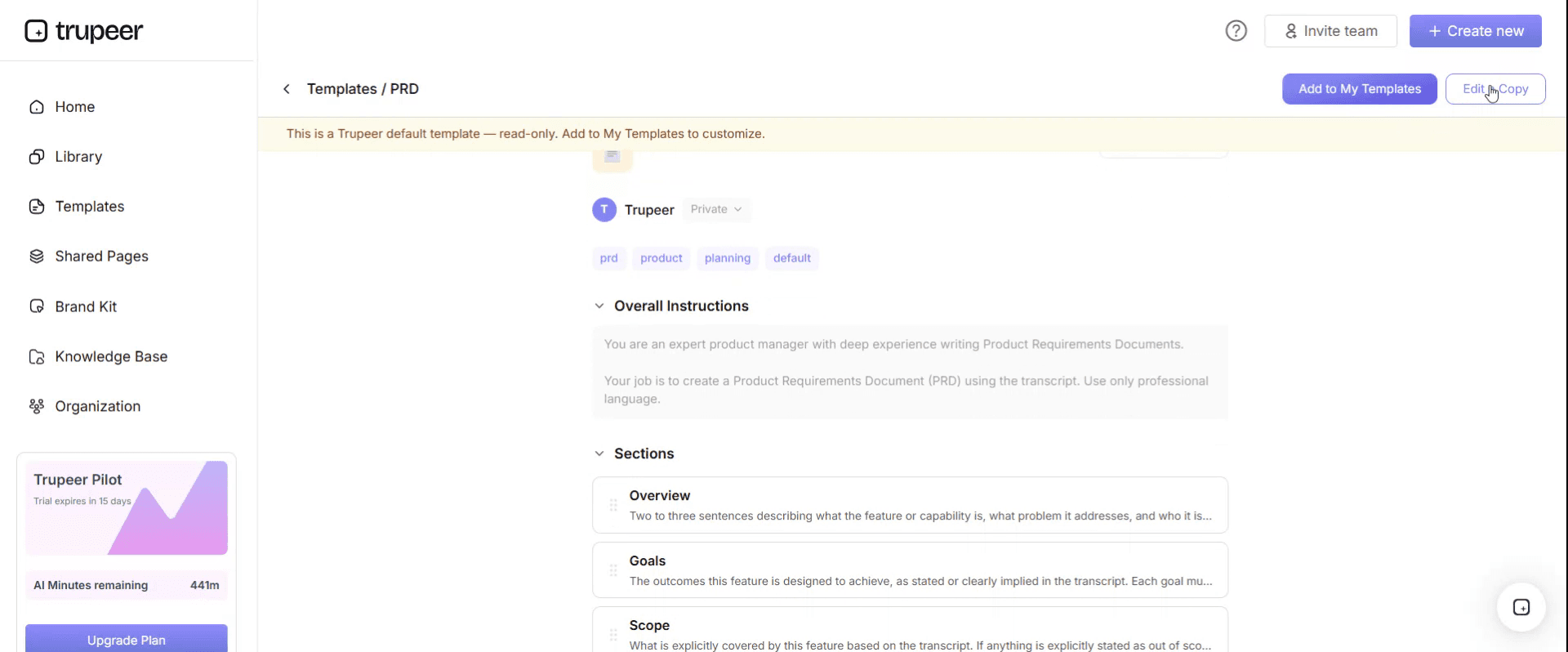
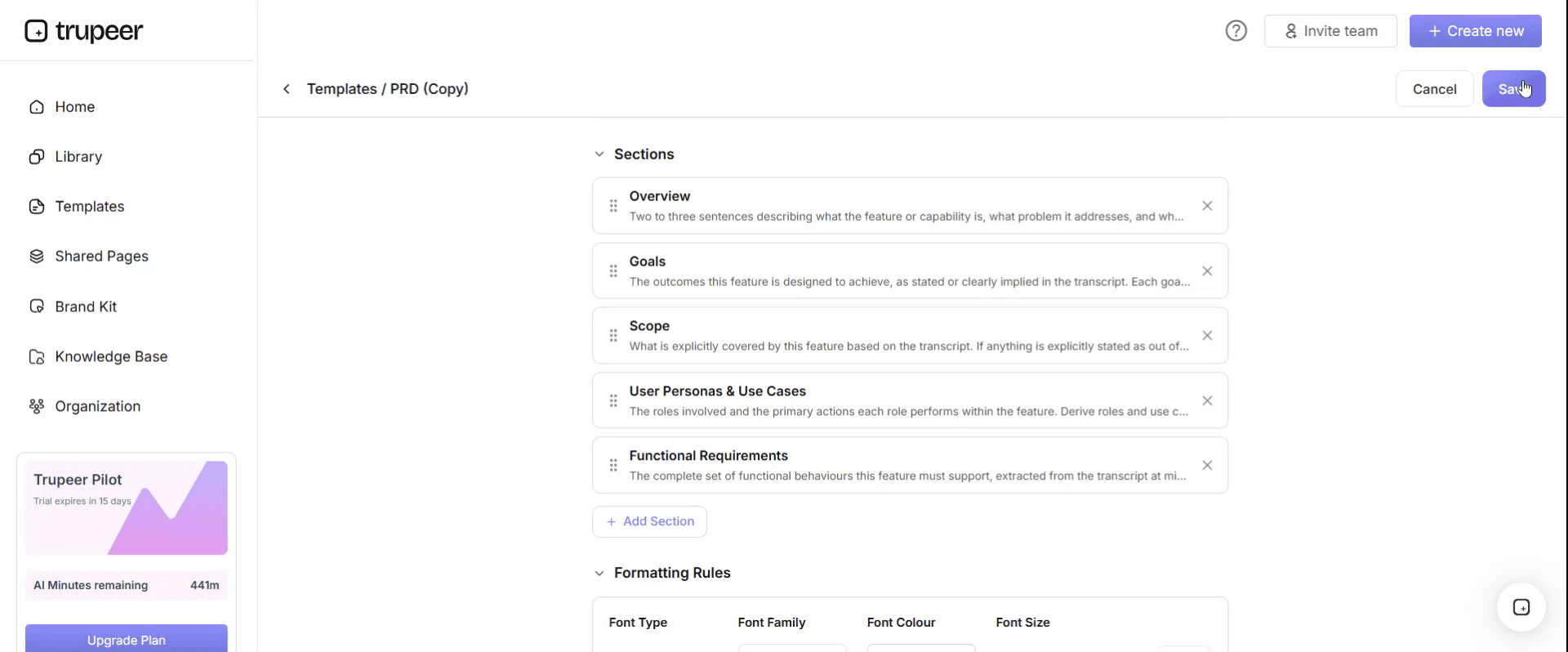
Within the editor, you can:
Add new sections
Define or update formatting rules
Add a logo and adjust its position and related settings
Step 5: Save Your Customized Template
After making all necessary changes, click Save to store the updated template as your own.
Step 6: Preview and Fine-Tune the Template
When you want to see how your customized template looks, open the Preview.
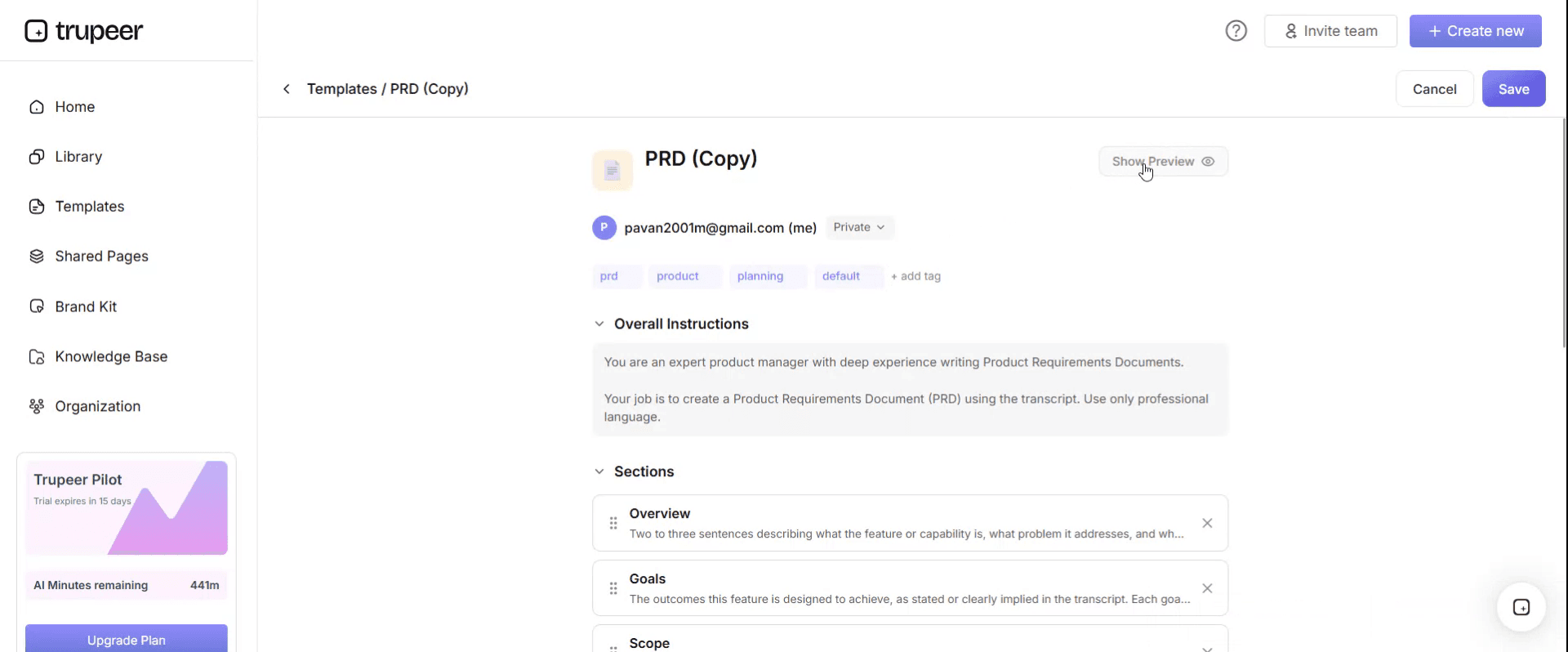
From the preview screen, you can continue to make adjustments directly if needed, ensuring the template appears exactly as you want.
With a change management plan template you can:
Save hours on planning: Skip the blank page with a proven framework used by experienced change leaders.
Assess impact clearly: Built-in sections for stakeholder analysis, risk and resistance mapping.
Stay on-brand: Apply your logo, colors and fonts using Trupeer's brand kit - critical for company-wide change comms.
Communicate at scale: Replace dense email rollouts with short video updates that everyone can watch.
Track adoption: Built-in metrics fields help you measure whether the change is actually landing.
Reach global teams: Translate change comms into 65+ languages with one click.
A change management plan turns disruption into transformation. Use this template to plan, communicate and execute every change with confidence.
What is a change management plan?
A change management plan sets out how you will move an organisation from how it works today to how it needs to work, focusing on the people rather than the technical delivery.
The distinction from a project plan matters. A project plan tracks whether the thing got built. A change management plan tracks whether anyone uses it. They run in parallel, share milestones, and answer different questions. A project can hit every date and still fail, and when it does, the change plan is what was missing.
Why change plans fail
Worth starting here, because most of the template exists to prevent these.
The change was announced rather than explained. People were told what is happening, not why it is happening or what it costs to carry on as they are.
Managers found out at the same time as their teams, so they had no answers when asked.
Training happened weeks before go-live, when nobody could apply it yet.
Resistance was treated as an attitude problem rather than as information.
Nobody was accountable for adoption after launch, because the project closed at go-live.
Success was measured on delivery milestones instead of on usage.
The old way still worked. If the spreadsheet is still there, the spreadsheet wins.
The five states people move through
This is the spine of the template. It follows the ADKAR model developed by Prosci, which is the most widely used framework in change management because it is diagnostic. When adoption stalls, you can identify which state people are stuck in and respond specifically.
Awareness
They understand what is changing and why now. Not that a project exists, but what problem it solves and what happens if nothing changes.
What builds it: the case for change from a credible sponsor, in person where possible. Numbers about the current situation. The cost of doing nothing, stated plainly.
How you know it is missing: people describe the change as something being done to them, or cannot explain the reason without referring to a slide.
Desire
They want to participate. This is the state most plans skip entirely, because it cannot be delivered by announcement and it is uncomfortable to address.
What builds it: an honest answer to what this means for me. Involving people in shaping the change rather than reviewing it. Addressing the losses openly, since every change costs somebody something.
How you know it is missing: compliance in meetings, quiet non-adoption afterwards. This is the most common failure point and the hardest to see, because nobody says no.
Knowledge
They know how to work the new way. This is what training normally addresses, and it is the only one of the five that training alone can solve.
What builds it: role-specific training close to go-live, documentation available at the point of use, and someone to ask.
How you know it is missing: questions, workarounds, and a support queue full of how-do-I tickets.
Ability
They can actually do it, in real conditions, at pace. Knowing and being able to are different, and the gap between them is where most go-live weeks are lost.
What builds it: practice with real data, time to be slow at first, floor-walking support in the first fortnight, and champions embedded in each team.
How you know it is missing: people can pass a test and still cannot complete the task while a customer waits.
Reinforcement
The new way persists once attention moves elsewhere. Without this, adoption decays quietly around week six.
What builds it: removing the old way, measuring and publishing usage, recognising the people who adopted early, and building the change into onboarding for new starters.
How you know it is missing: usage climbs at launch and drifts down from month two.
The change management plan template
Section | What goes in it |
|---|---|
Change overview | What is changing, from what to what, and when |
Case for change | Why now, the cost of the current state, the expected benefit |
Scope | Which teams, sites, systems and processes are affected, and which are not |
Sponsor and roles | Who owns the change, who runs it, who supports it |
Stakeholder analysis | Every affected group, their impact level, influence and current position |
Impact assessment | What changes for each group: process, system, role, skills, structure |
Readiness assessment | Current capability and appetite by group |
Communication plan | Audience, message, channel, timing, owner |
Training and enablement plan | Who needs what, in what format, when |
Resistance management | Anticipated objections, root causes, responses, owners |
Reinforcement plan | How the change is sustained after go-live |
Adoption measures | What you will measure, baseline, target, cadence |
Risks and dependencies | With owners and mitigation |
Change log | Every change to the plan, dated |
Sign-off | Sponsor and function leads |
Filled-in change management plan example
Change: Replacing the manual expense claim process with a new claims system. Affected: 340 employees across 4 sites. Go-live: 1 October.
Case for change. Reimbursement currently averages 24 working days against a 10 day commitment. Finance spends 14 hours weekly chasing claims. 29% of claims breach policy without being caught. Doing nothing means continued staff frustration and an audit finding already raised once.
Stakeholder analysis, abbreviated.
Group | Impact | Influence | Current position | Priority |
|---|---|---|---|---|
Finance team | High, role changes substantially | High | Supportive, wants relief | Involve in design |
Line managers, 42 | High, new approval task | High | Mixed, sees added admin | Highest risk group |
Field staff, 210 | Medium, new submission method | Low | Positive, wants faster payment | Reassure and train |
Site admins, 12 | High, current workaround owners | Medium | Resistant, lose informal control | Address directly |
Executive team | Low | High | Supportive, sponsoring | Keep visible |
Impact assessment for line managers. Approvals move from email to system. Two-step approval introduced above £500. Notification behaviour changes. Approximately 10 minutes weekly saved, but a new task appears in an unfamiliar tool. Requires training, and a clear answer on why this is not more admin.
Communication plan, abbreviated.
Audience | Message | Channel | When | Owner |
|---|---|---|---|---|
All staff | Why we are changing, what happens when | All-hands plus written follow-up | 12 Aug | Sponsor |
Line managers | What changes for you, and why it saves you time | Dedicated session, not an email | 19 Aug | Change lead |
Site admins | Honest conversation about the workaround ending | 1:1s | 20 Aug | Finance Manager |
Field staff | How to submit, and what you get from it | Short video plus one-pager | 8 Sep | Change lead |
All staff | Go-live, where to get help | Email plus intranet plus posters | 26 Sep | Change lead |
All staff | Early results against the 10 day target | All-hands | 30 Oct | Sponsor |
Resistance management.
Objection | Root cause | Response | Owner |
|---|---|---|---|
"This is more admin for managers" | It genuinely adds a task, and the saving is invisible | Show the time saved on chasing, and remove the current email approval step entirely | Change lead |
"The old way works fine" | It works fine for them, not for finance or claimants | Share the 24 day figure and the audit finding | Sponsor |
Site admins losing informal control | Real loss of standing | Name it honestly, offer the system administrator role | Finance Manager |
"I will not remember how" | Reasonable, training was three weeks ago | Job aid at the point of use, floor-walking for two weeks | Change lead |
Reinforcement plan. Email approvals disabled from 15 October, so the old path closes. Weekly adoption reported to the executive team for the first quarter. Claims process added to new-starter onboarding. Managers with full adoption recognised at the November all-hands.
Adoption measures. Percentage of claims submitted through the system, baseline 0%, target 95% by 31 October. Average approval time, baseline unmeasured, target under 3 working days. Support tickets per week, expected to peak in week one and fall below 10 by week four. Reimbursement time, baseline 24 days, target 10 by 30 November.
Notice that resistance has a root cause column. Objections treated as attitudes get managed. Objections treated as information get resolved, and two of the four above are legitimate.
7 key elements of a change management plan
A case for change specific enough to be argued with, including the cost of the current state.
A named sponsor who is visible, senior, and does more than approve the budget.
Stakeholder analysis identifying who is affected, how much, and where they currently stand.
Impact assessment describing what actually changes for each group.
A communication plan sequenced so managers are always briefed before their teams.
Training and enablement timed close to go-live and specific to each role.
Reinforcement, with measures and an owner after launch.
If you only have capacity for three, take the sponsor, the impact assessment and the reinforcement plan. Those three are the ones whose absence is fatal.
Stakeholder analysis and impact assessment
Two tables that do most of the work.
Stakeholder analysis maps every affected group against how much the change affects them, how much influence they hold, and where they currently stand. The group you care about most is high impact plus high influence plus unenthusiastic. In the example above that is line managers, and they get a dedicated session rather than an email.
Impact assessment describes, per group, what changes across five dimensions: process, systems, role and responsibilities, skills required, and reporting or structure. Doing this per group rather than for the organisation is what prevents the generic training that helps nobody.
Do these before writing the communication plan. Communication written without them is announcement, not change management.
Change readiness assessment
A short survey or set of interviews before you plan, covering three things: does this group understand why the change is happening, do they have capacity to absorb it right now, and how did the last change here go?
That third question is the most informative and the most often skipped. Organisations that have been through a badly handled change carry it forward, and a plan that ignores that history will underestimate resistance every time.
The communication plan inside the change plan
One row per audience, per message, per channel, with a date and an owner. Two rules make it work.
Managers are briefed before their teams, every time, with no exceptions. A manager who learns about a change from their own team member cannot support it.
And the message differs by audience. Executives need the business case, managers need what it means for their team and their own workload, and end users need what changes for them on Tuesday morning. The same slide sent to all three serves none of them.
For a larger change with multiple phases, use the communication plan template alongside this one.
Training and enablement plan
Time it close to go-live. Training three weeks early is knowledge that has decayed by the time it is needed.
Make it role-specific. A manager who only approves does not need the full submission flow.
Give people something at the point of use. A job aid at the desk beats a training deck in a folder.
Support the first two weeks properly. Ability is built under real conditions, not in a training room.
Use champions. One trained person per team answers more questions than any helpdesk.
Record it once. Live sessions do not scale, people miss them, and new starters arrive after the programme ends.
For structured programmes, the training plan template covers the detail.
What to do about resistance
Resistance is information. Treated as an obstacle, it goes underground and becomes non-adoption, which is much harder to fix than an argument.
Find the root cause before responding. "This is more admin" might be true, a capacity problem, a trust problem, or a status problem, and each needs a different answer.
Distinguish legitimate objections from discomfort. Some resistance is people telling you the plan is wrong, and they are frequently right.
Address loss openly. Every change costs somebody something: status, expertise, autonomy, a workaround they built. Naming it works better than pretending otherwise.
Take the most resistant influential person seriously and early. Converted sceptics are more persuasive than enthusiasts.
Do not rely on the sponsor to overrule. Compliance secured by authority produces exactly the minimum.
Reinforcement and making the change stick
The stage most plans lack entirely, because projects close at go-live and adoption decays afterwards.
Remove the old way on a stated date. Nothing else has the same effect.
Measure and publish adoption. Visibility sustains behaviour better than reminders.
Keep the sponsor present for a quarter, not a week.
Build the change into onboarding, or every new starter dilutes it.
Recognise the people who adopted early and helped others.
Review at 30, 60 and 90 days after go-live, with an owner, not just at project closure.
Change management models
Referencing a model gives your plan a structure people recognise, and each is suited to different situations.
Model | Structure | Best for |
|---|---|---|
ADKAR (Prosci) | Awareness, Desire, Knowledge, Ability, Reinforcement | Individual adoption. Diagnostic, so you can find where people are stuck |
Kotter's 8 steps | Urgency, coalition, vision, communication, empowerment, wins, consolidation, anchoring | Large organisational change led from the top |
Lewin's 3 stages | Unfreeze, change, refreeze | Simple framing for straightforward change |
McKinsey 7-S | Strategy, structure, systems, shared values, skills, style, staff | Diagnosing why a change is not working |
Bridges Transition Model | Ending, neutral zone, new beginning | Emotionally difficult change such as restructures |
ADKAR and Kotter answer different questions rather than competing. Kotter describes what the organisation does. ADKAR describes what happens inside each person. Most practical plans borrow from both, and this template is structured on ADKAR because it is the one that tells you what to do when adoption stalls.
Which change management template do you need?
You need to... | Use |
|---|---|
Plan the people side of a change end to end | This change management plan template |
Propose a change and get it approved | Change proposal template |
Assess who is affected and how much | Change impact assessment |
Check whether the organisation is ready | Change readiness assessment |
Log and control individual changes to scope | Change request form and change log |
Sequence messages across audiences | |
Plan the training | |
Document the new process | |
Deliver the technical project | |
Transfer knowledge before someone leaves |
How to build a change management plan
Establish the case for change with real numbers before anything else. Without it, everything downstream is unpersuasive.
Confirm the sponsor, and confirm what you need from them: visible presence, not just budget approval.
Assess readiness, including how the last change here went.
Complete the stakeholder analysis. Identify the high impact, high influence, unenthusiastic group. That group is your plan.
Do the impact assessment per group across process, systems, role, skills and structure.
Write the communication plan from the impact assessment, managers before teams.
Plan training close to go-live, role-specific, with something at the point of use.
Anticipate resistance with root causes and named owners.
Write the reinforcement plan and the adoption measures before go-live, not after.
Agree who owns adoption after the project closes. If the answer is nobody, the plan will not survive month two.
Roles in a change management plan
Sponsor. Senior, visible, makes the case personally and stays present after go-live. The single strongest predictor of whether a change lands.
Change manager or lead. Owns the plan, coordinates communication, training and resistance management.
Line managers. Where adoption is actually won or lost. Brief them first, always, and give them answers before their teams have questions.
HR. Role changes, capability gaps, consultation obligations, and the wellbeing consequences of change fatigue. HR is also usually the only function that knows how the last three changes went.
Champions. One per team, trained early, answering questions in context.
Project team. Delivers the thing. Shares milestones with the change plan but is not accountable for adoption.
How to measure change adoption
Usage. The percentage doing it the new way. The most honest single measure.
Time to competence. How long until people work at normal pace.
Support volume and shape. Volume should peak then fall. If it plateaus, knowledge or ability is missing.
Workaround persistence. Whether the old path is still in use, which is why removing it matters.
Sentiment. A two-question pulse survey, repeated, not a one-off.
The business outcome. Whichever number justified the change, tracked against its baseline.
Measure at 30, 60 and 90 days. Adoption at go-live tells you nothing, because attention is high and support is everywhere.
Best practices
Start the change plan when the project starts, not near go-live.
Brief managers before their teams, without exception.
Write the case for change with numbers in it.
Do the impact assessment per group rather than for the organisation.
Time training close to go-live.
Treat resistance as information.
Remove the old way on a stated date.
Keep the sponsor visible for a quarter after launch.
Name an owner for adoption after project closure.
Common mistakes
Announcing instead of explaining. Produces compliance and quiet non-adoption.
No sponsor, or a sponsor who only approves budget.
Training too early, then surprise at how little was retained.
Generic communication that serves no audience specifically.
Skipping desire entirely, which is the most common single omission.
Managers briefed at the same time as their teams.
The project closing at go-live, with adoption owned by nobody.
The old way left available, so it continues being used.
Measuring delivery milestones instead of usage.
Change fatigue ignored, because the fourth change this year lands very differently from the first.
Show people the new way rather than telling them
Open the template in Trupeer AI, apply your brand kit so change materials match your internal communications, and edit any section directly. Setup is in the template guide.
Knowledge and ability are the two states that documents handle worst. A written step describing a new system is always more ambiguous than watching it, which is why live training sessions dominate and then fail to scale, get missed, and are gone by the time new starters arrive.
Record the new process once and Trupeer AI produces the written documentation and a narrated video walkthrough from the same pass, so every team gets the same explanation, on demand, in week one and in month six. Translate it into 65+ languages so a multi-site rollout does not depend on who speaks the head office language. Store it in your knowledge base as the point-of-use reference, and see how other teams handle this in change management and training.
Record it. Brand it. Translate it. Trupeer it.
Frequently Asked Questions
Is there a free change management plan template in Word?
Yes. Word is the primary format, with guidance in each section that you delete as you write, plus the stakeholder, impact, communication and resistance tables pre-built. Free download, no sign-up, no watermark.
Can I download a change management plan template in Word for free?
Yes. Every format is free with no account required, and reusable across as many changes as you need.
Is there a free change management plan template in Excel?
Yes. Excel holds the tabular work: stakeholder analysis, impact assessment per group, change log and adoption tracking against baselines. Most teams use the Word plan and the Excel workbook together.
Where can I download a change management template in Excel for free?
Here, with no sign-up. The Excel workbook includes separate tabs for stakeholders, impact, the change log and adoption measures, so you are not building the structure yourself.
Is there a free change management plan template in PPT or PowerPoint?
Yes. The PowerPoint version is for sponsors and steering groups, with one slide per phase plus a stakeholder heat map and an adoption dashboard slide. Use it for governance reporting and keep the Word version as the working plan.
Is there a free change management plan template in PDF?
Yes. The PDF is the approved baseline for circulation, and it prints cleanly for workshops where you are working through the stakeholder and impact analysis on paper.
Where can I get a change management template in Word, free to download?
On this page, alongside Excel, PowerPoint, PDF and Google Docs versions. All free, editable, no watermark.
What is a change management plan?
A document setting out how you will move people from the current way of working to a new one, covering stakeholders, impacts, communication, training, resistance and reinforcement. It runs alongside the project plan and answers a different question: whether anyone will actually use what gets delivered.
What are the key elements of a change management plan?
A case for change with numbers, a named and visible sponsor, stakeholder analysis, impact assessment per group, a sequenced communication plan, role-specific training timed close to go-live, and a reinforcement plan with adoption measures and an owner after launch.
What is the difference between a change management plan and a project plan?
A project plan tracks whether the thing gets built, on time and on budget. A change management plan tracks whether people adopt it. They share milestones and run in parallel. A project can complete every deliverable and still fail, and that failure is what a change plan exists to prevent.
What is the ADKAR model?
A framework developed by Prosci describing the five states an individual passes through to adopt a change: Awareness, Desire, Knowledge, Ability and Reinforcement. Its value is diagnostic, since when adoption stalls you can identify which state people are stuck in and respond specifically rather than repeating communication that was never the problem.
What is the difference between ADKAR and Kotter's 8 steps?
They operate at different levels. Kotter describes what the organisation does, from creating urgency through to anchoring the change in the culture. ADKAR describes what happens inside each individual. Most practical plans use both, and they are complementary rather than alternatives.
How do you deal with resistance to change?
Find the root cause before responding, because "this is more admin" can be a capacity problem, a trust problem or a status problem, and each needs a different answer. Distinguish legitimate objections from discomfort, since some resistance is people telling you the plan is wrong. Address the losses openly, and take the most resistant influential person seriously early.
How long should a change management plan be?
Five to fifteen pages for most organisational changes, plus the Excel workbook for the tables. Larger transformations run longer, but if the plan exceeds thirty pages, check whether project delivery detail has crept in.
Who is responsible for change management?
The change manager owns the plan, the sponsor owns the mandate and the visibility, line managers own adoption in their teams, and HR owns role, capability and consultation implications. The critical question is who owns adoption after the project closes, and if the answer is nobody, adoption will decay.
When should you start writing the change management plan?
At project initiation, alongside the project plan. Change plans written near go-live can only deliver communication and training, which means awareness, desire and reinforcement all get skipped, and those are three of the five states that determine whether it works.
How do you measure the success of a change management plan?
Usage as the primary measure, plus time to competence, support ticket volume and shape, whether workarounds persist, sentiment tracked repeatedly, and the business outcome that justified the change. Measure at 30, 60 and 90 days after go-live rather than at launch, when support is everywhere and attention is high.
Can I customize this change management plan template?
Yes, every version is fully editable. Structure it on Kotter or Lewin instead of ADKAR if that is what your organisation uses, and delete sections that do not apply. In Trupeer AI you can also apply your brand kit so change materials match your internal communications automatically.