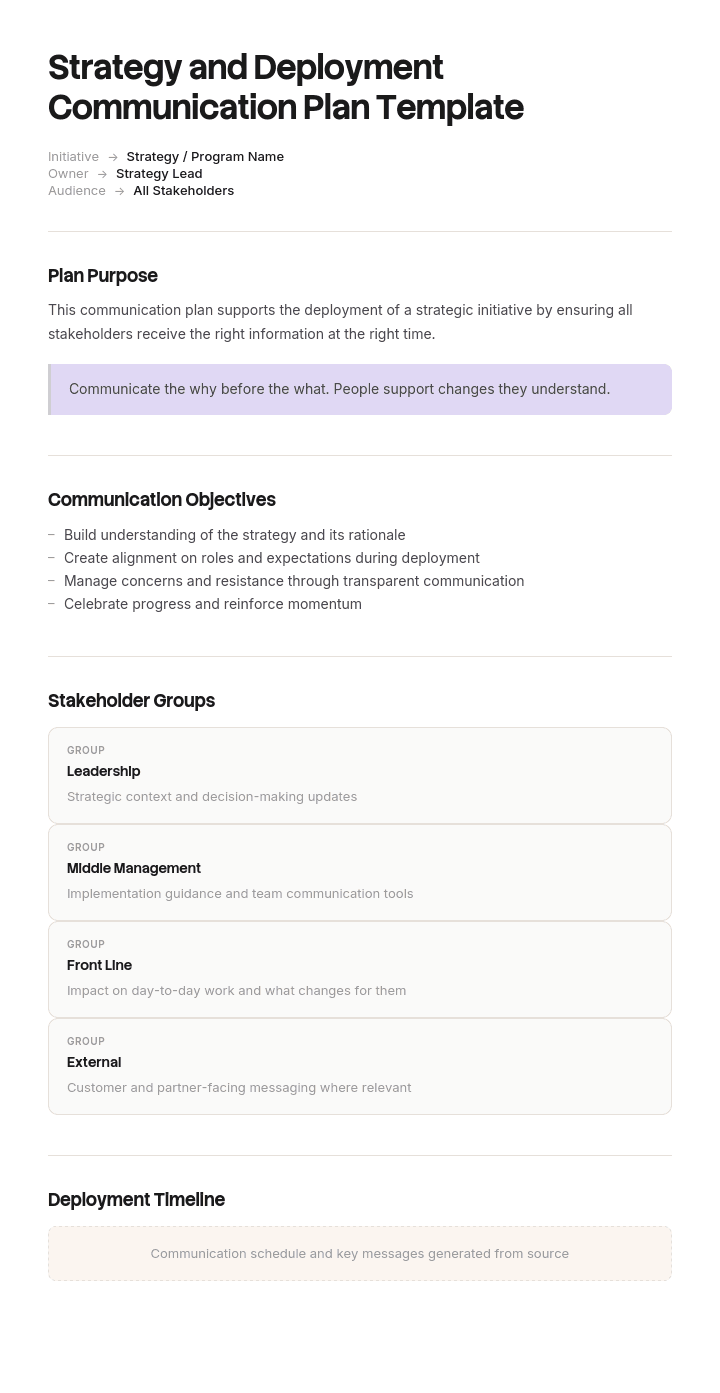
Use this template
A great strategy is worthless if no one understands it. With Trupeer, you can save hours on strategy communication by starting with a free strategy and deployment communication plan template, customizing it with your brand identity, and turning strategy decks into video updates every employee can absorb in minutes.
What is a free strategy and deployment communication plan template?
A free strategy and deployment communication plan template is a reusable structure for planning how a strategy is communicated across an organisation and turned into different behaviour at every level.
The two halves of that phrase do different work and only one of them normally gets planned. Strategy communication is telling people what the strategy is. Deployment is each team understanding what changes for them and doing it.
Almost every plan produced under this heading covers the first thoroughly and the second barely. It lists a launch event, a video, a briefing pack, a poster set, an intranet hub and a newsletter, all scheduled, all delivered on time, and it works exactly as designed. People find out that a strategy exists and can repeat its headline. Very few can say what it means for the next thing they do.
The template is not the plan. Audience, message, channel, owner, date is a five column table that takes ten minutes. What makes the difference is a sixth column, covered below.
Format follows use. A free strategy and deployment communication plan template Excel version suits the plan itself, which is a table with many rows and needs sorting by date and by audience. A free strategy and deployment communication plan template Word doc suits the narrative around it: the objectives, the key messages and the measurement approach.
Announcement is not deployment
The distinction is worth being precise about, because organisations routinely believe they have done the second when they have done the first.
An announcement transfers information. It tells somebody a decision has been taken. It is necessary, it is cheap, and it is where almost all communication effort goes because it is visible, schedulable and easy to report as complete.
Deployment changes what somebody does on Tuesday. It requires them to know which of their current habits is now wrong, what replaces it, whether they are permitted to stop doing something, and what happens if they get it wrong while learning.
None of that is carried by a launch event. A launch event can create attention and a shared moment, both of which are genuinely useful, and it cannot tell a branch assistant whether they should now be doing something different when a customer walks up to the counter.
The tell is in the plan itself. Count the rows. In most strategy communication plans, the large majority describe things being said to people, and a handful describe anything happening afterwards. The ratio is the diagnosis.
How to customize this template in Trupeer
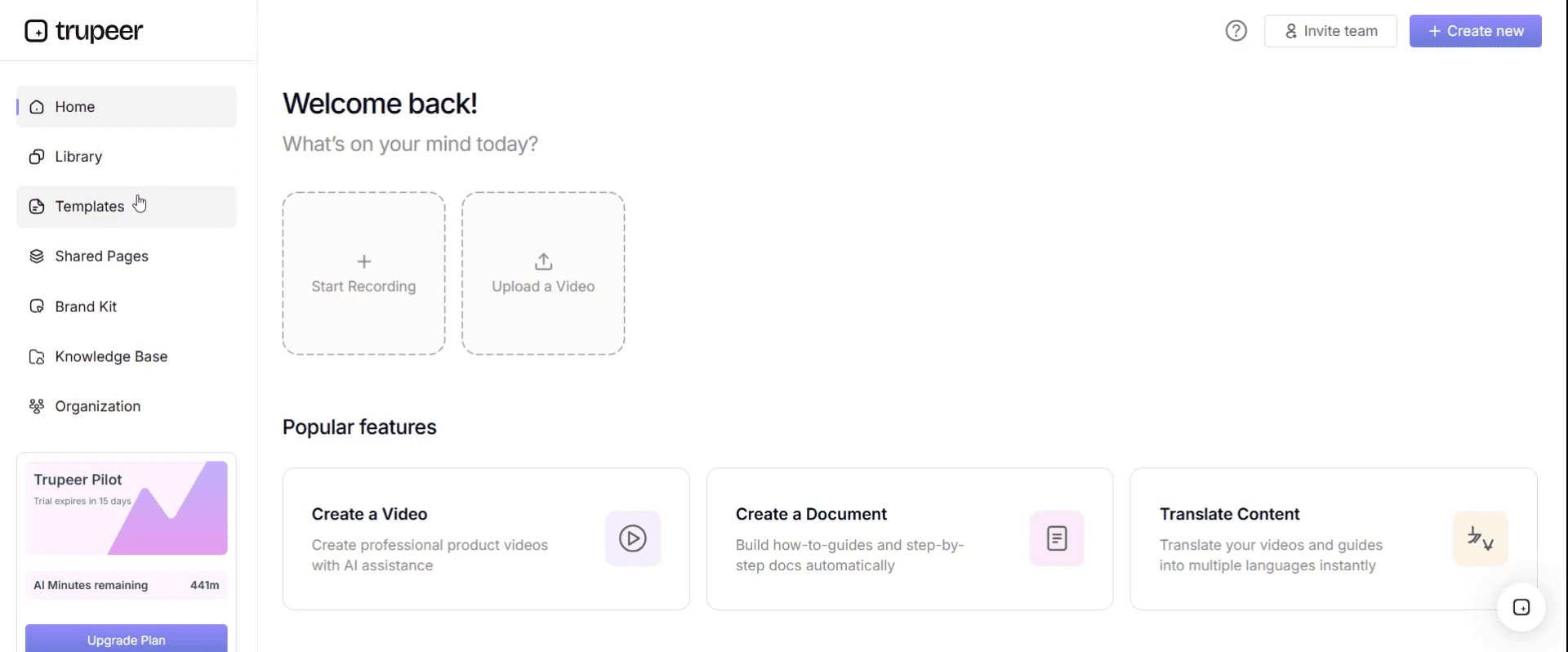
Step 1: Open the Templates Section
Go to the Templates section from the main navigation.
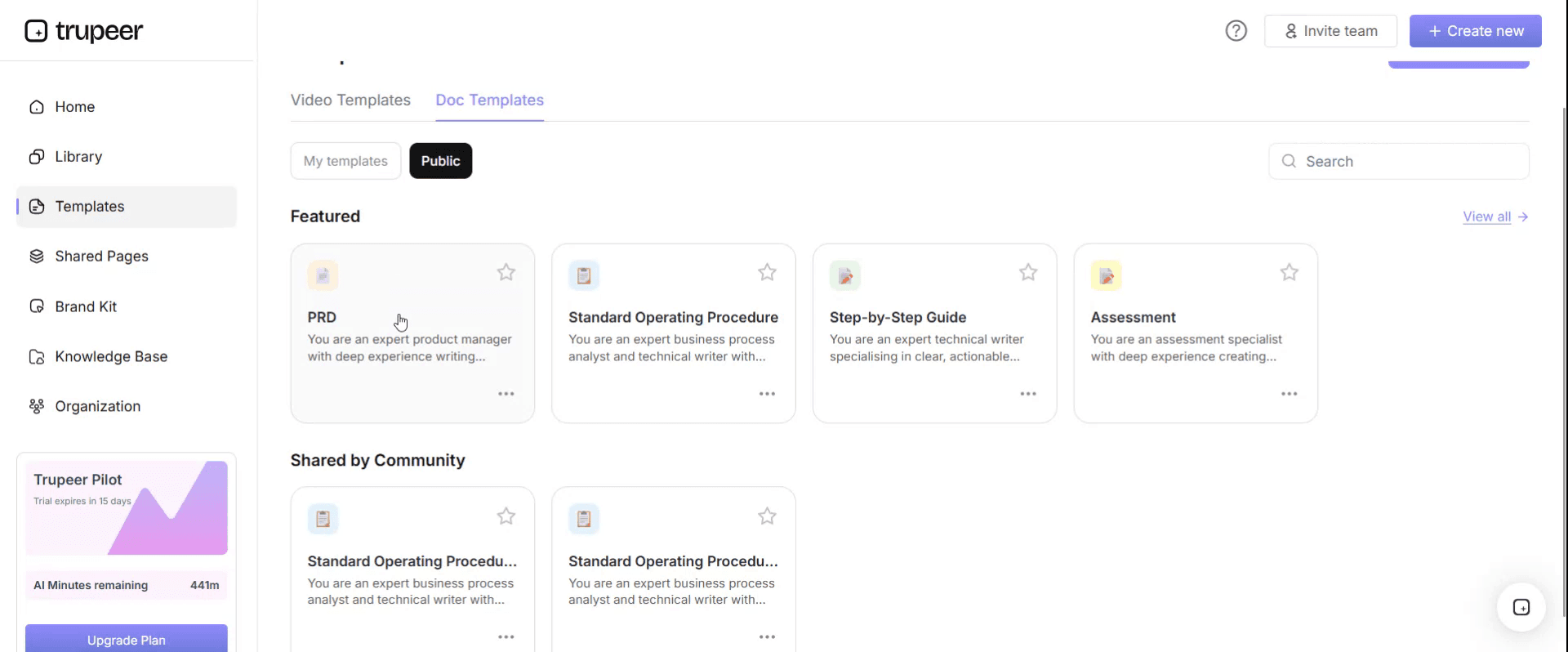
Step 2: Select and Open a Template
Click on any template you want to work with to open it.
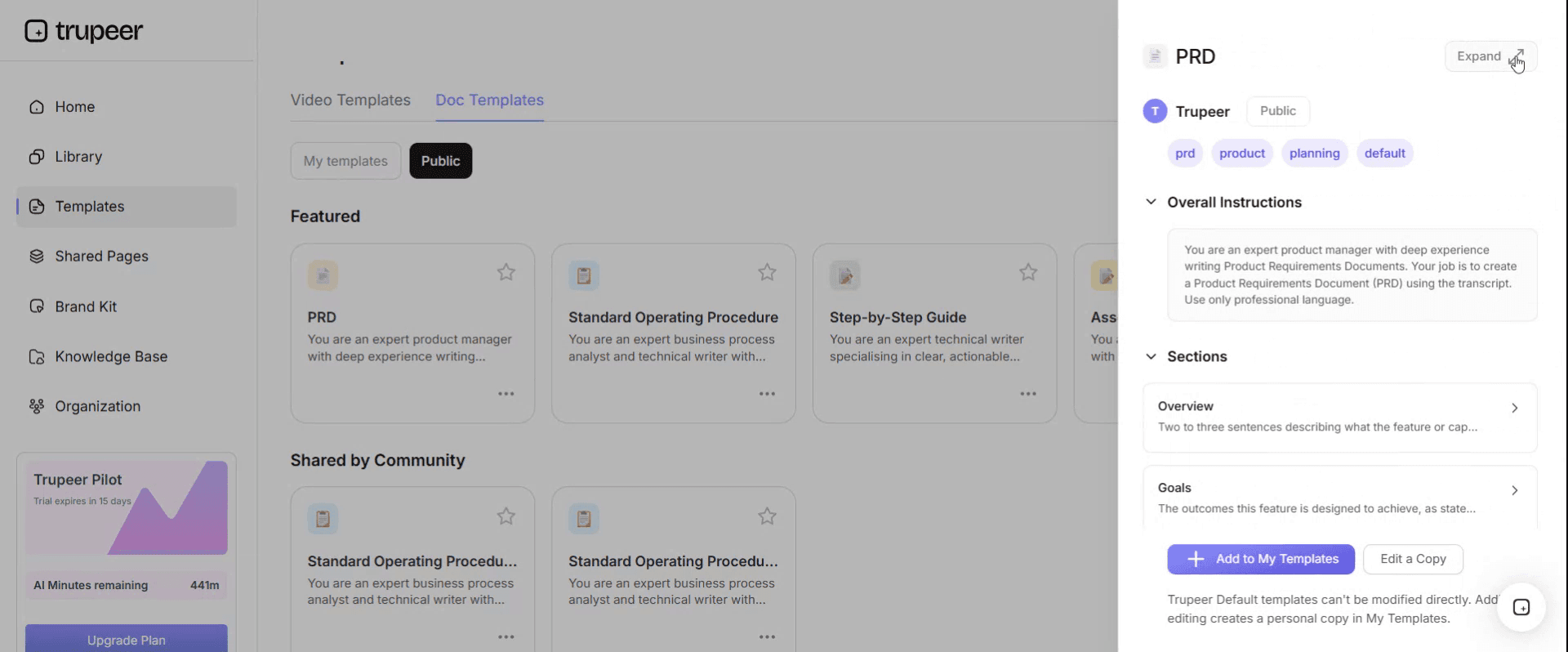
Step 3: Expand the Template View
If needed, expand the template view to see the full layout and details clearly.
Step 4: Edit the Template
Click on Edit to start modifying the selected template.
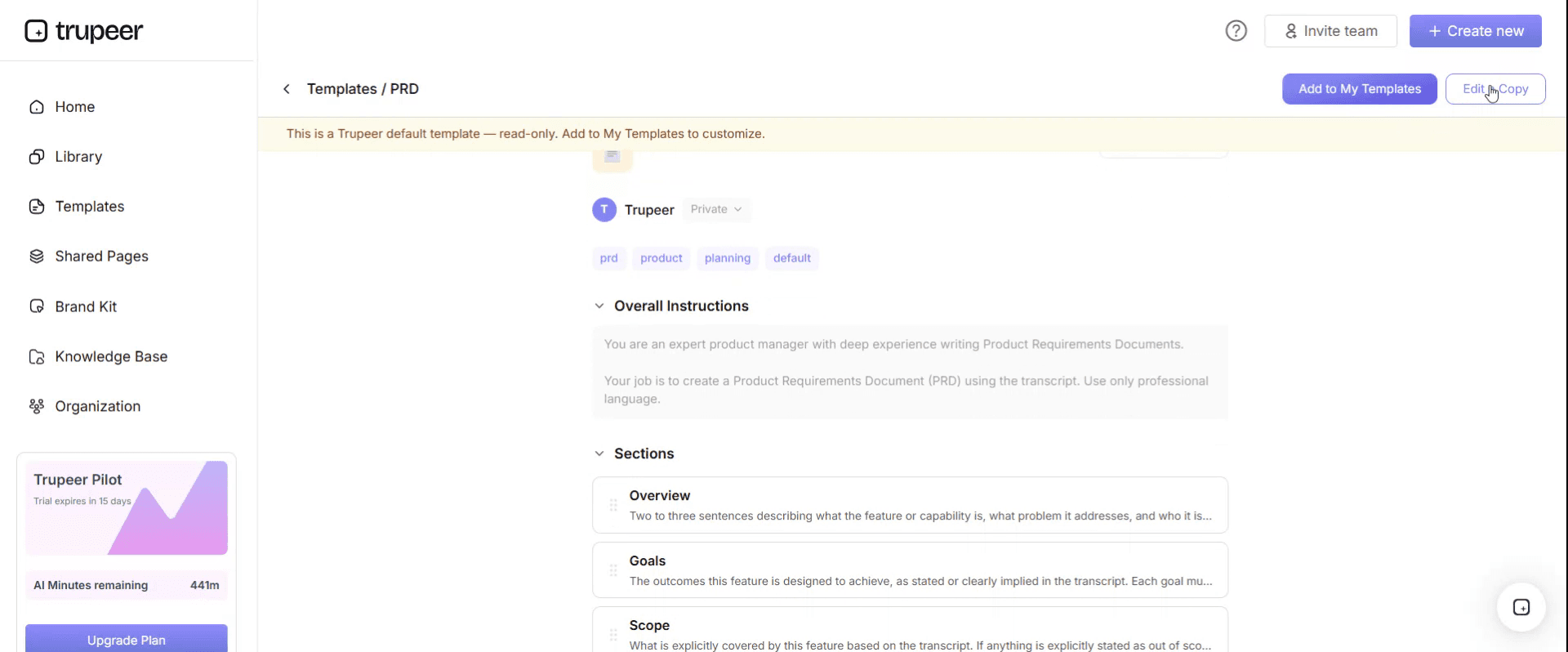
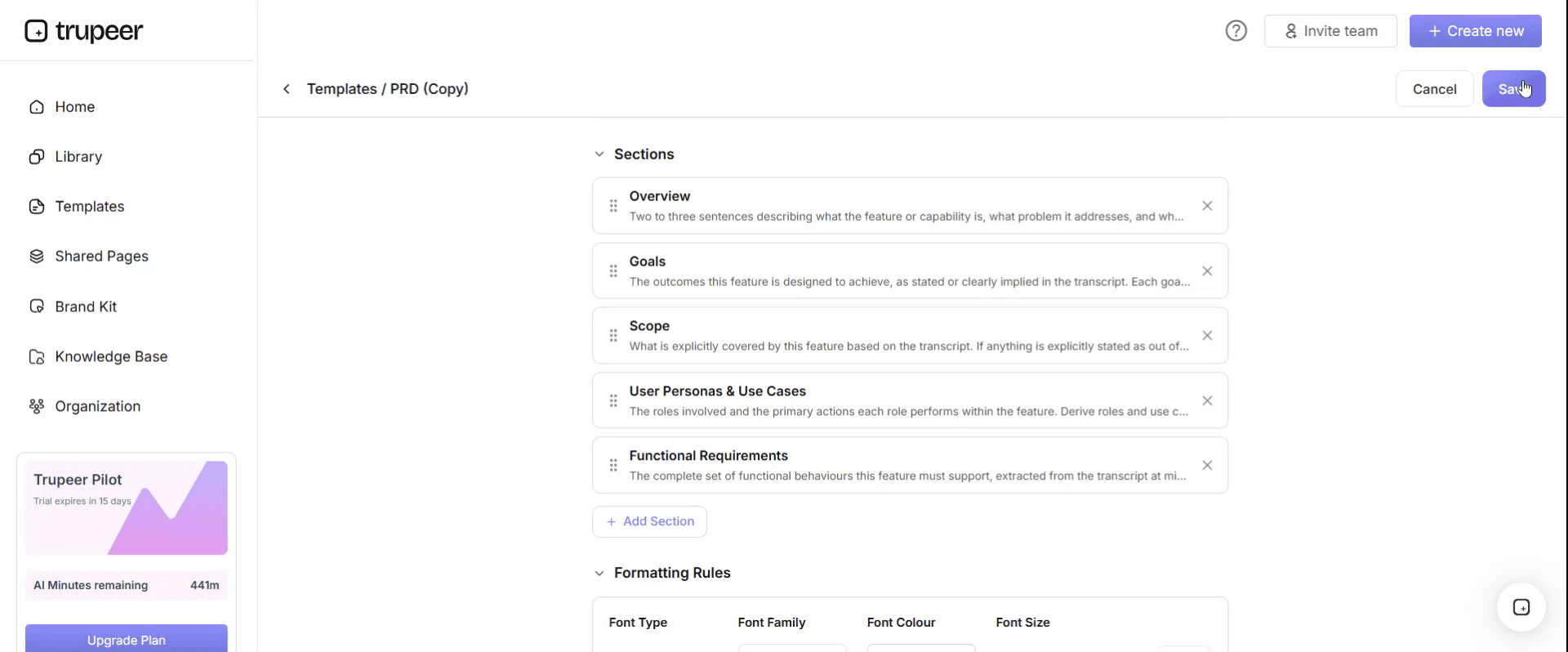
Within the editor, you can:
Add new sections
Define or update formatting rules
Add a logo and adjust its position and related settings
Step 5: Save Your Customized Template
After making all necessary changes, click Save to store the updated template as your own.
Step 6: Preview and Fine-Tune the Template
When you want to see how your customized template looks, open the Preview.
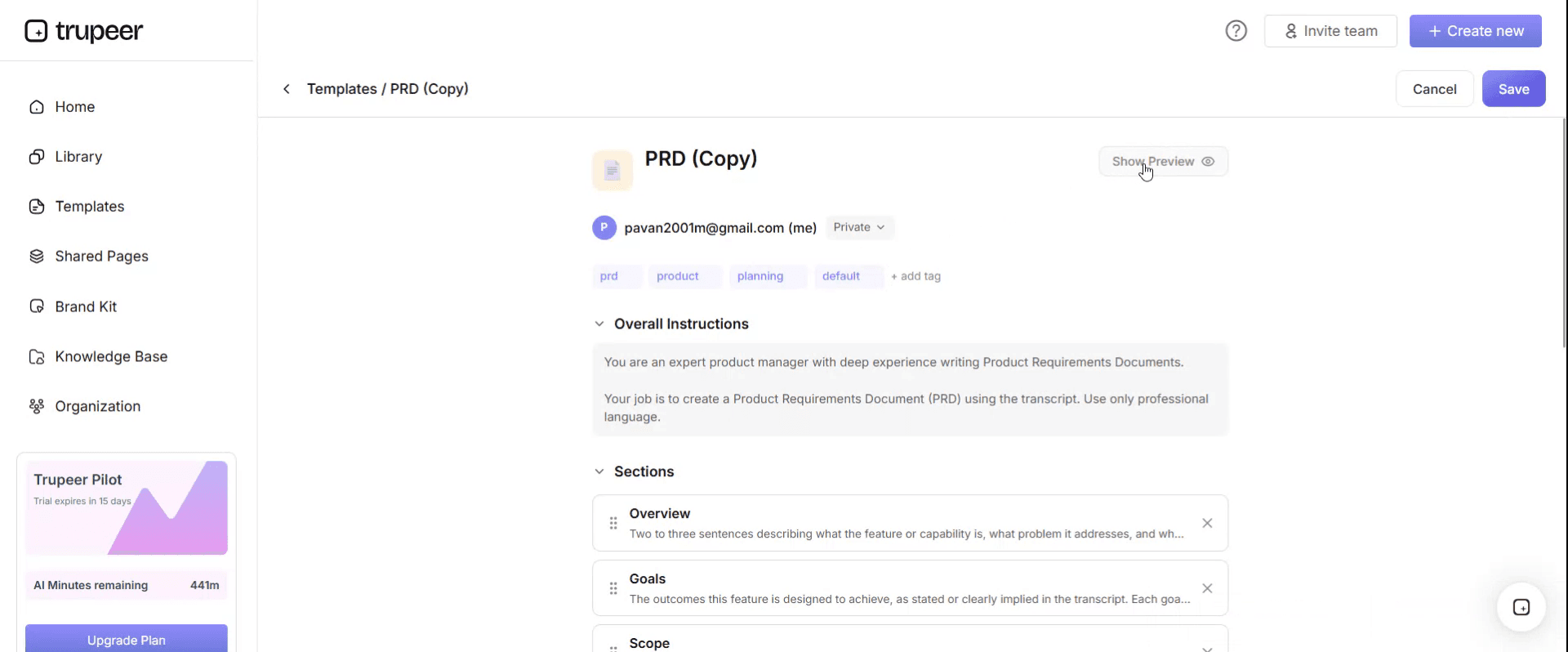
From the preview screen, you can continue to make adjustments directly if needed, ensuring the template appears exactly as you want.
With a strategy and deployment communication plan you can:
Save hours on planning: Skip the blank page with a structure built for strategy comms.
Cascade strategy clearly: Built-in fields ensure every audience gets the right level of detail.
Stay on-brand: Apply your logo, fonts and colors using Trupeer's brand kit.
Drive alignment fast: Convert strategy into video that executives, managers and frontline teams all understand.
Standardize across rollouts: Use the same template for every strategic initiative.
Reach global employees: Translate strategy comms into 65+ languages with one click.
Write the plan in behaviours, not messages
The change is to add one mandatory column and let it govern the plan.
For every row, name the behaviour it is meant to produce. Not the message, not the awareness, the behaviour. What will somebody do differently, and how would you know.
Three things happen when you do this, and each is useful.
Rows with no behaviour become visible. Some are legitimate. A launch event genuinely exists to create attention and a shared reference point, and that is a valid purpose provided it is stated rather than assumed to produce change on its own. Many other rows turn out to have no purpose at all beyond being the sort of thing communication plans contain.
The plan acquires rows that are not communications. Once you ask what produces the behaviour, the honest answers are frequently a changed prompt in a system, a different question in the daily huddle, a revised measure on the team board, or a manager having a specific conversation with a script. Those belong in a deployment plan even though nobody would call them communications, and leaving them out is why so many well executed plans change nothing.
The balance shifts down the organisation. Behaviour change is produced by line managers far more than by central communication, so a plan written in behaviours ends up with most of its rows concerning what managers do with their teams rather than what the centre broadcasts.
That third point is the uncomfortable one for a communications function, because it means the plan's success depends largely on people the function does not control. Naming that in the plan is better than discovering it in the survey results.
What the template must contain
Nine components. The behaviour and evidence columns are the ones that change what the plan does.
Component | What it does |
|---|---|
The strategy in one paragraph | The version everybody uses. Written once, and not paraphrased by each layer. |
Audiences | Segmented by what changes for them, not by department. Two teams with the same behaviour change belong together. |
Behaviour per audience | What each group does differently afterwards. The heart of the plan. |
Communication rows | Audience, message, channel, owner, date, and the behaviour each supports. |
Manager enablement | What line managers are given to run the conversation, since they will carry most of it. |
Non communication actions | System prompts, measures, meeting agendas, forms. Anything that makes the behaviour easier or the old one harder. |
Feedback route | How people say this does not work here, and who reads it. |
Measures | Awareness, understanding and behaviour, measured separately. Covered below. |
Sequence | What happens before the launch, at it, and in the twelve weeks after, which is where the work is. |
The manager enablement row deserves its own line in any plan. A cascade briefing pack sent to sixty managers produces sixty different briefings, and the variation between them is usually larger than the difference between the old strategy and the new one.
Free strategy and deployment communication plan template: the structure to copy
Filled with a real example rather than placeholders. The organisation is a builders' merchant shifting from counter transactions to trade account relationships.
Copy from here.
The strategy in one paragraph. The words everybody uses.
We are moving from serving whoever walks in to building trade accounts with local builders. Success is a bigger share of each customer's spend rather than more transactions. This changes what good looks like at the counter.
Audiences, segmented by what changes.
Audience | What changes for them |
|---|---|
Branch counter staff | Ask trade customers about account status, offer applications, record who they are |
Branch managers | Coach the above daily, review account applications weekly, stop celebrating transaction count |
Regional managers | Change what they ask about on branch visits |
Central functions | Reprice, restock and reforecast around account customers |
Everyone else | Awareness only, no behaviour change |
Plan rows.
# | Audience | What happens | Channel | Owner | When | Behaviour it supports |
|---|---|---|---|---|---|---|
1 | All | Launch conference | In person | CEO | Week 0 | None directly. Creates attention and a shared reference. Stated, not assumed. |
2 | Branch managers | Half day workshop, practising the counter conversation | In person, regional | Retail Director | Week 1 | Managers can demonstrate the conversation, not just describe it |
3 | Counter staff | Manager led huddle using a scripted opener | Daily huddle | Branch managers | Week 2 onward | Staff ask the account question |
4 | Counter staff | Recorded walkthrough of the account application | Intranet and tills | Retail Ops | Week 2 | Staff can complete an application without help |
5 | Branch managers | Weekly one to one guide with three questions | Document | Retail Director | Week 2 onward | Managers coach rather than announce |
6 | All branches | Branch board measure changed from transactions to applications | Physical board | Retail Ops | Week 2 | Old behaviour stops being celebrated |
7 | Counter staff | Till prompt added at transaction close | System | IT | Week 3 | The question gets asked when it is forgotten |
8 | Regional managers | Branch visit checklist revised | Document | Retail Director | Week 3 | Visits ask about accounts rather than tidiness |
9 | All | Progress note, real numbers, including where it is not working | CEO | Weeks 6 and 12 | Sustains the change past the first month | |
10 | Counter staff | Feedback route, one question form | Intranet | Retail Ops | Week 2 onward | Surfaces what does not work in practice |
Ten rows, of which four are not communications in the conventional sense. That ratio is the point.
Measures.
Awareness, from a two question pulse survey. Understanding, from asking a sample what it changes about their day and scoring the answers. Behaviour, from account applications per branch per week, which is the only one that matters.
Sequence. Four weeks of preparation before launch, mostly manager enablement. Launch in week zero. Twelve weeks of deployment afterwards, which is where nine of the ten rows sit.
Copy to here.
Example: eighty one percent could name it, twenty three percent could apply it
Bexworth Group runs sixty two builders' merchant branches with about two thousand one hundred staff. It adopted a strategy of moving from transactional counter sales towards trade account relationships, which was a sound strategy and a substantial behaviour change for branch teams.
The communication plan had thirty four rows. A launch conference, a CEO video, a branch briefing pack, a poster set, an intranet hub, a monthly newsletter and a series of regional roadshows. Every row was delivered on time and to a good standard. The communications team reported the plan complete.
Six months later a survey found that eighty one percent of branch staff could correctly name the strategy. Twenty three percent could say what it changed about their day.
The behaviour data agreed with the second number. Account applications were flat and the mix of counter transactions was unchanged.
Somebody then read the plan again with one question in mind: for each row, what is somebody meant to do differently as a result.
Thirty one of the thirty four rows had no answer. They described things being said to people. Three rows concerned anything happening afterwards, and two of those three were reporting.
The rewrite kept the strategy, the audiences and most of the messages. It added a behaviour column and applied it ruthlessly. Nineteen rows were cut or merged because they existed to inform an audience that had no behaviour change and already knew.
Eleven new rows were added, and this is the instructive part. None of them was a communication as the team had been thinking about communications. A scripted opener for the daily huddle. A revised weekly one to one guide for branch managers. A changed measure on the branch board so that transaction volume stopped being the thing celebrated. A till prompt at the point the question was most often forgotten. A revised branch visit checklist for regional managers.
Nine months after the rewrite, the proportion who could say what it changed about their day had gone from twenty three percent to sixty seven. Account applications were up forty one percent.
The strategy had never been badly communicated. It had been thoroughly communicated and never deployed, and the plan had no column that would have revealed the difference.
How to build the plan in six steps
Write the strategy paragraph once and freeze it. Every layer that paraphrases introduces drift, and by the fourth retelling the front line has a different strategy.
Segment audiences by behaviour change, not by department. Two teams doing the same new thing need the same treatment regardless of where they sit.
Write the behaviour before the message. For each audience, what do they do differently. If the answer is nothing, they need awareness only and one row will do.
Ask what would actually produce that behaviour. Frequently the answer is not a communication, and those actions belong in the plan anyway.
Give managers something to run, not something to send. A script, three questions, a demonstration. A briefing pack produces as many briefings as there are managers.
Plan twelve weeks after launch, not four weeks before. The preparation is worth doing and the deployment is where the change succeeds or reverts.
Step three is the one that reshapes the plan. Most plans are written from the message outward, which produces a communications schedule. Written from the behaviour backwards, you get a deployment plan that happens to include communications.
The cascade problem
Strategy degrades as it passes down an organisation, and the mechanism is retelling.
Each layer receives the strategy, interprets it, and passes on their interpretation. Four layers means four interpretations, and the version reaching the front line often bears a loose relationship to the original. Nobody has misbehaved. Everybody has summarised.
Three things limit it.
Fix the words. One paragraph, written centrally, used verbatim at every level. Managers add local meaning around it rather than rewriting it.
Shorten the chain. Where possible, the front line hears the strategy directly from the top as well as from their manager, so they have an unmediated version to compare against.
Test the far end. Ask people four levels down what the strategy is and what it changes. Whatever comes back is what you have actually communicated, regardless of what was sent.
The last one is the only reliable feedback available, and it is almost never done, because the survey that gets run asks whether people have heard about the strategy rather than what they think it means.
Measuring whether it landed
Three measures, and they must be separate, because collapsing them is how organisations conclude a deployment worked.
Awareness. Can they name it. Easy to move, easy to measure, and close to meaningless on its own. This is the number that reaches ninety percent and reassures everybody.
Understanding. Can they say what it changes about their own work. Measured by asking an open question to a sample and scoring the answers, which takes effort and is the most informative thing you will do.
Behaviour. Did the thing actually change. Account applications, referrals made, whatever the strategy is meant to produce. The only measure that settles the question.
The gap between the first and second is the deployment gap, and it is large in almost every organisation that has not deliberately closed it. Report all three side by side, because reporting awareness alone is what allowed Bexworth to believe the plan had worked.
This plan versus other communication plans
Four related documents, and using the wrong one is common.
A general communication plan covers routine organisational communication: who needs to hear what, through which channel, on what rhythm. The communication plan template covers it.
A strategy and deployment communication plan covers a specific change of direction and is judged on behaviour rather than reach. This page.
A campaign communication plan covers a time bound external campaign with phases, and the brand campaign communication plan covers that shape.
A situational or risk communication plan covers what you say when something goes wrong, where speed and authority to speak dominate everything else. Covered in the risk management communication plan.
If you are searching for a communication plan template Word file or a communication plan template Excel free download for general use, the first of those four is the one you want. This page assumes you are deploying a change and that the point is what people do afterwards.
Variants
The structure holds and the balance shifts.
Strategy deployment across a branch or site network. The example above. Line managers carry almost everything and consistency between sites is the main risk.
Policy deployment in a lean context. Where strategy deployment means hoshin kanri, the communication plan sits alongside the catchball process and the deployment matrices. The behaviour column still applies and the cascade is more formalised.
System or software deployment communication. Behaviour change is concentrated and datable, since people move to a new system on a known day. Manager enablement matters less and training and support routes matter more.
Restructure or operating model change. Carries employment law and consultation obligations in most jurisdictions, and the sequence of communication may be legally constrained. Take advice before writing the plan, because a well designed communication sequence that breaches consultation requirements is an expensive plan.
Merger or integration. Two organisations with two vocabularies. The fix-the-words rule matters more here than anywhere.
Small organisation. The cascade problem largely disappears below about fifty people, and the behaviour column still earns its place.
What a free strategy and deployment communication plan template cannot fix
A strategy nobody understands at the top. If the executive team describes it three different ways, no cascade will produce clarity below them.
Managers who cannot or will not run it. The plan depends on line managers, and if they are unconvinced, the deployment stops at their level regardless of what the centre sends.
Measures that still reward the old behaviour. Bexworth's branch boards celebrated transaction volume for the first six months of a strategy about accounts. No communication overcomes an incentive.
Awareness reporting. No free strategy and deployment communication plan template free download and no free strategy and deployment communication plan template Word free download will stop you measuring reach and calling it success. Only reporting the three measures together will.
Show the change rather than describing it
The rows in a deployment plan that produce behaviour are the ones where somebody sees the new way rather than reads about it. That is what a manager workshop achieves, and it is why the workshop works and the briefing pack does not.
The difficulty is that a workshop reaches whoever attended, and a branch network of sixty two sites with shift patterns and part time staff means a substantial proportion of the people whose behaviour must change were never in the room.
Trupeer AI makes the demonstration reproducible. Somebody performs the new process once while recording, and the output is a written walkthrough with screenshots already captured and placed, alongside a video, in your own branding. It becomes a row in the plan in its own right, available to everybody regardless of shift, site or when they joined.
Record it. Brand it. Translate it. Trupeer it.
Two points follow for deployment specifically. Consistency in the first weeks determines whether a change sticks or reverts, and a recording gives every site the same version rather than sixty two interpretations of a briefing pack. And people who join after the launch never attended anything, so a recorded demonstration is how a change survives its first year of staff turnover.
The material sits in your knowledge base and doubles as training. Where the new way becomes the standard way, it belongs in the SOP template. Consistency across your documents is a matter of setting the brand kit once, and setup is covered in the document template setup guide.
Frequently Asked Questions
Is there a free strategy and deployment communication plan template Excel version?
Excel suits the plan itself, because it is a table with many rows that you will want to sort by date, by audience and by owner. A free strategy and deployment communication plan template Excel file is the right working format.
Add the behaviour column as a required field rather than an optional one. A row with a blank behaviour cell is either a legitimate awareness item, which should say so, or something that does not need to be in the plan.
Is there a free strategy and deployment communication plan template Word version?
Word suits the narrative around the table: the strategy paragraph, the audience analysis, the measurement approach and the manager guidance. A free strategy and deployment communication plan template Word file works well for that.
Keep the row by row plan in a spreadsheet and reference it. Holding both in one document means the plan gets edited constantly and the narrative stops being read.
Is there a free strategy and deployment communication plan template Word doc version?
Yes, and a free strategy and deployment communication plan template Word doc file is the same as a Word file under an older extension.
The more useful decision is what you put in the manager pack. Managers need something to run rather than something to send: a script for the first conversation, three questions for the one to ones, and ideally a demonstration they can play rather than describe.
Is there a free strategy and deployment communication plan template Word free download?
Widely available, and almost all of them are a five column table of audience, message, channel, owner and date.
That table is fine and it is a communications schedule. A free strategy and deployment communication plan template Word free download will not include a behaviour column, and adding one takes a minute and changes what the plan is for.
Is there a free strategy and deployment communication plan template free download worth using?
The table takes ten minutes to build, so a free strategy and deployment communication plan template free download saves very little.
Judge any of them on one question. Is there a place to record what somebody will do differently as a result of each row? Essentially none have it, and without it a deployment plan and a communications schedule are the same document.
Where can I get a communication plan template Word file for general use?
For routine organisational communication rather than a deployment, the general document is the one you want. A communication plan template Word file covering audiences, channels, frequency and owners will serve, and our communication plan page covers that structure.
Use the general version when you are planning ongoing communication. Use this page's structure when you are trying to change what people do.
Where can I get a communication plan template Excel free download?
Excel is the natural format for any communication plan, since all of them are essentially tables. A communication plan template Excel free download will give you the columns and let you sort and filter, which is most of what you need.
The distinction that matters is not the format but the purpose. A routine plan tracks what gets sent. A deployment plan tracks what changes, and needs an extra column to do it.
Is there a communication plan template free download that covers both routine and deployment use?
In practice they are different documents and combining them tends to produce a plan that does neither well, because routine communication is scheduled by rhythm and deployment communication is sequenced around a change.
A communication plan template free download will typically be built for the routine case, which is the more common need. If you are deploying a strategy, start from that table and add the behaviour column, the manager enablement rows and the non communication actions, which is roughly what this page describes.