
Use this template
A great strategic plan is what aligns hundreds of decisions toward one direction. With Trupeer, you can save hours on strategic planning by starting with a free strategic plan template, customizing it with your brand identity, and turning the plan into a video summary that aligns leaders, managers and frontline teams.
What is a free strategic plan template?
A free strategic plan template is a reusable structure for setting out where an organisation intends to get to over the next few years, and what it will do to get there.
The section list is well established and every published template has broadly the same one: mission, vision, values, analysis of the current position, strategic priorities, objectives, initiatives, measures and a timeline. It is a sensible list and it is not where strategic plans fail.
They fail afterwards, in a specific and predictable way that the section list does nothing to prevent, and which the rest of this page is about.
The template is not the plan. A structure takes an afternoon. What determines whether a strategic plan still means anything in year three is a single field that almost no template contains.
Format follows use. A free strategic plan template Word doc suits the plan itself, which is a document that gets discussed, amended and approved. A free strategic plan template PPT layout suits the version presented to a board or to staff. A free strategic plan template Excel version suits the initiative tracker behind it, and a free strategic plan template PDF is the approved and published copy.
Strategic plans accumulate
Look at any organisation's strategic plan in year three of five and count the initiatives that are still listed as in progress.
The number is almost always close to the number that were listed at the start. A few will have completed. Very few will have been stopped. The rest are still there, still nominally live, several with no meaningful activity for a year, still appearing on the board report because nobody has the standing or the reason to take them off.
This happens because organisations are considerably better at starting things than stopping them, and because a strategic plan as normally written contains no mechanism for stopping anything.
Every initiative in a typical plan has an owner, a target and a date. None has a written statement of what would count as it not working. So when an initiative underperforms, the available responses are to continue, to continue with more resource, or to quietly stop reporting on it. Formally stopping requires somebody to argue that a thing the board approved should be abandoned, and that is a conversation nobody volunteers for.
The cost is not the failed initiative. It is attention. An executive team of eight nominally accountable for nineteen live initiatives is not concentrating on anything, and the two or three that genuinely determine whether the strategy works are getting a fraction of the leadership time they need.
How to customize this template in Trupeer
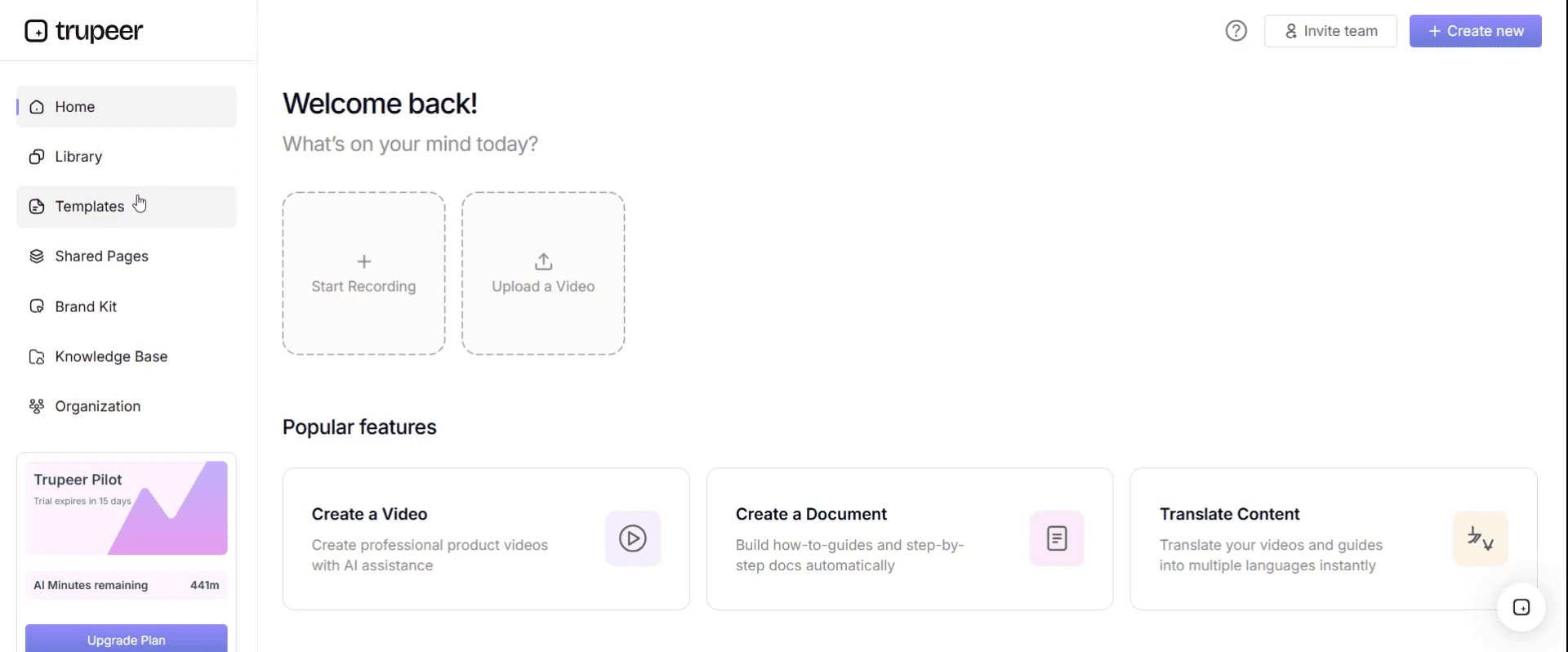
Step 1: Open the Templates Section
Go to the Templates section from the main navigation.
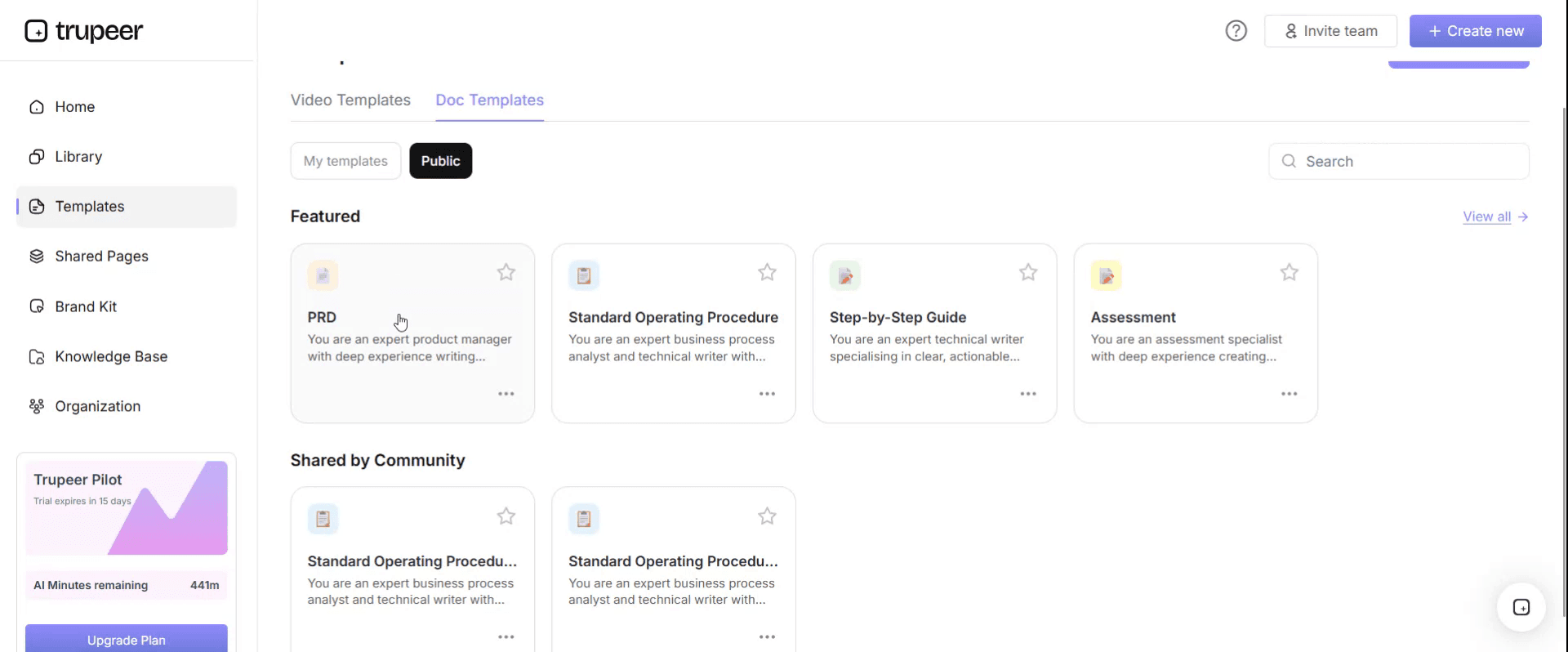
Step 2: Select and Open a Template
Click on any template you want to work with to open it.
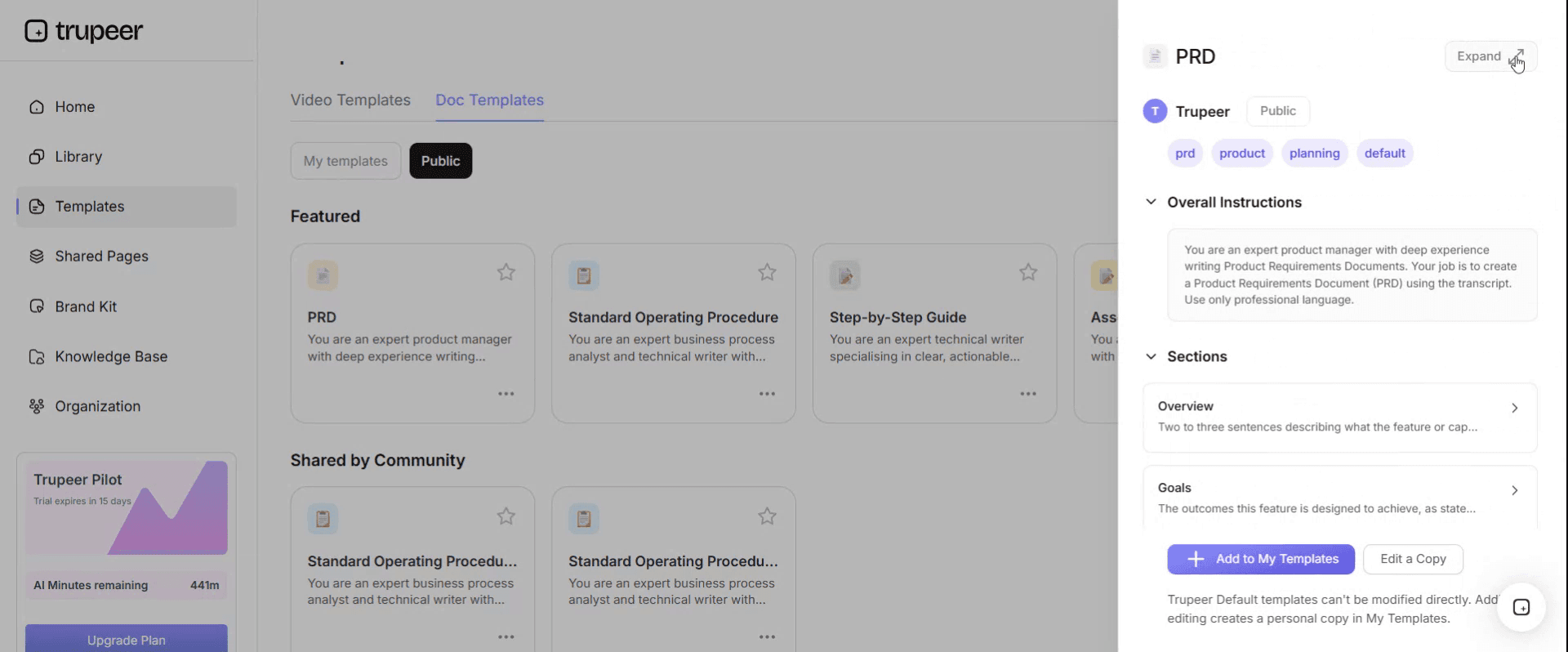
Step 3: Expand the Template View
If needed, expand the template view to see the full layout and details clearly.
Step 4: Edit the Template
Click on Edit to start modifying the selected template.
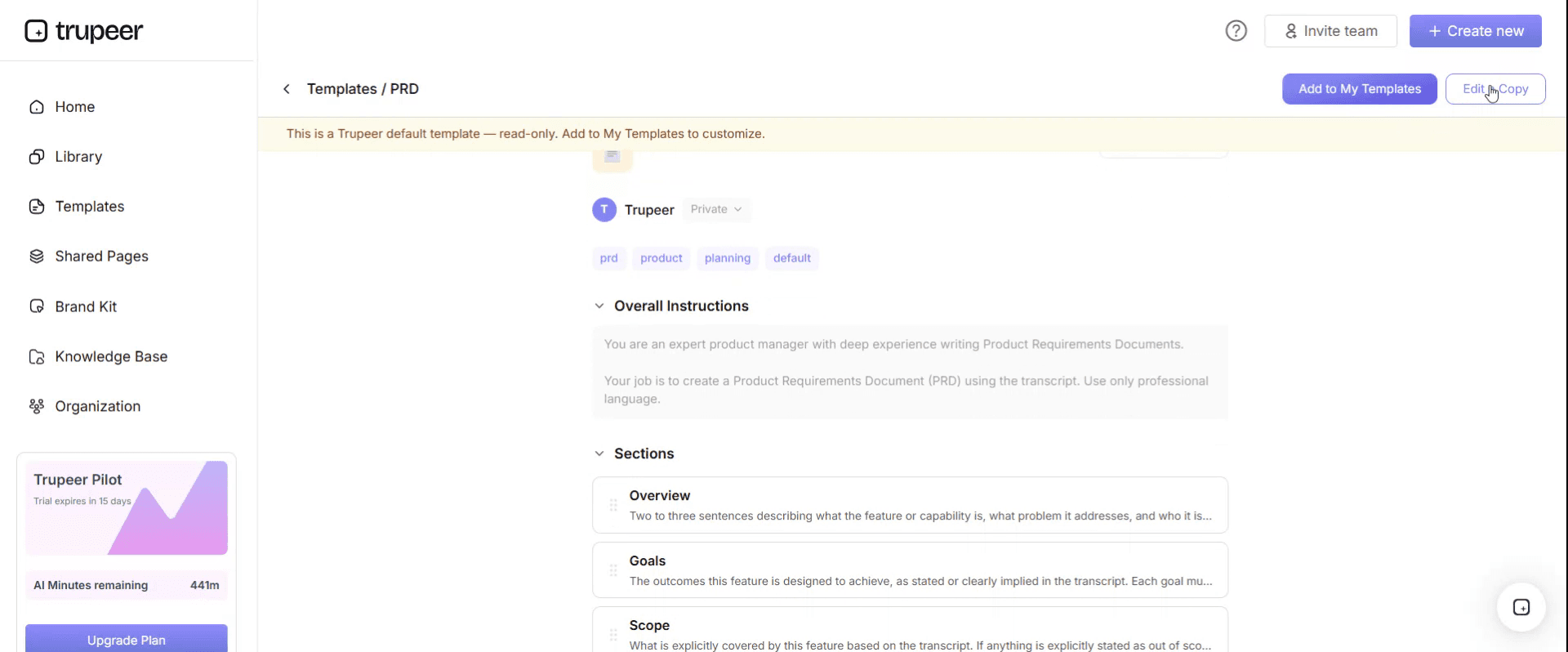
Within the editor, you can:
Add new sections
Define or update formatting rules
Add a logo and adjust its position and related settings
Step 5: Save Your Customized Template
After making all necessary changes, click Save to store the updated template as your own.
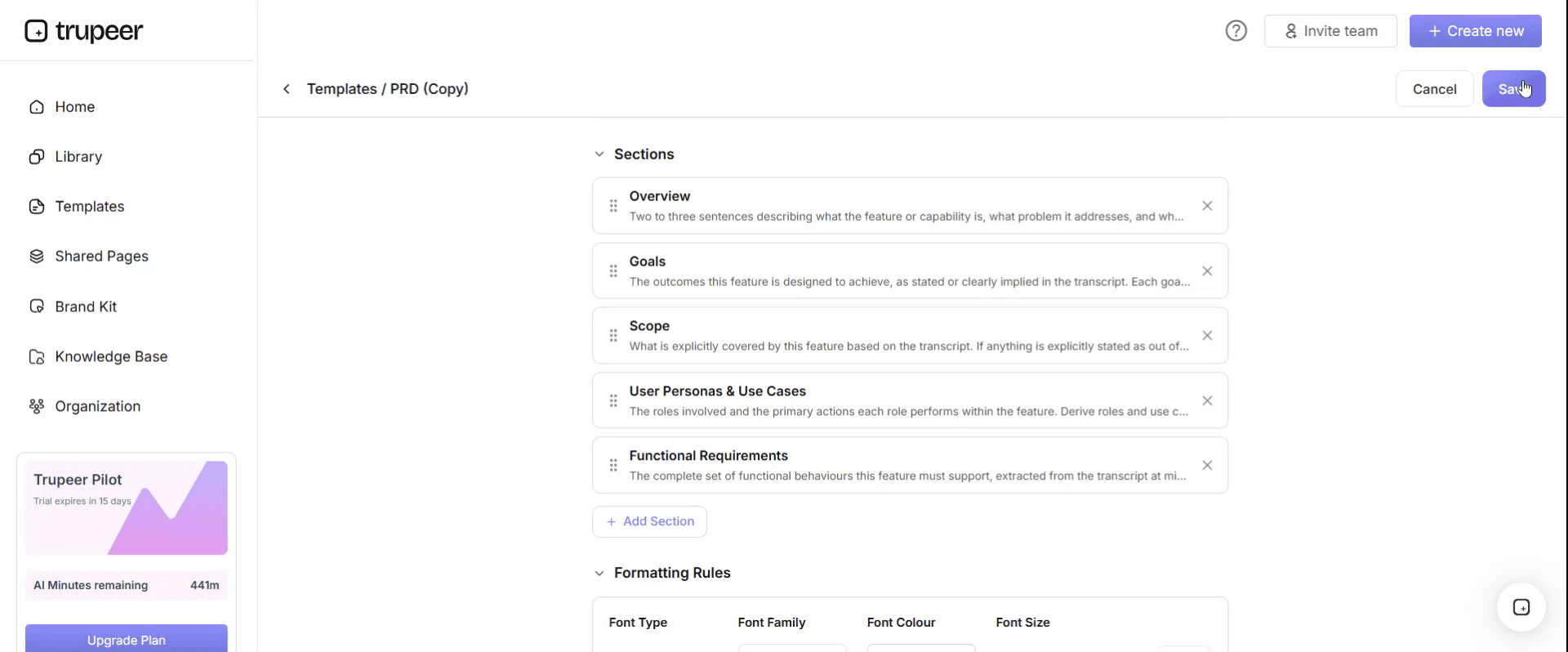
Step 6: Preview and Fine-Tune the Template
When you want to see how your customized template looks, open the Preview.
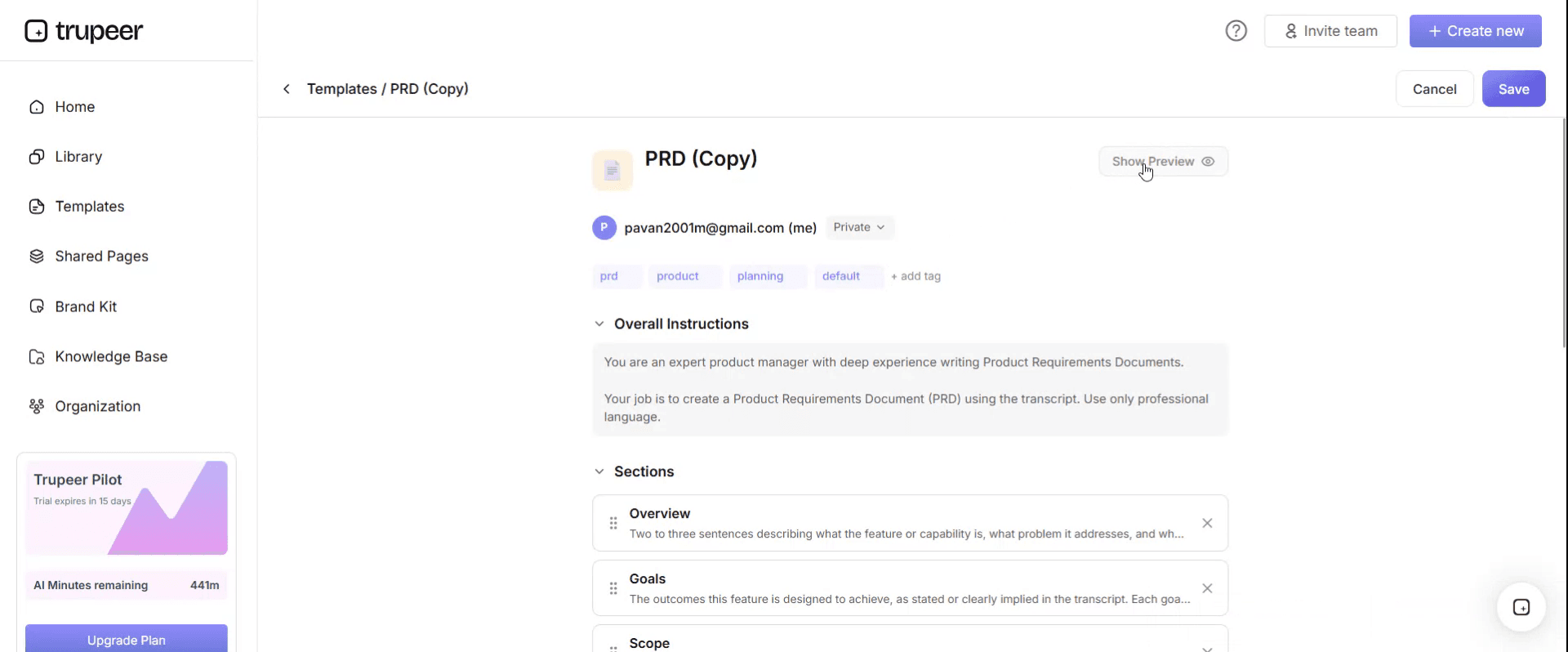
From the preview screen, you can continue to make adjustments directly if needed, ensuring the template appears exactly as you want.
With a strategic plan template you can:
Save hours on planning: Skip the blank page with a structure used by strategy teams.
Cover every element: Built-in sections for vision, mission, goals, initiatives and metrics.
Stay on-brand: Apply your logo, fonts and colors using Trupeer's brand kit.
Communicate at scale: Convert dense plans into video summaries everyone can absorb.
Standardize across functions: Use the same template for every level of strategy.
Reach global teams: Translate strategic plans into 65+ languages with one click.
Every initiative needs a kill condition
A strategic plan is a set of bets made under uncertainty. Some will be wrong, and the useful question is not how to avoid that but how you will find out.
So for each initiative, write two things the template will not have asked for.
A review date. Not the completion date. The date at which somebody looks at the evidence so far and decides whether to continue. Early enough that stopping is still cheap.
A kill condition. Written in advance, in observable terms. If by March we have fewer than two hundred sign ups, we stop this and reallocate the resource. If the pilot site has not reduced handling time by ten percent within six months, we do not roll it out.
Writing these before starting is what makes stopping possible. Nobody has to argue in month nine that the initiative has failed, because the organisation already agreed in month one what failure would look like. The decision becomes administrative rather than political, which is the entire point.
There is a second benefit that surprises people, and it appears immediately.
Some initiatives cannot be given a meaningful kill condition. When you try, you find there is no evidence that would cause you to stop, because the thing is not really a bet. It is something the organisation does anyway, or has to do, or is already committed to. Those are not strategic initiatives and putting them in a strategic plan is what makes the plan long.
Moving them into business as usual is not a demotion. It is a correction, and it is usually the fastest way to get a plan of twenty three initiatives down to a plan of nine.
What a strategic plan template must contain
Nine components. The last two rows of the initiative table are the ones that matter.
Component | What it does |
|---|---|
Where we are now | An honest assessment, including what is not working. Short. |
Where we intend to be | Three to five years out, described so that somebody could tell whether you got there. |
Strategic priorities | Three to five. More than five is a list of everything the organisation does. |
What we are not doing | Explicit. The things considered and declined, so nobody proposes them again in month four. |
Initiatives per priority | With owner, resource, and start date. |
Review date per initiative | When the evidence gets looked at, which is not the completion date. |
Kill condition per initiative | What would make you stop, written before you start. |
Measures | A small number, defined precisely, with the source of each figure. |
Review rhythm | Who meets, how often, and what they are empowered to decide. |
The fourth row is worth the discomfort it causes. A plan that only says what you will do provides no guidance when somebody proposes a reasonable new thing in month six, and reasonable new things are how strategies dissolve.
Free strategic plan template: the structure to copy
Filled with a real example rather than placeholders. The organisation is a disability charity.
Copy from here.
Where we are now. Honest, including the uncomfortable parts.
Income has been flat for four years at around twenty four million, with statutory contracts making up seventy one percent of it and margins on those contracts falling. Voluntary income has declined for three consecutive years. Our service model was designed for a funding environment that no longer exists. Staff turnover in front line roles is twenty eight percent.
Where we intend to be in five years. Described so it can be assessed.
Voluntary income at thirty percent of total, from twenty one percent today. Service model redesigned and operating in all regions. Front line turnover below twenty percent.
Strategic priorities. Three, not eight.
One, redesign the service model. Two, rebuild voluntary income. Three, stabilise the front line workforce.
What we are not doing. Considered and declined, with reasons.
Not expanding geographically. Not bidding for statutory contracts below our cost floor, even to retain volume. Not launching a trading subsidiary, which was considered and requires capability we do not have.
Initiatives.
Priority | Initiative | Owner | Review date | Kill condition |
|---|---|---|---|---|
Service model | Redesign pilot in two regions | Director of Services | End of month 9 | If the pilot has not reduced cost per person supported by 8 percent while holding outcome scores, we do not roll out and we redesign the approach |
Service model | Staff consultation and role redesign | Director of People | End of month 6 | No kill condition. This is a dependency of the pilot, not a bet |
Voluntary income | Digital fundraising capability | Director of Income | End of month 12 | If digital income has not reached four hundred thousand annualised by month twelve, we stop investing and return to a partnership model |
Voluntary income | Major donor programme | Director of Income | End of month 18 | If fewer than six donors above twenty five thousand by month eighteen, we close the programme |
Workforce | Pay and progression review | Director of People | End of month 6 | Not a bet, a commitment. Proceeds regardless |
Workforce | Front line management training | Director of People | End of month 12 | If turnover in participating teams has not moved relative to non participating teams, we stop and address the cause elsewhere |
Measures. Four, with sources.
Voluntary income as a percentage of total, from management accounts, monthly. Cost per person supported, from finance and service data, quarterly. Front line turnover, from HR system, monthly. Outcome scores, from the existing service measurement framework, quarterly.
Review rhythm. Executive team monthly against measures. Board quarterly, with any initiative reaching its review date taken as a decision item rather than a report item.
Copy to here.
Note that two of the six initiatives carry no kill condition, and both say why. That is more honest than inventing one, and it also makes clear which four are the actual bets.
Strategic plan example: nineteen live initiatives and eight people
Fernlea Trust, a disability charity with about three hundred and forty staff and income around twenty four million, adopted a five year strategic plan with six strategic priorities and twenty three initiatives.
The plan was well made. It had been through a proper process with staff and trustee involvement, the analysis was sound, and the initiatives were sensible.
By the middle of year three, nineteen of the twenty three were still reported as in progress. Two had completed. Two had been stopped, both because the person leading them had left.
Several had had no substantive activity for more than a year. They remained on the board report because removing something the board had approved required a proposal that nobody was willing to make.
The board received a twenty three row status table every quarter. Meetings spent about fifty minutes working through it and about ten minutes in discussion.
The executive team of eight was nominally accountable for nineteen live initiatives.
The change came from a question at a board meeting. A trustee asked what would have to happen for the board to decide to stop one of these.
Nobody had an answer. Not because the executives were evasive, but because no initiative had ever been given a stopping condition, so there was no answer available to give.
The exercise that followed took one afternoon. Each of the twenty three initiatives was assessed against two questions: when will we look at the evidence, and what would make us stop.
Nine could not be given a meaningful kill condition. Working through them showed that these were not bets at all. They were things the organisation had to do, or was already doing, or that were dependencies of something else. They were moved into operational planning, which removed them from the strategic plan without removing them from anybody's job.
Five were stopped, three of which had been dormant for over a year and two of which were now clearly not going to work.
Nine continued, each with a review date and a written condition.
Board reporting went from twenty three rows to nine. The meeting split reversed to about fifteen minutes of reporting and forty five minutes of discussion, which is what the board was there for.
The most useful outcome was not the five stopped initiatives. It was that the executive team went from nineteen nominal accountabilities to nine real ones, and the two initiatives that actually determined whether the strategy worked started getting the leadership attention they had never had.
How to write a strategic plan in six steps
Write the current position honestly, including what is not working. A plan built on a flattering assessment produces initiatives aimed at the wrong problems.
Choose three to five priorities. If you have eight, you have described the organisation rather than made a choice.
Write what you are not doing. Including the reasonable things you considered and declined, because those are what will be proposed again.
Attach a review date and a kill condition to every initiative. Where you cannot write a kill condition, ask whether the item belongs in the strategic plan at all.
Choose four to six measures with named sources. A measure with no existing source will be reported by impression.
Set the review rhythm and give it authority. A review that can only note progress is a status meeting.
Step four does most of the work and step three prevents most of the drift. Both are uncomfortable in the drafting session, which is why they get left out.
The five year question
Five year plans remain the convention and the horizon is worth thinking about rather than inheriting.
A 5-year strategic plan template free download will give you a five year structure, and for many organisations that horizon is genuinely useful: it is long enough to change something structural and short enough to be imaginable.
The problem is that the detail in years three to five is almost always fictional, and everybody knows it while writing it. The result is a document with a credible first eighteen months and three years of aspiration, treated as though it were all one thing.
A more honest structure separates them. State the five year destination and the reasoning behind it, since that is what the horizon is for. Then commit in detail only to the next twelve to eighteen months, which is the period you can actually plan. Refresh the detailed portion annually against the unchanged destination.
That arrangement gives you the strategic horizon without the pretence of precision, and it makes annual planning a real exercise rather than a restatement of a document written three years ago by people who have left.
Where a funder, regulator or board requires a full five year plan, produce it, and mark years three to five explicitly as direction rather than commitment.
Strategic plan examples and types
Types vary less than the naming suggests, and the differences are mostly emphasis.
Corporate or organisational strategic plan. The general case, covering the whole organisation over three to five years.
Non profit and charity strategic plans. Frequently required by funders and regulators, and typically carrying a stronger theory of change and outcome measurement component. The example above is this type.
Departmental or functional plans. Sit beneath the organisational plan and should reference it explicitly, or you get several functions optimising separately.
Small business strategic plans. Shorter and more useful when they are. Three priorities, six initiatives and a quarterly review beats a thirty page document nobody opens.
Public sector plans. Usually published, which changes the writing considerably, since anything committed to is in the public record.
For strategic plan examples worth studying, published charity and public sector plans are the most instructive source, because they are real, they are complete, and they were written knowing they would be read by people with an interest in holding the organisation to them. Read them for how they handle the years three to five problem, which is where the honest ones differ from the rest.
Strategic plan, business plan or operating plan?
Three documents that overlap and answer different questions.
A strategic plan answers where we are going and what we are choosing to do about it, over three to five years.
A business plan answers whether the business works: the model, the market, the numbers, the funding requirement. It is frequently written for an external reader such as an investor or a lender, and the business plan template covers it.
An operating or annual plan answers what we are doing this year, in detail, with budgets and accountabilities. It should derive from the strategic plan and it is where most of the nine initiatives that survived Fernlea's review actually live.
The common error is producing one document that tries to be all three, which results in a strategic plan too detailed to be strategic and an operating plan too vague to run anything. Keep the horizons separate.
Making the review actually happen
The plan is not the point of failure. The review is.
Three things make a review function. It has a date, in calendars, set when the plan is approved rather than arranged later. It has authority, meaning the people in the room can stop an initiative rather than recommend that somebody considers it. And initiatives reaching their review date appear as decision items rather than status items, which is a distinction on the agenda and a large distinction in behaviour.
The failure mode to watch for is the review that only ever confirms. If no initiative has been stopped in two years, either every bet was correct, which is unlikely, or the review is performing reassurance rather than decision.
One useful discipline: report the four to six measures every time, unchanged, in the same format. Changing what you report is how a plan quietly stops being tracked, and it usually happens shortly after a measure starts moving in the wrong direction.
What a free strategic plan template cannot fix
Priorities nobody chose. A plan with eight priorities usually reflects an unwillingness to disappoint anybody. That is a leadership decision rather than a documentation problem.
No capacity to deliver. Initiatives require the time of the same senior people who have day jobs. Counting that, honestly, before committing, prevents most of what later looks like poor execution.
A review with no authority. No free strategic plan template free download and no free strategic plan template Word free download will empower anybody to stop anything.
Measures without sources. A measure that requires new reporting to exist will be reported by impression until the reporting is built, which is usually never.
Show the change rather than describing it
Strategy is mostly delivered by people doing something differently, and the distance between a plan and a changed practice is where most of it is lost.
Fernlea's service redesign is a fair example. The initiative was sound and the pilot worked. Rolling it out meant several hundred front line staff, across regions and shift patterns, performing an assessment and recording process differently from how they had done it for years. Written procedure circulated by email does not achieve that, and a training day reaches whoever was on shift.
Trupeer AI closes some of that distance. Somebody performs the new process once while recording, and the output is a written walkthrough with screenshots already captured and placed, alongside a video, in your own branding, available to everyone regardless of shift or location.
Record it. Brand it. Translate it. Trupeer it.
Two points follow for strategic change specifically. Consistency matters more during a rollout than at any other time, because variation in the first months is what determines whether the new way sticks or reverts. And where an organisation operates across regions or languages, the same recording produces the same guidance everywhere, so a national initiative is genuinely one initiative.
The material sits in your knowledge base and doubles as training for people joining after the change, who otherwise learn the old way from whoever sits nearest. Procedure level detail belongs in the SOP template. Consistency across your documents is a matter of setting the brand kit once, and setup is covered in the document template setup guide.
Frequently Asked Questions
Is there a free strategic plan template Word version?
Word suits the plan itself, because it is a document that gets drafted, circulated, commented on and approved, often by a board. A free strategic plan template Word file is the right working format.
Build the initiative table with two columns most templates lack: review date and kill condition. Adding them at the drafting stage is straightforward. Adding them in year two, to initiatives already running, is a much harder conversation.
Is there a free strategic plan template Word doc version?
Yes, and a free strategic plan template Word doc file is the same thing under an older extension.
More useful than the format choice is keeping two documents rather than one. The strategic plan changes rarely and the initiative tracker changes monthly, and holding both in one file means either the plan gets edited constantly or the tracking stops.
Is there a free strategic plan template Word free download?
Widely available, and they are close to interchangeable, because the section list for a strategic plan is well established and uncontroversial.
What none of them contains is a place to record what would make you stop an initiative. If you take one thing from this page into a free strategic plan template Word free download, add that column.
Is there a free strategic plan template PPT version?
Slides suit the presented version, for a board, a staff briefing or a funder. A free strategic plan template PPT deck works well for the destination, the priorities and the measures.
Do not let it become the plan. A deck cannot hold the reasoning, the declined options or the kill conditions, and a strategy that exists only as slides gets remembered differently by everyone who saw them.
Is there a free strategic plan template Excel version?
Excel is the right tool for the initiative tracker rather than the plan. A free strategic plan template Excel file holds one row per initiative with owner, resource, review date, kill condition and status, and lets you sort by review date, which is the view that matters.
The measures belong here too, one row per measure per period, so the trend is visible rather than reconstructed each quarter from previous board papers.
Is there a free strategic plan template PDF?
PDF is the approved and published version. Export a free strategic plan template PDF once the board has adopted it, with the adoption date on it, and publish that.
Keep the editable source, because the detailed portion should be refreshed annually. A plan you can only revise by rebuilding is a plan that will run unchanged for five years.
Is there a free strategic plan template free download worth using?
The section list is the easy part and every download will give you a competent one, so a free strategic plan template free download saves you an afternoon of structuring at most.
Judge any of them on one question. Is there anywhere to record when each initiative will be reviewed and what would cause it to stop? Essentially none have it, and its absence is why plans accumulate.
Is there a 5-year strategic plan template free?
Yes, and the five year structure is the convention. A 5-year strategic plan template free download will give you a five year horizon with annual breakdowns.
Use the horizon for the destination and the reasoning, and commit in detail only to the next twelve to eighteen months, refreshing that portion annually. Detailed commitments for years three to five are written by people who know they are provisional and read by people who assume they are not, which is a reliable source of later disappointment.


