Use this template
A solid business plan is the foundation of any serious venture. With Trupeer, you can save hours on business planning by starting with a free business plan template, customizing it with your brand identity, and turning your plan into a polished video pitch that resonates with investors, partners and team members.
Most business plans are written for the wrong reason. Someone needs a document for a lender or a landlord, so they produce forty pages nobody will read again, and none of it changes what happens on Monday.
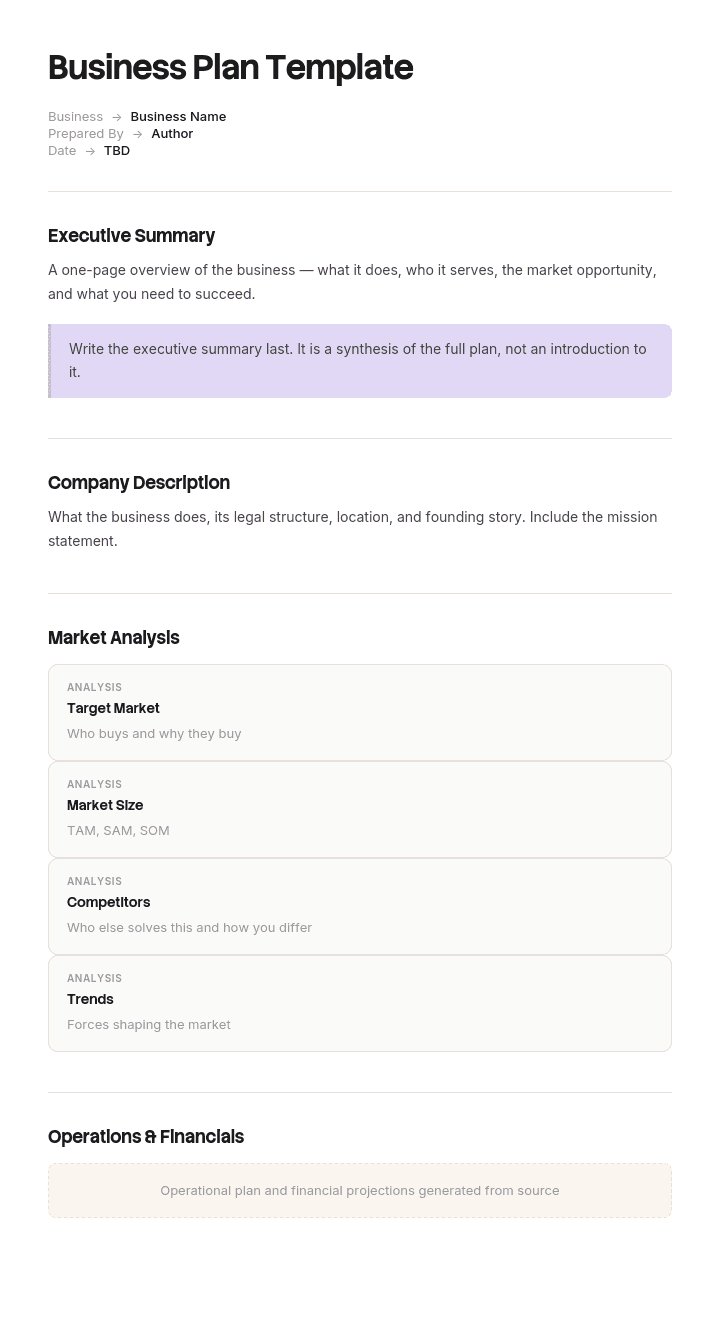
A business plan is worth writing when it forces a decision. Who exactly is the customer. What you charge. What it costs to serve them. Whether the numbers work. This template is structured around those questions, with guidance on what belongs in each section and roughly how long it should be.
Download the business plan template
Format | Best for |
|---|---|
Word (.docx) | The full written plan. Free download, no sign-up |
The finished version for lenders, investors and landlords | |
Excel (.xlsx) | Financial projections, cash flow and the sales forecast |
PowerPoint (.pptx) | The pitch version, when you're presenting rather than sending |
Google Docs | Collaborative drafting with a co-founder or advisor |
.doc | Older systems and legacy document libraries |
Free, editable, no watermark. Most people need the Word and Excel versions together, since the narrative and the numbers live in different tools.
The business plan structure at a glance
# | Section | What it answers | Length |
|---|---|---|---|
1 | Executive summary | Why should anyone care, in one page | 1 page |
2 | Company description | Who you are and what you do | 1 page |
3 | Market analysis | Who buys, how many, and who else sells to them | 2 to 3 pages |
4 | Organisation and management | Who runs it and who owns it | 1 page |
5 | Products and services | What you sell and why it's worth the price | 1 to 2 pages |
6 | Marketing and sales | How customers find you and how they buy | 2 pages |
7 | Operations plan | How the thing actually gets delivered | 1 to 2 pages |
8 | Financial projections | Whether the numbers work | 3 to 5 pages plus spreadsheet |
9 | Funding request | How much, what for, and on what terms | 1 page, if raising |
Plus an appendix for CVs, permits, letters of intent and detailed financials.
Fifteen to twenty-five pages is the realistic range for a full plan. Forty pages usually signals a plan written to look thorough rather than to be read.
What to write in each section
1. Executive summary
Write it last, even though it goes first. One page covering what the business does, who it serves, why now, the headline financials and what you're asking for. If someone reads only this page, they should be able to decide whether to keep reading.
The common failure is writing an introduction instead of a summary. This section should contain your actual numbers and your actual ask, not a promise that both appear later.
2. Company description
Legal structure, location, when you started or intend to, and what problem you exist to solve. Keep the mission statement short or leave it out. Nobody has ever funded a business because of its mission statement.
3. Market analysis
The section that separates a real plan from a hopeful one. Cover:
Your customer, specifically. Not "small businesses" but "independent dental practices with two to five chairs in the Midlands." If your customer description could apply to a million companies, you haven't done this section.
Market size, built from the bottom up. How many of those customers exist, what they'd pay, how many you could realistically reach. Top-down percentages of a huge market are the most obvious tell of a weak plan.
Competitors, named. Including the ones people don't count, like spreadsheets, doing nothing, and hiring someone.
Why you'll win. One or two real advantages, not five aspirational ones.
4. Organisation and management
Who does what, who owns what, and where the gaps are. Naming a gap is a strength rather than a weakness, since it shows you know what you need next. Put full CVs in the appendix and keep this section to relevant experience only.
5. Products and services
What you sell, what it costs to deliver, and what you charge. Include your pricing and defend it. Lead with the customer outcome rather than the feature list, and be explicit about what's not included, because scope ambiguity is where service businesses lose margin.
6. Marketing and sales
Two questions: how do customers find out you exist, and how do they buy? Be concrete about channels, expected cost of acquisition, and the sales process. "Social media and word of mouth" is not a plan. If you don't know your acquisition cost yet, say what you'll test and what number would make it viable.
7. Operations plan
How the work actually happens. Suppliers, premises, equipment, systems, headcount, and the process from order to delivery. This is where a plan meets reality, and it's the section most first-time founders skip.
If you're documenting the processes themselves, that's a separate document. Use an SOP template rather than putting procedures in the plan.
8. Financial projections
Three years, monthly for the first year. Include a profit and loss forecast, cash flow forecast, balance sheet, break-even analysis and your key assumptions written out plainly.
The assumptions matter more than the totals. Anyone experienced reads the plan by testing your assumptions, so make them easy to find and easy to challenge. Cash flow is the section that gets scrutinised hardest, because profitable businesses fail on cash rather than on margin.
9. Funding request
Only if you're raising. How much, what specifically it buys, what milestone it reaches, and what you're offering. Vague asks get vague answers.
How to customize this template in Trupeer
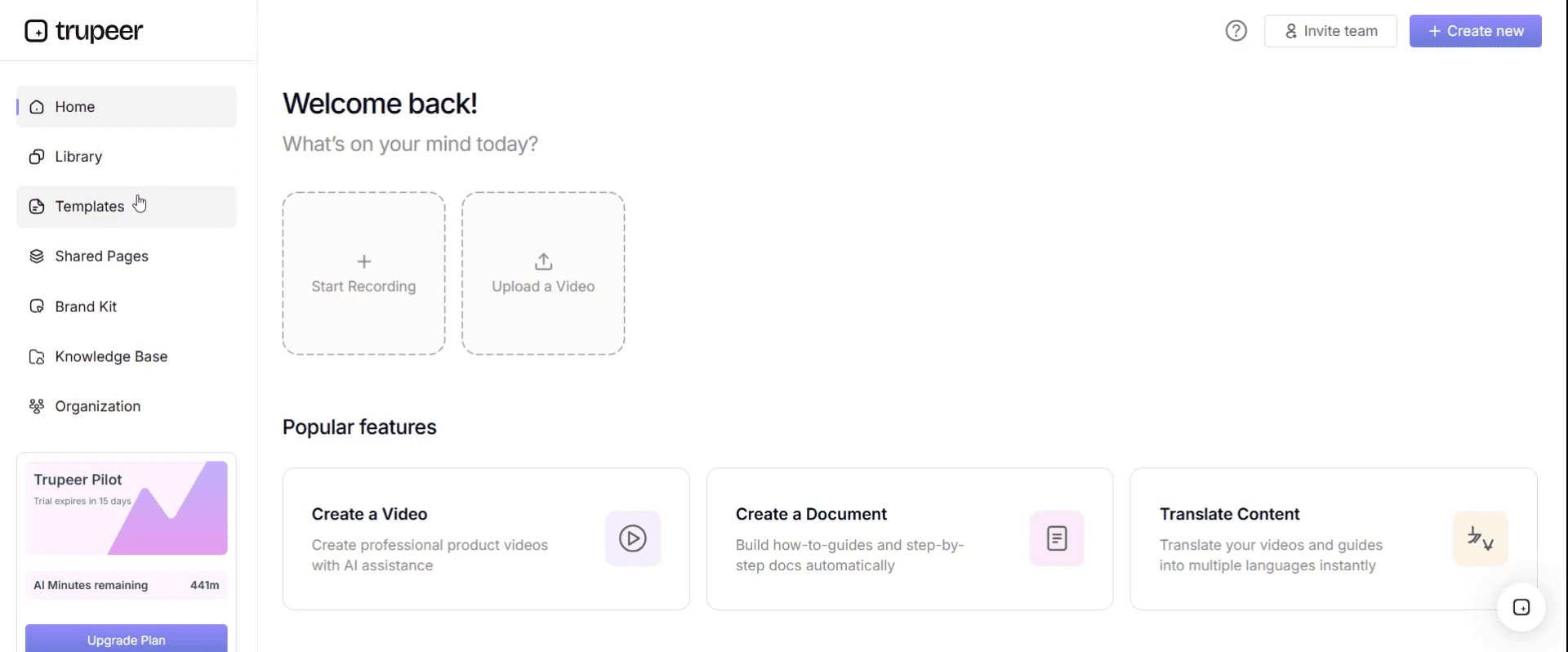
Step 1: Open the Templates Section
Go to the Templates section from the main navigation.
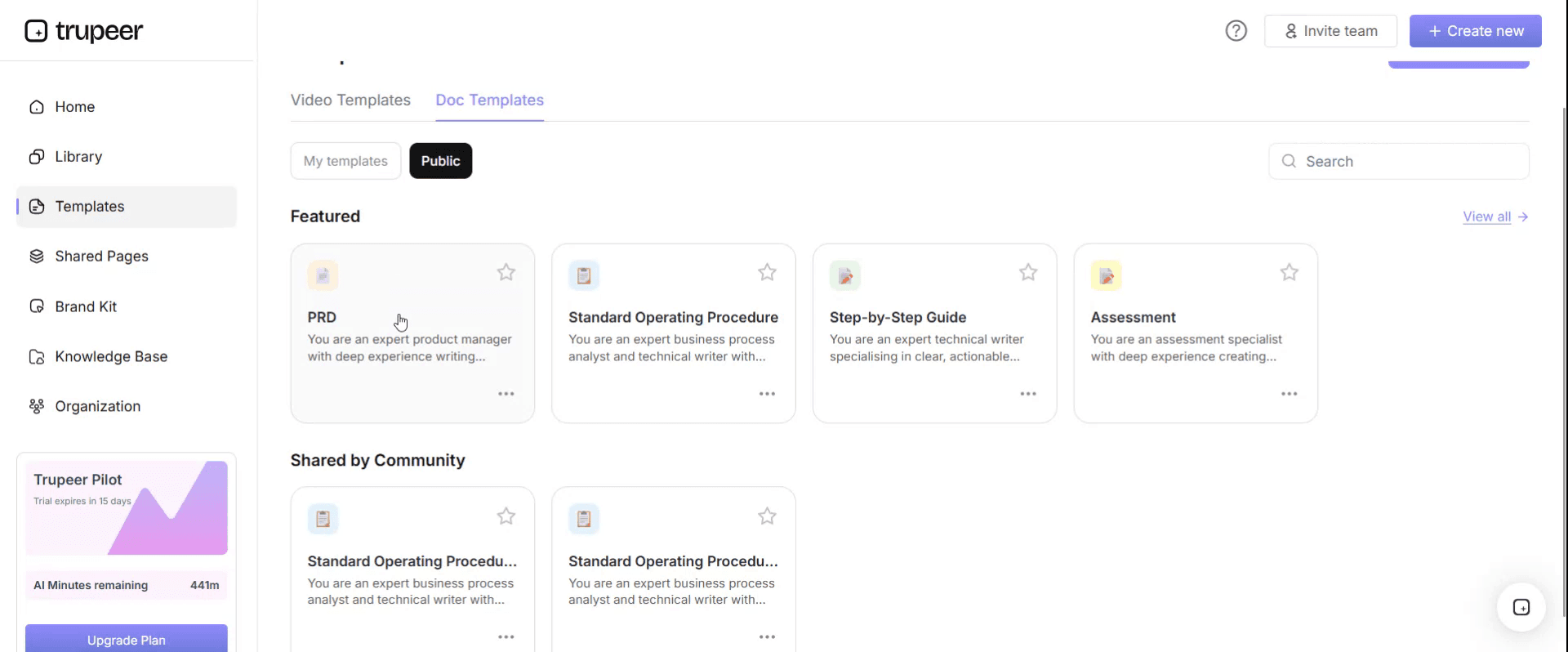
Step 2: Select and Open a Template
Click on any template you want to work with to open it.
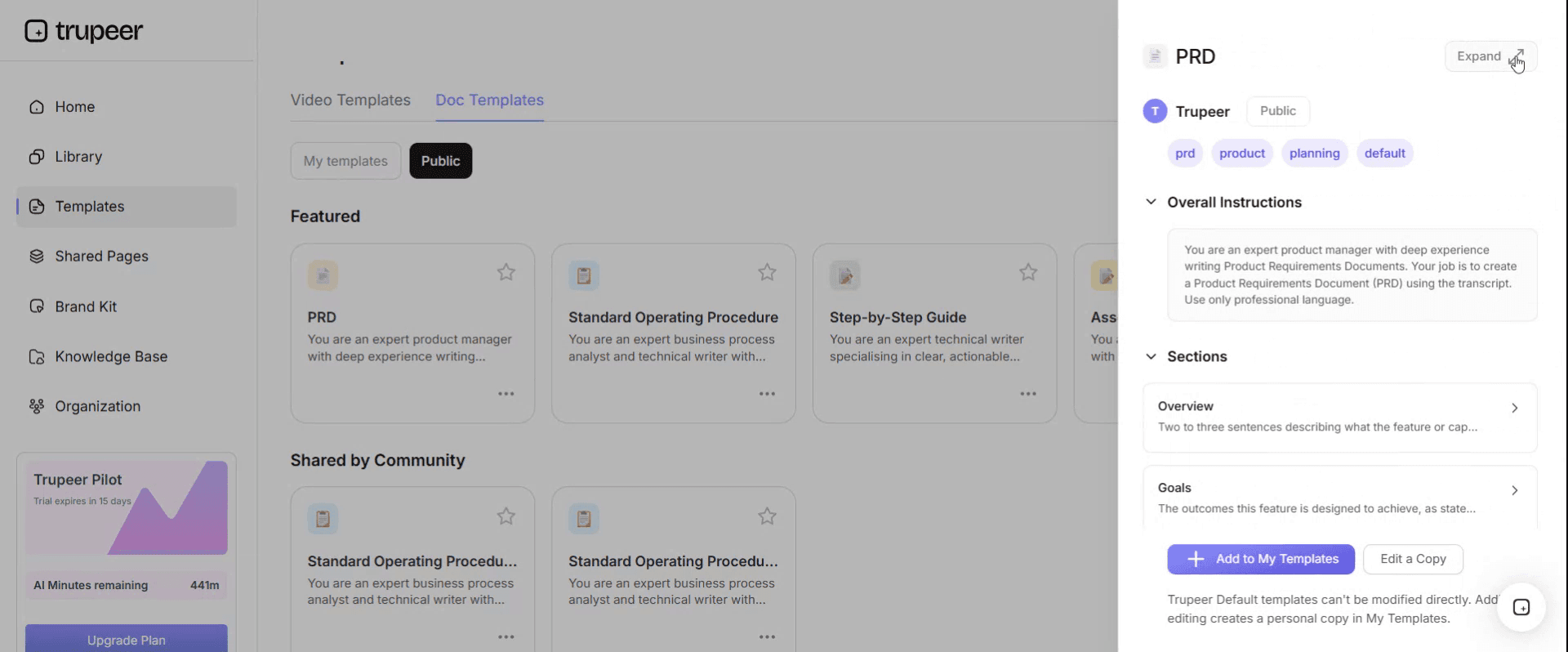
Step 3: Expand the Template View
If needed, expand the template view to see the full layout and details clearly.
Step 4: Edit the Template
Click on Edit to start modifying the selected template.
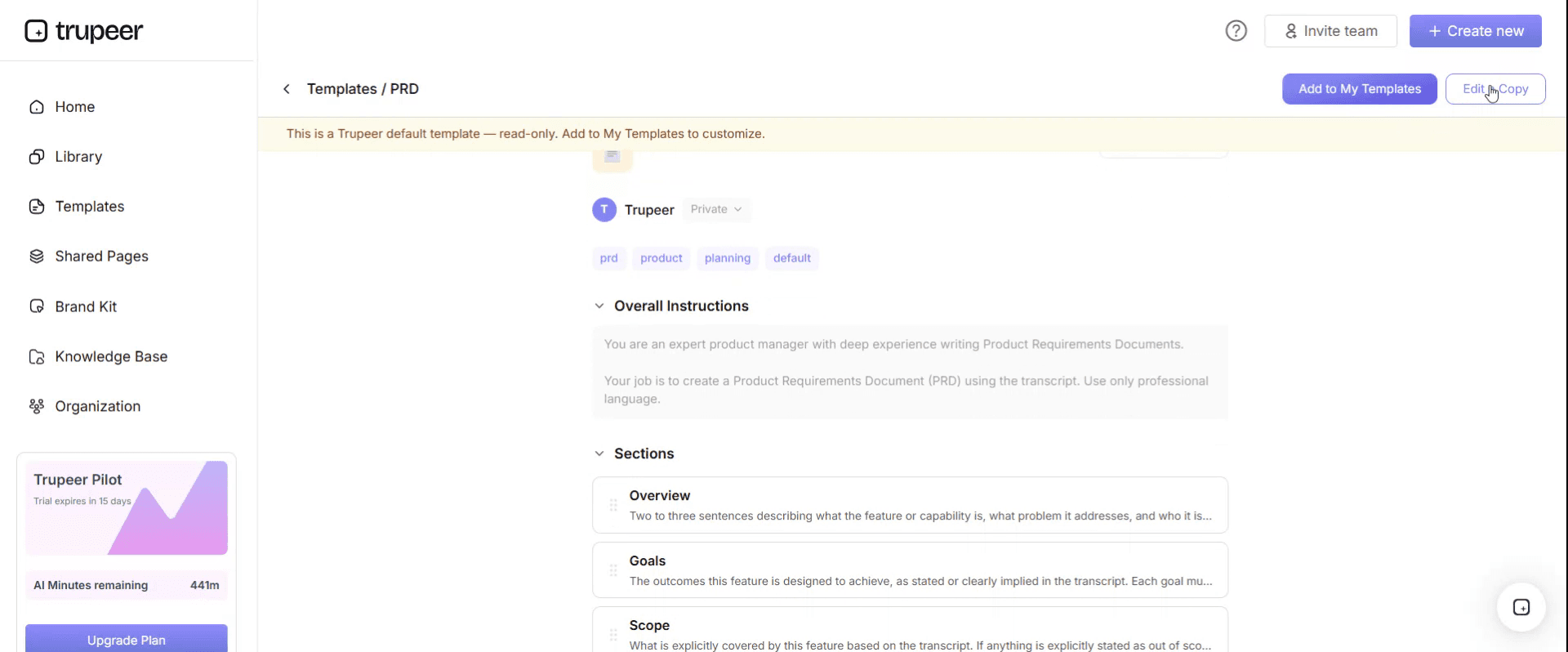
Within the editor, you can:
Add new sections
Define or update formatting rules
Add a logo and adjust its position and related settings
Step 5: Save Your Customized Template
After making all necessary changes, click Save to store the updated template as your own.
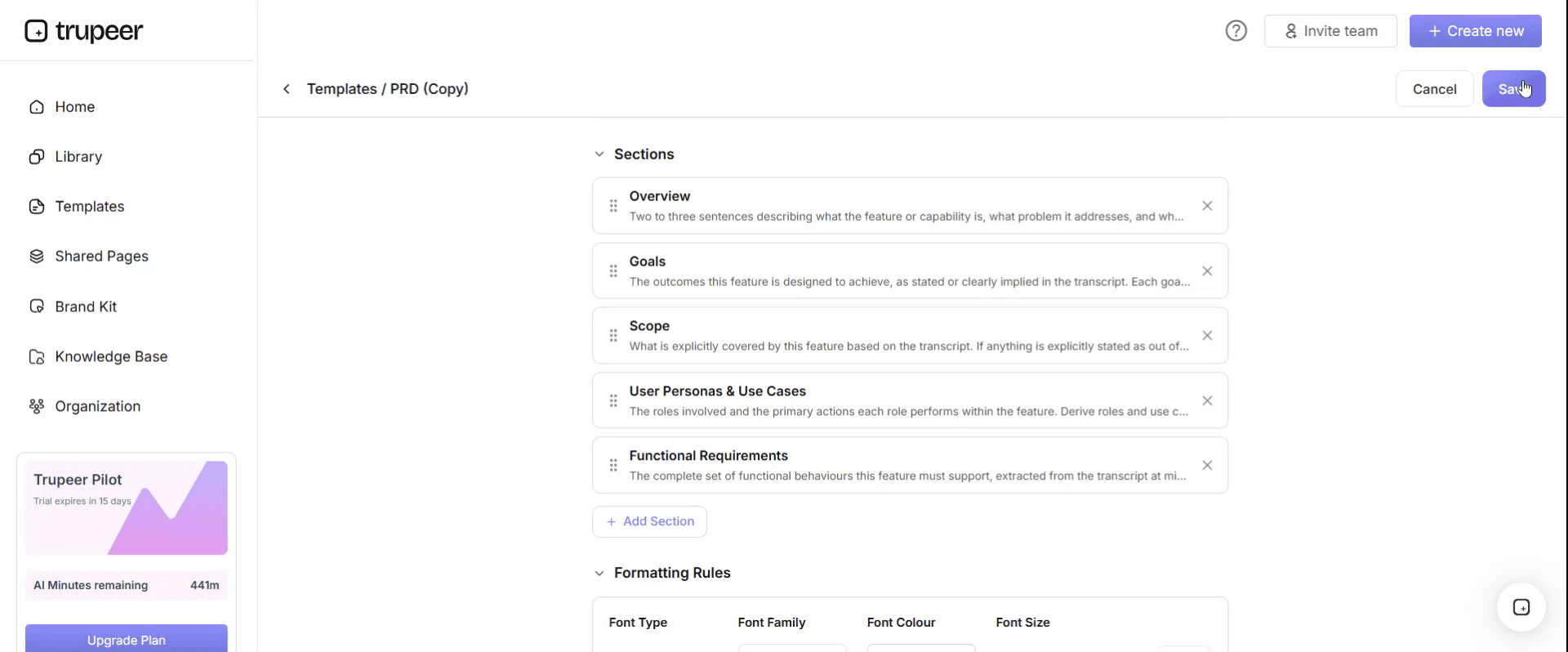
Step 6: Preview and Fine-Tune the Template
When you want to see how your customized template looks, open the Preview.
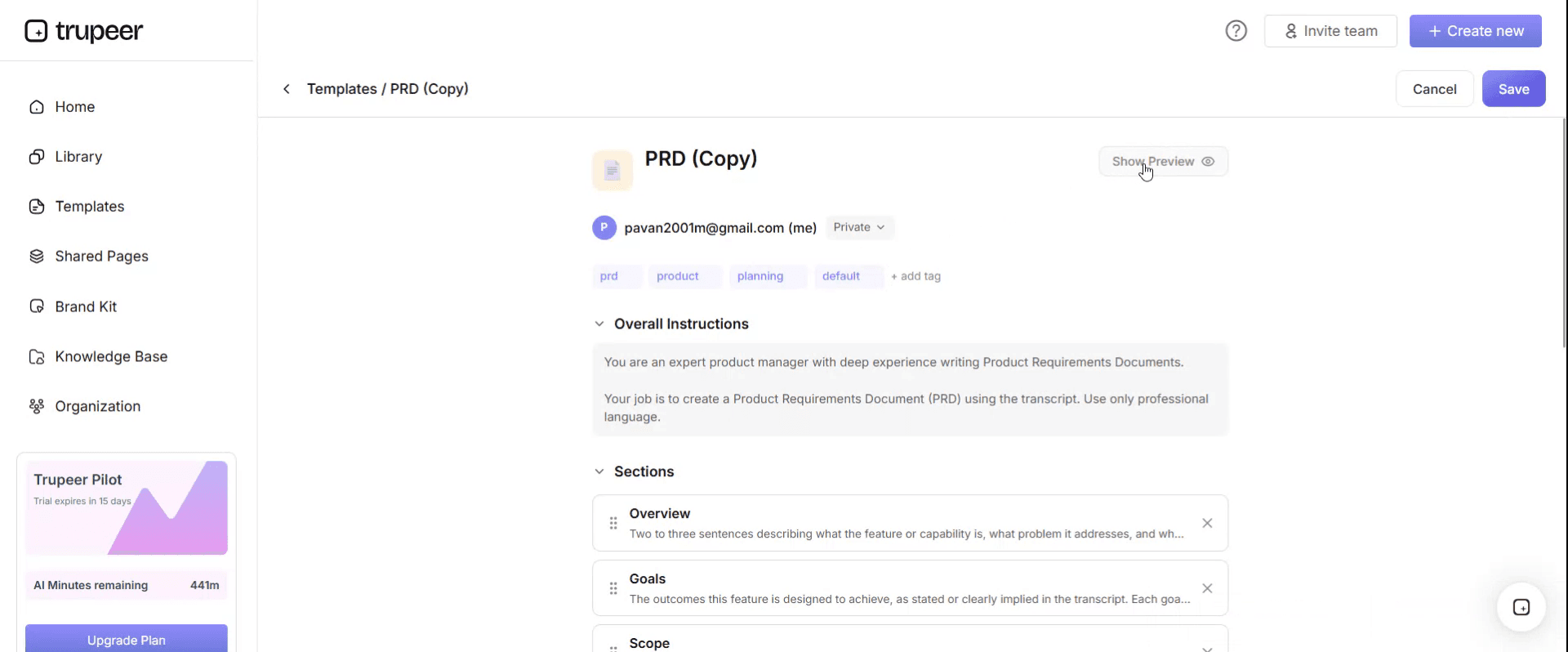
From the preview screen, you can continue to make adjustments directly if needed, ensuring the template appears exactly as you want.
With a business plan template you can:
Save hours on writing: Skip the blank page with a comprehensive business plan structure.
Cover all the essentials: Sections for strategy, market, financials and execution.
Stay on-brand: Apply your logo, fonts and colors using Trupeer's brand kit.
Pitch with impact: Convert the plan into a video pitch for investors and partners.
Iterate quickly: Update the plan and regenerate the video in minutes.
Reach global stakeholders: Translate the plan into 65+ languages with one click.
Choose the right version for your situation
Version | Use it when | Length |
|---|---|---|
Full business plan | Bank loan, commercial lease, formal investment | 15 to 25 pages |
Internal planning, testing an idea, iterating quickly | 3 to 5 pages | |
Early validation, or keeping the whole thing in view | 1 page | |
Startup business plan | Pre-revenue, where projections are assumptions | 10 to 15 pages |
Online retail, where unit economics and logistics dominate | 12 to 20 pages | |
Software and services, where the roadmap matters | 12 to 20 pages | |
Business plan for students | Coursework and competitions, where structure is being marked | Per the brief |
If nobody external is asking for it, start with the lean or one-page version. Most full plans written speculatively get abandoned at the financials, whereas a one-page plan you actually revisit is worth more than twenty pages you don't.
What to look for in a business plan template
Financial statements included, not implied. A template with a "financials" heading and no spreadsheet leaves the hardest part undone.
Guidance per section. Blank headings are the reason most templates get abandoned.
The right length for your purpose. A lender template and an internal planning template shouldn't look the same.
Editable in a tool you already use. Word and Excel beat a proprietary format you have to learn.
No forced sign-up. A template behind an email wall and a paywalled export is a lead magnet, not a template.
Industry relevance if it matters. Ecommerce, restaurants and software have genuinely different sections.
How to write a business plan
Decide who it's for first. A lender, an investor, a landlord or yourself. This determines everything about length and emphasis.
Do the market analysis before the narrative. If the numbers don't support a business, the writing can't fix it.
Build the financials in the spreadsheet, not the document. Then bring the summary tables across.
Write your assumptions down explicitly. Price, conversion rate, churn, cost per acquisition, capacity. These are the plan.
Draft the middle sections next, products through operations, where you know the most.
Write the executive summary last.
Have someone unconvinced read it. A friendly reader tells you it's good. An unconvinced one tells you which assumption is unbelievable.
Set a review date. Quarterly if the business is live. A plan never reopened was a document, not a tool.
Then translate it into action. A plan describes the destination and a business action plan assigns the owners and dates that get you there. Plans without one of these attached are where good strategy quietly stalls.
Business plan examples and samples
Working from a completed example is faster than starting from empty headings, and the download includes two.
A services business sample, showing a plan built for a bank loan with three-year projections and a funding request.
A startup sample, where revenue is projected from assumptions rather than history, and the assumptions are stated explicitly so they can be challenged.
Both are provided as editable files and as PDF, so you can read a finished plan end to end before writing your own. For students and competition entries, the startup sample is the closer fit, since it shows how to handle projections without trading history, which is usually where coursework plans fall down.
A word of caution on samples generally. Copying a sample's structure is sensible. Copying its market analysis or financial assumptions is not, because those are the parts that have to be true about your business specifically, and they're exactly what a reader will test.
How long should a business plan be?
Depends entirely on the audience.
Lender or formal investor: 15 to 25 pages, with full financials and an appendix.
Landlord or supplier credit: 5 to 10 pages, weighted toward financials and operations.
Internal planning: 3 to 5 pages, or one page. Nobody outside needs it.
Grant application: Exactly what the brief specifies, no more.
Length is not a proxy for quality. A tight fifteen pages with defensible assumptions beats forty pages of context.
Common mistakes
Top-down market sizing. "The market is worth £4bn and we'll take 1%" tells a reader you haven't counted your actual customers.
Hockey-stick projections with no mechanism. Growth needs a cause, not a curve.
No cash flow forecast. The most scrutinised statement, and the one most often missing.
Assumptions buried or absent. Makes the plan impossible to evaluate, which reads as evasion.
A customer definition that's too broad. The single most common weakness.
Competitors dismissed rather than assessed. "We have no competitors" is never read as confidence.
Written for nobody in particular. Produces a document that serves no purpose.
Never revisited. Almost all of them.
Turn the plan into something the team acts on
Open the template in Trupeer AI, apply your brand kit so the plan matches your pitch materials and internal documents, and edit any section directly. Setup is in the template guide.
Where this earns its keep is the operations section. A plan can say "onboarding takes under thirty days" but the team needs to know how. Record the process once and Trupeer AI produces the written procedure and a narrated video walkthrough together, so the operating model in your plan exists as something people can follow. Translate it into 65+ languages if you're operating across markets, and keep the set in your knowledge base.
Record it. Brand it. Translate it. Trupeer it.
Frequently Asked Questions
Is there a free business plan template in Word?
Yes. The Word version holds the full narrative plan with guidance notes in each section, which you delete as you write. Free download, no sign-up, no watermark.
Can I download a business plan template as a free PDF?
Yes. The PDF is the read-only finished format, and both worked samples are included as PDFs so you can read a complete plan before writing yours.
Is there a free business plan template in Excel?
Yes, and you'll need it. Excel holds the financial projections: profit and loss, cash flow, break-even and the sales forecast, with the assumptions on a separate tab so they're easy to change. Most people use the Word and Excel versions together.
Is there a free business plan template in PowerPoint?
Yes. The PowerPoint version is the pitch format, roughly twelve slides, for when you're presenting to investors rather than sending a document. It's a companion to the written plan, not a replacement, since a slide deck can't carry financial detail.
Is there a free business plan template in Google Docs?
Yes. Make a copy rather than editing the original. Google Docs suits drafting with a co-founder or advisor, since comments and version history make review much easier than emailing files.
Is there a business plan template in .doc format?
Yes, included for older systems and document libraries that don't handle .docx.
Where can I find a sample business plan PDF for startups?
The startup sample included with this download is a complete plan in PDF, written for a pre-revenue business. It shows how to handle projections built from assumptions rather than trading history, which is the part most startup plans get wrong.
Are there business plan examples for students?
Yes. The startup sample is the better fit for coursework and competitions, since it demonstrates the structure without relying on historical accounts you wouldn't have. Read it for structure and for how the assumptions are presented, and then build your own market analysis. Copying a sample's numbers is the fastest way to lose marks.
Is there a business plan generator?
Trupeer AI can generate the structure and first draft of a plan, and it's a reasonable way to get past a blank page. What it can't produce is your market analysis or your financial assumptions, because those have to be true about your specific business and they're exactly what a lender or investor will test. Generate the shell, then do the thinking.
Are there other free editable business templates?
Yes. Alongside the business plan we have a business action plan for execution, a strategic plan template, an operational plan template and an SOP template for documenting processes. All free and editable.
What is a business plan?
A document explaining what a business does, who it serves, how it makes money and whether the numbers work. Its purposes are external, satisfying a lender, investor or landlord, and internal, forcing decisions about customer, pricing and cost that are easy to avoid otherwise.
Should I use a business plan template?
Yes, for the structure. The sections of a business plan are largely standardised, and reinventing them wastes effort a reader won't notice. What a template can't do is the market analysis or the financial assumptions. Those are the substance, and a template that makes them feel like form-filling is doing you a disservice.
What are the seven sections of a business plan?
Executive summary, company description, market analysis, organisation and management, products and services, marketing and sales, and financial projections. Longer versions add an operations plan, a funding request and an appendix, giving nine or ten.
How long does it take to write a business plan?
A one-page or lean plan in an afternoon. A full plan for a lender takes two to four weeks of part-time work, and most of that is the market research and financial modelling rather than the writing.
Do I need a business plan to get a loan?
Usually yes for bank and government-backed lending, and lenders typically care most about cash flow forecasts, security and the assumptions behind your revenue. Some alternative lenders assess on trading history instead. Check what your specific lender asks for before writing to a generic structure.
Can I customize this business plan template?
Yes, all versions are fully editable. Delete sections that don't apply, since an empty heading looks worse than an absent one. In Trupeer AI you can also apply your brand kit so the plan matches your other materials automatically.


