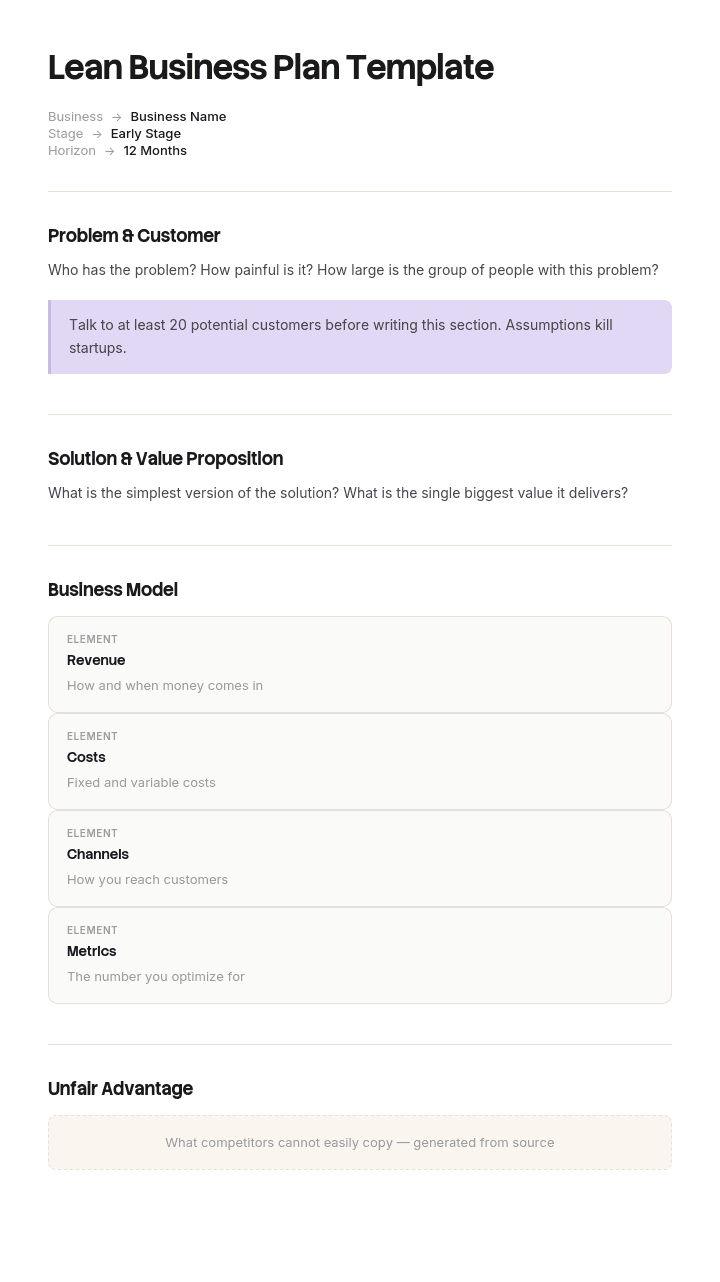
Use this template
The lean business plan was created for startups that need to move fast - test ideas, learn and iterate. With Trupeer, you can save hours on business planning by starting with a free lean business plan template, customizing it with your brand identity, and turning your lean canvas into a 2-minute video pitch you can share with anyone.
What is a lean business plan, and how is it different?
A lean business plan is a short internal planning document, usually one page, covering what the business does, who it is for, the numbers that decide whether it works, and what happens next. It is revised on a fixed cycle rather than written once.
The difference from a conventional business plan is audience, not length. A traditional plan is written for someone outside the business, typically a lender or an investor, and its job is to persuade. That job requires completeness, confidence and a tidy set of projections.
A lean plan is written for the people running the business, and its job is to help them decide things. That job requires the opposite: it needs to show what you are unsure about, because the uncertain parts are where the decisions are. A document that hides uncertainty is useless internally and essential externally, which is why one document cannot do both.
If you need the persuading version, our business plan template covers it. This page covers the internal one.
Why a shorter business plan is not a lean one
The most common mistake is treating lean as a synonym for brief. Teams take a thirty page plan, cut it to one page, feel better, and change nothing about what they do afterwards.
That produces something strictly worse than what they started with. The thirty page version at least contained the reasoning. A one page version reviewed annually is the same document with the evidence removed.
What makes a plan lean is not its length. It is that the plan is expected to be wrong, and there is a date in the diary for finding out how. Everything else follows from that. The page is short because it is going to be rewritten. The numbers are labelled as beliefs because they will be checked. The format only matters because a long document does not get revised monthly and a short one does.
So the test for whether you have a lean plan is not how many pages it runs to. It is how many times it changed last year.
How to customize this template in Trupeer
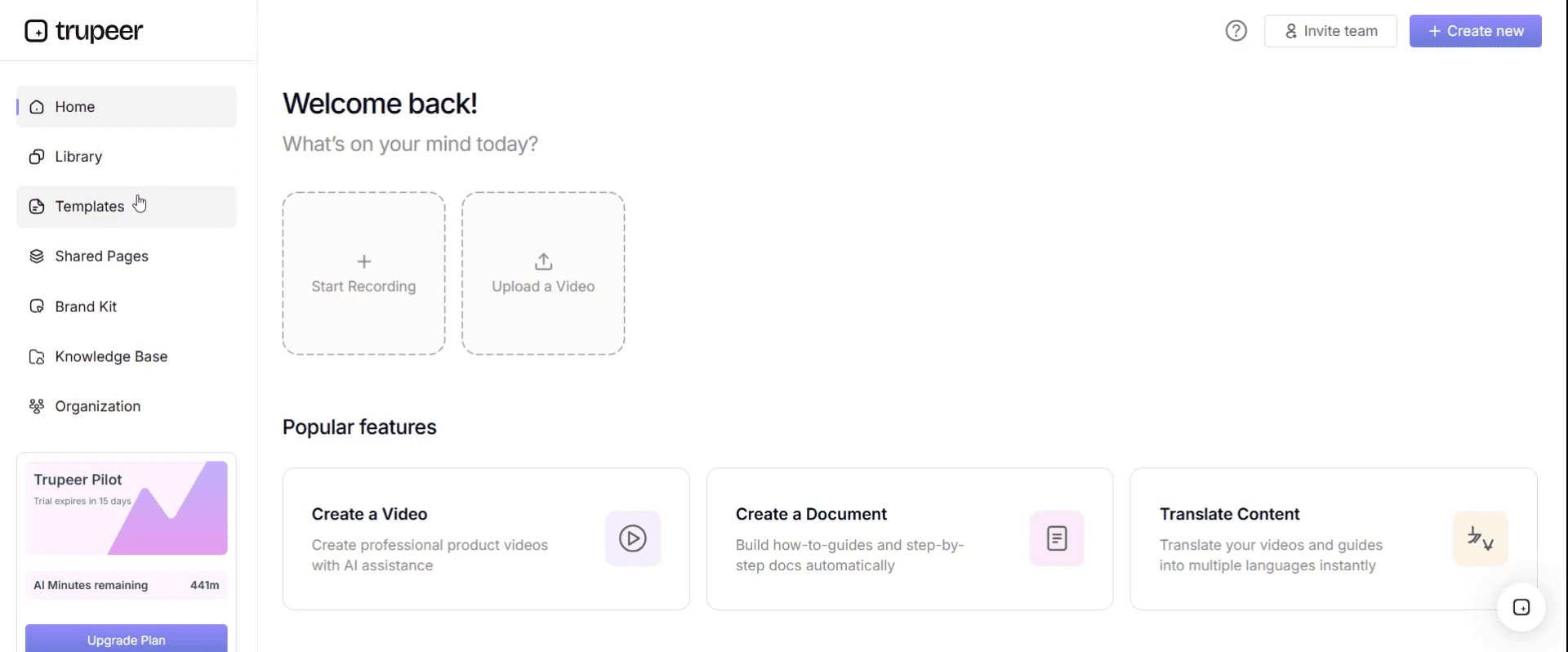
Step 1: Open the Templates Section
Go to the Templates section from the main navigation.
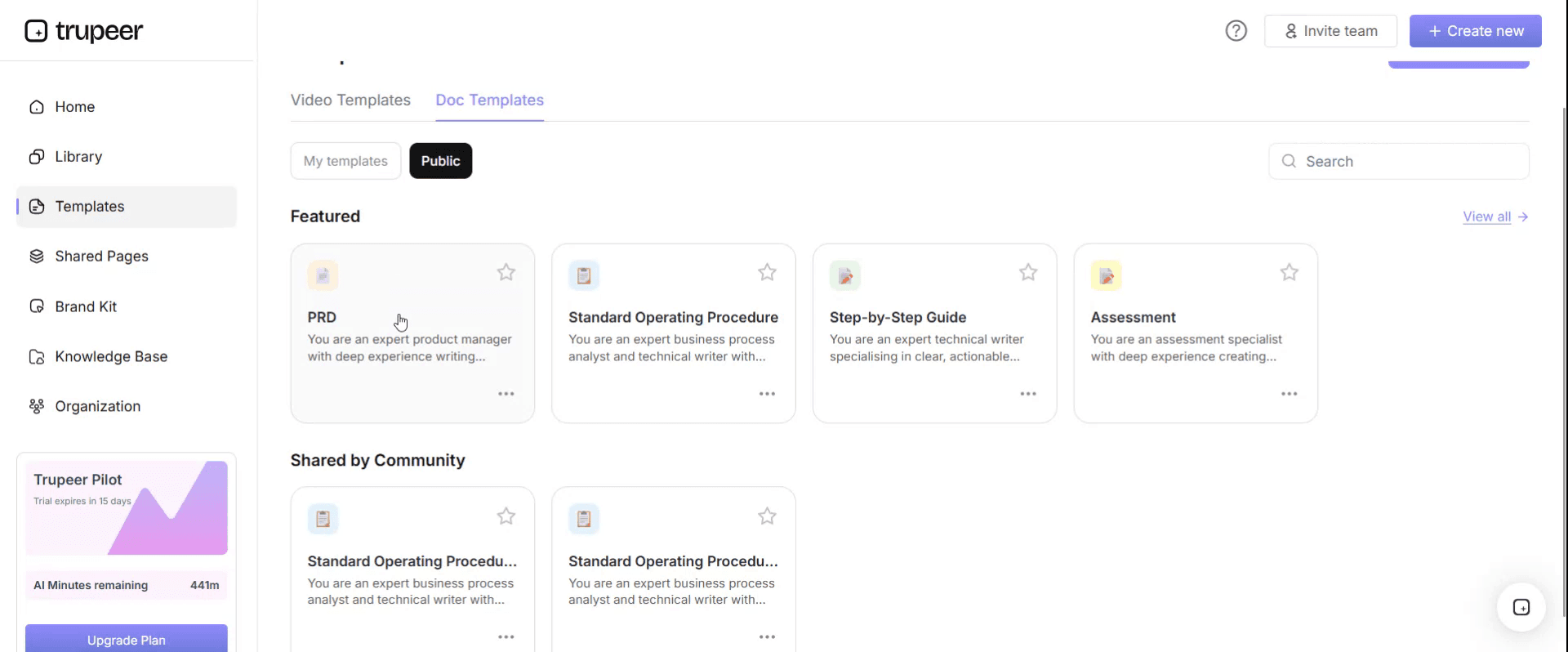
Step 2: Select and Open a Template
Click on any template you want to work with to open it.
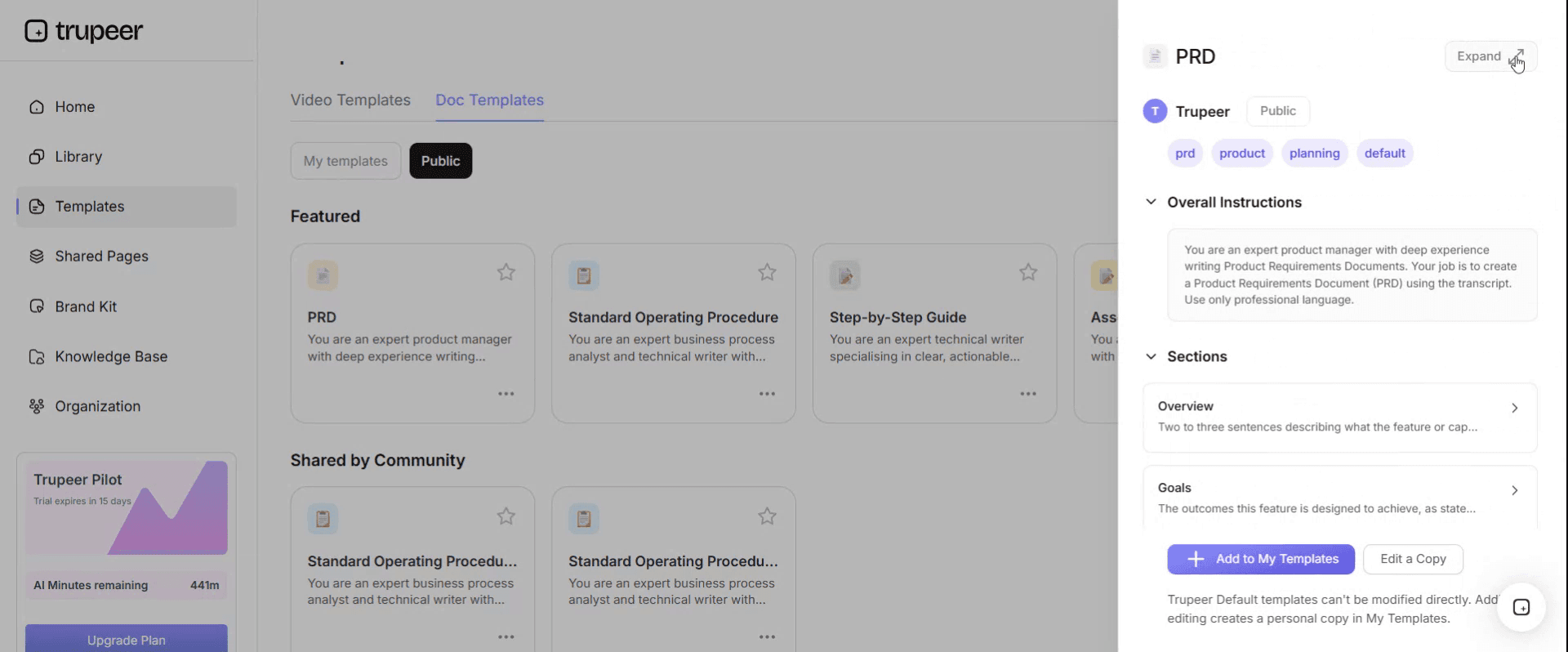
Step 3: Expand the Template View
If needed, expand the template view to see the full layout and details clearly.
Step 4: Edit the Template
Click on Edit to start modifying the selected template.
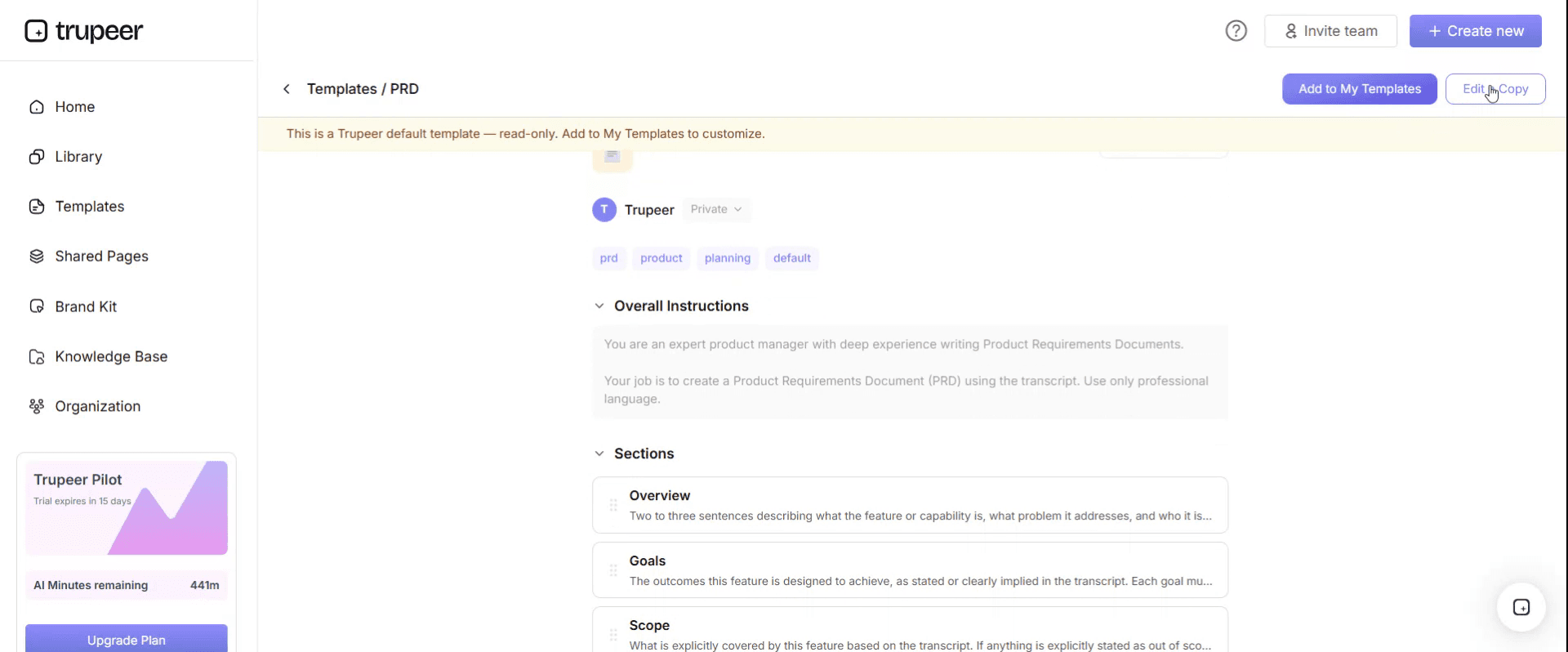
Within the editor, you can:
Add new sections
Define or update formatting rules
Add a logo and adjust its position and related settings
Step 5: Save Your Customized Template
After making all necessary changes, click Save to store the updated template as your own.
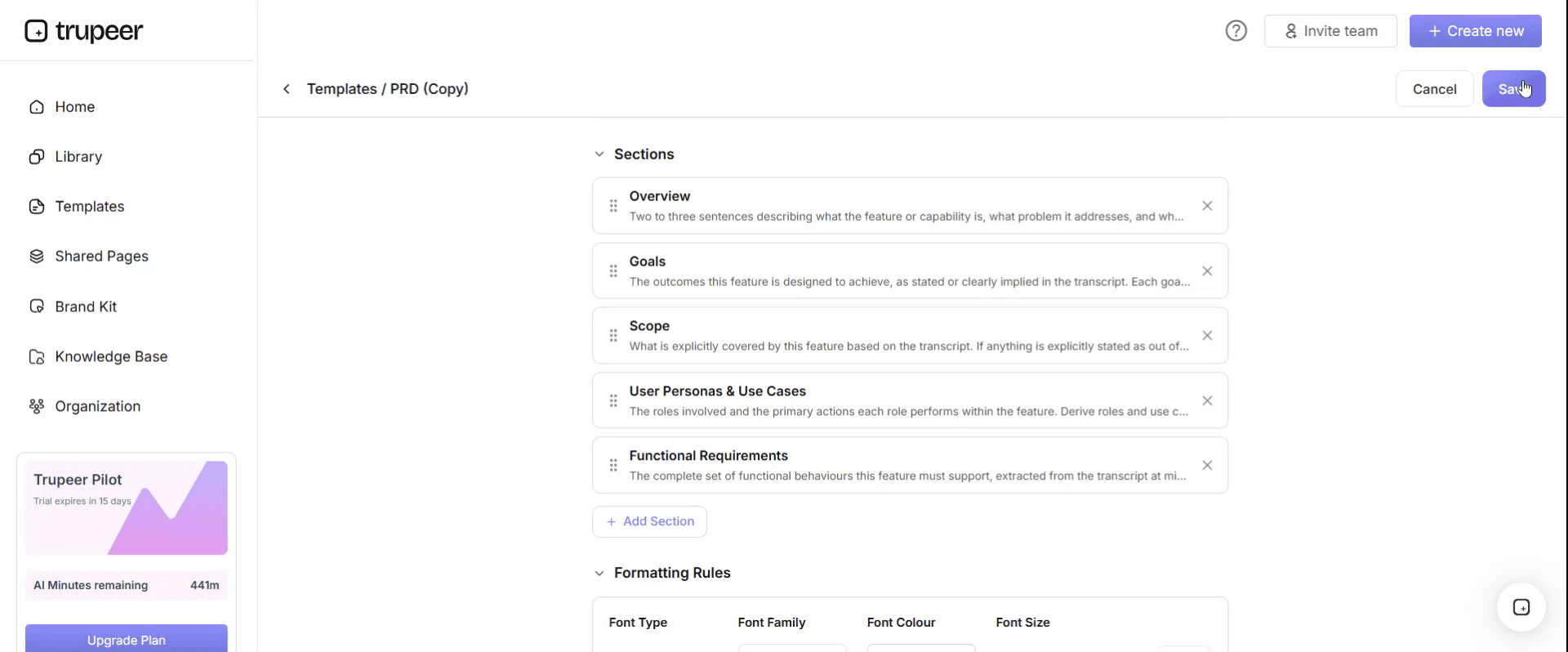
Step 6: Preview and Fine-Tune the Template
When you want to see how your customized template looks, open the Preview.
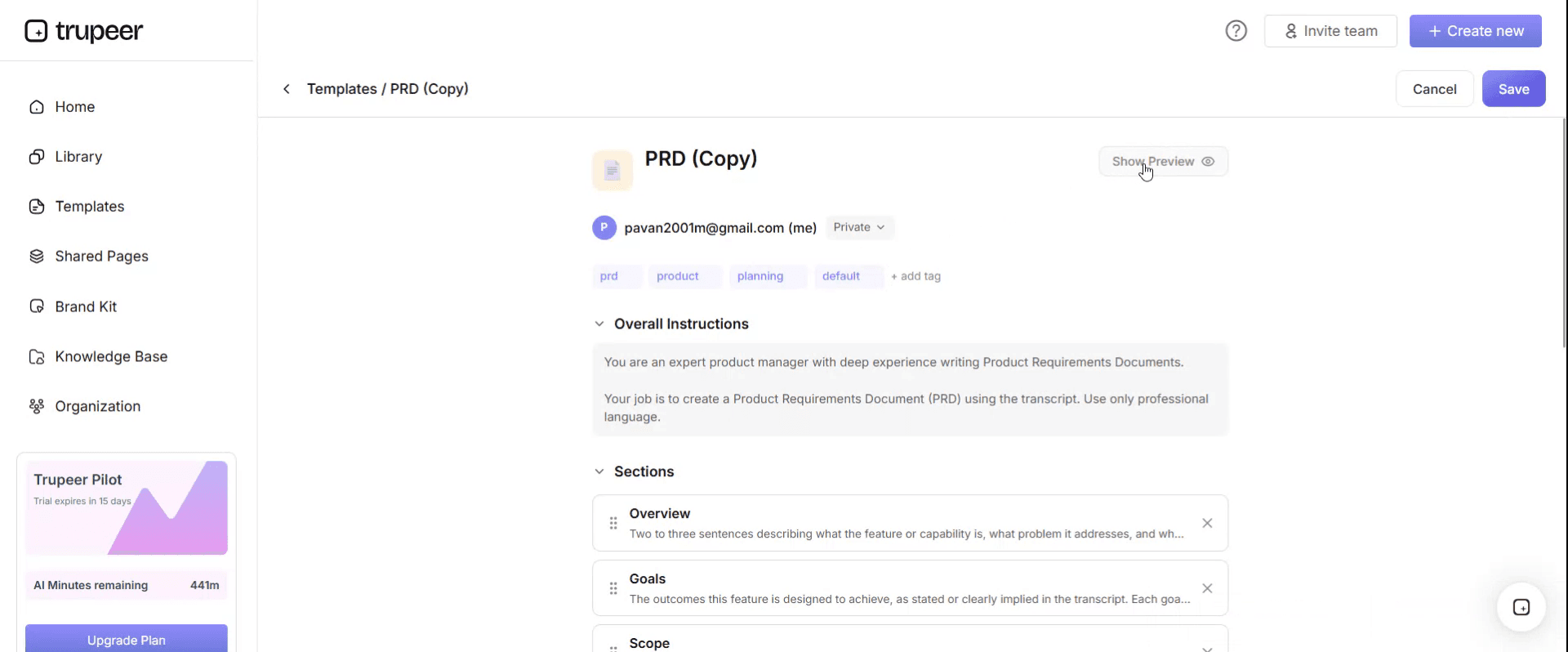
From the preview screen, you can continue to make adjustments directly if needed, ensuring the template appears exactly as you want.
With a lean business plan template you can:
Save hours on planning: Skip the 30-page format with a one-page lean structure.
Validate ideas faster: The lean format forces clarity on what matters most.
Stay on-brand: Apply your logo, fonts and colors using Trupeer's brand kit.
Pitch with impact: Convert the lean plan into a video pitch for investors and partners.
Iterate quickly: Update the plan and regenerate the video in minutes.
Reach global stakeholders: Translate the plan into 65+ languages with one click.
Every line in a lean business plan is an assumption
Open a conventional plan and the numbers appear as statements. Customer acquisition cost is twenty eight pounds. Monthly churn is four percent. Break-even at four thousand two hundred subscribers.
None of those are facts when you write them. They are beliefs, usually derived from a small sample, an industry benchmark or a hope. Writing them as statements is what makes a plan quietly dangerous, because a statement invites no follow-up and a belief does.
The lean version writes the same line differently. We believe customer acquisition cost will settle around twenty eight pounds. It is currently twenty two, measured over eleven customers, all organic. If it exceeds forty, the unit economics do not work at this price. We check on the first Tuesday of each month.
Same number, four extra clauses, and now the document does something. It tells you what would prove you wrong, it tells you when you will look, and it makes the consequence explicit before anyone is emotionally attached to the answer.
That is the whole method. The rest of this page is how to write it down.
The five columns that turn a plan into an assumption ledger
One row per assumption. Aim for six to ten rows in total, covering the handful of numbers that actually decide whether the business works.
The claim. What you believe, stated with a number.
Basis. Where the number came from and how much it is worth. Eleven customers, all organic, is a very different basis from a competitor's published figure, and both are different from three hundred paying customers over six months. Writing the basis down is what stops a guess hardening into a fact.
Current actual. The real number today, from wherever you already measure it. If nobody can fill this column, that is your first finding.
Kill line. The value at which the plan stops working. Not a target, a threshold. This is the column people resist and the one that does the work, because it has to be agreed before you know the answer.
Check date and action. When you next look, and what you do if the kill line has been crossed. The action needs to be a decision, not a discussion.
Add a header of three lines: what the business does, who for, and the single number you are trying to move this quarter. That is the complete document.
Free lean business plan template: the one page to copy
Copy from here.
What we do: [one sentence, no adjectives]. Who for: [the narrowest description that is still true]. The number we are moving this quarter: [one metric, one target, one date].
Assumption ledger
Claim | Basis | Current actual | Kill line | Check date and action |
|---|---|---|---|---|
Customer acquisition cost settles at £28 | 11 customers, all organic, months 1 to 3 | £22 | Above £40 | First Tuesday monthly. If crossed, pause paid channels and reprice |
Monthly churn stays at 4% | First cohort, 2 months of data | 4.1% | Above 6% | Monthly. If crossed, stop acquisition spend until cause is found |
Average order value £42 | Actual, 340 orders | £42 | Below £38 | Monthly, no action, monitor only |
Gross margin 61% | Supplier quotes at current volume | 58% | Below 50% | Quarterly. If crossed, renegotiate or reprice |
We reach break-even at 4,200 subscribers in month 14 | Derived from the four rows above | Month 9, 1,900 | Any input row crossing its kill line invalidates this | Recalculate monthly from actuals |
Decisions taken since last review: [three lines maximum]. Next review: [date].
Copy to here. The final row is the one that matters most, because it is derived rather than assumed, and a derived number is only as good as its inputs. Recalculating it monthly from actuals rather than restating it is the single habit that separates a lean plan from a laminated one.
What to include in a lean business plan, and what to cut
Include the assumptions that would change a decision if they turned out to be wrong. That is a much shorter list than most founders expect, usually six to ten lines, and it is almost always about acquisition cost, retention, price, margin and runway.
Cut the market size section. A total addressable market figure has never changed anything anyone did on a Monday, and it exists to impress outsiders.
Cut the competitor grid. Useful once, when you are deciding positioning, and useless as a maintained artefact because it dates immediately.
Cut the three year projection. Keep a runway number and a break-even calculation derived from live inputs. A month 36 revenue figure in an internal plan is decoration.
Cut the team biographies, the mission statement and the SWOT. All three belong in the document you show to other people.
What remains is uncomfortable to look at, which is the point. A lean plan you enjoy reading is usually one that has stopped asking anything difficult.
The lean plan that was never reviewed, and what it cost
Tallow and Vine sold a premium pet food subscription direct to consumers. They wrote a one page plan before launch and everyone who saw it admired how lean it was. It was pinned on the office wall.
Five numbers were on that page, written as statements. Acquisition cost twenty eight pounds. Monthly churn four percent. Average order forty two pounds. Gross margin sixty one percent. Break-even at four thousand two hundred subscribers in month fourteen.
Over the following twenty months the plan was formally reviewed twice: once at a board meeting and once while raising.
By month twenty they had three thousand one hundred subscribers, were burning cash, and had about eleven weeks of runway.
The retrospective was uncomfortable because nothing had been hidden. Acquisition cost had been twenty eight pounds for the first three months, when every customer came organically through founder networks. Once they moved to paid channels it settled at sixty one. That was visible in the dashboard by month six. Churn had been four percent in the first cohort and reached nine percent by month five, once the novelty of the first box wore off. Visible by month seven.
Both numbers had been on a dashboard the whole time. Neither had ever been compared against the plan, because the plan was not the sort of thing anyone put numbers against. It was a description of the business, and descriptions do not invite arithmetic.
Recalculated with the real figures, break-even at that price point was not reachable at all. That was determinable in month seven. They found out in month twenty, which is thirteen months of spending against a plan that had already failed.
The second version of the document was the same length. Each line became a claim with a basis, an actual, a kill line and a check date, and the founders met for forty minutes on the first Tuesday of each month with the dashboard open.
Within two months they had raised prices by eighteen percent, stopped two acquisition channels and changed the first box offer. None of those decisions required insight the founders did not already have. They required someone to look.
How to run the monthly review that makes the plan lean
Forty minutes, same day each month, same two or three people, dashboard open. Longer than that and it gets cancelled.
Go row by row. Read the claim, read the actual, and answer one question: has this crossed its kill line. Nothing else. Do not discuss why the number moved, do not open a strategy conversation, and do not adjust the kill line to accommodate the actual, which is the most common way this ritual quietly dies.
Where a kill line has been crossed, take the action written in the row. That is why it was written in advance, when nobody was defending anything.
Then recalculate the derived rows, write the three lines of decisions taken, and set the next date. Any row that has not moved for six months and has no realistic path to its kill line should be deleted, because a ledger full of settled questions stops being read.
Lean business plan or Lean Canvas: which do you need?
They are different artefacts and both show up under this search.
A Lean Canvas is a one page model of the business: problem, customer segments, unique value proposition, solution, channels, revenue, costs, key metrics, unfair advantage. It is a thinking tool, best used early and best used in a room with other people. It has no time dimension and no actuals, so it cannot tell you whether anything is working.
A lean business plan is a management document. It has numbers, current values and dates, and it is compared against reality on a cycle.
Use the canvas first, when you are still deciding what the business is. Move to the plan once you have customers, because the canvas has nothing to say about a churn rate. Many teams keep both, canvas revisited perhaps twice a year and plan reviewed monthly, and that works well.
Benefits and limitations of a lean business plan template
The benefits are real. It gets written, which a thirty page plan often does not. It surfaces the assumptions that decide the outcome. It makes the monthly conversation short and specific. And it is cheap enough to throw away, which means people are willing to be wrong in it.
The limitations are equally real and less often stated.
A lean plan will not get you a bank loan or an SBA loan, and it is not what an investor doing diligence expects to receive. It has no persuasive function whatsoever.
It also assumes you can measure the actuals. A business with no reliable numbers gets a ledger of empty columns, and the honest first step there is instrumentation rather than planning.
And a template cannot supply the kill lines. Those are judgements about your business that nobody else can make, and a plan where every kill line was copied from an example is not a plan.
Nothing here is financial advice. Where the numbers feed a lending application, an investment decision or a solvency judgement, have an accountant or a qualified adviser review them.
When a lean plan will not do, and you need the full version
Four situations require the conventional document, and using a lean plan for any of them wastes everyone's time.
Applying for debt finance, including SBA-backed lending, where the lender has a required format and will ask for detailed projections. Raising equity beyond friends and family, where diligence expects depth. Any grant or public funding application, which will specify its own structure. And formal partnership or franchise arrangements, where the plan forms part of an agreement.
In all four, write the lean plan anyway and write the long one from it. That order works well, because the assumptions are already explicit and you are converting them into the confident register the outside document needs. Doing it the other way round tends to produce a lean plan that is just the summary section of the long one, which inherits all its false certainty.
Can I get a lean business plan template in Word, Excel or PDF?
Excel is the right home for this and it is not a close call. The ledger has a current actual column that changes monthly and a derived break-even row that should recalculate itself, and both of those want formulas. One sheet, one row per assumption, plus a tab for the monthly snapshot so you can see how your beliefs moved over a year. That history turns out to be one of the more useful things a young company owns.
Word suits the three header lines and the decisions log if you prefer prose. PDF suits nothing here except a snapshot for a board pack, because the whole document is designed to be edited.
How to make a plan change actually reach the team
The monthly review produces decisions: reprice, stop a channel, change the first box offer. That is the point of it. The failure that follows is quieter than the one above and just as expensive, which is that the plan changed and the business did not.
A price change means the sales script, the checkout copy and the support responses all change in the same week. A channel stopping means someone stops doing work they have been doing daily. If those changes travel by a message in a channel, roughly half of them do not land.
Trupeer AI is useful here because it makes updating the way something is done cheap enough to do on the same day the decision is made. Record the new version of the task once and you get a written guide, a video and a document in your knowledge base in your own branding, rather than a change that exists only in the meeting notes.
Record it. Brand it. Translate it. Trupeer it.
For the recurring parts of the operation, the SOP creator keeps the procedure and the decision that changed it in one place, which also means the next monthly review can see what actually shipped. Setup instructions are in the document template setup guide.
Frequently Asked Questions
Is there a free lean business plan template in Word or doc?
The header block, the five column ledger and the decisions log paste straight into Word or Google Docs. There is no gated download and no form. Most teams move the ledger into a spreadsheet within a month, because the actual column wants to be maintained rather than retyped, and that migration is a good sign rather than a failure of the format.
Is there a free lean business plan template in Excel?
Excel is the format this document actually wants. One row per assumption with columns for claim, basis, current actual, kill line, check date and action, plus a conditional format that flags any actual past its kill line. Add a monthly snapshot tab. The snapshot history is worth more than the current state after about a year.
Is there a free lean business plan template in PDF?
Export a snapshot for a board pack or an advisory meeting, and keep the working version editable. A PDF lean plan is close to a contradiction, since the defining feature of the document is that it gets rewritten.
Where can I find a business plan template free download in PDF?
That is the conventional plan rather than the lean one, and it is a different document with a different purpose. Our business plan template covers the full structure, including the sections deliberately cut from this page.
What is the best free lean business plan template?
The one with a kill line column. Almost every free lean business plan template offers a one page layout with headings, which is the easy part and the part that changes nothing. If a template does not ask what would prove each number wrong and when you will check, it is a summary format rather than a planning method.
Is the SBA lean business plan template the same thing?
The SBA publishes both a traditional and a lean format, and the lean one is a genuine short-form plan covering business identity, problem, solution, competition, funding and revenue. It is closer to a Lean Canvas than to the ledger on this page, and it is designed to be shown to someone. If you are applying for SBA-backed lending, use their format and their guidance.
How long should a lean business plan be?
One page, six to ten assumption rows. If it runs longer, the usual cause is that descriptive sections have crept back in. Length is not really the target though: a plan revised monthly at two pages is leaner in every sense that matters than a one page plan revised annually.
Can I use a lean business plan to raise money or get a loan?
No, and trying tends to damage credibility. Lenders and investors read the uncertainty a lean plan deliberately exposes as a lack of preparation, because they are reading a document written for a different purpose. Write the lean plan for yourself, then write the external document from it.


