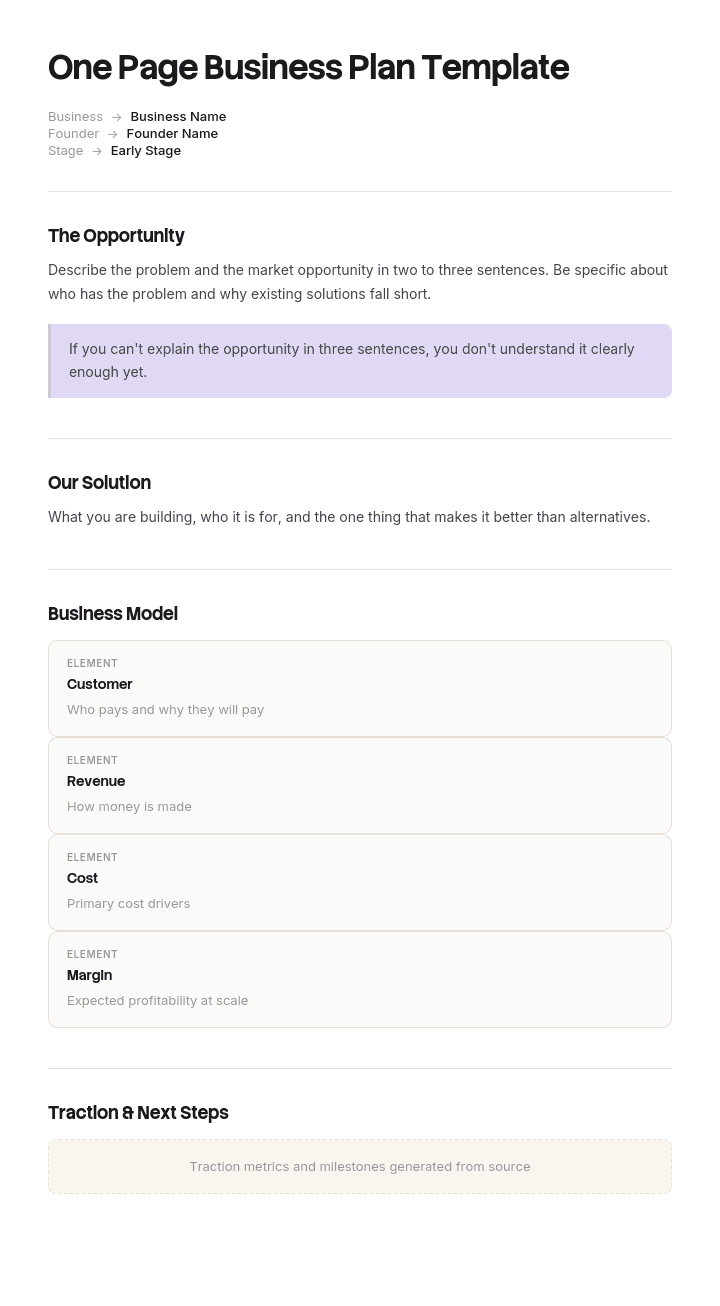
Use this template
You don't need a 30-page document to clarify your business strategy - sometimes one page is enough. With Trupeer, you can save hours on business planning by starting with a free one-page business plan template, customizing it with your brand identity, and turning the plan into a 2-minute video pitch you can share with anyone.
What is a one page business plan, and what is it for?
A one page business plan sets out what your business does, who it serves, how it makes money and where it is going, on a single side.
The important word in that sentence is not "one". It is "sets out". A one page plan is a communication document. You do not plan on one page, you plan somewhere else and then compress, and the page exists so that somebody who is not you can understand the business quickly enough to do something about it.
That makes it a different animal from the plan you run the business with. Our lean business plan template covers the internal management version, which is short for entirely different reasons and gets reviewed monthly. The full document, the one written to persuade at length, is covered in our business plan template.
This page covers the version you hand to somebody.
A one page plan is written for one reader
Here is the question almost no template asks and every good one page plan answers first: who is reading this, and what do you want them to do afterwards.
A bank relationship manager reads it to decide whether to progress a lending application. A prospective senior hire reads it to decide whether the business is worth leaving a job for. A wholesale buyer reads it to decide whether you can supply them. Your own team reads it to decide what to prioritise this quarter.
Those four readers want almost entirely different information, and no single page can serve all of them. The attempt produces a document containing a little of what each needs and enough for none, which is a specific and very common failure rather than a vague one.
So the honest position is that you will end up with more than one page, generated from the same underlying plan. That sounds like more work and it is considerably less, because writing for a named reader is fast and writing for everybody is what takes three drafts and still misses.
How to customize this template in Trupeer
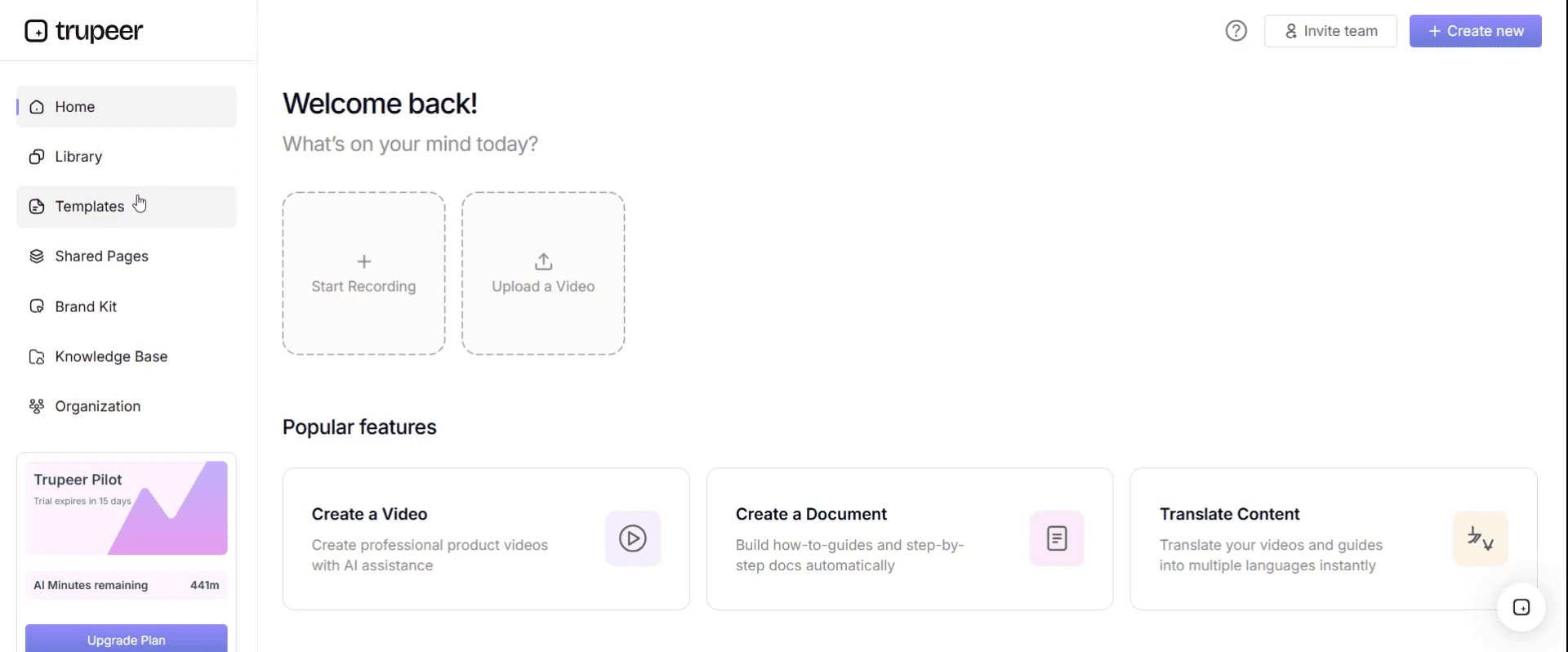
Step 1: Open the Templates Section
Go to the Templates section from the main navigation.
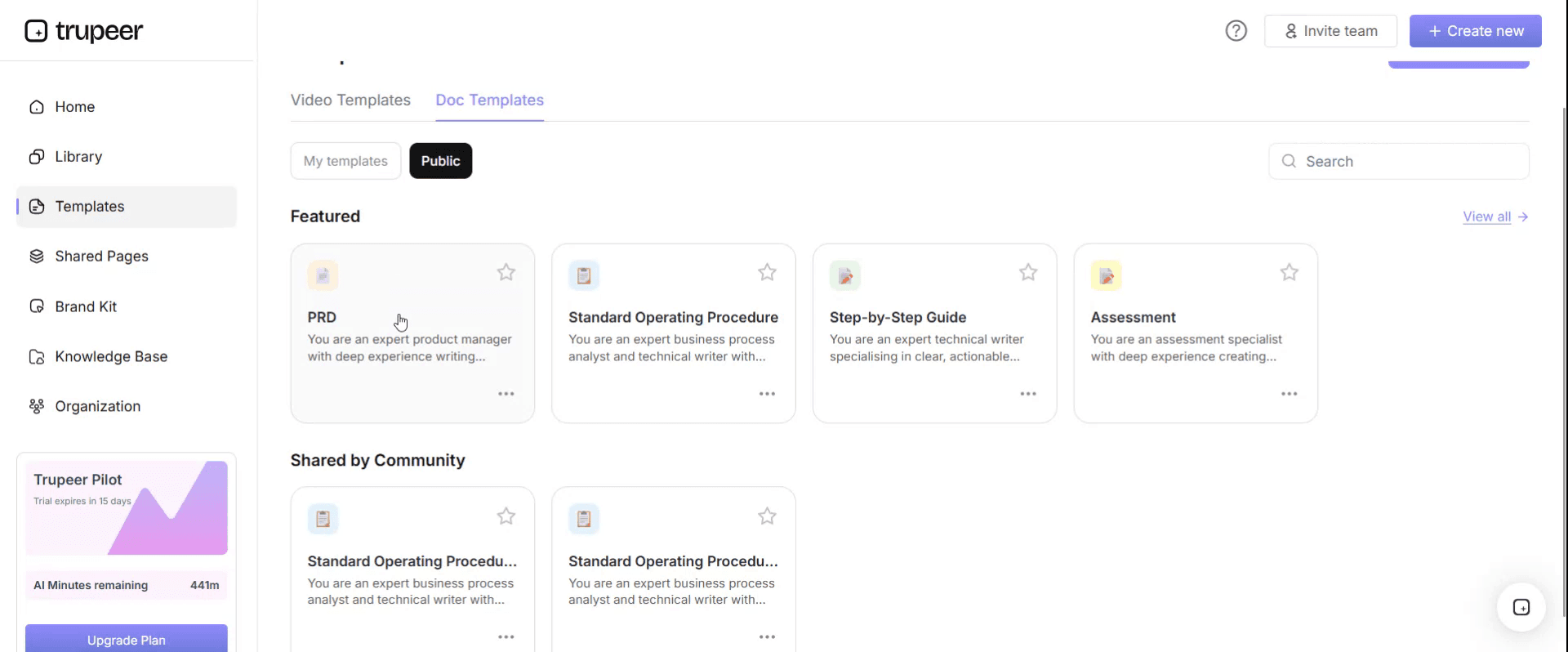
Step 2: Select and Open a Template
Click on any template you want to work with to open it.
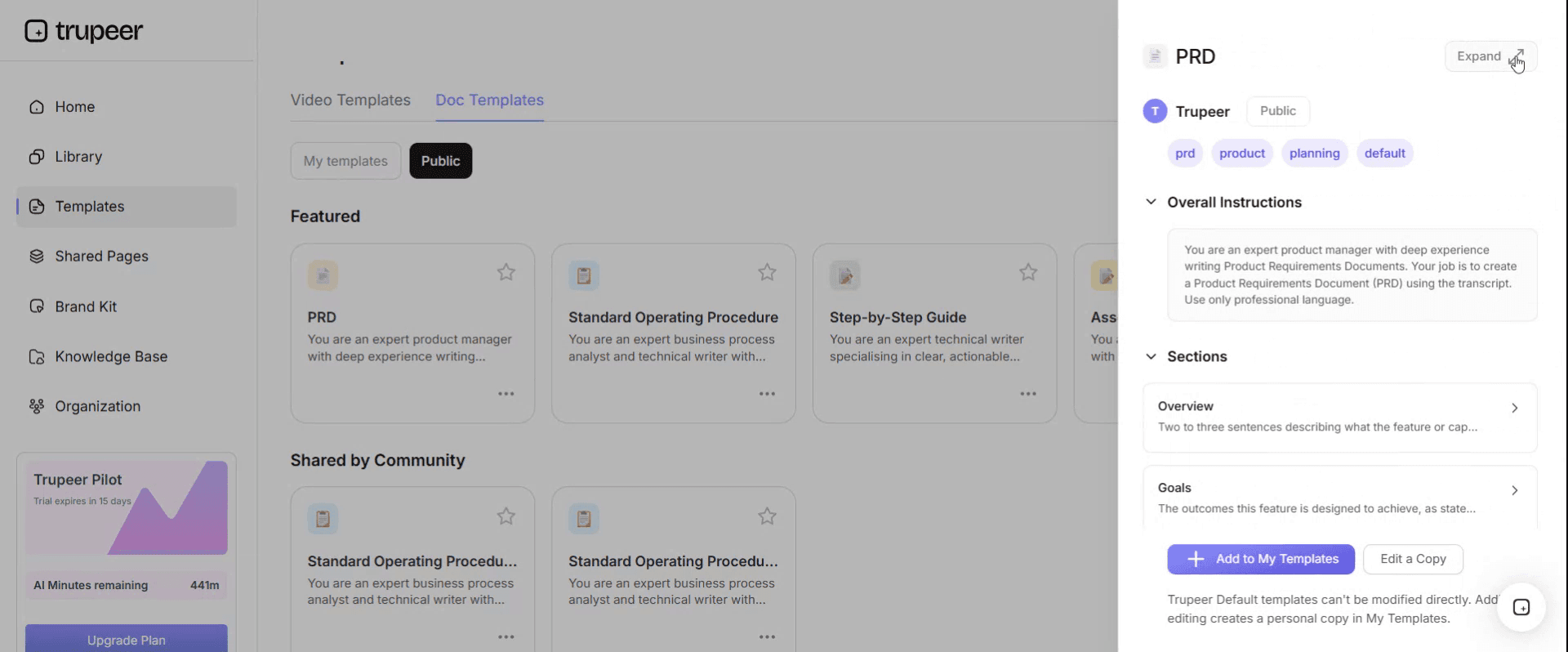
Step 3: Expand the Template View
If needed, expand the template view to see the full layout and details clearly.
Step 4: Edit the Template
Click on Edit to start modifying the selected template.
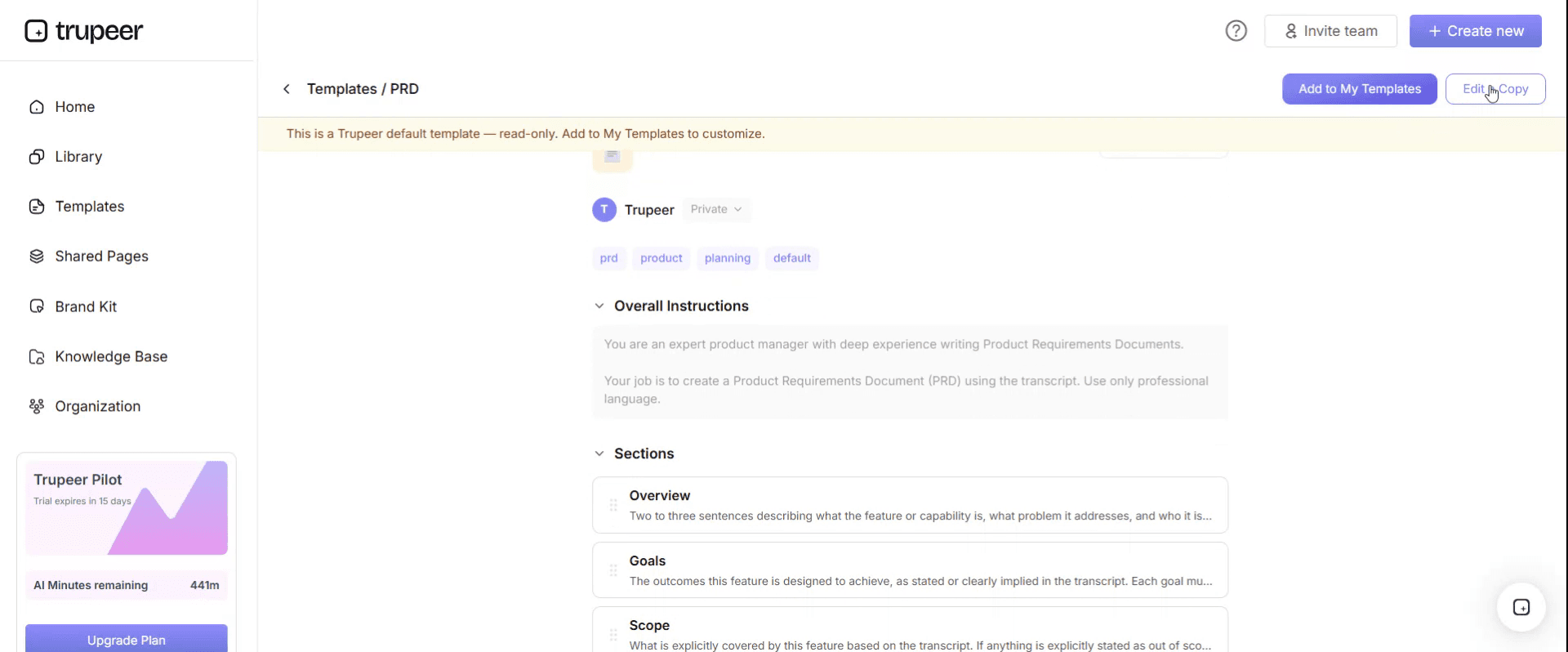
Within the editor, you can:
Add new sections
Define or update formatting rules
Add a logo and adjust its position and related settings
Step 5: Save Your Customized Template
After making all necessary changes, click Save to store the updated template as your own.
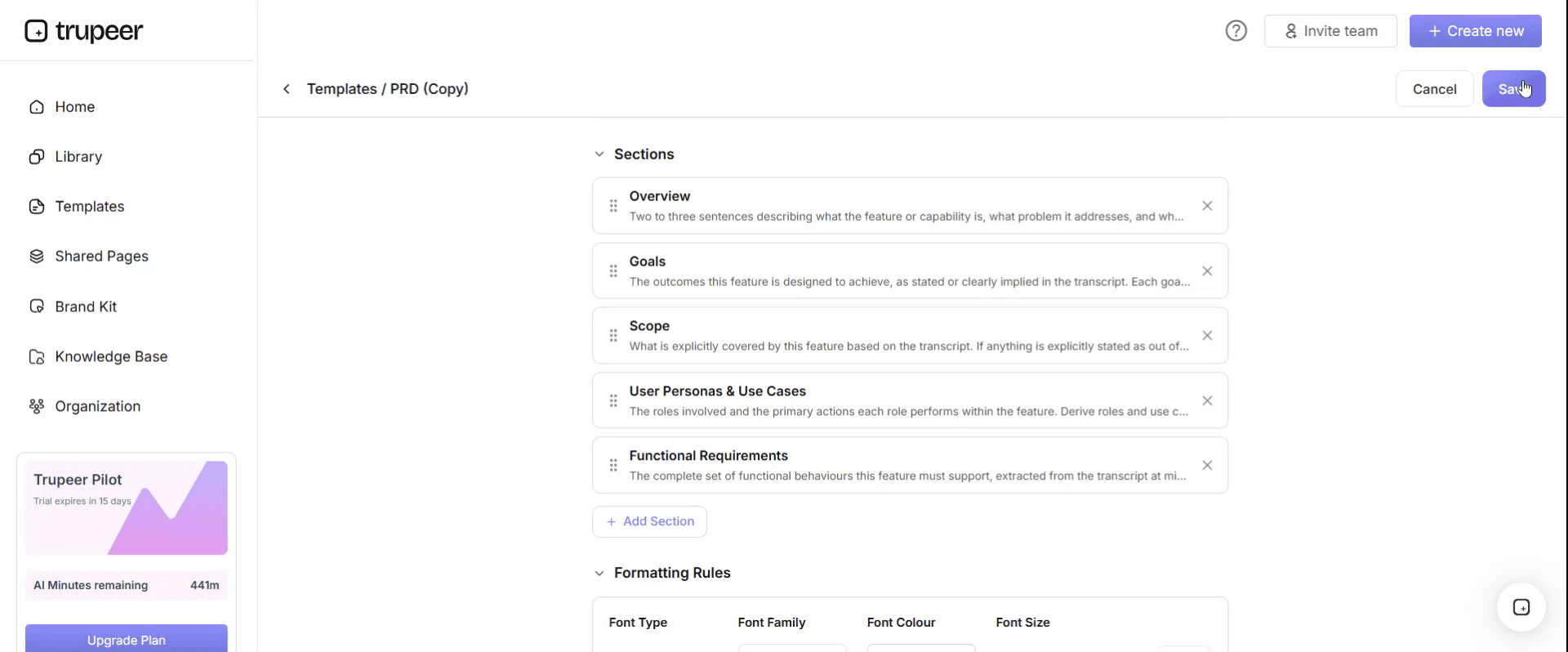
Step 6: Preview and Fine-Tune the Template
When you want to see how your customized template looks, open the Preview.
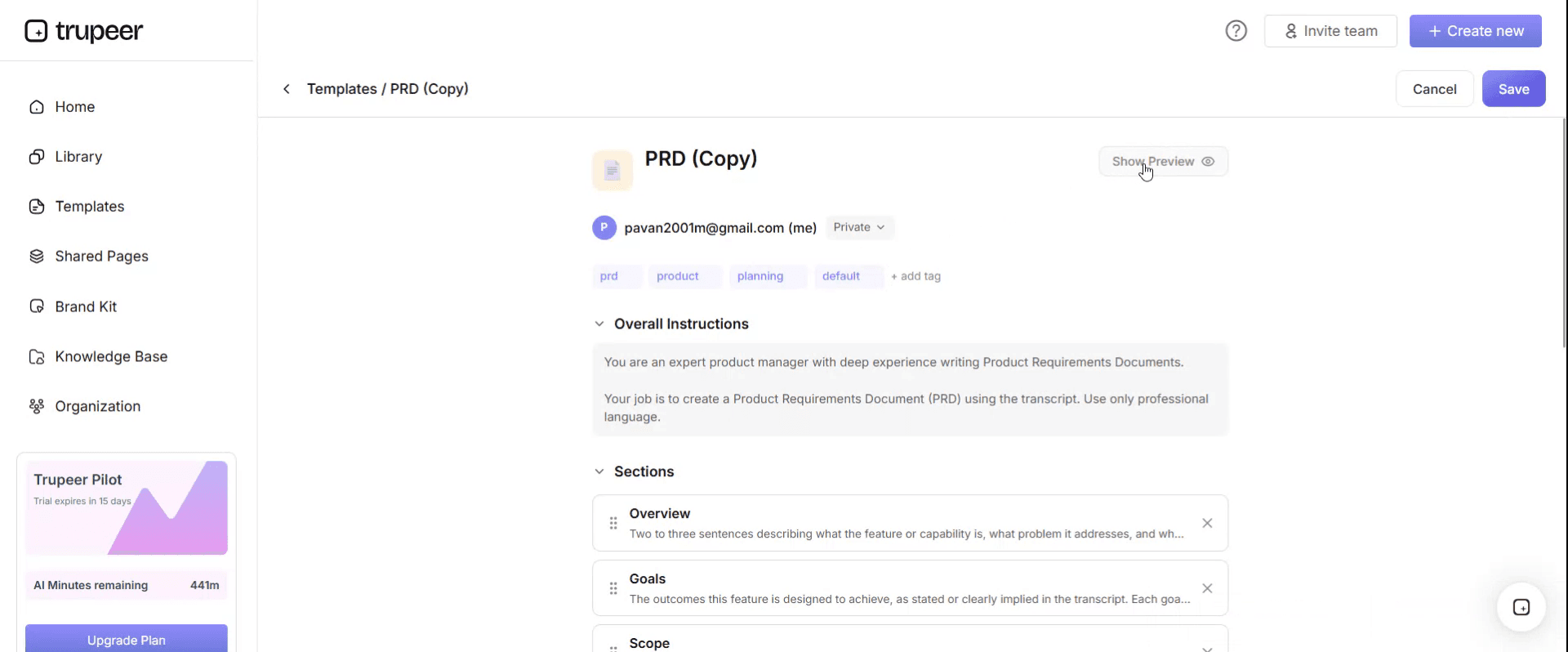
From the preview screen, you can continue to make adjustments directly if needed, ensuring the template appears exactly as you want.
With a one-page business plan template you can:
Save hours on planning: Skip the 30-page format - capture the essentials in one focused view.
Validate ideas faster: A one-pager forces clarity on what's most important.
Stay on-brand: Apply your logo, fonts and colors using Trupeer's brand kit.
Pitch with impact: Convert the one-pager into a video pitch for investors and stakeholders.
Iterate quickly: Update the plan and regenerate the video in minutes.
Reach global stakeholders: Translate the plan into 65+ languages with one click.
How to name the reader and the decision first
Before writing anything, put two lines at the top of your working document. They will not appear on the final page.
Reader. Not a category. A named person or a specific role at a specific organisation. "The relationship manager at our bank" is workable. "Investors" is not, because investors at different stages want different things and you are about to write for an average that does not exist.
Decision. What you want them to do next, stated as an action with a timeframe. Progress our application to credit. Agree to a first interview. Put us on a trial listing in two stores. Approve the quarter's priorities.
Then everything on the page has to earn its place by serving that decision. Market size is essential to an investor and irrelevant to a wholesale buyer, who wants to know whether you can produce four thousand units a week. Team biographies matter to a candidate and almost not at all to a bank, which cares about cash flow and security.
The test for any section is simple. If removing it would not change the reader's decision, it is there because it is in the template, and it is taking space from something that would.
The ninety second test every one page plan should pass
Give the page to somebody who does not know the business and ask them, after ninety seconds, to tell you three things: what the business does, who it is for, and what you are asking of them.
Most first drafts fail on the third. Founders are comfortable describing and uncomfortable asking, so the ask ends up implied or missing entirely, and a reader who cannot tell what is wanted defaults to doing nothing.
Two other things this test finds quickly. Whether the first line does its job, because a reader who does not understand the business in one sentence spends the next thirty seconds working it out rather than reading. And whether the numbers are legible, since financial detail compressed onto a shared page is often technically present and practically unreadable.
Run it with two people. The second one catches what the first was too polite to mention.
Free one page business plan template: the structure to copy
Copy from here. Nine blocks. Delete any that do not serve your named decision, and expect to delete two or three.
What we do. One sentence, no adjectives. If it needs a comma and a "which", it is two sentences and the business may be two businesses.
Who it is for. The narrowest true description of the customer, with a number attached. How many of them exist, or how many you currently have.
The problem and why now. Two sentences on what is happening that makes this the right time.
How we make money. Pricing, unit, and the shape of the revenue. Subscription, transaction, wholesale, retail.
Traction. The three numbers most relevant to your reader. Revenue, customers, growth rate, retention, capacity, whatever their decision depends on.
What is next. Twelve months, three or four concrete objectives with numbers and dates rather than themes.
What it costs and what we have. Funding position, runway, and the money involved in whatever you are asking for.
Who we are. Two lines. More only if the reader's decision depends on the people, which for a candidate or an investor it does and for a buyer it does not.
The ask. Explicit, at the bottom, in one sentence. What you want and by when.
Copy to here. Two formatting rules matter more than they sound. Do not shrink the type below about ten point to fit, since an unreadable page is worse than a two page one. And leave white space, because a full page reads as a document to work through and a spacious one reads as a page to take in.
What to include in a one page business plan
The nine blocks above cover it, and the more useful guidance is what to leave out, since the constraint is what makes the document work.
Leave out the market size figure unless your reader is an investor. It is the section founders most want to include and the one that most often makes a page look naive, because a large number with no path to it reads as optimism rather than evidence.
Leave out the competitor grid. It cannot be legible at this size and it is rarely what decides anything.
Leave out the mission statement, the values and the SWOT. All three are internal artefacts that describe rather than commit.
Leave out any projection beyond twelve months. On a single page a five year revenue figure carries no supporting reasoning, so it functions as decoration and experienced readers discount it.
What almost everybody omits and should not is the ask. A page ending on a growth projection leaves the reader to work out what is wanted, and most will not.
The bakery whose one page plan failed three audiences
Rushmere Bakehouse was a craft bakery moving from one site to three. The founder wrote a one page business plan and it was genuinely good: a clear proposition, an honest read of the local market, the revenue model, three year targets and the team.
She used the same page for four things over eight months.
She sent it to the bank with an application for a hundred and eighty thousand pounds for equipment and fit-out. She sent it to a candidate for head of production. She took it to a meeting with a regional grocery chain about wholesale. And she used it in her own quarterly planning.
Only the last one worked.
The bank came back with eleven follow-up questions and a request for a full plan with three years of forecasts. Nine of those eleven were things a page written for a lender would have answered: use of funds broken down, cash flow through the fit-out period, what security was available, and how repayments were covered while two sites were operating below capacity. The process took an extra seven weeks.
The head of production declined after a second conversation. She said later that she could not tell from the page what the role would actually own, how many people she would manage, or whether the business had the funding to see the expansion through.
The grocery buyer never followed up. His first question in the meeting had been whether they could produce four thousand units a week and whether they held BRC certification. Neither appeared anywhere on the page, because the page had been written to describe the business rather than to answer a buyer.
The fix was three pages from one underlying plan. The bank version led with use of funds, a cash flow summary, security and repayment cover. The candidate version led with what the role owned, the team structure, the funding position and an eighteen month picture. The buyer version led with capacity, accreditation, lead times, references and pricing tiers.
The second bank approach was approved in five weeks, with the full plan attached as an appendix rather than requested afterwards. A head of production was hired from the second search. The grocery chain took a trial listing in two stores.
Nothing about the business changed between the first attempt and the second. The underlying plan did not change either. Only the page did.
How to write a one page business plan, step by step
Write the long version first, or at least have it. A one page plan compressed from a real plan reads differently from one written directly, because the compression forces choices and the choices show.
Name the reader and the decision.
Draft the nine blocks without worrying about length. First drafts run to three pages and that is fine.
Now cut, and keep a record of what you cut. That record is useful twice: it becomes the appendix when someone asks, and it tells you what the other versions of the page will need.
Set it out with real white space and readable type, then run the ninety second test on two people.
Finally, write the ask last and put it at the bottom. Written last, it tends to be specific. Written first, it tends to be aspirational.
One page business plan template variants by business type
The nine blocks hold across business types. What changes is which three numbers go in traction and what the reader will not accept as vague.
Service business. Traction is utilisation, repeat rate and average engagement value. The question a reader will always ask is capacity, meaning what happens when you sell more than you can deliver.
Product business. Traction is unit economics, margin and inventory position. Lead times and supplier concentration matter more than founders expect.
Retail or hospitality. Traction is site level: revenue per site, covers or transactions, and the position on rent and staffing. A second site is a different business from a first, and readers know it.
Startup seeking investment. Traction is growth rate, retention and burn, and the market size section becomes essential rather than optional.
Nonprofit. The revenue block becomes funding sources with their renewal dates, and the ask is usually specific to one funder's criteria, which should be visible on the page.
Real estate or agent-led. Traction is pipeline and conversion, and the personal track record carries more weight than the entity's.
One page plan or lean plan: which do you need?
They look similar and they do opposite jobs.
A one page business plan is outward facing. It is written for a named reader, it presents the business with confidence, and its success measure is whether that reader does the thing you asked. It is rewritten per audience and it does not change much otherwise.
A lean business plan is inward facing. It is a management instrument, it records what you are unsure about rather than hiding it, and it is revised monthly against actuals. Showing it to a lender would be actively harmful, because the uncertainty it deliberately exposes reads as unpreparedness to someone assessing risk.
Most growing businesses want both, and the sequence that works is to run the lean plan internally and generate one page versions from it as needed. Doing it the other way round tends to produce a lean plan that is just the one pager with a review date attached, which inherits all of its confidence and none of its usefulness.
Should you write a business plan from scratch?
Rarely worth it for the one page version, and usually worth it for the long one.
A template is genuinely helpful here because the nine blocks are stable across businesses and the value of the document lies in the choices you make within them, not in the structure. Starting from a blank page mostly costs you an afternoon rediscovering that a business plan needs a section about customers.
The long plan is different. Structure there is often dictated by whoever will read it, meaning a lender's format, a grant application's required sections or an investor's expectations, and starting from a generic template can mean rewriting to fit theirs anyway. Ask what format they want before you write it.
Nothing on this page is financial advice. Where numbers feed a lending application, an investment decision or a solvency judgement, have an accountant or qualified adviser review them before they leave the building.
Can I get a one page business plan template in Word or Excel?
Word or Google Docs is right for the page itself. It handles the layout, the white space and the type sizes that decide whether the thing is readable, and it exports cleanly to PDF, which is how you should send it.
Excel is right for the numbers behind the page rather than the page. Keep the model, the cash flow and the traction metrics in a spreadsheet and pull the three figures the reader needs onto the page. Building the page in Excel produces something that looks like a report, which is the wrong register for a document meant to be taken in quickly.
PDF is how it should arrive. Send the PDF, keep the working version editable, and expect to make a new version for each reader rather than editing one file into a compromise.
What people ask for after they read the one page
A page that works does not end the conversation. It produces a request: send me more, show me how it works, tell me what your process looks like, can I see the operation.
That second document is where most businesses lose the thread, because the one pager was polished and what follows is an assortment of whatever existed already.
Trupeer AI helps here more than it does on the page itself. Record a walkthrough of how the business actually operates once and you have a video and a written guide to send, which for a wholesale buyer, a candidate or a franchisee often does more than another document would. Brand kits keep everything that follows the one pager looking like it came from the same business, which matters when the reader is deciding whether you are ready.
Record it. Brand it. Translate it. Trupeer it.
The same material populates your knowledge base for whoever joins next. Setup instructions are in the document template setup guide.
Frequently Asked Questions
Is there a free one page business plan template in Word?
The nine block structure above pastes straight into Word or Google Docs. There is no gated download and no form. Set your type at ten point or above and leave real margins, because the two most common failures of a one page plan are unreadable text and no white space.
Is there a free one page business plan template in PDF?
Write it in a document editor and export to PDF, which is the format to send in. A fixed PDF template is a poor starting point here because the blocks you delete depend entirely on who is reading, and every reader needs a different combination.
Is there a free one page business plan template in Excel?
Excel belongs behind the page rather than on it. Keep the model and the cash flow there and lift the three relevant figures onto the page. A one page plan laid out in a spreadsheet reads as a report, which changes how quickly people engage with it.
Where can I find a full business plan template to download in PDF?
That is the long document rather than this one, and it has a different purpose, structure and reader. Our business plan template covers the full version, including the sections deliberately cut from a single page.
Will a one page business plan get me a bank loan?
On its own, almost never. Lenders have required formats and will ask for detailed forecasts, security information and often several years of accounts. A one pager written for a lender is useful as the front of an application rather than as the application, and it works best when it pre-answers the questions their process will ask anyway.
How long should a one page business plan actually be?
One side, which usually means between three hundred and five hundred words plus a small number of figures. If you are at seven hundred words in eight point type, you have a two page plan pretending otherwise, and the reader will treat it as a document rather than a page.
One page plan or executive summary: what is the difference?
An executive summary summarises a document that exists and is read alongside it. A one page plan stands alone and is often the only thing anyone reads. The practical difference is the ask: a summary rarely contains one, and a one page plan is failing if it does not.
Who should write the one page business plan?
Whoever will have the conversation it leads to, which is usually the founder or the person who owns the relationship. Delegating it tends to produce an accurate description of the business and no ask, because the ask depends on knowing what you actually want from this particular reader.


