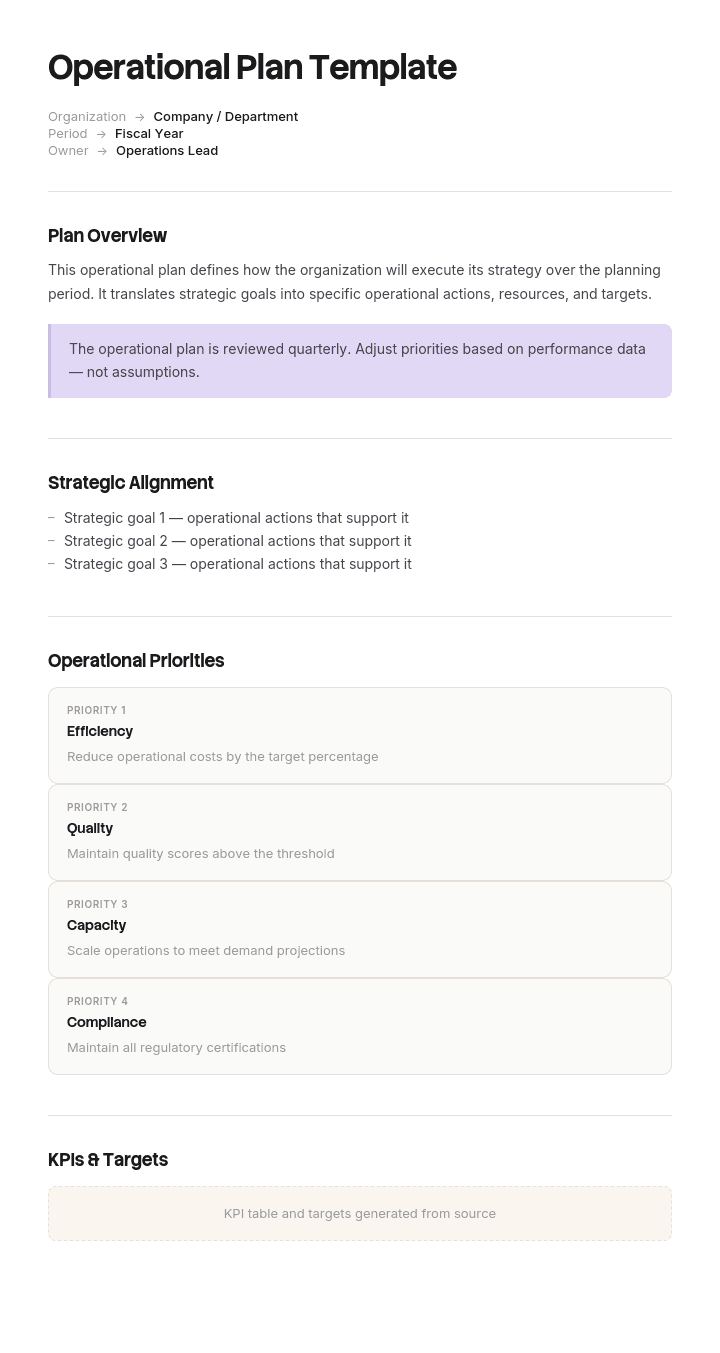
Use this template
An operational plan is the bridge between strategy and execution. With Trupeer, you can save hours on operational planning by starting with a free operational plan template, customizing it with your brand guidelines, and turning the plan into video updates that align teams across functions.
What is an operational template, and what is an operational plan?
An operational plan sets out what a team or function will actually do over a defined period, usually a year, with owners, timescales, resources and measures. It is the layer between strategy, which says where the organisation is going, and the day to day work that gets it there.
An operational template, in the sense people usually mean when they search for one, is the reusable structure for writing that plan. Sections, columns, and the fields each entry needs.
The distinction worth holding onto is that an operational plan is not a project plan and not a strategy. A strategy says what you are trying to achieve and why. A project plan covers one piece of work with a start and an end. An operational plan covers everything a function does in a period, including the work that has no end date at all.
That last part is where most templates fall down.
Why operational plans leave out most of the work
Open almost any operational plan and you will find a list of initiatives. Improve this, launch that, migrate the other. Each with an owner, a date and a benefit.
Now ask what proportion of the function's time those initiatives represent. In most operations it is somewhere between ten and twenty five percent. The rest is the running: the orders processed, the tickets answered, the shifts covered, the audits done, the maintenance performed, the month end closed.
None of that appears in the plan, because it is not new and nobody feels the need to plan it. Everyone knows it happens.
The consequence is that the plan is a list of additions with no statement of what is already committed. Initiatives get approved against capacity that was spoken for before the meeting started, and at year end the function has delivered a fraction of them while running perfectly well, which reads externally as underperformance.
A plan describing only the change is not an operational plan. It is a project portfolio with an operational title.
How to customize this template in Trupeer
Step 1: Open the Templates Section
Go to the Templates section from the main navigation.
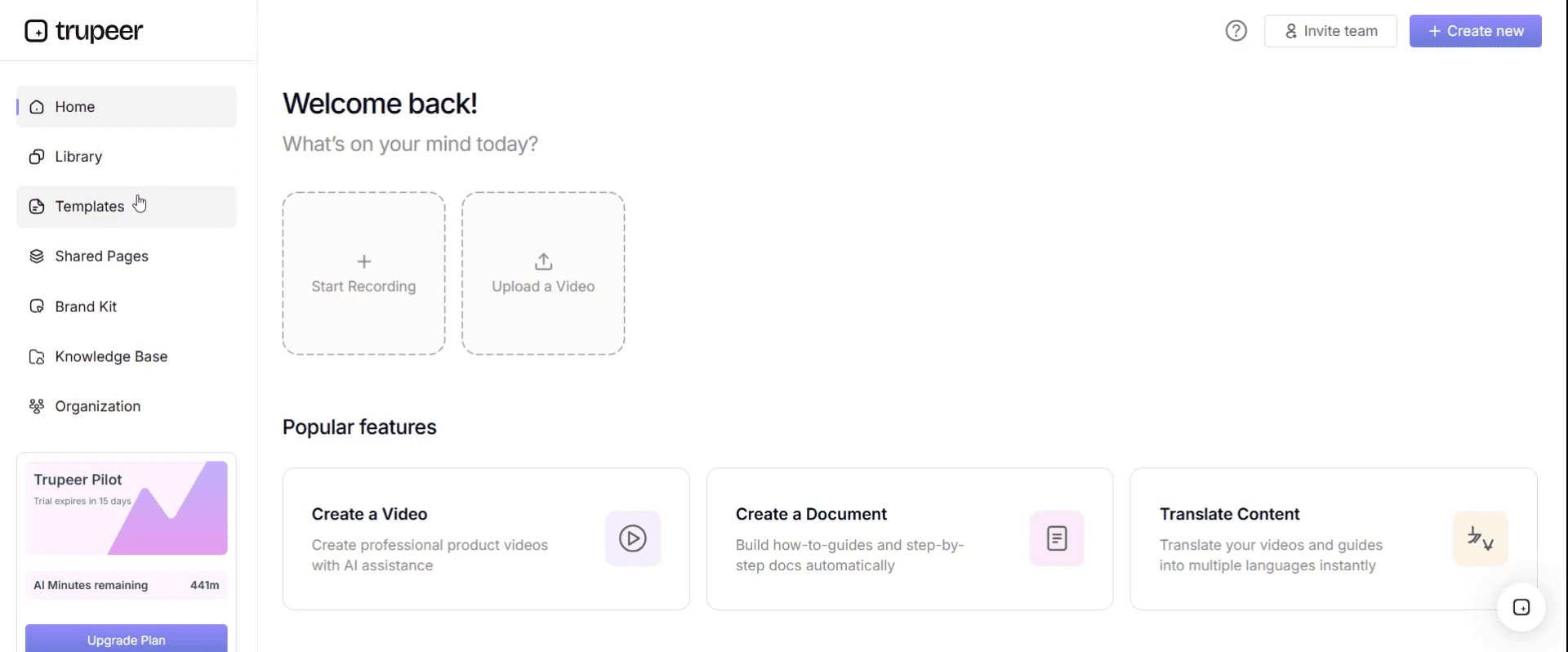
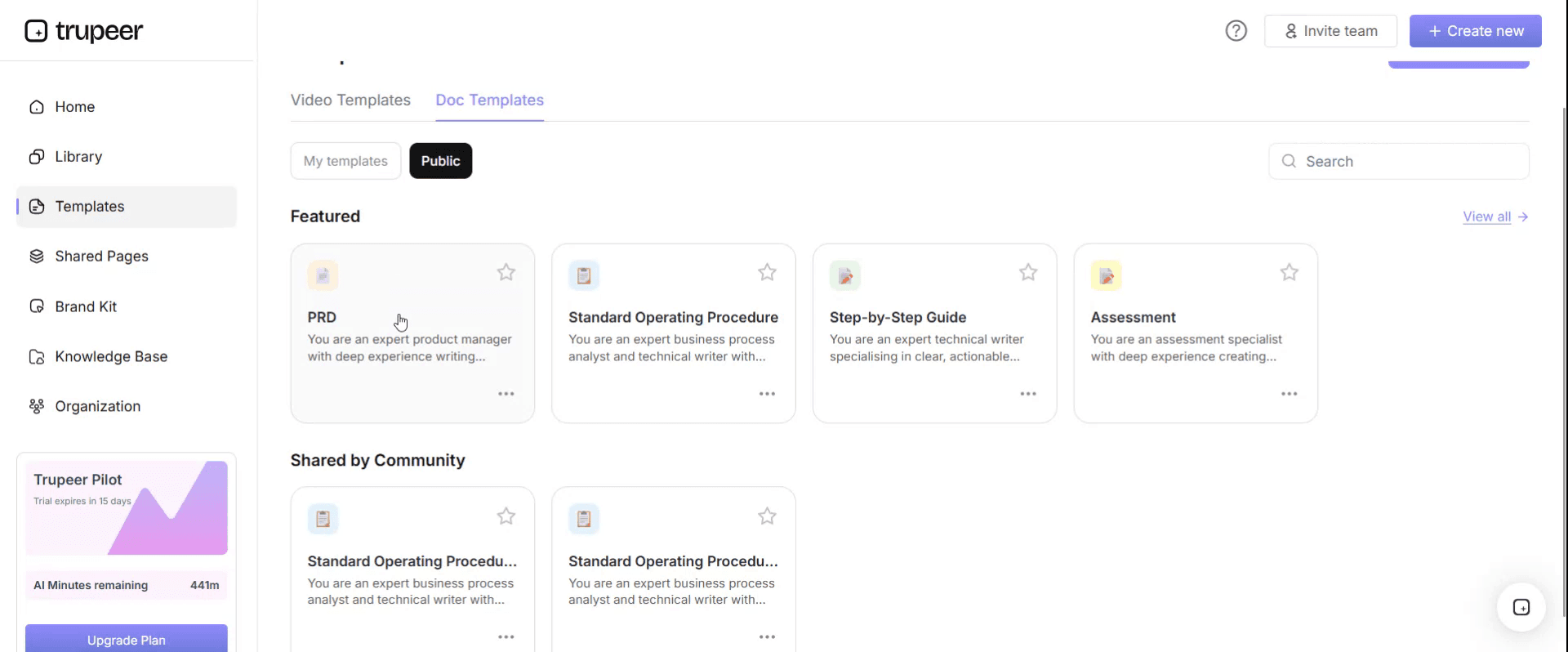
Step 2: Select and Open a Template
Click on any template you want to work with to open it.
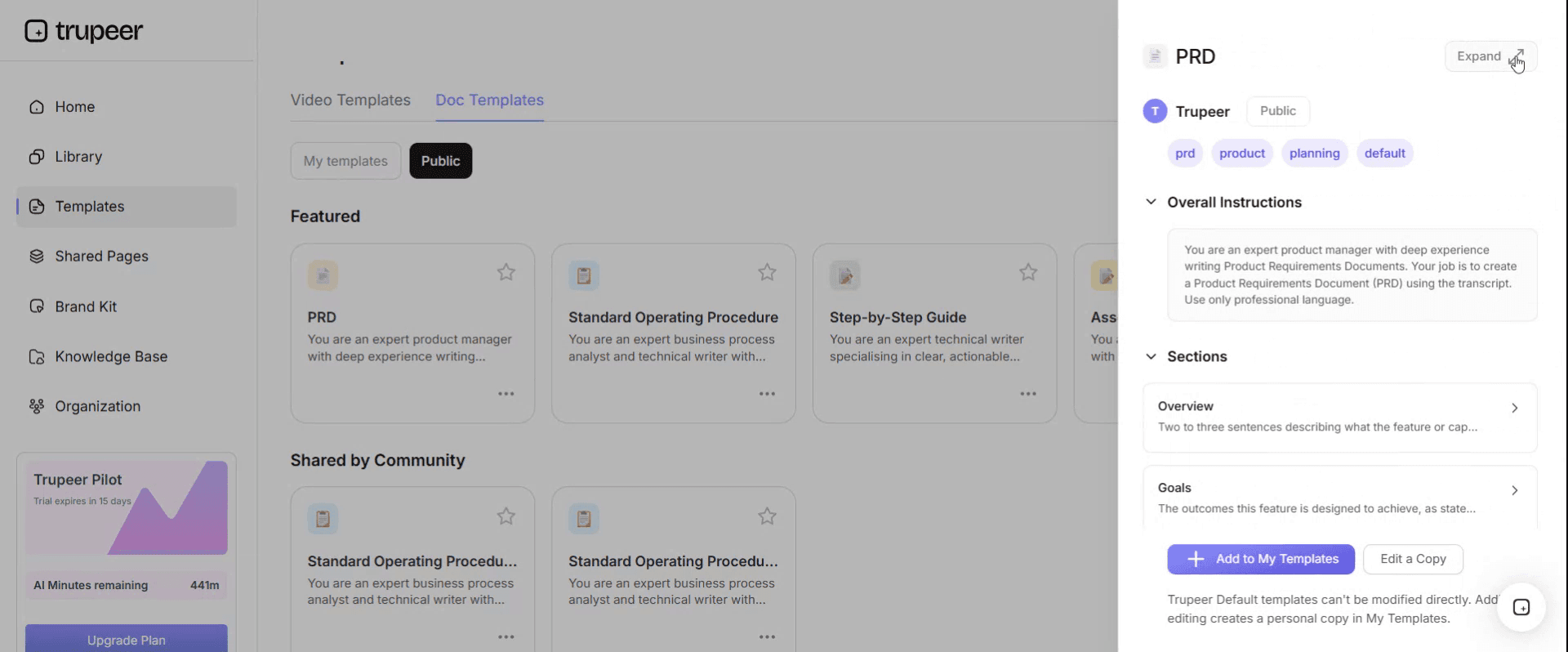
Step 3: Expand the Template View
If needed, expand the template view to see the full layout and details clearly.
Step 4: Edit the Template
Click on Edit to start modifying the selected template.
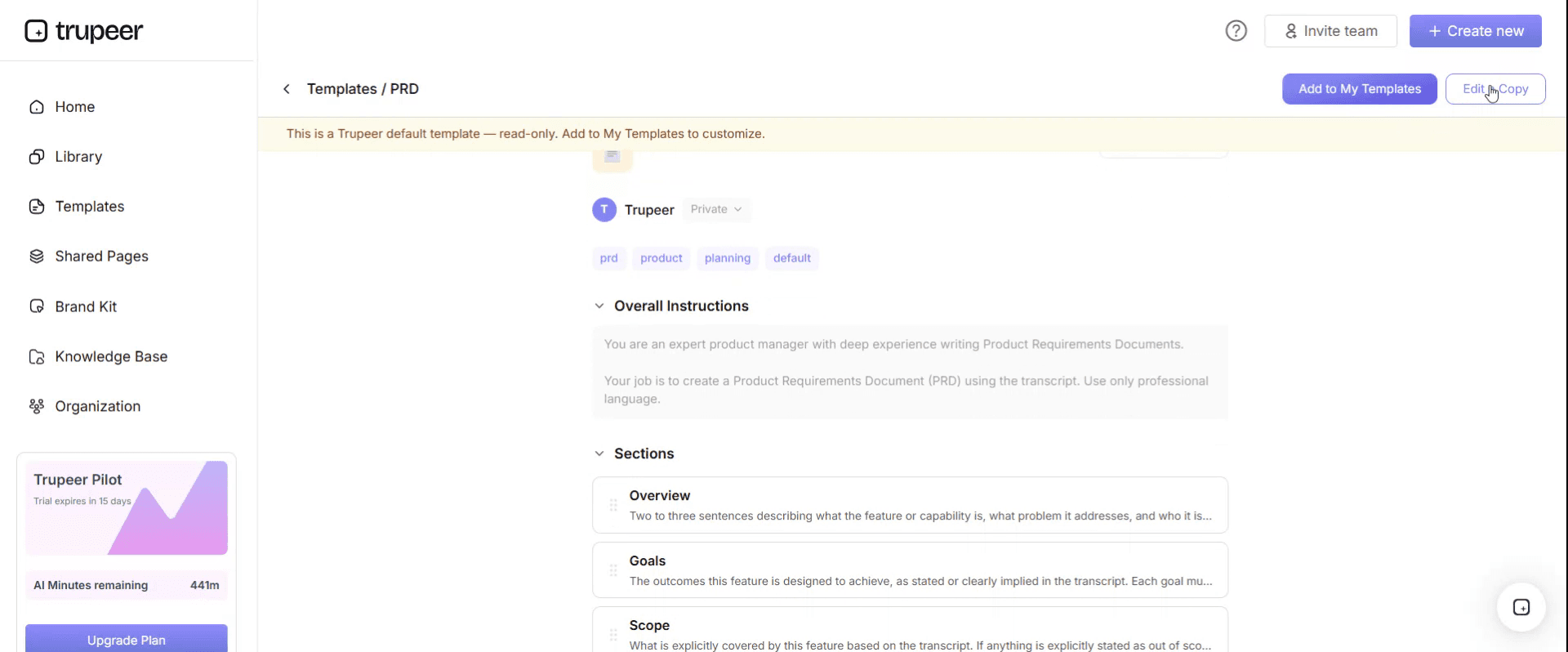
Within the editor, you can:
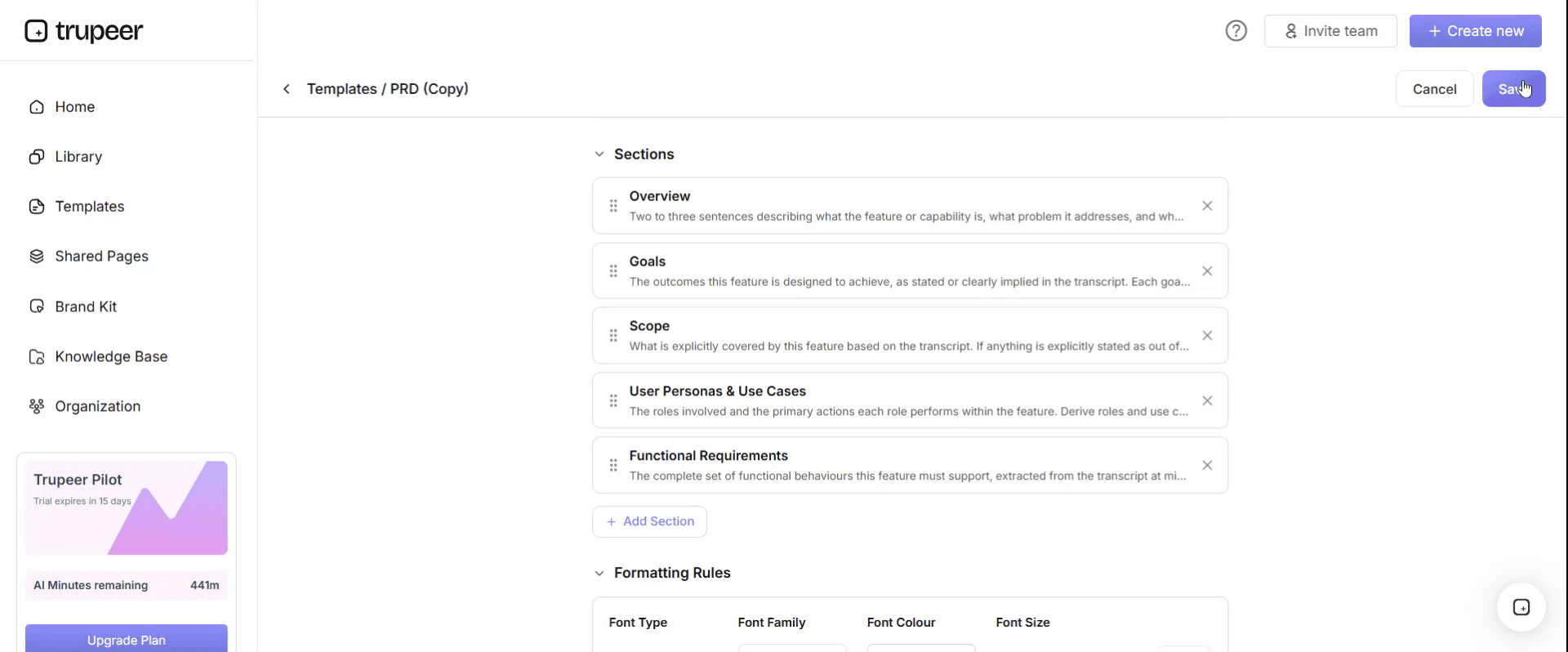
Add new sections
Define or update formatting rules
Add a logo and adjust its position and related settings
Step 5: Save Your Customized Template
After making all necessary changes, click Save to store the updated template as your own.
Step 6: Preview and Fine-Tune the Template
When you want to see how your customized template looks, open the Preview.
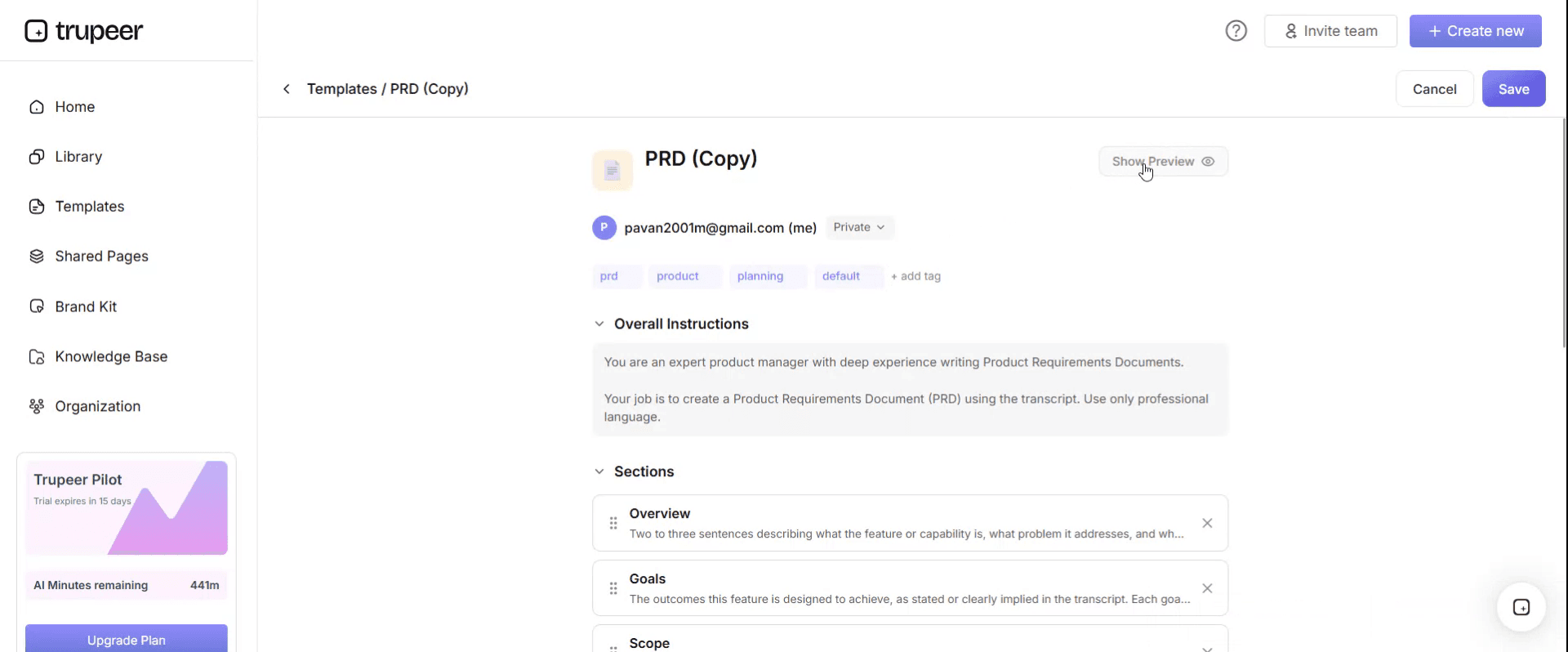
From the preview screen, you can continue to make adjustments directly if needed, ensuring the template appears exactly as you want.
With an operational plan template you can:
Save hours on planning: Skip the blank page with a structure built for operations.
Connect strategy to execution: Built-in fields tie activities to strategic goals.
Stay on-brand: Apply your logo, fonts and colors using Trupeer's brand kit.
Standardize across departments: Use the same template for every operational area.
Track performance: Built-in KPI sections measure whether ops is delivering.
Reach global teams: Translate operational plans into 65+ languages with one click.
The run and change split every operational plan needs
The fix is structural and it costs one extra section.
Run. Every recurring workstream the function is responsible for, with its volume and the effort it consumes. Orders processed per month and the hours that takes. Tickets, shifts, inspections, reports, audits, closes. This section has no end dates because the work does not end.
Change. The initiatives, as most plans already have them, with two fields added: the effort each one needs, and its effect on the run section once it lands.
That second field is the one that changes behaviour. Every initiative does one of three things to running work. It reduces it, which is the best kind and the kind that funds next year. It leaves it unchanged. Or it adds to it, which is common and almost never acknowledged, because a new process, a new report or a new control is recurring work from the day it goes live.
Write the run section first. It is uncomfortable, it takes a week of asking people how their time actually goes, and it is the only way the change section means anything.
How to size change capacity by owner, not in aggregate
Aggregate capacity is misleading and it is how most plans get approved.
If a function of sixty people spends eighty four percent of its time on running work, the arithmetic says roughly ten full time equivalents are available for change. That number is technically true and practically useless, because change work is not spread evenly. It concentrates on a small number of people, usually the team leads and specialists, and those are the same people carrying the heaviest run responsibilities.
So size it by owner instead.
Owner | Run commitment | Time available for change | Initiatives assigned | Hours needed |
|---|---|---|---|---|
Team lead A | 94% | ~110 hours | 11 | ~800 |
Team lead B | 95% | ~90 hours | 9 | ~700 |
Team lead C | 92% | ~140 hours | 8 | ~600 |
Everyone else | 82% | ~9,000 hours | 6 | ~400 |
Build that table before the plan is signed off, not after. The pattern above is extremely common: three people hold most of the initiatives and almost none of the available time, while the capacity that exists sits with people nobody has assigned anything to.
Two fixes follow directly. Move ownership to where the capacity is, which usually means giving initiatives to people who have never owned one and supporting them. And cut the list to what the real owners can carry, which is always a smaller number than the exec expects and a larger number than gets delivered by accident.
Free operational plan template: the structure to copy
Copy from here.
Header. Function or team. Period covered. Owner. Version and date. The two or three organisational objectives this plan supports, in one line each.
Section 1, Run. One row per recurring workstream: what it is, volume per month or year, hours consumed, who covers it, the service standard it is held to, and the main risk if it degrades. Total the hours.
Section 2, Capacity. Total available hours for the period, less the run total, gives available change hours. Then the same calculation for each individual who will own initiatives, which is the number that actually constrains the plan.
Section 3, Change. One row per initiative: what it is, the objective it supports, owner, start and end, estimated hours, dependencies, the measure of success, and the effect on run hours once live, as a plus or minus.
Section 4, Not doing. Initiatives considered and deliberately excluded this period, with a one line reason. This section prevents the same proposal returning every quarter and it makes the capacity constraint visible to whoever asks why something is not happening.
Section 5, Risks and dependencies. Only those that would change the plan, with a trigger and an owner rather than a likelihood score.
Section 6, Review. Dates, and what gets reviewed at each. Run performance monthly, change progress monthly, the whole plan quarterly.
Copy to here. The plan should run to a handful of pages. If it is longer, the usual cause is that initiative descriptions have expanded into mini business cases, which belong in their own documents.
What are the 7 things an operational plan should contain?
The seven that consistently earn their place:
Objectives. What this plan is in service of, taken from the level above rather than invented here.
The running work. Volumes, hours and standards, as above.
Initiatives. What you are adding or changing, with owners and dates.
Resources. People, budget and anything scarce, stated as commitments rather than requests.
Timelines. Real ones, sized against the capacity of the named owner rather than against the calendar.
Measures. How you will know, for both run performance and change delivery. These are different measures and both belong.
Review points. When the plan gets looked at and what gets decided at each.
Most published lists substitute a mission statement, an executive summary or a risk register for one of these. The one nearly always missing is the second, and it is the one that makes the other six honest.
The team with 34 initiatives and 340 spare hours
Calverton Group's customer operations function ran orders, queries and returns for a distribution business with sixty two staff.
Its annual operational plan listed thirty four initiatives. Each had an owner, a target date and a benefit statement. It was well written and the exec approved it without difficulty.
There was no section describing the running work. The function handled around eleven thousand four hundred orders and four thousand two hundred queries a month, which consumed roughly eighty four percent of available hours before anyone touched an initiative.
Twenty eight of the thirty four initiatives had one of three team leads as owner. Those three leads had between six and eight percent of their time uncommitted, which came to roughly three hundred and forty hours between them for the whole year. The initiatives assigned to them were estimated, afterwards, at about two thousand one hundred hours.
At the year end review, seven initiatives were complete, nine were partially delivered and eighteen had not been started.
Two of the seven that did complete made things worse. A revised returns process added about ninety seconds of handling per return. At eight hundred returns a month that is twenty hours a month, or two hundred and forty hours a year of new recurring load, which nobody had counted because there was no run section to add it to.
The exec's reading was that the function had underdelivered. Two of the three team leads left within four months, both citing workload. The following year's draft plan proposed twenty nine initiatives.
The rebuild added the run section and the per owner capacity table. Available change hours were calculated for each of the nine people who could realistically own something, rather than in aggregate. Initiatives were re-scoped to fit, ownership was spread from three people to nine, and eleven were selected totalling around nineteen hundred hours against roughly twenty two hundred available.
Three of the eleven were chosen specifically because they reduced run hours.
At the following year end, nine of the eleven were complete and two had been deliberately deferred at the half year review. Net run hours had fallen by around eleven hundred a year. Nobody left citing workload.
The function did less and delivered more, which is what the arithmetic said would happen.
How to create an operational plan, step by step
Start with the objectives from the level above. If you cannot name them, the operational plan will drift into a list of things the team would like to fix.
Build the run section next, before anything else. Ask each area what they do, how much of it, and roughly how long it takes. A week of asking is enough for numbers good enough to plan with, and precision beyond that adds nothing.
Calculate capacity, in aggregate and then per likely owner. The second number is the constraint.
Now list candidate initiatives without filtering, then attach an owner, an hours estimate and a run impact to each.
Cut to fit the per owner capacity, and record what you cut in the not doing section.
Agree measures for both halves, meaning service standards for run and delivery milestones for change.
Set the review cadence and the first review date before anyone signs it. Plans without a scheduled first review are read once.
What are the 4 types of operational plans?
Four categories cover most of what organisations mean by the term.
Single use plans exist for one specific outcome and then stop. A site opening, a system migration, a seasonal peak. Closer to project plans, and they are often better written as one.
Standing or ongoing plans cover recurring operations and are refreshed periodically rather than completed. This is what most annual operational plans should be and frequently are not.
Functional plans cover one department or function, meaning operations, customer service, production or facilities, and roll up into an organisational plan.
Contingency plans cover what happens if something specific goes wrong: a supply failure, a site becoming unavailable, a demand spike. They sit alongside the main plan rather than inside it.
The categories matter less than noticing which one you are actually writing. Teams routinely set out to write a standing plan and produce a collection of single use ones, which is the same failure as leaving out the run section.
Operational planning vs strategic and tactical planning
Three levels, distinguished by horizon and by who is deciding.
Strategic covers roughly three to five years, is owned by the executive, and answers where the organisation is going and why. It changes rarely and deliberately.
Operational covers a year, is owned by function heads, and answers what this function will run and change in service of the strategy. It is refreshed annually and reviewed quarterly.
Tactical covers weeks to a quarter, is owned by team leads, and answers how the operational plan is actually executed right now. Rotas, sprint plans, weekly priorities.
The most common failure between the levels is a strategy that adds without subtracting, arriving at the operational layer as pure addition. The operational plan is where that gets resolved, which is why the not doing section is not optional. Somebody has to be the one who says the capacity is not there, and if it is not the function head writing this plan, it will not be said at all.
Daily, simple and multi-year operational plan templates
The structure adapts by horizon and by how much apparatus the team can carry.
Simple. One page. Objectives, the run summary as three or four lines, five initiatives with owners, and the not doing list. Suitable for small teams and considerably better than a long plan nobody finishes.
Daily. Not really the same document. A daily operational plan is a tactical instrument: today's volumes, today's staffing, today's exceptions and escalations. Keep it to a board or a single sheet, and let the annual plan set the standards it operates against.
Three and five year. Used mostly in the public and nonprofit sectors where funding cycles are longer. The run section becomes more important rather than less, because five years of assumed volumes is where these plans usually go wrong. State the volume assumptions explicitly and review them annually.
Nonprofit and grant funded. Often required in a funder's format. Write your own version first and map it onto theirs, rather than letting the funder's structure become your plan.
Common operational planning pitfalls and how to avoid them
No run section. Everything else on this page follows from it.
Aggregate capacity. Ten free FTE spread across sixty people is not the same as ten free FTE, and initiative ownership concentrates.
Initiatives with no run impact stated. New processes create recurring work and nobody counts it.
No not doing list. The plan looks like it accommodates everything, so everything keeps being proposed.
Measures only for change. Run performance degrades quietly while everyone watches the initiative tracker.
Annual plan, no cadence. Written in December, read in December, opened again the following December.
Written by the planner, not the doers. Estimates are optimistic and ownership is assumed rather than agreed.
Initiatives that reduce running work are the ones worth protecting when the list gets cut, because they are what creates capacity for next year. Our kaizen method template covers the smaller version of that discipline, where improvements are made and recorded continuously rather than waiting for a planning cycle.
Can I get an operational plan template in Excel or Word?
Excel, for the reason this whole page is about. The run section needs volumes multiplied by handling times, the capacity section needs totals subtracted per person, and the change section needs hours summed against that. All of it is arithmetic that wants to recalculate when a number changes, and none of it survives being maintained by hand.
Build it as three sheets: run, capacity by owner, and change. Add a cell showing change hours committed against change hours available, and colour it. That single cell is the plan's honesty check.
Word for the narrative around it, meaning objectives, the not doing list with reasons, and the risks. Plenty of teams keep a short document with the sheet linked from it, which works well because the two parts have different audiences.
PDF for the version circulated once agreed, exported from the live copy at the point of sign off.
How to keep the run section honest over a year
The run section is accurate on the day it is written and starts drifting immediately, because processes change and every completed initiative alters what running the function involves.
The habit that keeps it true is small. When an initiative goes live, update the run row it affected, in the same week, with the new volume or handling time. That is the moment the number is known and the only moment anyone cares.
Trupeer AI helps because the same moment usually requires the procedure to be updated too, and that is what does not happen. The person who changed the process records the new version once and gets a written procedure with the steps captured, so updating the documentation stops competing with the next thing on the list.
Record it. Brand it. Translate it. Trupeer it.
The recordings become the SOPs and guides your run section refers to, living in your knowledge base in consistent branding. The SOP creator covers the procedures themselves, and our operational manual template covers documenting how the function runs, which is the natural companion to the run section here. Setup instructions are in the document template setup guide.
Frequently Asked Questions
Is there a free operational plan template in Word?
The structure above pastes straight into Word or Google Docs and works for the narrative sections. There is no gated download and no form. Keep the run, capacity and change tables in a spreadsheet and link to them, because those three need to recalculate and a document cannot.
Is there a free operational plan template in Excel?
Excel is the right container for this plan. Three sheets, run, capacity by owner and change, with the committed against available cell as your check. Most teams find that building the capacity sheet changes the plan before it is ever presented, which is the point of building it first.
Is there a free operational plan template in PDF?
Export the agreed version at sign off and circulate that, keeping the working copy editable. The change section will move at every quarterly review, and a frozen plan quietly becomes a record of what you intended in January rather than what you are doing.
Where can I find a sample operational plan in PDF?
Published samples are easy to find and are worth reading for section order rather than content, since the volumes and initiatives in any real plan belong to one organisation. The more useful exercise is to write your own run section for one team, which takes a week and tells you more than any sample will.
Who should own the operational plan?
The head of the function it covers, not a planning or PMO function. The owner has to be someone who can decline an initiative on capacity grounds, and that is a line management decision rather than an administrative one. A plan owned by a coordinator becomes a tracker.
How long should an operational plan be?
A handful of pages plus the spreadsheet. Longer usually means initiative descriptions have grown into business cases, which belong in their own documents with the plan referencing them. For a small team, one page plus one sheet is genuinely enough.
How often should the operational plan be reviewed?
Run performance monthly, change progress monthly, and the whole plan quarterly with the capacity numbers recalculated. The quarterly review is where initiatives get deferred deliberately rather than by attrition, which is the difference between a plan that adapts and one that is quietly abandoned.
What is the difference between an operational plan and a project plan?
A project plan covers one piece of work with a defined start, end and deliverable. An operational plan covers everything a function does across a period, including recurring work that never ends. Projects appear inside an operational plan as rows in the change section, with their own plans held separately.