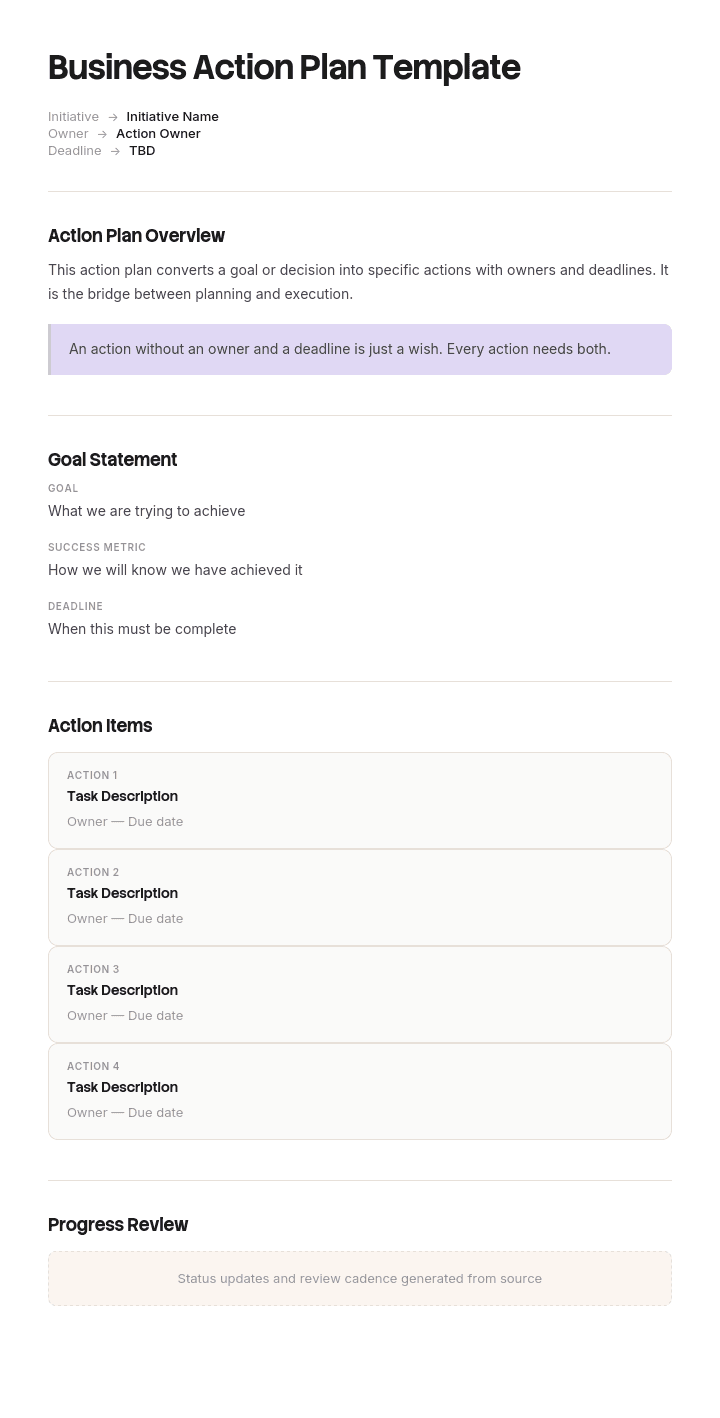
Use this template
Strategy without action is just a document. With Trupeer, you can save hours on action planning by starting with a free business action plan template, customizing it with your brand guidelines, and turning the plan into video updates that drive accountability across teams.
Most business plans die in a folder. The strategy is sound, the market analysis is thorough, and then nothing happens on Monday because nobody translated it into work with names and dates on it.
A business action plan is that translation. It takes each business objective and breaks it into initiatives, then into actions with an owner, a deadline, a budget and a number that says whether it worked.
Download the business action plan template
Format | Best for |
|---|---|
Excel (.xlsx) | The working plan. Filter by owner, sort by date, total the budget column |
Word (.docx) | The narrative version for stakeholders, lenders and board packs |
PowerPoint (.pptx) | Presenting the plan by objective to leadership or investors |
Google Sheets | Live tracking across a team |
The approved version, and printing |
Free download, editable, no watermark.
How a business action plan is structured
This is what separates it from a standalone action plan. A business action plan cascades, so every action traces back to a business goal.
Business goal → the outcome for the year. "Grow revenue from £2m to £3m."
Objective → the measurable contributor. "Add £600k from new customers, £400k from existing accounts."
Initiative → the body of work. "Launch outbound sales motion." "Build an expansion play for top 20 accounts."
Action → the individual step with an owner and a date. "Hire two SDRs by 30 September."
Four levels. If an action doesn't ladder up to a goal, it's busywork with a deadline. If a goal has no actions beneath it, it's an aspiration. Most failing plans have one problem or the other, and the cascade makes both visible immediately.
How to customize this template in Trupeer
Step 1: Open the Templates Section
Go to the Templates section from the main navigation.
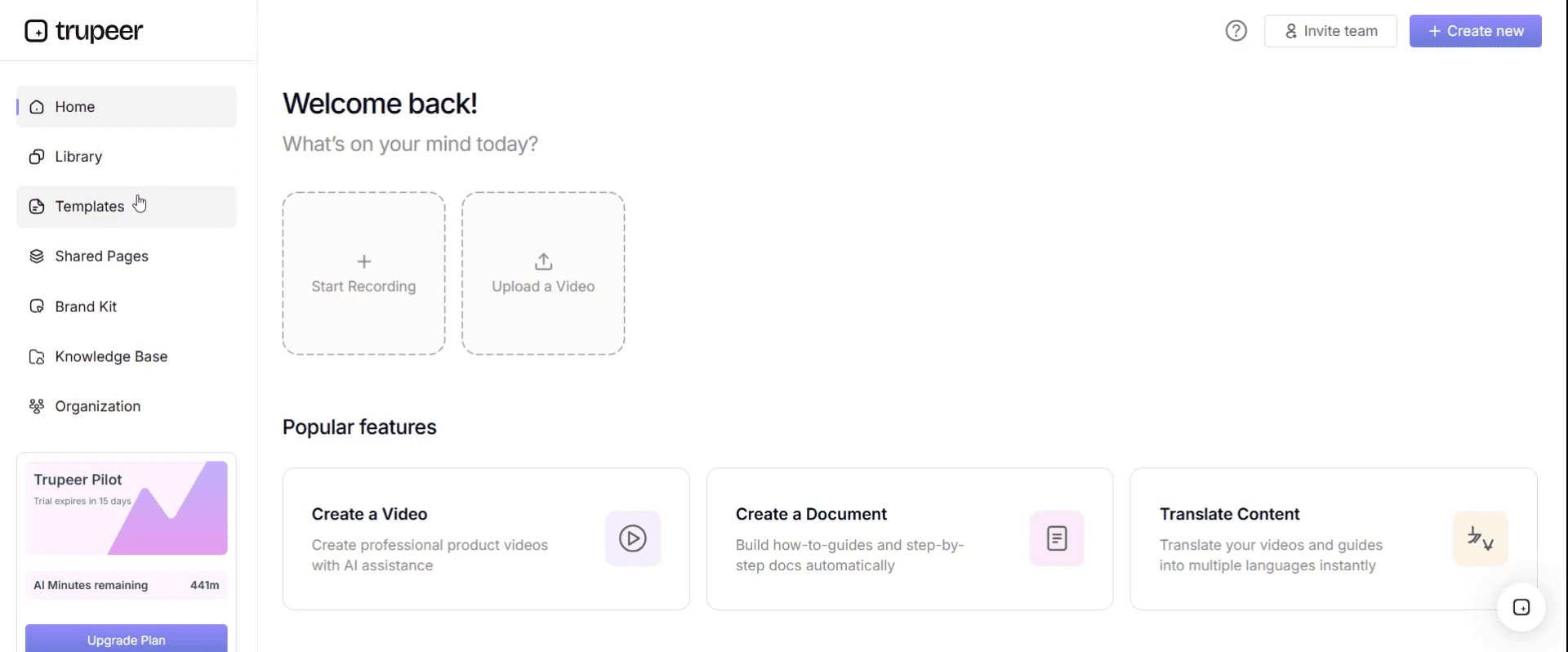
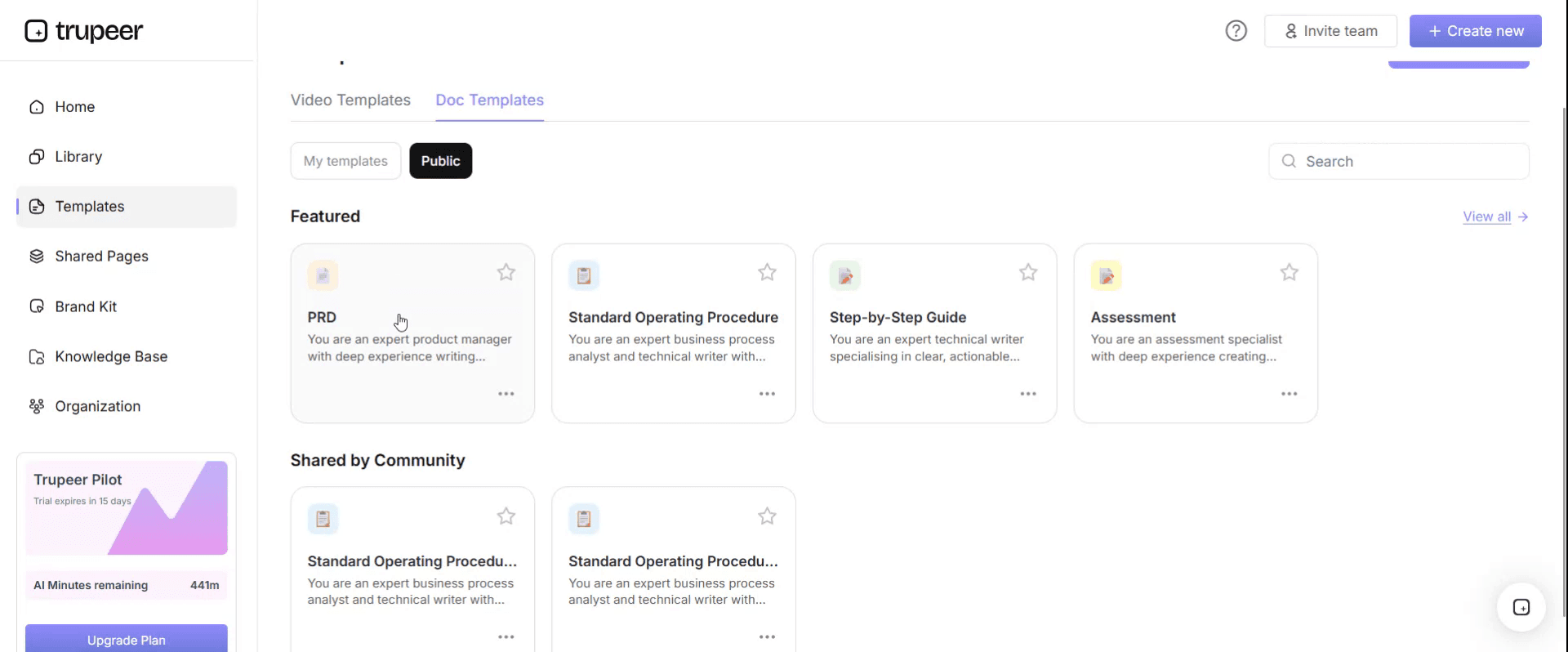
Step 2: Select and Open a Template
Click on any template you want to work with to open it.
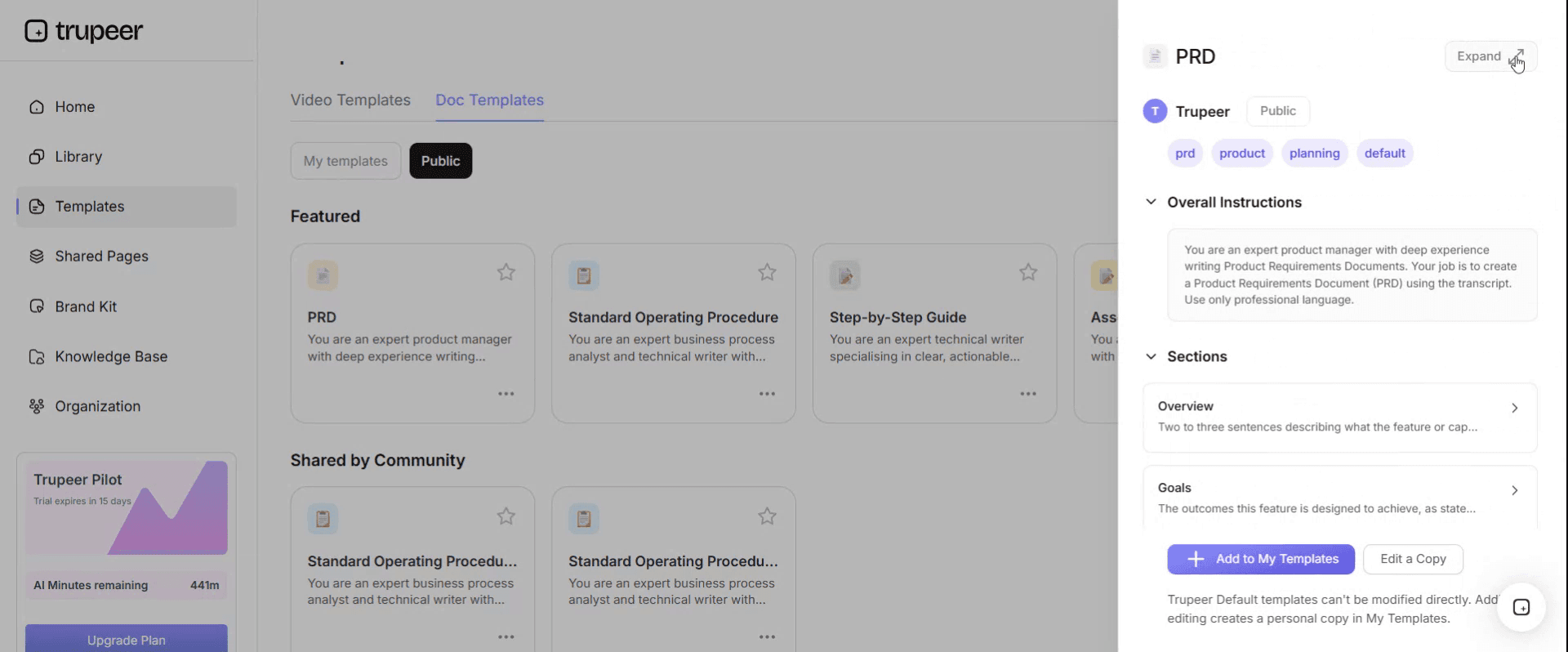
Step 3: Expand the Template View
If needed, expand the template view to see the full layout and details clearly.
Step 4: Edit the Template
Click on Edit to start modifying the selected template.
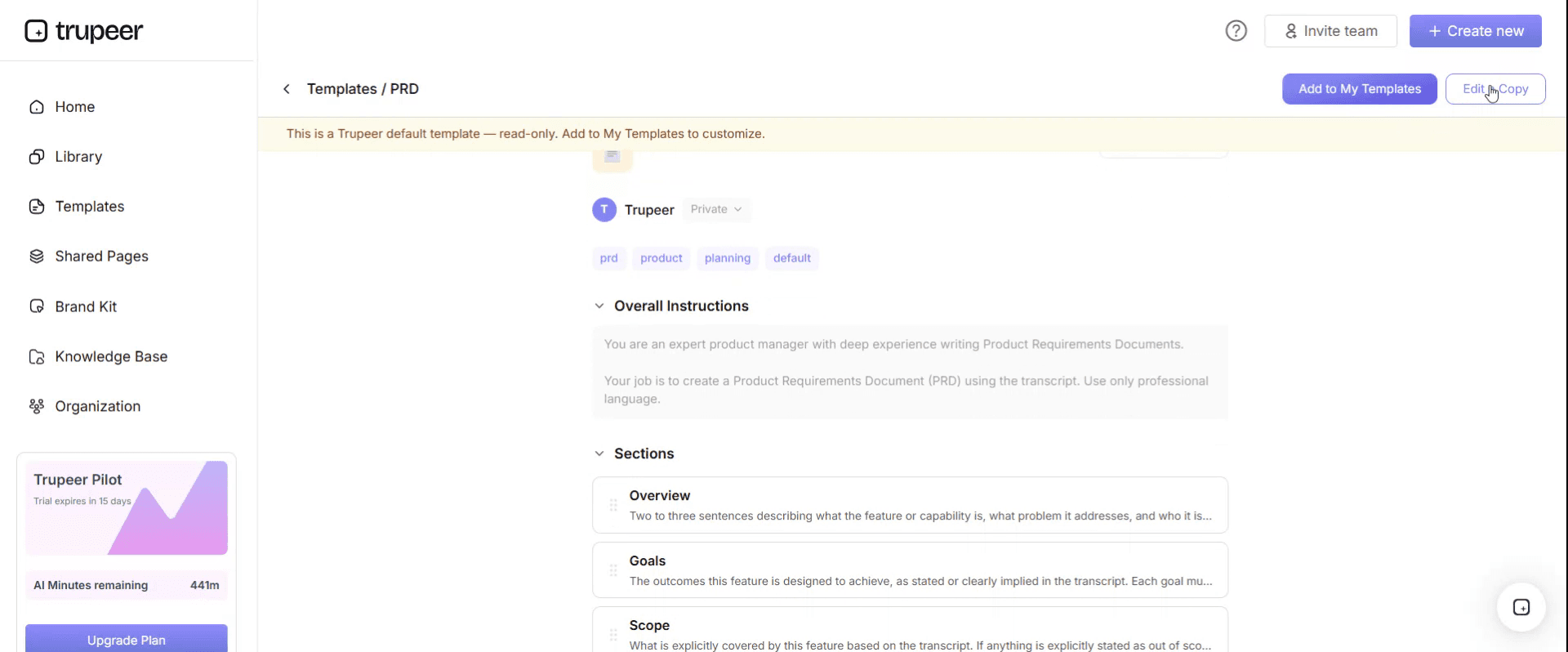
Within the editor, you can:
Add new sections
Define or update formatting rules
Add a logo and adjust its position and related settings
Step 5: Save Your Customized Template
After making all necessary changes, click Save to store the updated template as your own.
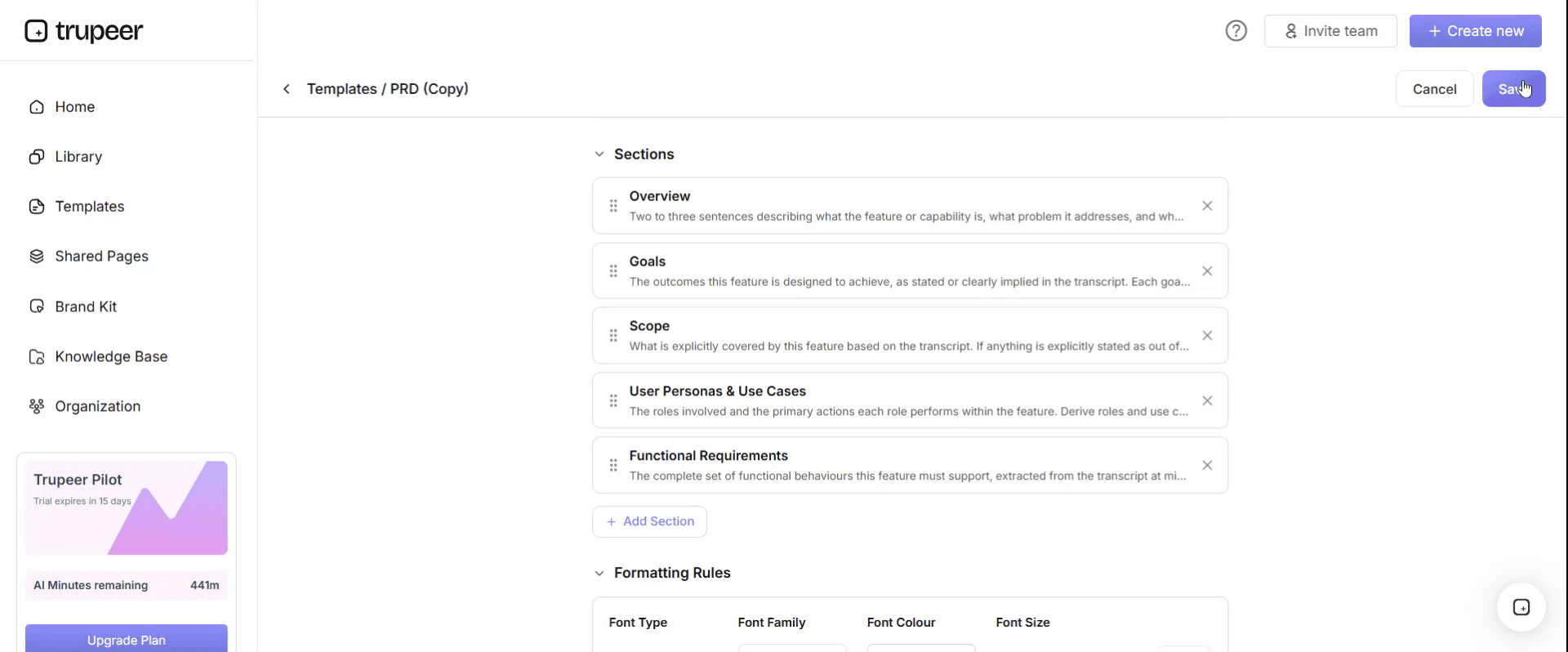
Step 6: Preview and Fine-Tune the Template
When you want to see how your customized template looks, open the Preview.
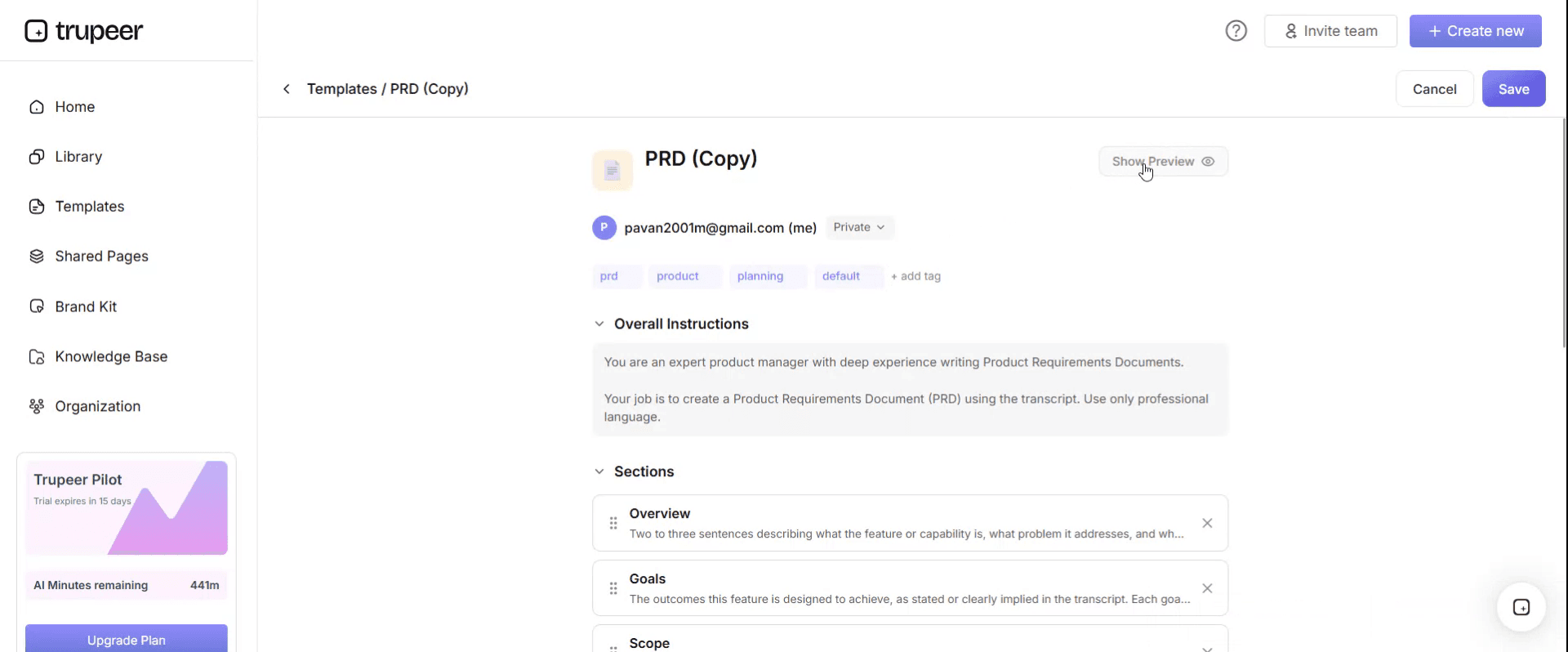
From the preview screen, you can continue to make adjustments directly if needed, ensuring the template appears exactly as you want.
With a business action plan template you can:
Save hours on planning: Skip the blank page with a structure built for execution.
Drive accountability: Built-in fields for owners, deadlines and metrics.
Stay on-brand: Apply your logo, fonts and colors using Trupeer's brand kit.
Communicate clearly: Convert plans into video updates teams can absorb fast.
Standardize execution: Use the same template for every strategic initiative.
Reach global teams: Translate action plans into 65+ languages with one click.
A great business action plan turns strategy into results. Use this template to bridge the gap between what's planned and what gets done.
The business action plan template
Business goal | Objective | Initiative | Action | Owner | Start | Due | Budget | Resources | KPI | Status |
|---|---|---|---|---|---|---|---|---|---|---|
Group rows by objective so the plan reads top-down. The budget column is what makes this a business plan rather than a task list, and it's the column most templates omit.
Filled-in business action plan example
A services business growing from £2m to £3m over twelve months.
Business goal: Increase annual revenue from £2m to £3m by 31 December.
Objective | Action | Owner | Due | Budget | KPI | Status |
|---|---|---|---|---|---|---|
£600k new customer revenue | Hire two SDRs | Sales director | 30 Sep | £95k | Both in seat and ramped by 31 Oct | In progress |
Build outbound sequence for top segment | Sales director | 15 Oct | £4k tooling | 15% reply rate | Not started | |
Launch paid search on three service lines | Marketing lead | 1 Oct | £60k | Cost per qualified lead under £250 | Not started | |
Publish six case studies | Marketing lead | 30 Nov | £9k | 2 used in every deal | In progress | |
£400k expansion revenue | Map top 20 accounts for expansion | Account director | 12 Sep | None | All 20 scored, opportunities named | Done |
Build expansion offer and pricing | Commercial lead | 30 Sep | None | Approved by finance | In progress | |
Run quarterly reviews with all 20 | Account director | Ongoing | £6k travel | 100% completion rate | In progress | |
Protect 92% retention | Formalise onboarding process | Ops lead | 31 Aug | None | Time to first value under 30 days | Done |
Introduce health scoring | Ops lead | 15 Oct | £8k tooling | All accounts scored monthly | Not started | |
Hold gross margin at 45% | Review delivery utilisation monthly | Finance | Ongoing | None | Utilisation above 75% | In progress |
Renegotiate two supplier contracts | Finance | 30 Nov | None | 8% cost reduction | Not started |
Total budget: £182k. Review cadence: monthly against KPI column, quarterly against objectives.
Notice that every action has a cost or explicitly says none. A plan without a budget column produces commitments nobody funded, which is the most common way business action plans quietly stall.
The 4 key elements of an action plan
Every workable action plan has four, and a row missing any one of them will not get done.
The action. One specific, verifiable step. Not "improve sales" but "hire two SDRs."
The owner. One named person. Not a team, not a department.
The deadline. A date, not a quarter.
The measure. How you'll know it worked, decided before you start.
That's the minimum viable row. Everything else on the template, budget, resources, status, dependencies, makes the plan easier to manage but those four make it a plan at all.
The 5 areas a business action plan covers
Broader than the four elements above, these are the sections the document itself needs.
Goals and objectives. What the business is trying to achieve, expressed as numbers.
Actions and initiatives. The work that delivers each objective, sequenced.
Responsibilities. Who owns each action and who approves it.
Timeline and milestones. Dates, dependencies and the checkpoints between them.
Resources and measurement. Budget, people and tools required, plus the KPIs and the review cadence.
Some frameworks split resources and measurement into separate areas, giving six. The substance is the same. What matters is that measurement is present at all, because it's the area most often skipped and the reason plans get judged on effort rather than results.
How to create a business action plan in 7 steps
Start from the business goal, expressed as a number. If you can't put a figure on it, you're not ready to plan. "Grow revenue to £3m" works. "Grow the business" doesn't.
Break the goal into two to four objectives. Each with its own number, and the numbers should add up to the goal.
Involve the people who'll do the work. Plans written alone by the owner or the leadership team get quietly ignored. The people closest to the work also know which actions are impossible, which is information you want now rather than in month four.
List concrete actions under each objective. One verb, one owner, one date. If an action needs a paragraph to explain, break it down further.
Attach budget and resources to every action. This is the step that separates a business action plan from a wish list. An unfunded action is not planned.
Set the measurement and the review rhythm. A KPI per action where possible, monthly reviews, quarterly against objectives. Decide the review day before you start.
Communicate it, then keep it alive. Share it with everyone whose work appears in it, and revisit it on the cadence you set. A plan reviewed once at year end is a document, not a management tool.
The seventh step is where most plans fail. Not in the writing.
Business action plan vs business plan
Different documents for different audiences, frequently confused.
Business plan | Business action plan | |
|---|---|---|
Purpose | Explain the business and its strategy | Execute the strategy |
Audience | Lenders, investors, board | The team doing the work |
Horizon | Three to five years | Three to twelve months |
Contains | Market analysis, financials, projections | Actions, owners, dates, budget, KPIs |
Updated | Annually or when raising | Monthly |
Length | 20 to 40 pages | One to three pages |
The 7 steps of a business plan, since this is the related question people ask: executive summary, company description, market analysis, organisation and management, products and services, marketing and sales strategy, and financial projections. Some versions add a funding request and an appendix, giving nine sections. Either way, the business plan explains and the action plan delivers. If you need the former, start with the business plan template or the one-page business plan template.
Small business action plan
Smaller businesses need a shorter version, and the usual mistake is copying an enterprise structure that nobody has time to maintain.
One goal, not five. A ten-person business pursuing five strategic goals is pursuing none of them.
Keep it to one page. If it doesn't fit, cut actions rather than shrinking the font.
Owner is often the same person. That's fine, but it makes capacity the binding constraint, so check the date column for weeks where one person owns four things.
Budget in cash, not percentages. Small businesses plan against cash flow, so put real numbers in.
Review monthly, not quarterly. Things move faster and there's less margin for a bad quarter.
Include the founder's own actions. They're usually the bottleneck and usually undocumented.
Types of business action plan templates
Template | Use it for | Fields that become essential |
|---|---|---|
Business action plan | Executing annual business objectives | Business goal, objective, budget, KPI |
Small business action plan | Owner-managed businesses | Cash budget, single-owner capacity |
Growth action plan | Revenue and expansion targets | Revenue objective, channel, cost of acquisition |
Strategic action plan | Leadership execution of a strategy | Strategic objective, quarterly milestone |
Operational action plan | Improving day-to-day operations | Process, current versus target performance |
Startup action plan | Pre and early revenue | Milestone, runway impact, validation measure |
Marketing action plan | Campaign and channel execution | Channel, budget, KPI, result |
Sales action plan | Territory, quota and pipeline | Target, activity metric, review cadence |
Corrective action plan | Fixing an underperforming area | Root cause, verification, closure date |
Turnaround action plan | Recovering a struggling business | Cash impact, timeframe, decision point |
Keeping the plan alive
Review on a fixed day. Monthly against actions, quarterly against objectives. A plan with no scheduled review has no owner in practice.
Update status in the plan, not in a separate deck. Two versions of the truth means neither is trusted.
Change dates openly and note why. Silent slippage is what makes people stop believing the plan.
Watch the budget column. Actions with no funding attached are the first to disappear.
Kill actions that stopped mattering. A plan that only grows becomes noise.
Report progress to everyone in it. People who see their row moving stay engaged with it.
Common mistakes
Objectives that don't add up to the goal. Three objectives worth £700k against a £1m target means the plan cannot succeed as written.
No budget column. Produces commitments nobody funded.
Actions without owners. The most common single failure.
Written without the team. Guarantees the impossible actions stay in.
Quarters instead of dates. "Q3" means the last week of September to most people.
No review cadence. The plan becomes a record of intentions.
Copying an enterprise structure into a ten-person business. Overhead nobody maintains.
Confusing it with the business plan. Different audience, different document, different length.
Turn the plan into something the team acts on
Open the template in Trupeer AI, apply your brand kit so the plan matches your board packs and internal docs, and edit any section directly. Setup is in the template guide.
Then close the gap between the plan and the doing. Rows like "formalise onboarding process" stall because nobody knows what the new process actually is. Record it once and Trupeer AI produces the written procedure and a narrated video walkthrough together, so the action arrives with instructions attached. Translate it into 65+ languages if your team spans markets, and keep the set in your knowledge base so the current version is the only one people find.
Record it. Brand it. Translate it. Trupeer it.
Frequently Asked Questions
How do you create a business action plan?
Start from a business goal expressed as a number, break it into two to four measurable objectives, list concrete actions under each with one owner and one date, attach budget and resources to every action, set the KPIs and the review rhythm, then share it with everyone whose work appears in it and review it monthly.
What are the 5 areas of an action plan?
Goals and objectives, actions and initiatives, responsibilities, timeline and milestones, and resources and measurement. Some frameworks separate resources from measurement to give six areas. Measurement is the one most often left out and the one that determines whether the plan can be assessed.
What are the 4 key elements of an action plan?
The action, the owner, the deadline and the measure. A row missing any one of those four will not reliably get done.
What are the 7 steps of a business plan?
Executive summary, company description, market analysis, organisation and management, products and services, marketing and sales strategy, and financial projections. Longer versions add a funding request and an appendix. Note this is the business plan, which explains the business. The action plan is the shorter document that executes it.
Is there a business action plan template for Excel?
Yes, and it's the version most teams work from. Excel lets you filter by owner, sort by due date and total the budget column, which matters because budget is what separates a business action plan from a task list.
Is there a business action plan template in Word?
Yes. Word suits the narrative version, the one that goes into a board pack or to a lender, where objectives and reasoning need to be read rather than filtered.
Is there a business action plan template PPT?
Yes. The PowerPoint version splits the plan by objective across slides, which is the right format for presenting to leadership or investors rather than managing week to week.
Is there a business action plan template PDF?
Yes. The PDF is the approved, circulated version and prints cleanly on one page for planning sessions.
Can I download a business action plan template in Word for free?
Yes. Every format is a free download, editable, with no watermark and no account required.
Is there a free downloadable action plan template for Excel?
Yes. The general action plan template is available in Excel with conditional formatting and a status dropdown already applied. Use that one when the plan doesn't need to cascade from a business goal.
Is there an action plan template in Word?
Yes, both the business version on this page and the general action plan template come in Word.
What's the difference between a business action plan and a business plan?
A business plan explains the business and its strategy for lenders, investors and the board, usually over three to five years and 20 to 40 pages. A business action plan executes that strategy over three to twelve months in one to three pages, with owners, dates, budgets and KPIs.
How long should a business action plan be?
One to three pages. If it runs longer, you have too many objectives rather than a document problem. Enterprise plans get longer, but the discipline of fitting the current quarter on one page is worth keeping regardless of size.
How often should a business action plan be reviewed?
Monthly against actions and quarterly against objectives. Small businesses should review monthly at minimum, since there's less room to absorb a bad quarter.
Who should write the business action plan?
The business owner or leadership sets the goal and objectives. The people who'll do the work should write the actions, because they know what's achievable and where the dependencies are. Plans written entirely top-down keep the impossible actions in.
Can I customize this business action plan template?
Yes. Every version is fully editable. Add or remove columns to match how you operate. In Trupeer AI you can also apply your brand kit so the plan matches your other business documents automatically.


