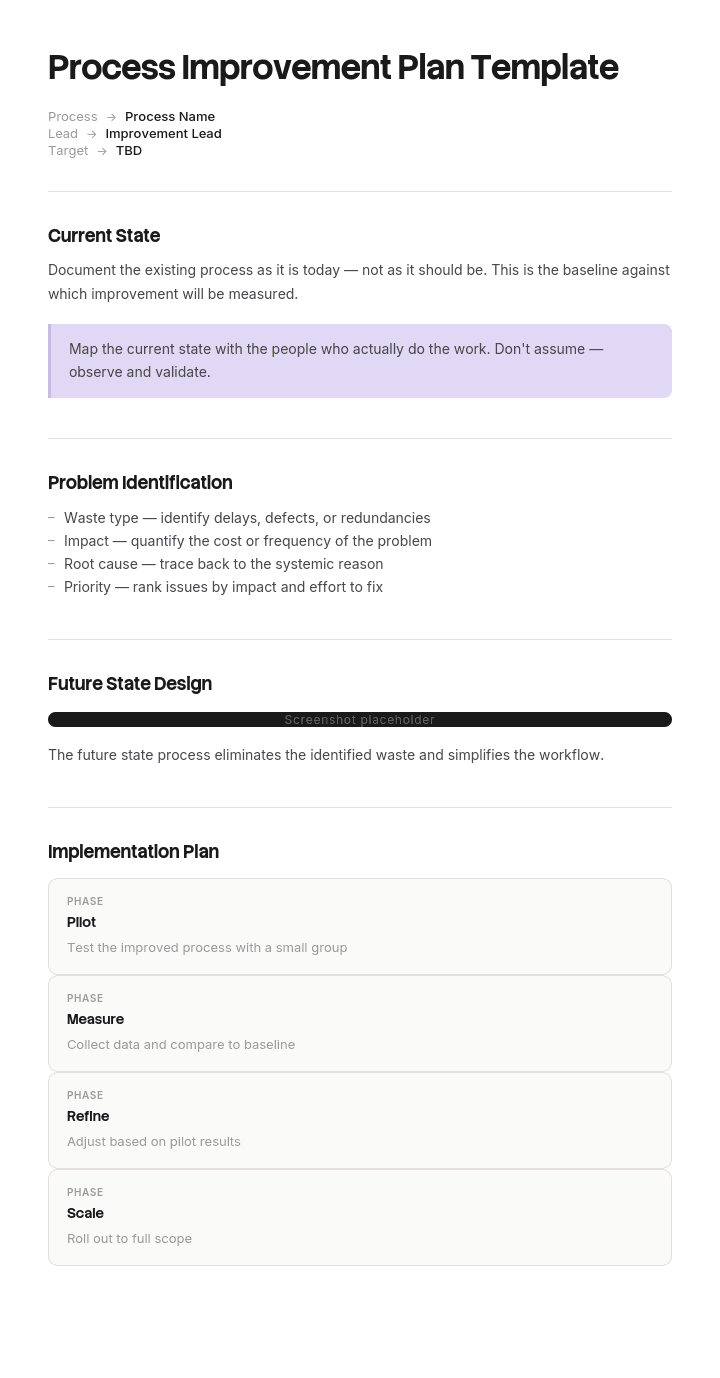
Use this template
Continuous improvement is what separates the best operators from the rest. With Trupeer, you can save hours on improvement planning by starting with a free process improvement plan template, customizing it with your brand guidelines, and turning improvement plans into video updates that drive adoption across teams.
What is a process improvement plan template?
A process improvement plan sets out what is wrong with a process, what will change, who will do it, by when, and how you will know whether it worked.
It is forward-looking, which distinguishes it from the record you produce afterwards. Our process improvement documentation templates cover that half, meaning the report, the register and the dependencies. This page covers the plan you write before anything changes.
A template for it gives you the sections: problem, current state, root cause, proposed change, benefits, timeline, owners, measures. Every version you will find offers roughly those, and they are the right sections.
What they miss is that a process improvement is not a project with a start and an end. It is a change made to something that has to keep working throughout, which is a materially harder problem and the one most plans are silent about.
Why a process improvement plan cannot stop the process
A project plan can assume a clean sequence. Build the thing, test it, release it. A process improvement plan cannot, because the work does not pause while you improve it.
On the day you switch, there is a queue. There are items part way through under the old method, customers who have not adopted the new one, staff at different points on the learning curve, and two sets of instructions in circulation.
That period is where improvements are lost. The design is usually sound. The benefits case is usually reasonable. What consumes the benefit is the weeks of running two methods at once, unplanned and unstaffed, with quality dipping precisely because everyone is doing something unfamiliar while also handling the residue of the old way.
The measure you are trying to improve almost always gets worse first. If nobody has planned for that, the improvement gets judged during its worst period and either abandoned or quietly reverted, which is a common and avoidable outcome.
How to customize this template in Trupeer
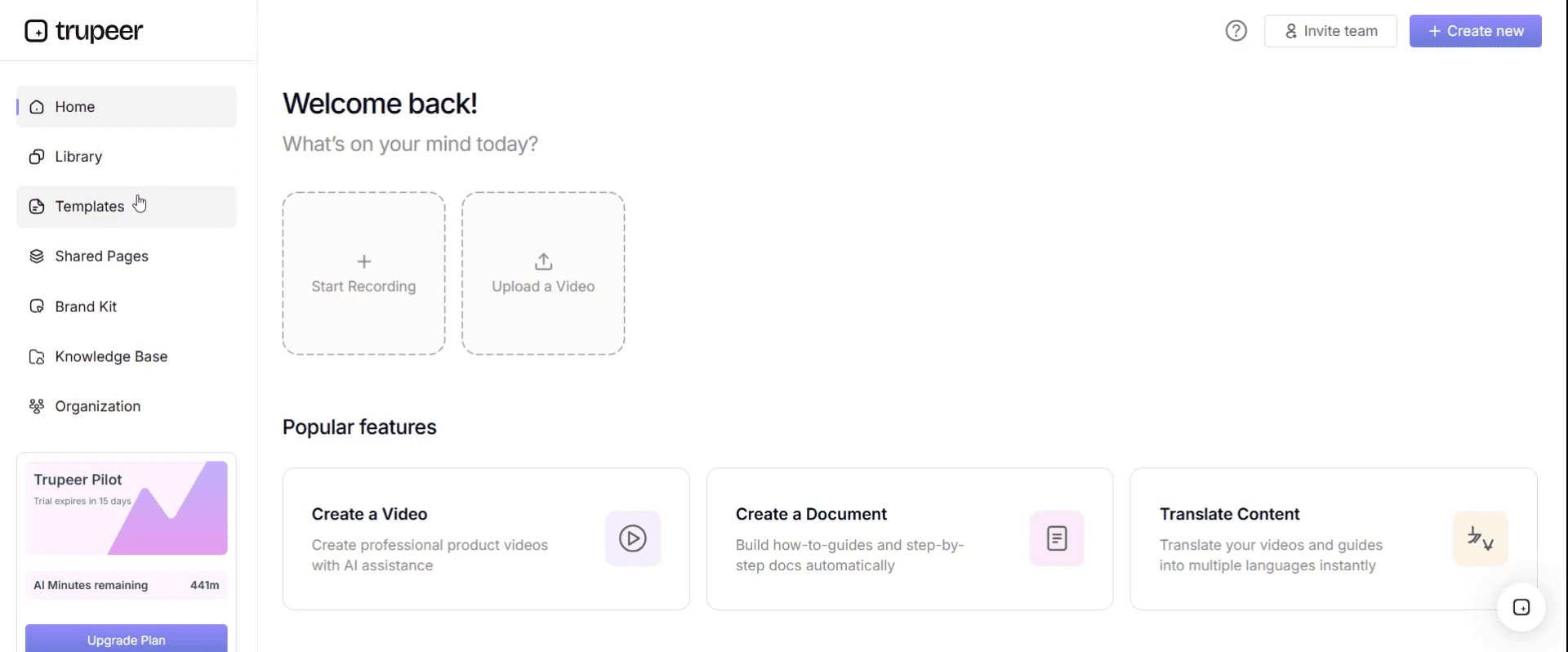
Step 1: Open the Templates Section
Go to the Templates section from the main navigation.
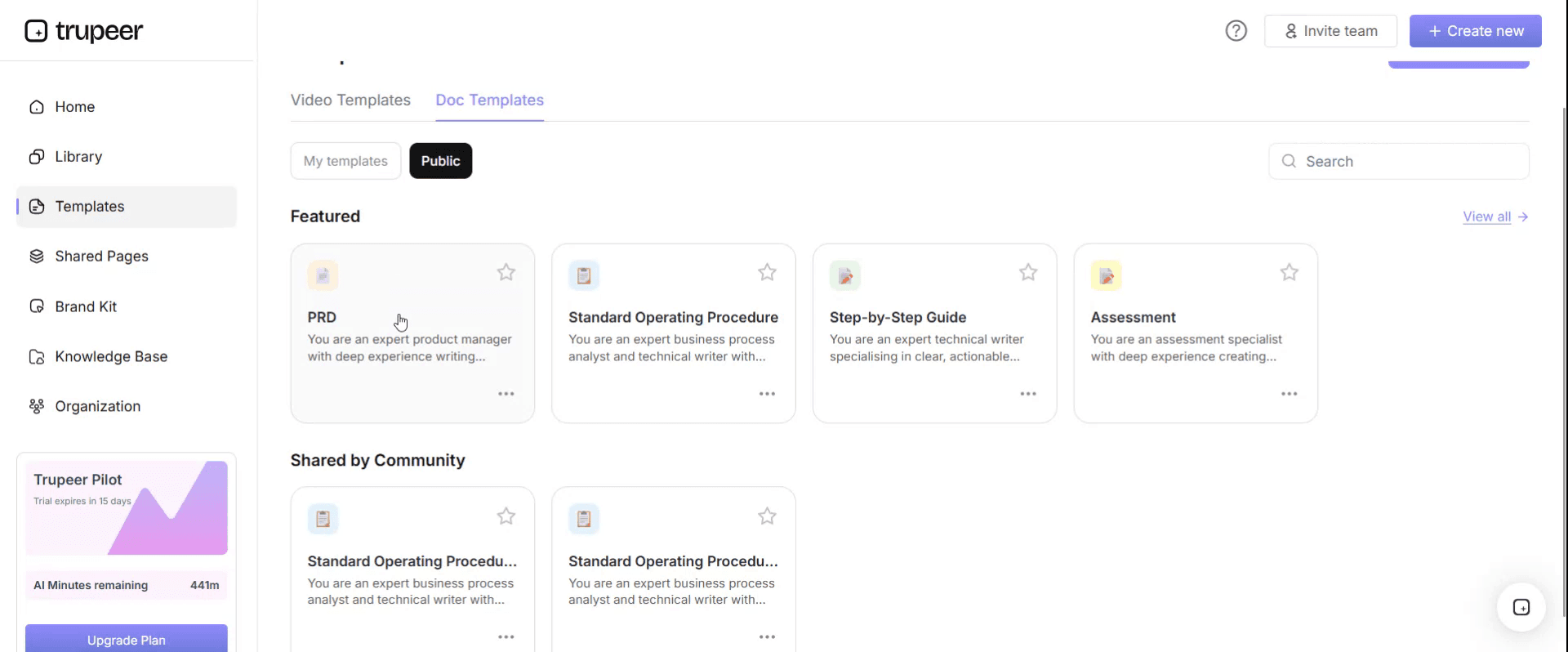
Step 2: Select and Open a Template
Click on any template you want to work with to open it.
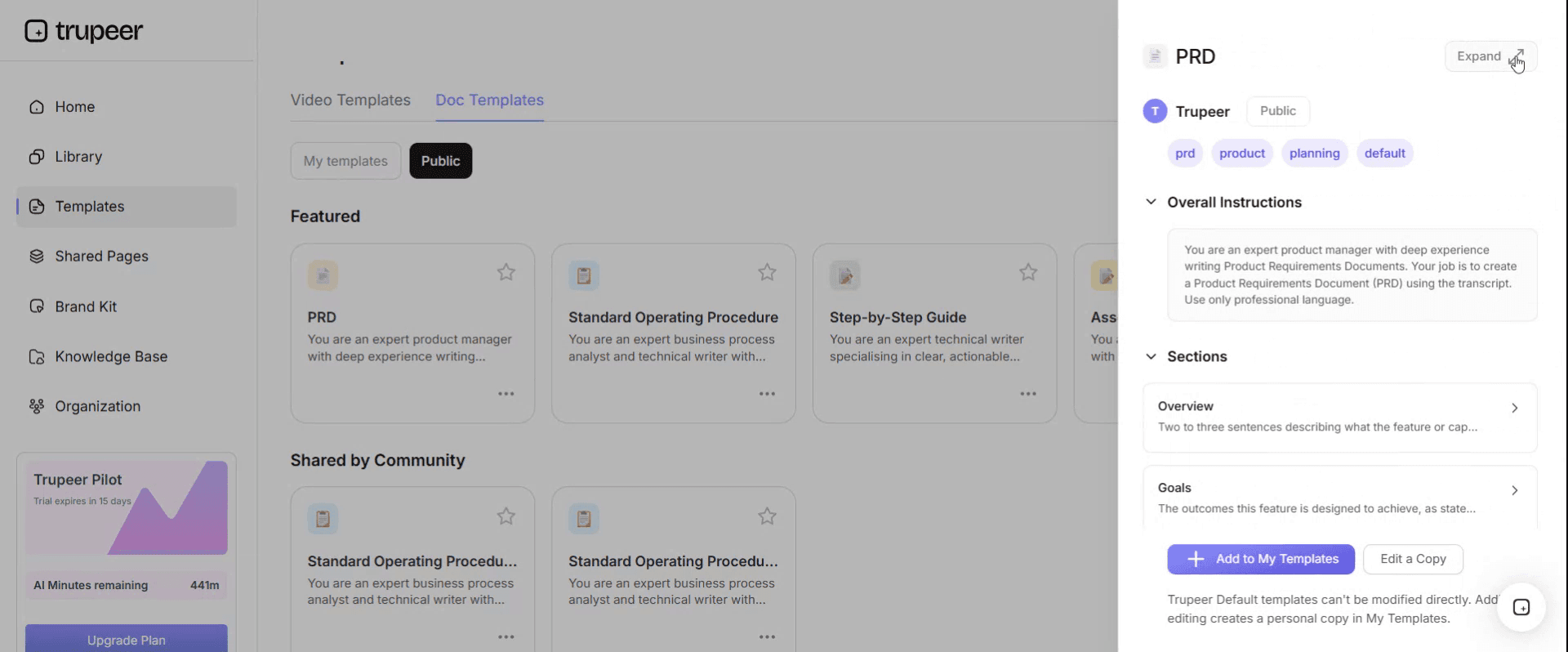
Step 3: Expand the Template View
If needed, expand the template view to see the full layout and details clearly.
Step 4: Edit the Template
Click on Edit to start modifying the selected template.
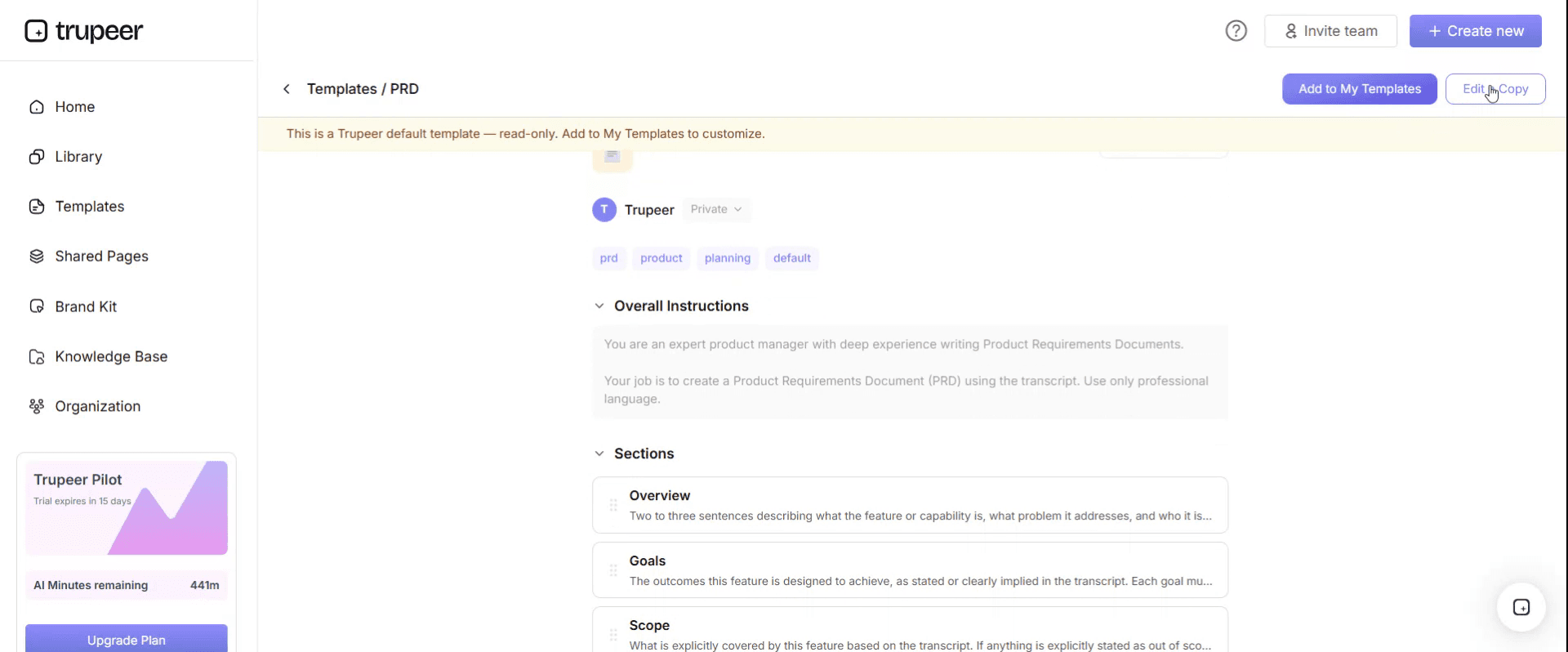
Within the editor, you can:
Add new sections
Define or update formatting rules
Add a logo and adjust its position and related settings
Step 5: Save Your Customized Template
After making all necessary changes, click Save to store the updated template as your own.
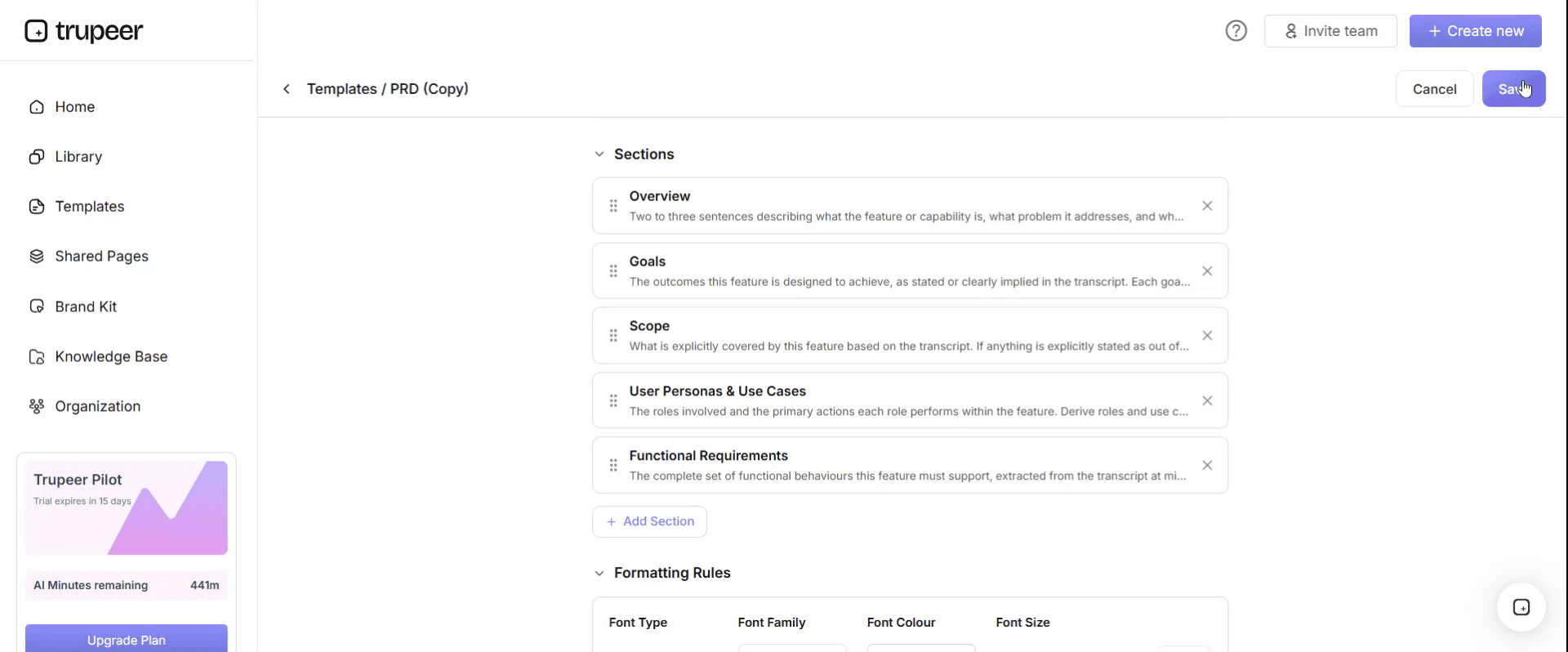
Step 6: Preview and Fine-Tune the Template
When you want to see how your customized template looks, open the Preview.
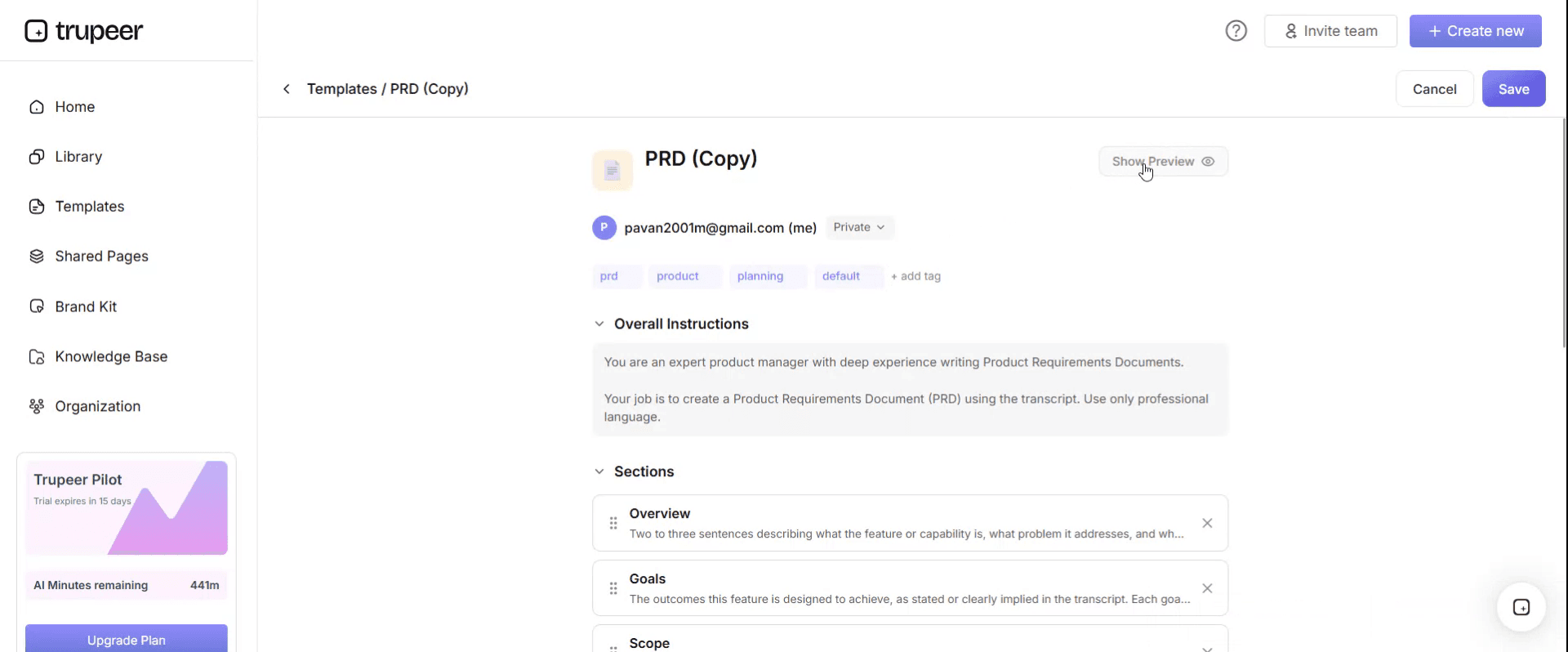
From the preview screen, you can continue to make adjustments directly if needed, ensuring the template appears exactly as you want.
With a process improvement plan template you can:
Save hours on planning: Skip the blank page with a structure used by Lean and Six Sigma practitioners.
Drive measurable improvement: Built-in metrics fields ensure improvements are tracked.
Stay on-brand: Apply your logo, fonts and colors using Trupeer's brand kit.
Roll out changes faster: Pair plans with change management video walkthroughs.
Standardize improvement: Use the same template across teams and functions.
Reach global teams: Translate improvement plans into 65+ languages with one click.
The transition section improvement plan templates omit
Four questions, none of which appears in a conventional improvement plan, all of which will have to be answered under pressure if they are not answered in advance.
What happens to work already in flight? Items started under the old method on the day you switch. This is the biggest of the four and it gets its own section below.
Who moves when? Big bang or phased. If phased, which cohorts, in what order, and what has to be true before the next one moves.
What does dual running cost, and who is paying for it? Two methods running side by side costs more than either one alone, in time, in supervision and in error rate. Nobody budgets for it, so the transition gets compressed and the errors get blamed on the new method.
How will you tell, later, which method produced a given piece of work? A version marker, a reference format, a flag. Trivial to add in advance, close to impossible to reconstruct afterwards, and it matters for measurement, audit and customer queries.
Answering these takes about an hour with the people who run the process. It is the highest return hour in the whole exercise.
The in-flight rule, and what it costs to get wrong
On switchover day there is a population of work already started under the old method. There are three options and one of them has to be chosen explicitly.
Option | What it means | When it fits | The cost |
|---|---|---|---|
Finish under old | Anything already started completes the old way | Short cycle times, clear start points, low volume in flight | Two methods run until the queue clears, so dual running is longer |
Convert to new | In-flight work is migrated into the new method | Long cycle times, or where the old method is the actual problem | Rework, data mapping, and a spike of effort on day one |
Hold and restart | Work is paused and restarted under the new method | Rare, and only where a pause is genuinely acceptable | Customer impact, and it usually is not acceptable |
The failure is not choosing badly. It is not choosing, which means staff improvise item by item, differently, and the same piece of work sometimes gets handled both ways.
Whichever you pick, write down the boundary precisely: work is in flight if it has reached a stated point by a stated time. Then estimate the volume, because that number tells you how long dual running lasts and therefore what it costs.
Cohorts, dual running and how you tell which is which
Cohorts. Unless the process is small, move people or customers in groups rather than all at once. Sequence them by risk rather than by convenience: start with a group where a problem is recoverable and where the people involved will tell you honestly what went wrong. Set a move criterion, meaning what has to be true before the next cohort goes, and make it observable. Two consecutive weeks at or above the previous quality level is a reasonable default.
Dual running. Estimate the period and staff it. During dual running, expect handling time per item to rise materially, because people check both systems, ask questions and make mistakes. Budget for it as a cost of the improvement rather than treating it as a failure to execute. A plan that shows a dip and a recovery is credible. A plan showing immediate benefit is not, and it destroys trust when the dip arrives.
Identification. Add something to every item that says which method produced it. A prefix on the reference, a field, a version number on the output. It costs nothing at the design stage. Without it, any question three months later, from a customer, an auditor or your own analysis, requires manual reconstruction.
Free process improvement plan template: the structure to copy
Copy from here. The transition section is the addition.
Header. Reference, title, process affected, owner, sponsor, dates, status.
Problem. An observation with a number. What happens, how often, and how you know.
Baseline. The measure, its current value, the method, the period and the date captured. Everything downstream depends on this being recorded before you start.
Root cause. What the analysis found, with the evidence, distinguished from what was assumed at the outset.
Proposed change. What will be different, described precisely enough that somebody else could implement it.
Scope. Where the process starts and stops for the purposes of this plan, and what is explicitly excluded.
Transition. The in-flight rule with its boundary and volume. The cohort sequence with move criteria. The dual running period, its expected cost and who carries it. The identification marker. The expected dip in the measure and its expected duration.
Documents to change. Which procedures, work instructions and job aids will need updating, named, with an owner and a date. An improvement with no document changes will not survive.
Benefits. Stated as the measure moving, with the date by which it should be visible. Financial figures secondary, since they are derived.
Risks and dependencies. Only those that would change the plan, each with a trigger.
Measures and review points. What is checked, when, and what decision each review makes.
Copy to here. Three or four pages. If the plan runs longer, the analysis has usually been pasted in and belongs in an appendix.
The laboratory that lost four months of its benefit
Ilkeston Testing Services is a materials testing laboratory handling around four thousand two hundred test requests a month.
Its improvement plan was good. Handwritten sample registration forms were causing transcription errors, and six point eight percent of samples were being re-tested as a result. The plan mapped the current state, established the cause properly, specified a digital intake portal, and made a benefits case of around a hundred and ninety thousand pounds a year. Seven steps, owners, a go-live date.
It contained nothing about the transition.
The portal went live for all customers on the first of March.
Nineteen hundred samples were already in the lab, registered on paper and part way through testing. No rule existed for them. Staff decided case by case. Some were re-entered into the portal, some stayed on paper, and a number ended up in both.
Both systems ran for five weeks. Nobody had planned for dual running, so nobody had staffed for it. Registration time per sample rose from about four minutes to eleven during the overlap, because staff were checking both systems before doing anything.
Customers moved at their own pace. By week four, sixty one percent were using the portal and thirty nine percent were still emailing forms. The plan had assumed full adoption within two weeks.
The measure they were trying to improve went the wrong way. Median turnaround rose from six point one days to eight point nine during the transition and did not come back below six until month five.
The most expensive detail was the smallest. The portal and the paper log used different reference formats, so for any given sample there was no quick way to tell which route it had come through. When a customer queried a result in month three, reconstructing the chain of custody took two days.
The transition was later costed at roughly seventy four thousand pounds in additional handling. Against a hundred and ninety thousand pound annual benefit, that is more than four months of the benefit consumed before any of it started accruing, and none of it appeared anywhere in the plan.
The plan template was rewritten with a transition section covering the four questions above.
The next improvement, a change to the reporting format, used it. The in-flight rule said anything already booked finishes under the old format. Three customer cohorts moved over six weeks with a move criterion of two clean weeks each. Dual running was budgeted at half a full time equivalent for eight weeks. Every report carried a version marker.
Turnaround dipped from six point zero days to six point four for three weeks and returned. The transition cost about nine thousand pounds against a planned eleven.
How to create a process improvement plan in 7 steps
One. Establish the baseline before anything else. The measure, the method, the period, the date. Retrofitted baselines are always slightly flattering.
Two. Investigate the cause rather than confirming a solution. Most improvement plans are written to justify something somebody already wants to do. Write down your initial hypothesis so you can tell later whether it was right.
Three. Define the scope at both ends. Where the process starts and stops for this plan, and what is deliberately excluded.
Four. Design the change and the transition together. Not the change first and the transition later, because the transition frequently changes the design. A method that is excellent at steady state and impossible to migrate to is not the right method.
Five. Name the documents that will change, with owners and dates. Do this at planning time, since it is invariably underestimated afterwards.
Six. Agree the expected dip. How far the measure will fall, for how long, and at what point you would stop. Agreeing this in advance is what prevents a good improvement being abandoned in week three.
Seven. Set the review points, including one after the transition has fully settled, which is usually later than anyone plans for.
Process improvement methodologies, and when each one fits
The plan is the container. The method is how you work out what to change, and picking one before you understand the problem is a common mistake.
PDCA suits testing a specific change against a baseline where you have a hypothesis but are not certain. Our PDCA method template covers it, including why the check stage usually fails.
Kaizen suits continuous small improvements made by the people doing the work, most of which are too small and too reversible to need a plan at all. Our kaizen method template covers the threshold below which a plan is overhead.
Lean and value stream mapping suit flow problems: waiting, handoffs, inventory and rework across a whole process rather than at one step.
Six Sigma and DMAIC suit variation in a stable, high volume process where you have data and somebody trained to analyse it. Heavier than PDCA and stronger where the problem is inconsistency rather than level.
5S suits workplace organisation specifically, and our 5S process improvement template covers it.
Business process reengineering suits the case where the process should not exist in its current shape at all. It is the only one of these where the transition problem dominates everything else, which is why several public sector bodies publish their own BPR improvement plan formats.
What a process improvement plan is not, and what it is
It is not a project plan. A project has a defined end and a deliverable. An improvement changes something that continues afterwards, which is why the transition and the standardisation matter more than the delivery date. Where the improvement is large enough to need proper scheduling, our IT project plan template covers that layer and this plan sits inside it.
It is not process documentation. Documentation describes how the process runs. The plan describes how it will change. Our process documentation template covers the former, and a successful improvement produces an update to it.
It is not a business case. Benefits belong in the plan, but a document written primarily to secure funding will be shaped to persuade rather than to be executed, and the two read very differently.
And it is not a performance improvement plan, which is covered next because a surprising number of people arrive at this term looking for one.
Process improvement plan or performance improvement plan?
Both are abbreviated to PIP in conversation and they are entirely different documents, so it is worth being clear.
A process improvement plan addresses how work gets done. It is about a system, it is not about any individual, and its output is a changed process.
A performance improvement plan addresses an individual employee performing below the required standard. It is a formal HR and employment law instrument with defined timescales, evidence requirements and consequences, and it usually forms part of a disciplinary or capability procedure.
Confusing them is genuinely harmful in both directions. Framing a process problem as an individual performance issue is the classic management error and it fixes nothing, since the next person in the role will hit the same problem. Framing a genuine performance concern as a process improvement avoids a conversation that needs having and weakens the employer's position if it later becomes formal.
If you need the performance version, it should come from your HR function and be reviewed against your jurisdiction's employment law rather than adapted from a template. Nothing here is employment advice. Our leadership development plan template covers the developmental case, which is a third thing again and should never be blended with either.
Can I get a process improvement plan template in Word or Excel?
Word or Google Docs for the plan. The problem, cause, proposed change and transition sections are prose that gets argued over, and the document is circulated for approval.
Excel for three things that want columns. The transition tracker, meaning cohorts, move dates, criteria met and current status. The document change list, with owner and due date. And the measure log, capturing the baseline, the dip and the recovery on the same axis, which is what stops the improvement being judged during its worst week.
PowerPoint for the approval presentation, built from the plan rather than instead of it. Where only the deck survives, the transition section is the first thing lost, because it is the least impressive part to present and the most important part to have.
PDF for the approved version once signed off, with the working copy kept editable, since cohort dates and move criteria change during execution.
How to make the new method stick after go-live
Every improvement plan has a line about updating the documentation, and it is the line most often missed, usually because the project has run long and the team has moved on.
That omission is what causes reversion. The improvement exists in the heads of the people who were involved, and it lasts until they change role, at which point the process quietly returns to whatever the written instruction still says.
Trupeer AI makes standardisation fast enough to actually happen inside the project rather than after it. Whoever performs the new method records it once, and the output is a written procedure with the steps and screens already captured, ready to check rather than compose. The documents named in your plan get updated in the week the method is proven.
Record it. Brand it. Translate it. Trupeer it.
Recording the old method before the change is worth doing too, since it gives you a before artefact for the transition period and makes it obvious to everyone which method they are looking at. The SOP creator covers the procedures, our process documentation template covers the description that has to change, and the output lives in your knowledge base in consistent branding. Setup instructions are in the document template setup guide.
Frequently Asked Questions
Is there a free process improvement plan template in Word?
The structure above pastes straight into Word or Google Docs, including the transition section that standard templates omit. There is no gated download and no form. Write the transition section before the benefits section, because the transition cost usually changes the benefits figure.
Is there a free process improvement plan template in Excel?
Excel suits the trackers rather than the plan. Three sheets: cohorts with move criteria and status, documents to change with owners and dates, and the measure log showing baseline, dip and recovery. That third sheet is the one that protects a good improvement from being judged during its worst three weeks.
Is there a free process improvement plan template in PowerPoint?
Use slides for the approval conversation and keep the plan itself as a document. Six slides works: the problem with its number, the cause, the change, the transition and its cost, the expected dip and recovery, and what you need approved. The transition slide is the one people remember when the dip arrives.
Is there a free process improvement plan template in PDF?
Export the approved version at sign-off and keep the working copy editable. Cohort dates and move criteria change during execution, and a frozen plan stops being consulted the first time reality diverges from it.
How long should a process improvement plan be?
Three or four pages plus the trackers. Longer plans are usually carrying analysis that belongs in an appendix, or a business case that belongs in a separate document. The test is whether somebody covering for the owner could run the transition from it.
Who should own the process improvement plan?
The person accountable for the process afterwards, not the person running the project. Improvements owned by a project function tend to be delivered and then orphaned, and the transition period is exactly when an owner who will still be there in six months makes the difference.
Process improvement plan or project plan: what differs?
A project plan covers work with a defined end and a deliverable. A process improvement plan covers a change to something that continues running, which is why it needs a transition section and a standardisation step that a project plan does not. Large improvements need both, with the improvement plan sitting inside the project.
How do you measure whether a process improvement plan worked?
The same measure as the baseline, using the same method, taken after the transition has fully settled rather than at go-live. Agree in advance how far the measure may fall and for how long, so that the dip is expected rather than treated as failure. Also track whether the documents named in the plan were actually updated, since that predicts whether the result holds.