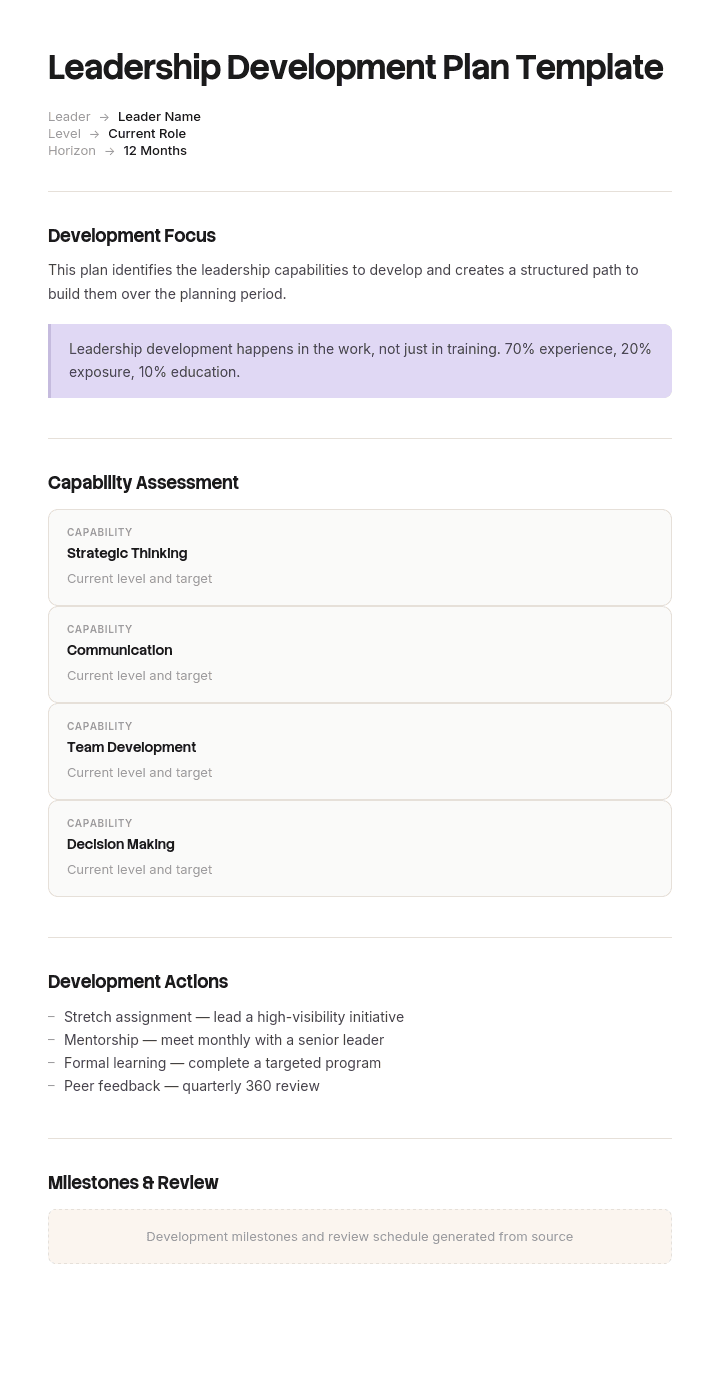
Use this template
The best companies build their next generation of leaders intentionally - not by accident. With Trupeer, you can save hours on development planning by starting with a free leadership development plan template, customizing it with your brand guidelines, and turning development plans into video summaries that align managers, mentors and learners.
What is a leadership development plan, and what makes it different?
A leadership development plan sets out how a specific person moves from where they are now to holding more responsibility, over a defined period, with named actions and a way of telling whether it worked.
What makes it different from a training plan is the thing being developed. Skills training closes a gap between what someone can do and what the job requires, and you can test it. Leadership is not a skill in that sense. Nobody has ever become a leader by being able to do something they previously could not do. They become one by being made accountable for outcomes they cannot deliver alone, and then adjusting.
That distinction has a practical consequence. A plan built as a curriculum of leadership topics will produce someone who is well informed about leadership. A plan built as a sequence of things they are now accountable for will produce a leader, and the second kind is harder to write because it requires their manager to give something up.
Why competency-based development plans rarely change anything
The standard approach starts with a competency framework. Nine or twelve leadership behaviours, a 360 assessment against them, scores out of five, and a plan targeting the lowest scores.
It is comfortable, it reports well, and it very often changes nothing about what anyone is allowed to do. Three reasons.
The behaviours are adjectives. Strategic thinking, executive presence, influencing without authority. Nobody can say what a person would do differently on Monday to move from a three to a four, so the plan cannot be acted on and cannot be failed.
The assessment measures perception rather than authority. A 360 score can rise substantially while actual scope stays exactly where it was, and the second thing is the one that matters.
And the plan is agreed with the participant rather than with the person holding the scope. The manager who would have to hand something over is often not in the room, so nothing they own appears on it.
The way out is to stop asking what the person is missing and ask their manager a different question.
How to customize this template in Trupeer
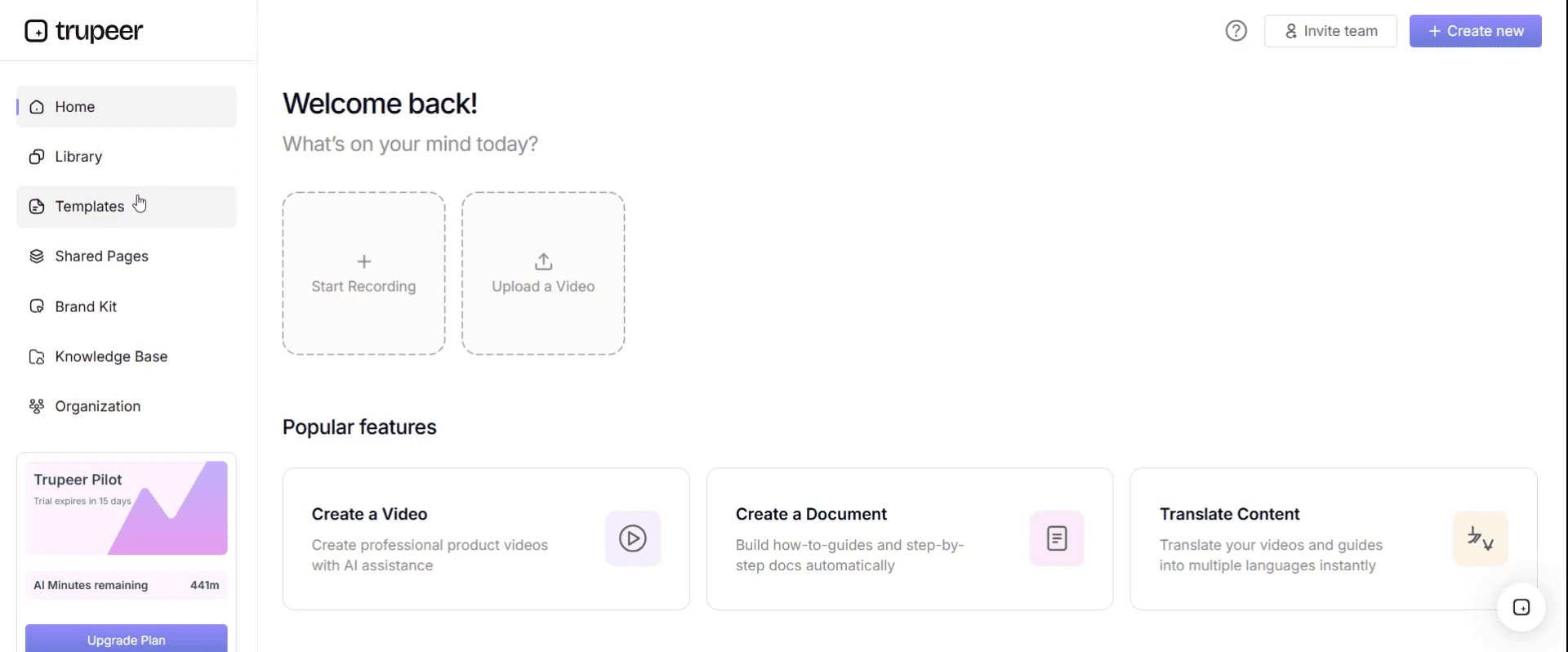
Step 1: Open the Templates Section
Go to the Templates section from the main navigation.
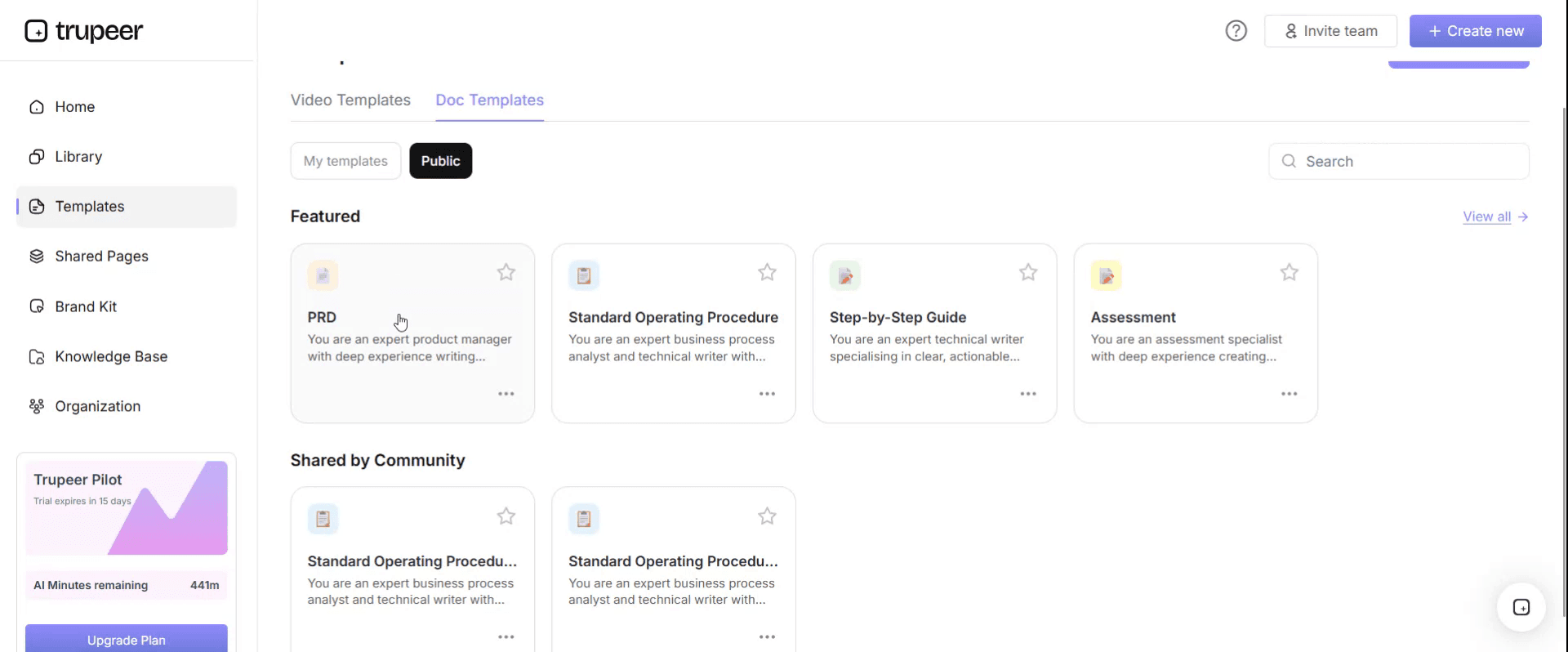
Step 2: Select and Open a Template
Click on any template you want to work with to open it.
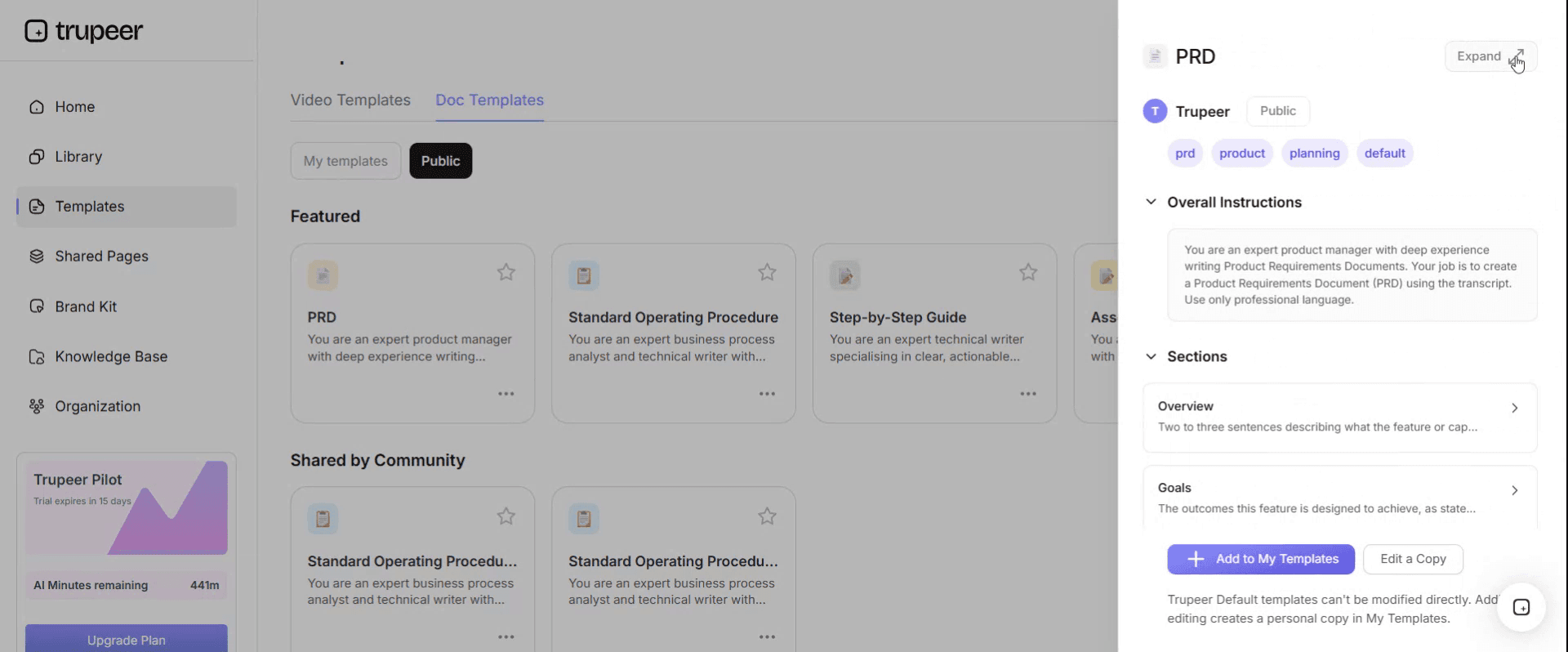
Step 3: Expand the Template View
If needed, expand the template view to see the full layout and details clearly.
Step 4: Edit the Template
Click on Edit to start modifying the selected template.
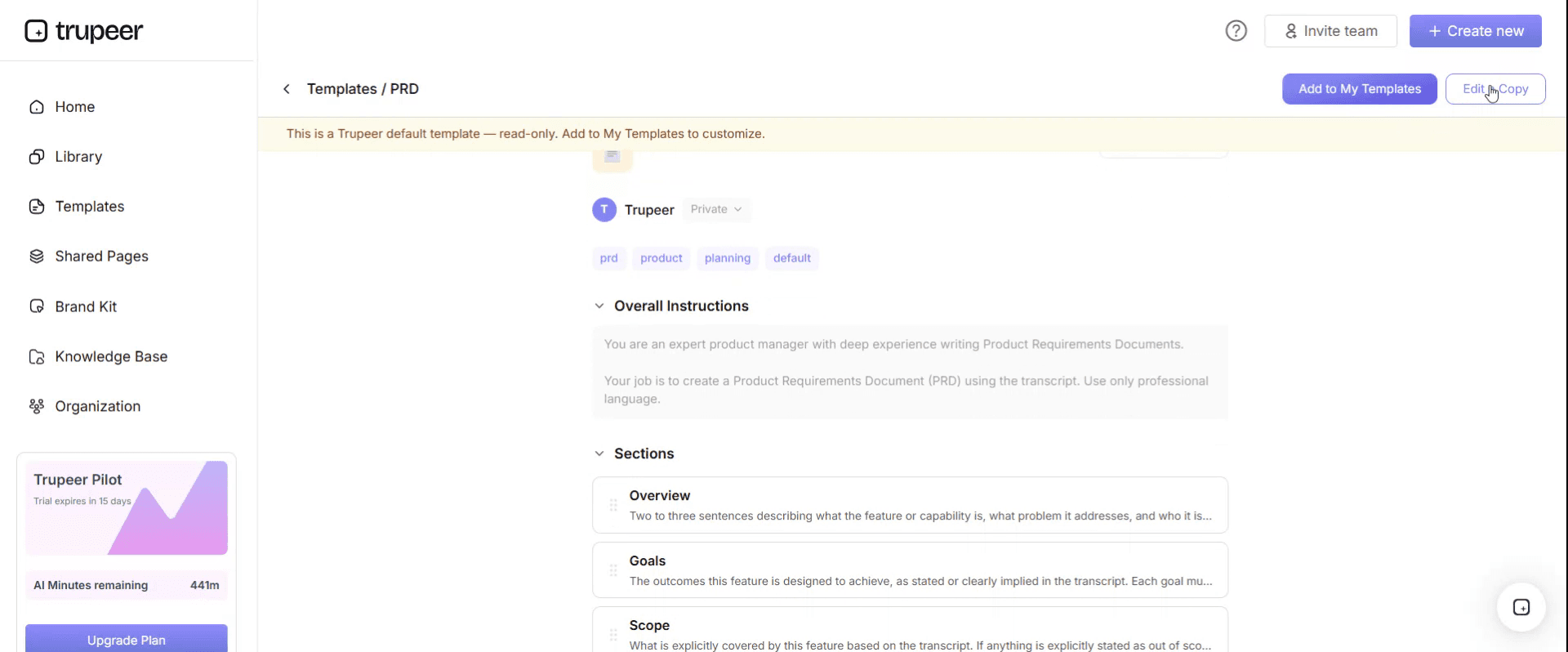
Within the editor, you can:
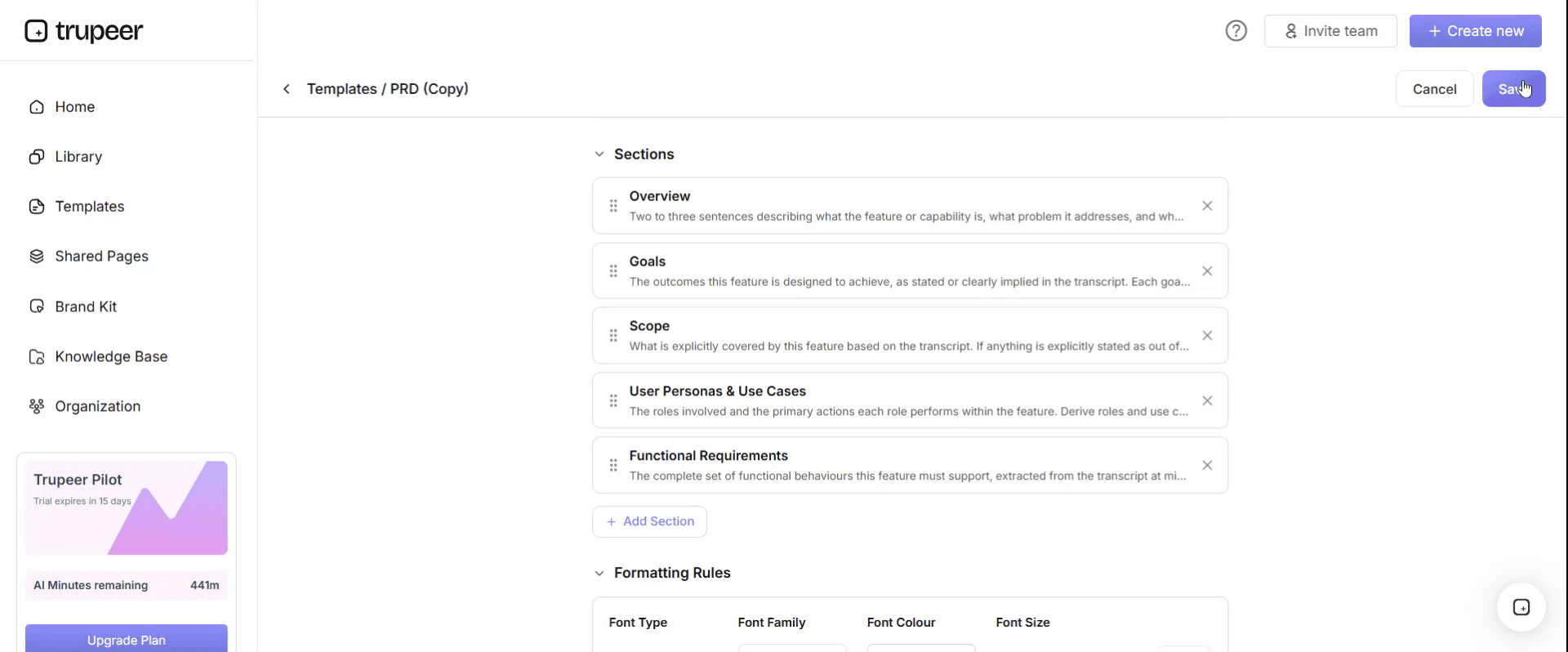
Add new sections
Define or update formatting rules
Add a logo and adjust its position and related settings
Step 5: Save Your Customized Template
After making all necessary changes, click Save to store the updated template as your own.
Step 6: Preview and Fine-Tune the Template
When you want to see how your customized template looks, open the Preview.
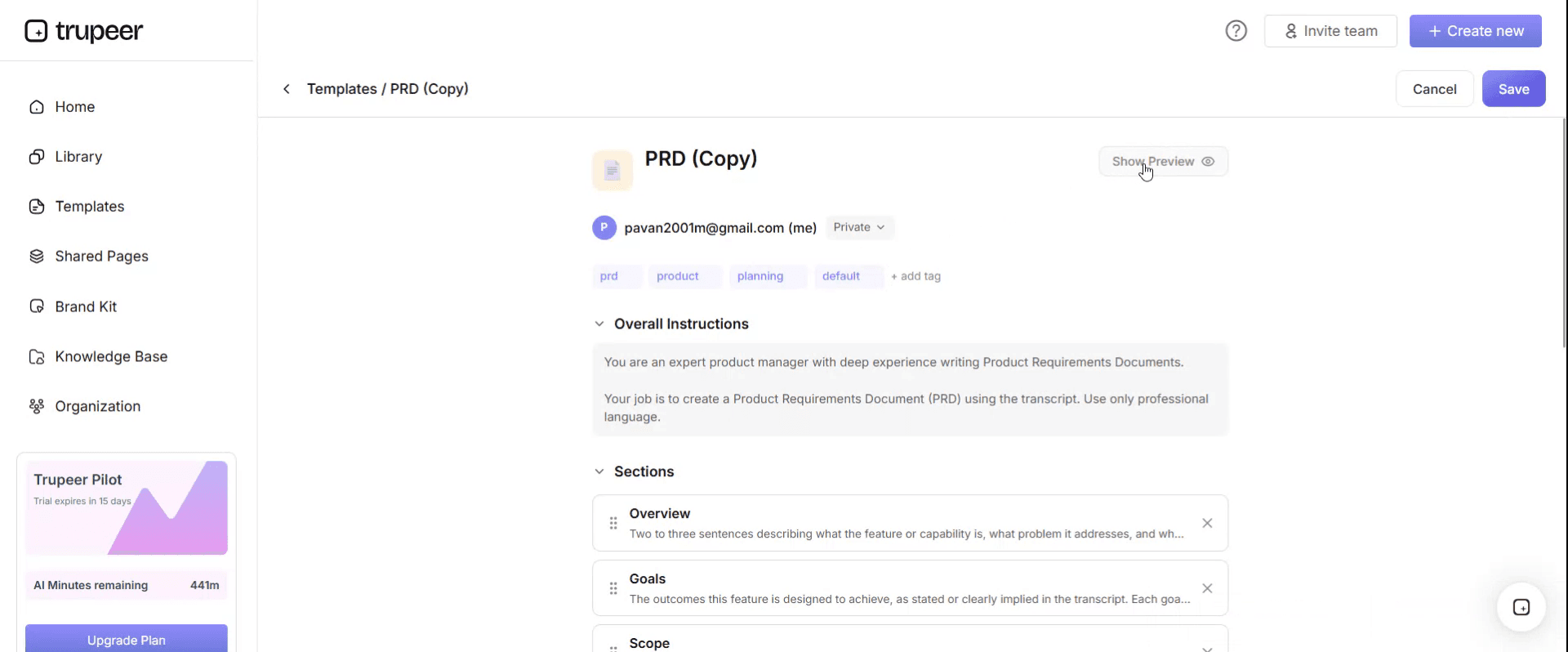
From the preview screen, you can continue to make adjustments directly if needed, ensuring the template appears exactly as you want.
With a leadership development plan template you can:
Save hours on design: Skip the blank page with a proven development structure.
Build leaders intentionally: Built-in sections cover competencies, experiences and mentorship.
Stay on-brand: Apply your logo, fonts and colors using Trupeer's brand kit.
Track progress: Built-in milestones and metrics keep development on track.
Standardize across the org: Use the same template for every leader in development.
Reach global leaders: Translate plans into 65+ languages with one click.
A leadership development plan is a list of decisions, not skills
Ask the manager this: what decisions do you currently make that this person could plausibly be making in a year, and what stops you handing each one over today?
Managers answer this question well. They will not tell you someone lacks strategic thinking, but they will tell you they are not ready to let her approve a scope change over fifty thousand without looking at it first, and they will tell you exactly why. The reason is usually specific and usually addressable.
Those answers are the plan. Each decision becomes a row. The development work exists to close the specific gap the manager named, and the plan is complete when the decision is handed over in writing and the manager stops being copied.
This has three properties the competency approach does not. It is falsifiable, because either the decision was delegated or it was not. It commits the manager, since every row is something they have to give up. And it is visible to the person, who can see precisely what they are working towards rather than a score on an adjective.
How to build the decision inventory with the person's manager
Book an hour with the manager, without the participant, and produce the list first. Do not start with the framework.
Prompt with the manager's own week. What did you approve, sign, arbitrate or escalate last month? Which of those could this person have done? For the ones they could not, what would you need to see first?
Aim for five to eight decisions. Fewer and the plan will not change anyone's role. More and it becomes a wish list nobody sequences.
Two disciplines make the hour work. Write each decision as something with an outcome and a boundary, so "approve scope changes up to fifty thousand" rather than "commercial decisions". And insist on the reason, because "she is not ready" cannot be planned against. Push until you get something observable: has not seen a project go wrong, has never had to say no to that client, does not know how we price risk.
Then take the list to the participant. Most find it a relief, because it replaces a vague sense of not yet with something they can work through.
How to sequence the handover from small decisions to large
Two axes decide the order. How costly it is to get wrong, and how much the decision depends on people the person does not manage.
Stage | Decision looks like | What it develops | Typical handover |
|---|---|---|---|
1 | Reversible, own team, low value | Judgement without consequence | Delegate outright, review monthly |
2 | Costly to undo, own team | Owning a mistake in public | Supervised trial, then delegate |
3 | Reversible, needs people who do not report to them | Getting agreement without authority | Supervised trial, manager silent in the room |
4 | Costly to undo, needs people who do not report to them | Holding a position under pressure | Two supervised, then delegate with escalation route |
5 | Costly to undo, and someone senior disagrees | The actual job | Delegate late, and only after stage 4 |
The mistake almost everyone makes is jumping from stage 1 to stage 4 because a vacancy appeared. The stage that gets skipped is 3, which is where influencing without authority is genuinely learned, and skipping it is why capable people fail in their first real leadership role while their 360 scores looked fine.
Stage 5 is not a training stage. If the person cannot hold a position against a senior colleague, no assignment fixes that inside a year, and the plan should say so rather than pretending.
Free leadership development plan template: the five columns to copy
One row per decision. Five columns. That is the plan.
The decision. Stated as something with an outcome and a boundary. "Approve supplier scope changes up to fifty thousand pounds."
Why not yet. The manager's specific reason, in the manager's words. Not a competency label.
The assignment. One piece of real work that forces the gap into the open. Not a course. Running the quarterly supplier review, taking the difficult renewal, chairing the incident post-mortem.
The supervised trial. The first time they make this decision with the manager present but silent, and the date. The manager's job in the room is to say nothing and take notes.
Delegation date and review. The date the decision transfers for real, plus how it will be reviewed afterwards. The transfer is written down and communicated to everyone affected, or it has not happened.
Add a single header block: the person, the manager, the period, and one sentence describing the role they are being developed towards. Anything more and the document starts to be maintained instead of used.
A leadership development plan example for a new team lead
Filled, for a senior engineer moving to engineering team lead over twelve months.
Decision: approve technical designs for changes affecting production without a second reviewer. Why not yet: has never seen a design of hers cause an outage, so tends to optimise for elegance over blast radius. Assignment: own the post-incident review process for two quarters, including writing the reviews. Supervised trial: March, next major design. Delegation: June.
Decision: set the team's quarterly priorities against product's requests. Why not yet: has never had to say no to the product director and does not know where our margins actually are. Assignment: present the team's capacity model at the quarterly planning session, and own the number. Supervised trial: Q2 planning, manager present and silent. Delegation: Q3 planning.
Decision: decide who goes on call and handle the resulting complaints. Why not yet: avoids conflict with peers she has worked alongside for four years. Assignment: run the rota for one quarter and personally handle every swap request. Supervised trial: first refusal she has to give. Delegation: end of Q2.
Decision: hire into her own team, including the final no. Why not yet: has interviewed but never rejected anyone at final stage. Assignment: shadow two full loops, then run one as hiring manager. Supervised trial: October, one full loop. Delegation: January.
Four rows, four real changes to what she is allowed to do. Compare that with a plan reading "develop strategic thinking, improve executive presence, build stakeholder influence" and it is clear which one a person can act on.
What a competency programme cost, and what replaced it
Calderwood Partners, a professional services firm of about six hundred people, ran a leadership development programme for twenty four senior managers identified as successors.
Twelve months, nine leadership competencies, a 360 assessment for each participant, six workshop days and an external coach. Around four thousand two hundred pounds per person in direct cost, plus roughly fourteen days of each participant's time.
The measured outcomes were good. Average 360 scores improved. Self-reported confidence rose. Participants rated the programme highly.
Eighteen months after it finished, three of the twenty four had been promoted or given expanded scope. Five had left.
The review interviewed the participants' managers and got the same answer repeatedly. She is excellent, but I am not ready to let her run the account on her own. Pushed on what would change that, every one of them could name it precisely, and none of it had been written down anywhere, because the framework had never asked. It measured strategic thinking from one to five. Nobody had recorded that a manager would not yet let someone sign a scope change unsupervised.
The relaunch changed the plan and kept half the programme. Each manager spent an hour listing decisions they currently made that the participant could plausibly make within a year. The median list was six. Three of the six workshop days survived, on the topics those lists kept surfacing.
Twelve months on, of twenty two participants, ninety six of the hundred and thirty one listed decisions had been formally handed over. Eleven had been promoted or given expanded scope. Two had left, at slightly lower cost than the first programme.
Personal leadership development plan template and examples
The same structure works without a programme behind it, with one adjustment people tend to skip.
Write the decision list yourself, then take it to whoever holds the scope and get their version. The two will differ, and the gap between them is the most useful information available to you. If you think the blocker is exposure and they think it is that you have never delivered bad news to a client, you have been working on the wrong thing.
The columns are identical, except that the delegation date needs someone else's agreement to be real. A personal plan with no named person who can hand things over is a reading list. Get one name into the document, even if it is a project sponsor rather than your line manager.
If you are early in a role, a 30-60-90 day plan covers the first quarter and this covers the year after it.
What are the 4 components, 5 phases and 4 C's?
These come up constantly and it is worth being straight about them.
The four components usually given are assessment, goals, development activities and measurement. That describes any development plan and is not specific to leadership.
The five phases vary by whoever is publishing them and there is no canonical version. Most run from self-awareness through skill building to leading others, then leading leaders, then leading an organisation, which describes a career rather than a plan.
The four C's are quoted differently by different sources, most often as competence, character, connection and culture, sometimes as clarity, communication, collaboration and commitment. Both are memorable and neither tells you what to do next.
None is wrong. They are vocabulary for talking about leadership development, and vocabulary is not a plan. Use one for a steering paper if you need to. Use the decision list for anything the person has to act on.
What are the challenges when creating a leadership development plan?
The binding one is that the manager has to give something up, and nobody designs for that. Every genuine leadership development plan reduces the manager's own scope, which is uncomfortable and rarely acknowledged. If the manager will not name a single decision they would hand over, the plan is not going to work and the honest response is to say so rather than write it anyway.
Three others are common. Plans are written against a promotion that does not exist, which produces someone ready for a role nobody is going to create. Progress gets measured by activity completed rather than authority transferred. And plans are agreed in January and never reopened, when the useful cadence is quarterly against the delegation dates.
One caution worth taking seriously. Where a development plan feeds promotion decisions, or where selection into a programme could be challenged, have HR and your employment counsel review the selection criteria and the record keeping. Development plans have been used as evidence in both directions in disputes, and a plan that reads as a performance concern rather than a development one creates a risk you did not intend.
How to tell when a leadership development plan is finished
Not when the twelve months are up, and not when the activities are complete.
It is finished for a given row when the decision has been transferred in writing, the people affected have been told, and the manager has stopped being copied on it. That last condition is the one that catches informal reversal, which is extremely common: the decision is nominally delegated and the manager is still quietly consulted every time, which means it was not.
At the plan level, review quarterly against delegation dates only. If dates are slipping, the question is whether the assignment was wrong or whether the manager is not ready to let go, and those need different conversations. Rows that keep slipping for the second reason are worth escalating, because they are usually about the manager rather than the participant.
How to make delegation possible by documenting what you hand over
There is a practical blocker under all of this. You cannot delegate a decision when the reasoning behind it lives entirely in one head, and this is the real reason many managers hold on. It is easier to keep making the call than to explain how you make it.
Trupeer AI is useful at exactly that point. The manager records themselves working through a real example, thinking aloud, and the result is a formatted guide someone else can follow rather than a meeting that has to be repeated. The SOP creator turns the recurring parts into a written procedure, which is what makes a supervised trial possible without the manager in the room.
Record it. Brand it. Translate it. Trupeer it.
The same recording produces a written guide, a video and a document in your knowledge base in consistent branding, so the reasoning survives the handover rather than the successor rebuilding it. Where the transfer is a full role rather than a single decision, our knowledge transfer SOP covers the longer version. Setup instructions are in the document template setup guide.
Frequently Asked Questions
Is there a free leadership development plan template in Word or doc?
The five column structure pastes straight into Word or Google Docs as a simple table, one row per decision. There is no gated download, which also means no form between you and the template. Keep it to one page, because a leadership development plan that runs to six pages stops being reviewed by the second quarter.
Is there a leadership development plan example in PDF?
The filled example above covers a senior engineer moving to team lead, with four real rows rather than placeholder text. Export your own to PDF once the manager has agreed the delegation dates, because those dates are the commitment and freezing them is worth doing. Keep the working copy editable, since rows get added as the year goes on.
Is there a free leadership development plan template in Excel?
Excel is the right container if you are running this across a cohort rather than one person. One row per decision, columns for participant, manager, decision, why not yet, assignment, trial date, delegation date and status. The single number worth reporting from that sheet is the proportion of decisions actually delegated, which is the only cohort metric that means anything.
Can I download a leadership development plan template for free?
The five columns, the sequencing table, the filled example and the manager interview prompts are free and unrestricted. Adapt them to your organisation and put them in your own toolkit under your own name with no attribution needed.
How long should a leadership development plan be?
One page, four to eight rows, twelve months. Longer plans are usually a sign that activities have been listed rather than decisions, since activities multiply and decisions do not.
Who writes the leadership development plan?
The manager and the participant together, with the decision list produced by the manager first and separately. Reversing that order is the most common way these go wrong, because a list generated with the participant in the room drifts towards what they would like to do rather than what the manager is prepared to hand over.
How is this different from a performance improvement plan?
Entirely different in purpose and in law. A development plan is for someone performing well who is being prepared for more. A performance improvement plan addresses performance below the required standard and carries formal consequences. Never blend the two documents or the vocabulary, because a development plan that reads like a warning damages trust and can be read against you later.
What if my manager will not delegate anything?
Ask once, specifically, for a single decision with a date, rather than for development in general. If the answer is still no, look for scope outside their gift: a cross-functional project, a committee, an initiative with a different sponsor. Stage 3 in the sequencing table above is deliberately about people who do not report to you, and that stage is often available even when your own manager is holding on.