Use this template
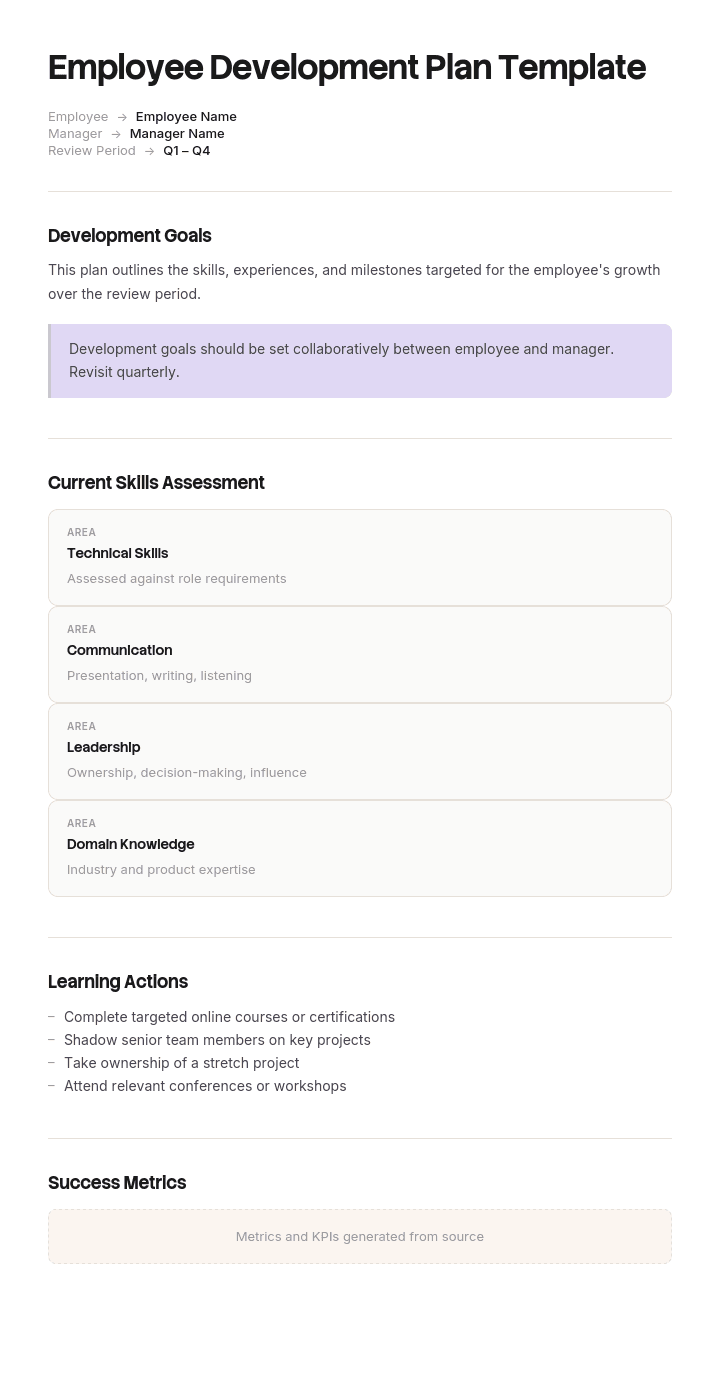
An employee development plan is a structured roadmap that helps employees grow their skills, advance their careers and align personal goals with company objectives. With Trupeer, you can save hours on creating individual development plans by starting with a ready-to-use template, customizing it with your brand guidelines, and turning each plan into a personalized video walkthrough that managers and employees can revisit anytime.
Ask someone what their development plan says and most will describe a course they are booked on. That course is real, and it accounts for a small fraction of how anyone actually gets better at their job.
People develop mainly by doing harder work than they have done before, and by learning from people around them. A development plan that does not cover those two is a training booking with a header on it.
Download the employee development plan template
Format | Best for |
|---|---|
Excel (.xlsx) | Tracking plans across a team, with goals, actions and review dates |
Word (.docx) | The individual plan the employee and manager work from |
The agreed version, and printing for review conversations | |
Google Docs | A shared living plan both parties can update |
.doc | Older HR systems and legacy document libraries |
Free, editable, no watermark. Word for the individual plan, Excel once you are managing more than a handful.
Why most development plans fail
They list training, not development. A course attended is not a capability gained.
The goals are aspirations. "Improve leadership skills" cannot be assessed or planned against.
They are written by the manager. Plans handed to someone rather than built with them get complied with, not pursued.
They are annual. Written in January, opened in December, and by then the role has changed.
Nothing in the day job changes. The plan sits alongside the work rather than being delivered through it.
No time is protected. Development competes with delivery and loses every time.
Nobody owns the manager's half. The employee has actions and the manager has none, which is where most plans quietly die.
How to customize this template in Trupeer
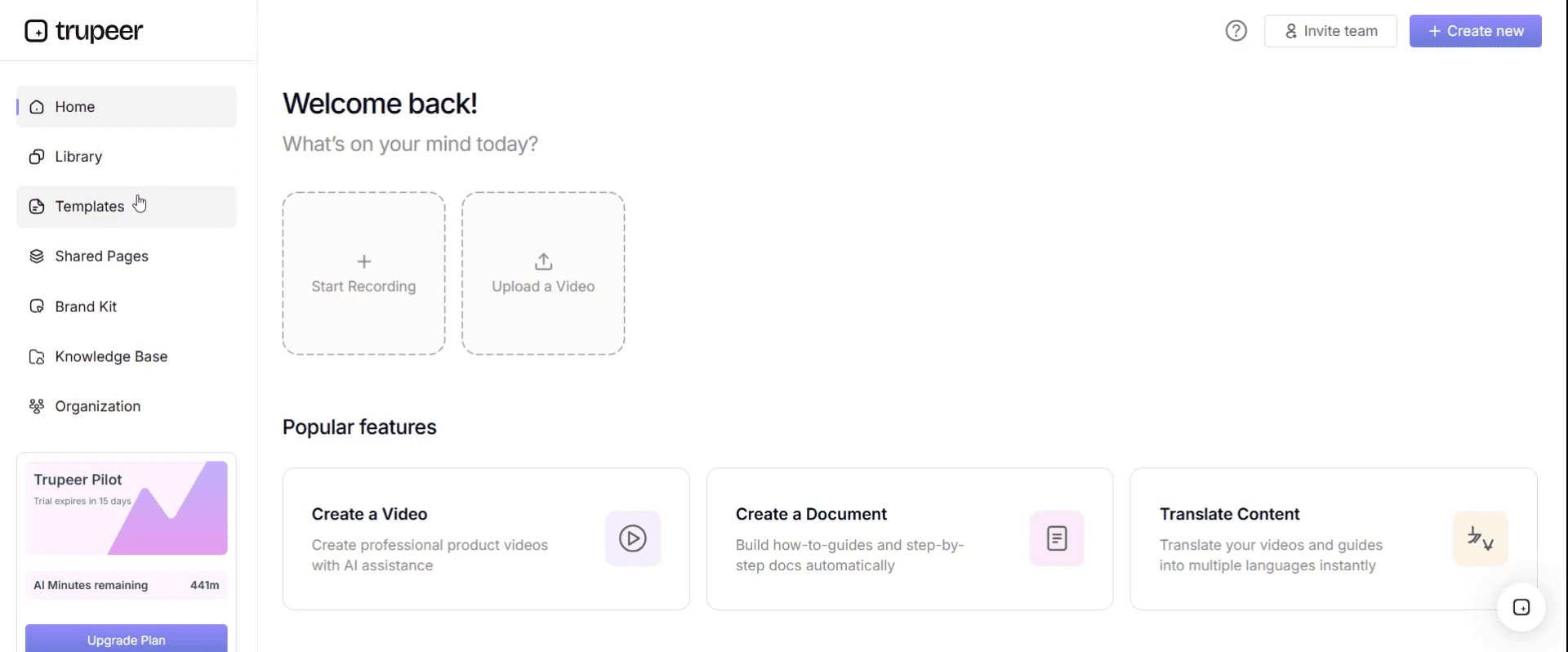
Step 1: Open the Templates Section
Go to the Templates section from the main navigation.
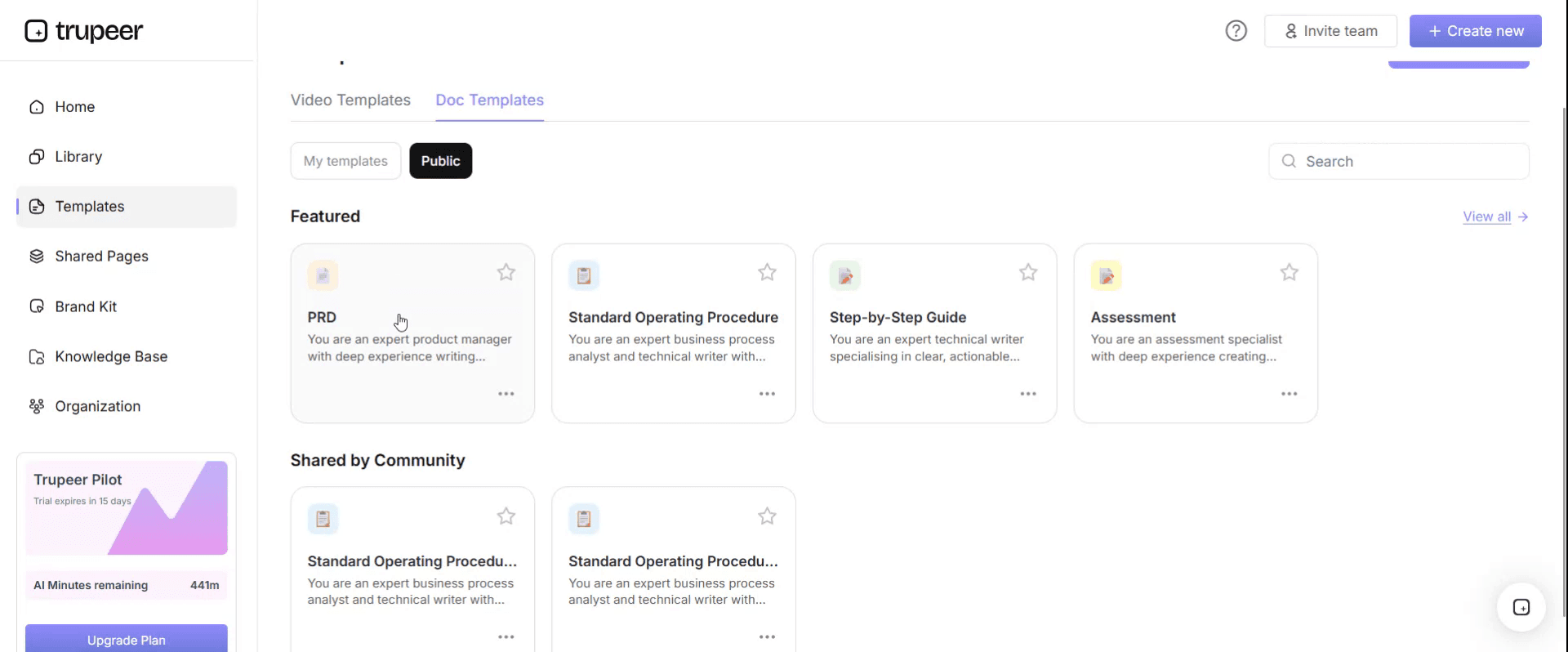
Step 2: Select and Open a Template
Click on any template you want to work with to open it.
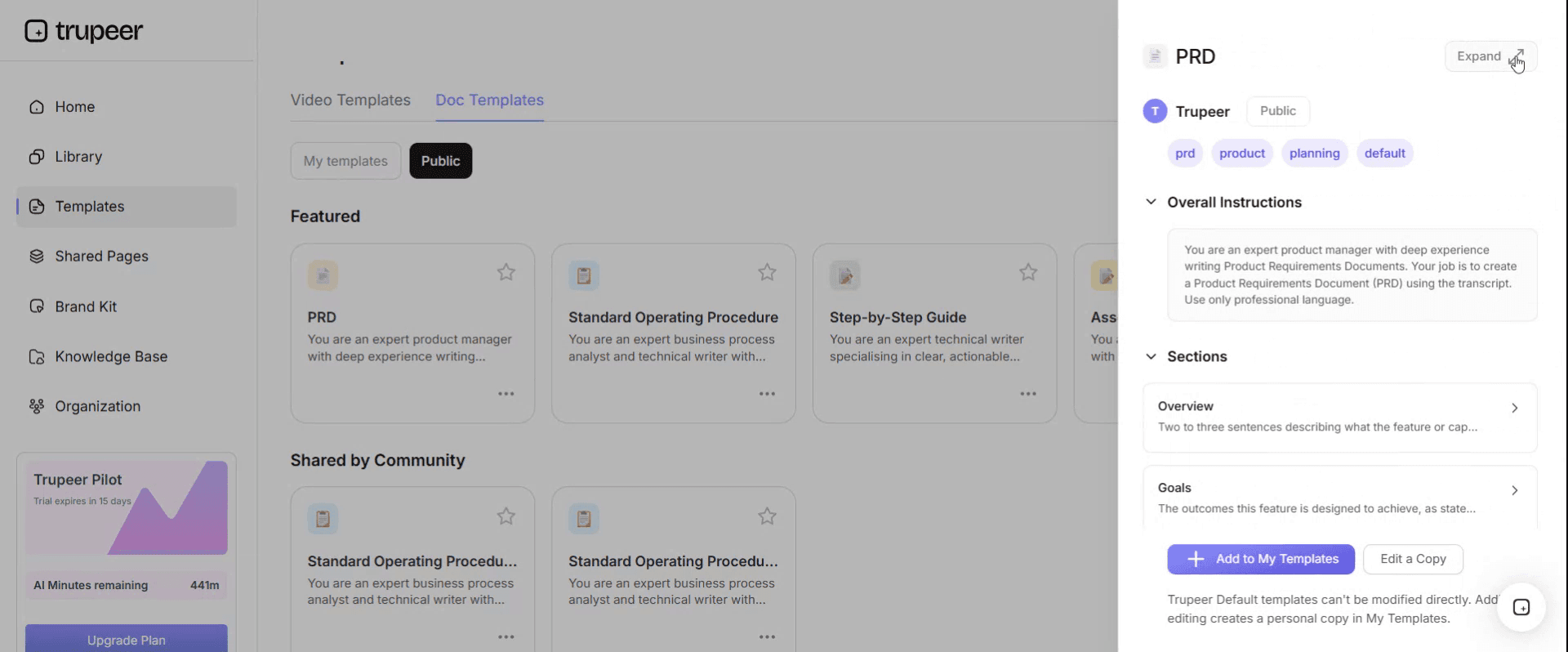
Step 3: Expand the Template View
If needed, expand the template view to see the full layout and details clearly.
Step 4: Edit the Template
Click on Edit to start modifying the selected template.
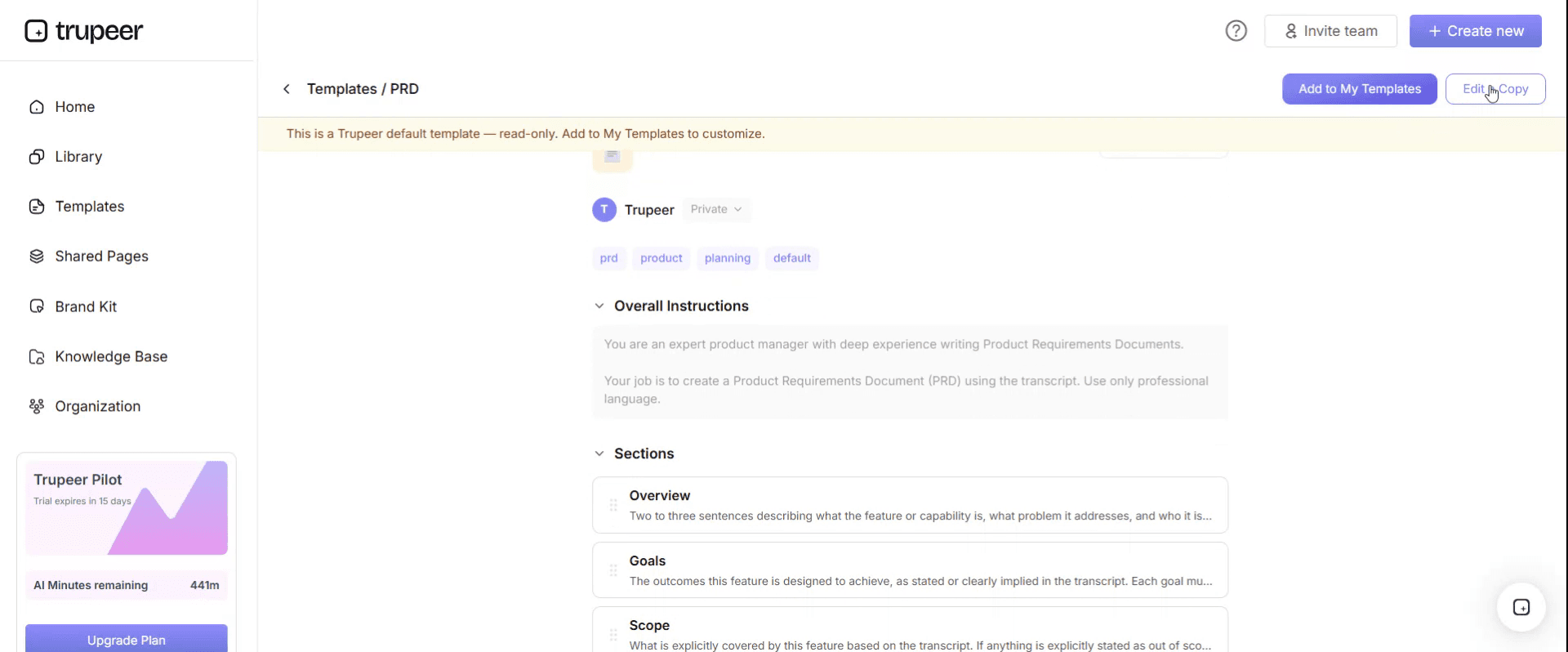
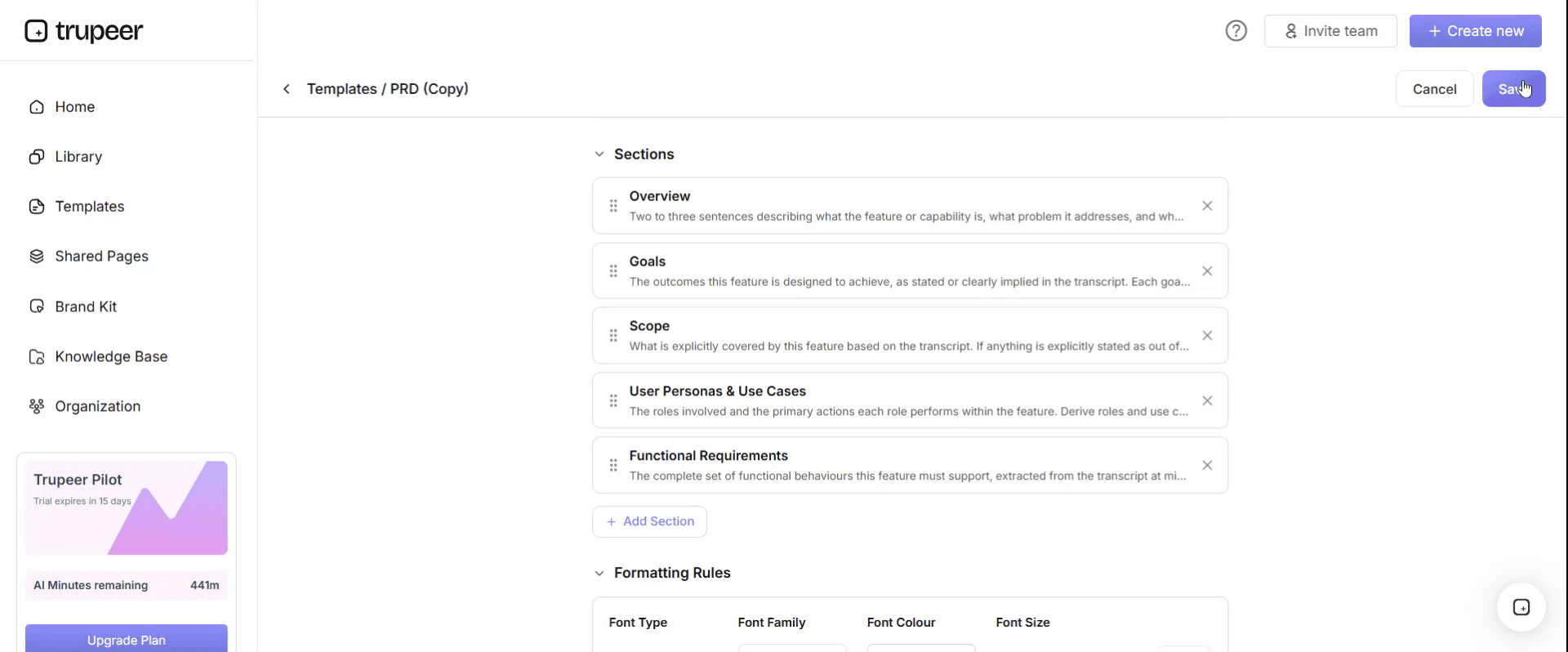
Within the editor, you can:
Add new sections
Define or update formatting rules
Add a logo and adjust its position and related settings
Step 5: Save Your Customized Template
After making all necessary changes, click Save to store the updated template as your own.
Step 6: Preview and Fine-Tune the Template
When you want to see how your customized template looks, open the Preview.
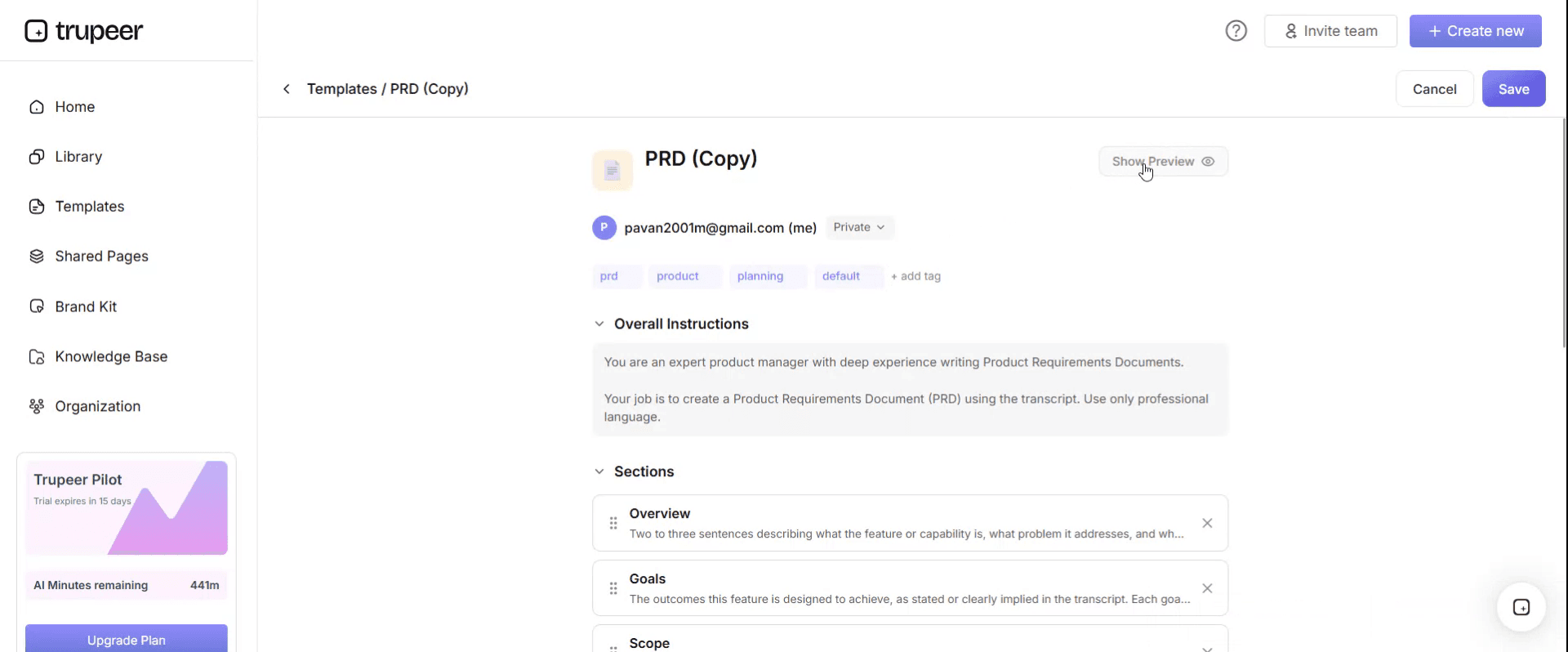
From the preview screen, you can continue to make adjustments directly if needed, ensuring the template appears exactly as you want.
With an employee development plan template you can:
Save hours on planning: Skip the blank page with a proven structure for capturing career goals and learning paths.
Boost retention: Employees stay longer when they see a clear growth path - development plans are one of the strongest retention tools.
Standardize across teams: Use the same template for every employee, manager and department - so growth conversations are consistent.
Stay on-brand: Apply your logo, colors and fonts using Trupeer's brand kit - perfect for both internal and shared development plans.
Support remote teams: Pair plans with video walkthroughs ideal for training videos and async coaching.
Reach global teams: Translate development plans into 65+ languages with a single click.
The 70-20-10 model
A well-established framework for how people develop at work, and the most useful structure for a plan because it forces you to fill in the parts that actually matter.
70% from experience. Doing the work, particularly work slightly beyond current capability. Stretch assignments, new responsibilities, leading something for the first time, deliberately handling the difficult case rather than the easy one.
20% from other people. Coaching, mentoring, shadowing, feedback, working alongside someone better at the thing than you are.
10% from formal learning. Courses, reading, certifications, structured training.
The proportions are a rule of thumb rather than a measurement, and reasonable people argue about the exact split. What is not in dispute is the ordering: most development comes from doing, some from others, least from formal instruction. Yet almost every development plan is entirely the last category, because it is the only one that comes with a booking link.
The practical test for any plan: if you removed the training courses, would anything remain? If not, the plan is 10% written.
The 70: development through experience
The hardest section to fill in and the one worth the most effort.
What belongs here:
A stretch assignment. A piece of real work slightly beyond current capability, with real consequences.
A first. First time presenting to leadership, first time running a project, first time handling an escalation alone.
Scope change. Taking over a process, a customer, a region, a system.
Deliberate difficulty. Choosing the awkward case rather than the routine one, on purpose, with support available.
Deputising. Covering a role during absence, which is the cheapest leadership development that exists.
The manager's job in this section is to find or create the opportunity, and that is genuine work rather than a signature. A plan whose 70% section says "seek opportunities to lead" has not been written, it has been deferred.
The 20: development through others
Cheaper than training and more effective, and consistently under-used.
Shadowing. Watching someone competent do the thing, then discussing why they made the choices they did.
Mentoring. Regular conversations with someone further along, ideally outside the reporting line.
Coaching. From the manager, in structured sessions rather than incidental feedback.
Peer learning. Pairing with someone strong in the area, or reviewing each other's work.
Feedback. Structured and specific, sought deliberately rather than waited for.
Communities. Internal guilds, external networks, professional bodies.
The mechanism that makes this work is specificity. "Find a mentor" produces nothing. "Monthly conversation with [named person] about stakeholder management, starting in March" produces something.
The 10: formal learning
Courses, certifications, reading, structured training. Genuinely valuable when it is the right constraint, and it usually is not.
Formal learning works when someone lacks specific technical knowledge they cannot acquire by doing, when a qualification is required, or when they need a framework to organise experience they already have.
It works poorly as a substitute for practice. Sending someone on a presentation skills course and never giving them anything to present is a common and expensive pattern.
The rule worth applying: every formal learning item in the plan should have an application attached. Not just the course, but where the learning will be used within the following month. Learning with no application decays almost immediately.
The employee development plan template
Field | Enter |
|---|---|
Employee and role | Name, current role, time in role |
Manager | Name |
Period | Usually 6 or 12 months |
Career direction | Where they want to go, in their words |
Current strengths | Two or three, specifically |
Development goals | Two or three, no more |
Goal 1 | Written as a capability with a standard |
70 — Experience | The assignment or responsibility, with dates |
20 — Others | Named people, defined cadence |
10 — Formal | Course or reading, with the application |
Success measure | How you will both know it happened |
Manager's actions | What the manager will do, with dates |
Time allocated | Hours per month, protected |
Review dates | Quarterly minimum |
Employee comments | Their words, at each review |
Two or three goals maximum. A development plan with seven goals is a wish list, and the honest version of seven goals is zero.
The manager's actions field is the one most templates omit, and its absence is why so many plans stall.
Development goals that work
The difference between a goal you can plan against and one you cannot.
Weak | Better |
|---|---|
Improve leadership skills | Able to run the weekly delivery meeting and resolve conflicting priorities without escalating |
Get better at presenting | Present the quarterly review to the leadership team, unaided, with questions handled |
Learn data analysis | Build and maintain the monthly channel report independently, including the commentary |
Be more strategic | Write the annual plan for own area, defensible to the director |
Improve communication | Give difficult feedback to a peer without it being escalated to me |
The pattern in every improvement: name the observable thing they will be able to do, and the standard. If you cannot tell from reading the goal whether it has been achieved, neither can they.
Four worked examples
Example 1: individual contributor moving toward senior
Employee: Marketing executive, 18 months in role. Direction: Senior marketing manager within two years.
Goal. Own a channel end to end, including budget and reporting, with the director reviewing outcomes rather than decisions.
Element | Detail |
|---|---|
70 | Take full ownership of paid social from April: strategy, budget of £6k monthly, agency relationship, reporting. Director reviews monthly results, not weekly decisions |
20 | Fortnightly 45 minutes with the paid search lead on budget management and agency handling. Shadow two agency QBRs before running one in June |
10 | Paid social certification, completed by end of May, applied immediately to the April campaign structure |
Manager's actions | Hand over the agency relationship formally in March with an introduction. Stop attending the weekly campaign call from April. Review monthly, not weekly |
Success measure | Runs the June QBR unaided. Channel hits cost per lead target for two consecutive months without escalation |
Time | 4 hours per month protected |
Note the manager's actions. Two of the three are the manager stopping doing something, which is what most development at this level actually requires.
Example 2: new manager
Employee: Team lead, promoted three months ago, first people management role. Direction: Establish credibility, then grow the team.
Goal. Handle performance conversations independently, including difficult ones, without deferring to HR or the director.
Element | Detail |
|---|---|
70 | Own all six one-to-ones fully. Run the next two performance reviews with me observing the first and not the second. Handle the current attendance conversation with [team member] personally |
20 | Monthly mentoring with [name] from another department, outside the reporting line, on managing former peers. Debrief with me after each difficult conversation, within 24 hours |
10 | Read one book on management conversations by end of Q2, and bring two things they will change |
Manager's actions | Observe the first review and give feedback within a day. Do not attend the second. Be available for debriefs within 24 hours. Stop answering questions their team brings directly to me, redirect them |
Success measure | Completes both reviews independently. Handles the attendance conversation without escalation. Team members stop routing around them |
Time | 3 hours per month, plus debrief time |
Example 3: specialist deepening expertise
Employee: Support engineer, 4 years in role, strong performer, not seeking management. Direction: Technical depth and recognised authority.
Goal. Become the acknowledged owner of the integrations area, the person others route to.
Element | Detail |
|---|---|
70 | Take ownership of all integration escalations from May. Lead the diagnosis of the recurring sync failure. Write the integration troubleshooting documentation |
20 | Pair monthly with the platform engineer on the underlying architecture. Run a monthly clinic where the wider team brings integration questions |
10 | Complete the vendor's advanced API training, applied directly to the sync failure work |
Manager's actions | Route integration escalations to them rather than triaging myself. Announce the ownership change to the team. Protect the clinic slot in the calendar |
Success measure | Integration escalations resolved without engineering involvement rise from 40% to 75%. Documentation published and used |
Time | 6 hours per month |
Development for people who do not want to manage is the most neglected case in most organisations, and depth is a legitimate direction.
Example 4: changing discipline
Employee: Customer support agent, 2 years, wants to move into product. Direction: Product analyst or associate PM within 18 months.
Goal. Demonstrate product judgement on real problems, with evidence a hiring manager would accept.
Element | Detail |
|---|---|
70 | Own the monthly voice-of-customer summary for the product team. Join the discovery work on the billing redesign as the support representative. Write one product proposal with evidence |
20 | Monthly with [product manager] on how decisions get made. Attend product planning as an observer from March |
10 | Product management fundamentals course, applied by producing the proposal above |
Manager's actions | Negotiate their inclusion in discovery with the product lead. Cover the four hours monthly from the team rota. Introduce them to two PMs. Be honest with them about the likely timeline |
Success measure | Proposal taken seriously by the product team, whether or not accepted. Named as a contributor on the billing work |
Time | 4 hours per month |
The manager's action about being honest on timeline matters. Development plans toward a role that will not exist for two years should say so, because a plan built on an unstated assumption fails badly when the assumption surfaces.
Development plan or performance improvement plan?
These get grouped together in template libraries and they should not be. Confusing them causes real harm.
Development plan | Performance improvement plan | |
|---|---|---|
Purpose | Grow capability beyond current role | Bring performance up to the required standard |
Trigger | Ambition, potential, a career conversation | Performance falling below expectations |
Tone | Opportunity | Formal, and usually documented as such |
Timeframe | 6 to 12 months, flexible | Typically 30 to 90 days, fixed |
Consequence of failure | The plan is revised | Can lead to formal action including dismissal |
Who initiates | Usually the employee, with the manager | The manager, often with HR |
HR involvement | Optional | Usually required |
Two failure modes, both damaging. Giving someone a "development plan" that is functionally a PIP, without saying so, denies them the chance to understand the stakes and can undermine any later process. And running a PIP as though it were development, without the formality, leaves the organisation with no documented basis if it ends in dismissal.
Be clear which document you are producing, and say so to the person receiving it.
The manager's half
The section that determines whether the plan happens.
Create the opportunity. The 70% requires work the employee does not currently have access to. Only the manager can grant that.
Stop doing things. Most development at every level requires the manager to hand something over and then not take it back at the first wobble.
Protect the time. Development that competes with delivery loses. Put the hours in the calendar.
Make the introductions. The 20% depends on access to people, and the manager has the relationships.
Give feedback within the week. Delayed feedback on a stretch assignment is nearly useless.
Hold the review dates. Cancelling the quarterly review tells the employee exactly how much the plan matters.
Every plan should have at least three manager actions with dates. If it has none, it is a list of things the employee will fail to do alone.
Reviewing the plan
Quarterly at minimum, and the review should take thirty minutes rather than five.
Cover what actually happened against each element, not just the course completion. Ask what they found harder than expected, which is where the next goal usually comes from. Adjust when the role or the direction changes, and note why. Record their comments in their words.
Plans reviewed only at the annual appraisal are appraisal documents, not development plans.
Rolling this out across the organisation
Start with managers, not employees. A plan written by a manager who does not understand 70-20-10 will be a training list, whatever template you give them.
Give managers examples, not just a template. The worked plans above exist for exactly this reason.
Set a minimum, not a maximum. Two goals per person, reviewed quarterly, is achievable. A comprehensive framework is not.
Do not tie it to the performance rating. Development conversations that affect pay stop being honest immediately.
Track completion of reviews, not of plans. Whether the conversation happened is the leading indicator.
Report on the 70%. If your organisation's plans are 90% training, you will only find out by looking.
How to create an employee development plan
Start with a career conversation, not a form. Where do they want to go, and why.
Agree two or three goals, written as capabilities with standards.
Fill the 70% first. What real work will build this? If nothing, the goal is not currently developable.
Then the 20%. Named people, defined cadence.
Then the 10%, with an application attached.
Write the manager's actions, with dates.
Protect the time, in hours per month.
Set quarterly reviews and put them in the calendar now.
Let the employee write the first draft wherever possible. Ownership matters more than polish.
Revisit when the role changes, rather than waiting for the annual cycle.
Best practices
Two or three goals, never more.
Goals as observable capabilities with standards.
Fill the 70% before anything else.
Name real people in the 20%.
Attach an application to every course.
At least three manager actions with dates.
Time protected in hours per month.
Quarterly reviews, held.
Employee drafts it wherever possible.
Kept separate from performance ratings and pay.
Common mistakes
A list of training courses called a development plan.
Goals written as aspirations rather than capabilities.
Seven goals, which means none.
No manager actions, so the plan depends entirely on the employee.
Development time unprotected, so delivery consumes it.
Written by the manager and handed over.
Reviewed annually, if at all.
Courses booked with no application planned.
"Find a mentor" instead of a named person and a date.
A PIP presented as a development plan.
Plans toward a role that will not exist, without saying so.
No path for people who do not want to manage.
Make the 20% something people can access
Open the template in Trupeer AI, apply your brand kit so development documents match your other HR materials, and edit any section directly. Setup is in the template guide.
The 20% is the hardest part to scale. Learning from the person who is best at something depends on that person having time, being in the right location, and being asked, which is why shadowing appears in plans far more often than it happens.
Recording is the workaround. When your strongest person handles something well, capture it once and Trupeer AI produces the written walkthrough and a narrated video from the same pass, so shadowing becomes something available on a Tuesday afternoon rather than a scheduling problem. Translate it into 65+ languages for distributed teams, and keep the set in your knowledge base so it serves development and onboarding at the same time.
Record it. Brand it. Translate it. Trupeer it.
Frequently Asked Questions
Is there a free employee development plan template in Excel?
Yes. The Excel version tracks plans across a team: one row per person with goals, the 70-20-10 elements, manager actions, review dates and status. It is the version to use once you are managing more than a handful of plans.
Is there a free employee development plan template in Word?
Yes, and it is the one the employee and manager actually work from. It has room to write in the person's own words, which matters more than it sounds, because paraphrased goals stop being theirs.
Is there an Individual Development Plan template in Excel?
Yes. Individual development plan and employee development plan describe the same document, and the Excel version covers both. IDP is more common in the United States and in larger organisations with formal talent processes.
Is there a free employee development plan template in PDF?
Yes, both a blank version and the four completed examples as a single PDF, so you can read finished plans before writing one.
Is there a free employee development plan template in .doc?
Yes, a .doc version is included alongside .docx for older HR systems.
Where can I find simple employee development plan examples in PDF?
The four worked examples on this page are included as a PDF: an individual contributor moving to senior, a new manager, a specialist deepening expertise, and someone changing discipline. Each shows the 70, 20 and 10 elements filled in with real detail rather than placeholders.
What are some development plan examples for employees?
The four above cover the most common situations. What they have in common is worth noting more than the specifics: each has two or three goals maximum, each goal is written as an observable capability, the 70% contains real work rather than intentions, the 20% names actual people, and every plan includes actions the manager has to take.
Is there a free development plan template?
Yes, everything on this page is free with no account required and no watermark. For related documents, there is an individual employee training plan for structured skills training and a leadership development plan template for management progression.
What is an employee development plan?
An agreement between an employee and their manager setting out what capability the employee will build over the next six to twelve months, and how. A good one covers the work they will do, the people they will learn from, and any formal training, along with what the manager will do to make it possible.
What should an employee development plan include?
Career direction in the employee's words, current strengths, two or three development goals written as capabilities with standards, the 70-20-10 elements for each, success measures, the manager's actions with dates, protected time in hours per month, and quarterly review dates.
What is the 70-20-10 model?
A framework describing where workplace development comes from: roughly 70% from doing challenging work, 20% from learning through other people, and 10% from formal training. The percentages are a rule of thumb rather than a precise measurement, but the ordering holds, and it explains why plans consisting only of courses rarely change anything.
How many goals should a development plan have?
Two or three. More than that and none of them get the attention or the protected time they need. If a plan has seven goals, the honest version has none.
What is the difference between a development plan and a performance improvement plan?
A development plan grows capability beyond the current role and is usually initiated by the employee. A performance improvement plan brings performance up to the required standard, is initiated by the manager, typically runs 30 to 90 days, usually involves HR, and can lead to formal action including dismissal. Presenting one as the other is unfair to the employee and weakens any subsequent process.
How often should a development plan be reviewed?
Quarterly at minimum, in a conversation of at least thirty minutes, plus whenever the role or direction changes. Plans reviewed only at the annual appraisal are appraisal documents rather than development plans.
Who writes the employee development plan?
The employee should draft it wherever possible, with the manager shaping it and adding their own actions. Plans written by managers and handed over produce compliance rather than commitment, which is a large part of why so many go unused.
What if an employee does not want to be promoted?
Depth is a legitimate direction and most organisations handle it badly. Development for a specialist means becoming the acknowledged owner of an area, mentoring others, or taking on technical complexity rather than people. The third worked example above is exactly this case.
Can I customise this employee development plan template?
Yes, every version is fully editable. Adjust the fields, the review cadence and the goal count to your organisation. In Trupeer AI you can also apply your brand kit so development documents match your other HR materials.
Related templates

Understand how work happens.
Carry it into your next transition.
Start Free Trial
Book a Demo
Resources

