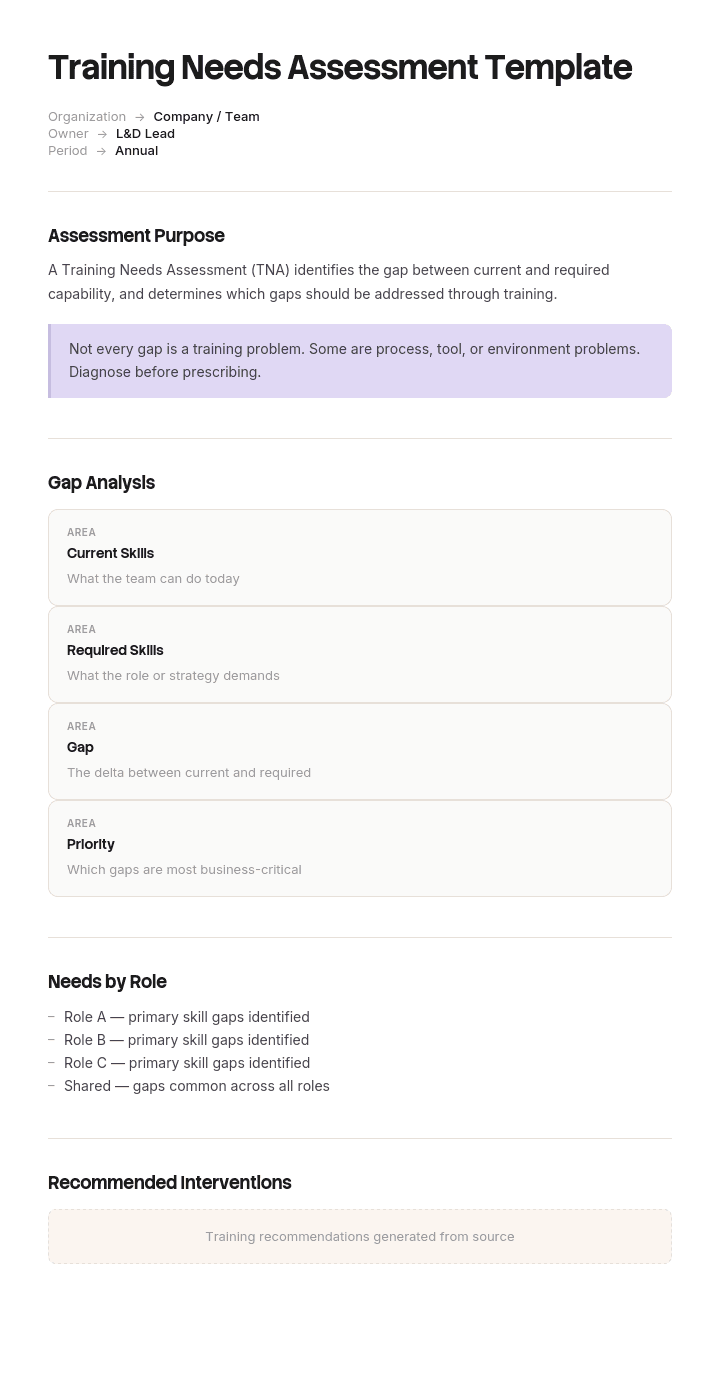
Use this template
Most training fails because it solves the wrong problem - or no problem at all. With Trupeer, you can save hours on assessment design by starting with a free training needs assessment template, customizing it with your brand guidelines, and turning assessment results into video summaries that secure executive buy-in for training programs.
What is a free training needs assessment template?
A free training needs assessment template is a reusable structure for working out what training an organisation, a team or an individual actually needs, before anybody designs or buys any.
Every published version does broadly the same thing. It asks what skills are required, what skills exist, and it subtracts one from the other to produce a gap. That gap becomes a training plan.
The arithmetic is fine. The assumption underneath it is the problem, and it is built into the name of the document. A training needs assessment sets out to find training needs, and an instrument designed to find training needs will find them, whether or not training is what the situation requires.
The template is not the issue. What decides whether the exercise is worth doing is one question asked before the gap analysis begins, covered two sections down.
Format follows use. A free training needs assessment template Excel version suits the gap matrix, the scoring and anything covering many roles at once. A free training needs assessment template Word file suits the narrative and the report. A free training needs assessment template PDF suits the issued version.
Training needs assessment or training needs analysis?
The same thing, and the terms are used interchangeably, which is worth stating because the search results mix them freely.
Training needs analysis, usually shortened to TNA, is the more common phrase in the United Kingdom and in learning and development generally. Training needs assessment is more common in North America and in public sector and healthcare contexts.
There is occasionally a claimed distinction, with assessment covering the identification and analysis covering the diagnosis, but it is not consistently observed and nobody will misunderstand you either way. A training needs analysis template Excel file, a training needs analysis template Word file and a training needs assessment template are the same document under different names, and a training needs analysis example PDF is the same thing filled in.
What matters far more than the label is whether the document tests its own assumption, which almost none do.
How to customize this template in Trupeer
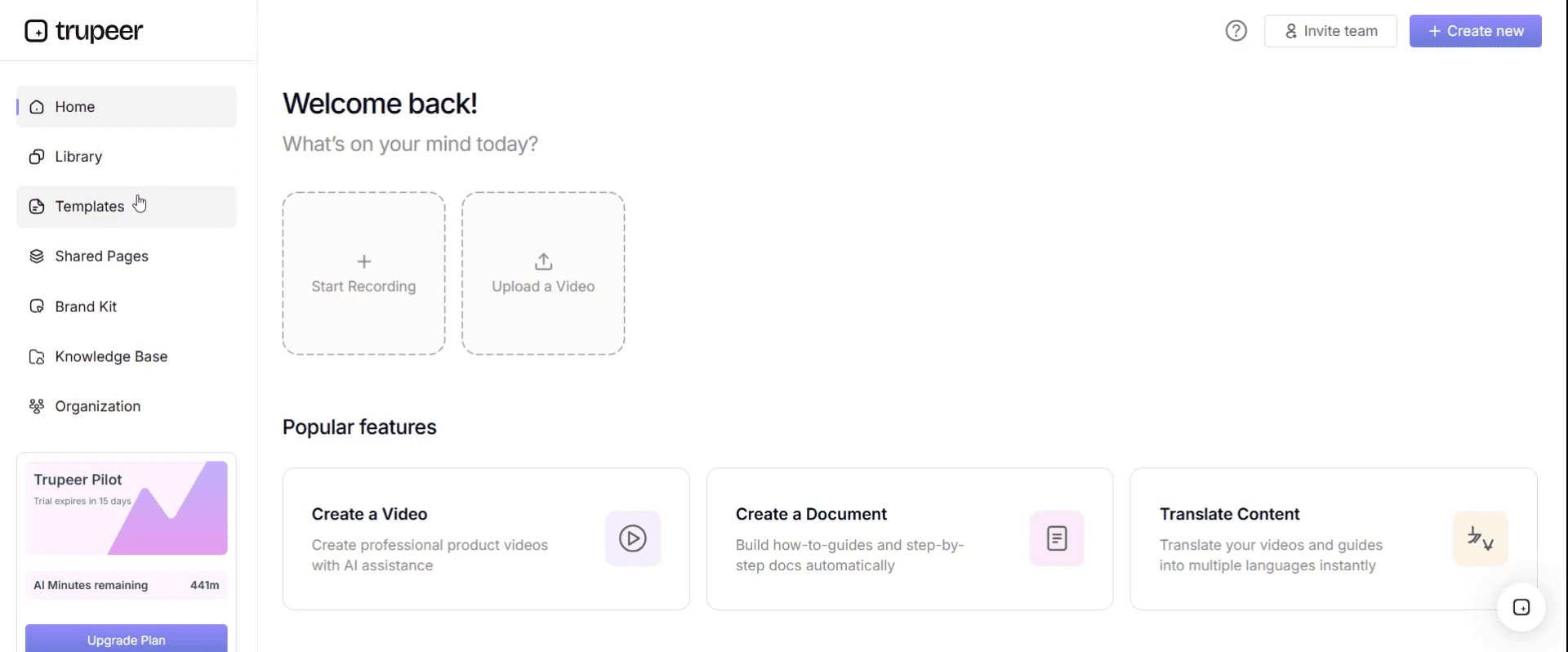
Step 1: Open the Templates Section
Go to the Templates section from the main navigation.
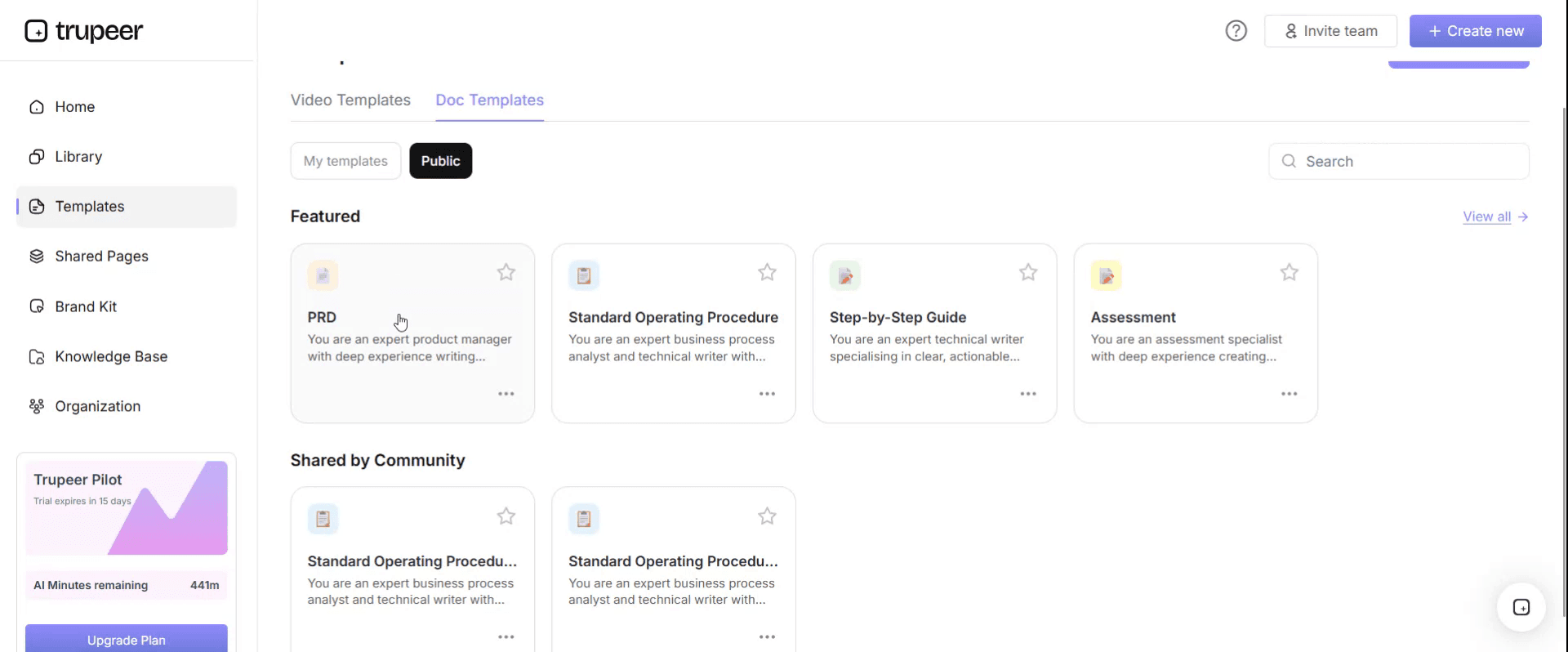
Step 2: Select and Open a Template
Click on any template you want to work with to open it.
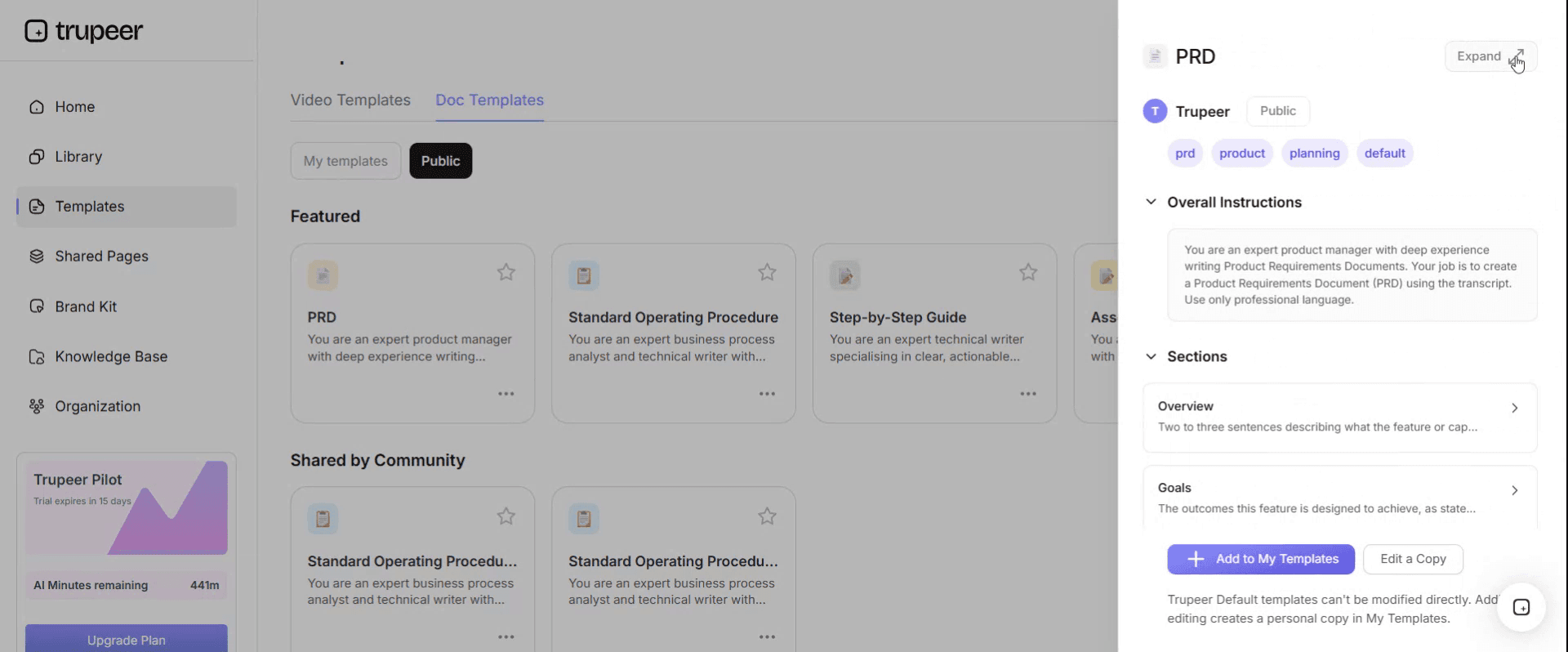
Step 3: Expand the Template View
If needed, expand the template view to see the full layout and details clearly.
Step 4: Edit the Template
Click on Edit to start modifying the selected template.
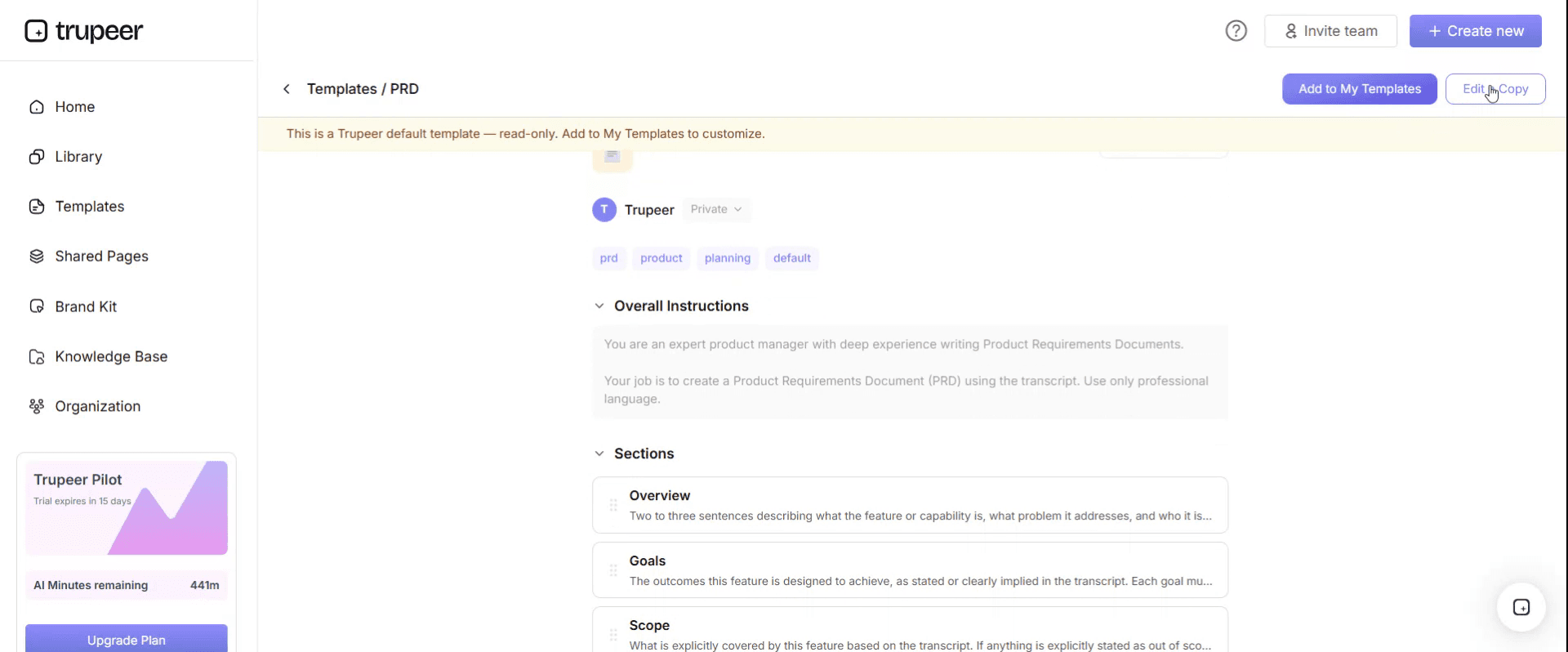
Within the editor, you can:
Add new sections
Define or update formatting rules
Add a logo and adjust its position and related settings
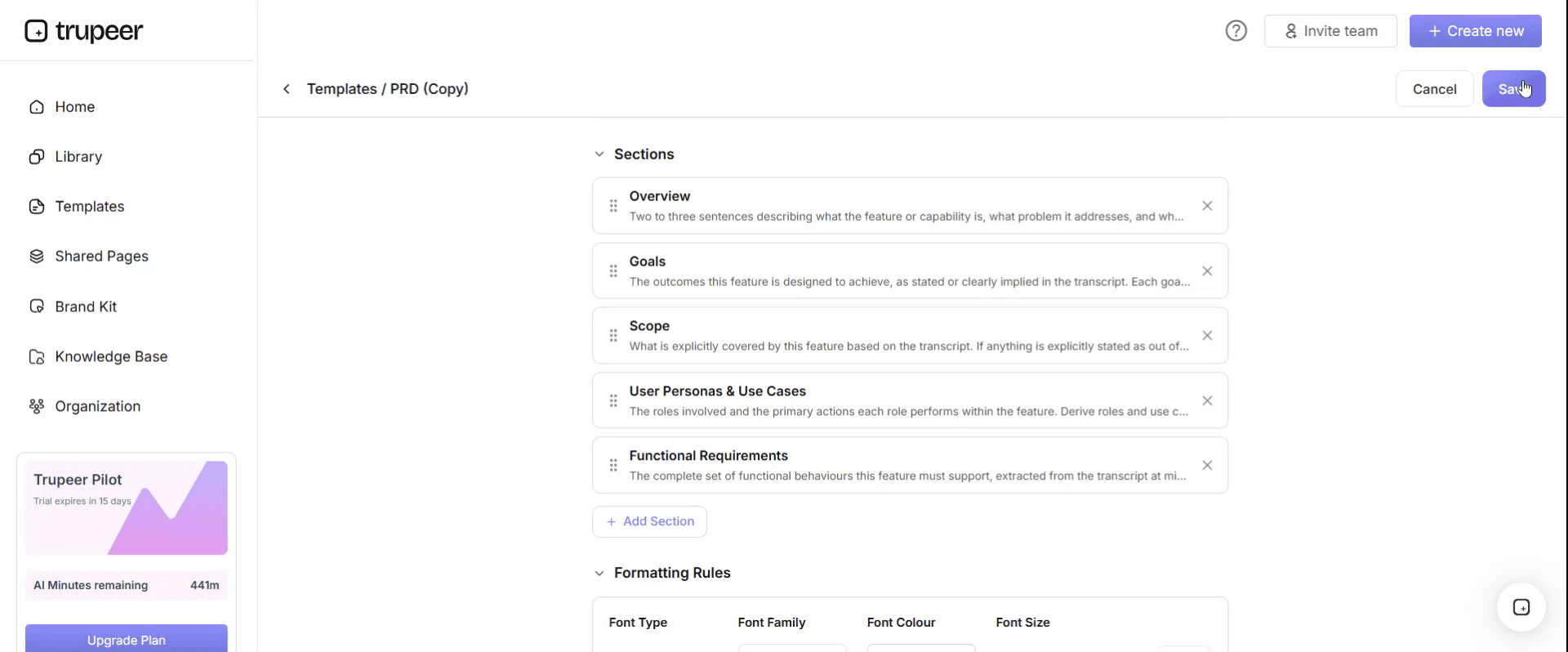
Step 5: Save Your Customized Template
After making all necessary changes, click Save to store the updated template as your own.
Step 6: Preview and Fine-Tune the Template
When you want to see how your customized template looks, open the Preview.
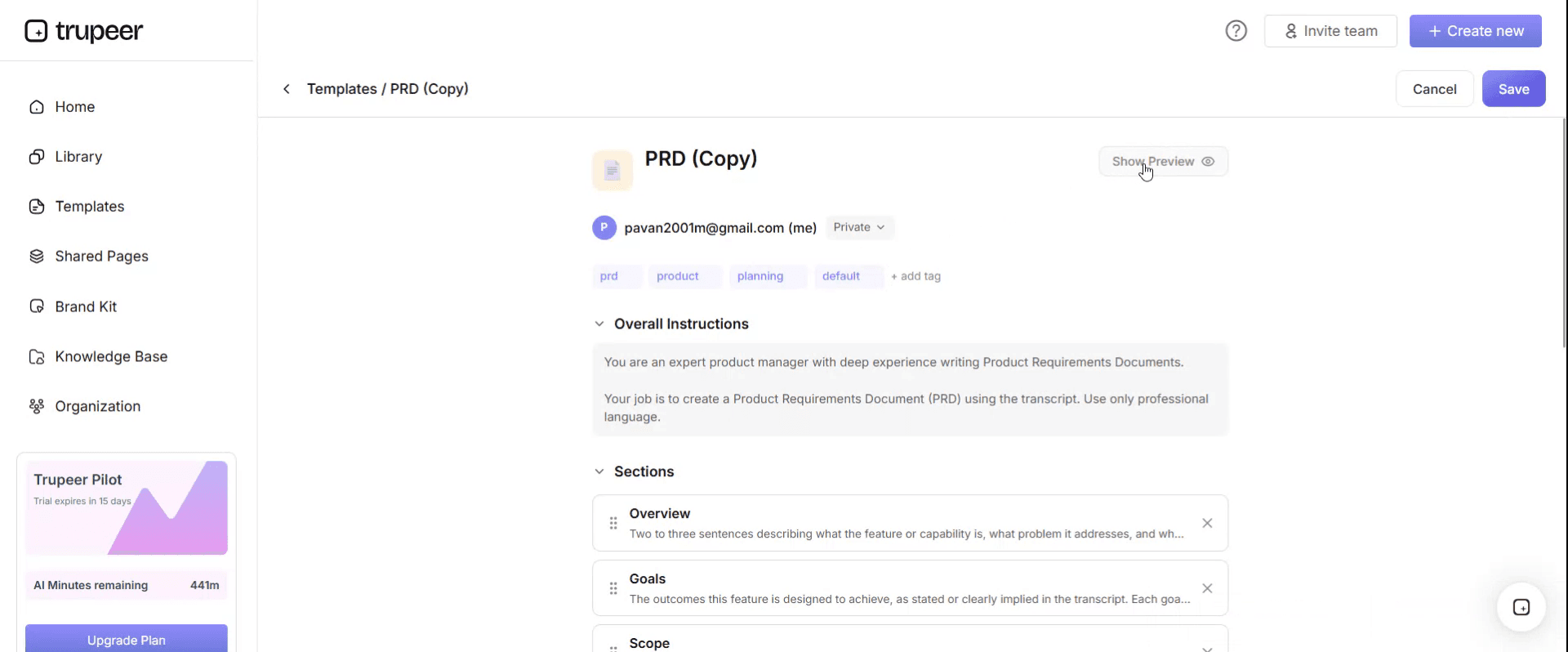
From the preview screen, you can continue to make adjustments directly if needed, ensuring the template appears exactly as you want.
With a training needs assessment template you can:
Save hours on assessment: Skip the blank page with a proven L&D structure.
Invest in the right training: Built-in fields tie training to actual business performance gaps.
Stay on-brand: Apply your logo, fonts and colors using Trupeer's brand kit.
Secure executive buy-in: Convert assessments into video summaries leaders can quickly review.
Standardize across initiatives: Use the same template for every training need.
Reach global L&D teams: Translate assessments into 65+ languages with one click.
Most assessments assume the answer is training
Here is the sequence that plays out in most organisations.
Somebody notices a performance problem. Errors are too high, a process is too slow, a metric is missing its target. Training is proposed, because training is the available response and because it is nobody's fault in a way that other explanations are not.
A needs assessment is conducted. It surveys the people doing the work and asks about their confidence and their knowledge. People report that they would like more training, because almost everybody says yes when asked whether more training would help.
A module is designed and delivered. Completion is high. Feedback is positive.
The performance problem does not move.
This happens often enough to be the normal outcome rather than an unusual one, and the reason is that the assessment never established whether the gap was a skills gap. It asked what training people wanted and got an answer.
The one question that prevents it comes from the performance analysis tradition and it is disarmingly simple.
Could they do it today, correctly, if it genuinely mattered? If somebody stood beside them and the outcome was consequential, would they get it right?
If the answer is yes, they can do it and are not doing it, which is not a training problem. No amount of instruction improves the performance of somebody who already knows how.
If the answer is genuinely no, you may have a training need, and the rest of the assessment is worth doing.
The five causes of a performance gap
Applied properly, this is a fifteen minute conversation per gap and it changes the conclusion more often than not.
They do not know what is expected. The standard has never been stated, or was stated once at induction, or is stated differently by different supervisors. The remedy is telling them, which is not training and takes an afternoon.
They do not have what they need. Tools, time, information, access, a system that works. This is the most commonly misdiagnosed cause, because a person working around a broken tool looks exactly like a person who has not been trained.
They get no feedback. They cannot tell whether they are doing it correctly, or the feedback arrives weeks later from somebody else. Without feedback, performance drifts regardless of how well somebody was trained.
The consequences point the other way. They are measured on something that conflicts with doing it properly. Where speed is enforced and quality is not, people will be fast. This is not a character failing, it is a rational response to how the job is measured.
They lack the knowledge or skill. The genuine training need, and the last of the five to check rather than the first.
Only the fifth is solved by training. The first four are solved by clarity, resources, measurement and incentives, and all four are cheaper than a training programme.
A useful discipline: for every gap on your assessment, record which of the five it is. If most of your gaps land in the fifth, check the analysis rather than congratulating yourself, because that distribution is unusual.
What a training needs assessment template must contain
Nine components. The third and fourth are where this differs from a standard template.
Component | What it does |
|---|---|
The performance gap, stated as a number | Not "customer service could be better" but "thirty one percent of deliveries lack a usable photo". A gap you cannot measure cannot be closed or evidenced. |
Who is affected | Roles, sites, numbers. Whether it is everybody or a subset, because a subset points at a cause. |
The five cause test | Which of the five applies, with the evidence for that conclusion. |
Could they do it if it mattered | Recorded explicitly, with how you established it. |
Required capability | What somebody should be able to do, stated as an observable action rather than a topic. |
Current capability and how it was established | Observation, assessment, output data. Self reported confidence is the weakest evidence and the most commonly used. |
Recommendation | Which of the five remedies, not automatically training. |
Cost and expected effect | What the remedy costs and what change you expect in the number from the first row. |
Review point | When you will look at that number again to see whether it worked. |
The last two rows turn an assessment into something falsifiable. Most needs assessments recommend training and are never checked against the outcome, which is why the same gaps reappear in the following year's assessment.
Free training needs assessment template: the structure to copy
Filled with a real example rather than placeholders. The organisation is a logistics business.
Copy from here.
Performance gap, as a number. Thirty one percent of deliveries have a missing or unusable proof of delivery photograph. Measured from the delivery system over three months. Cost is around two hundred and ten thousand pounds a year in credited claims we cannot defend.
Who is affected. Three hundred and forty drivers across six depots. Rates by depot: Depot A eleven percent, B fourteen percent, C thirty eight percent, D forty one percent, E thirty nine percent, F forty three percent. Note the split, which is the most informative line in this document.
The five cause test.
Cause | Applies? | Evidence |
|---|---|---|
Do not know what is expected | Partly | 71 percent could state the requirement correctly when asked, before any training |
Do not have what they need | Yes | Depots C to F use the older handheld. Its camera takes about 11 seconds to focus and fails frequently in low light. Depots A and B use the newer device. |
No feedback | Yes | Photo rejection happens in the back office and is never communicated to the driver |
Consequences point the other way | Yes | Drop time targets are enforced per driver. Photo quality is not measured per driver at all. |
Lack knowledge or skill | No | Drivers who use the newer handheld achieve 11 to 14 percent without additional training |
Could they do it if it mattered. Yes, on the newer device. Established by observing twelve drivers across two depots and by the depot split above. On the older device, several could not do it reliably regardless of effort.
Required capability. Capture a photograph at the point of delivery that shows the parcel, the location and any signature, legible enough to be used in a dispute.
Current capability and evidence. Adequate where the device permits it. Evidence is output data by depot plus direct observation, not self reported confidence.
Recommendation. Not training. Replace handhelds at depots C to F. Add a same day message to the driver when a photograph is rejected. Add photo quality to the depot dashboard alongside drop times.
Cost and expected effect. Device replacement ninety four thousand pounds one off. Feedback message and dashboard change, four days of development. Expected effect: rate below ten percent within four months, based on the rates already achieved at depots A and B.
Review point. Four months, against the same measure from the same source.
Copy to here.
Training needs assessment example: seventy one percent already knew
Farnworth Logistics employs about eleven hundred people across six depots, with three hundred and forty drivers.
Thirty one percent of deliveries had a missing or unusable proof of delivery photograph. Customers disputed deliveries the company could not defend, and credited claims were running at around two hundred and ten thousand pounds a year.
A training needs assessment was conducted properly by the standards normally applied. Drivers were surveyed about their understanding of the requirement. The finding was a lack of understanding of proof of delivery standards.
A forty five minute module was developed and delivered to all three hundred and forty drivers over eight weeks. Two hundred and fifty five hours of driver time plus development came to about sixty eight thousand pounds.
Six months later the rate was twenty nine percent.
Somebody then applied the five cause test, and four of the five turned out to apply.
Knowledge was never the constraint. Seventy one percent could state the requirement correctly before the training, and eighty eight percent afterwards. Seventeen percentage points of knowledge gain had produced two points of performance change, which is the signature of a problem that was never about knowledge.
The tools were the constraint. Four of the six depots used an older handheld whose camera took around eleven seconds to focus and failed regularly in poor light. Drivers working to enforced drop times skipped it, which was the rational choice available to them.
Feedback did not exist. Rejections happened in the back office weeks later and were never communicated to the driver who took the photograph.
And the consequences pointed the other way. Drop time was measured per driver and enforced. Photo quality was measured nowhere at driver level.
The depot data had contained the answer the whole time. Depots A and B, on the newer device, were running at eleven and fourteen percent without any additional training. That split was in the reporting before the assessment began and nobody had looked at it, because the question being asked was what training drivers needed.
The remedy cost ninety four thousand pounds for device replacement, which is more than the training cost, plus four days of development for the feedback message and the dashboard change.
The rate went from twenty nine percent to six percent in four months. Credited claims fell by about a hundred and seventy thousand pounds a year.
The sixty eight thousand pounds spent on training was not wasted through incompetence. It was spent because the instrument used to diagnose the problem was designed to find training needs.
How to conduct a training needs assessment in six steps
State the gap as a number, with its source. If you cannot, you have a concern rather than a gap, and you will not be able to tell whether anything you do works.
Break the number down by site, team, shift and individual. Variation is diagnostic. A gap that is uniform points at knowledge or standards. A gap concentrated in some places points at tools, supervision or measurement.
Ask whether they could do it if it mattered. Establish it by observation, not by survey. Watch the work.
Test all five causes before concluding. Record which applies and what the evidence was.
Recommend the remedy the cause implies, which is training only where the fifth cause applies.
Set the review point and the expected number. An assessment with no falsifiable prediction cannot be learned from.
Step two is the cheapest and most neglected. Farnworth's answer was sitting in their own reporting before anybody surveyed anybody.
Questions worth asking
Most needs assessments ask people what training they want. Better questions get better information.
About the work, not the training. Walk me through how you did this yesterday. What slowed you down. What did you have to work around. Where did you have to guess.
About the standard. What does good look like here, in your own words. Who told you that. How do you know when you have got it wrong.
About feedback. How would you find out if you had done this badly. How long would it take. Who tells you.
About the conflict. What are you measured on. If doing this properly made you slower, which would you choose, and what would happen.
Only then about capability. Is there any part of this you were never shown how to do.
Notice that the last question is the only one a conventional assessment asks, and that answering the four before it usually makes the answer to it unnecessary.
Avoid asking whether people would like more training. Almost everybody says yes, the answer carries no information, and it commits you to an intervention before the diagnosis.
What goes in the assessment report
Six sections, and it should be short. Two to four pages.
The gap as a number, with its source and its cost. The breakdown showing where it is concentrated. The five cause analysis with evidence per cause. The recommendation, with which cause it addresses. The cost against the expected change in the number. And the review point.
What to leave out: survey results reporting how people feel about their own confidence, unless they are supporting evidence for something established another way. Self reported confidence correlates weakly with capability and strongly with recent experience, which makes it a poor basis for spending money.
Where the recommendation is not training, say so plainly and early. A report that buries a device replacement recommendation on page nine of a training document will have its recommendation ignored, because everybody reading it expects a training plan.
Levels: organisational, team and individual
The same five cause logic applies at three levels and the evidence differs.
Organisational. Driven by strategy, regulation or a systemic performance problem. Evidence is output data, audit findings and incident patterns. The risk at this level is assuming a widespread gap is a capability gap, when widespread gaps more often indicate a standards or systems problem.
Team or role. The most common level and the one the template above suits. Comparison between similar teams is the strongest evidence available, as it was at Farnworth.
Individual. Here a genuine capability gap is more likely, since the variation is within a group facing the same tools, standards and measures. Where one person is behind their peers, the fifth cause becomes plausible in a way it was not at team level. The individual training plan covers what follows.
Once needs are confirmed, the schedule for meeting them belongs in the training plan and the content in the training manual.
What a free training needs assessment template cannot fix
A gap nobody has measured. No free training needs assessment template free download will produce a number for you, and without a number the exercise is a discussion.
An organisation that has already decided. Where training has been announced before the assessment, the assessment becomes a justification. That is worth naming rather than participating in.
Self reported evidence. Surveys are cheap and observation is expensive, which is why most assessments rest on the weaker one. No training needs analysis template Excel free download will change what evidence you gather.
Incentives pointing the wrong way. The fourth cause is the hardest to remedy because it usually requires changing what somebody senior chose to measure, and a training recommendation is considerably easier to get approved.
Show the work rather than surveying it
The strongest evidence in the whole assessment is watching people do the job, and it is the step that gets replaced by a survey because watching costs time and travel.
Farnworth's diagnosis came from observing twelve drivers across two depots. That is a day and a half of somebody's time, and it produced a conclusion that sixty eight thousand pounds of training had not.
Trupeer AI makes that observation reproducible and cheap. Recording several people performing the same task produces a written walkthrough with screenshots and a video, in your own branding, and the differences between the recordings are the diagnosis. Where two people do the same job differently, one of them has found a workaround, and a workaround is evidence about tools, standards or feedback rather than about skill.
Record it. Brand it. Translate it. Trupeer it.
Two further consequences. Where the assessment does conclude that training is needed, a recorded walkthrough is frequently the whole intervention, and it costs a fraction of a course for a genuine knowledge gap that affects a handful of steps. And where the first cause applies, meaning nobody ever stated the standard clearly, a recording of the task done properly is the cheapest way to state it.
The material sits in your knowledge base and doubles as training. Consistency across your documents is a matter of setting the brand kit once, and setup is covered in the document template setup guide.
Frequently Asked Questions
Is there a free training needs assessment template Excel version?
Excel is the right tool for the analytical half. A free training needs assessment template Excel file handles the gap matrix, scoring across roles, and the breakdown by site or team that tells you where a gap is concentrated.
The most useful thing you can build in it is not the skills matrix. It is a single table of the performance number broken down by team, site and shift, because variation is what distinguishes a capability gap from a tools or measurement problem.
Is there a training needs analysis template Excel version?
The same document under the more common British name. A training needs analysis template Excel file will give you a skills matrix with required and current levels per role, which is the standard format.
Add one column to it: which of the five causes this gap is attributed to, and the evidence. Without that column a skills matrix quietly assumes every gap is a skills gap, which is the assumption worth testing.
Where can I get a training needs analysis template Excel free download?
Widely available from learning and development sites and consultancies, and most are variations of the same matrix. A training needs analysis template Excel free download will give you rows for competencies and columns for people, scored.
They are genuinely useful for the fifth cause and silent on the other four. Treat one as the last step of an assessment rather than the whole of it.
Is there a free training needs assessment template Word version?
Word suits the report rather than the analysis. A free training needs assessment template Word file works for the narrative: the gap, the evidence, the five cause analysis and the recommendation.
Keep it to two to four pages and put the recommendation on page one. A recommendation that is not training, buried inside a document titled training needs assessment, tends to be read past.
Is there a training needs analysis template Word version?
Yes, and a training needs analysis template Word file is the same thing. The naming varies by region rather than by content.
Whichever you use, structure the report around the gap and its causes rather than around the training you propose. A report organised around a proposed course cannot easily conclude that no course is needed.
Is there a free training needs assessment template PDF?
PDF suits the issued report, particularly where it supports a funding request or a regulatory requirement. Export a free training needs assessment template PDF once agreed, with the date and the review point on it.
The review point is the field worth protecting. An assessment PDF filed without a date to revisit the number becomes a historical document rather than something anybody learns from.
Where can I find a training needs analysis example PDF?
Public sector bodies, skills agencies and healthcare organisations publish real ones, and a training needs analysis example PDF from those sources is more instructive than a commercial template because it had to justify actual spending.
Read them for what evidence they relied on. The good ones cite output data and observation. The weaker ones cite survey responses about confidence, and they are the majority.
Is there a free training needs assessment template free download worth using?
The matrix takes half an hour to build and every published version is broadly similar, so a free training needs assessment template free download saves you little.
Judge any of them on one question. Does it ask whether the person could already do the task if it mattered? None do, and that single question determines whether the entire exercise leads anywhere useful.


