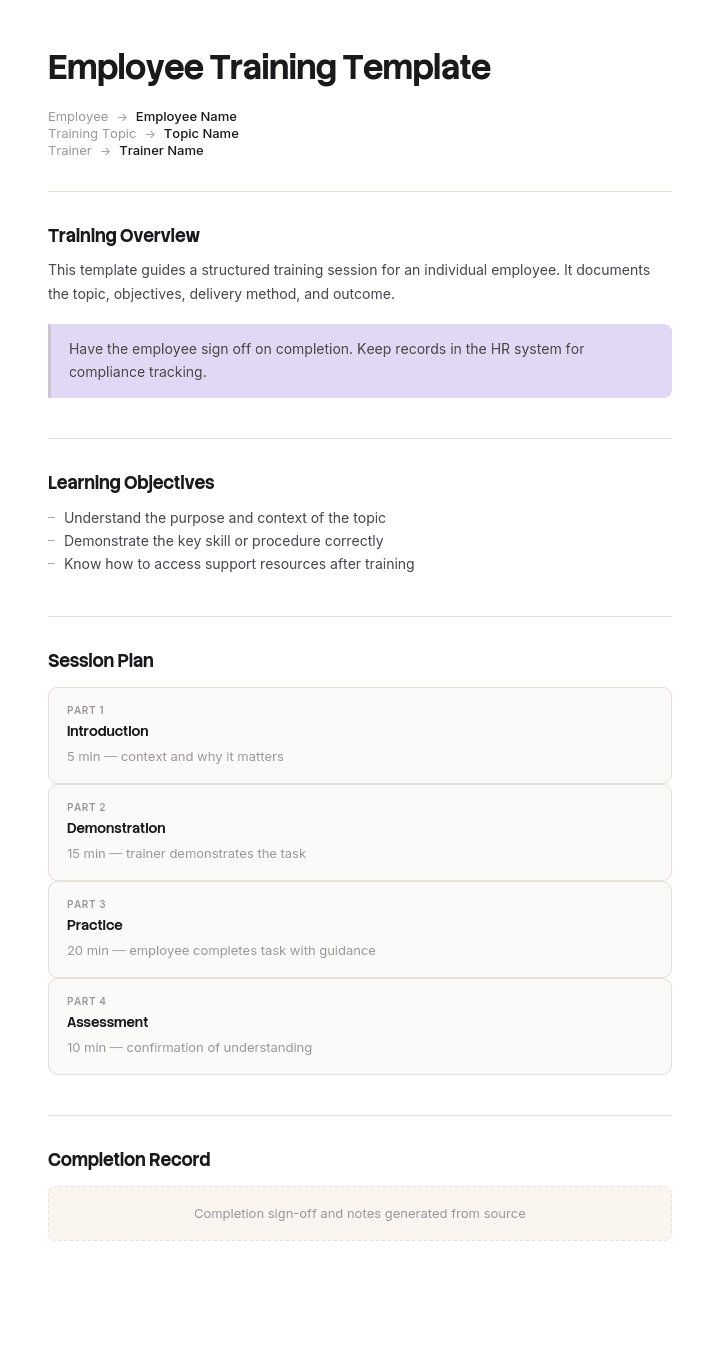
Use this template
Effective employee training is one of the highest-ROI investments any company can make - it drives performance, retention and culture. With Trupeer, you can save hours on training design by starting with a free employee training template, customizing it with your brand guidelines, and delivering it as video-based training employees actually finish.
Most organisations know what training they have delivered. Very few can answer the more useful question, which is who is currently qualified to do what, and what expires next month.
That is a tracking problem rather than a planning problem, and it needs a matrix rather than a plan.
Download the employee training templates
Format | Best for |
|---|---|
Excel (.xlsx) | The training matrix, records, expiry tracking and the schedule |
Word (.docx) | Session plans, attendance sheets and evaluation forms |
Printable attendance sheets and certificates of completion | |
Google Sheets | Shared matrix that managers can view and update |
.doc | Older HR systems |
Free, editable, no watermark. Excel is the centre of gravity here, because everything on this page is fundamentally a table.
Which training document do you need?
Four different things get called a training template. Pick the right one first.
You need to... | Use | Where |
|---|---|---|
Decide what training people need | Training needs assessment | |
Plan what training will happen, for whom, when | Training plan | |
Plan one person's development over months | Individual plan | |
Track who is trained, when, and what expires | Training matrix and records | This page |
Write the content people are trained on | Training manual | |
Grow capability beyond the current role | Development plan |
Most teams need the assessment, the plan and the matrix. The matrix is the one that gets asked for in an audit.
How to customize this template in Trupeer
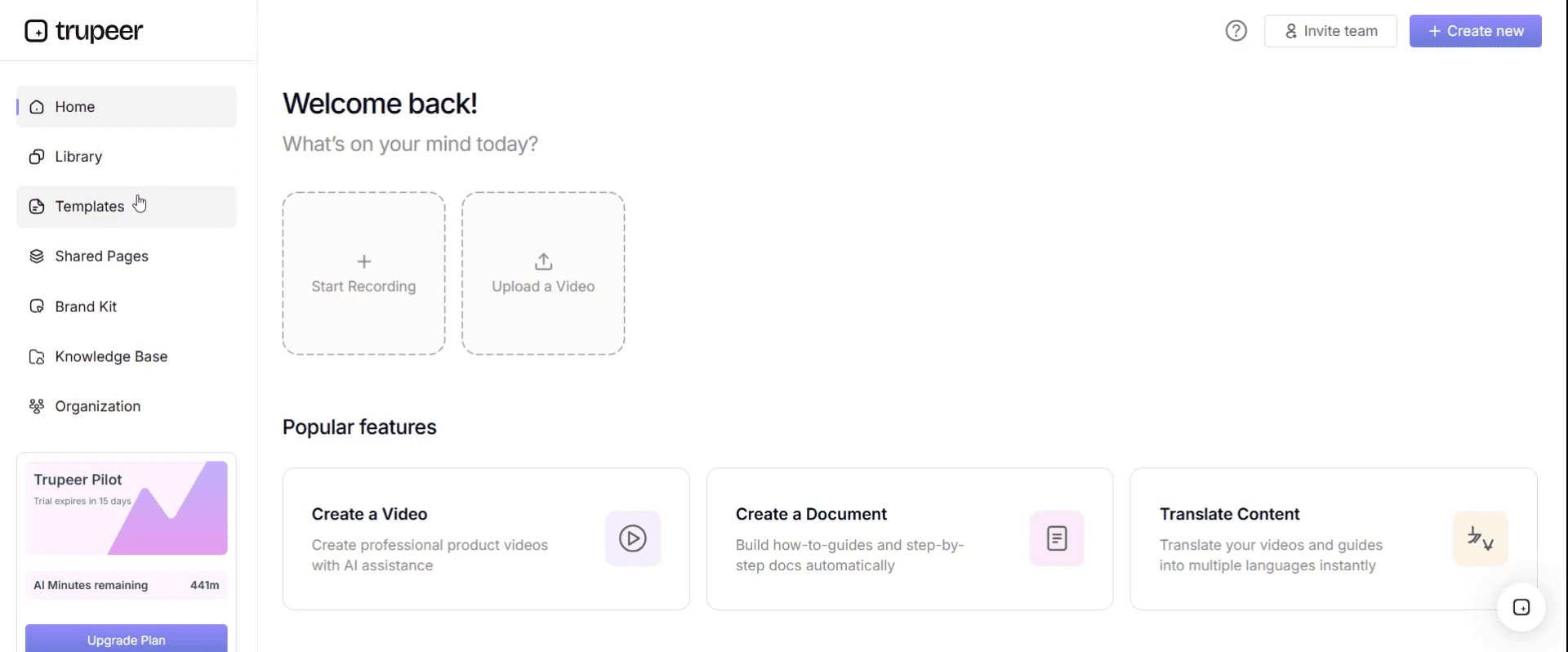
Step 1: Open the Templates Section
Go to the Templates section from the main navigation.
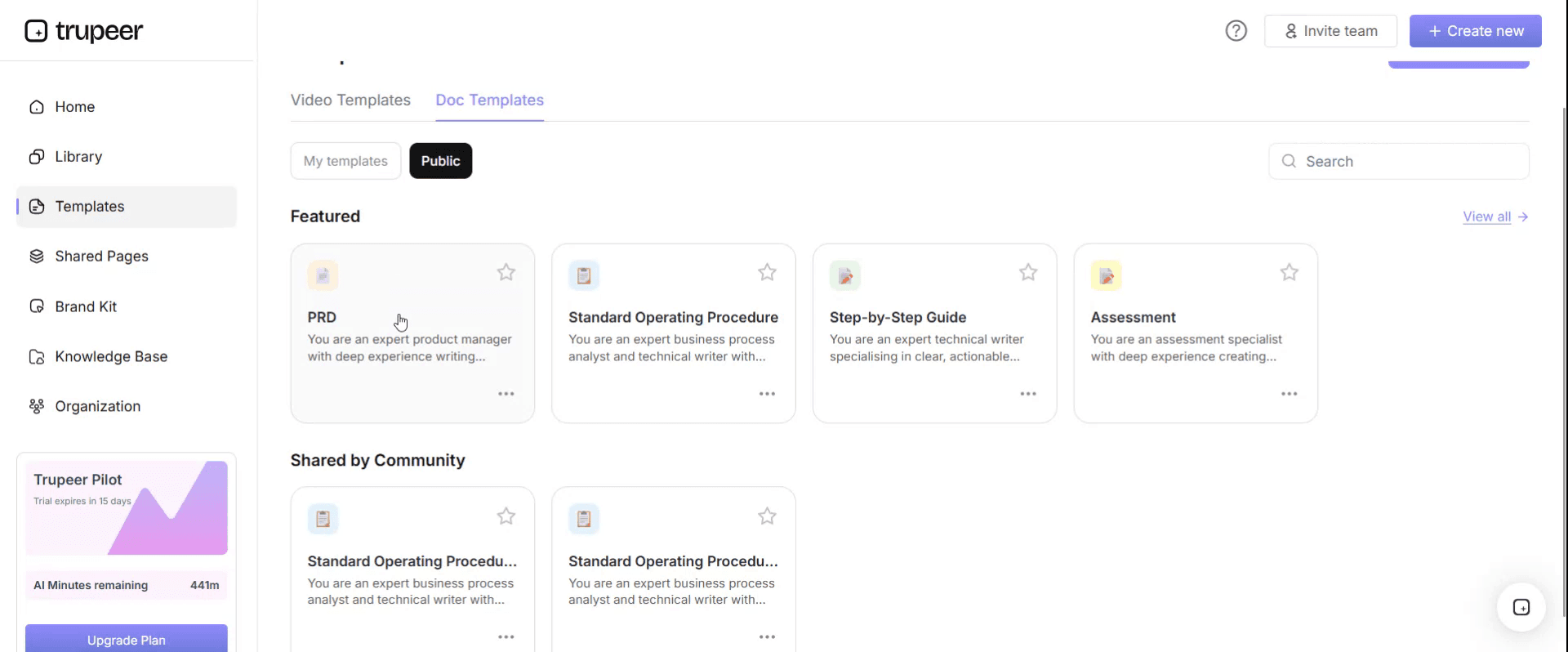
Step 2: Select and Open a Template
Click on any template you want to work with to open it.
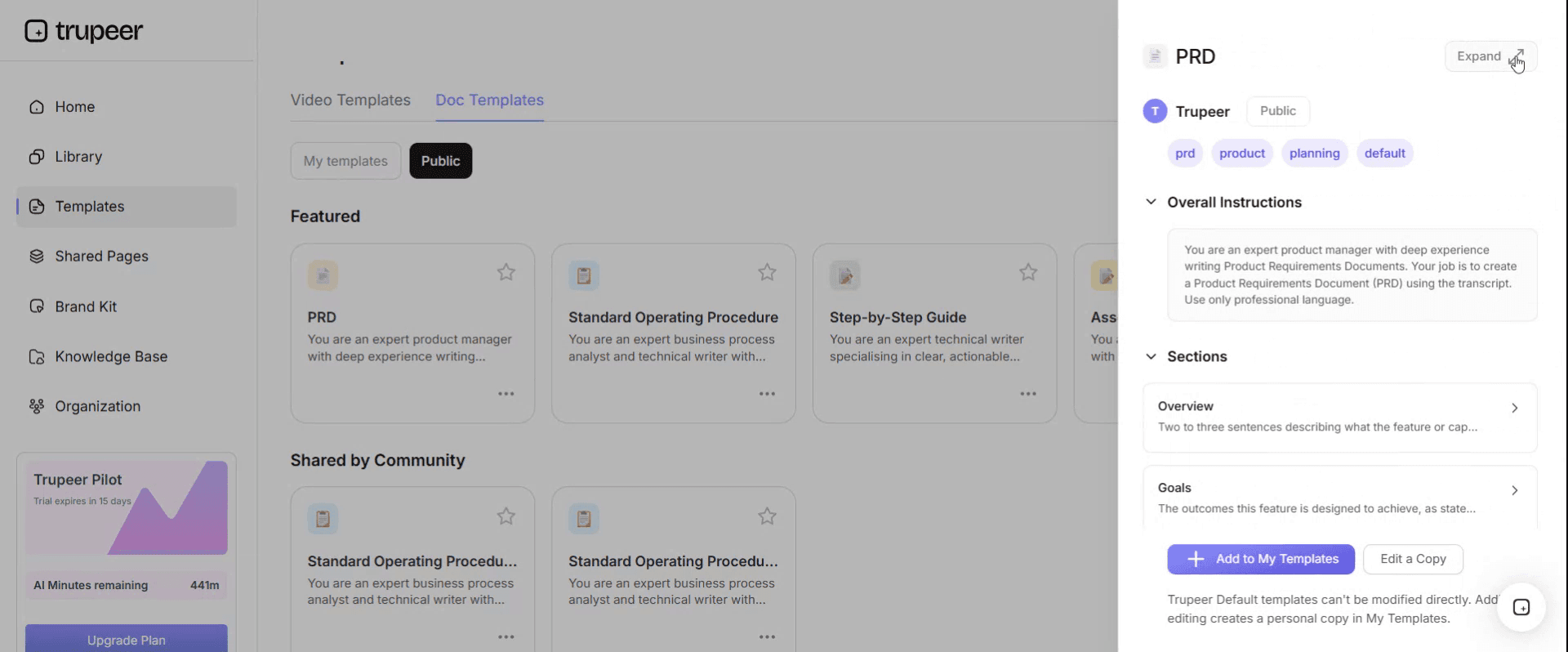
Step 3: Expand the Template View
If needed, expand the template view to see the full layout and details clearly.
Step 4: Edit the Template
Click on Edit to start modifying the selected template.
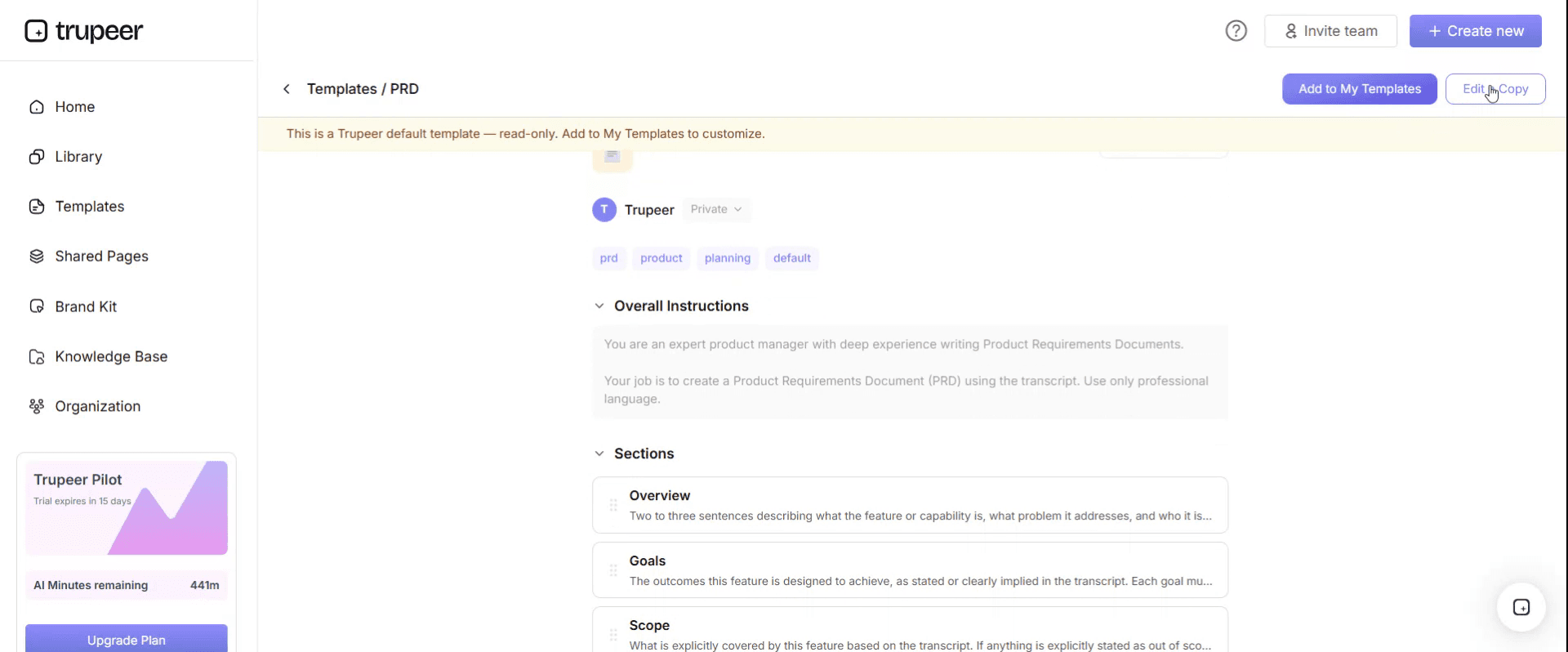
Within the editor, you can:
Add new sections
Define or update formatting rules
Add a logo and adjust its position and related settings
Step 5: Save Your Customized Template
After making all necessary changes, click Save to store the updated template as your own.
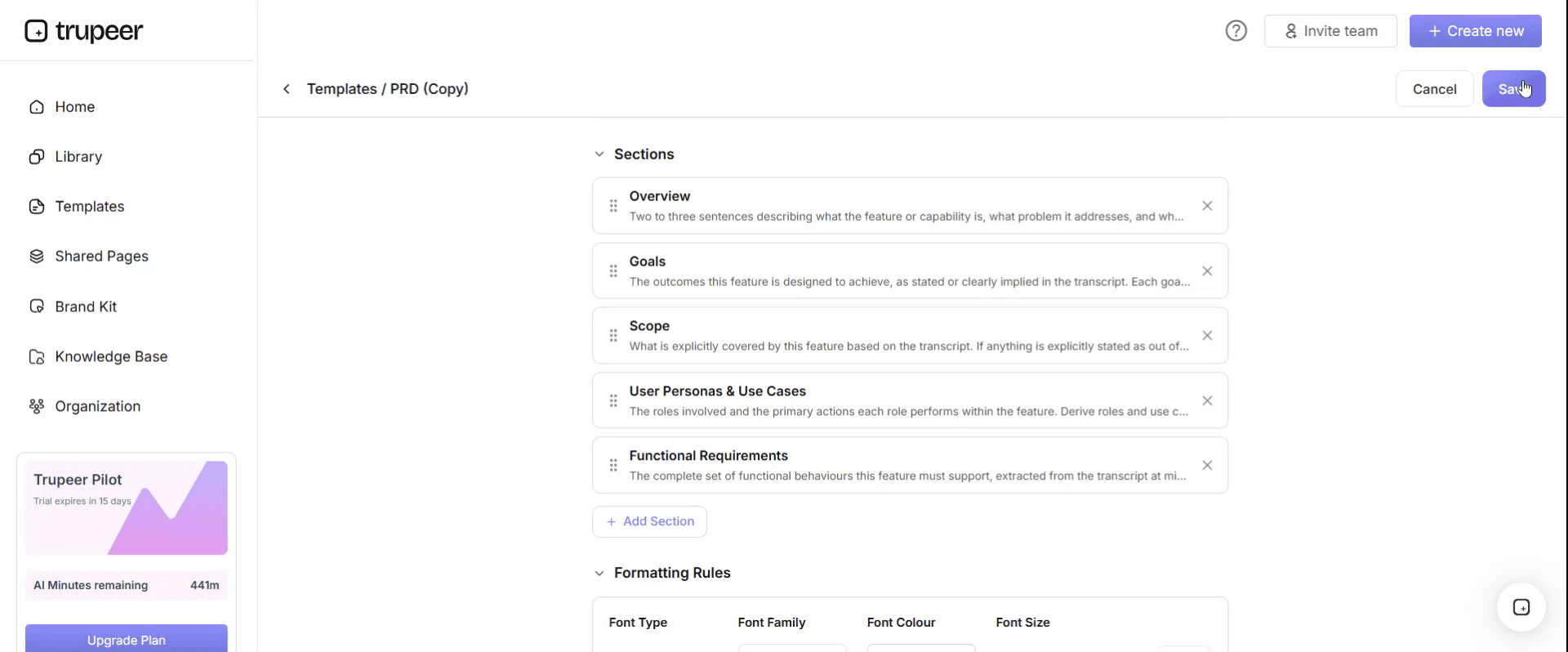
Step 6: Preview and Fine-Tune the Template
When you want to see how your customized template looks, open the Preview.
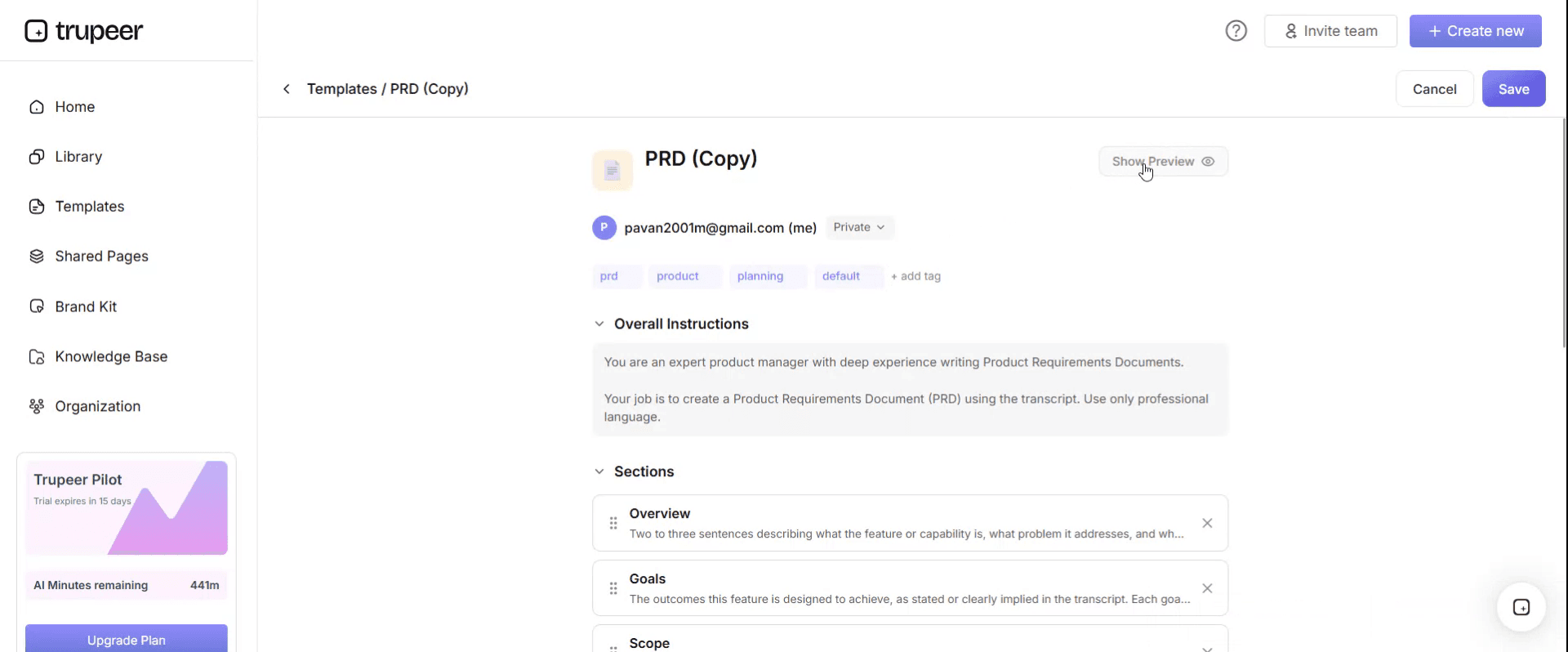
From the preview screen, you can continue to make adjustments directly if needed, ensuring the template appears exactly as you want.
With an employee training template you can:
Save hours on design: Skip the blank page with a proven training structure.
Standardize learning: Use the same template for every program - so quality stays consistent.
Stay on-brand: Apply your logo, fonts and colors using Trupeer's brand kit.
Engage learners: Convert text-heavy content into video training that's easier to consume and retain.
Scale globally: Translate training materials into 65+ languages with one click. Turn the completed template into a video with our guide on how to create training videos from existing documents.
Measure impact: Built-in metrics fields help you track engagement and outcomes.
The training matrix
The central artifact. Roles down one axis, required training across the other, status in the cells.
Employee | Role | Induction | H&S | Data protection | Fire warden | System A | Product cert |
|---|---|---|---|---|---|---|---|
A. Patel | Ops analyst | 12 Jan 26 | 4 Mar 26 | 4 Mar 26 | n/a | 20 Jan 26 | Expires 30 Sep 26 |
J. Okafor | Ops analyst | 3 Feb 26 | Overdue | 4 Mar 26 | 12 Feb 26 | 15 Feb 26 | 8 Apr 26 |
S. Lindqvist | Team lead | 8 Nov 25 | 4 Mar 26 | 4 Mar 26 | 12 Feb 26 | Not started | 8 Apr 26 |
M. Rossi | Ops analyst | Booked 2 Sep | n/a | n/a | n/a | Not started | n/a |
Four states per cell: complete with a date, booked with a date, not started, or not applicable. Add a fifth, expired or overdue, in red.
What makes it useful rather than decorative:
Required training is driven by role, not by person. Change the role definition once and every holder's requirements update.
Dates, not ticks. A tick tells you it happened. A date tells you whether it is still valid.
Expiry calculated, not typed. The Excel version derives expiry from completion date plus validity period.
Gaps visible at a glance. The point of a matrix is that empty cells are obvious.
Building the matrix
List the roles, not the people. Ten roles is easier to maintain than eighty individuals.
For each role, list required training. Split into mandatory, meaning legal or policy-required, and role-specific, meaning needed to do the job.
Set a validity period for each. Some training expires by regulation, some by sensible policy, some never.
Populate the current state honestly. The first version will look bad. That is the finding, not a reason to delay.
Set the refresh trigger. Who updates it, when, and on what event.
Make it visible. A matrix only HR can see does not change behaviour. Managers should see their own team's.
Keep it to training that genuinely matters. A matrix with forty columns will not be maintained, and an unmaintained matrix is worse than none because it will be produced in an audit and found wrong.
Expiry and recertification
The half of training tracking that everyone forgets until an auditor asks.
Training type | Typical validity | Renewal trigger |
|---|---|---|
First aid | 3 years, varies by scheme | Certificate expiry |
Fire warden | 1 to 2 years | Certificate expiry |
Manual handling | 2 to 3 years | Policy |
Data protection | Annual | Policy, plus on any material change in law |
Information security | Annual | Policy |
Anti-harassment | 1 to 2 years | Policy or jurisdiction requirement |
Role-specific certification | Varies by scheme | Certificate expiry |
System training | On version change | Product release |
Build alerts at 90, 30 and 7 days before expiry, to the person and their manager. Expiry that surfaces only in a monthly report gets noticed after the fact.
For anything with a legal or insurance implication, treat lapsed as not trained. Someone whose first aid certificate expired last month is not a first aider, whatever the wall chart says.
The training record
The individual-level detail behind each cell in the matrix.
Field | Enter |
|---|---|
Employee name and ID | |
Training title and reference | |
Type | Induction, mandatory, role-specific, development |
Delivery method | Classroom, online, on the job, recorded |
Provider | Internal or external, named |
Date completed | |
Duration | Hours, for reporting and for cost |
Trainer or assessor | |
Assessment result | Pass, fail, competent, not yet competent |
Certificate reference | And where the certificate is stored |
Expiry date | Calculated |
Cost | Direct cost plus time |
Version trained on | Which version of the material |
That last field matters more than it looks. When a procedure changes, you need to know who was trained on the old version, and a record saying only "Data protection training, March" cannot tell you.
Retention: keep records for at least the period your industry or insurer requires, and longer for anything safety-related. Records of training on a process that later caused an incident are exactly what gets requested.
The training schedule
The forward calendar. Distinct from the plan, which says what should happen, and from the matrix, which says what has happened.
Date | Session | Audience | Delivery | Trainer | Capacity | Booked | Room or link |
|---|
Practical points. Publish a quarter ahead so managers can plan around it. Cap capacity and track bookings, since an over-subscribed session delivered badly is worse than a second date. Schedule mandatory refreshers from the expiry dates in the matrix rather than from memory. And put recorded alternatives against every session, because someone will always be unable to attend.
Session materials
What you need per session, kept in the same folder as the record.
Session plan. Objectives, timings, content, activities, materials required.
Attendance sheet. Printed and signed for anything compliance-related. A calendar accept is not attendance.
Handouts or job aid. The thing people take away and actually use afterwards.
Assessment, where competence needs demonstrating rather than assuming.
Evaluation form. Short, and see below on what to ask.
Recording, where the session will need repeating.
Evaluating training
Most evaluation asks whether people enjoyed the session, which tells you almost nothing. The Kirkpatrick model gives four levels, and the useful ones are the harder ones.
Level 1, reaction. Did they find it useful and well delivered. Easy to collect, weakly correlated with anything. Worth asking, worth not over-weighting.
Level 2, learning. Can they now do or explain the thing. Requires an assessment rather than a feedback form.
Level 3, behaviour. Are they doing it differently at work, four to twelve weeks later. This is where value appears and where almost nobody measures.
Level 4, results. Did the business metric move. Errors down, tickets down, time to competence shortened.
The practical version for most teams: always do level 1 briefly, do level 2 for anything with a competence requirement, and do level 3 for your two or three most important programmes only. Level 4 is worth attempting when the training was commissioned to fix a specific measured problem.
A level 3 check is simpler than it sounds. Six weeks after the session, ask the manager one question: is this person doing anything differently. If every manager says no, the training was theatre regardless of the feedback scores.
Types of employee training to track
Type | Purpose | Typically expires |
|---|---|---|
Induction | Getting started | No |
Mandatory and compliance | Legal or policy requirement | Yes |
Health and safety | Statutory in most jurisdictions | Yes |
Role-specific | Doing the job | On process or system change |
Systems | Using the tools | On version change |
Product | What you sell | On release |
Cross-training | Cover and resilience | Refresh if unused |
Leadership | Management capability | No |
Soft skills | Communication, feedback, conflict | No |
Certification | External qualification | Per scheme |
Mandatory and safety training are the columns an auditor will look at first. Cross-training is the one with the highest operational value and the least tracking.
A worked example
Team: 12-person operations team. Roles: analyst, senior analyst, team lead.
Required training by role
Training | Analyst | Senior | Lead | Validity |
|---|---|---|---|---|
Induction | Required | Required | Required | Once |
Health and safety | Required | Required | Required | 2 years |
Data protection | Required | Required | Required | Annual |
Core system | Required | Required | Required | On version change |
Reconciliation process | Required | Required | Required | On process change |
Exception handling | Required | Required | On process change | |
Supplier system | Required | Required | On version change | |
Managing performance | Required | Once, refresh 3 years | ||
Recruitment and interviewing | Required | 2 years | ||
Fire warden | 1 per shift | 2 years |
Current state, summarised from the matrix
Metric | Value | Action |
|---|---|---|
Fully compliant on mandatory | 9 of 12 | Three overdue on data protection, booked for 9 Sep |
Expiring within 90 days | 4 | H&S refresh scheduled 14 Oct |
Trained on current reconciliation version | 7 of 12 | Process changed in June, five never retrained |
Cross-trained on exception handling | 3 of 12 | Single point of failure if two people are absent |
Fire wardens per shift | 1, 1, 0 | Night shift uncovered. Priority |
The two findings that matter are not the overdue mandatory training, which is visible and will be fixed. They are that five people are running a process to an outdated version, and that the night shift has no fire warden. Neither would appear in a training plan. Both are obvious in a matrix.
Compliance training
Different rules apply where training is a legal requirement.
Evidence standards are higher. You need the record, the attendance signature, the assessment result and often the material version. A completion tick in an LMS may not be sufficient depending on the requirement.
Overdue means non-compliant, immediately, not at the next audit. Build the alerting to prevent lapses rather than to report them.
Content changes with the law, which means people trained last year may need retraining rather than refreshing. Track the material version alongside the date.
And check whether your jurisdiction mandates specific frequencies or content, since generic annual refreshers may not satisfy a specific statutory requirement.
Cross-training
The type with the best return and the worst tracking.
Track it as a coverage question rather than an individual one. For each critical task, how many people can do it unsupervised. Anything with a count of one is a risk, and the matrix makes those visible in a way no plan does.
Set a minimum coverage target per critical task, usually two or three, and treat falling below it as an incident to schedule against rather than an aspiration.
Then refresh it. Cross-training used once and never again decays within months, and a person who was trained eighteen months ago and has not done the task since is not genuine cover.
How to run employee training
Start from the matrix, not the calendar. What is missing or expiring determines what to schedule.
Define requirements by role and keep the role list short.
Populate the current state, accepting that the first version will be uncomfortable.
Set validity periods and build the alerts.
Schedule from the expiry dates, a quarter ahead.
Record properly at delivery, including the material version.
Assess where competence matters, rather than recording attendance as achievement.
Check behaviour at six weeks for your most important programmes.
Review coverage on critical tasks quarterly.
Give managers visibility of their own team's matrix.
Best practices
Requirements driven by role, not by individual.
Dates in the cells, never ticks.
Expiry calculated automatically, with alerts at 90, 30 and 7 days.
Material version recorded alongside the completion date.
Attendance signed for anything compliance-related.
Assessment where competence matters, not just attendance.
One behaviour check at six weeks for key programmes.
Coverage tracked per critical task, with a minimum of two.
Managers can see their own team's matrix.
Matrix kept short enough to be maintained.
Common mistakes
Ticks instead of dates, so nothing can be checked for currency.
No expiry tracking, discovered at audit.
Requirements listed per person, becoming unmaintainable at scale.
Attendance recorded as competence.
Evaluation that only asks whether people liked it.
No record of which version of the material was delivered.
Cross-training tracked as completed rather than as current coverage.
Forty-column matrix that nobody updates.
Matrix visible only to HR, so managers never act on it.
Lapsed certification treated as almost valid.
Training scheduled by calendar habit rather than by what is expiring or missing.
Deliver the same training every time without delivering it every time
Open the templates in Trupeer AI, apply your brand kit so training materials match your other documentation, and edit any section directly. Setup is in the template guide.
The matrix usually reveals the same two problems. People are overdue because sessions are hard to schedule, and people are trained on an outdated version because retraining twelve people after a process change means running the session again.
Recording solves both. Capture the session or the process once and Trupeer AI produces the written guide and a narrated video walkthrough from the same pass, so completion stops depending on everyone being free at the same hour, and a process change means re-recording rather than rescheduling. Completion is trackable, which is what the matrix needs.
Translate it into 65+ languages, which matters for compliance training where understanding has consequences. Keep the set in your knowledge base so it serves as reference after the session, and use it across onboarding and ongoing training.
Record it. Brand it. Translate it. Trupeer it.
Frequently Asked Questions
Is there a free employee training template in Excel?
Yes, and Excel is the main format here. It includes the training matrix with automatic expiry calculation, individual training records, and the forward schedule. Everything on this page is fundamentally a table, which is why the spreadsheet does the most work.
Is there a free employee training template in Word?
Yes. Word covers the session plan, the attendance sheet and the evaluation form, meaning the documents people write into rather than the ones you filter and sort.
Is there an employee training template in Word doc format?
Yes, a .doc version is included alongside .docx for older HR systems and document libraries.
Can I download a free employee training template in Word?
Yes, every format is a free download with no account required and no watermark.
Is there a free employee training template in PDF?
Yes, as printable attendance sheets, the evaluation form and a completion certificate you can issue after a session.
Is there a training schedule template in Excel, free to download?
Yes. The schedule tab covers date, session, audience, delivery method, trainer, capacity, bookings and location. Schedule from the expiry dates in the matrix rather than from the calendar, since that is what actually determines what needs running.
Is there a training plan template in Word?
Yes, though that is a different document from the ones on this page. A training plan sets out what training will happen and for whom. Use the training plan template for planning, and the matrix here for tracking what has actually been completed.
Is there a free training plan template in Word to download?
Yes, on the training plan template page, free with no sign-up. For one person's plan specifically, the individual employee training plan is the better fit.
What is a training matrix?
A grid showing which training each role requires and which individuals have completed it, with dates rather than ticks so currency is visible. It answers who is currently qualified to do what, which a training plan cannot.
What should an employee training record include?
Employee, training title, type, delivery method, provider, completion date, duration, trainer, assessment result, certificate reference, expiry date, cost and the version of the material delivered. That last field is what lets you identify who was trained on a superseded process.
How do you track employee training?
With a matrix at role level showing completion dates and calculated expiry, individual records behind each entry, and alerts at 90, 30 and 7 days before anything lapses. Give managers visibility of their own team, since a matrix only HR can see does not change behaviour.
How long should training records be kept?
At least as long as your industry, regulator or insurer requires, and longer for anything safety-related. Records of training on a process that later caused an incident are exactly what gets requested, so err toward keeping them.
How often does mandatory training need refreshing?
It depends on the training and the jurisdiction. First aid is commonly around three years, fire warden one to two, data protection and information security typically annual, manual handling two to three. Check the specific requirement rather than applying a blanket annual refresh, since some statutory requirements specify content as well as frequency.
How do you measure whether training worked?
Four levels: whether people found it useful, whether they can now do it, whether they are doing it differently at work six weeks later, and whether the business metric moved. Most organisations only measure the first, which correlates weakly with anything. One behaviour check at six weeks on your most important programmes is worth more than any number of feedback forms.
What is the difference between a training plan and a training matrix?
A plan is forward-looking and says what training will happen, for whom and when. A matrix is a current-state record showing who is trained on what and whether it is still valid. You need both, and the matrix should drive the plan rather than the other way round.
How do you track cross-training?
As coverage per critical task rather than as completion per person. For each critical task, count how many people can do it unsupervised. Anything with a count of one is a single point of failure, and that is the number worth reporting.
Can I customise these employee training templates?
Yes, all versions are fully editable. The role definitions and validity periods are the parts that must be yours. In Trupeer AI you can also apply your brand kit so training materials match your other documentation.
Related templates

Understand how work happens.
Carry it into your next transition.
Start Free Trial
Book a Demo
Resources

