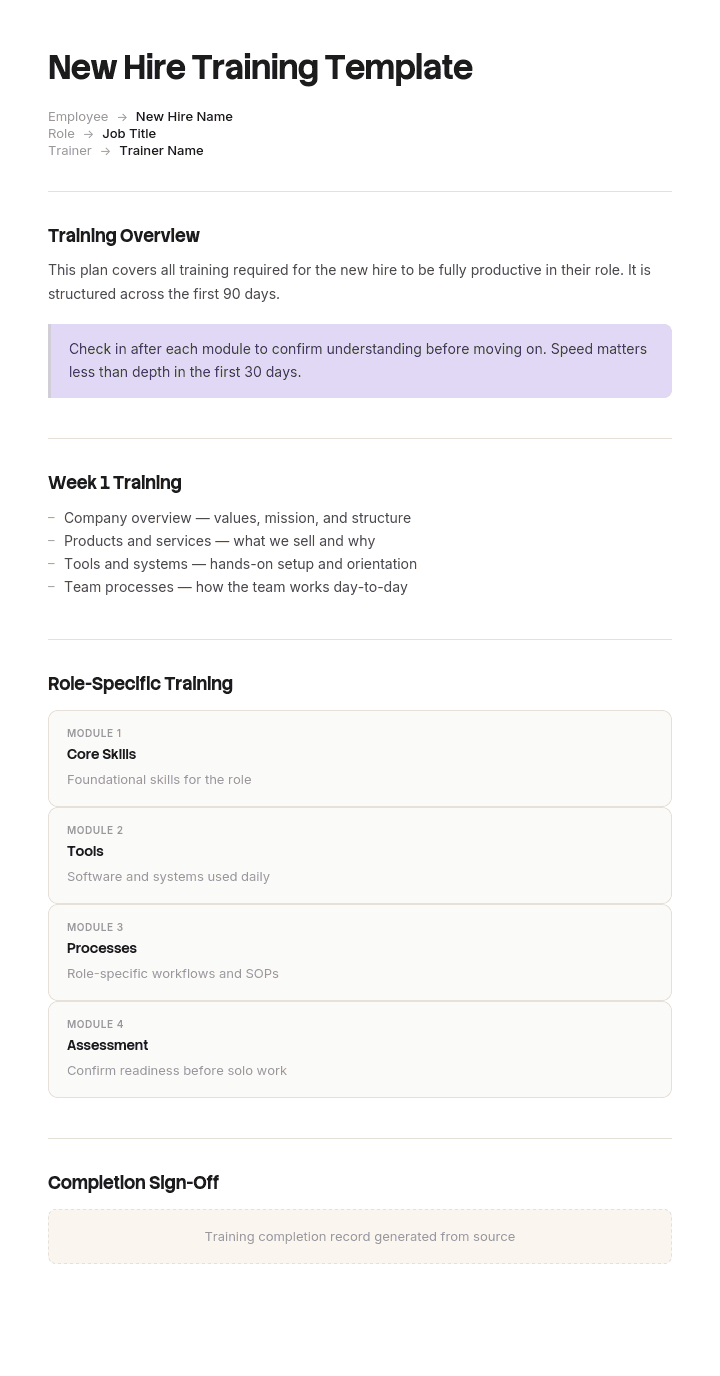
Use this template
Strong new hire training is the single biggest predictor of long-term employee success. With Trupeer, you can save hours on training design by starting with a free new hire training template, customizing it with your brand guidelines, and turning training into engaging video modules new hires actually finish.
What is a new hire training template, and what does it plan?
A new hire training template is the reusable structure for planning what a new starter learns, in what order, from whom, and by when. It covers the skills and knowledge specific to doing the job, which is narrower than onboarding and broader than a single course.
It answers three questions. What does this person need to be able to do. In what sequence will they learn it. And how will anyone tell whether it worked.
Most templates you will find answer the first two by mapping content onto a calendar counted from the start date: week one, week two, thirty days, sixty days. That is the intuitive structure and it is the source of the problem this page is about.
Why week one training is mostly forgotten by week five
Almost every organisation front-loads. The first week or two is a dense sequence of systems demonstrations, product overviews, policy briefings and process walkthroughs, delivered while the new starter has no context to attach any of it to.
There are good reasons it happens. Trainers are available then. It feels efficient to batch. Everyone is nervous about the person having nothing to do. And there is a real sense that you should tell people things before they need them rather than after.
The trouble is that people do not retain procedural knowledge they have no immediate use for. Show someone how to raise a credit note in week one and they will not raise one until week six, at which point they will need showing again. The training happened, the record says complete, and the knowledge is not there.
You can see this in a number every organisation could calculate and almost none does: the gap between the day a piece of training is delivered and the day the person first uses it. Where that gap is a few days, retention is good. Where it is two months, the training was essentially theatre, and the real teaching will be done later by whoever is nearest when the person gets stuck.
How to customize this template in Trupeer
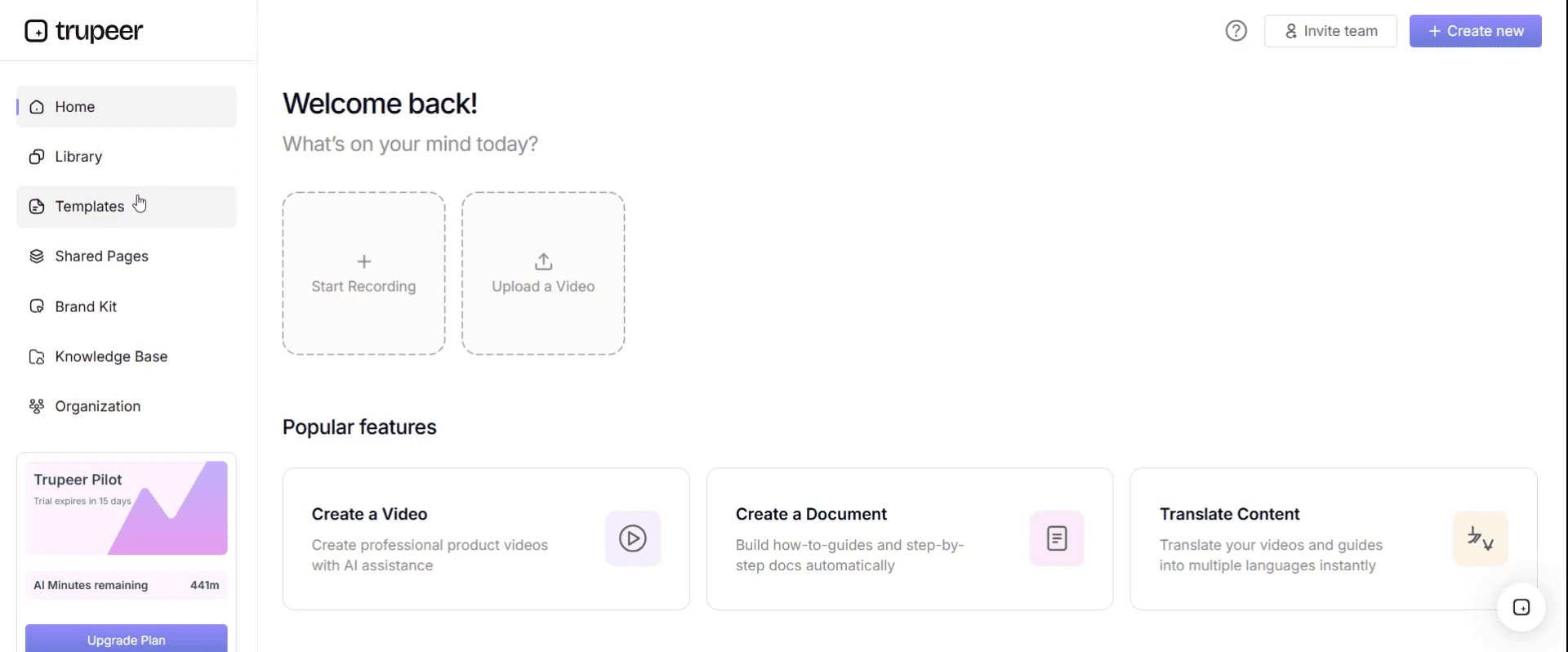
Step 1: Open the Templates Section
Go to the Templates section from the main navigation.
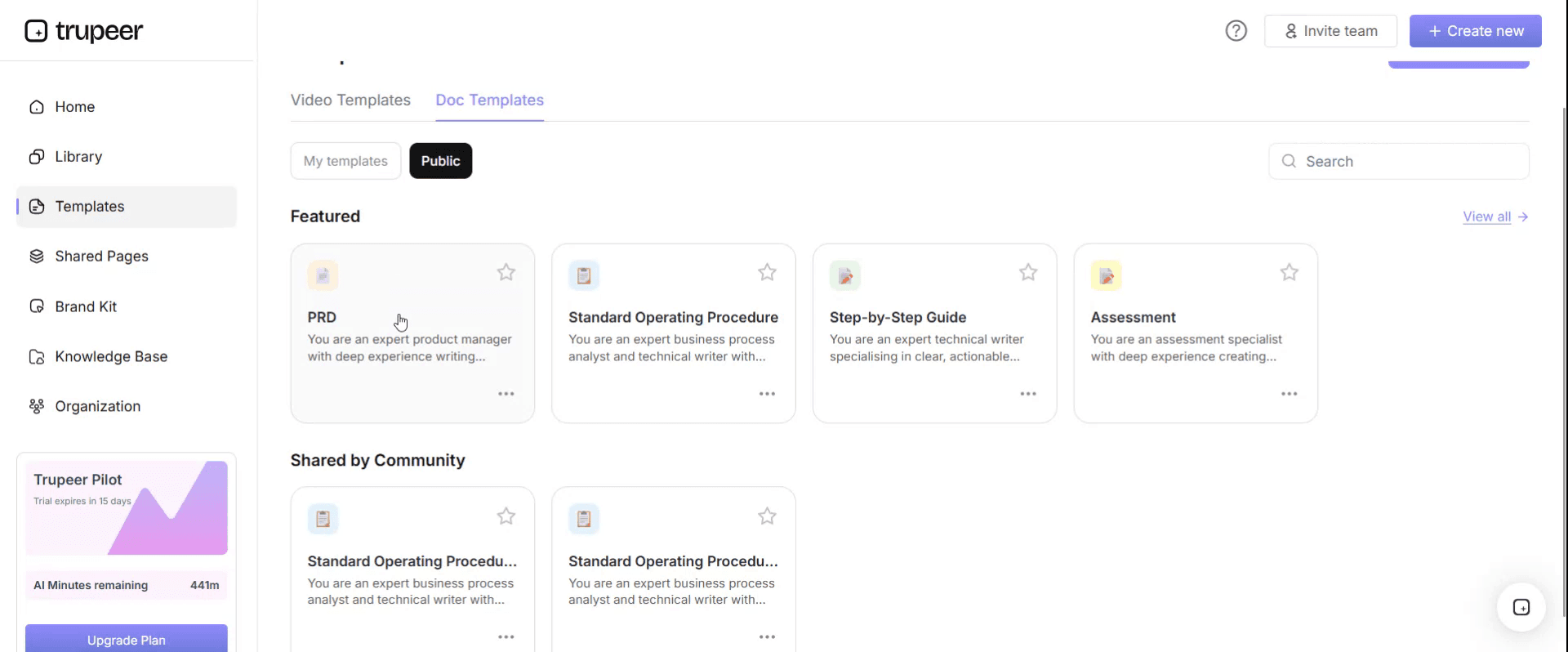
Step 2: Select and Open a Template
Click on any template you want to work with to open it.
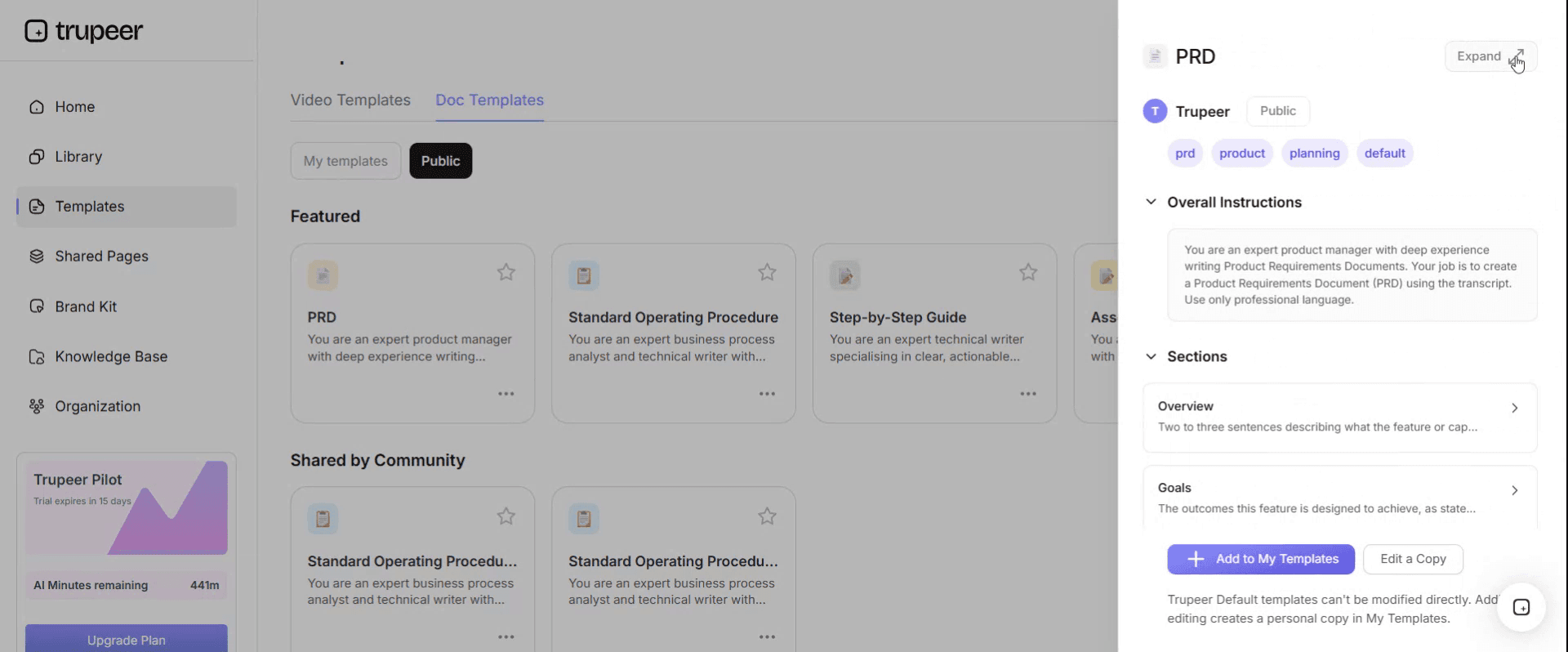
Step 3: Expand the Template View
If needed, expand the template view to see the full layout and details clearly.
Step 4: Edit the Template
Click on Edit to start modifying the selected template.
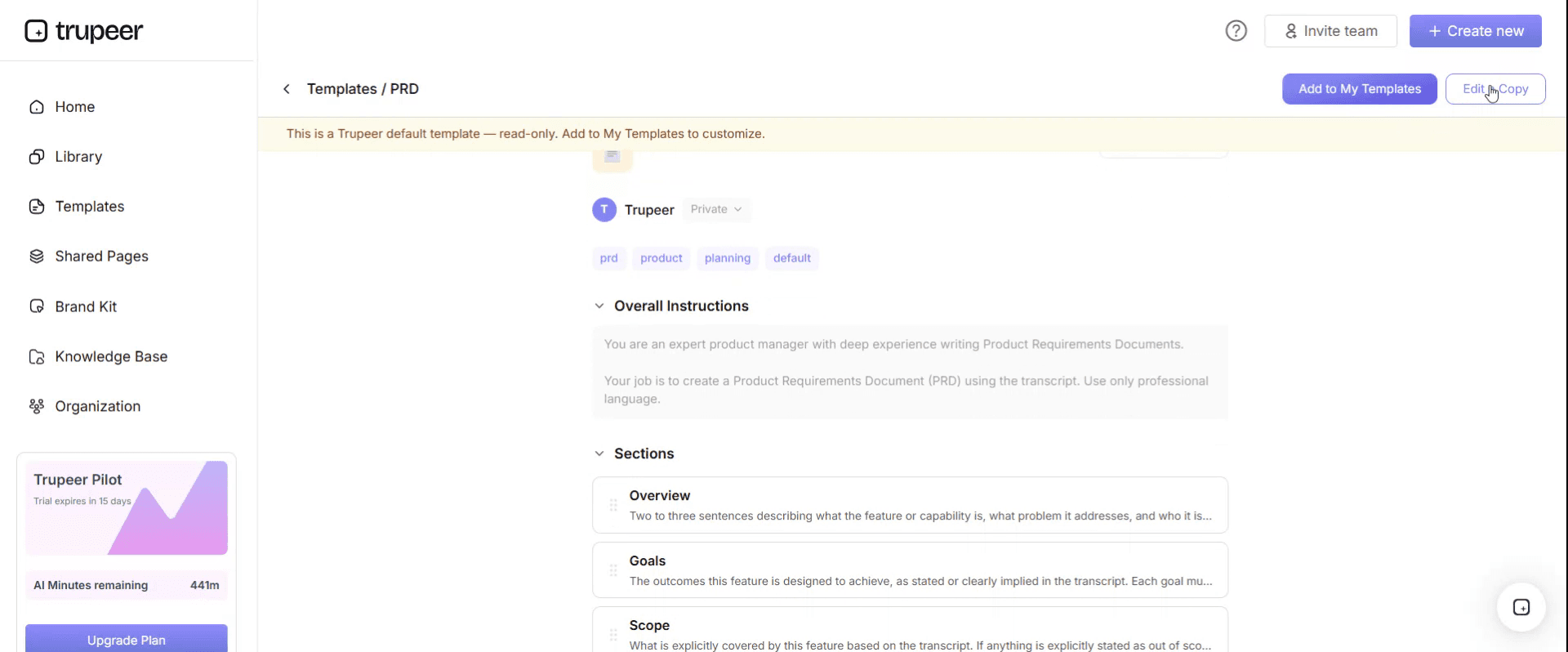
Within the editor, you can:
Add new sections
Define or update formatting rules
Add a logo and adjust its position and related settings
Step 5: Save Your Customized Template
After making all necessary changes, click Save to store the updated template as your own.
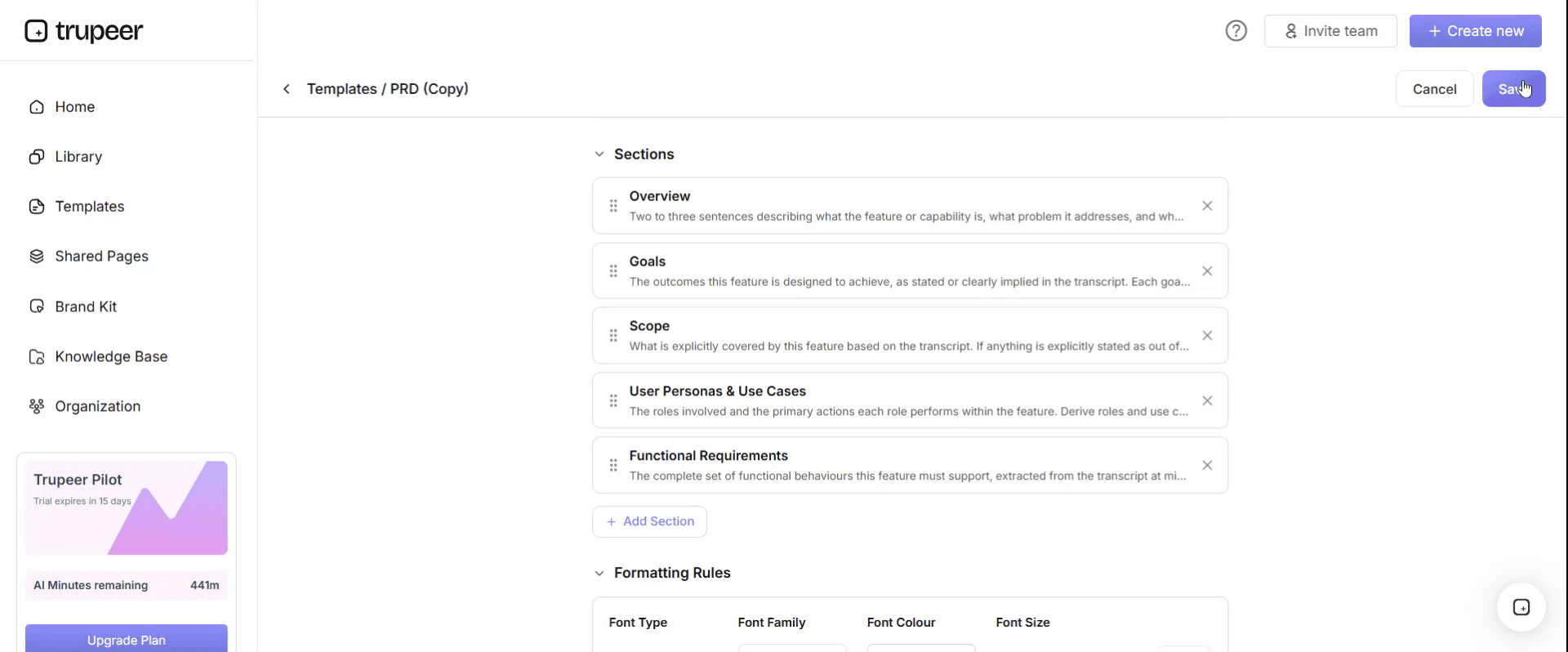
Step 6: Preview and Fine-Tune the Template
When you want to see how your customized template looks, open the Preview.
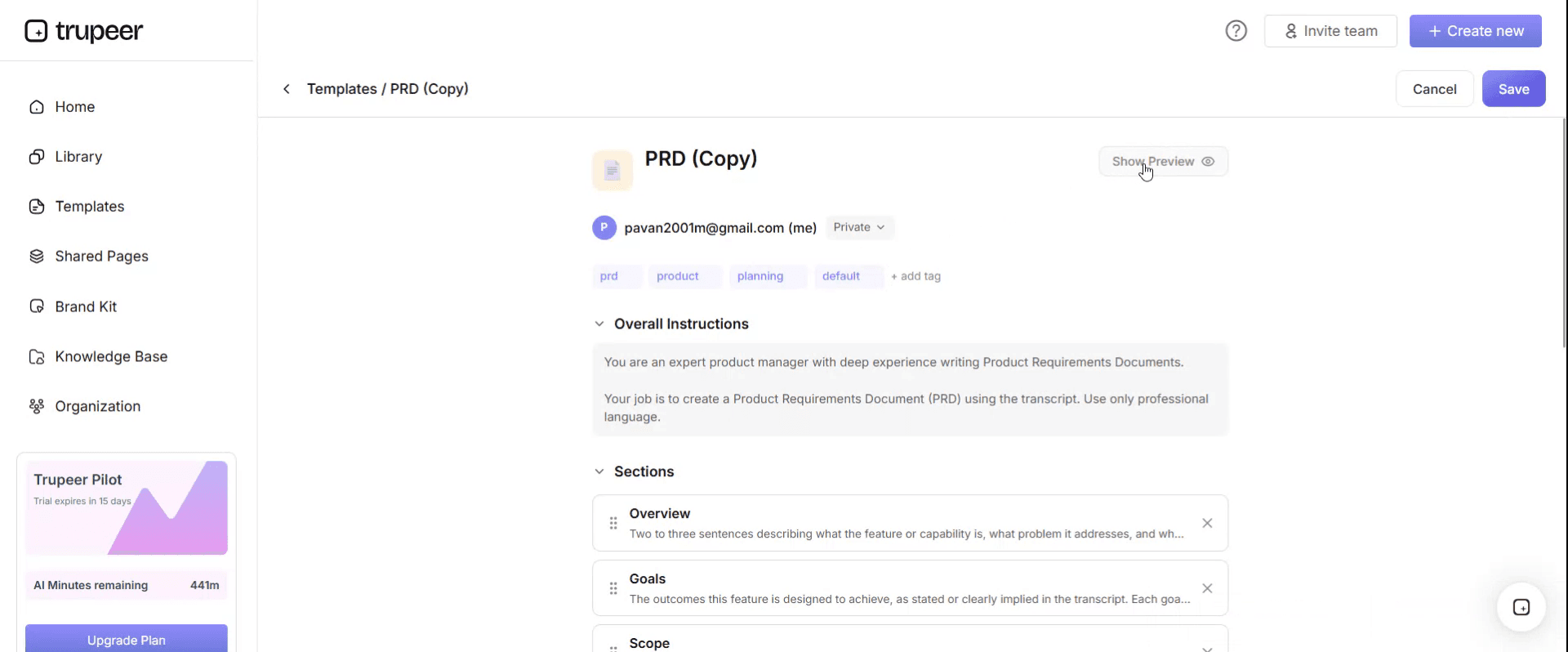
From the preview screen, you can continue to make adjustments directly if needed, ensuring the template appears exactly as you want.
With a new hire training template you can:
Save hours on design: Skip the blank page with a comprehensive structure for new hire training.
Ramp faster: Clear training cuts time-to-productivity for every new hire.
Stay on-brand: Apply your logo, fonts and colors using Trupeer's brand kit.
Engage from day one: Convert dense training into video modules new hires actually watch.
Standardize across hires: Use the same template for every role and region.
Reach global hires: Translate new hire training into 65+ languages with one click.
The delivery to first use gap, and why it predicts everything
Take your existing new hire training and list every module, session or topic. Then, for each one, work out the median day on which a new starter first actually uses it.
That second number is knowable. Ask three people who joined in the last year, or look at the work itself: when does a new salesperson first negotiate a contract, when does a new engineer first deploy, when does a new support agent first handle an escalation.
Subtract. The result is the delivery to first use gap for each item, and it sorts your training into three groups.
Under about ten days, the training will hold. This is the material that genuinely belongs in the first fortnight.
Between two weeks and a month, retention is partial. The person will remember it exists and will need a reference rather than a re-teach, which means a job aid rather than another session.
Beyond about a month, treat it as untrained. Whatever you delivered will need delivering again, so the honest options are to move the training later or to accept you are paying for it twice.
The redesign that follows is straightforward. Keep the short-gap items where they are. Convert the medium-gap items into reference material. Move the long-gap items to the point they are needed, triggered by the work rather than by the calendar.
How to map every training item to its first use
Module | Delivered | Median first use | Gap | Verdict |
|---|---|---|---|---|
CRM basics and daily hygiene | Day 2 | Day 3 | 1 day | Keep in week one |
Product demonstration, core | Day 4 | Day 12 | 8 days | Keep in week one |
Discovery and qualification | Day 6 | Day 34 | 28 days | Move to week four |
Pricing and discount authority | Day 7 | Day 52 | 45 days | Trigger on first proposal |
Contract redlines and MSA terms | Day 8 | Day 96 | 88 days | Trigger on first negotiation |
Security questionnaires | Day 9 | Day 118 | 109 days | Trigger on first enterprise deal |
Build this table for your own programme before changing anything. It usually takes an afternoon and it makes the argument for you, because the numbers in the gap column are difficult to defend once they are written down.
Two cautions. Some training genuinely must be front-loaded regardless of gap, meaning anything with a safety, legal or regulatory requirement attached, and those rows stay where they are for reasons that have nothing to do with retention. And a long gap sometimes indicates the work is sequenced badly rather than the training, which is worth checking before you move anything.
Free new hire training template: the structure to copy
Copy from here. One row per training item.
Header. Role. Start date. Manager and training owner. The single outcome this training exists to produce, stated as something the person will be able to do unsupervised.
Capability list. What this person must be able to do independently by the end of the training period. Six to ten items, phrased as tasks rather than topics. "Run a discovery call unaided" rather than "discovery training".
Training rows. For each item: what it covers, who delivers it, format, when it is delivered, the trigger that fires it where it is not calendar-based, expected first use, and how competence is checked.
Triggers. The observable events that release later training. First deal reaching a given stage, first escalation received, first month end, first customer complaint. This is the column that distinguishes the template from a schedule.
Checks. For each capability, how you will know. Observation, a live task done unsupervised, a review of real output. Not a quiz, and not attendance.
Reference material. What exists as a document or job aid instead of a session, for the medium-gap items.
Review points. Two dates: one at the end of the front-loaded period, one at the point most triggers should have fired. At each, the question is which capabilities are confirmed rather than which sessions were delivered.
Copy to here. Keep the whole thing to two pages. The failure mode of training templates is that they expand to list every topic in the business, at which point nobody schedules against them.
What should a new hire training plan include?
Six things, and most templates include four of them.
The capabilities, written as tasks the person will do unsupervised. The training items that build each one. Who delivers each, by name. When, whether by date or trigger. How competence is confirmed. And what happens if it is not.
The two usually missing are the trigger column and the last one. Almost no training plan says what happens when someone reaches the review point without a capability confirmed, which means the answer is usually nothing, and the plan quietly becomes a record of sessions attended.
State it plainly: extend, re-teach, adjust the role, or escalate. Naming the options in advance makes the conversation possible.
The bootcamp that taught security questionnaires on day nine
Wickstead Software hired account executives into a two week onboarding bootcamp covering twenty three modules: product, pricing, competitive positioning, CRM, discovery, objection handling, contracting, security questionnaires and procurement navigation among them.
It was well built and well reviewed. Median time to a new AE's first closed deal was a hundred and forty one days against a target of ninety.
Someone mapped each module to the median day a new AE first used it.
Six modules were used within ten days: CRM basics, prospecting, core product demonstration. Nine fell between day thirty and day seventy, mostly discovery, pricing and objection handling. Eight were not used until after day ninety. MSA redlines, taught on day eight, first used on day ninety six. Competitive displacement, day one hundred and four. Security questionnaires, taught on day nine, first needed on day one hundred and eighteen. Procurement navigation, day one hundred and thirty one.
The median gap across all twenty three modules was sixty one days.
The second number came from the managers. Asked how much time they spent re-explaining bootcamp content to AEs in their first six months, the answer averaged four hours per AE per month. Across twenty two hires that year, roughly a thousand hours of sales management time spent teaching things that had already been taught.
The redesign cut the bootcamp from two weeks to four days, covering only the six modules with short gaps. The remaining seventeen became triggered sessions, released by the AE's own pipeline. Security questionnaire training fires when their first enterprise opportunity enters technical evaluation. Redlines training fires when a proposal is accepted in principle. Procurement navigation fires the first time a deal reaches legal.
Median time to first closed deal moved from a hundred and forty one days to a hundred and four. Manager re-teaching fell from about four hours per AE per month to one and a half.
The unexpected result was the satisfaction score, which rose. Four focused days landed better than two weeks of firehose, and new AEs reported feeling less behind rather than more.
How to create a new hire training plan, step by step
Write the capability list first, with the manager rather than with HR. Six to ten things the person must be able to do unsupervised, phrased as tasks.
For each capability, ask when a new starter first has to do it. That gives you the first use column before you have designed anything, which is the right order.
Now decide the delivery point for each, working back from first use rather than forward from the start date. Anything with a short gap goes in the first fortnight. Anything with a long gap gets a trigger.
Name the person delivering each item. Training with no named deliverer does not happen, and "the team" is not a name.
Decide how each capability is checked, and make it observation of real work wherever possible.
Then pressure-test it by walking a real new starter's first ninety days against it. Every point where the plan says taught and the work says not yet needed is a row to move.
How to customise the training plan by role
The structure holds across roles. Three things change.
The capability list, obviously, and it should be written by the person who manages that role rather than adapted from another team's.
The trigger events, because they come from the work. Sales triggers come from pipeline stages. Support triggers come from ticket types received. Engineering triggers come from the first time a certain kind of change is needed. Operations triggers often come from the calendar, meaning first month end or first stock count, and those are the easiest to plan against.
And the front-loaded portion, which varies more than people expect. Roles with immediate customer contact need more in the first week because the cost of an early mistake is external. Roles with a long safe period can afford almost nothing up front.
Where a role has a regulatory or safety component, that portion is not negotiable regardless of gap, and it belongs at the start with a recorded completion. This page is not compliance advice, and where training is legally required, the requirement sets the schedule rather than this method.
Types of new hire training template, and which to use
Calendar-based plan. Everything scheduled by day or week from the start date. Simple, and it is what most templates give you. Works where the job is repetitive and everything is used quickly, which is true for some operational roles and almost no professional ones.
Trigger-based plan. Later items released by observable events in the work. Better retention, more administration, and it needs someone watching for the triggers.
Hybrid. Front-loaded fortnight for the short-gap material, triggers for the rest. This is what the template above assumes and what most organisations should use.
Cohort programme. Fixed groups moving together, common in high-volume hiring. Efficient to deliver and structurally at odds with triggers, since triggers fire at different times per person. The compromise is a fixed cohort start plus individual triggers afterwards.
Buddy or shadow-led. Learning by working alongside somebody. Excellent for tacit knowledge, unreliable for coverage, and it works best as a supplement rather than the plan.
How do you measure new hire training success?
Not by completion, and not by satisfaction, though both are worth collecting.
Three measures tell you something. Time to first unsupervised completion of each capability, which is the direct read on whether training worked. Re-teaching hours, meaning how much time managers spend re-explaining, which is the clearest signal of a gap problem. And the point at which a new starter's output quality matches the team median, which is the number the business actually cares about.
Collect the first from the manager at each review point, the second by asking managers monthly for a quarter, and the third from whatever quality measure the role already has.
Satisfaction scores are worth watching for one specific thing. A high score with a long ramp usually means the training was enjoyable and mistimed, which is exactly the pattern in the worked example above.
Training plan or onboarding guide: which are you building?
They are different documents for different readers and it is worth separating them before you start.
The training plan is for the manager and the training owner. It sequences capability building, names deliverers and defines checks. The new starter sees it, but it is not written to them.
The onboarding guide is for the new starter. It covers what happens, what they can do without asking, who to ask about what, and what is normal. Our new hire onboarding guide template covers it, and it answers questions this plan does not touch.
The 30-60-90 plan is the outcome document agreed between manager and hire, covering what they will have achieved rather than what they will have been taught. Our 30-60-90 day template covers that, and it sits alongside this rather than replacing it.
If you are building all three, build this one second. The guide should exist before day one, the training plan before week one, and the 30-60-90 in the first fortnight once the manager has met the person.
Can I get a new hire training template in Word or Excel?
Excel suits the plan itself, because the useful version has a row per training item with columns for delivery point, trigger, expected first use, gap and check. The gap column should calculate itself, and sorting by it is what produces the redesign.
Word suits the capability list and the review notes, and it is the better format if your plan is going to be discussed with the new starter rather than only used for scheduling.
PDF suits the version filed at the end of the training period as a record of what was delivered and confirmed. For the mapping exercise in the table above, use a spreadsheet, because the value is entirely in sorting by the gap column.
How to build training content without a course project
The reason long-gap training gets front-loaded is rarely conviction. It is that the trainer is available in week one and organising them again in month four is harder, so everything gets delivered when it can be rather than when it should be.
Recording removes that constraint entirely. Trupeer AI turns a screen recording into a written guide and a video from the same pass, so the person who knows how to handle a security questionnaire records it once and it fires when the trigger does, without anyone rescheduling a session.
Record it. Brand it. Translate it. Trupeer it.
That also fixes the medium-gap items, which want a reference rather than a session. The same recording produces a document for your knowledge base and a short guide in your own branding. Training videos and guides cover the wider programme, and translation means a plan built for one region works in the next. Setup instructions are in the document template setup guide.
Frequently Asked Questions
Is there a free new hire training template in Word or doc?
The structure above pastes straight into Word or Google Docs, including the trigger column that standard templates omit. There is no gated download and no form. Write the capability list first, because everything else depends on it and it is the part that needs the manager rather than a template.
Is there a free new hire training template in Excel?
Excel is the right container. One row per training item, with columns for capability, deliverer, delivery point, trigger, expected first use, calculated gap, and check. Sort by the gap column once and the redesign becomes obvious without anyone having to argue for it.
Is there a free new hire training template in PDF?
Export at the end of the training period as the record of what was delivered and which capabilities were confirmed. Keep the working version editable, since triggers fire at different times per person and the plan changes as they do.
Is there a training schedule template in Excel?
A schedule and a plan are different things. The schedule is dates, rooms, deliverers and attendance, which Excel handles well. The plan is capabilities and checks. Build the plan first, then generate the schedule from the front-loaded portion of it, because a schedule written first tends to fill the available time rather than the actual need.
Where can I find a free employee onboarding template in Word?
Onboarding covers equipment, accounts, compliance and welcome, which is a different document from training. If you want the version written for the new starter to read, our new hire onboarding guide template covers it. The employer-side checklist is a third document again.
How long should new hire training last?
The front-loaded portion should be as short as the short-gap material requires, which is usually three to five days rather than two weeks. The full programme runs as long as the triggers take to fire, which for a complex role can be six months. Those are different numbers and conflating them is why bootcamps get long.
Who should deliver new hire training?
Whoever does the work, with the manager owning the plan. Training delivered entirely by a central function tends to be well structured and slightly wrong in the specifics, since the details change faster than the course does. Name a person against every row, because unassigned training does not happen.
What is the difference between a training plan and a training matrix?
A plan is for one person over one period. A matrix is for a team, showing who is trained on what and where the coverage gaps are, and it is a standing document rather than a temporary one. New starters appear as a column in the matrix once their plan is complete.

Understand how work happens.
Carry it into your next transition.
Start Free Trial
Book a Demo
Resources

