Use this template
The first 90 days set the tone for the rest of an employee's tenure. With Trupeer, you can save hours on onboarding planning by starting with a free 30-60-90 day plan template, customizing it with your brand guidelines, and turning the plan into a personalized video walkthrough that helps new hires ramp up faster.
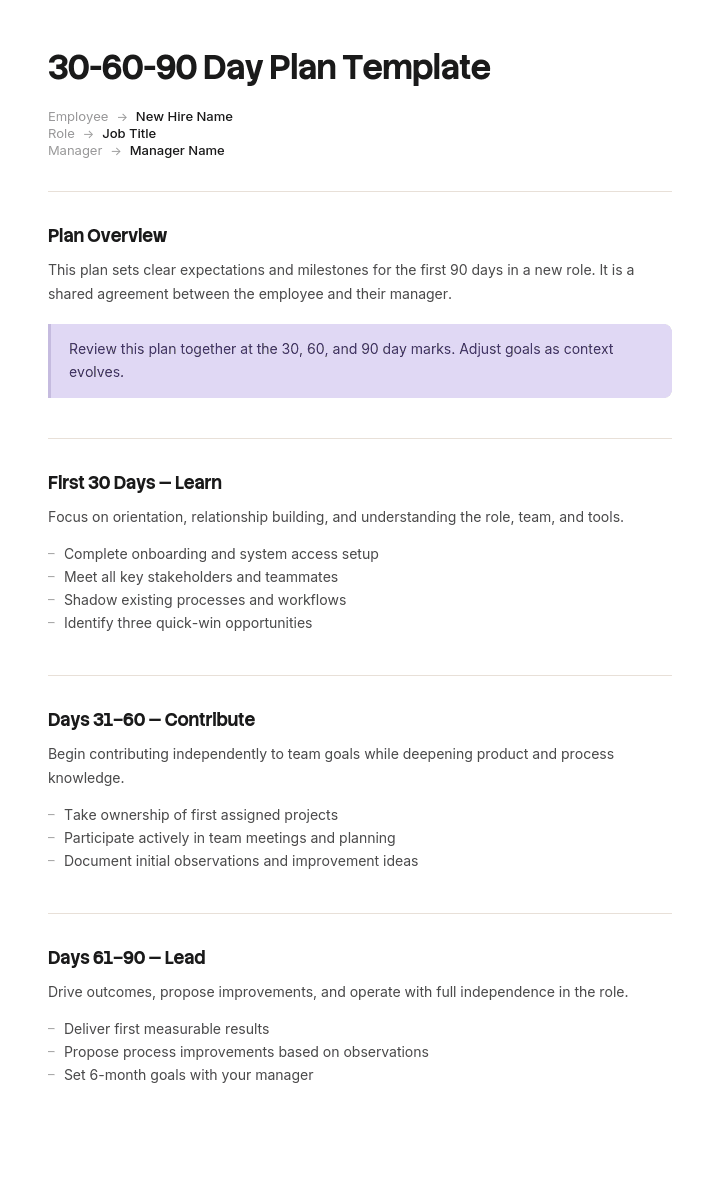
This 30-60-90 day plan template provides a structured framework to capture learning goals, key relationships, early wins and 90-day deliverables - useful for new managers, sales reps, individual contributors and executives alike. Pair it with Trupeer's AI-generated onboarding videos to bring the plan to life, and translate it into 65+ languages for international hires.
What is a 30-60-90 day plan template?
A 30-60-90 day plan template is a pre-structured document with the sections already built: phase goals, learning priorities, people to meet, deliverables, milestones and KPIs. Instead of designing the framework yourself, you fill in the specifics for your role.
The distinction matters. A 30-60-90 day plan is the finished, role-specific document. The template is the reusable shell, which is why one template can serve a new sales rep, a promoted manager and a candidate preparing for an interview.
Preview the 30-60-90 day plan template
Here is the full structure. Copy it straight into a doc, or download it in your preferred format below.
Phase | Focus | Objectives | Learning priorities | People to meet | Deliverable | KPI / success metric |
|---|---|---|---|---|---|---|
Days 1-30 | Learn | Understand the role, product and team | Product, systems, customers, process | Manager, direct team, key partners | One documented process or summary | Can explain the role's purpose unprompted |
Days 31-60 | Contribute | Own a defined piece of work end to end | Edge cases, quality standards, tooling depth | Adjacent teams, senior peers | First shipped piece of real work | Work ships without step-by-step supervision |
Days 61-90 | Own | Deliver measurable results independently | Where the role can be improved | Stakeholders, leadership | Owned outcome with a number attached | Hits an agreed target and proposes a change |
How to customize this template in Trupeer
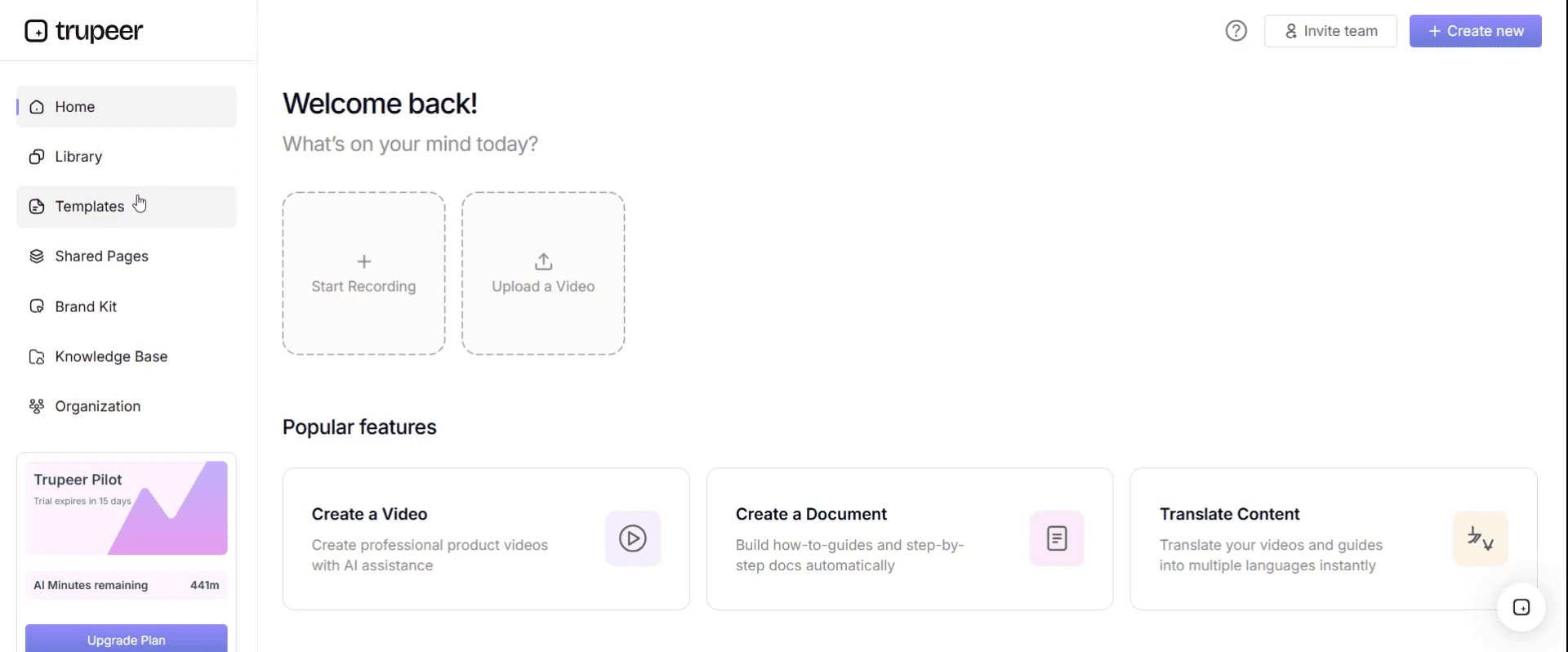
Step 1: Open the Templates Section
Go to the Templates section from the main navigation.
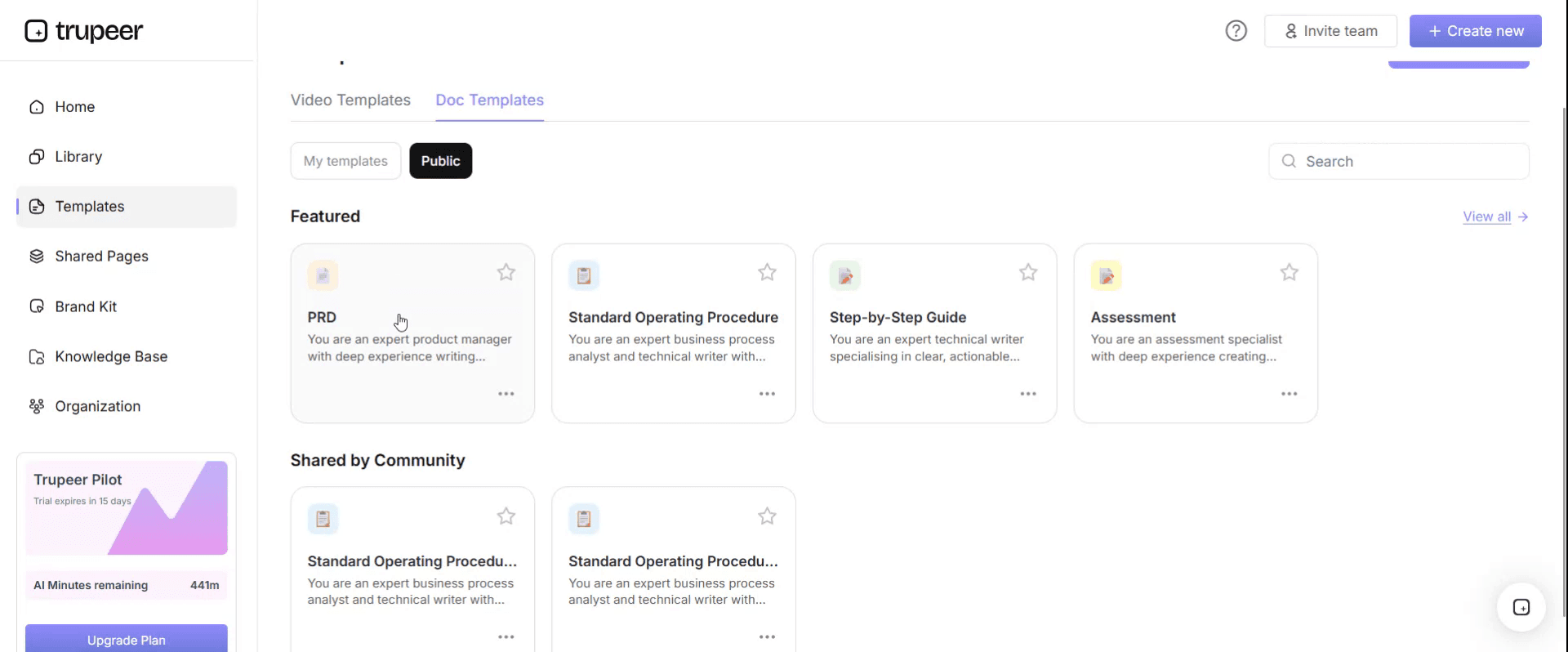
Step 2: Select and Open a Template
Click on any template you want to work with to open it.
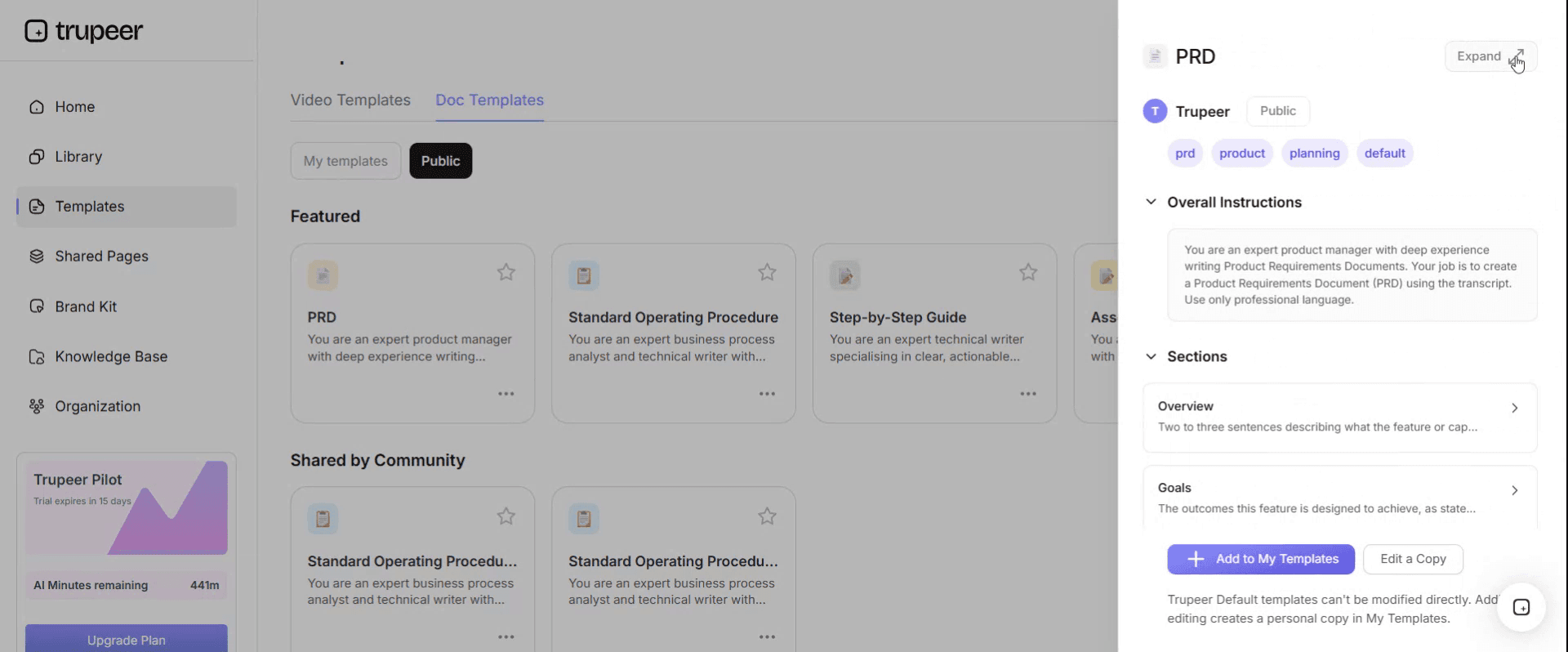
Step 3: Expand the Template View
If needed, expand the template view to see the full layout and details clearly.
Step 4: Edit the Template
Click on Edit to start modifying the selected template.
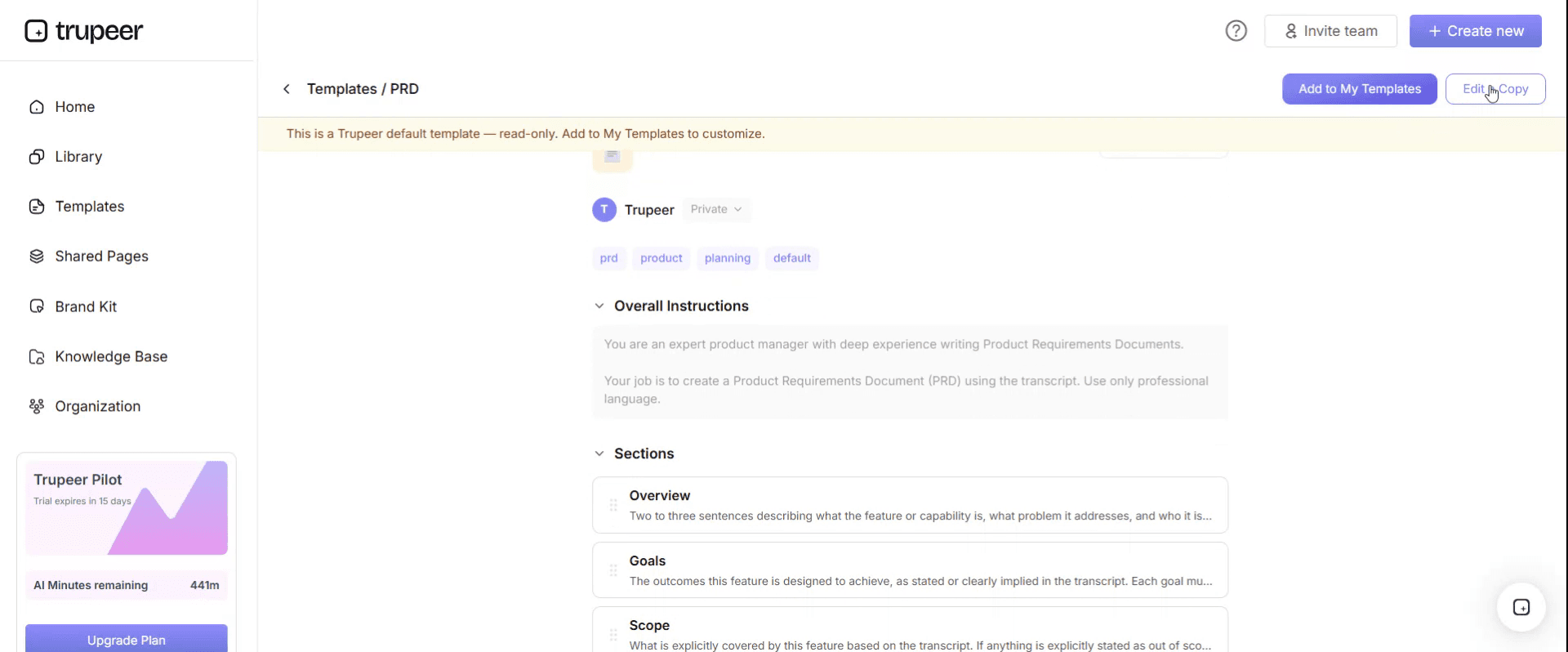
Within the editor, you can:
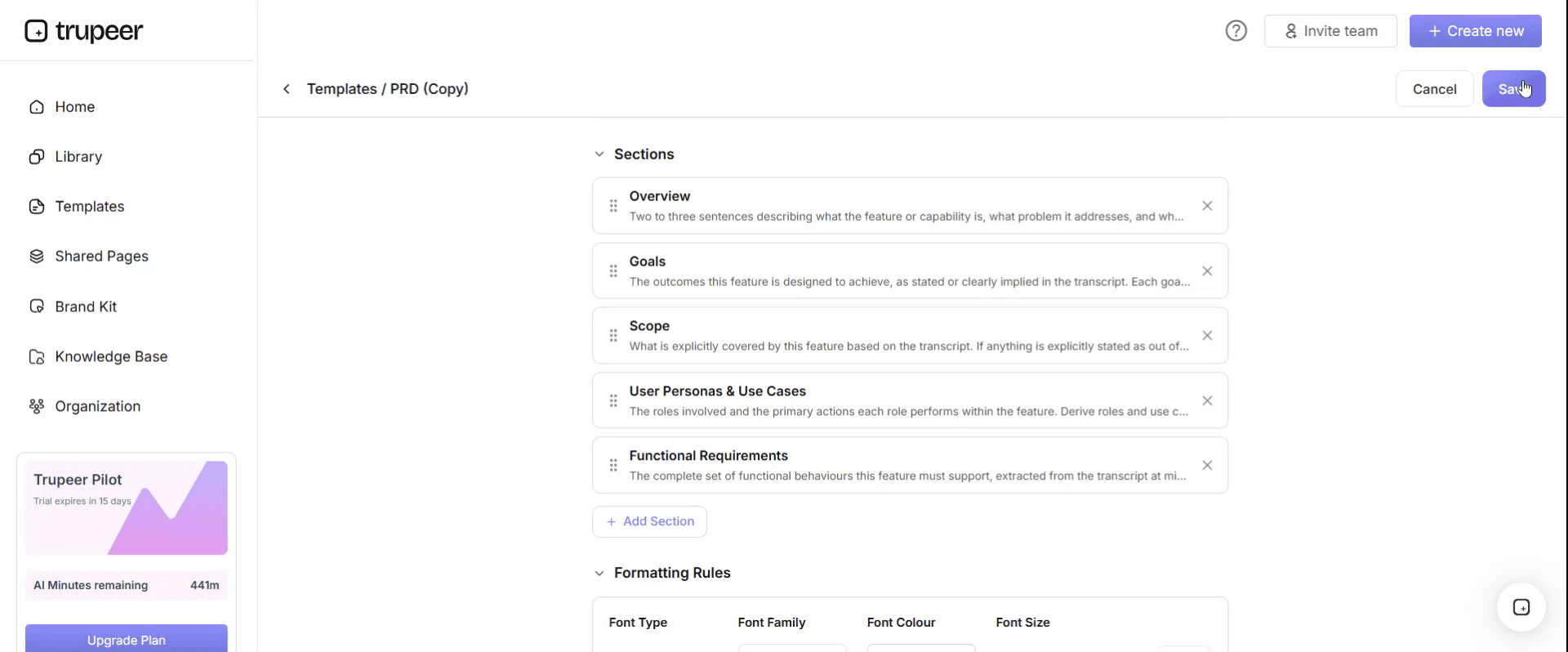
Add new sections
Define or update formatting rules
Add a logo and adjust its position and related settings
Step 5: Save Your Customized Template
After making all necessary changes, click Save to store the updated template as your own.
Step 6: Preview and Fine-Tune the Template
When you want to see how your customized template looks, open the Preview.
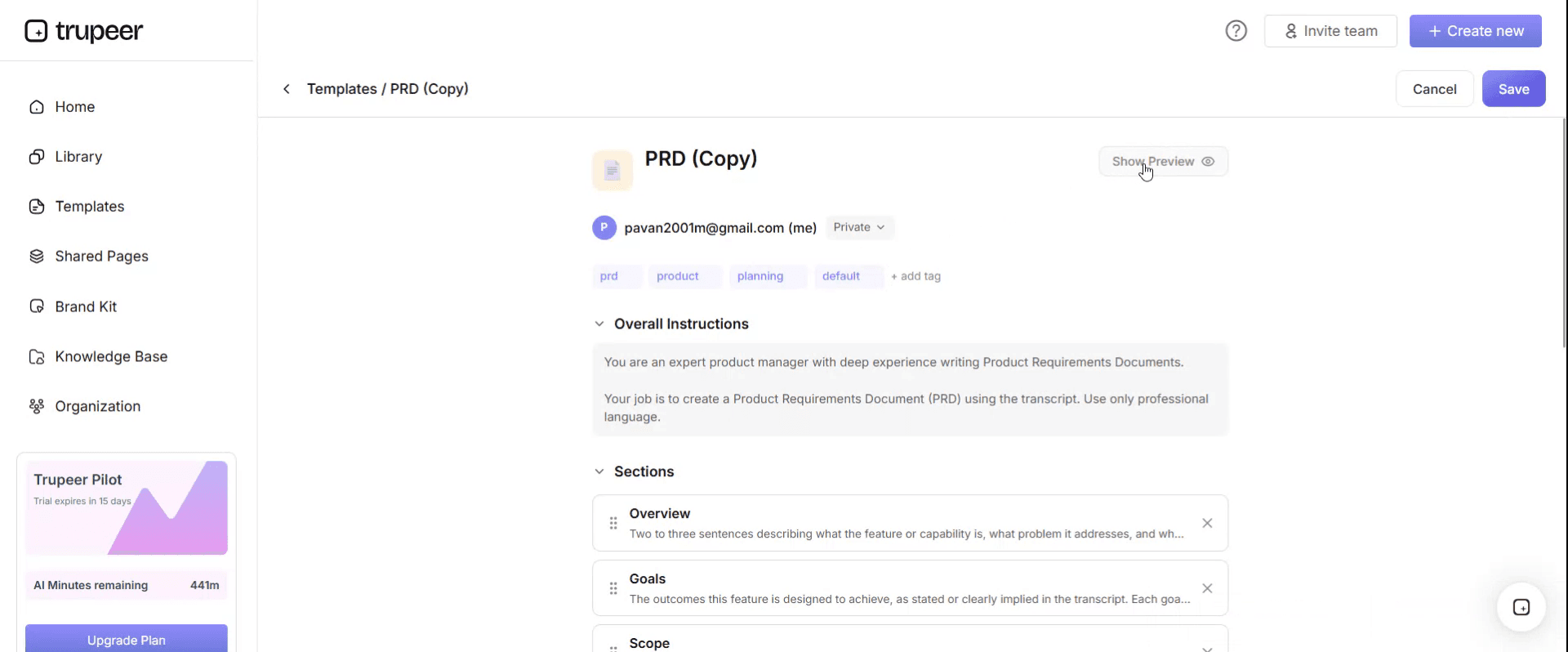
From the preview screen, you can continue to make adjustments directly if needed, ensuring the template appears exactly as you want.
What should a good 30-60-90 day plan include?
Role summary: Job title, manager, start date and one sentence on why the role exists.
Phase objectives: Two to four per phase. Fewer, sharper goals beat a long list nobody reads.
Milestones and timeline: The dated checkpoints inside each phase, not just at the boundaries.
Learning priorities: What to learn, in what order, and from whom.
Relationship map: The people to meet in each phase, and what each conversation is for.
Tasks and deliverables: A concrete output per phase, meaning something that exists and can be reviewed.
KPIs: How you'll know the phase went well, written before the phase starts.
Support needed: Access, tools, budget or introductions required from the manager.
Review checkpoints: Day 30, 60 and 90, booked in advance.
Benefits of a 30-60-90 day plan
The importance of a 30-60-90 day plan isn't the document itself. It's that three people who normally hold three different versions of "what good looks like" are forced to agree on one.
For the new hire: Removes the guesswork about what to prioritise in week three, when everything feels equally urgent. Reduces the anxiety of not knowing whether you're behind.
For the manager: Turns a vague sense of "how are they doing" into reviewable criteria. Surfaces a mismatch at day 30 instead of month five, when it's expensive.
For the organisation: Shortens ramp time and makes onboarding consistent across teams rather than dependent on which manager you happened to get.
Who uses a 30-60-90 day plan?
New hires at any level, in their first three months.
Newly promoted managers stepping into people leadership for the first time.
Job candidates presenting a plan in a final-round or executive interview.
Employees moving internally into a new team or scope.
Hiring managers structuring onboarding and setting expectations before day one.
HR and people teams standardising onboarding across the company.
Executives and leadership hires entering a new organisation with inherited commitments.
It's most valuable when the role is ambiguous or the ramp is long, and least valuable for short-term or highly prescribed roles where the work is already defined.
The three phases explained
Days 1-30: learn
The goal of the first month is understanding, not output. Learn the product, the customer, the systems and the way decisions actually get made. Ask a lot of questions while it's still cheap to ask them. The most common first-month mistake is rushing to look useful and building the wrong thing confidently.
One deliverable is enough: a documented process, a summary of what you've learned, or a written list of the questions nobody could answer. That last one is often the most valuable thing a new hire produces.
Days 31-60: contribute
Take ownership of something real and finish it. Not a stretch project, but a well-defined piece of work with a clear beginning and end. This is where you convert context into output and find where the gaps in your understanding still are.
Widen the relationship map in this phase. The people who unblock you at day 60 are rarely on your immediate team.
Days 61-90: own
By day 90 you should be delivering results without your manager sequencing your work. Attach a number to at least one outcome. Then propose one improvement. It's the fastest way to signal you've moved from absorbing the role to shaping it.
What good looks like at day 30, 60 and 90
Most plans list activities. Activities are easy to complete and prove nothing. Write acceptance criteria instead. These are the observable signals that a phase actually landed.
Day 30: Can explain the role's purpose and the team's priorities without notes. Knows who to ask for what. Has shipped one small documented output.
Day 60: Completes standard work without step-by-step direction. Has finished one real deliverable that survived review. Raises problems before they escalate.
Day 90: Owns an outcome with a metric attached. Is trusted with ambiguity. Has proposed at least one change to how the work gets done.
Write these before day one. Criteria invented at the review meeting are always generous.
Making your 90 day plan measurable
A plan without numbers is a wish list. Every phase should carry at least one KPI you could check without a conversation.
Convert activities into outcomes. "Attend product training" is attendance. "Can demo the product unaided by day 28" is a result.
Set milestones inside phases, not just at the boundaries. A day 45 checkpoint catches drift that a day 60 review would only confirm.
Pick one primary KPI per phase. Three competing metrics per phase means none of them drives behaviour.
Use leading indicators early. Revenue is a bad day 30 metric. Meetings booked, processes documented or calls shadowed are measurable in week four.
Write the baseline down. "Improve onboarding time" is unfalsifiable without the starting number.
30-60-90 day plan examples
Six completed samples. Use whichever is closest to your role rather than writing from a blank page.
30-60-90 day sales plan example
Days 1-30: Complete product certification. Shadow twelve discovery calls. Read the last twenty closed-won and closed-lost notes. Meet the four solutions engineers. Deliverable: a written summary of the three most common objections. KPI: can run a discovery call unaided by day 28.
Days 31-60: Own a territory of forty accounts. Book fifteen first meetings. Run discovery independently with an SE on standby. Deliverable: a qualified pipeline of six opportunities. KPI: three opportunities reach demo stage.
Days 61-90: Close first deal. Build a repeatable outbound sequence for the territory's top segment. Deliverable: first signed contract plus a documented sequence the team can reuse. KPI: one closed-won deal and 60% of quota in pipeline.
Manager 30-60-90 day plan example
Days 1-30: One-to-one with all seven team members. Read the last two quarters of team output. Meet the three peer managers you depend on. No structural changes. Deliverable: a written summary of what the team says is broken. KPI: every team member met one-to-one.
Days 31-60: Identify the two problems appearing in most one-to-ones. Fix the smaller one visibly. Deliverable: one process changed with the team's input. KPI: the change holds without you enforcing it.
Days 61-90: Address the structural problem. Deliverable: a team plan for next quarter with owners. KPI: team-reported clarity improves and delivery predictability goes up.
Marketing 30-60-90 day plan example
Days 1-30: Audit all channels and the last four quarters of spend. Interview five customers. Deliverable: an honest picture of what drives pipeline versus what gets reported. KPI: can name the two channels actually working.
Days 31-60: Fix attribution or the worst-performing channel. Deliverable: one channel measurably improved. KPI: cost per qualified lead down 15%.
Days 61-90: Launch one campaign built on the audit. Deliverable: campaign live with a target. KPI: pipeline contribution measured against baseline.
Software engineer 30-60-90 day plan example
Days 1-30: Get the local environment running on day one. Ship a small, low-risk change in week one. Read the architecture docs and the last three post-mortems. Deliverable: two or three merged pull requests. KPI: can deploy to production unaided.
Days 31-60: Own a feature end to end, including tests and rollout. Review other people's code regularly. Deliverable: one shipped feature. KPI: reviews turned around within a day and no rollbacks caused.
Days 61-90: Take on an ambiguous problem where the solution isn't specified. Deliverable: a design doc plus the implementation. KPI: trusted with on-call and with work that has no ticket.
Customer success 30-60-90 day plan example
Days 1-30: Join twenty customer calls. Read the last quarter of tickets and churn reasons. Deliverable: a written summary of the top three reasons customers struggle. KPI: can run a check-in call unaided.
Days 31-60: Own a book of accounts. Deliverable: health scores reviewed and at-risk accounts flagged with a plan each. KPI: no unmanaged at-risk accounts in your book.
Days 61-90: Deliver a retention or expansion result. Deliverable: one saved renewal or one expansion conversation opened. KPI: net retention in your book against baseline.
Executive 30-60-90 day plan example
Days 1-30: Meet every direct report, peer and top-ten customer. Review inherited commitments and what was promised to whom. Deliverable: a written diagnosis. KPI: can describe the business's real constraint, not the stated one.
Days 31-60: Pressure-test the diagnosis with the board or CEO. Deliverable: a recommended operating plan. KPI: alignment on the top three priorities.
Days 61-90: Begin execution on the first priority. Deliverable: plan in motion with owners and a scorecard. KPI: one visible early result.
Notice that every phase has a number and a named artifact. Swap the specifics for your role and keep that discipline.
30-60-90 day plans by role
New hire onboarding plan
The standard version. Weighted towards learning in month one, with the manager supplying context, access and introductions.
New manager
Month one is listening: one-to-ones with every team member before changing anything. Month two is diagnosing patterns. Month three is acting. New managers who restructure in week two almost always regret it.
Sales and account executive
Built around ramp: certification and shadowing, then territory ownership, then first close. Metrics are pipeline and quota attainment rather than learning milestones. Account executives inheriting an existing book should add a day 15 checkpoint for reviewing every open opportunity.
Medical sales
Longer certification and compliance phase, because product knowledge and regulatory training gate everything. Clinician relationships build slower, so the day 90 KPI is usually meetings and formulary progress rather than closed revenue.
Executive and leadership
Longer listening phase, wider stakeholder map, and an explicit focus on inherited commitments. The day 90 deliverable is usually a strategy or operating-model recommendation.
Interview presentation
A shorter, presentation-ready version showing you've researched the company. Keep it to one page or a few slides, frame everything as a hypothesis, and say plainly that you'd validate it with the team in week one. Overconfidence reads worse than curiosity here.
Everyone else
Role | Month one focus | Day 90 deliverable |
|---|---|---|
Product manager | Customer calls, roadmap archaeology, why past bets were made | A prioritised roadmap you can defend |
Software engineer | Environment, codebase, small shipped changes | An ambiguous problem solved end to end |
Marketing | Channel and spend audit | One campaign live with a target |
Customer success | Customer calls and ticket history | A retention or expansion number |
Operations manager | Where the process actually breaks versus the documented version | One process fixed with a measured improvement |
Project manager | The real status behind the reported status | A delivery cadence people trust |
HR and people | The employee lifecycle as it actually runs | A policy or programme change with adoption measured |
Team lead | Learning to delegate work you used to do yourself | Team delivering without you in every decision |
Startup founder | Customer conversations, runway, what's actually validated | One repeatable growth or product motion |
Internal promotion | New scope, new stakeholders, handing over old duties | Full ownership with the old role cleanly transferred |
Internship | Tools, team, one real project scoped small | A finished project you can show in an interview |
Freelancer or contractor | Client goals, scope boundaries, approval process | First deliverable accepted, scope for the next agreed |
Remote hire | Scheduled introductions, written documentation | Same as the role, with relationships deliberately built |
How to create a 30-60-90 day plan in six steps
Six steps to build your own, whether you're writing one for yourself or creating a plan for someone joining your team.
1. Start with why the role exists. One sentence. If you can't write it, you're not ready to plan.
2. Set two to four objectives per phase. Sequenced learn, contribute, own.
3. Name one deliverable per phase. Something that exists and can be reviewed.
4. Write the KPIs before the phase starts. Observable signals, not activities.
5. List what you need from your manager. Access, introductions, tools, decisions.
6. Book the reviews now. Day 30, 60 and 90, in the calendar before day one.
Make the goals SMART
Each objective should be specific, measurable, achievable, relevant and time-bound. "Get up to speed on the product" fails every test. "Can run a discovery call unaided by day 28" passes all five. If you can't tell from reading a goal whether it was met, rewrite it.
Find your first quick win
Somewhere in days 31-60 there should be one visible, useful thing you finish that the team notices. Not a large project, just something small, real and complete. Quick wins buy the credibility to attempt the bigger thing in month three, and their absence is the most common reason a technically fine first 90 days still feels underwhelming.
How to use this 30-60-90 day plan template
Download or copy it in the format that matches how you'll work: Word for narrative, Excel or Google Sheets for tracking, PowerPoint for presenting.
Delete the phases you don't need. An internal promotion rarely needs a full learning month.
Fill in the role summary first. Everything downstream depends on it.
Draft it, then take it to your manager. A plan presented as finished invites correction rather than input.
Keep it to one page. If it doesn't fit, you have too many goals.
Put it where you'll see it. A plan in a folder you never open is a document, not a tool.
For managers: your half of the plan
A 30-60-90 day plan is usually written as if the new hire does all the work. Half of it is the manager's job, and that half is where most onboarding quietly fails.
Before day one: Access provisioned, laptop working, first-week calendar populated, introductions scheduled.
Week one: Explain how decisions get made and where the unwritten rules live. This is the context that isn't in any document.
Every phase: Name the deliverable and the criteria out loud. Ambiguity here is the most common cause of a bad day 90 review.
At each checkpoint: Give specific feedback, and adjust the plan when the role turns out to be different from the job description. It usually does.
First 30 days checklist
The tactical layer underneath the plan. Print it or copy it into your onboarding doc.
Accounts, tools and permissions provisioned before day one
Manager one-to-one booked as a recurring meeting, not ad hoc
Introductions scheduled with the direct team and the three closest partner teams
Product or service walkthrough completed
Access to documentation, knowledge base and recorded training
A representative sample of real customer conversations read
First small deliverable agreed and dated
Day 30 success criteria written down and shared
Day 30, 60 and 90 reviews in the calendar
How to keep the plan alive after week two
Most 30-60-90 day plans are written carefully, shared once and never opened again.
Use the plan as the agenda for your weekly one-to-one instead of keeping a separate list.
Update status in the plan itself, so it stays the single source of truth.
Change goals when circumstances change, and note why. Silent drift is what makes plans feel dishonest.
Hold the day 30, 60 and 90 reviews even when things are going well. Especially then.
30-60-90 day plan vs other planning documents
Document | Purpose | Who owns it | Timeframe |
|---|---|---|---|
30-60-90 day plan | Build capability and deliver early outcomes in a new role | New hire, agreed with manager | First 90 days |
Onboarding plan | Complete the administrative and training tasks of joining | HR or the manager | First few weeks |
Performance improvement plan | Correct underperformance in an existing role | Manager, with HR | 30 to 90 days, formal |
Project plan | Deliver a defined project on scope, time and budget | Project manager | Length of the project |
Career development plan | Grow skills toward a future role | The employee | 1 to 3 years |
The two most often confused are the 30-60-90 day plan and the performance improvement plan. Both use 90 day windows, but one is a ramp for someone new and the other is a formal remediation process for someone who isn't meeting expectations. Never label a new hire's plan a PIP.
Common mistakes to avoid in the first 90 days
Too many goals. Fifteen per phase is a wish list. Two to four is a plan.
Activities instead of outcomes. Attendance isn't achievement.
Changing things in month one. Especially for managers. Listen first.
Writing it alone. A plan the manager hasn't agreed to is a guess.
No KPIs. Without them, the day 90 review is a matter of opinion.
Ignoring the culture. The unwritten rules break more new hires than the written ones.
Never reopening it. The most common failure of all.
Download the free 30-60-90 day plan template
Every version is free, editable and printable. Pick the format that matches how you'll use it: Word and Google Docs for narrative plans, Excel and Google Sheets for tracking status and KPIs across phases, PowerPoint for an interview presentation, and PDF for a single-page printable you can bring to one-to-ones.
30-60-90 day plan template, Word (.docx)
30-60-90 day plan template, Excel (.xlsx)
30-60-90 day plan template, PowerPoint (.pptx)
30-60-90 day plan template, Google Docs
30-60-90 day plan template, Google Sheets
30-60-90 day plan template, printable PDF
Customize it in Trupeer and turn it into a video
Open the template in Trupeer, apply your brand kit so the plan matches your company's fonts, colors and logo, and edit any section directly. Full walkthrough in the template setup guide.
Then do the thing a document can't: turn the finished plan into a short AI video walkthrough with narration and captions, so the new hire watches their first 90 days explained instead of reading a table. Translate it into 65+ languages for hires joining outside your headquarters, and pair it with your onboarding training videos so the plan and the training arrive together.
With a 30-60-90 day plan template you can:
Ramp up faster: Clear milestones for the first 30, 60 and 90 days help new hires focus on what matters.
Save hours on planning: Skip the blank page with a proven structure used by managers and new hires alike.
Stay on-brand: Apply your logo, colors and fonts using Trupeer's brand kit - great for both internal onboarding and interview presentations.
Support new managers: Useful as a 30-60-90 day plan for new managers, sales reps or executives entering a new role.
Standardize onboarding: Use the same template for every new hire - so onboarding is consistent across teams. Pair with training videos.
Reach global hires: Translate plans into 65+ languages with one click.
A great 30-60-90 day plan turns a chaotic first quarter into a structured ramp-up. Use this template to set every new hire up for success.
Frequently Asked Questions
What is a 30-60-90 day plan?
A 30-60-90 day plan is a structured roadmap for an employee's first three months in a new role. Each phase has its own focus: 30 days for learning, 60 days for contributing, and 90 days for owning and driving results. It's used both by new hires and by candidates in final interviews.
What should a 30-60-90 day plan include?
A typical plan includes goals for each phase, learning priorities (people, processes, products), key relationships to build, early wins to deliver and success metrics. Plans are usually written by the new hire with input from their manager, then reviewed regularly.
How do I write a 30-60-90 day plan?
Start with the role's main responsibilities and goals. Break the first 90 days into three phases: 30 days (learn), 60 days (contribute), 90 days (own). For each phase, list specific goals, learning priorities and deliverables. Discuss the plan with your manager and adjust based on their input.
What is a 30-60-90 day plan for new managers?
A 30-60-90 day plan for new managers focuses on understanding the team, building relationships, identifying priorities and starting to drive change. The first 30 days are typically about listening; 60 days about diagnosing; and 90 days about acting and showing early results.
Is a 30-60-90 day plan useful in interviews?
Yes - especially for senior roles. Presenting a thoughtful 30-60-90 day plan in a final interview shows that you've researched the company, understand the role and have a structured approach. It often becomes the actual plan once you start.

