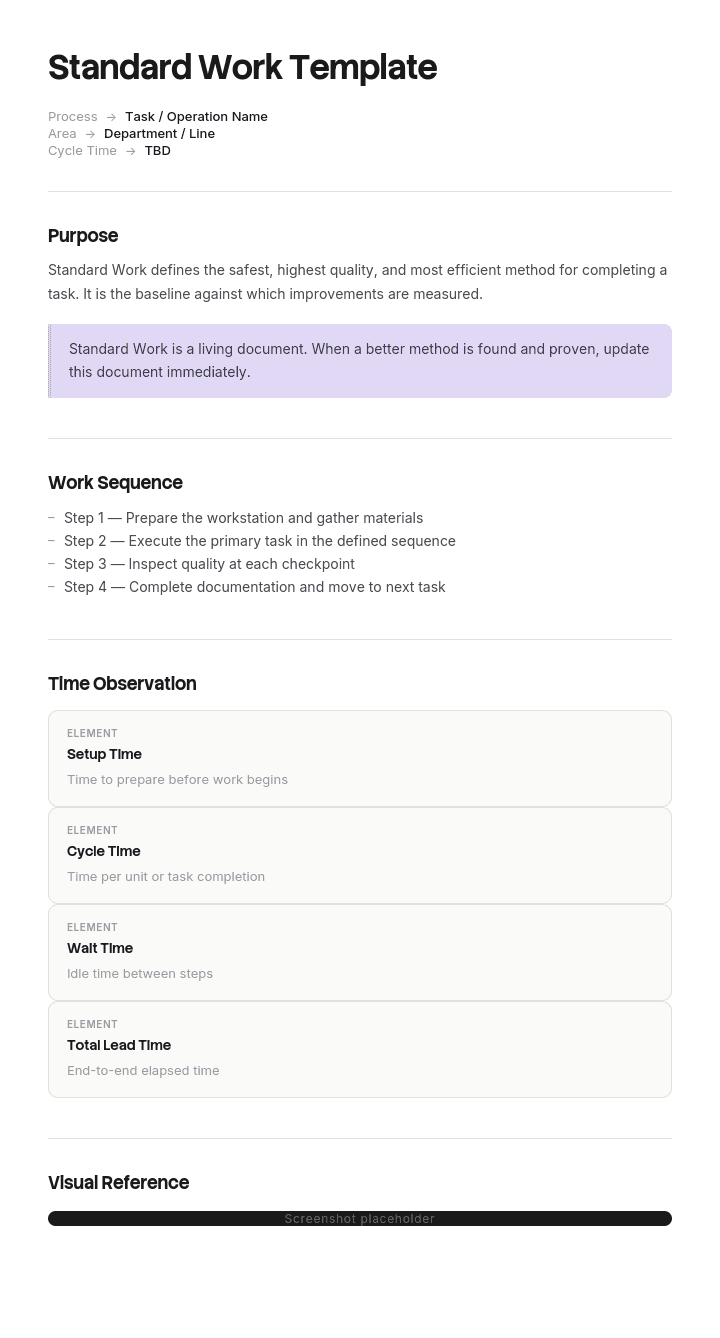
Use this template
Standard work is one of the cornerstones of lean manufacturing and operational excellence. With Trupeer, you can save hours on documenting standard work by starting with a free standard work template, customizing it with your brand guidelines, and turning written standard work documents into video walkthroughs that frontline workers actually use.
What is a free standard work template?
A free standard work template is a reusable structure for documenting the current best known way of performing a repeating operation, at the pace the operation is required to run.
It comes from the Toyota Production System and it is a different document from a procedure or a work instruction, in a way that gets lost almost everywhere. Standard work is not primarily a description of what to do. It is a baseline against which variation becomes visible, and against which improvement is measured.
Most templates published under this name are a numbered list of steps with photographs, which is a work instruction. It is a useful document and it is missing two of the three things that make standard work standard work.
Format follows use. A standard work template Excel free layout is the most common, because the calculations behind it are arithmetic and the document is revised often. A free standard work template Word file suits documents with more narrative around them. A free standard work template PPT layout suits the version displayed at the cell, and a free standard work template PDF suits the controlled copy where an auditor may ask what was in force.
What is standard work?
The agreed current best method for a repeating task, documented with the pace it must run at and the inventory it needs to run smoothly.
Three characteristics distinguish it from other process documents.
It applies to repeating work with a reasonably consistent cycle. A task performed once a quarter does not have standard work, it has a procedure.
It is tied to a required rate. The same operation has different standard work at different demand levels, because the sequence that is efficient at one pace may not be at another.
And it is expected to change. This is the characteristic most implementations lose, and it is the subject of the section after next.
How to customize this template in Trupeer
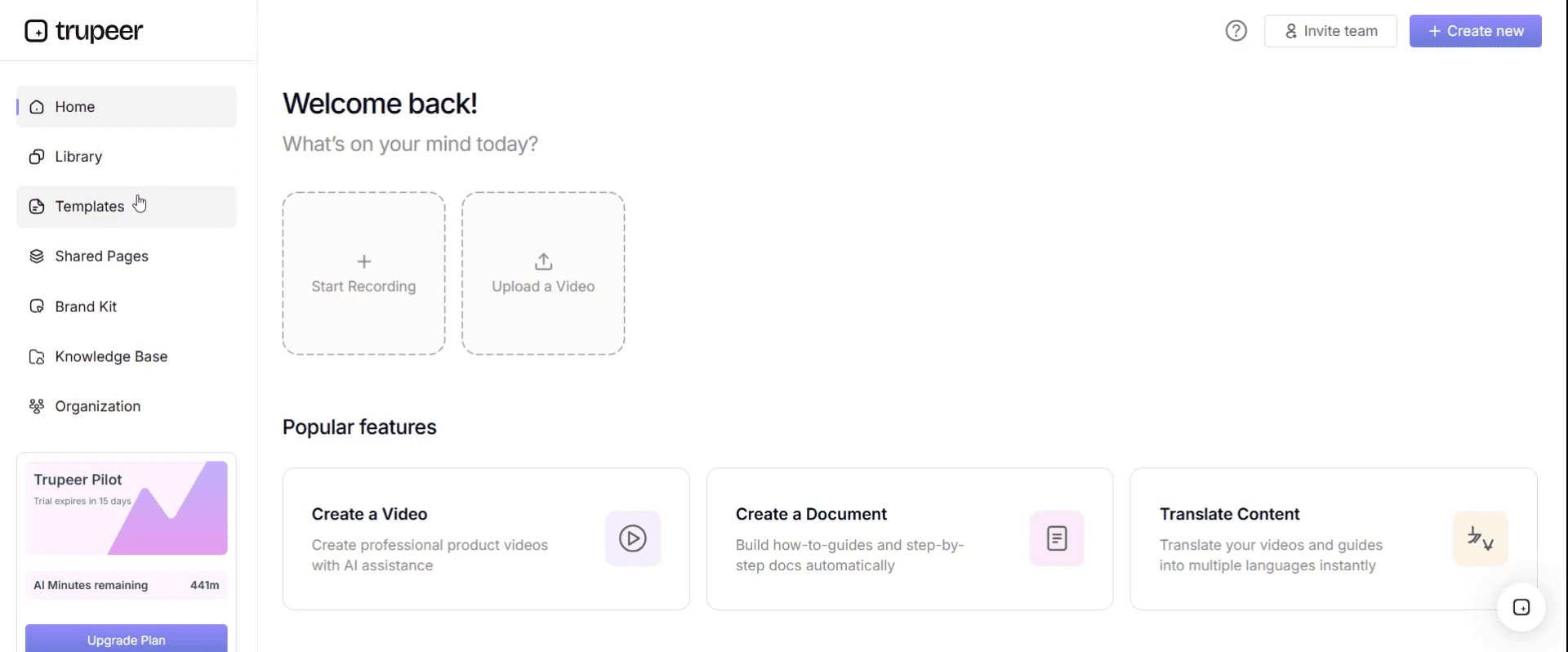
Step 1: Open the Templates Section
Go to the Templates section from the main navigation.
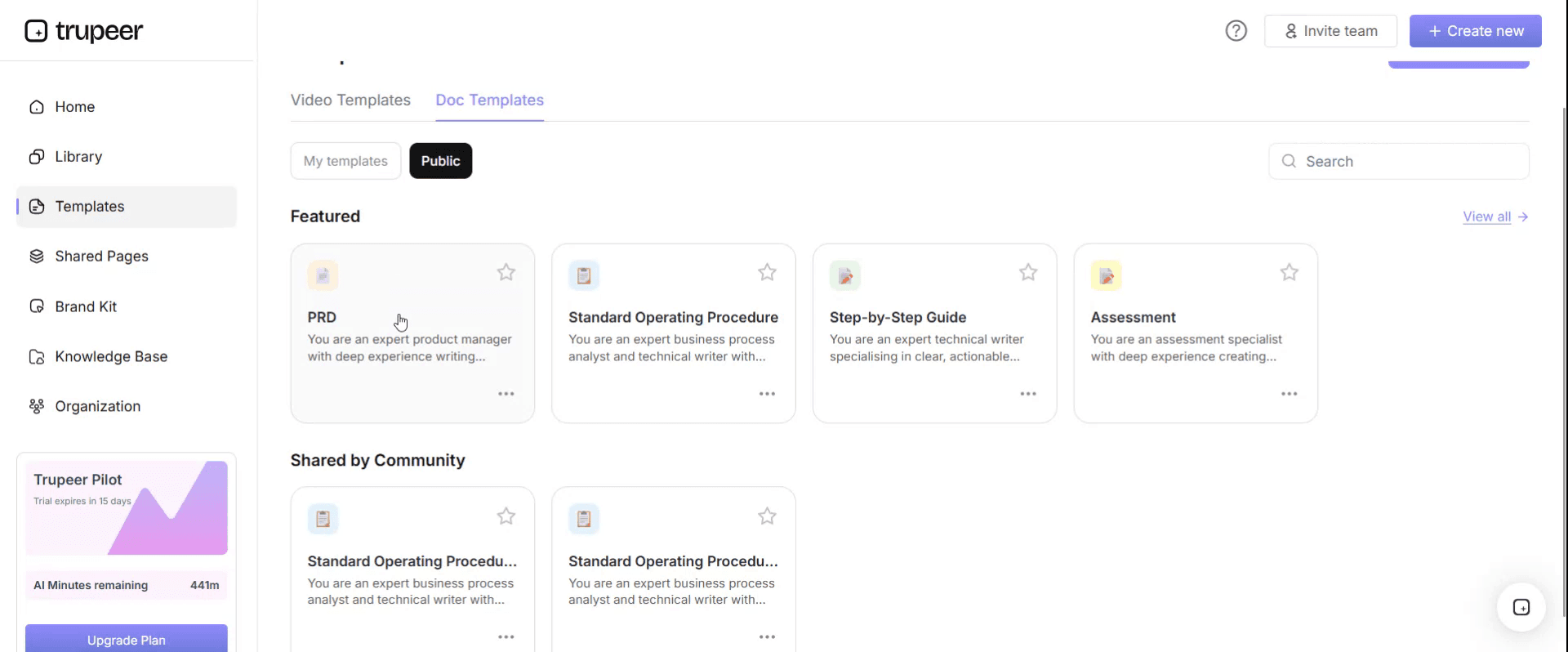
Step 2: Select and Open a Template
Click on any template you want to work with to open it.
Step 3: Expand the Template View
If needed, expand the template view to see the full layout and details clearly.

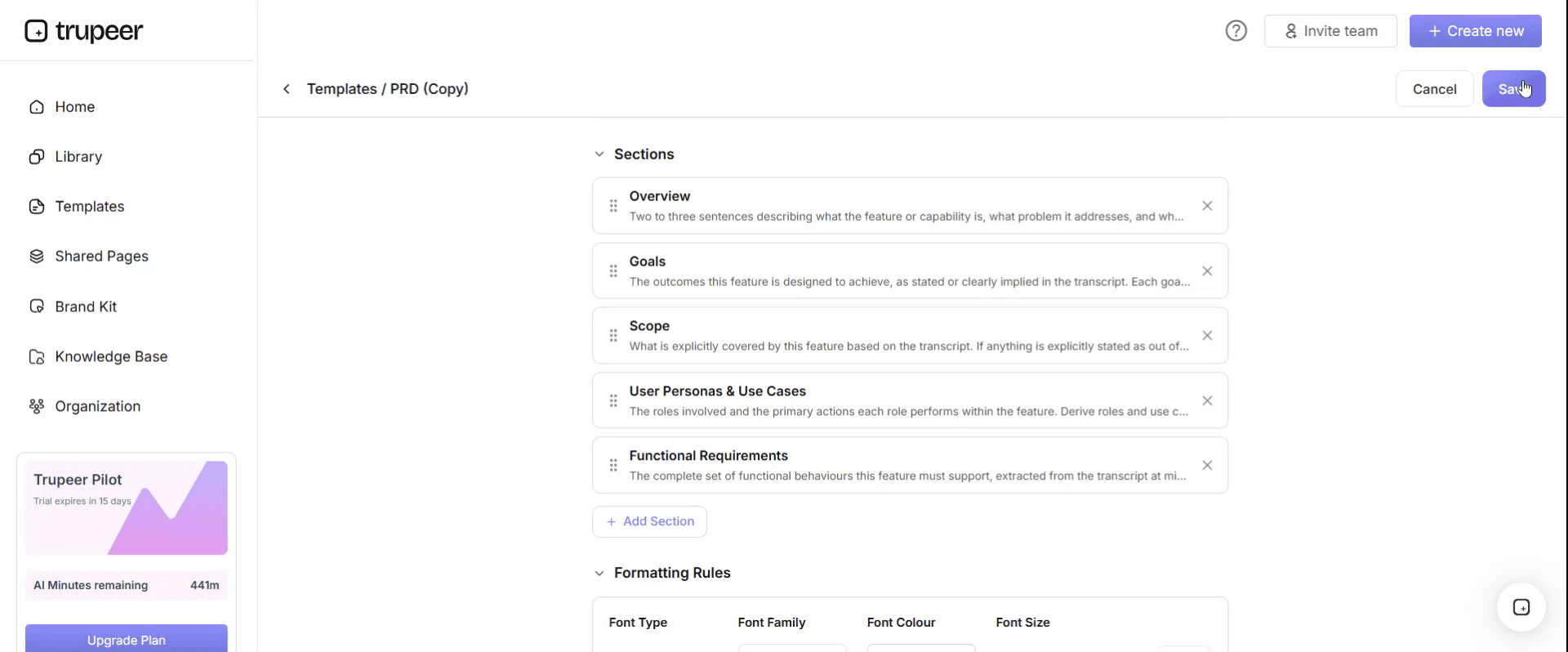
Step 4: Edit the Template
Click on Edit to start modifying the selected template.
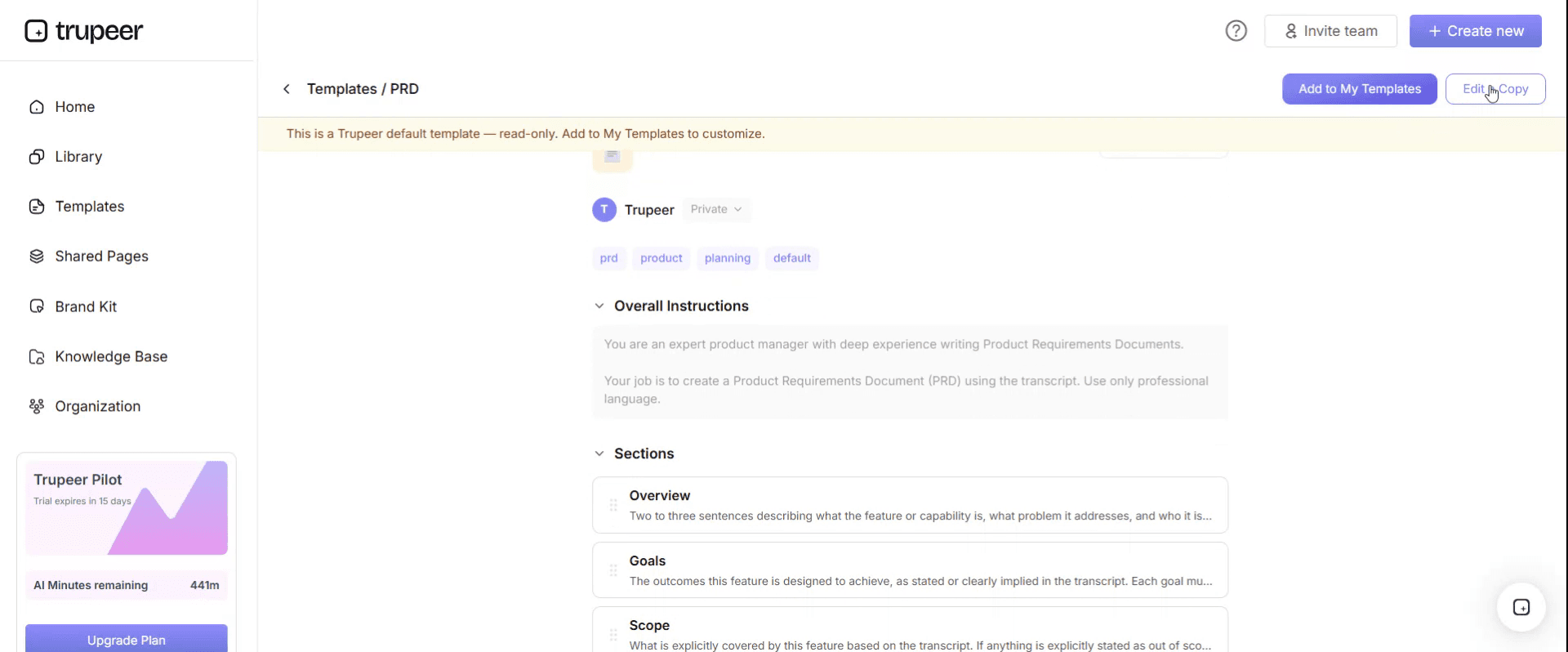
Within the editor, you can:
Add new sections
Define or update formatting rules
Add a logo and adjust its position and related settings
Step 5: Save Your Customized Template
After making all necessary changes, click Save to store the updated template as your own.
Step 6: Preview and Fine-Tune the Template
When you want to see how your customized template looks, open the Preview.
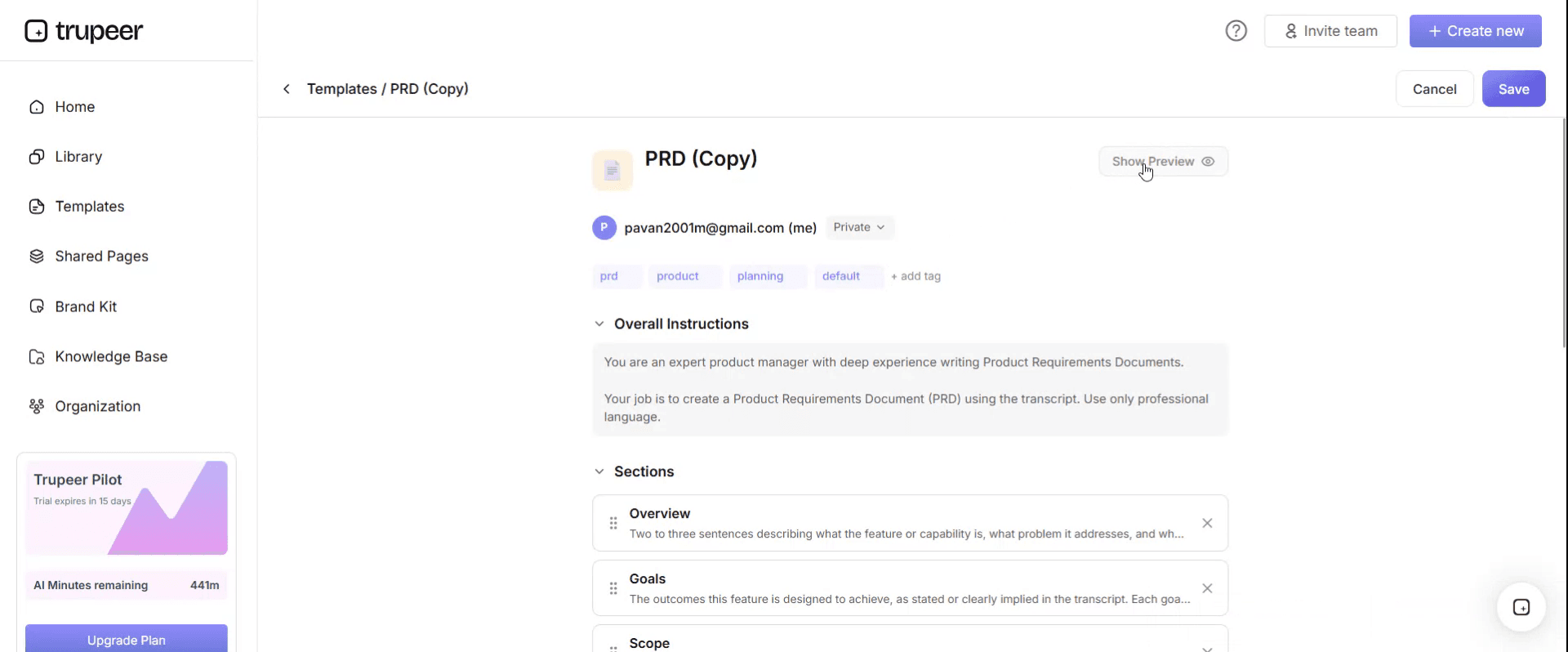
From the preview screen, you can continue to make adjustments directly if needed, ensuring the template appears exactly as you want.
With a standard work template you can:
Save hours on writing: Skip the blank page with a structure built for lean operations.
Improve quality: Standard work reduces variation - the #1 driver of defects in any process.
Stay on-brand: Apply your logo, fonts and colors using Trupeer's brand kit - so every site sees consistent docs.
Train every shift: Pair standard work with video walkthroughs - perfect for new hires and cross-shift consistency.
Standardize globally: Use the same template across plants, regions and product lines.
Reach global teams: Translate standard work into 65+ languages with one click.
The three elements most templates leave out two of
Standard work has three elements. Published templates almost always contain the second and omit the first and third.
Takt time. The rate at which the operation must produce to meet demand, calculated as available working time divided by required output. If a cell works four hundred and fifty minutes a day and demand is three hundred units, takt is ninety seconds. Every sequencing decision follows from this number, and a standard work document without it cannot tell an operator whether they are ahead, behind or on pace.
Work sequence. The order of steps, with the time each takes. This is the part every template has. On its own it is a work instruction.
Standard work in process. The minimum inventory needed within the cell for the sequence to run without interruption. Usually small and usually specific: one unit at this station, none at that one, two in the fixture. Where this is unspecified, operators each hold whatever buffer feels comfortable, and different buffers produce different rhythms and different cycle times for the same documented sequence.
The third element is the one that surprises people, and it is frequently the cause of variation nobody can explain. Two operators following the same steps at different buffer levels are running two different processes.
Some sources describe four elements, adding the quality check points or separating cycle time from takt. The three above are the core and the additions are refinements rather than disagreements.
Standard work is a baseline, not a rule
Here is the test, and it takes one question.
When was your standard work last changed, and who changed it?
If the answer is that an engineer wrote it during an improvement programme two years ago and it has not changed since, you do not have standard work. You have a rule, and the people doing the job have almost certainly found better ways and are not telling you.
Standard work exists in its original form so that improvement has something to improve against. A process with no standard cannot be improved in any measurable way, because there is nothing to compare a change to. That is the entire reason the document exists, and it implies that the document must move.
What goes wrong in practice is that standard work gets adopted as a compliance instrument. It is written by engineers, issued to operators, audited for adherence, and never revised. Under that regime the document stops describing what happens within months, because the people doing the work continue to improve regardless and simply stop mentioning it.
The consequences are worse than a stale document. Auditing adherence to a standard that people have improved past teaches everyone that improvements should be hidden. Once that lesson lands, you lose the improvements and the honest reporting together.
Two mechanisms keep it a baseline. Anyone performing the work can propose a change, with a defined response time so proposals do not disappear. And the document itself shows who last changed it and when, on the face of it, so a standard nobody has touched in a year is visibly a question rather than an achievement.
What a standard work template must contain
Eight components. The first and third are the ones missing from most published templates.
Component | What it does |
|---|---|
Takt time | Required pace, with the calculation shown so it can be rechecked when demand changes. |
Work sequence | Steps in order, with the time each takes and the cumulative time. |
Standard work in process | How much inventory sits where, for the sequence to run without stopping. |
Cycle time against takt | Total sequence time compared to takt, so the gap is visible. |
Quality and safety check points | Marked at the step, not collected at the end. |
Layout or motion diagram | Where the operator moves, which is where a large share of avoidable time goes. |
Owner, version and last changed | On the document, with who changed it. |
Change record | What changed, when, proposed by whom. Short, and on the document rather than in a separate system. |
The change record is small and does more than its size suggests. A document showing three operator proposed changes in the last year is telling everyone that proposals are welcome. A document with a blank change record for two years is telling them the opposite.
Free standard work template: the structure to copy
Filled with a real example rather than placeholders. The operation is an electronics assembly cell.
Copy from here.
Header. Cell, product family, version, date, owner, and who last changed it.
Cell 3, controller board family B. Version 11, 22 May. Owner: Cell Team Leader. Last changed by an operator, sequence steps 4 and 5 reordered.
Takt time. With the calculation.
Available time 450 minutes per shift. Required output 300 units. Takt time 90 seconds. Recalculated whenever the production plan changes by more than ten percent.
Work sequence.
# | Step | Time | Cumulative | Check |
|---|---|---|---|---|
1 | Collect board from input rack, place in fixture | 6s | 6s | |
2 | Fit connector A, verify seated | 11s | 17s | Visual check, both clips engaged |
3 | Fit connector B | 9s | 26s | |
4 | Apply thermal pad | 8s | 34s | |
5 | Fit heatsink and torque both screws | 19s | 53s | Torque tool confirms, audible click |
6 | Functional test, press start and wait | 14s | 67s | Green lamp. Red lamp routes to rework, do not repeat the test |
7 | Label and place in output rack | 8s | 75s |
Cycle time against takt. Sequence total 75 seconds against takt of 90 seconds. Fifteen seconds of margin, which absorbs normal variation and short interruptions. If cycle time approaches takt, raise it rather than absorbing it.
Standard work in process. Two boards in the input rack, one in the fixture, one in test, one awaiting labelling. Five units total in the cell. More than this and the cell is hiding a problem upstream. Less and the operator waits.
Layout. Diagram showing the fixture, test station, racks and the operator's path. Total walking distance in the current sequence is about four metres per unit.
Change record.
Date | Change | Proposed by | Effect |
|---|---|---|---|
22 May | Steps 4 and 5 reordered so the thermal pad is applied before the board is repositioned | Operator, cell 3 | Removed one reposition, saved about 4 seconds |
3 Feb | Standard WIP in input rack reduced from four to two | Team leader | Made upstream delays visible within one cycle |
14 Nov | Torque tool replaced, step 5 time reduced | Engineering | 3 seconds |
Copy to here.
Standard work example: twenty two percent variation nobody could explain
Bewdley Electronics, a contract electronics manufacturer of about three hundred and eighty people, runs six assembly cells.
It held forty four standard work documents, one per cell per product family, produced three years earlier by two industrial engineers during a lean programme. Each was a numbered sequence with photographs and step times. They were neatly done and they were audited for adherence.
Cycle times on the same cell, same product, varied by about twenty two percent between operators. Nobody could explain it. Every operator, asked directly, said they followed the standard work, and they were being truthful as they understood the question.
Two things were missing from all forty four documents.
There was no takt time anywhere. Operators had no way of knowing what pace was required, so pace was set by individual habit and by whatever the previous operator had left behind.
There was no standard work in process. Buffer levels in the cells ranged from two units to eleven, depending entirely on operator preference. An operator with a large buffer works in a different rhythm from one with almost none, and the same written sequence produces different cycle times under each.
The third finding came from watching. Three operators on one cell were observed through a full shift. All three used different sequences. Two were faster than the document.
The fastest had reordered two steps roughly two years earlier, saving a reposition. She had never mentioned it. Asked why, she said the standard was the standard, and that raising it would have looked like she had not been following it.
That sentence was the most useful output of the whole exercise.
The rewrite added takt time and standard work in process to all forty four documents, and adopted the fastest observed sequence as the new standard in nine cells. It also introduced a proposal route: any operator can propose a change, with a response required within five working days, and the change record printed on the face of the document.
Cycle time variation fell from about twenty two percent to seven.
Over the following fourteen months, sixty one changes were proposed and thirty eight were adopted. Output per cell rose about nine percent, and roughly two thirds of that came from changes proposed by the people doing the work.
The improvements had existed all along. The document had been designed in a way that made mentioning them feel like an admission.
How to create standard work in six steps
Calculate takt time first. Available time divided by required output. Everything downstream depends on it, and a sequence designed without it is designed for an imaginary pace.
Observe the work several times, with a stopwatch. Different operators, different shifts. The variation between them is the raw material.
Time each element, not the whole cycle. A total tells you there is a problem. Element times tell you where.
Choose the best observed sequence, not an idealised one. Somebody is already doing this well. Start from what they do rather than from what an engineer thinks should happen.
Set standard work in process deliberately. The minimum that lets the sequence run without waiting. Setting it lower than comfortable is how upstream problems become visible.
Put the change record on the document and use it within the first month. A standard with no changes in its first quarter is one nobody feels able to question.
Step four is where most implementations go wrong. Standard work designed at a desk describes a process nobody performs, and operators respond by following it during audits and doing something sensible the rest of the time.
Leader Standard Work
A related and distinct practice, and one of the more useful ideas in lean management.
Where standard work covers the repeating operation, Leader Standard Work covers the repeating routine of the people supervising it. What a team leader checks every day, what a supervisor reviews weekly, what a manager looks at monthly, and where each of them physically goes.
A Leader Standard Work template is usually a calendar or checklist rather than a sequence. Daily items might include confirming the previous shift's issues were resolved, walking the cells and looking at the boards, and checking that yesterday's standard work proposals have had a response. Weekly items are typically reviews and follow ups. Monthly items are longer horizon.
Two design points matter. The routine should be mostly at the place the work happens rather than at a desk, because the value comes from observing rather than reporting. And it should be a small number of items done reliably rather than a long list done sometimes, since the whole mechanism depends on people being able to predict when their leader will appear and what they will ask.
The connection to standard work is direct. A proposal route that nobody follows up dies within a quarter, and the follow up is a Leader Standard Work item. That is usually where a stalled improvement culture is actually failing.
Standard work, SOP or work instruction?
Three documents that overlap and answer different questions.
Standard work covers repeating operations with a cycle, tied to a required pace, and exists to make variation visible. Takt, sequence, standard WIP.
A standard operating procedure describes a process end to end, usually across roles, and answers who does what in what order. It has no pace element. The SOP template covers it.
A work instruction describes one task in enough detail for somebody unfamiliar to perform it. It is the closest relative and the work instructions template covers it.
The practical distinction between standard work and a work instruction is what the document is for. A work instruction exists so that the task is performed correctly. Standard work exists so that the task can be improved, which is why it carries times and a change record and the work instruction does not.
If your document has no time against each step and no takt, it is a work instruction with a different title, and calling it standard work will not make anybody improve anything.
Standard work template variants
The structure holds and the emphasis moves.
Assembly and manufacturing cells. The classic case. Takt, sequence, standard WIP and a motion diagram, exactly as above.
Machine paced operations. Where the machine sets the cycle, operator standard work is about what happens during and between machine cycles, and standard WIP matters more than sequence.
Healthcare and clinical processes. Standard work is used widely in improvement programmes here. Takt is often better expressed as a target interval than a strict cycle, and any standard work touching clinical practice needs clinical governance approval rather than engineering approval alone.
Office and transactional processes. Genuinely applicable and rarely done well. The unit is a case or a transaction rather than a physical item, and standard WIP becomes how many cases sit in a queue at each stage, which is usually far higher than anyone would set deliberately.
Leader Standard Work. Covered above. A calendar rather than a sequence.
Maintenance and changeover. Standard work for a changeover is what a rapid changeover programme improves against, and the time element carries all the weight.
What a free standard work template cannot fix
Unstable demand or supply. Takt time assumes a knowable required rate. Where demand swings wildly or materials arrive unpredictably, standard work will be rewritten constantly or ignored, and the instability is the thing to address first.
A document used for compliance only. No template prevents an organisation from auditing adherence and never revising the standard. That is a management choice and it produces the hidden improvement problem described above.
Standard work written at a desk. No free standard work template free download contains observation data, and no free standard work template Excel free download will supply your element times either. Observation is where the content comes from.
A process that genuinely varies. If every unit is different, the work is not repeating and standard work is the wrong tool. A procedure with documented branches will serve better.
Show the work rather than describing it
Standard work is built from observation, and observation is the expensive part. Somebody has to watch several operators through several cycles, time each element, and notice the differences between them. That is a day of an engineer's time per cell, which is why standard work gets created once during a programme and then never revisited.
Trupeer AI changes what that costs. Recording the operation while it is performed captures the sequence, the timings and the deviations in one pass, and the output is a written step by step document with images already captured, annotated and placed, alongside the video, in your own branding.
Record it. Brand it. Translate it. Trupeer it.
Three consequences follow for standard work specifically. Recording two or three people performing the same operation makes the variation directly comparable, which is exactly the analysis standard work requires and the one that took Bewdley a shift of observation per cell. Updating after an accepted proposal means re-recording rather than reshooting a photo sequence, which is what determines whether a change record has three entries a year or thirty. And where an operation runs across sites or languages, the same recording produces the same standard in each, so the same product is genuinely built the same way.
The material sits in your knowledge base and doubles as training for new operators, which is the other job standard work documents are asked to do. Consistency across your documents is a matter of setting the brand kit once, and setup is covered in the document template setup guide.
Frequently Asked Questions
Is there a standard work template Excel free version?
Excel is the natural format, because standard work is arithmetic: element times, cumulative times, cycle against takt. A standard work template Excel free layout lets you change one element time and see the cycle recalculate, which is the whole point during improvement work.
Build the takt calculation as a formula rather than a typed figure. Demand changes, and a takt time that has to be recalculated by hand is a takt time that will silently go out of date.
Is there a free standard work template Excel free download?
Widely available and most of them give you a step table with times, which is the middle element only. A free standard work template Excel free download will rarely include takt time or standard work in process.
Add both. Two rows at the top for takt and its calculation, and a short block stating how much inventory sits where. Those two additions are what separate standard work from a timed work instruction.
Is there a free standard work template Word version?
Word suits standard work that carries more narrative, such as documents for office and transactional processes where the steps need explanation. A standard work template Word file works well for those.
For cell level manufacturing standard work it is a poorer fit, because the document is mostly numbers that need recalculating. Use a spreadsheet for the working version and produce a document or a display version from it.
Is there a free standard work template PPT version?
Slides suit the version displayed at the workstation, where it is read at a glance rather than studied. A free standard work template PPT layout gives you control over placement, which matters for a document read from a metre away.
Generate it from the working version rather than maintaining it separately. A display copy that has drifted from the current standard is worse than none, because it is the copy people actually look at.
Is there a free standard work template PDF?
PDF suits the controlled and issued copy, particularly where an auditor may ask which standard was in force on a given date. Export a free standard work template PDF at each revision with the version and date visible.
Keep the superseded versions rather than overwriting them. The history of how a standard changed is evidence that improvement is happening, and it is the thing an assessor of a lean programme will actually want to see.
Is there a free standard work template free download worth using?
The table takes twenty minutes to build, so a free standard work template free download saves little, and nearly all of them are step lists with times.
Judge any of them on two questions. Is there a field for takt time, and is there a field for standard work in process? Almost none have both, and a template with neither is a work instruction that has borrowed the name.
Where can I get a Leader Standard Work template?
Leader Standard Work is usually a calendar or checklist rather than a sequence, so a Leader Standard Work template looks quite different from operator standard work: daily, weekly and monthly items against a routine.
Keep it short. A leader routine of five reliable daily items beats twenty aspirational ones, because the mechanism depends on people knowing when their leader will appear and what they will ask. Include following up on improvement proposals, since that item is what keeps operator standard work alive.
What are the elements of standard work?
Three. Takt time, meaning the pace required to meet demand. Work sequence, meaning the order of steps and the time each takes. And standard work in process, meaning the minimum inventory needed within the operation for that sequence to run without waiting.
Some descriptions give four, usually by separating cycle time from takt time or by adding quality check points. The difference is presentational. What matters is that most published templates contain the sequence alone, and a sequence without a pace and without an inventory standard cannot do the job standard work exists to do.