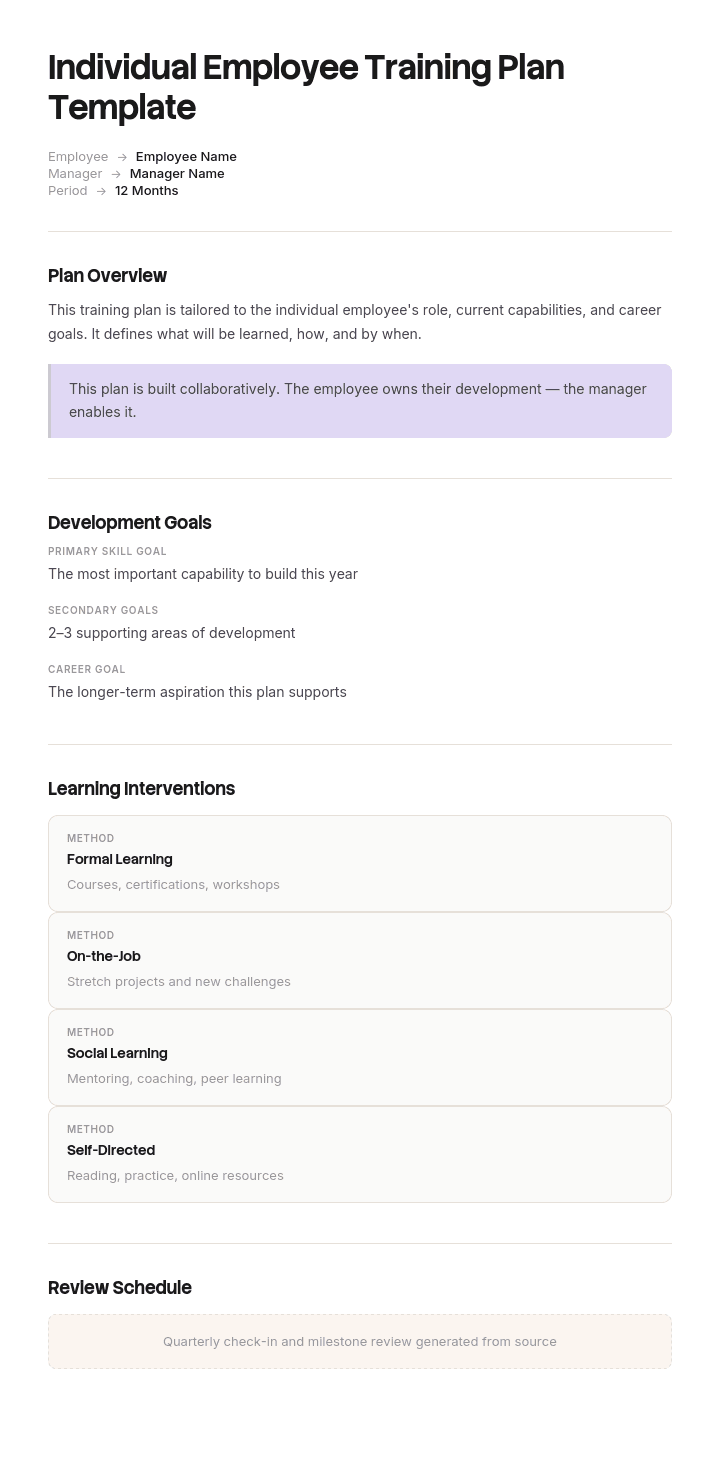
Use this template
One-size-fits-all training rarely fits anyone perfectly. With Trupeer, you can save hours on personalized development by starting with a free individual employee training plan template, customizing it with your brand guidelines, and turning each plan into a video summary employee and manager can revisit during 1:1s.
Most individual training plans are a list of courses someone was signed up for. They are rarely wrong, exactly, but they are rarely derived from anything either.
An individual plan is worth writing when it starts from a specific gap: this person needs to be at level three on this competency, they are at level one, and here is how they get there by when. Everything else is a training booking with a name on it.
Download the individual training plan template
Format | Best for |
|---|---|
Excel (.xlsx) | The skills matrix, gap assessment and the plan itself |
Word (.docx) | The plan document the employee and manager work from |
The agreed version, and printing for review conversations | |
Google Sheets | A shared plan both parties update |
.doc | Older HR systems |
Free, editable, no watermark. Excel first, because the gap assessment is a grid and the plan falls out of it.
How to customize this template in Trupeer
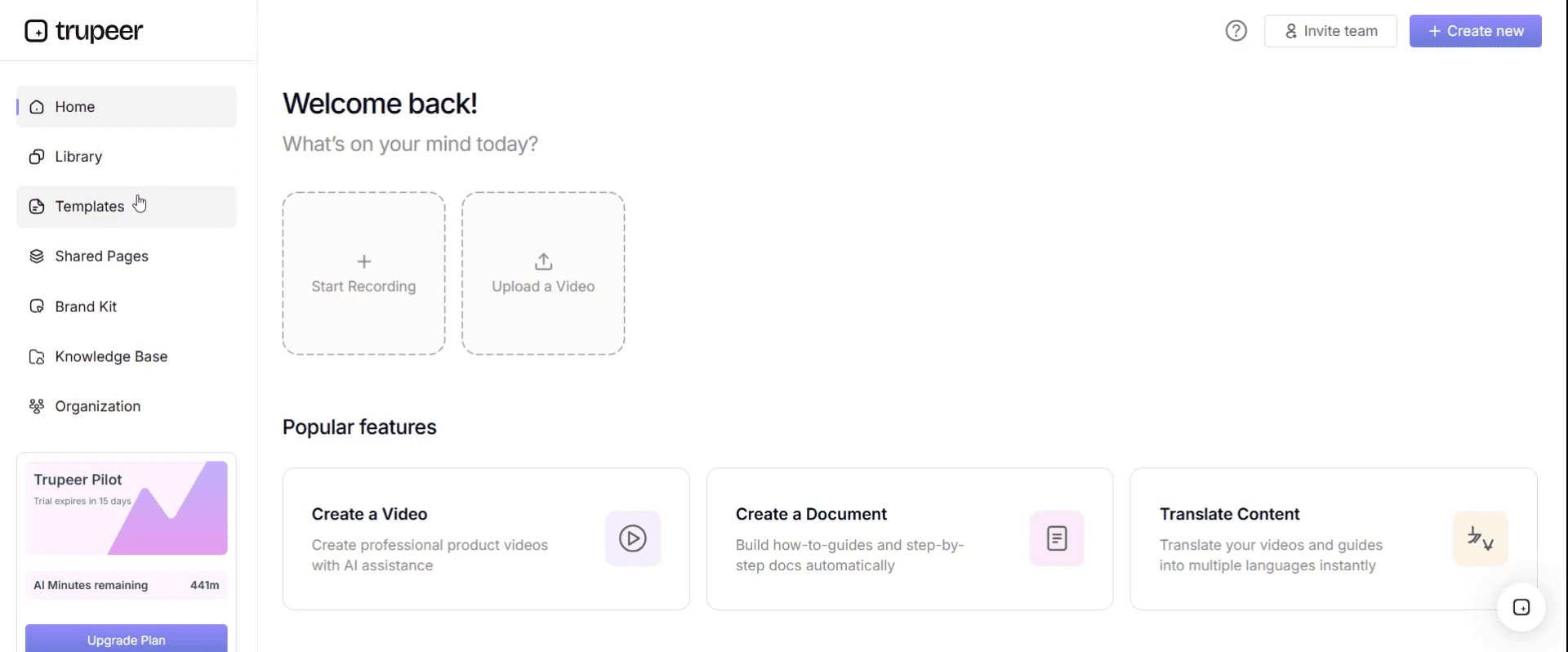
Step 1: Open the Templates Section
Go to the Templates section from the main navigation.
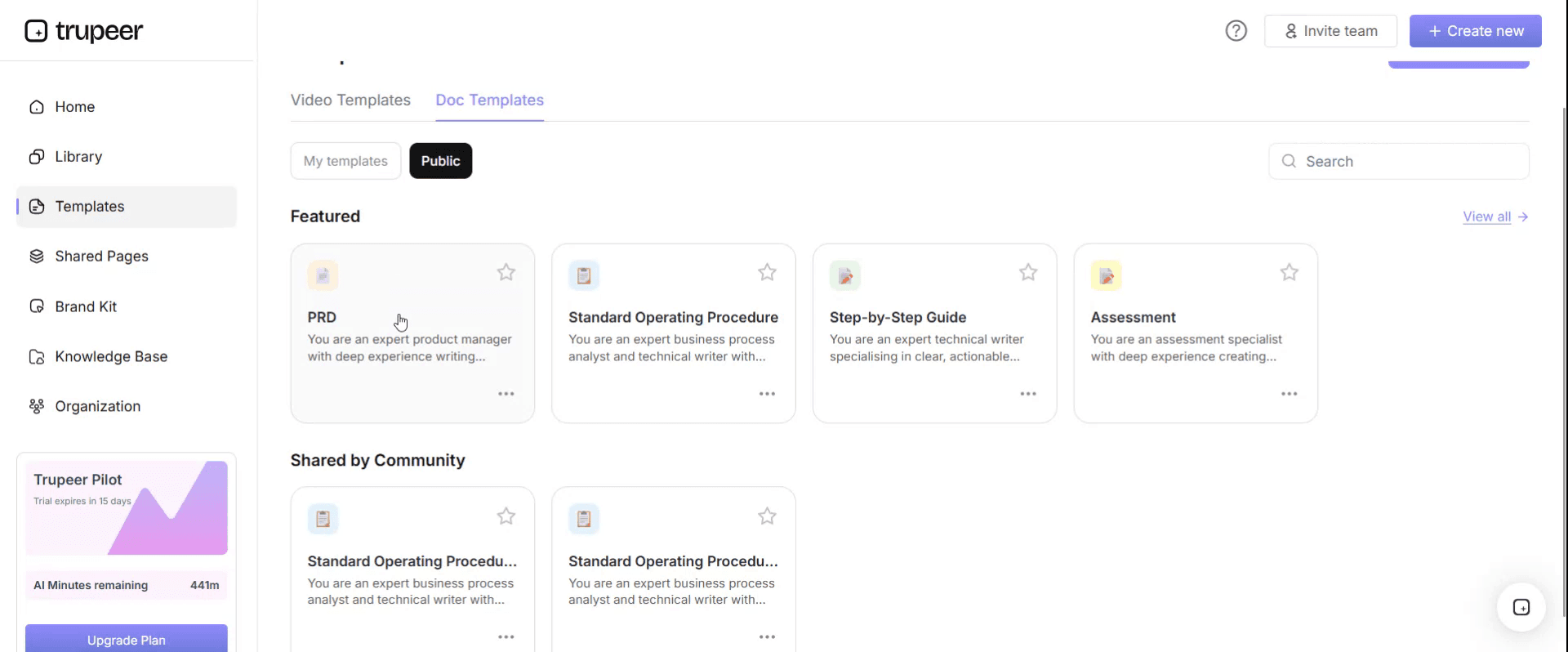
Step 2: Select and Open a Template
Click on any template you want to work with to open it.
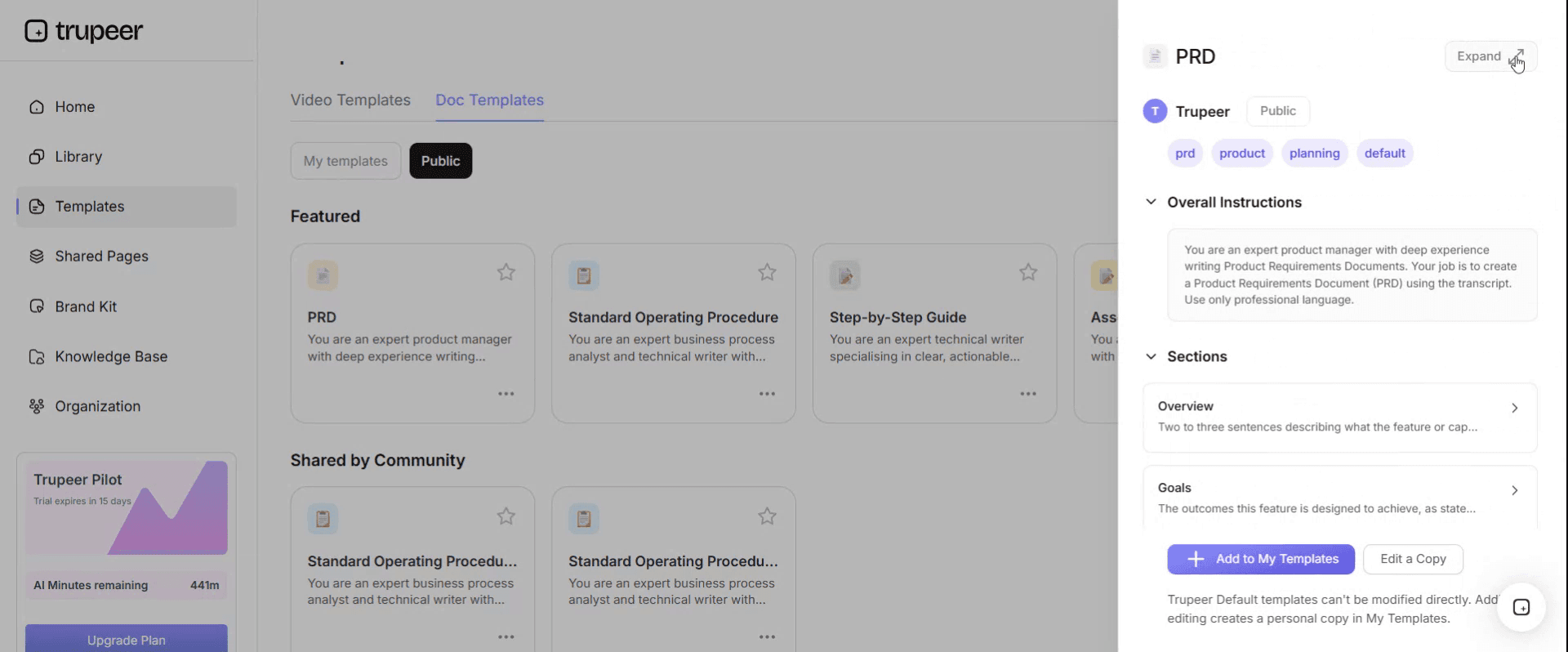
Step 3: Expand the Template View
If needed, expand the template view to see the full layout and details clearly.
Step 4: Edit the Template
Click on Edit to start modifying the selected template.
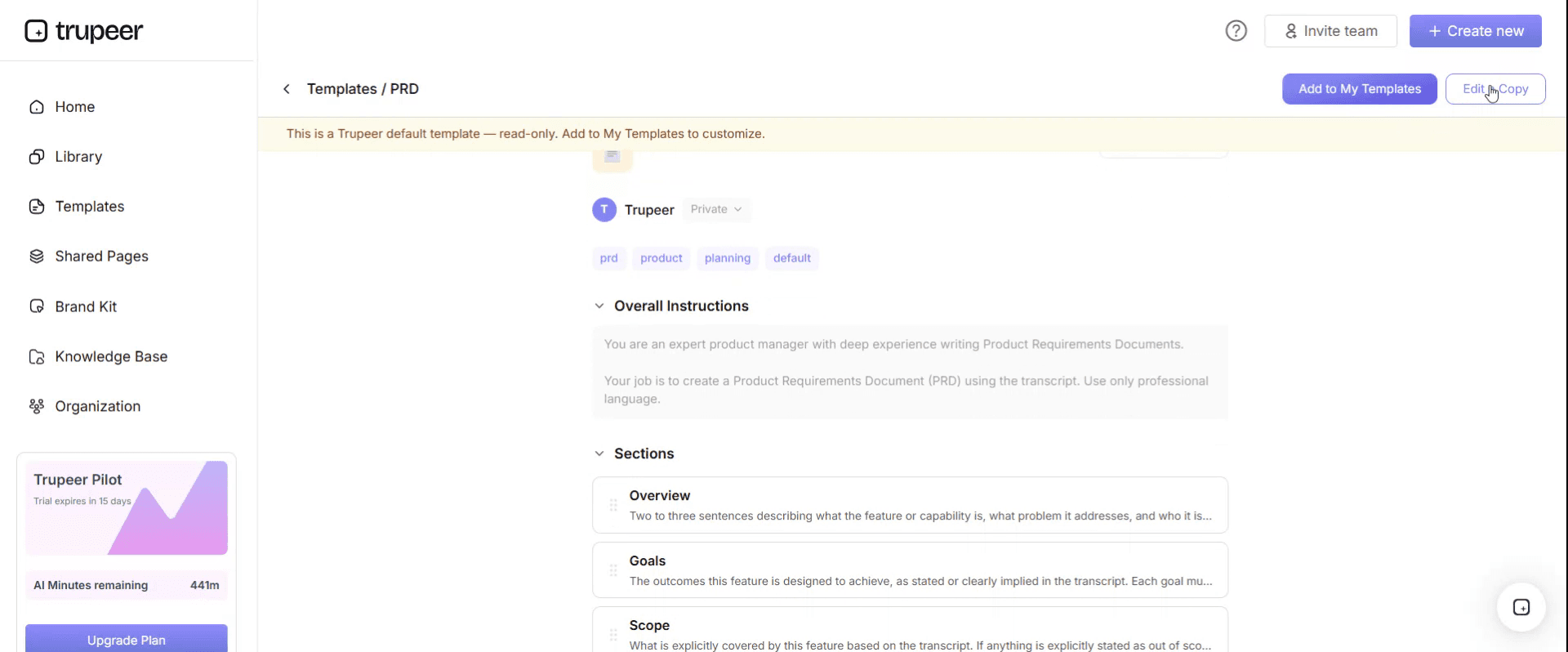
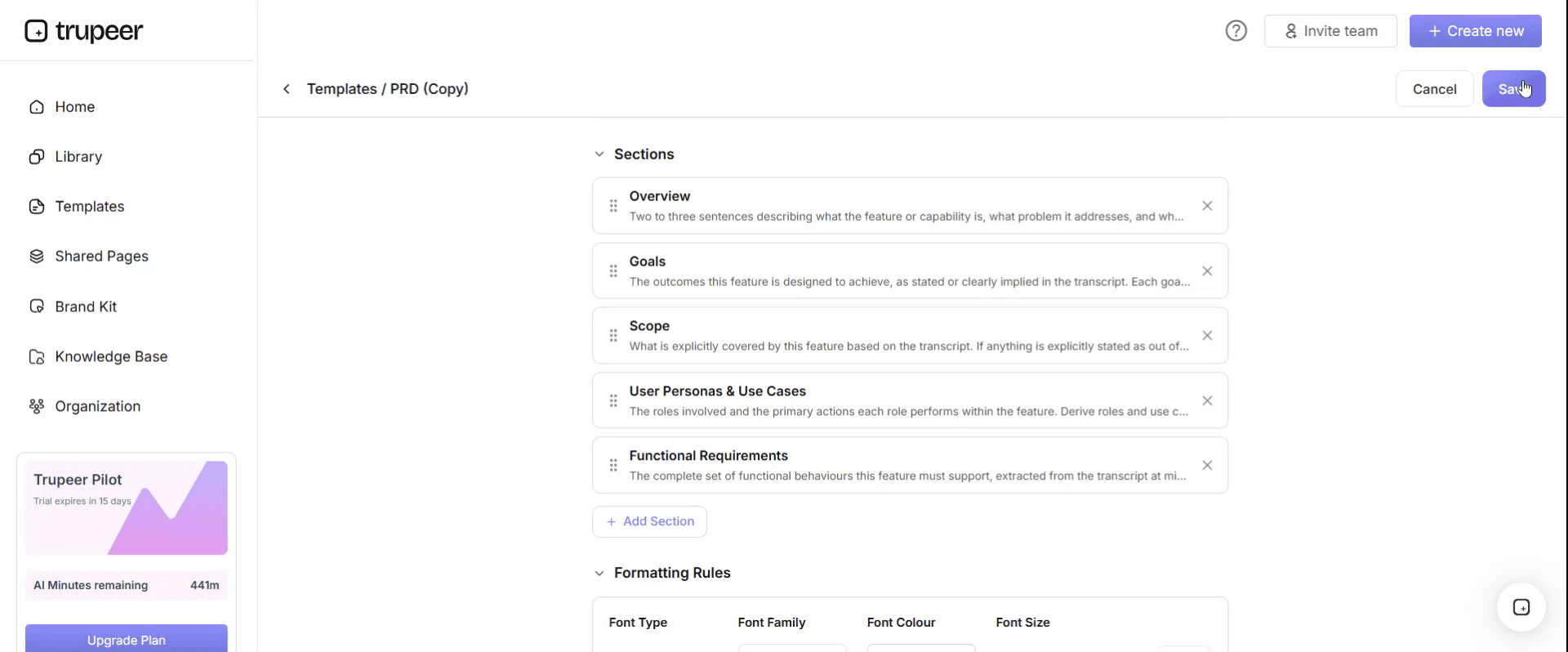
Within the editor, you can:
Add new sections
Define or update formatting rules
Add a logo and adjust its position and related settings
Step 5: Save Your Customized Template
After making all necessary changes, click Save to store the updated template as your own.
Step 6: Preview and Fine-Tune the Template
When you want to see how your customized template looks, open the Preview.
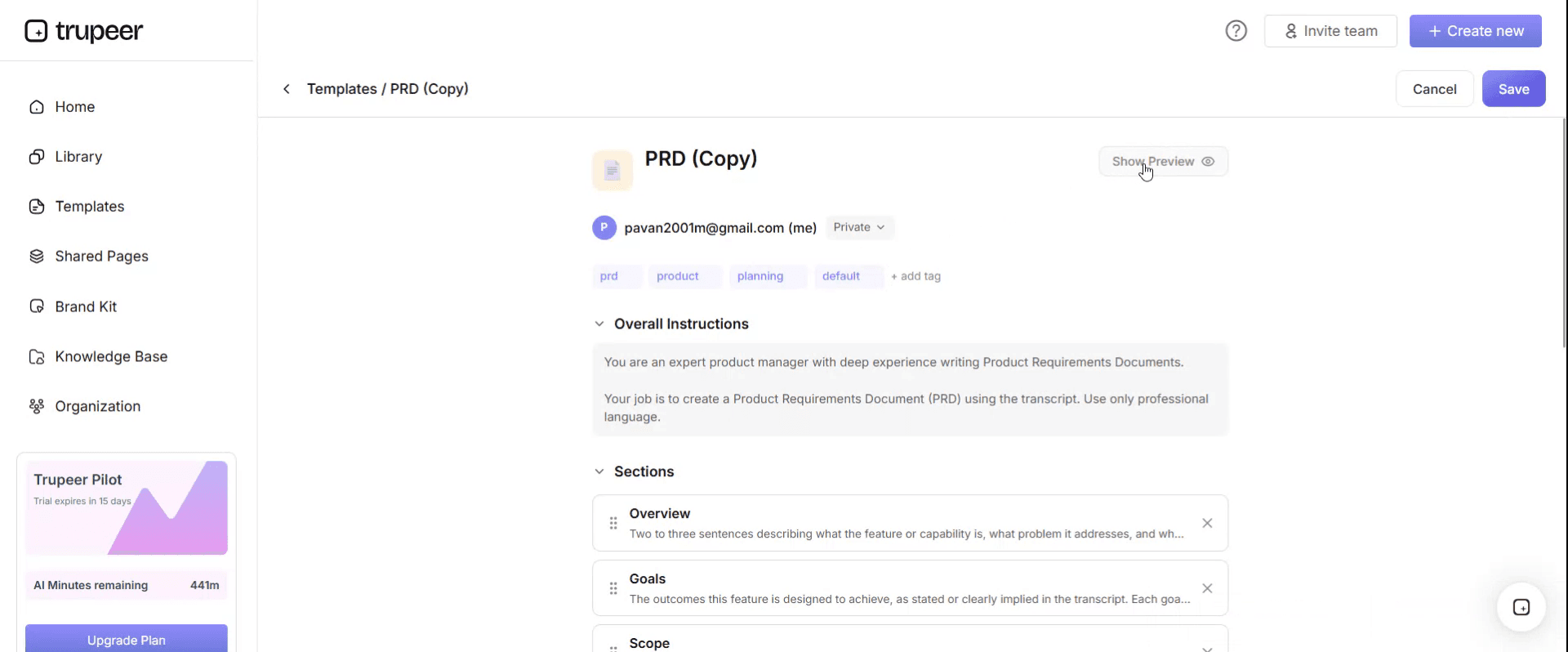
From the preview screen, you can continue to make adjustments directly if needed, ensuring the template appears exactly as you want.
With an individual employee training plan template you can:
Save hours on planning: Skip the blank page with a structure built for personalized development.
Tailor learning to the person: Built-in fields cover individual role, goals and gaps.
Stay on-brand: Apply your logo, fonts and colors using Trupeer's brand kit.
Drive engagement: Personalized plans signal investment in the employee's growth.
Standardize across employees: Use the same template for every team member.
Reach global teams: Translate training plans into 65+ languages with one click.
Which training document do you need?
You need to... | Use |
|---|---|
Plan training for one named person | This template |
Plan training across a team or the organisation | |
Track who has been trained on what, and expiry | |
Work out what training is needed at all | |
Grow someone beyond their current role | |
Write the material people are trained on | |
Onboard someone new |
Training plan or development plan?
Two documents for the same person that answer different questions, and conflating them is why both end up vague.
Individual training plan | Development plan | |
|---|---|---|
Question | Can they do their current job? | Where are they going next? |
Starts from | A skills gap in the current role | Career direction and ambition |
Timeframe | Weeks to months | Six to twenty-four months |
Content | Specific competencies to reach a required level | Stretch work, exposure, some formal learning |
Driven by | The role requirements | The person's goals |
Owner | Manager, with the employee | Employee, with the manager |
Ends when | The gap closes | It rolls forward |
A new starter, someone in a changed role, or someone underperforming on a specific competency needs a training plan. Someone competent who wants to progress needs a development plan. Many people need both, and they should be separate documents because mixing them makes the training targets soft.
The proficiency scale
Everything depends on being able to say what level someone is at and what level the role needs. Without a scale, gaps are opinions.
Level | Means | Test |
|---|---|---|
0. None | No exposure | Has not done it |
1. Aware | Understands what it is, cannot do it | Can explain the purpose |
2. Assisted | Can do it with help or supervision | Completes it, asks questions |
3. Independent | Can do it unaided, to standard | Completes it correctly, unsupervised |
4. Proficient | Handles exceptions and edge cases | Deals with the unusual case without escalating |
5. Expert | Can teach it and improve it | Others come to them, and they change how it is done |
Five levels is enough. More granularity produces arguments about whether someone is a 6 or a 7 without changing any decision.
The important distinction is between 2 and 3, because that is the line between needing supervision and not. Most training plans exist to move someone across it.
Level 5 is rarely a training target. It comes from years of doing the work, not from a course.
The individual skills matrix
One person, their competencies, the required level and where they are.
Competency | Required | Current | Gap | Priority |
|---|---|---|---|---|
Run the monthly reconciliation | 3 | 1 | 2 | High |
Handle supplier queries | 3 | 2 | 1 | High |
Use the reporting system | 3 | 3 | 0 | None |
Process exceptions | 2 | 0 | 2 | Medium |
Produce the quarterly pack | 3 | 0 | 3 | Low, not due until November |
Data protection compliance | 2 | 2 | 0 | None |
The required column comes from the role, not from the person. Define it once per role and reuse it for everyone in that role, which also makes the assessment defensible rather than personal.
Note the row with a gap of three that is low priority. Size of gap and urgency are different things, and treating the biggest gap as the most important is a common error.
Identifying the gap honestly
Self-assessment alone overstates in some people and understates in others, fairly predictably. Manager assessment alone misses what the manager does not observe.
The practical method: both assess independently against the same scale, then discuss where they differ. The disagreements are the useful part, and they usually reveal either that the competency is poorly defined or that the person's work is not visible to their manager.
Where the stakes justify it, add evidence. Watch them do the task, review recent output, or ask someone who works with them. Assessment based only on a conversation tends to measure confidence rather than competence.
Be specific about the competency itself. "Good with spreadsheets" cannot be assessed. "Can build a pivot table from raw export data and check it reconciles" can.
Prioritising the gaps
Not all gaps get closed at once. Three factors decide the order.
Consequence of the gap. What goes wrong today because they cannot do this? A gap on something they need weekly outranks a gap on something quarterly.
Urgency. When do they need it by? A gap on a task due in November is not this month's priority even if it is large.
Dependency. Some competencies are prerequisites for others. Order them.
Two or three active gaps at a time. A plan targeting six competencies simultaneously produces slow progress on all of them and the person ends up assessed as still at level 2 across the board.
The individual training plan template
Field | Enter |
|---|---|
Employee and role | Name, role, time in role |
Manager | |
Plan period | Usually 3 to 6 months |
Reason for the plan | New starter, role change, gap identified, compliance |
Competencies in scope | From the matrix, two or three |
Per competency | |
Required level | From the role definition |
Current level | Agreed between both |
Target for this plan | Often not the full required level, if the gap is large |
Method | How they will learn it |
Who provides it | Named person or provider |
Timeline | Start and target date |
How competence will be assessed | The specific test |
Manager's actions | What the manager will do |
Time allocated | Hours per week or month, protected |
Review dates | Monthly for an active plan |
Employee comments | Their words |
The "how competence will be assessed" field is what turns this from a schedule into a plan. Decide it before the training happens, or assessment becomes a conversation about whether they feel ready.
A worked individual training plan
Employee: Operations analyst, 6 weeks in role. Reason: New starter. Period: 3 months.
Competency 1: Run the monthly reconciliation
Required | 3, independent |
Current | 1, aware |
Target this plan | 3 by end of month 3 |
Method | Watch once, do with support once, do unaided with review |
Provider | Senior analyst, plus the recorded walkthrough |
Timeline | Month 1 observe, month 2 supported, month 3 unaided |
Assessed by | Runs the month 3 reconciliation alone, output checked, no material errors |
Manager's actions | Ensure senior analyst is available for the month 2 run. Do not intervene in month 3 unless asked |
Time | Half a day per month, plus 2 hours prep |
Competency 2: Handle supplier queries
Required | 3 |
Current | 2, assisted |
Target this plan | 3 by end of month 2 |
Method | Shadow five queries, then handle with review, then handle unaided |
Provider | Team lead |
Timeline | Weeks 1 to 3 |
Assessed by | Handles ten consecutive queries with no escalation and no complaints |
Manager's actions | Stop copying myself into supplier threads from week 4 |
Time | Within normal work |
Competency 3: Process exceptions
Required | 2, assisted |
Current | 0 |
Target this plan | 2 by end of month 3 |
Method | Written procedure plus walkthrough of the two most common exception types |
Provider | Senior analyst |
Timeline | Month 3 |
Assessed by | Can identify an exception and knows which procedure applies. Not expected to resolve unaided at level 2 |
Manager's actions | Flag exceptions to them as they occur rather than handling silently |
Time | 2 hours total |
Not in this plan. Quarterly pack, gap of 3, deferred to the next plan since it is not required until November. Recorded walkthrough available in the meantime.
Review: monthly, 20 minutes.
Notice competency 3 targets level 2 rather than 3. Setting an achievable intermediate target is better than a full-gap target that quietly fails, and the plan says explicitly what level 2 does and does not mean.
Choosing the method for each gap
The method should match the type of gap, and most plans default to a course regardless.
Gap type | Best method | Poor method |
|---|---|---|
Does not know a fact or rule | Written reference, short reading | A day-long course |
Cannot operate a system | Recorded walkthrough plus supervised practice | Written instructions alone |
Cannot perform a physical or manual task | Demonstration then supervised practice | Any document |
Cannot handle judgement calls | Shadowing, then doing with review, then debrief | Anything without a real case |
Lacks broad theory | Formal course or qualification | Learning on the job |
Knows how but is slow or error-prone | Repetition with feedback | More instruction |
That last row is worth noticing. Someone who understands a task and still gets it wrong does not need more explanation. They need to do it more, with someone checking, which is a different intervention entirely.
Scheduling
Protect the time in hours, in the calendar. Training that competes with delivery loses every week.
Sequence prerequisites first. Some competencies depend on others.
Match the timing to the task cycle. Learning a monthly process takes three months minimum, because you only get three attempts.
Do not front-load. A week of training before anyone can apply anything is largely wasted.
Leave slack. Plans with every week allocated fail on the first busy fortnight.
The task cycle point is the one people underestimate. For anything quarterly or annual, the honest answer is that the person cannot reach independent within the plan period and the plan should say so, with a recording as the interim.
Assessing competence
Decide the assessment before the training, and make it observable.
Level target | Assessed by |
|---|---|
1, Aware | Can explain what it is and when it applies |
2, Assisted | Completes it with support, asking sensible questions |
3, Independent | Completes it unaided, output checked and correct |
4, Proficient | Handles a genuine exception without escalating |
Watch them do it. Do not ask whether they feel confident, since confidence and competence correlate weakly and the direction of the error varies by person.
For anything with compliance implications, record the assessment result and the date against the training matrix, not just in the plan.
The manager's role
An individual training plan requires more from the manager than a group programme does.
Define the required levels for the role, before assessing anyone against them.
Assess honestly, including the competencies where the person is already there.
Create the opportunity. Most methods above need access to real work that the manager controls.
Protect the time and do not reclaim it in a busy week.
Stop doing the thing. For several competencies, the manager's key action is to stop intervening, which is harder than it sounds.
Assess at the end, by observation rather than conversation.
Hold the review dates.
Every competency in the plan should have at least one manager action. If none of them do, the plan will not happen.
Reviewing the plan
Monthly for an active plan, and twenty minutes is enough.
Cover what was attempted rather than what was booked. Ask what they found harder than expected, which usually reveals a gap nobody identified. Reassess the current level honestly, including where it has not moved. Adjust the timeline rather than pretending it is on track.
Close the plan formally when the gaps are closed, and say so. A training plan that fades leaves the person unsure whether they are considered competent.
How to build an individual training plan
Define the required proficiency per competency for the role, once, and reuse it.
Assess independently, both employee and manager, against the same scale.
Discuss the differences, which are the informative part.
Prioritise on consequence, urgency and dependency, not on gap size.
Pick two or three competencies, no more.
Set a realistic target level for each, which may be an intermediate step.
Choose the method to match the gap type.
Define the assessment before the training.
Write the manager's actions and protect the time.
Review monthly and close the plan explicitly.
Best practices
Required levels defined by role, not per person.
Both parties assess independently first.
Two or three competencies at a time.
Intermediate targets where the gap is large.
Method matched to gap type.
Assessment defined before training and done by observation.
Time protected in hours.
A manager action per competency.
Monthly reviews of twenty minutes.
Plan closed explicitly when the gaps are closed.
Common mistakes
A list of courses with no gap assessment behind it.
Competencies too vague to assess, such as "good communication".
Required levels invented per person rather than defined by role.
Manager assessing alone, missing what they do not observe.
Six competencies at once, so nothing moves.
Full-gap targets that were never achievable in the period.
A course chosen for every gap regardless of type.
Assessment by conversation, measuring confidence.
Time unprotected, so training loses to delivery every week.
No manager actions, so the plan depends entirely on the employee.
Plans for monthly or quarterly tasks with a timeline shorter than the task cycle.
Never formally closed, so nobody knows whether it worked.
The 20 percent that will not scale
Open the template in Trupeer AI, apply your brand kit so training documents match your other HR materials, and edit any section directly. Setup is in the template guide.
Look at the method column in the worked example. Most gaps close through watching someone competent, then doing it with them available. That depends on the senior analyst having time, being present, and the task happening while the learner is free.
For anything monthly or quarterly, that is a real constraint. Three attempts in three months is the absolute maximum, and if one is missed the plan slips by a month.
Record the task once and Trupeer AI produces the written procedure and a narrated video walkthrough from the same pass, so the observation step is available whenever the person is ready rather than when the cycle comes round. It does not replace doing the task, which is where competence actually comes from, but it removes the scheduling dependency from the learning part.
Translate it into 65+ languages, and keep the set in your knowledge base so the next person's plan can use the same material.
Record it. Brand it. Translate it. Trupeer it.
Frequently Asked Questions
Is there a free individual employee training plan template in Word?
Yes. The Word version is the plan document the employee and manager work from, with room to write in the person's own words. Free download, no sign-up, no watermark.
Is there an individual employee training plan template in Word doc format?
Yes, a .doc version is included alongside .docx for older HR systems.
Can I download a free individual employee training plan template in Word?
Yes, every format is a free download with no account required and no attribution.
Is there a free individual employee training plan template in Excel?
Yes, and Excel is where the work happens. It contains the skills matrix with required and current proficiency per competency, the calculated gap, priority, and the plan itself. The gap assessment is a grid, so a spreadsheet suits it better than a document.
Is there a free individual employee training plan template in PDF?
Yes, as the agreed version for signature and as a completed worked example so you can see the level of specificity that makes a plan usable.
Is there a training schedule template in Excel, free to download?
Yes, though that is a different document. A training schedule is the forward calendar of sessions across the organisation, and it lives on the employee training template page along with the training matrix and records.
Is there a training plan template in Word?
Yes. For a team or organisation-wide programme rather than one person, use the training plan template. This page covers the plan for a single named individual, built from their specific gaps.
What is an individual employee training plan?
A plan for one named person setting out which competencies they need to reach a required level in, where they currently are, how they will close the gap, by when, and how competence will be assessed. It differs from a training plan in that it starts from an individual's gap rather than from a programme.
What should an individual training plan include?
The employee and role, why the plan exists, two or three competencies in scope, the required and current proficiency for each, the target for this plan, the method, who provides it, timelines, how competence will be assessed, the manager's actions, protected time, and review dates.
How do you identify an employee's training needs?
Define the required proficiency per competency for the role first, then have the employee and manager assess independently against the same scale and compare. The disagreements are the useful part, since they usually mean either the competency is poorly defined or the person's work is not visible to their manager. Where stakes justify it, add evidence by observing the task.
What is a proficiency scale and why use one?
A defined set of levels, typically none, aware, assisted, independent, proficient and expert, used to describe where someone is on a competency. Without one, gaps are opinions and progress cannot be assessed. The critical line is between assisted and independent, since that is what most training plans exist to cross.
How many competencies should an individual training plan cover?
Two or three at a time. More produces slow progress across all of them and a person who is still assisted on everything at the review. Close two gaps and start a new plan rather than opening six.
What is the difference between a training plan and a development plan?
A training plan closes a gap in the current role and typically runs weeks to months. A development plan grows someone toward a future role over six to twenty-four months. Keep them as separate documents, since combining them makes the training targets soft and the development goals too short-term.
How long should an individual training plan run?
Three to six months for most gaps. The binding constraint is often the task cycle rather than the learning: for a monthly process, three months gives three attempts, and for anything quarterly the plan should say honestly that independence is not achievable within the period.
How do you assess whether training worked?
By observation against the target level, decided before the training started. At independent level that means completing the task unaided with the output checked and correct. Asking whether someone feels ready measures confidence, which correlates weakly with competence.
Can I customise this individual training plan template?
Yes, every version is fully editable. The proficiency scale is worth keeping consistent across your organisation even if you change the labels, since plans are only comparable if everyone is using the same definitions.
Related templates

Understand how work happens.
Carry it into your next transition.
Start Free Trial
Book a Demo
Resources

