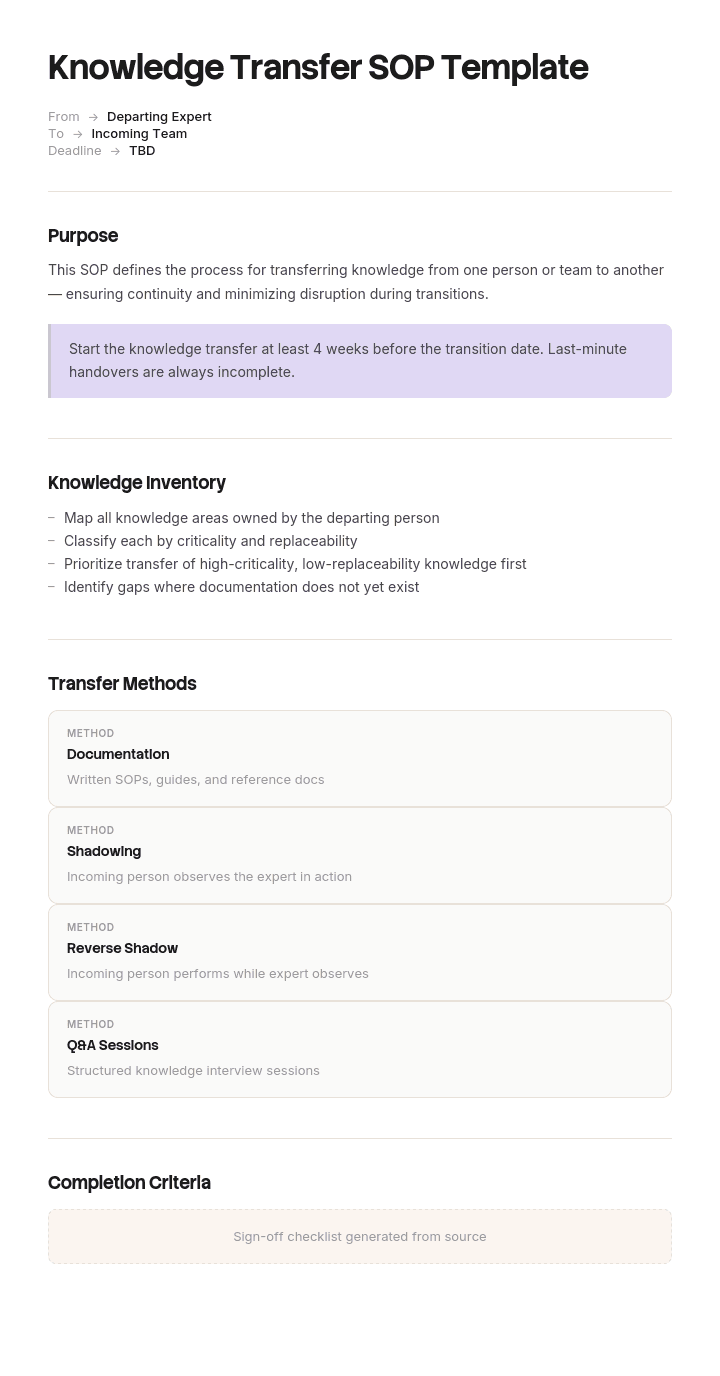
Use this template
Knowledge transfer is what keeps an organization resilient when people move on. With Trupeer, you can save hours on knowledge transfer documentation by starting with a free knowledge transfer SOP template, customizing it with your brand guidelines, and using our AI SOP creator to turn knowledge into video walkthroughs the next person can actually use.
What is a knowledge transfer SOP template, and when do you need one?
A knowledge transfer SOP is the standing procedure for moving what one person knows into someone else's hands, and into writing, before that person becomes unavailable. It is a procedure rather than a plan because the same sequence runs every time, and a plan written from scratch for each departure arrives too late to be useful.
You need one when a role has knowledge that is not written down and not held by anyone else. That is a narrower set of roles than most organisations assume and a more urgent one. The test is simple: if this person did not come in tomorrow, what stops, and how long before anyone notices.
Run it on resignation, on internal moves, on parental leave over about three months, and on any role held by one person for more than roughly four years. That last trigger is the one people skip, and it is the one that produces the worst surprises, because length of tenure is what converts explicit knowledge into invisible habit.
Why inventory-based knowledge transfer misses what matters
Almost every knowledge transfer template in circulation works the same way. Ask the leaver to list what they know or what they own. Turn the list into documents. Tick the items off. Sign a form.
The method has one fatal assumption, which is that people can see their own knowledge. They cannot, and the more experienced they are the less they can. Six years into a role, the checks you run without thinking, the person you call rather than the queue you are supposed to use, the file that arrives late one month in four: none of these feel like knowledge. They feel like Tuesday.
So an inventory produces a faithful record of the responsibilities and almost none of the habits. The documentation looks thorough, the checklist is complete, and the things that break in month one are all items nobody thought to list, including the leaver.
The fix is not a better list. It is to stop asking and start watching.
How to customize this template in Trupeer
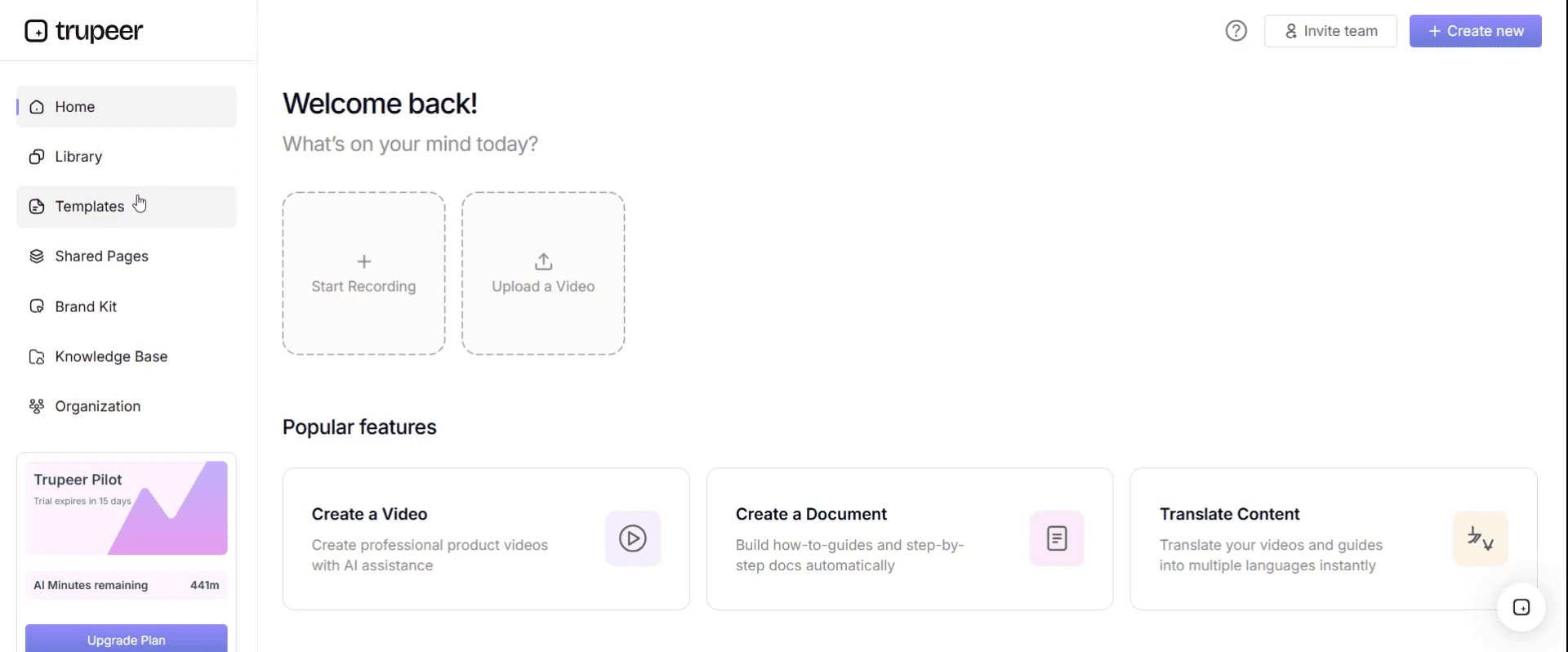
Step 1: Open the Templates Section
Go to the Templates section from the main navigation.
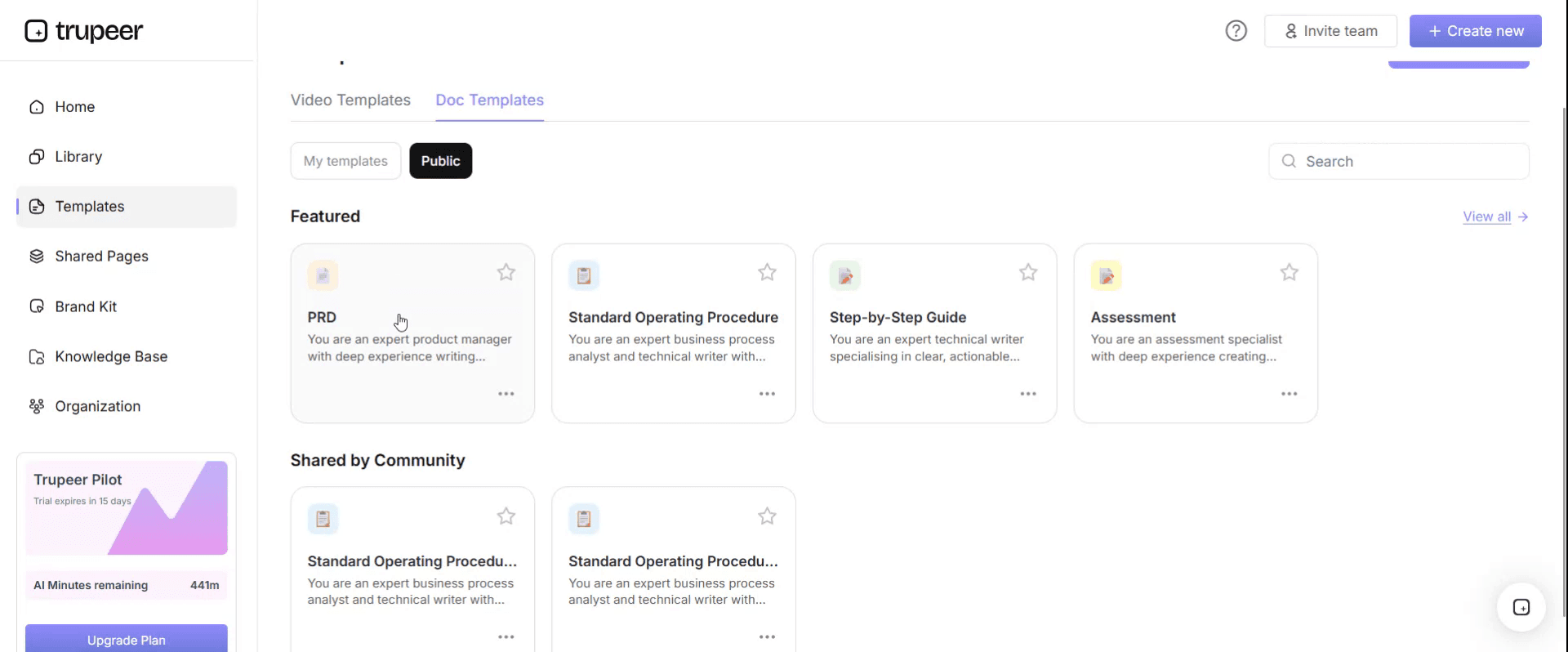
Step 2: Select and Open a Template
Click on any template you want to work with to open it.
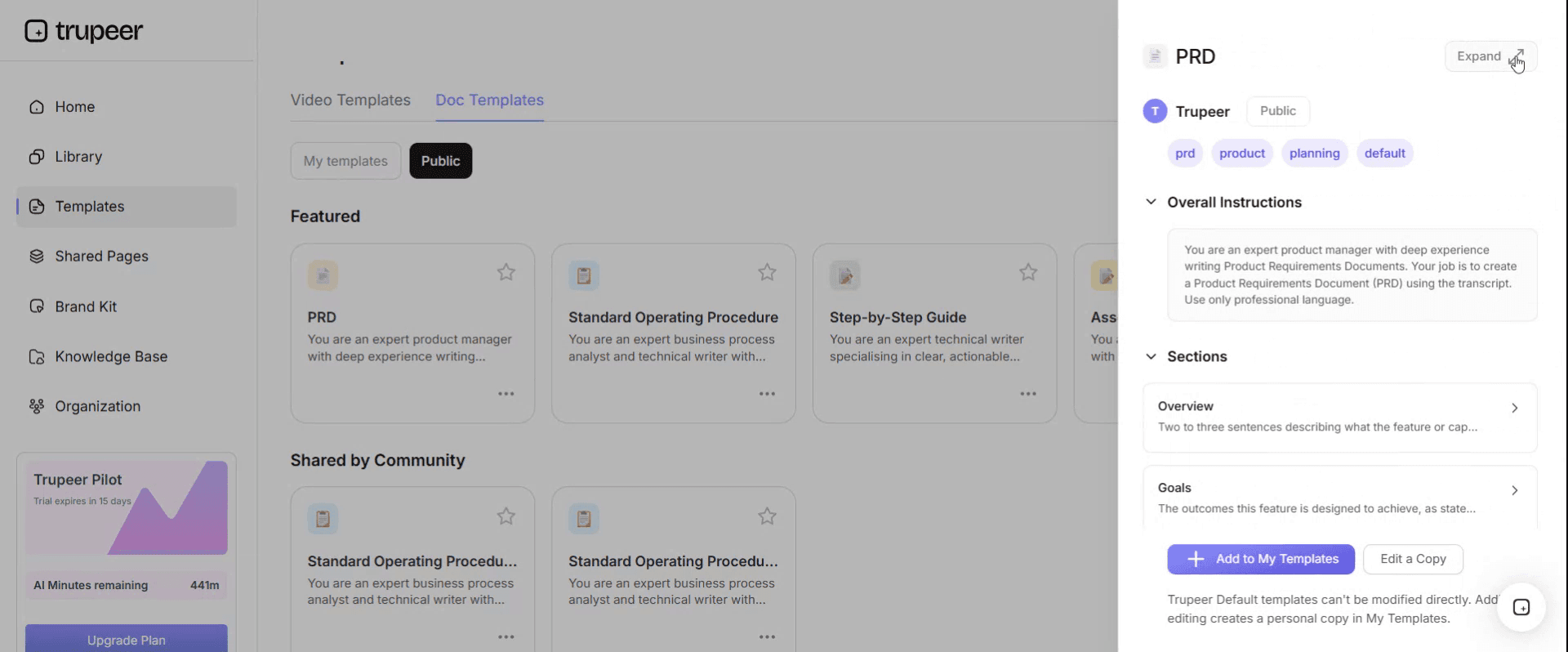
Step 3: Expand the Template View
If needed, expand the template view to see the full layout and details clearly.
Step 4: Edit the Template
Click on Edit to start modifying the selected template.
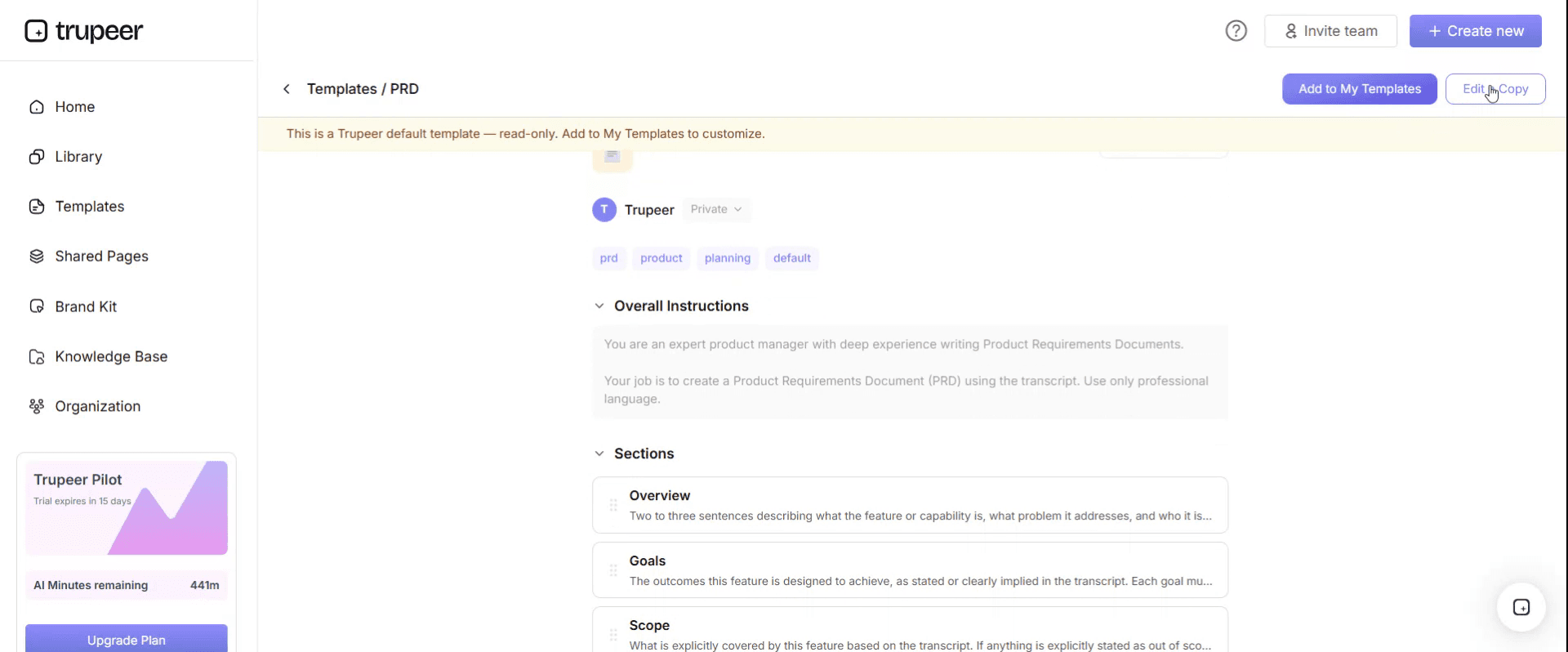
Within the editor, you can:
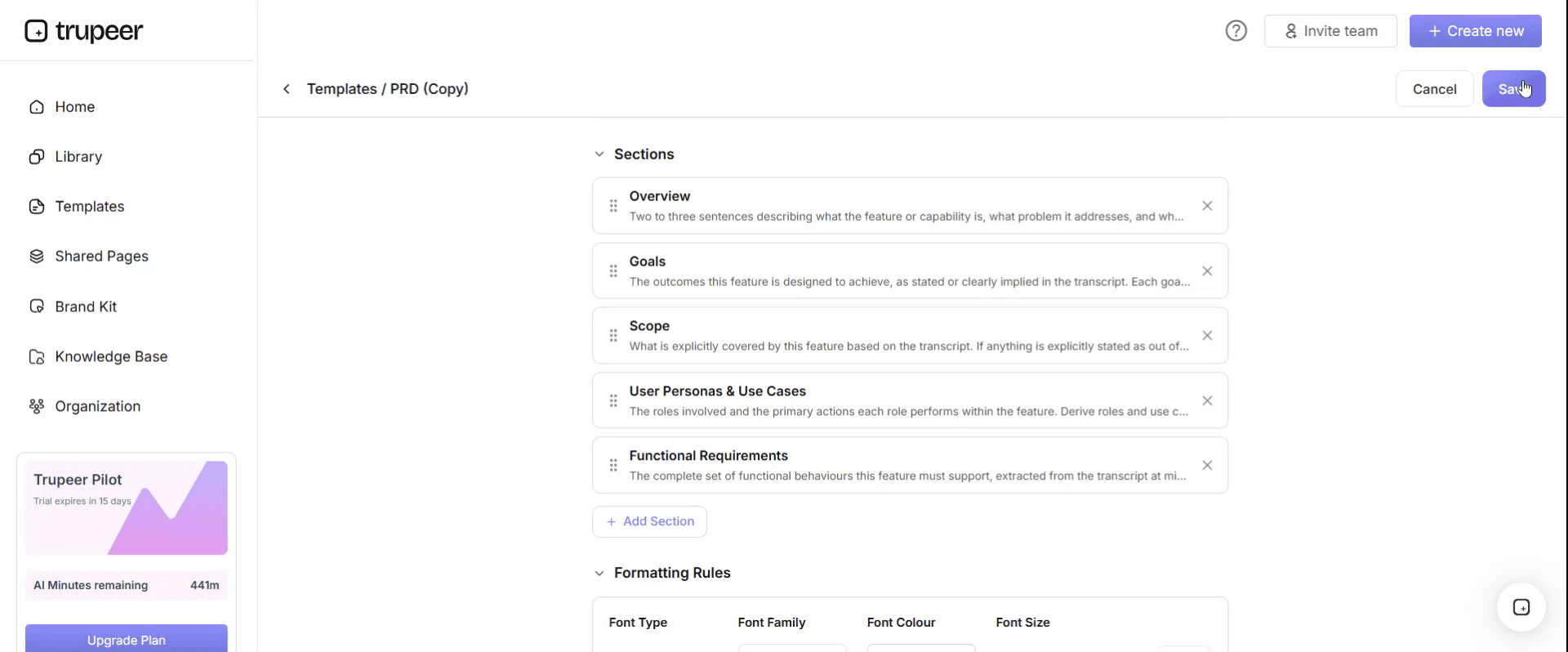
Add new sections
Define or update formatting rules
Add a logo and adjust its position and related settings
Step 5: Save Your Customized Template
After making all necessary changes, click Save to store the updated template as your own.
Step 6: Preview and Fine-Tune the Template
When you want to see how your customized template looks, open the Preview.
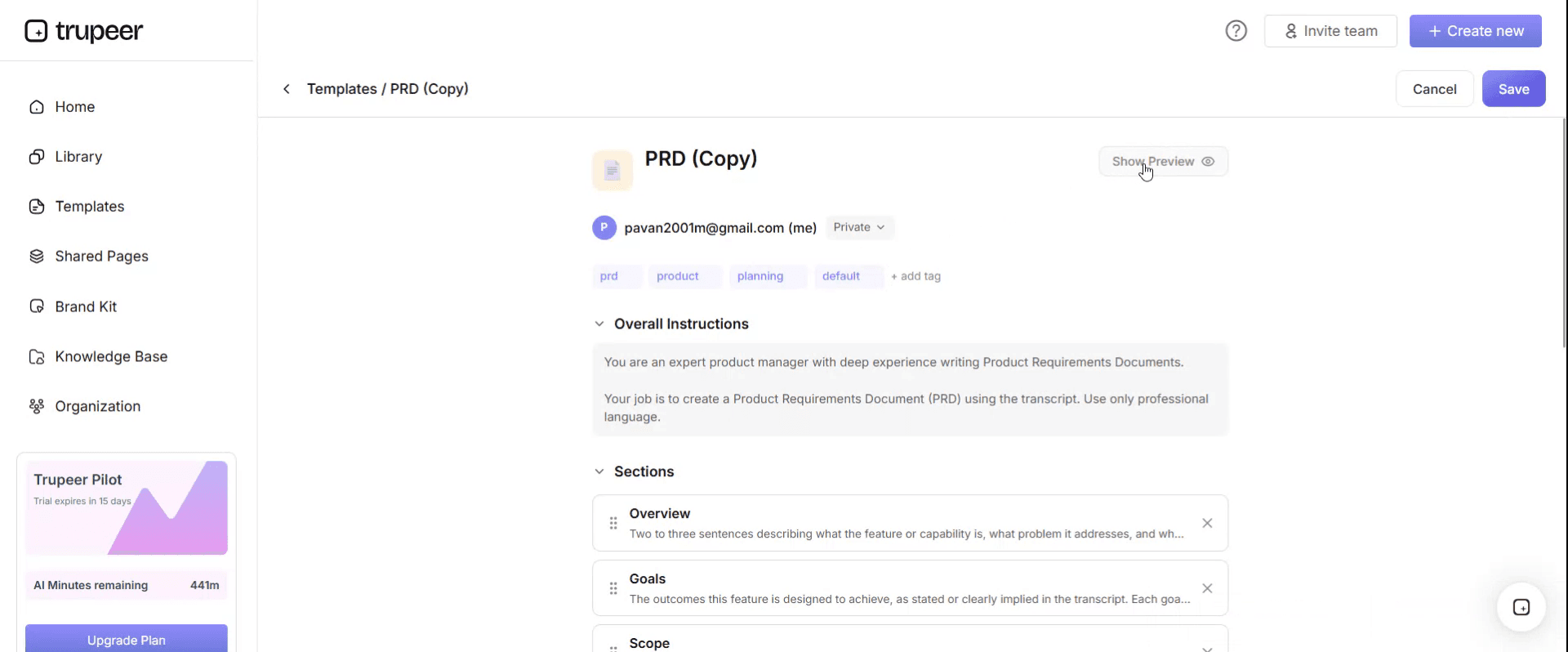
From the preview screen, you can continue to make adjustments directly if needed, ensuring the template appears exactly as you want.
With a knowledge transfer SOP template you can:
Save hours on documentation: Skip the blank page with a structure built for transitions.
Capture critical knowledge: Built-in sections ensure tacit and explicit knowledge both get transferred.
Stay on-brand: Apply your logo, fonts and colors using Trupeer's brand kit.
Onboard the new owner faster: Pair the SOP with video walkthroughs so they can ramp quickly.
Standardize transitions: Use the same SOP for every role change or exit.
Reach global teams: Translate knowledge transfer docs into 65+ languages with one click.
Reverse shadowing: the leaver watches the successor work
Standard shadowing has the successor watching the leaver. It feels productive and it teaches very little, because a fluent person performing a familiar task skips the decisions. The successor sees what happened and not why, and cannot tell which parts were choices.
Invert it. From the first week, the successor does the work while the leaver sits beside them and says nothing unless something is about to go wrong.
This is uncomfortable for both people and it is where the value is. Every time the leaver has to speak, they have just revealed a piece of knowledge that no list would have surfaced, because the trigger for saying it was watching someone get it wrong rather than being asked what they know. Those interventions are the deliverable.
The transfer is finished when a full cycle of the work passes and the leaver says nothing at all. Not when a checklist is complete, and not when the documents are written. Silence is the exit test, and it is the only one that is hard to fake.
The interruption log at the centre of this SOP template
One artefact carries the whole procedure. Every time the leaver speaks, someone records a line.
What the successor was doing. The task, at the point of interruption.
What the leaver said. In the leaver's words, not tidied up.
Would this have been on a list? Yes or no. Track this, because the proportion answering no is the argument for running the procedure this way next time.
Consequence if missed. Three levels: cosmetic, rework, or incident. This is how the documentation gets prioritised afterwards, since not every interruption deserves a written article.
Written up? The link, once it exists.
The log is filled in live by whoever is observing, which can be the manager rather than either of the two principals. Two people in a stressful conversation are poor note takers.
Count the interruptions weekly. A healthy transfer shows a steep fall, typically something like twenty five in week one to under five by week four. A flat line means the successor is not being given real control, which is the most common failure of this method.
Free knowledge transfer SOP template: the full procedure to copy
Copy from here. Replace anything in square brackets.
1. Purpose. To transfer the working knowledge of a departing or moving role holder to a named successor and into written form, before the role holder becomes unavailable.
2. Trigger. Resignation accepted, internal move confirmed, extended leave approved, or a role identified as single-person-dependent during [annual risk review]. The procedure starts within [2] working days of the trigger.
3. Scope test. Run the full procedure where the role holder performs any recurring task that no one else has performed in the last [6] months, or holds any system access that no one else holds. Where neither is true, a written handover note is sufficient.
4. Roles. The leaver observes and intervenes. The successor performs the work. The observer, normally the line manager, keeps the interruption log and holds the sign-off. [Role] provides cover so the successor is genuinely released from their previous duties, which is the step most often skipped and the one that decides whether this works.
5. Week one, transfer of controls. The successor performs the full range of the role's recurring work with the leaver present. The leaver does not touch the keyboard. Every intervention is logged.
6. Weeks two and three, documentation from the log. Working from the log, highest consequence first, the successor writes the documentation. The successor writes it rather than the leaver, because the successor is the only one who still remembers what was not obvious. The leaver reviews. Anything rated cosmetic can stay in the log unwritten.
7. Final week, the silent cycle. The successor completes one full cycle of the work, including any monthly or period-end tasks, with no intervention. If the leaver has to speak, the cycle restarts or the item is escalated as a known gap.
8. Access, relationships and credentials. Handled separately and never inside a working session. Access transfers through [normal access request process] to role-based accounts rather than named ones. Relationships transfer by introduction with a named handover in writing, not by passing on a contact list.
9. Known gaps register. Anything the transfer did not cover, with an owner and a date. Every real transfer has these. A procedure that produces none has not been run honestly.
10. Sign-off. The observer signs when the silent cycle is complete and the known gaps register has an owner for each entry. Not before the leaver's last day, and not on the leaver's last day.
Copy to here.
How to run the silent cycle that ends the transfer
The silent cycle is the only part people try to skip, usually because the leaver's notice period has run out. Resist that, because the cycle is where you find out whether any of the preceding weeks worked.
Define the cycle as the longest period the work naturally runs on. For most operational roles that is a month, since it has to include period-end, the monthly report, the supplier who invoices on the twenty eighth. For a role whose work is genuinely weekly, a week is enough. Choosing a shorter cycle to fit the notice period is the single most common way this procedure gets quietly broken.
During the cycle the leaver stays reachable and stays silent. If they are pulled in, log it, and treat that item as a gap rather than as a failure of the transfer.
If notice is too short for a full cycle, run the cycle after the leaver has gone with a named external fallback, and record it as a known gap rather than pretending it happened.
A knowledge transfer example: 31 checklist items, 9 incidents
Nordvale Energy, around nine hundred staff, lost the data engineer who had owned its nightly reporting pipeline for six years. The pipeline fed both the trading dashboards and a regulatory return.
The transfer was thorough by conventional standards. She listed everything she owned, which came to thirty one items. She wrote fourteen documents totalling roughly nine thousand words and recorded four walkthrough videos. Her manager signed the checklist off on her last day.
In the first month after she left there were nine incidents on the pipeline. Six of them traced to things that had never appeared on the list, and not because she had withheld anything.
There was a manual step she ran every Tuesday and had run every Tuesday for four years, which had stopped registering as a step. There was a supplier file that arrives late roughly one month in four, which she handled by waiting rather than by any process anyone could name. There was a specific person in Finance she rang when a reconciliation would not balance, instead of the official queue, because the official queue took three days. Two dashboards looked broken between six and six forty every morning and were meant to. And a script had a hard-coded date that needed changing each April.
None of that is exotic. All of it is the residue of six years, and none of it is retrievable by asking someone what they know.
Eight months later a second engineer left the same team. This time the successor ran the pipeline from the first week with the leaver observing. The interruption log recorded twenty seven interventions in week one, eleven in week two, four in week three and one in week four. Forty three items in total, of which nineteen were marked as items that would never have appeared on a list.
Documentation was written from the log rather than from an inventory, mostly one or two lines each, prioritised by consequence. The month after that departure produced two incidents.
The second transfer took no more calendar time than the first. It produced fewer words and a great deal less breakage.
Types of knowledge to transfer, and why lists miss most of it
Most guides at this point offer a taxonomy: explicit and tacit, technical and relational, procedural and contextual. The categories are accurate and they are not much use as a working tool, for the reason above. You cannot ask someone to enumerate their tacit knowledge, because the defining property of tacit knowledge is that its holder does not experience it as knowledge.
Use the taxonomy for coverage checking after the fact rather than as a prompt beforehand. At the end of week one, look at the interruption log and ask which categories are underrepresented. If every entry is procedural and none is relational, you have not yet given the successor anything that requires talking to another department, and week two should fix that.
The one category worth prompting for directly is knowledge about failure: what has gone wrong before, what it looked like, and what was done. That is the only kind people can reliably recall on demand, because incidents are memorable in a way that Tuesdays are not.
Knowledge transfer methods compared, and when each one works
Method | What it is | Works when | Fails when |
|---|---|---|---|
Documentation first | Leaver writes it all up before handover | The work is genuinely procedural and stable | Tenure is long, because habit is invisible to the writer |
Shadowing | Successor watches leaver work | Very short notice, or the successor is entirely new to the domain | Used alone, because fluent people skip the reasoning |
Reverse shadowing | Leaver watches successor work | There is at least three or four weeks of overlap | The successor is not released from their old duties |
Structured interview | A third party questions the leaver | Extracting failure history and relationships | Used to extract routine, which the leaver cannot articulate |
Recorded walkthrough | Leaver records themselves performing tasks | Building reference material fast | Treated as the whole transfer rather than an input |
Paired working | Both do the work together over a period | Complex judgement-heavy roles | Notice is short, since it needs the most time |
Known gaps register | Recording what did not transfer | Always, as the closing step | Treated as a failure rather than as an honest output |
The practical combination for a four week notice period is reverse shadowing for the routine, a structured interview for failure history and relationships, and recorded walkthroughs to make the documentation cheap. Nothing on that list is a substitute for overlap.
Software and IT knowledge transfer for systems-heavy roles
Engineering and IT roles need three additions, because the knowledge sits partly in systems that the successor cannot inspect from a document.
Run the transfer against the real environment, including production access, with the leaver observing. A transfer conducted entirely in staging teaches the shape of the work and none of the reality.
Include at least one on-call rotation or period-end run inside the overlap, because the failure knowledge that matters only surfaces when something is broken and there is time pressure.
And treat undocumented dependencies as a first-class output. Which jobs consume which credentials, which scripts run from which machine, what a service actually depends on. This is the material that produces incidents six months later, and it belongs in your IT documentation rather than in a handover note that gets filed.
For a role with genuine operational depth, pair this procedure with a 30-60-90 day plan for the successor, since the transfer covers the first month and the remaining competence takes longer.
What if there is no successor and no overlap?
This is the most common real situation and almost no template addresses it, so it is worth being direct.
If there is no named successor, transfer to the manager or to the person who will hold the work temporarily, and run the same procedure with them. It is imperfect and it is far better than transferring to nobody, because it converts the knowledge from one head into two plus a log.
If there is no overlap at all, because the departure was immediate, accept that a full transfer is not available and run a shortened version. Spend the available time on failure history and dependencies rather than on routine, since routine can be rediscovered slowly and dependencies cannot. Then populate the known gaps register aggressively and treat it as a live risk list rather than a closing formality.
In regulated roles, meaning anything with a named responsible person under a licence, a controlled function, or a role required by a safety case, neither shortcut is acceptable. Involve compliance at the point of resignation, because the vacancy itself may need reporting and the successor may need to be approved before they can act.
Can I get a knowledge transfer SOP template in Word, Excel or PPT?
Word suits the procedure itself, meaning the ten numbered clauses above, and it is what most organisations will want in their process library. Excel suits the interruption log, which is where the actual work happens: one row per intervention, with columns for task, what was said, list-able yes or no, consequence and written-up link. That sheet is the most useful artefact this page produces, and it is the one no downloadable template provides.
PowerPoint suits the summary you give the steering group or the leaver's director, showing the interruption count falling week by week. That chart makes the case for overlap better than any argument, which matters because overlap is the expensive part and the first thing finance questions.
How to document a knowledge transfer without stopping the work
The documentation step is where transfers stall. Weeks two and three assume the successor has time to write, and a successor who has just taken on a full role does not.
Trupeer AI removes most of that cost. The successor performs a task with the leaver watching, records it once, and the result is a formatted step-by-step guide with screenshots already in place. Editing a draft that already exists is a different job from writing from a blank page at the end of a long week.
Record it. Brand it. Translate it. Trupeer it.
The same recording produces a written procedure, a video for whoever comes next, and a document in your knowledge base in consistent branding. Because the interruption log is prioritised by consequence, you record the ten items that matter rather than the forty that do not. The SOP creator covers the procedure side and setup instructions are in the document template setup guide.
Where the transfer is one of several moments your organisation should be capturing knowledge at, our knowledge management template sets out the others.
Frequently Asked Questions
Is there a free knowledge transfer SOP template in Word?
The ten clause procedure above pastes straight into Word or Google Docs and is written to sit in a process library without further editing beyond the bracketed fields. There is no gated download, which also means no form between you and the text. Save your filled version with your own trigger definitions, because those are the part that makes it yours.
Is there a knowledge transfer template in Excel or xls?
Excel is the right home for the interruption log, and the log matters more than the procedure. Five columns: task, what was said, would this have been on a list, consequence, and the link once written up. Add a weekly count so the fall is visible, since that number is what tells you whether the transfer is working while it is still running.
Is there a knowledge transfer SOP template in PPT?
Use slides for the case rather than the procedure. Four slides work: the roles at risk, the overlap being requested with dates, the interruption count from the last transfer you ran, and the known gaps register from that transfer. The last two are what get overlap approved next time.
Is there a knowledge transfer SOP template in PDF?
Export your own once the bracketed fields carry your triggers, your notice periods and your named roles. A generic PDF cannot hold those, and a procedure still saying [Role] in clause 4 will not be followed by anyone.
What is the full form of KT plan?
KT stands for knowledge transfer, so a KT plan is a knowledge transfer plan. The term is most common in IT services and outsourcing, where transition between vendors or between offshore and onshore teams happens often enough to need a standing name. A KT plan is usually the per-departure instance. The SOP on this page is the standing procedure that generates each one.
How long should a knowledge transfer take?
Long enough to include one full cycle of the work with no intervention, which is a month for most operational roles because of period-end tasks. Four weeks of genuine overlap is the practical target. Two weeks is workable for narrow roles and is not enough for anyone who has held a job for several years.
Who should own the knowledge transfer?
The line manager, as observer and sign-off. Not the leaver, who has the least incentive and the least visibility of their own knowledge, and not HR, who can own the trigger and the checklist but cannot judge whether the successor can actually do the work.
What is the difference between knowledge transfer and handover?
A handover is the document and the moment, meaning here is what you are picking up. Knowledge transfer is the process that makes the handover survivable, and it takes weeks rather than an afternoon. A handover note with no transfer behind it is a list of what the successor is now responsible for not knowing.

