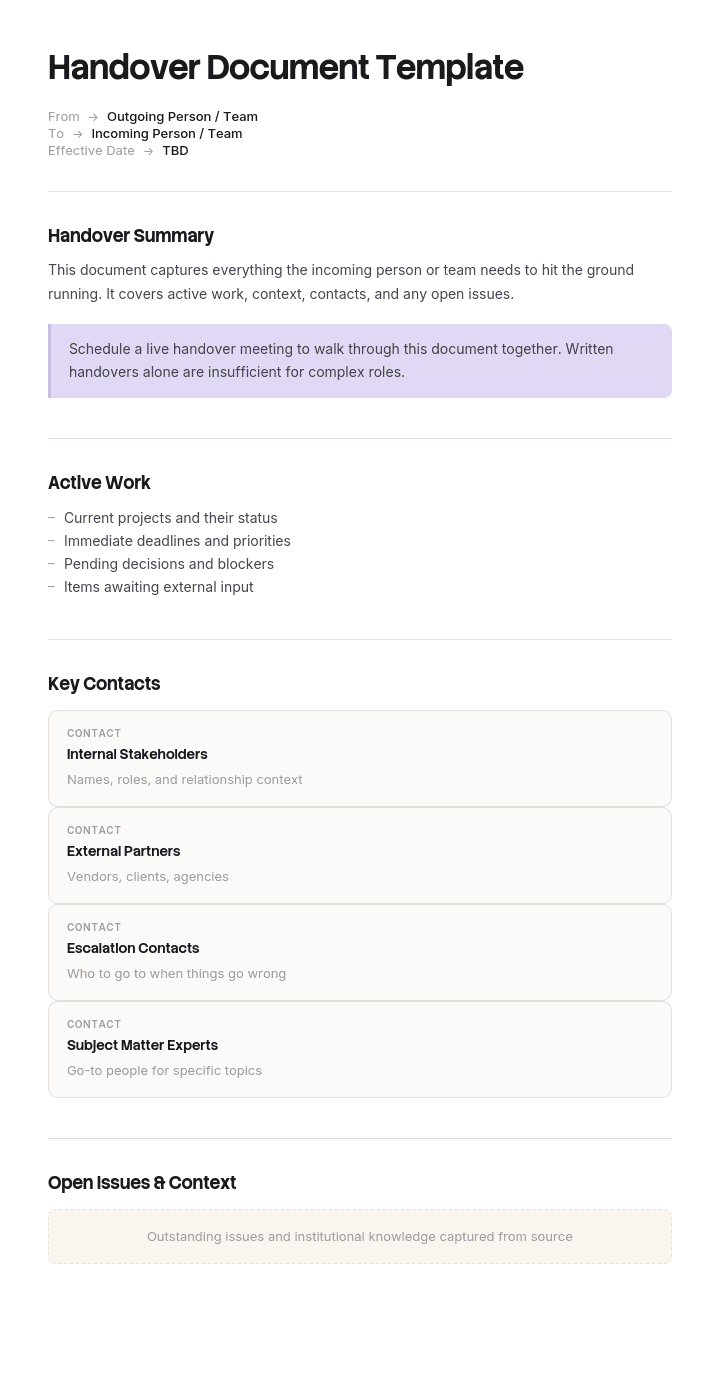
Use this template
A great handover document is what stops critical knowledge from walking out the door when someone leaves a role. With Trupeer, you can save hours on writing handovers by starting with a free handover document template, customizing it with your brand guidelines, and turning the handover into a video walkthrough the new owner can watch on day one.
Every handover document contains the tasks the person consciously performs. Almost none contains the things they do automatically, the exceptions they have absorbed, or the relationships that make the job possible.
That is why handovers feel complete and then fail three weeks later, when something happens that the document never mentioned because the person who wrote it stopped noticing it years ago.
Download the handover document template
Format | Best for |
|---|---|
Word (.docx) | The handover document itself. Free download, no sign-up |
Excel (.xlsx) | The responsibility register, recurring task calendar and access list |
The signed, agreed version | |
Google Docs | A living document both parties edit during the handover period |
.doc | Older systems and legacy libraries |
Free, editable, no watermark.
Which handover do you need?
Situation | Document | Where |
|---|---|---|
Someone is leaving the organisation | Job handover, plus the exit process | This page, and employee offboarding |
Someone is changing role internally | Job handover | This page |
Maternity, paternity or extended leave | Job handover, with a return plan | This page |
A project is finishing and being handed to operations | Project handover | |
Confirming a project handover is complete | Handover checklist | |
End of shift in a continuous operation | Shift handover | This page, shift section |
Documenting a whole process permanently | SOP | |
Systematic knowledge capture before departure | Knowledge transfer |
How to customize this template in Trupeer
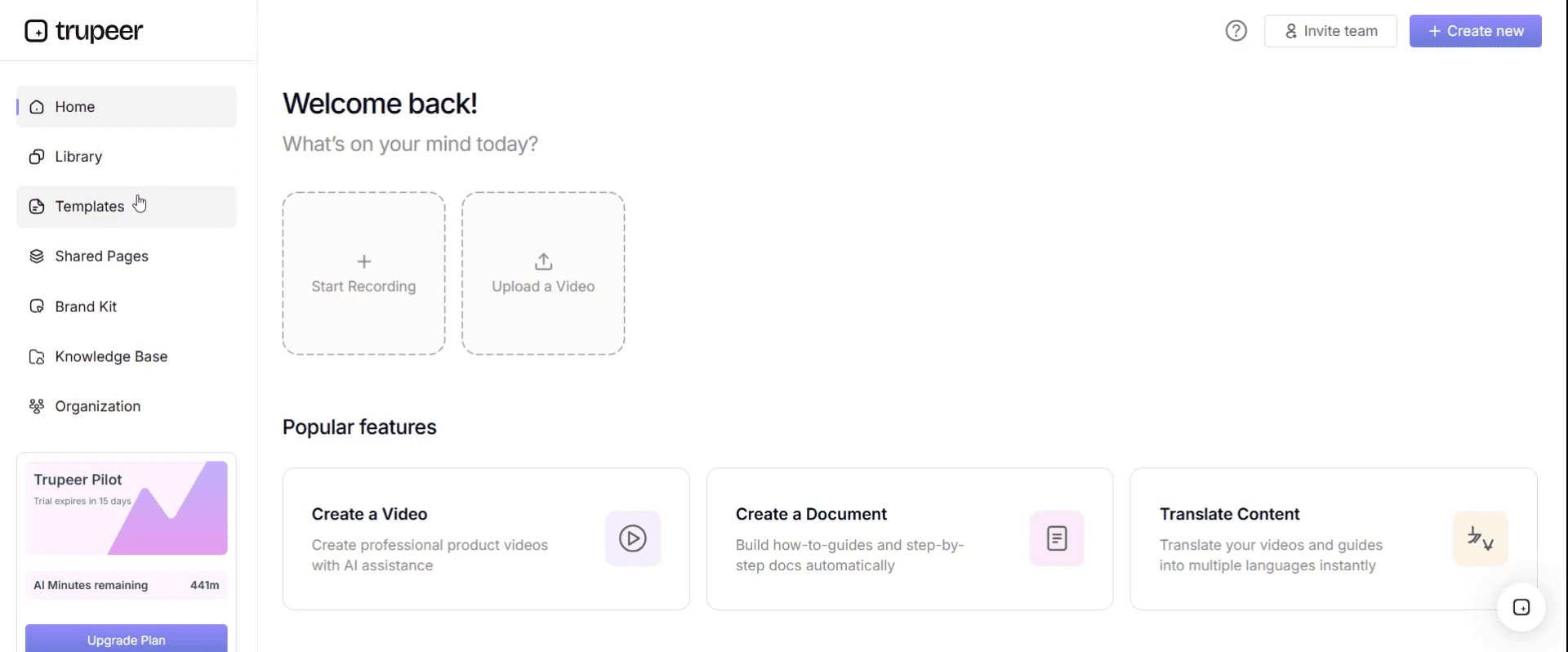
Step 1: Open the Templates Section
Go to the Templates section from the main navigation.
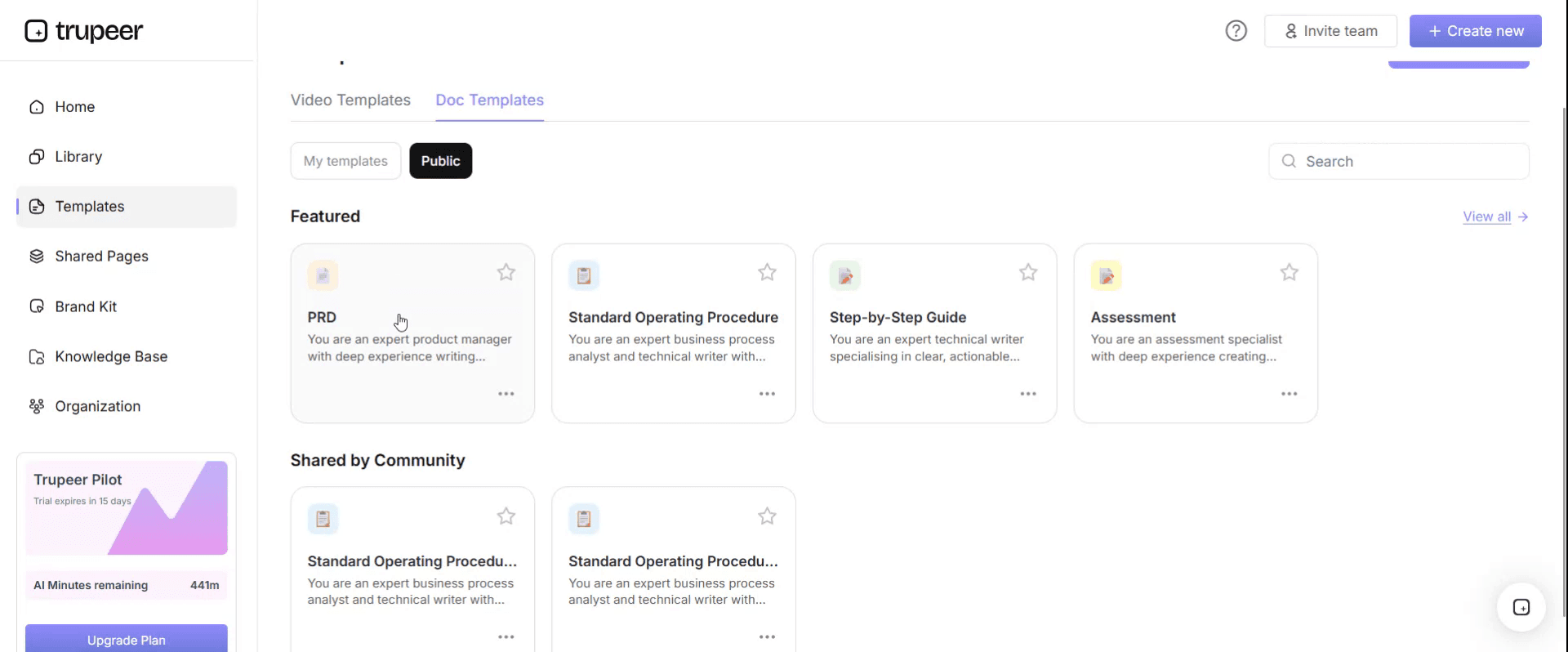
Step 2: Select and Open a Template
Click on any template you want to work with to open it.
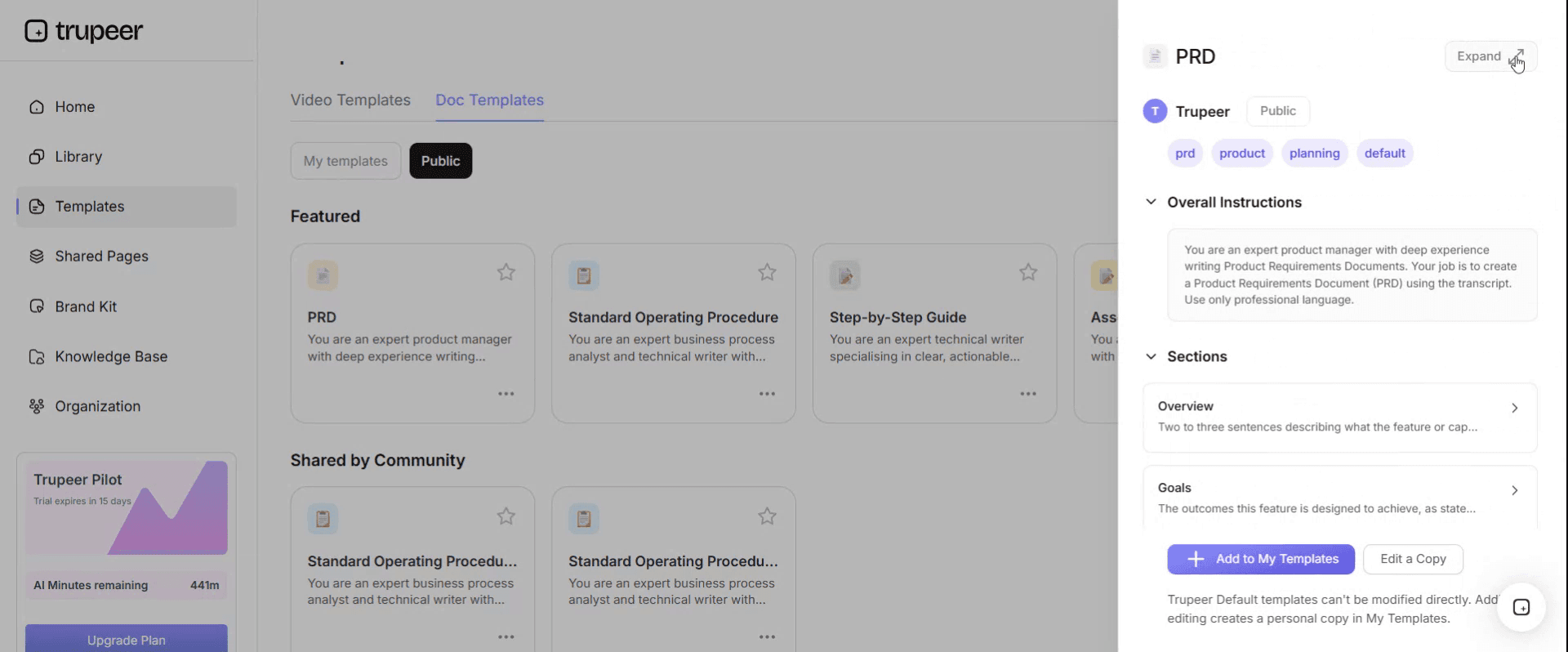
Step 3: Expand the Template View
If needed, expand the template view to see the full layout and details clearly.
Step 4: Edit the Template
Click on Edit to start modifying the selected template.
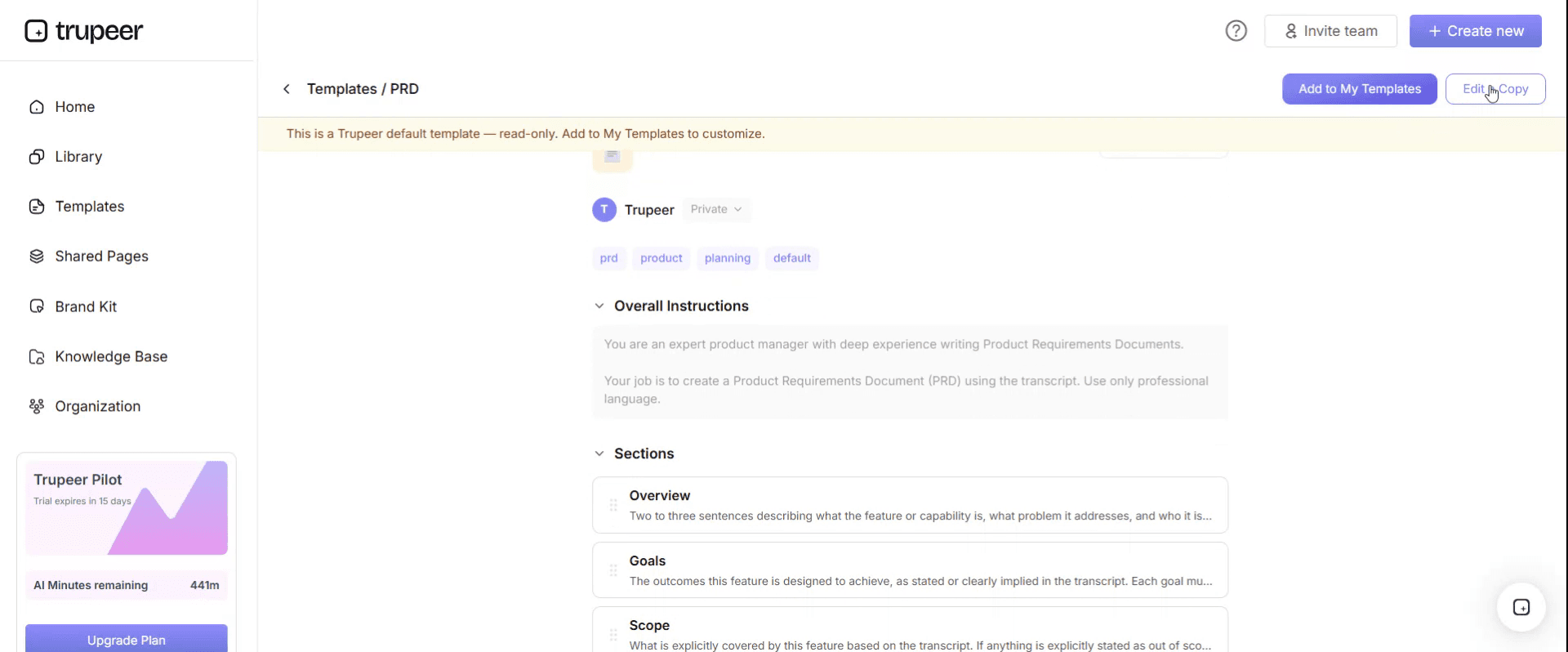
Within the editor, you can:
Add new sections
Define or update formatting rules
Add a logo and adjust its position and related settings
Step 5: Save Your Customized Template
After making all necessary changes, click Save to store the updated template as your own.
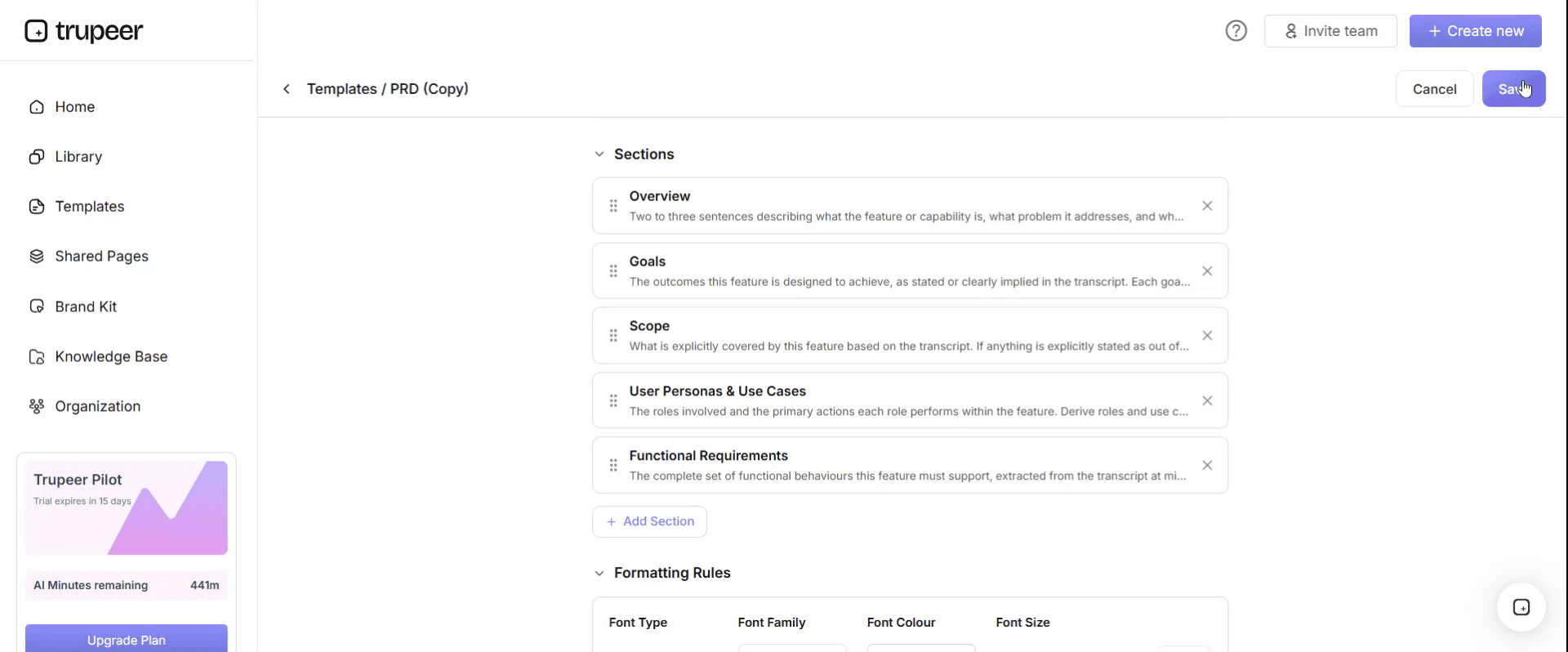
Step 6: Preview and Fine-Tune the Template
When you want to see how your customized template looks, open the Preview.
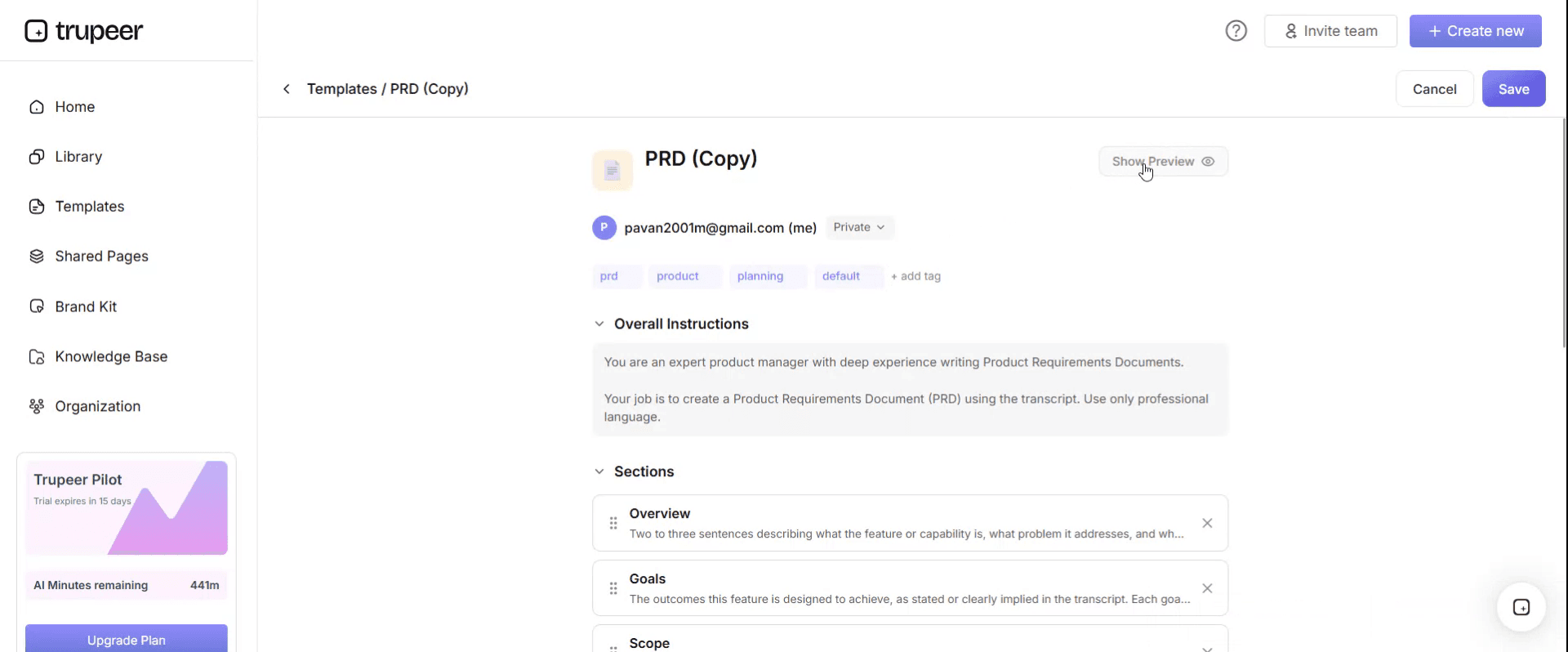
From the preview screen, you can continue to make adjustments directly if needed, ensuring the template appears exactly as you want.
With a handover document template you can:
Save hours on writing: Skip the blank page with a structure built for transitions.
Capture full context: Built-in sections ensure nothing important gets missed.
Stay on-brand: Apply your logo, fonts and colors using Trupeer's brand kit.
Onboard the new owner faster: Pair the doc with a video walkthrough so they can ramp in days, not months.
Standardize handovers: Use the same template for every role and project transition.
Reach global teams: Translate handovers into 65+ languages with one click.
The four kinds of knowledge in a handover
Each needs a different extraction method, and only the first can be handled by asking someone to write a document.
Type | What it is | Can they tell you? | How to capture it |
|---|---|---|---|
Documented | Already written down somewhere | Yes | Point at it, confirm it is current |
Undocumented but conscious | They know it, nobody wrote it down | Yes, if asked | Interview and write |
Tacit | They do it without thinking about it | No | Watch or record them doing it |
Relational | Lives in a relationship, not a fact | Partly | Introduction, not documentation |
A standard handover template captures the first two and misses the second two entirely. The second two are where the failures come from.
Documented knowledge
The easy category. Existing SOPs, runbooks, wikis, previous handovers.
The only real work is verification. Ask directly: is this current, and do you actually follow it? A surprising proportion of documented processes are out of date or were superseded by a workaround nobody recorded. A handover that points at a stale document is worse than one that admits nothing is written, because the successor will trust it.
Undocumented but conscious knowledge
Things they know and could tell you if you asked the right question. Most of a good handover document.
The extraction technique is questions rather than a blank form. "List your responsibilities" produces a job description. These produce a handover:
What do you do that is not in your job description?
What happens in your job monthly, quarterly and annually, that will not come up in the next two weeks?
What do people come to you for that they should probably ask someone else?
What would break first if you disappeared tomorrow?
What is the thing you always mean to document and never do?
Which of your tasks would you be nervous about handing to someone new?
That last one is the highest-yield question in a handover interview.
Tacit knowledge
The category that causes the failures. Things they can do but cannot explain, because they have stopped consciously performing them.
The signal is a task that takes them ten minutes and takes their successor two hours, with no obvious reason. They are making a dozen small judgements they are not aware of making: which report to cross-check, when the number looks wrong, which supplier to call rather than email, that the Thursday run always needs a manual correction.
You cannot get this by asking. They will say "it is straightforward" and mean it.
The only reliable extraction method is observation. Watch them do it, or record them doing it, and interrupt with "why did you do that?" every time they take an action you did not expect. The answers to those interruptions are the handover.
Relational knowledge
Who to call, who actually decides, which supplier will bend a deadline, which colleague to approach before a meeting rather than during it.
Documentation captures the names. It does not transfer the relationship, and a successor with a list of contacts starts from zero with all of them.
The transfer mechanism is introduction, not writing. A joint call where the leaver explicitly hands over is worth more than a paragraph of context. Do these while the leaver still has standing, which means weeks before departure rather than in the final days.
For the important relationships, write the context too: what this person cares about, what has gone wrong before, what they respond to. That part can be written, and it is usually the most useful section of a handover document.
The handover document template
Section | Contents |
|---|---|
Header | Who is handing over, to whom, effective date, handover period |
Role summary | What the job actually involves, as distinct from the job description |
Responsibilities | Each area, who is taking it, whether they have been briefed |
Recurring tasks | Daily, weekly, monthly, quarterly, annual, with triggers and timing |
In-flight work | Item, status, next action, deadline, new owner |
Key contacts | Internal and external, what each relationship is for, and the context |
Systems and access | What they use, at what level, who needs it next |
Files and locations | Where things live, including anything local |
Known exceptions | The workarounds, the awkward cases, what breaks |
Recorded walkthroughs | Links to recordings of anything tacit |
Open questions | What they never resolved |
Handover log | What has been transferred, when, and confirmed by whom |
Sign-off | Both parties, and the manager |
Two sections do most of the work. Known exceptions is the most valuable and the most often left blank, because writing it feels like admitting the process is untidy. Ask for it directly and explain why you want it.
Recurring tasks matters because of timing. A monthly task handed over in week one of a four-week notice period gets done together once. An annual task will not come up at all, which means it needs recording rather than shadowing.
A worked handover
From: Operations analyst, leaving 30 September. To: Junior analyst, plus two items to the team lead. Handover period: four weeks.
Role summary. Owns the monthly supplier reconciliation, the weekly stock report, and is the primary contact for two suppliers. Also, undocumented until now, is the person who spots and corrects the pricing errors in the Thursday import.
Responsibilities
Area | To | Briefed | Status |
|---|---|---|---|
Monthly supplier reconciliation | Junior analyst | Yes, done together in week 2 | Recorded, ran solo in week 3 |
Weekly stock report | Junior analyst | Yes | Running solo since week 2 |
Supplier A relationship | Junior analyst | Introduced on a joint call, week 1 | Complete |
Supplier B relationship | Team lead | Introduced week 2, awkward history explained | Complete |
Thursday import check | Junior analyst | Not previously documented | Recorded week 3 |
Quarterly audit pack | Team lead | Not due until November | Recorded, not practised |
Recurring tasks
Task | Frequency | Trigger | Timing | Notes |
|---|---|---|---|---|
Stock report | Weekly, Monday | Calendar | 2 hours | Straightforward |
Supplier reconciliation | Monthly, working day 3 | Month end close | Half a day | Recorded. Two exceptions below |
Thursday import check | Weekly | Import completes ~14:00 | 20 mins | Was undocumented. See exceptions |
Quarterly audit pack | Quarterly | Finance request | 1 day | Recorded only, next one in November |
Annual supplier review | Annual, January | Contract dates | 2 days | Recorded. Successor has never seen one |
Known exceptions
Supplier A's invoices arrive with the reference in a different field. The reconciliation macro does not pick it up. Correct manually before running.
The Thursday import drops decimal places on any price above £1,000. Check the top twenty lines by value every week. This has never been fixed and nobody outside this desk knows it happens.
Supplier B will not respond to email. Call. There is history with a previous account manager.
Month end falling on a Monday means the reconciliation runs on working day 4, not 3, because the close is late.
Recorded walkthroughs. Reconciliation including both exceptions. Thursday import check. Quarterly audit pack. Annual supplier review.
Open questions. Nobody knows why the import drops decimals. Raised twice with IT, ticket closed as no fault found both times.
The Thursday import check is the point of this document. It took twenty minutes a week, the leaver did not think of it as a task, and it would not have appeared in any handover produced from a blank template. It surfaced because someone watched them work on a Thursday.
The handover meeting
Not one meeting. Three, at least.
The interview, week one. The manager or successor asks the extraction questions above and takes notes. The leaver does not write anything yet. Talking surfaces more than writing does, and it takes them less time, which matters when they are already halfway out.
The walkthroughs, weeks one to three. Each significant task performed together, recorded where possible. Leaver does it first while the successor watches, then the successor does it while the leaver watches. The second order is the important one and the one usually skipped.
The review, final week. Go through the document together, check nothing has been missed, and both sign it. Ask one final question: is there anything you have thought of since we started that is not in here?
Shadowing and reverse shadowing
The order matters more than most people realise.
Shadowing, the successor watching, is useful once for context and quickly stops teaching anything. Watching someone competent perform a task they find easy conveys very little, because the difficulty is invisible.
Reverse shadowing, the successor performing while the leaver watches, is where the transfer happens. Every hesitation is a gap. Every "actually, at this point you need to" is a piece of tacit knowledge that was never going to make it into the document.
Plan for at least one reverse shadow of every significant recurring task, and do them early enough that there is time for a second attempt.
Handover when leaving a job
The most common case, and the one with a hard deadline.
Start in week one of the notice period, not the last week. A handover written in the final days is produced by someone who has mentally left, under time pressure, and it shows.
Sequence by frequency, not by importance. Weekly tasks can be handed over by doing them together. Monthly tasks may come round once during a four-week notice. Quarterly and annual tasks will not come round at all, and must be recorded rather than demonstrated.
Make the introductions early, while the leaver still has standing and the counterpart still has reason to take the call.
And ask the question nobody asks: is there anything the team relies on that lives on your laptop rather than somewhere shared? The answer is frequently yes.
The wider exit process, access revocation, final pay and the exit interview, is covered on the employee offboarding template.
Shift handover
A different problem: high frequency, low volume, and the risk is what happened in the last eight hours rather than what happens every quarter.
Keep it to a fixed structure so nothing depends on memory: what happened this shift, what is outstanding, what needs watching, what is escalated and to whom, anything unusual, and anything the next shift must do at a specific time.
Do it face to face or voice where possible, with a written record. Written-only handovers lose the emphasis, and the emphasis is often the information.
In safety-critical operations, use a structured format such as SBAR, situation, background, assessment, recommendation, and require read-back on anything critical. The read-back is what catches the misheard item.
Project handover
Handing a completed project to the team who will operate it. Distinct enough to warrant its own document.
What it needs beyond the general template: as-built documentation, support and escalation arrangements, warranty or defect liability terms, training delivered and to whom, outstanding items and who owns them, and formal acceptance sign-off.
The failure mode is the project team disbanding before the operations team is ready, leaving nobody who knows how it was built. Build a defined support period into the plan, with named people, rather than assuming goodwill.
Use the project handover template and the checklist.
The handover timeline
When | Activity |
|---|---|
Week 1 | Extraction interview. Start the document. Make key introductions |
Week 1 to 2 | Shadow the significant recurring tasks. Record anything that will not recur before departure |
Week 2 to 3 | Reverse shadow. Successor performs, leaver watches. Fix the gaps this reveals |
Week 3 | Successor runs the significant tasks alone. Leaver available but not present |
Final week | Review the document together. Sign off. Ask the final question |
After | Successor has a named person to ask for the first month, ideally not the leaver |
Compress proportionally for shorter notice periods, but keep the reverse shadow. If you only have time for one thing, it is the successor doing the task while the leaver watches.
How to know the handover worked
Not at the point of sign-off. Sign-off measures whether the document was completed, not whether the knowledge transferred.
The successor performs each significant task alone, before the leaver goes. Anything not attempted is not handed over.
Count the questions in the first month, and to whom. Questions to the leaver after they have left mean the handover was incomplete.
Watch for the first annual or quarterly task. That is the real test, and it happens months later.
Ask the successor at 30 days what they wish had been in the document. Feed it into the next handover.
Most organisations declare a handover successful on the last day. The evidence arrives in month three.
Best practices
Start in week one, not the final week.
Interview before writing. Talking surfaces more than a blank form.
Ask what they would be nervous about handing over.
Record anything that will not recur before they leave.
Reverse shadow every significant task.
Introduce people in person or on a call, while the leaver still has standing.
Write the exceptions section, and ask for it directly.
Ask what lives on their laptop.
Give the successor a named person to ask afterwards.
Review at 30 days and improve the next one.
Common mistakes
Written in the final week.
A blank form handed to the leaver with no interview.
Tasks listed, exceptions omitted.
Shadowing only, never reverse shadowing.
Quarterly and annual tasks skipped because they do not come up during the notice period.
Contacts listed without introductions.
Sign-off treated as evidence of success.
No named person for the successor to ask afterwards.
Points at documentation that is out of date.
Nobody asks about local files.
Same process for a four-week notice and a same-day exit.
The tacit knowledge never surfaces because nobody watched anyone work.
Record the things they cannot explain
Open the template in Trupeer AI, apply your brand kit so handover documents match your other materials, and edit any section directly. Setup is in the template guide.
Two categories of knowledge in a handover cannot be written down by the person leaving. The tacit part, because they have stopped noticing they do it. And anything quarterly or annual, because it will not happen again before they go.
Both are solved the same way. Have them do the task while you record. Trupeer AI turns that recording into the written procedure and a narrated video walkthrough, captured in the order the work actually happens rather than the order they remember it. It takes less of their time than writing, which matters when they are already half gone, and the successor can watch the quarterly process again in November when it finally comes round.
Translate it into 65+ languages for distributed teams, and keep the set in your knowledge base so it survives the next handover as well as this one.
Record it. Brand it. Translate it. Trupeer it.
Frequently Asked Questions
Is there a free handover document template in Word?
Yes. Word is the main format, with every section structured and prompt questions in each to surface what people forget. Free download, no sign-up, no watermark.
Can I download a free handover document template in Word?
Yes, every format is a free download with no account required and no attribution.
Is there a handover document template in Word doc format?
Yes, a .doc version is included alongside .docx for older systems.
Is there a work handover template in Word and PDF, free to download?
Yes, both. Word for writing it during the handover period, PDF for the signed version at the end. The PDF includes the sign-off block for both parties and the manager.
Is there a free handover document template in Excel?
Yes. Excel holds the tabular parts: the responsibility register, the recurring task calendar showing what falls due when, the access list and the handover log tracking what has actually been transferred rather than just written down.
Is there a work handover template in Excel?
Yes, that is the same workbook. The recurring task calendar is the most useful tab, because it shows immediately which tasks will not come round before the person leaves and therefore need recording rather than demonstrating.
Is there a free handover document template in PDF?
Yes, as the signed final version and as a printable interview prompt sheet for the extraction conversation.
Is there a handover template for when leaving a job?
Yes, and that is the primary use case for this template. Start it in week one of the notice period rather than the final week, sequence the handover by task frequency, and record anything quarterly or annual since it will not come round again before they go. For the full exit process including access and final pay, see the employee offboarding template.
What is a handover document?
A record of what one person is passing to another: responsibilities, recurring tasks, in-flight work, contacts, systems, and the exceptions and workarounds that are not written down anywhere else. It exists so the successor can do the job without the predecessor.
What should a handover document include?
Role summary, responsibilities and who is taking each, recurring tasks with their triggers and timing, in-flight work with status and next actions, key contacts with context, systems and access levels, where files live including anything local, known exceptions and workarounds, links to recordings, open questions, and sign-off.
How do you write a handover document?
Interview before writing, since talking surfaces more than a blank form. Ask what they do that is not in the job description, what happens monthly and annually, and what they would be nervous about handing over. Watch them work to catch what they no longer notice doing. Then write it, reverse shadow to test it, and revise.
How long should a handover take?
The full notice period, starting in week one. Weekly tasks can be handed over by doing them together. Monthly tasks may come round once. Quarterly and annual tasks will not come round at all and must be recorded. Compress proportionally for shorter notice, but keep the reverse shadow.
Why do handovers fail?
Because people cannot document what they have stopped thinking about. A handover written from a blank template captures the tasks someone consciously performs and misses the small judgements they make automatically, which are exactly the things that break when someone new does the job.
What is reverse shadowing and why does it matter?
The successor performs the task while the person leaving watches, rather than the other way round. Watching someone competent teaches very little, because their difficulty is invisible. Doing it yourself with them present surfaces every gap immediately, and their corrections are the tacit knowledge that would never have reached the document.
What is a shift handover?
A structured handover between shifts in a continuous operation: what happened, what is outstanding, what needs watching, what is escalated, anything unusual, and anything time-critical for the incoming shift. In safety-critical settings a fixed format and read-back on critical items are standard.
What is the difference between a handover document and an SOP?
A handover document transfers a specific person's role to a specific successor at a point in time, and includes in-flight work and relationships. An SOP documents a process permanently, for anyone. A good handover often results in several SOPs being written, and it should reference existing ones rather than duplicating them.
Can I customise this handover document template?
Yes, all versions are fully editable. The extraction questions are the part worth keeping regardless of what else you change, since they are what surfaces the content a blank template never gets to. In Trupeer AI you can also apply your brand kit so handover documents match your other materials.