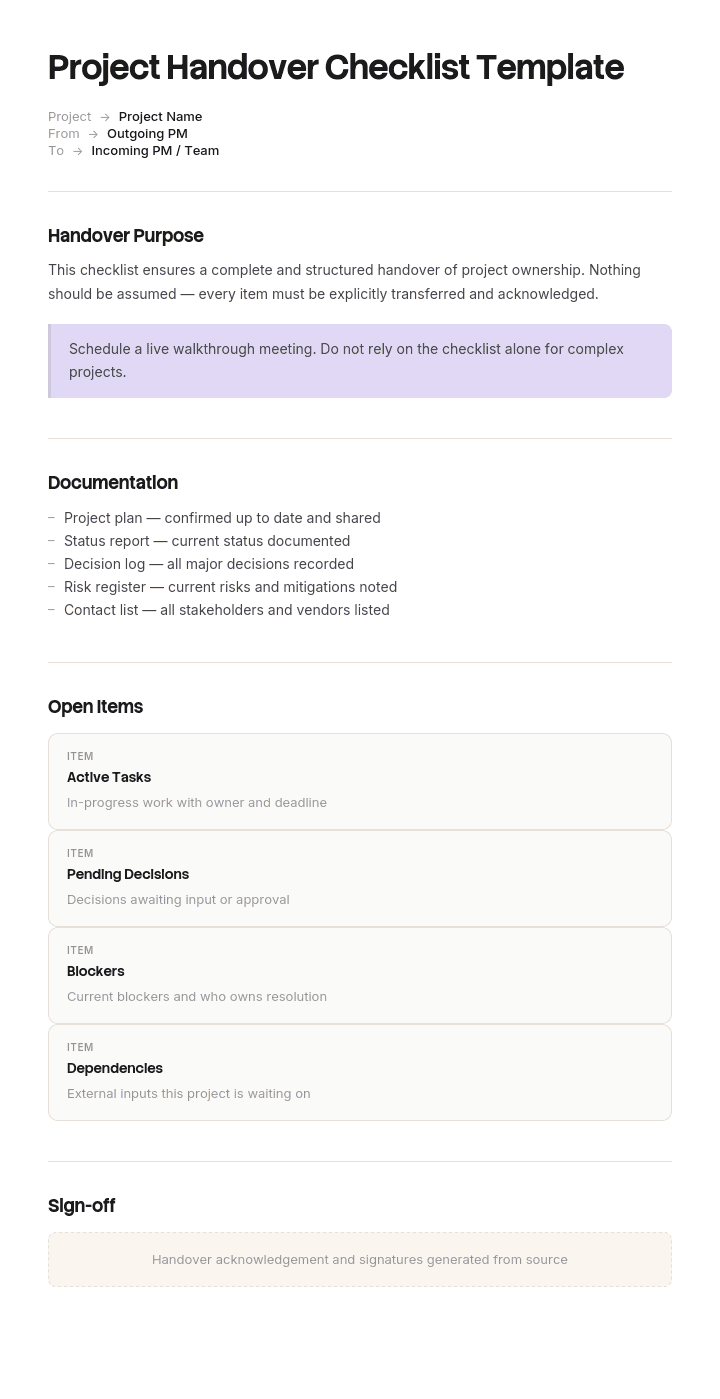
Use this template
Project handovers are where momentum gets lost - unless you have a clear checklist. With Trupeer, you can save hours on handover documentation by starting with a free project handover checklist template, customizing it with your brand guidelines, and turning the checklist into a video walkthrough the receiving team can use to ramp up fast.
What is a project handover checklist template?
A project handover checklist is the list of things that must be true before a project's output passes from the team that built it to the team that will run it.
It covers documentation, training, access, support arrangements, outstanding defects, ownership and formal sign-off. A template gives you the items and the sign-off block.
The distinction worth drawing at the outset is that this is not a personal handover. When one person leaves a role and passes it to a successor, the problem is knowledge transfer between individuals, and our knowledge transfer SOP template covers that.
A project handover is between organisations rather than people. A project ends; something continues. The receiving team will live with it for years, and they will do so under conditions the project set.
A handover is an acceptance, not a notification
Almost every handover checklist has the same structure and the same fatal property. It is completed by the project team, item by item, and then signed by the receiving team at the end.
That sequence makes the receiver's signature a formality. By the time it is requested, the project is closing, the sponsor is in the room, the budget is being released and the delivery date has been announced. Refusing at that point means being the person who blocked a completed project at the final step.
So the signature is given, and the receiving team spends the next two years dealing with what they signed for.
An acceptance is different from a notification in exactly one respect: the right to refuse has to be real. That requires two things, neither of which appears in a standard handover checklist. The criteria have to be written by the receiver rather than the project. And they have to be agreed early enough that refusing later is pre-authorised rather than politically expensive.
How to customize this template in Trupeer
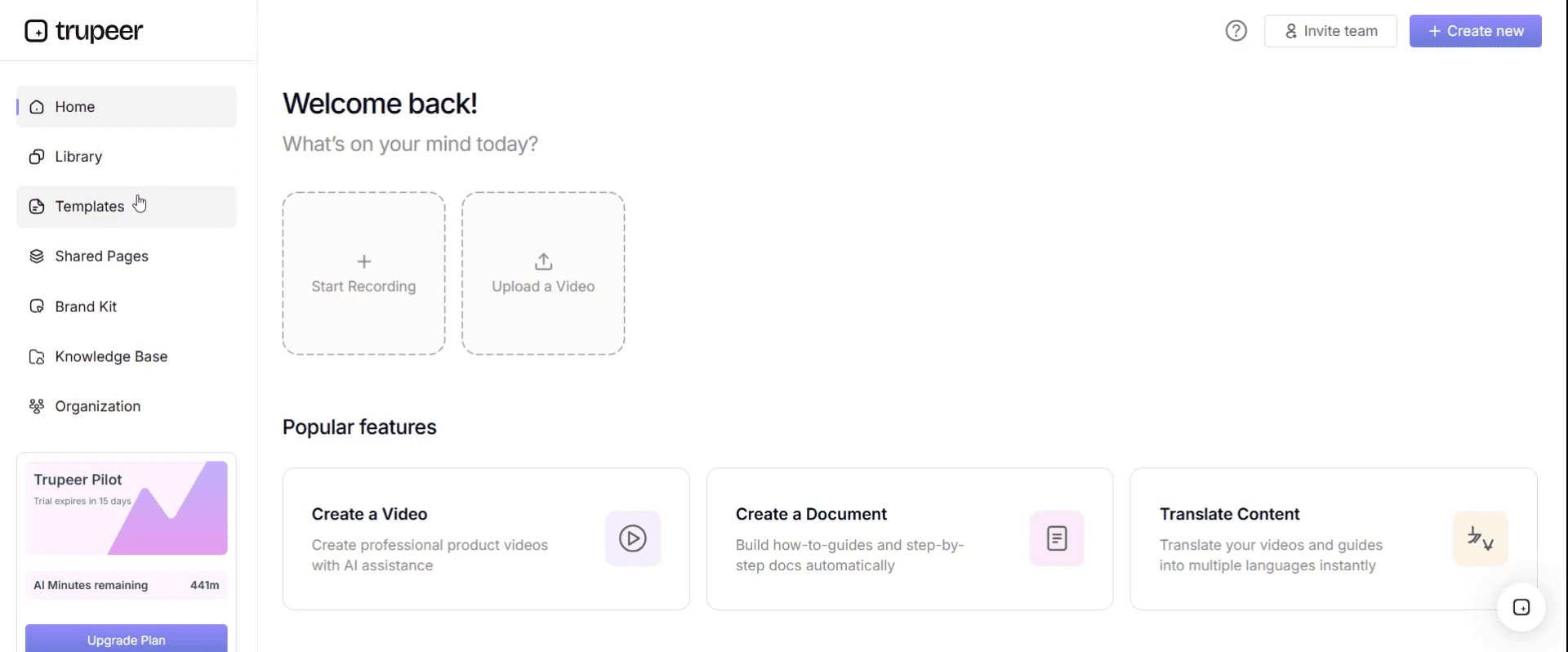
Step 1: Open the Templates Section
Go to the Templates section from the main navigation.
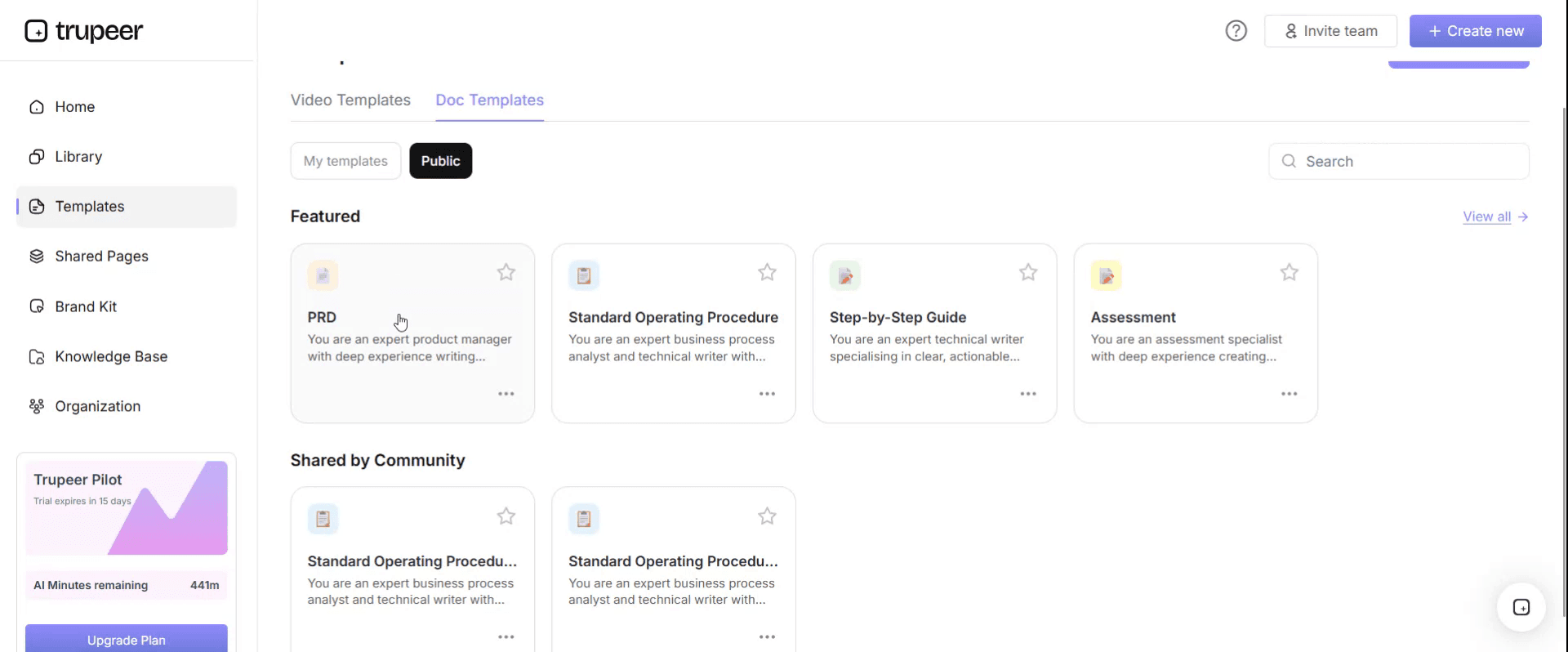
Step 2: Select and Open a Template
Click on any template you want to work with to open it.
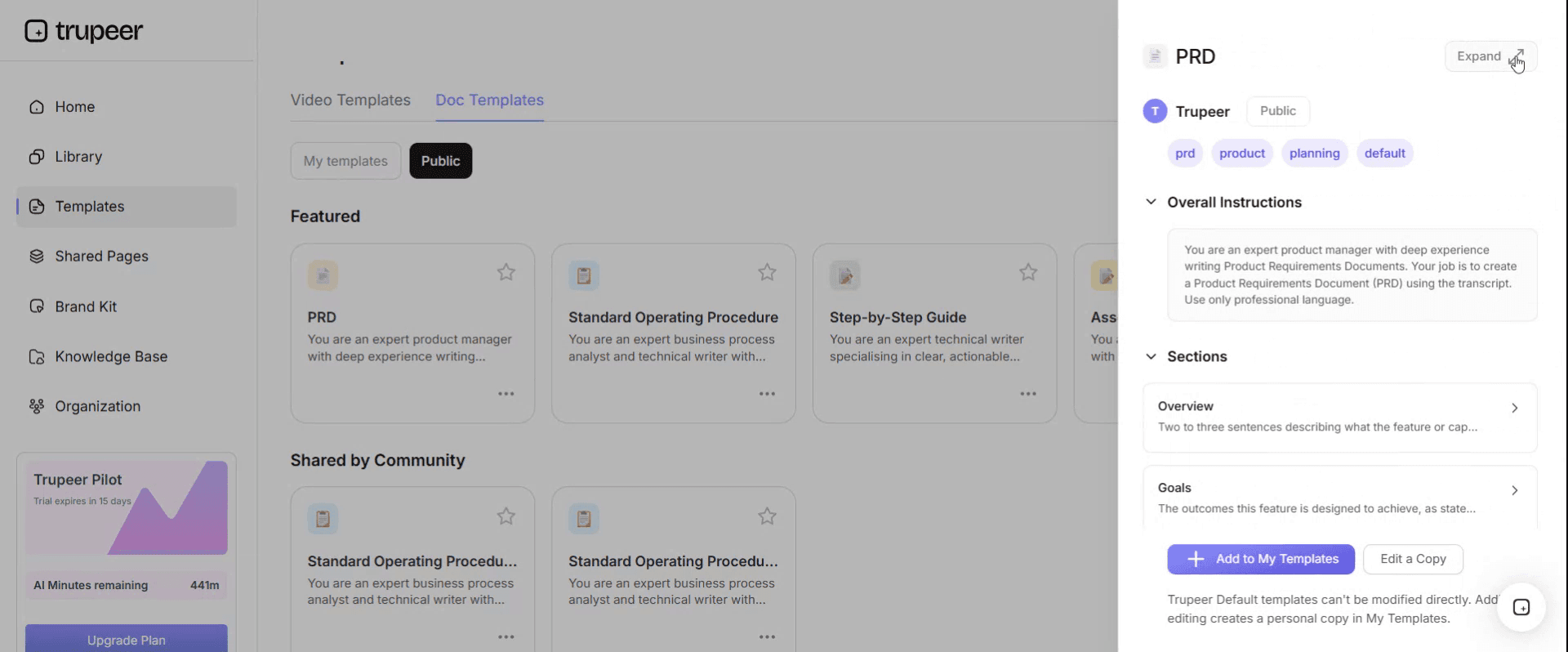
Step 3: Expand the Template View
If needed, expand the template view to see the full layout and details clearly.
Step 4: Edit the Template
Click on Edit to start modifying the selected template.
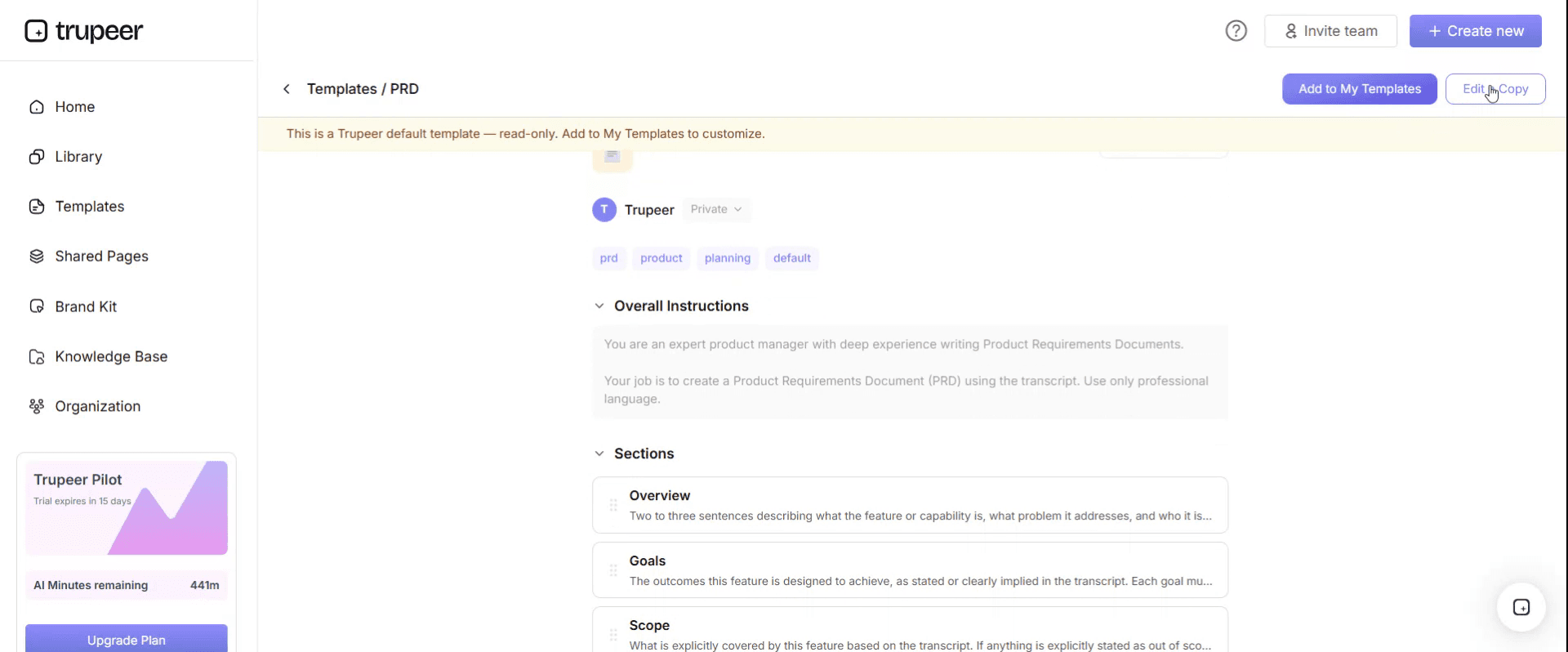
Within the editor, you can:
Add new sections
Define or update formatting rules
Add a logo and adjust its position and related settings
Step 5: Save Your Customized Template
After making all necessary changes, click Save to store the updated template as your own.
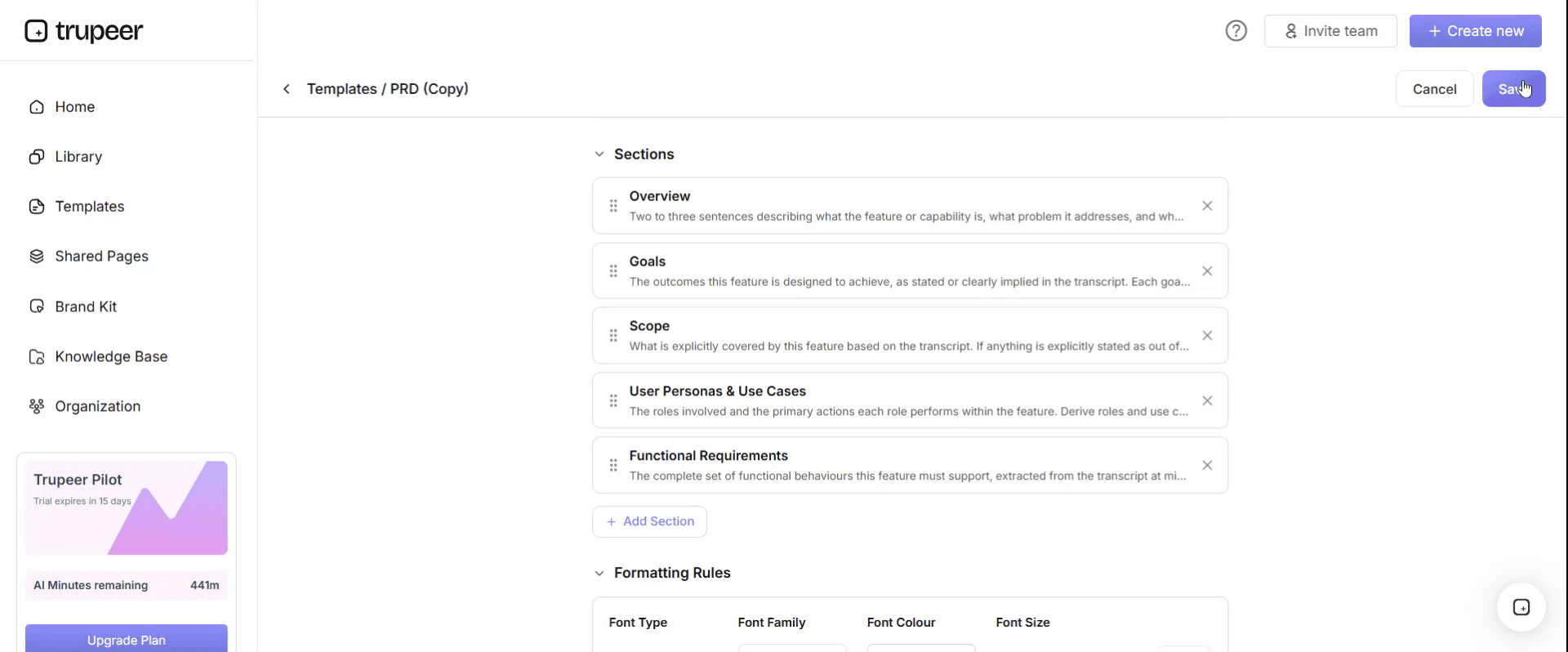
Step 6: Preview and Fine-Tune the Template
When you want to see how your customized template looks, open the Preview.
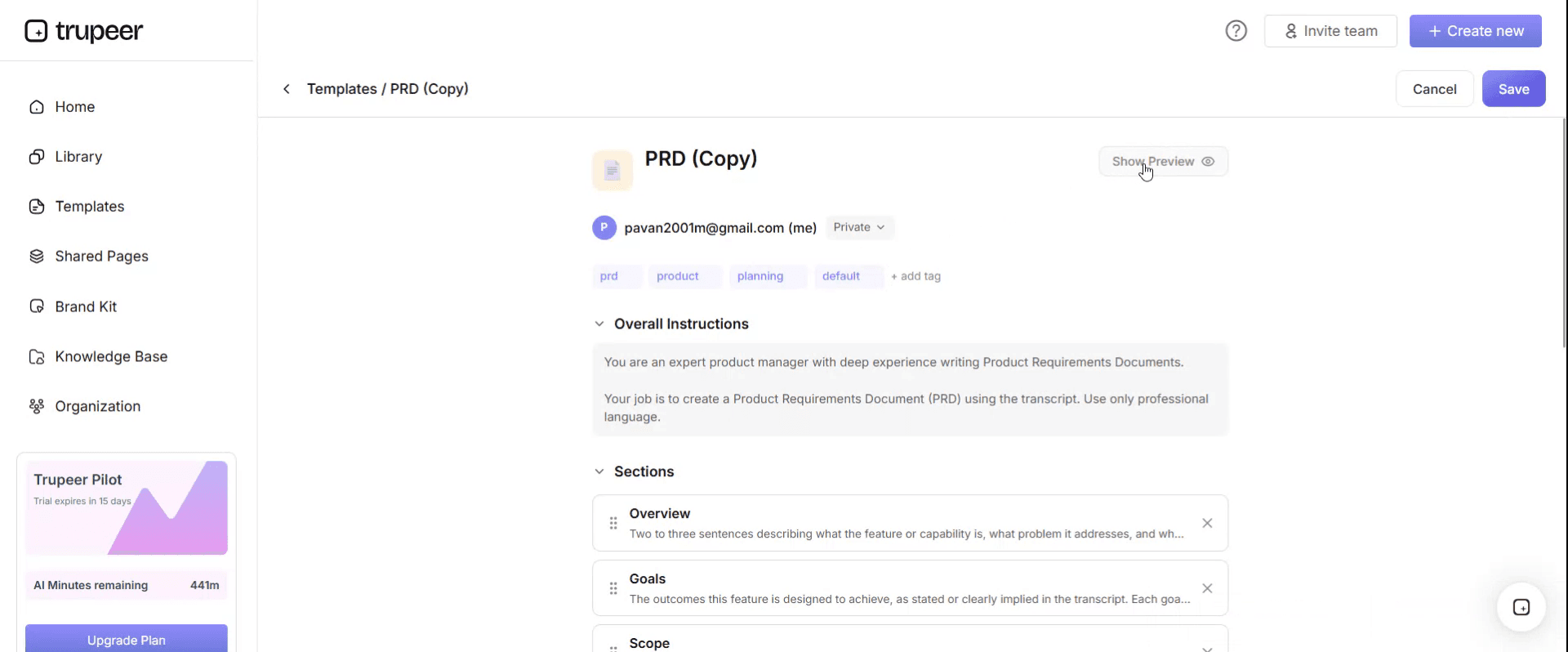
From the preview screen, you can continue to make adjustments directly if needed, ensuring the template appears exactly as you want.
With a project handover checklist template you can:
Save hours on handovers: Skip the blank page with a structure built for project transitions.
Cover every artifact: Built-in sections ensure nothing important gets missed.
Stay on-brand: Apply your logo, fonts and colors using Trupeer's brand kit.
Onboard the receiving team faster: Pair the checklist with a video walkthrough.
Standardize handovers: Use the same template for every project transition.
Reach global teams: Translate handover checklists into 65+ languages with one click.
The receiving team had no say in the design
It is worth naming the underlying asymmetry, because it explains the behaviour rather than blaming anybody for it.
A project is commissioned by a sponsor, scoped by a project manager, and delivered by a team assembled for the purpose. The people who will operate the result afterwards are usually consulted about requirements, sometimes, and almost never about maintainability.
They then inherit the consequences: the on-call burden, the manual workarounds, the technical debt, the defects that were deferred, the vendor whose support contract covers business hours only, and the customer complaints.
None of those things is visible in a requirements document, and none of them is anybody's fault in particular. The project's incentives run to delivery. The operations team's incentives run to the following three years. The handover is the single point at which those two sets of incentives meet, and it happens on the last day, in a room where one party has all the momentum.
The fix is to move the conversation to a point where both parties still have something to gain.
Acceptance criteria written by the receiver at planning
The intervention is small and it changes the whole dynamic.
At planning stage, before delivery begins, the team who will operate the output writes the conditions under which they will accept it. Not the project. Them.
A workable set runs to ten or twelve criteria. Runbooks exist for every scheduled or automated job. No defects above an agreed severity remain open. On-call and out-of-hours support is agreed and contracted, with the cost known. The service desk has been trained, with a documented pass rate. As-built documentation has been verified by operations performing a small number of real tasks using only that documentation. Access and permissions are transferred to role-based accounts. The vendor's support arrangements are in place and tested. Monitoring and alerting exist and have been proven.
Both the project sponsor and the receiving manager sign that list at planning.
Two things follow. The project can plan and budget for meeting the criteria rather than discovering them at the end, which is cheaper for everybody. And refusing at closure becomes the enforcement of a prior agreement rather than an act of obstruction, which is the difference between a right that exists on paper and one somebody can actually use.
Hypercare, and why the project must not leave at go-live
The second mechanism aligns incentives after the signature rather than before it.
A project that hands over at go-live and disbands has no stake in what happens next. Every deferred defect, every undocumented job and every missing runbook becomes somebody else's problem the following Monday.
A hypercare period changes that. For a defined period after handover, typically thirty to ninety days depending on scale, the project team remains accountable. Named individuals stay available, the budget stays open, and defects arising in that window are fixed by the project rather than raised as new work.
The value is not mainly the support. It is what it does to behaviour during delivery. A team that knows it will be answering the phone in month one documents differently in month twelve.
Three details make it work. Name the individuals, because "the project team" disperses. Hold the budget open explicitly, since a hypercare commitment with no money is a promise nobody can keep. And define what hypercare covers, meaning defects and knowledge gaps, as distinct from new requests, or the period becomes a free enhancement window and the project never closes.
Free project handover checklist template: the items to copy
Copy from here. The two blocks marked with an asterisk are the additions.
Header. Project, output being handed over, handing team, receiving team, target handover date, hypercare end date.
Acceptance criteria, written by the receiver at planning. The ten to twelve conditions, each with a means of verification and a yes or no. This section is completed by the receiving team, not the project.
Documentation. As-built description verified against reality. Runbooks for every scheduled job. Known limitations and current workarounds. Architecture or asset records. Our project documentation template covers which of these are worth keeping.
Operational readiness. Monitoring in place and tested. Alerting routed to a real destination. Backup and restore proven, not just configured. Capacity headroom stated. Escalation path named with out-of-hours cover.
Defects and debt. Open defects listed by severity, with owners and target dates. Anything deliberately deferred, recorded as a decision rather than as an omission.
Training and people. Who has been trained, on what, with evidence. Named owner on the receiving side. Support desk readiness.
Access and administration. Accounts transferred to role-based rather than named individuals. Licences and contracts assigned. Vendor support arrangements tested.
Commercial. Ongoing costs confirmed and budgeted. Warranty terms and expiry. Contracts novated where needed.
Hypercare terms. Duration, named individuals, what is covered and what is not, and how it ends.
Sign-off. Handing party, receiving party, and sponsor. With the date, and with any conditions attached.
Copy to here.
The firm whose ops manager signed under pressure
Bramfield Group, a professional services firm of about two thousand two hundred people, replaced its practice management system. Sixteen months, roughly four point six million pounds, delivered on time.
Handover to IT operations happened at go-live. The checklist had thirty four items, all completed by the project team, and was signed by the IT operations manager on the day the project closed.
What operations actually received was less encouraging than thirty four ticks suggested. Eleven documents, of which four described the system as designed rather than as built. No runbooks for any of the six scheduled overnight jobs. Forty seven open defects, nine of them rated high. No on-call arrangement, since the vendor's support contract covered business hours only. And no service desk training, because it had been assumed the vendor would provide it.
The operations manager signed anyway. Asked about it afterwards, he said the project was closing that Friday, the sponsor was in the room, and refusing would have meant being the person who blocked a four and a half million pound project at the last hurdle.
Over the following six months there were three overnight job failures that required escalating to a contractor who had already left. Service desk first contact resolution on the new system ran at twenty two percent against seventy one percent on the system it replaced. The nine high severity defects took a median fourteen weeks to resolve, because the project budget had closed and each one required its own business case. IT operations recorded three hundred and forty hours of additional overtime, around nineteen thousand pounds.
Total unplanned cost across the six months, including defect remediation, came to somewhere near two hundred and forty thousand pounds.
The next programme did two things differently.
IT operations wrote twelve acceptance criteria at planning stage, including runbooks for every scheduled job, zero high severity defects at handover, a contracted on-call arrangement, a trained service desk with a documented pass rate, and as-built documentation verified by operations performing three real tasks using only the documentation. Both the sponsor and the operations manager signed that list before delivery began.
And a ninety day hypercare period was agreed, with two named project staff retained and the budget held open.
The first handover attempt failed on two criteria and was fixed in three weeks. Service desk first contact resolution was sixty four percent in month one. There were no escalations to former project staff. Hypercare consumed about a hundred and forty hours of the retained budget.
General components of a project handover checklist
Component | What it must contain | The usual failure |
|---|---|---|
Acceptance criteria | Conditions written by the receiver, agreed at planning | Written by the project, presented at closure |
As-built documentation | What exists, verified by somebody using it | As-designed documents, never checked |
Runbooks | Every scheduled, automated or recurring task | Missing entirely for overnight jobs |
Defect position | Open items by severity with owners and dates | A number with no owners |
Operational readiness | Monitoring, alerting, backup and restore proven | Configured but never tested |
Training | Who, on what, with evidence of competence | Assumed to be somebody else's responsibility |
Access | Role-based accounts, not named individuals | Admin access belonging to a departing contractor |
Support arrangements | Contracted, with hours and cost confirmed | Business hours only, discovered in month two |
Ongoing cost | Confirmed and in somebody's budget | Unbudgeted, surfacing at the next planning round |
Hypercare | Duration, named people, scope, budget | Absent, so the project leaves at go-live |
The row that predicts most of the others is the first. Where acceptance criteria come from the receiver at planning, the remaining rows tend to be met, because the project had twelve months to plan for them.
The steps to a successful project handover
At planning. The receiving team writes the acceptance criteria. Both sponsor and receiver sign. The handover date and hypercare terms go into the plan, and our IT project plan template covers making those dates real rather than aspirational.
During delivery. Documentation and runbooks accumulate rather than being produced at the end. The receiving team's named owner attends design reviews for anything affecting operability.
Four to six weeks before handover. A dry run against the acceptance criteria, so failures are found while there is still time. This is the step that turns a refusal into a fix.
At handover. Formal verification against the criteria, with the receiver performing the verification rather than reading a report. Sign-off with any conditions recorded.
During hypercare. Defects and knowledge gaps handled by the project. A weekly check between both parties.
At the end of hypercare. A short review, the closure of the project, and the transfer of remaining items into the receiving team's normal work with owners.
Common challenges in project handovers, and the fixes
The receiver cannot refuse. Acceptance criteria agreed at planning, signed by the sponsor, which is the whole argument of this page.
Documentation describes the design rather than the build. Verify it by having operations perform real tasks from it, which is the only test that works.
Runbooks missing for automated jobs. These are invisible during delivery because they work, and they are the most common cause of a three in the morning escalation to somebody who has left.
Deferred defects become permanent. List them with owners and dates before sign-off, and treat anything undated as a criterion failure.
No on-call arrangement. Cheap to agree during procurement and expensive to add afterwards, so it belongs in the acceptance criteria and in the contract.
Access held by individuals. Transfer to role-based accounts before handover, not after somebody leaves.
The project disbands at go-live. Hypercare, with named people and held budget.
Nobody owns the output. Name the receiving owner at planning, not at closure, and involve them in design reviews.
Construction and IT handover, and where they differ
The structure is common and two things differ materially.
Construction and facilities handover has a statutory and contractual layer. Practical completion, the defects liability period, retention, building regulations sign-offs, and the health and safety file required under construction regulations, which is a separate deliverable from the operating documentation. The operating and maintenance manual is the central handover artefact and it deserves its own treatment, which our operation and maintenance manual template provides, including why it is usually accepted rather than checked.
IT and software handover has no statutory equivalent in most cases, which means the discipline has to come from the acceptance criteria rather than from a contract. Its distinctive items are monitoring, restore testing, on-call, defect severity thresholds and access transfer, and its distinctive risk is that everything looks fine until the first out-of-hours failure.
Where the change goes live in a window with a rollback option, our method of procedure template covers the cutover itself, which is a different document from the handover.
Project handover or personal handover when leaving a job?
Two documents, both called a handover, with different problems.
A project handover transfers an output from a delivering team to an operating team. The problem is acceptance, operability and ongoing cost, and it is largely a commercial and organisational matter.
A personal handover transfers a role from one individual to their successor. The problem is tacit knowledge, and it is largely a matter of what the leaver does not know they know. Our knowledge transfer SOP template covers it, including why asking somebody to write down what they know produces their job description rather than their knowledge.
If you are leaving a job, you want the second one. A project handover checklist adapted for personal use produces a list of systems and passwords, which is the easy part, and omits everything that actually matters.
Can I get a project handover checklist template in Excel?
Excel, and it is the right choice for one specific reason: the acceptance criteria need a verification column and a status, and the defect list needs severity, owner and date. Both are tables that get filtered and reviewed rather than read.
Build it as two sheets. The acceptance criteria with columns for criterion, how it is verified, who verifies it, status and date. And the defect register with severity, owner, target date and whether it is accepted as deferred.
Word or Google Docs for the surrounding agreement: hypercare terms, sign-off block and any conditions attached to acceptance. That is the part that gets signed.
PDF for the signed handover, archived with the project record. Given that a handover is the document people return to when something goes wrong eighteen months later, freezing and dating the signed version matters more here than for most documents.
How to produce runbooks the receiving team will accept
Runbooks are the item most often missing at handover and the one that causes the most damage, because a scheduled job that has run flawlessly for six months of testing gives no warning that nobody knows how to recover it.
They are missing for a mundane reason. Writing a runbook means somebody documenting a process they configured months earlier, in detail, at the point in the project when there is least time and least appetite.
Trupeer AI removes most of that cost. Whoever built or operates the job records themselves running it, including the failure and recovery path, and the output is a written runbook with the steps and screens already captured. Six overnight jobs become an afternoon rather than a task that gets ticked without being done.
Record it. Brand it. Translate it. Trupeer it.
That also makes the documentation verifiable, which is what the acceptance criteria require: operations can perform the task from the runbook rather than reading it and hoping. The SOP creator covers the procedures, our IT SOP template covers deciding which are worth maintaining, and the material lives in your knowledge base in consistent branding. Setup instructions are in the document template setup guide.
Frequently Asked Questions
Is there a free project handover checklist template in Excel?
Excel is the right format, with the acceptance criteria and the defect register as separate sheets, both with verification and status columns. There is no gated download and no form. The change worth making to whatever you already use is having the receiving team fill in the criteria sheet at planning rather than the project filling it in at closure.
Is there a free project handover checklist template in Word?
Word suits the agreement around the checklist: hypercare terms, sign-off, and any conditions attached to acceptance. Keep the criteria and defect tables in a spreadsheet, since both need filtering and neither is read as prose.
Where can I find a project handover document in PDF?
Several universities and public bodies publish theirs and they are worth reading for the item list. Read them for coverage rather than for structure, and note whether any of them has acceptance criteria authored by the receiving party, since most do not and that is the difference this page is about.
Is there a handover template for when you leave a job?
That is a personal handover rather than a project one, and it needs a different approach entirely, since the hard part is the knowledge you do not realise you have. Our knowledge transfer SOP template covers it, including a method that surfaces what a list will not.
Who signs off a project handover?
Three parties: the handing team, the receiving team, and the sponsor. The sponsor's signature matters because it is what makes the receiver's refusal legitimate rather than obstructive, and that is the reason the criteria should be signed at planning as well as at handover.
How long should a hypercare period be?
Thirty days for something small, sixty to ninety for a substantial system, and longer where a full business cycle needs to pass before problems appear, such as a first month end or a first year end. What matters more than the duration is that named individuals and held budget sit behind it.
What happens if the receiving team refuses the handover?
If the criteria were agreed at planning, the answer is straightforward: the project fixes the failing criteria and re-presents. In the example above the first attempt failed on two criteria and was resolved in three weeks. Refusal without prior criteria becomes a negotiation instead, which is why the criteria matter more than the refusal right.
What is the difference between handover and closure?
Handover transfers the output to whoever will run it. Closure ends the project: final costs, contracts, resources released, records archived. They are frequently done on the same day, which is a mistake, because closure removes the budget and the people that hypercare depends on. Hand over, run hypercare, then close.