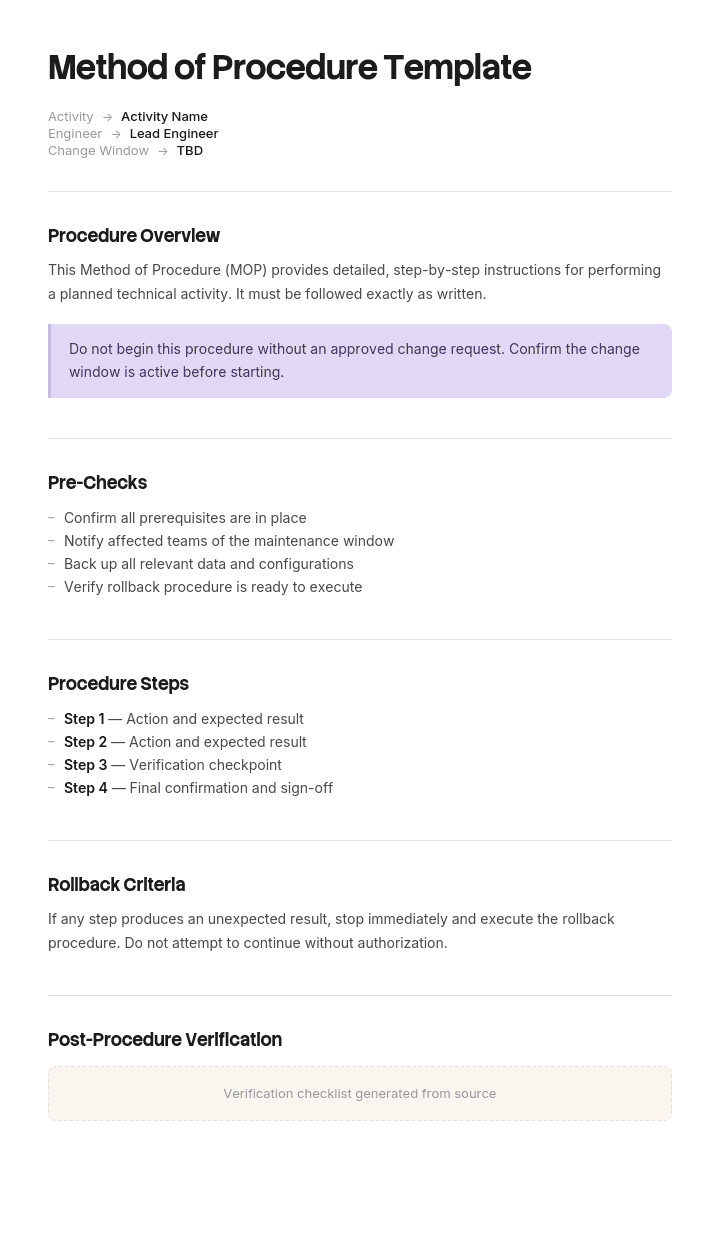
Use this template
A method of procedure (MOP) is the gold standard for executing planned changes safely - especially in IT, telecom, network operations and data centers. With Trupeer, you can save hours on MOP writing by starting with a free method of procedure template, customizing it with your brand guidelines, and turning MOPs into video walkthroughs that ops teams can review before every change window.
What is a method of procedure, and when do you need one?
A method of procedure, usually shortened to MOP, is the step-by-step document for carrying out one specific planned change on something that is currently running. A firmware upgrade on a live switch, a database migration, a power feed transfer in a data centre, a cutover between systems.
Three properties distinguish it. It is written for a single execution at a specific time, usually inside a maintenance window. It is executed by someone who may not have written it. And it carries a back-out plan, because the thing being changed is in service and failure has an audience.
You need one whenever a change is planned, affects production, and cannot simply be retried the next morning. Where the work is routine and repeated, you want a procedure instead. Where the work is a project rather than a single window, you want a plan, and our IT project plan template covers that level, with the MOP sitting inside it as the cutover document.
SOP or MOP: which document are you actually writing?
The distinction gets muddled constantly, partly because a lot of search traffic for one lands on the other.
An SOP is standing. It describes how your organisation does something that recurs, it has no date, and it is written once and maintained. Restore a mailbox, onboard a customer, run the month end.
A MOP is single-use. It describes one change, on one night, on named equipment, with a start time and an end time. It is approved for that window and then archived as a record of what was done.
The practical test is whether the document names specific equipment and a specific date. If it does, it is a MOP. If it says "the affected device", it is a procedure.
Many organisations need both and the relationship is clean. The SOP says how you generally upgrade firmware. The MOP says you are upgrading these two devices, in this window, in this order, with this back-out. Writing an SOP where a MOP is needed produces a document too vague to execute under pressure. Writing a MOP where an SOP is needed means rewriting the same thing forty times.
How to customize this template in Trupeer
Step 1: Open the Templates Section
Go to the Templates section from the main navigation.
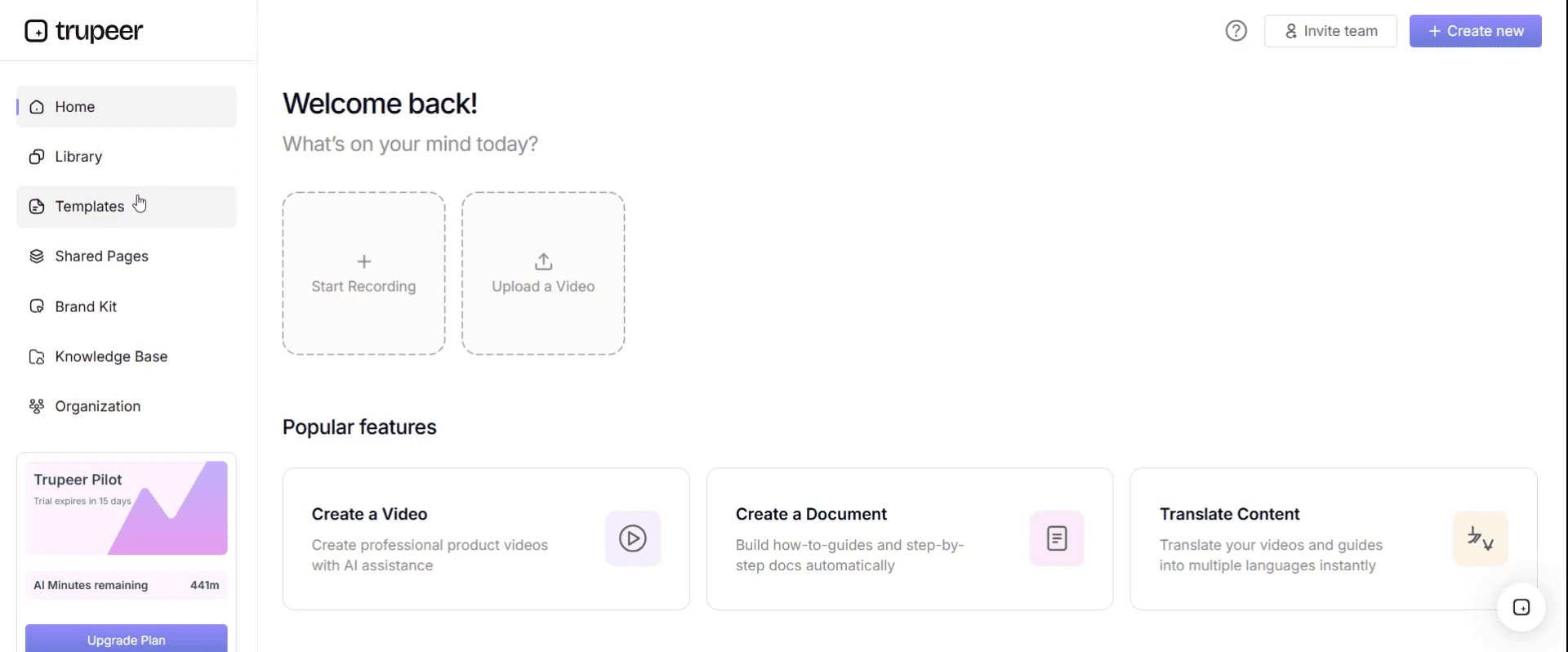
Step 2: Select and Open a Template
Click on any template you want to work with to open it.
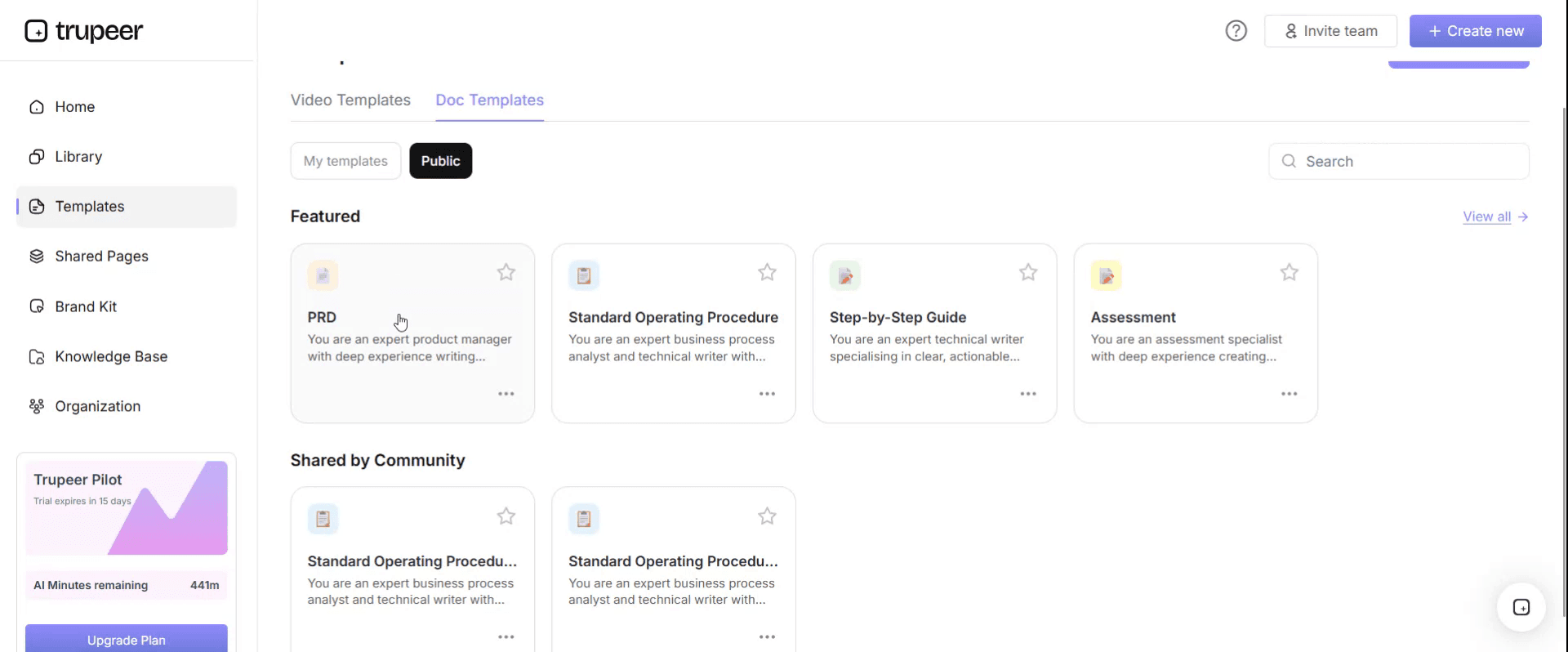
Step 3: Expand the Template View
If needed, expand the template view to see the full layout and details clearly.
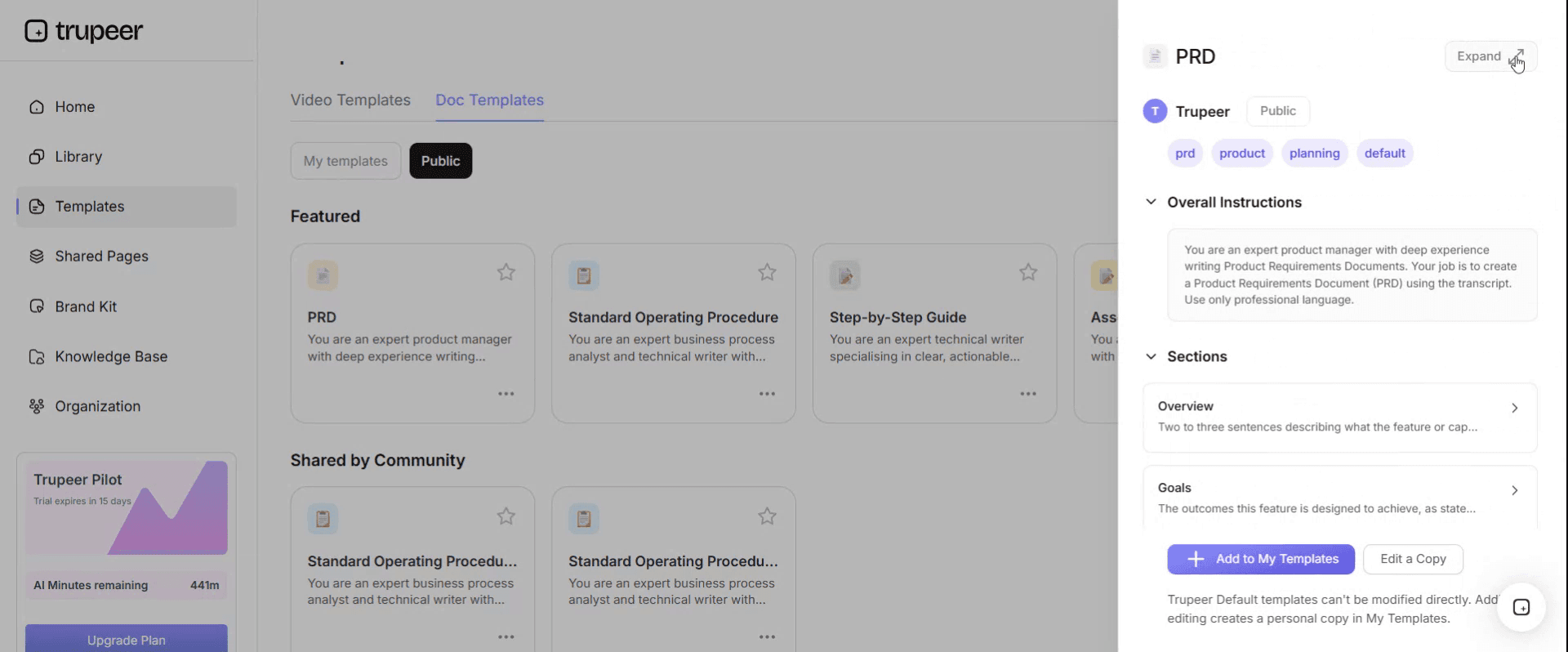
Step 4: Edit the Template
Click on Edit to start modifying the selected template.
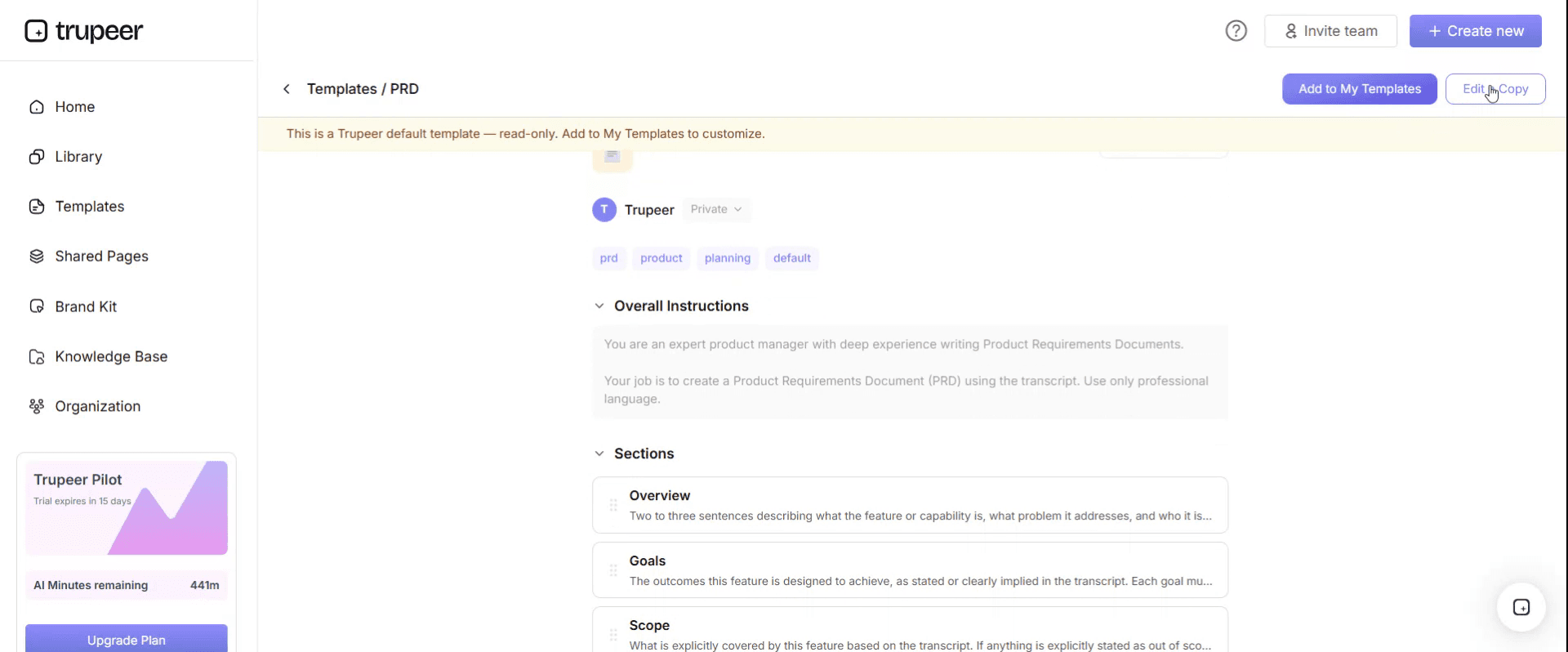
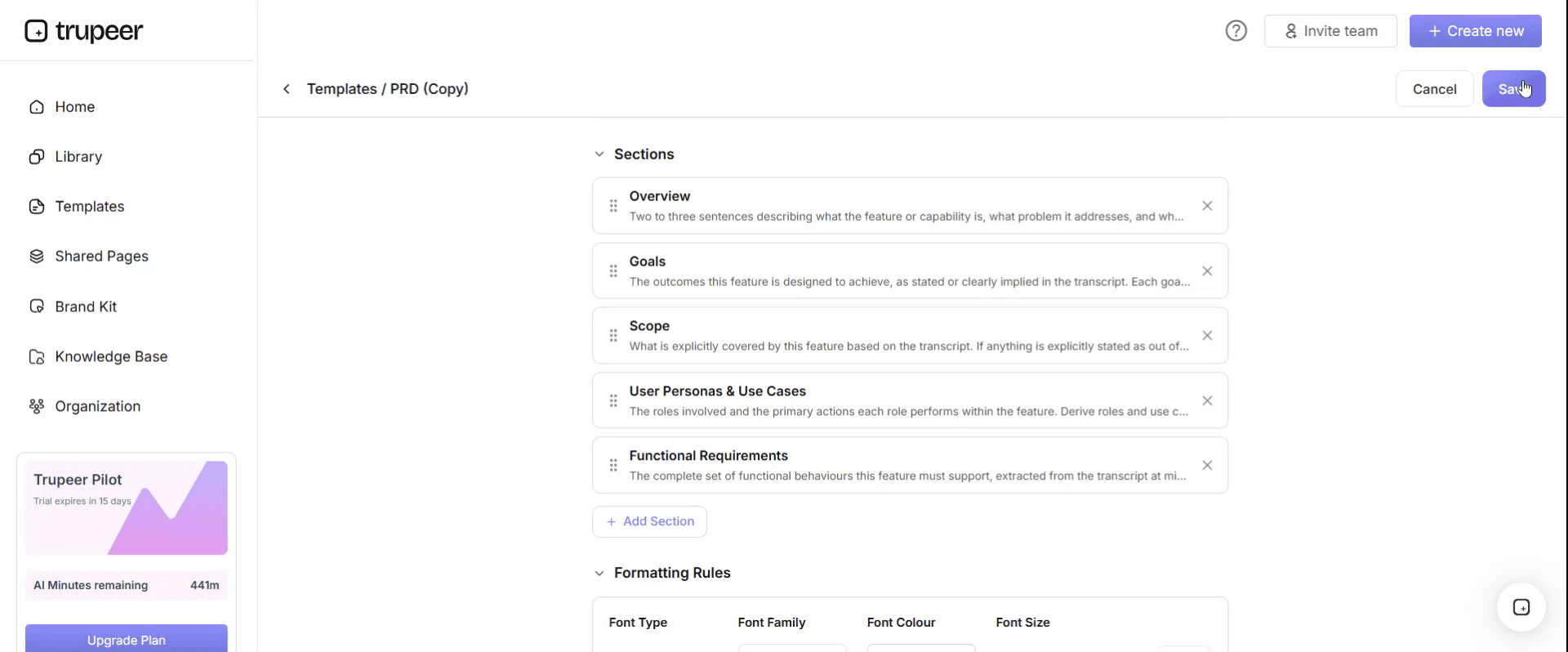
Within the editor, you can:
Add new sections
Define or update formatting rules
Add a logo and adjust its position and related settings
Step 5: Save Your Customized Template
After making all necessary changes, click Save to store the updated template as your own.
Step 6: Preview and Fine-Tune the Template
When you want to see how your customized template looks, open the Preview.
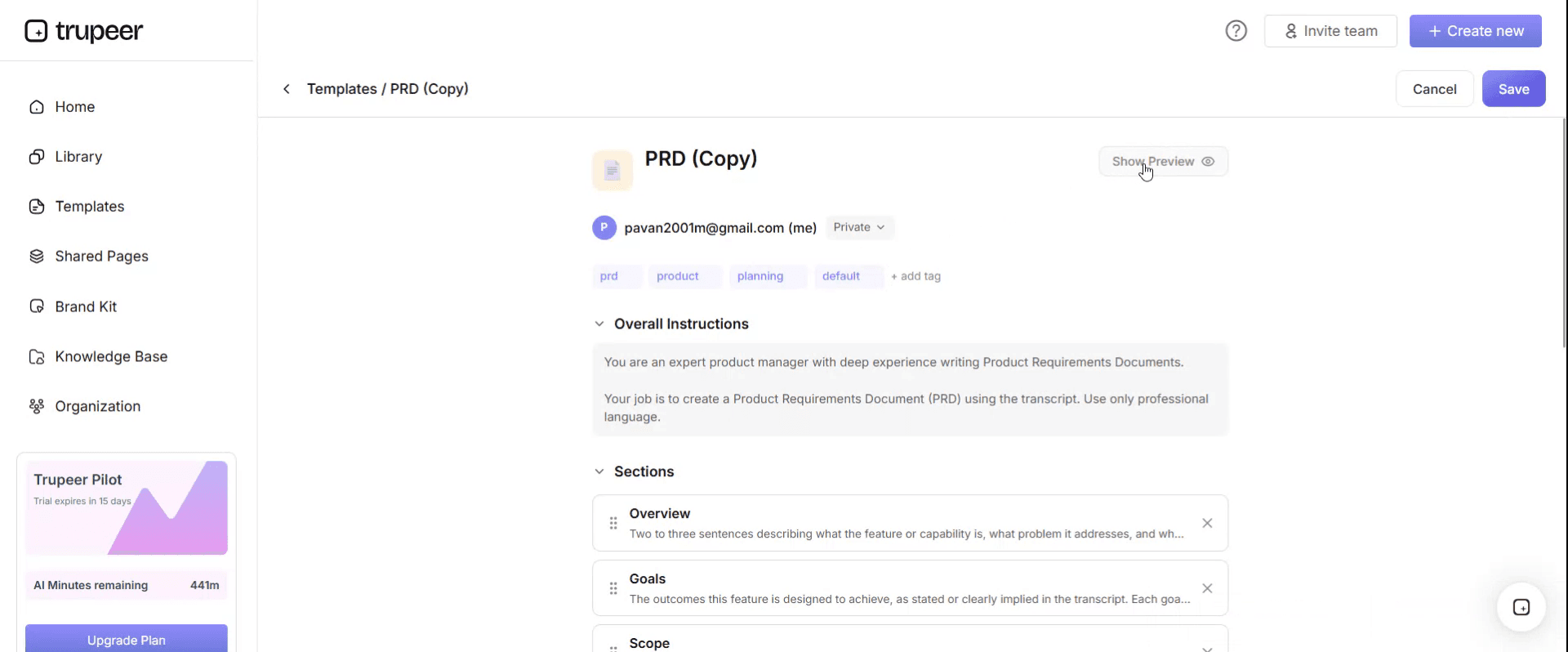
From the preview screen, you can continue to make adjustments directly if needed, ensuring the template appears exactly as you want.
With a method of procedure template you can:
Save hours on writing: Skip the blank page with a structure built for change execution.
Reduce change failures: Clear MOPs catch missing steps before they cause outages.
Stay on-brand: Apply your logo, fonts and colors using Trupeer's brand kit.
Train ops teams: Pair MOPs with video walkthroughs - perfect for change management.
Standardize change execution: Use the same MOP format for every change.
Reach global teams: Translate MOPs into 65+ languages with one click.
Why MOPs fail on time arithmetic, not on steps
Read a MOP that went wrong and the steps are usually fine. Someone competent wrote them, someone competent reviewed them, and the sequence was correct.
What is missing is arithmetic. Almost every MOP in circulation has a maintenance window, a list of steps, and a back-out section. Almost none of them has a duration against each step, and almost none has a duration for the back-out itself.
That omission matters because of one fact people rarely state plainly. The moment you can no longer safely abort is not the end of the window. It is the end of the window minus however long the rollback takes.
If your window closes at four and your rollback takes seventy five minutes, your real decision deadline is quarter to three. Every minute after that, you are committed whether you have decided to be or not, and the choice to keep going has been made by the clock rather than by a person.
Most teams discover this at about ten past three, in the middle of something that is not working.
How to calculate the rollback clock and the abort time
Three numbers, worked out before the window rather than during it.
Step durations. A realistic time against every step, taken from a rehearsal or from the last time you did it, not from an estimate. Sum them for a planned finish.
Rollback duration. How long the back-out actually takes, timed the same way. This is the number nobody has, and getting it usually means rehearsing the rollback in a lab, which is worth the afternoon it costs.
Latest abort time. Window end, minus rollback duration, minus a contingency of around twenty percent. Write it at the top of the MOP in bold, in clock time rather than elapsed time, because at three in the morning nobody is doing subtraction.
Then place go or no-go gates at the points where the decision is still live. A gate is a named step, a clock time by which you must have reached it, and an observable condition. Reached step 22 by 02:00 with all interfaces up. Not reached, or condition not met, means abort.
The gate before the point of no return is the one that matters, and it is worth marking differently from the rest. After it, rollback is no longer an option you are choosing between. It is the only thing that will fit.
Free method of procedure template: the full MOP to copy
Copy from here. Replace anything in square brackets.
Header. MOP reference and version. Title, naming the change and the equipment. Site or system. Change record number. Window start and end, in clock time with time zone. Latest abort time. Author, reviewer, approver, and the person executing, if different. Date approved.
Purpose and scope. One paragraph on what changes and what does not. Name the specific devices, circuits, databases or systems by identifier.
Impact. What is affected, for how long, and who has been told. Include the customers or internal teams who will notice, and whether the impact is expected or only possible.
Prerequisites. Access, credentials, physical presence, spares on site, software images staged and checksummed, backups taken and verified, permits or isolations in place, and the named people who must be reachable. Every item is a yes or no confirmed before the window opens.
Pre-checks. The state of the system before you touch it, captured as evidence. Command outputs, screenshots, readings, counts. Without these you cannot prove afterwards whether something was already broken.
Steps. Numbered, one action each, with the exact command or setting, the expected result, and two time columns: estimated duration and cumulative elapsed. Mark go or no-go gates and the point of no return distinctly.
Back-out plan. Full steps, not a summary, with its own durations and its own total. If the back-out has a point past which it will not work either, say so.
Post-checks and acceptance. What must be true to declare success, including anything that only becomes visible after a delay such as an overnight batch or a replication cycle.
Communications. Who is told at start, at each gate, at completion or abort, and by what route.
Sign-off. Executed by, verified by, time completed, and what actually happened including any deviation from the document.
Copy to here. The two additions most MOPs lack are the time columns and the latest abort time. Everything else you will find in any decent template.
Components of a method of procedure template
If you strip it back, a MOP is doing four jobs and each section serves one of them.
Establishing that it is safe to begin, which is prerequisites and pre-checks. Executing the change, which is the steps. Deciding whether to continue, which is the gates, the abort time and the back-out plan. And proving what happened, which is the evidence, post-checks and sign-off.
Sections that serve none of those four are usually inherited from a project template and can go. Background, business justification and stakeholder lists belong in the change record, not in the document someone is holding at two in the morning.
The one component people underrate is evidence capture. A MOP without before-and-after evidence leaves you unable to answer the question that always follows a bad night, which is whether the change caused it.
The upgrade that missed its abort point by five minutes
Padstow Networks, a regional business ISP, planned a firmware upgrade on a core switch pair. Window midnight to four. Thirty four steps, reviewed and approved, with a back-out plan describing image revert, configuration reload and verification in three lines.
Nobody had timed the back-out.
Steps one to twenty two ran clean but slowly, finishing at ten past two against an estimate of half past one. The configuration backup on a heavily loaded device took far longer than anyone expected.
The upgrade itself started at ten past two. Image load and reboot took forty minutes. At ten to three the switch came back up with two of its six line cards failing to initialise.
Seventy minutes of window remained. The back-out, when someone later timed it properly, took seventy five minutes at best. They were already five minutes past the point where a clean abort was possible and nobody in the room knew, because the number had never been calculated.
They spent thirty five minutes trying to fix forward. Reseating and reloading did not bring the cards up. Rollback began at twenty five past three and took a hundred and five minutes rather than seventy five, because the line cards needed physical attention on the way back as well.
Service was restored at ten past five, seventy minutes past the end of the window and into the start of the business day for about four thousand customers. SLA credits came to roughly thirty eight thousand pounds, and the outage was reportable under their licence obligations.
The post-incident review did not find a bad MOP. The steps were right. What it found was a document with a four hour window, no step durations, and a back-out plan that had never once been executed end to end with a stopwatch running.
Every MOP since carries a time column and a latest abort time in the header, and any MOP with a back-out that has not been rehearsed does not get approved. Across the next fourteen major changes, three were aborted at the computed gate. All three finished inside the window and none of them became an incident.
Aborting three times out of fourteen sounds like a poor record until you compare it with what one overrun cost.
How to write a method of procedure, step by step
Start from the change record, not from a blank page. Everything in the header should already exist somewhere.
Write the back-out plan before the steps. Doing it in that order forces you to know what you are undoing, and it stops the back-out becoming an afterthought written at the end when you are tired of the document.
Rehearse both in a lab or on a like-for-like device, with a timer. This is the step teams skip and it is where the durations come from. If a lab is genuinely impossible, use the last execution's actual times and add a margin.
Compute the latest abort time and put it in the header.
Place gates at the points where a decision is still available, and phrase each condition so it is observable rather than felt. All interfaces up and error counters static is a condition. Looks healthy is not.
Then hand it to someone who was not involved and ask them to walk it. Every question they ask is a defect, and it is much cheaper to find them now than at two in the morning.
Method statements, RAMS and construction MOPs
In construction and facilities work, particularly in the UK, the same document is usually called a method statement and is paired with a risk assessment as a RAMS pack. The purpose overlaps heavily, with one important difference of emphasis.
A network MOP is mostly concerned with service continuity: what breaks, for how long, and how you get back. A method statement is mostly concerned with people: the sequence of work, the hazards at each stage, the controls, the plant and the competencies required. Both name specific work at a specific place on a specific date.
If your work involves both, which is common for data centre power work or any change involving physical access, you will need both documents and they need to agree with each other on sequence and timing. Our construction site work instruction template covers the site-facing side.
The time arithmetic in this page applies to method statements too, and is more often missing there, because a permit or isolation frequently has a hard end that behaves exactly like a maintenance window.
MOP use cases across telecoms, data centres and utilities
Telecommunications is where the term originated and where MOPs are most formalised. Firmware and software upgrades, circuit migrations, card replacements, routing changes, anything touching a live network element.
Data centres use them for power work, cooling changes, UPS and generator testing, and physical moves. These carry the highest consequence of the three, because a mistake removes several customers' systems at once and rollback may be physical.
Utilities use them for switching operations and for work on live distribution, where they interlock with permit to work systems and the MOP cannot begin until an isolation is confirmed.
Beyond infrastructure, the same document is useful for any high-consequence single-execution change: a database migration, an ERP cutover, a payment provider switch. The pattern holds wherever the thing is running, the window is fixed and the back-out has a cost.
Where the change is significant enough to need people trained beforehand, pair the MOP with the standing procedure it is derived from and with a short job aid for the steps most often got wrong.
Can I get a method of procedure template in Word or Excel?
Excel suits the steps table, and the reason is the time columns. You want estimated duration and cumulative elapsed calculating themselves, a rollback total, and a cell computing the latest abort time from the window end. Doing that arithmetic by hand is exactly what does not happen when the MOP is written on a Friday afternoon.
Word suits the surrounding document: purpose, impact, prerequisites, communications and sign-off. Plenty of organisations use both, with the step table embedded or attached.
PDF is right for the approved version issued for execution, because you want the copy in the field frozen and stamped with its version. Print it. A MOP that exists only on a laptop is a MOP you cannot read when the thing you are changing is the network.
Policy and procedure templates for healthcare, and why this is not one
Some people arrive at this term looking for healthcare policy and procedure templates, and it is worth saying plainly that this is not that document.
A healthcare policy and procedure describes standing clinical or operational practice, is governed by accreditation and regulatory requirements, needs clinical review and version control against those standards, and is maintained indefinitely. A MOP is a single-use engineering document for one change on one night.
The confusion is understandable, since both contain the word procedure, and the structure here will not serve you if what you need is a clinical policy. Those requirements vary by jurisdiction and accrediting body, and they should come from your own governance function rather than from a general template.
More broadly, nothing on this page is safety or compliance advice. Where the work involves electrical isolation, permits to work, licensed activity or regulated infrastructure, the MOP sits underneath those systems rather than replacing them, and your existing safety process governs.
How to make the MOP match what was actually done
Two gaps open up around every MOP. The written steps drift from how the work is really performed, because the author is recalling rather than watching. And the record of what actually happened on the night is thinner than anyone intends, because at four in the morning people write "completed as per MOP" whether or not that is true.
Trupeer AI helps with both. Record the lab rehearsal once and the output is a formatted step list with the commands and screens already captured, which becomes the draft MOP rather than something you write from memory afterwards. The durations come from the recording too.
Record it. Brand it. Translate it. Trupeer it.
For the standing procedure the MOP derives from, the SOP creator covers it, and technical documentation keeps the equipment records and the procedures in one place so the next MOP starts from something accurate. Setup instructions are in the document template setup guide.
Frequently Asked Questions
Is there a free method of procedure template in Word?
The full structure above pastes straight into Word and covers header, purpose, impact, prerequisites, pre-checks, steps, back-out, post-checks, communications and sign-off. There is no gated download and no form. Most teams end up with the narrative in Word and the step table in a spreadsheet, because the time columns want formulas.
Is there a free method of procedure template in Excel?
Excel is the better home for the part that matters. Columns for step number, action, expected result, estimated duration and cumulative elapsed, with a second block for the back-out and its total, and a cell computing latest abort time from the window end minus rollback minus contingency. That single computed cell is the most useful thing in the document.
Is there a free method of procedure template in PDF?
Export and print the approved version for the window. A MOP is one of the few documents where paper is genuinely better, since the change you are making may be the thing your laptop depends on to reach the file. Stamp the version and the abort time on every page.
Is there a simple procedure template for smaller changes?
For low-risk repeated changes, use a standing procedure rather than a MOP, and keep it to a page. The test for whether you can drop to the simple version is whether a failure is recoverable the next working day without anyone outside the team noticing. If yes, an SOP is enough. If no, write the MOP.
What is the difference between a MOP and a method statement?
Largely regional and emphasis. Method of procedure is the term used in telecoms, data centres and North American engineering generally, and it focuses on service continuity and back-out. Method statement is the UK construction and facilities term, usually paired with a risk assessment, and it focuses on the safety of the people doing the work. The documents overlap substantially and some work needs both.
Who approves a method of procedure?
Whoever owns the service being changed, plus whoever owns the risk, which in most organisations means a change advisory board or a nominated change manager. The approver's job is not to re-check the steps. It is to confirm the impact is understood, the back-out is credible and timed, and the window is right.
How long should a MOP be?
As long as the change requires, with one constraint that keeps it honest: the executable part must be readable in sequence under pressure without hunting. That usually means the steps and the back-out fit within a few pages and everything else sits before them. If the step list runs past about fifty, consider whether it is two changes on two nights.
Where can I find SOP templates instead?
If what you need is a standing procedure rather than a single-use change document, our SOP template covers the general structure and the IT SOP template covers technical operations specifically, including how to decide which procedures are worth writing at all.


