Use this template
Clear construction site work instructions reduce defects, accelerate work and protect every worker on the site. With Trupeer, you can save hours on field documentation by starting with a free construction site work instruction template, customizing it with your brand guidelines, and turning instructions into video walkthroughs trades can watch on a phone right at the work area.
On site, a work instruction has to survive being read at seven in the morning, outdoors, by a gang that may be new this week, possibly in their second language, before a task that could hurt someone.
That is a harder document to write than a manufacturing procedure, and most templates for it are manufacturing procedures with the word construction swapped in. This one is built for the site: sequence, hazards, controls, permits, hold points, and a sign-on sheet the supervisor can actually use at the briefing.
Which construction document do you actually need?
Worth thirty seconds, because two very different documents share this name.
You need to... | Document | Who issues it |
|---|---|---|
Tell operatives how to carry out a task safely and correctly | Work instruction or task instruction | Contractor, supervisor or engineer |
Set out the method and risk controls for a work package | Method statement, RAMS or SWMS | Contractor, before work starts |
Instruct the contractor formally under the contract | Site instruction, architect's or engineer's instruction | Client representative, CA or engineer |
Confirm an instruction that was given verbally on site | Confirmation of Verbal Instruction (CVI) | Contractor, back to the CA |
Record work done on a time and materials basis | Daywork sheet | Contractor |
Instruct a change to scope, cost or programme | Variation or change order | Client representative |
This page covers the first one. Site instructions, CVIs and variations are covered further down, since they turn up under the same search and get confused constantly.
How to customize this template in Trupeer
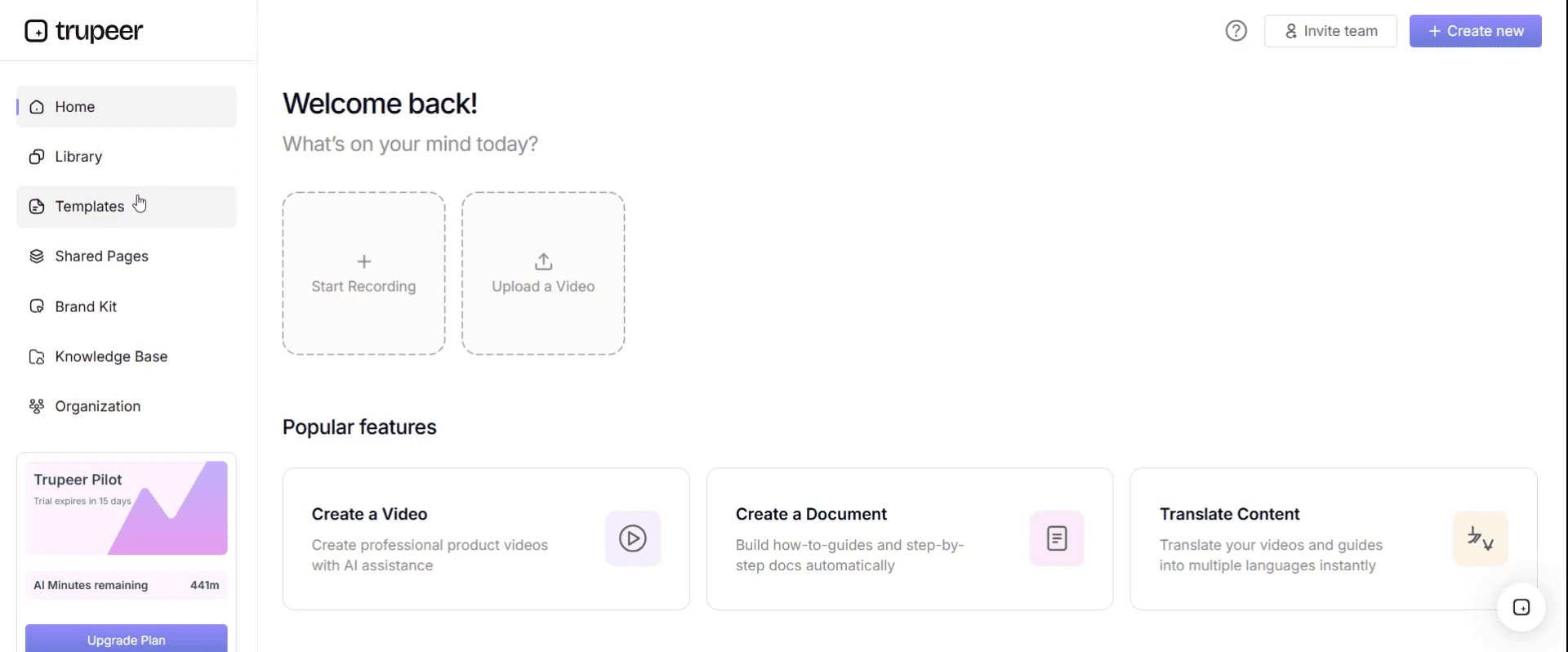
Step 1: Open the Templates Section
Go to the Templates section from the main navigation.
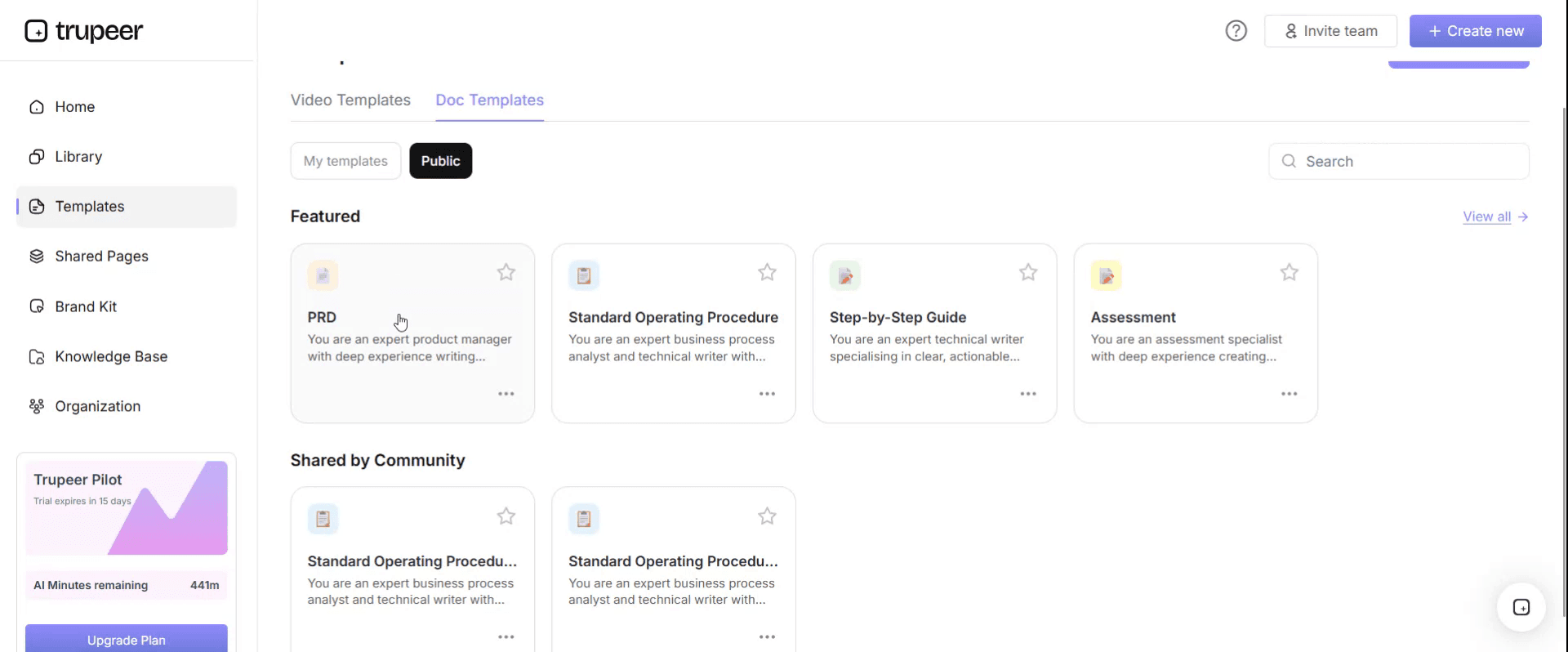
Step 2: Select and Open a Template
Click on any template you want to work with to open it.
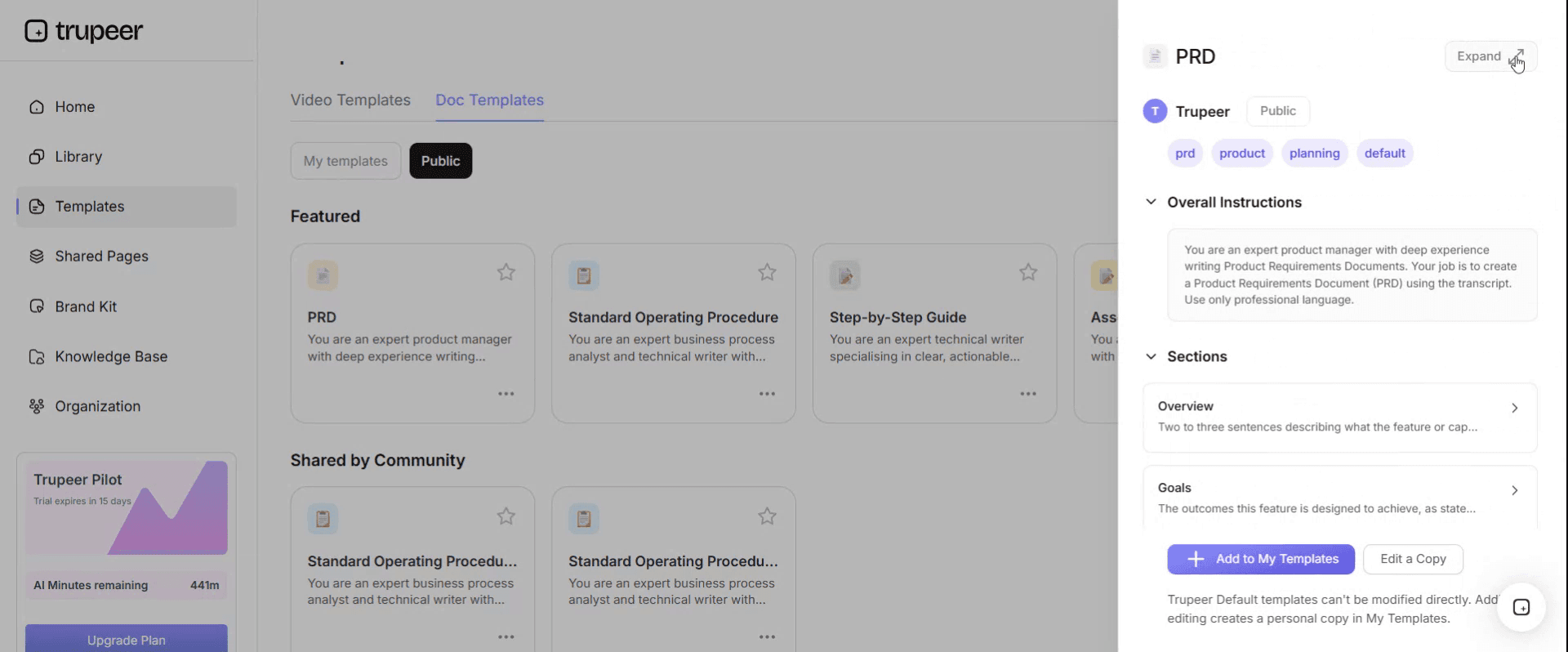
Step 3: Expand the Template View
If needed, expand the template view to see the full layout and details clearly.
Step 4: Edit the Template
Click on Edit to start modifying the selected template.
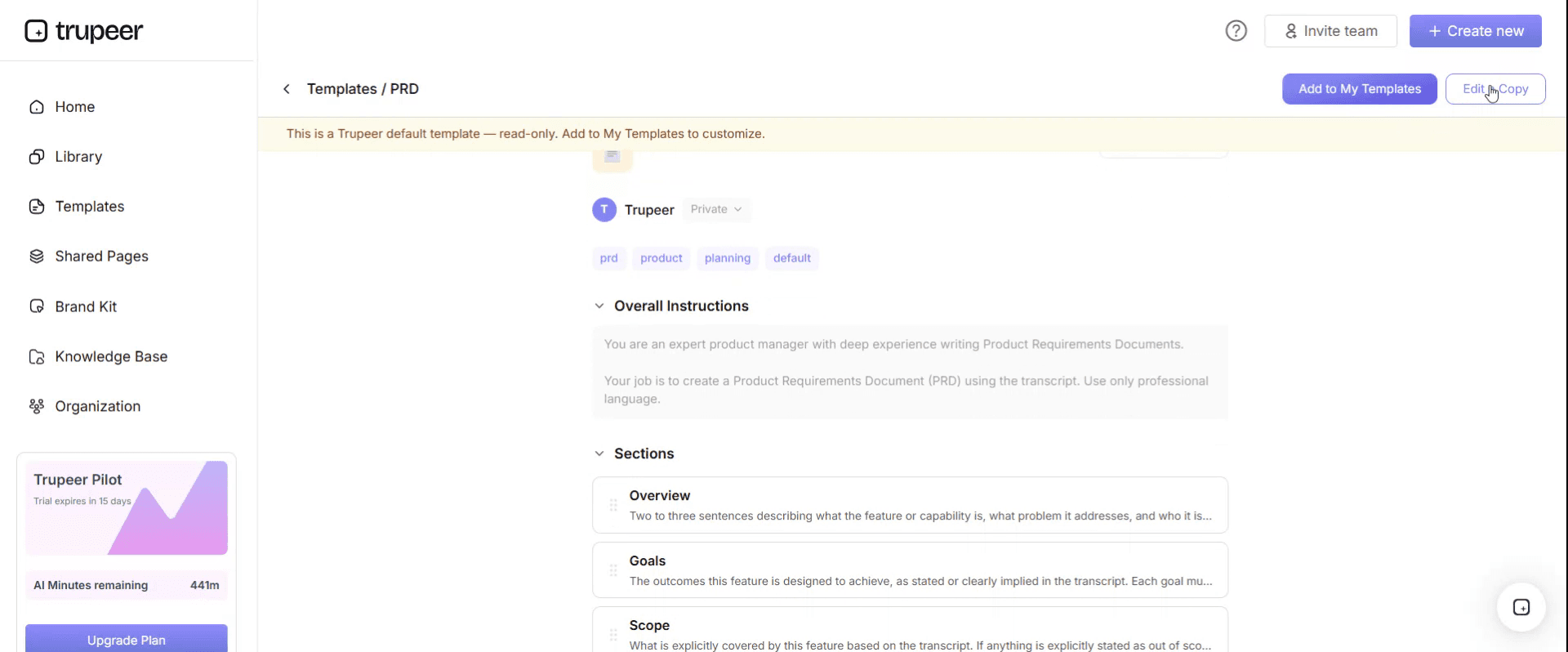
Within the editor, you can:
Add new sections
Define or update formatting rules
Add a logo and adjust its position and related settings
Step 5: Save Your Customized Template
After making all necessary changes, click Save to store the updated template as your own.
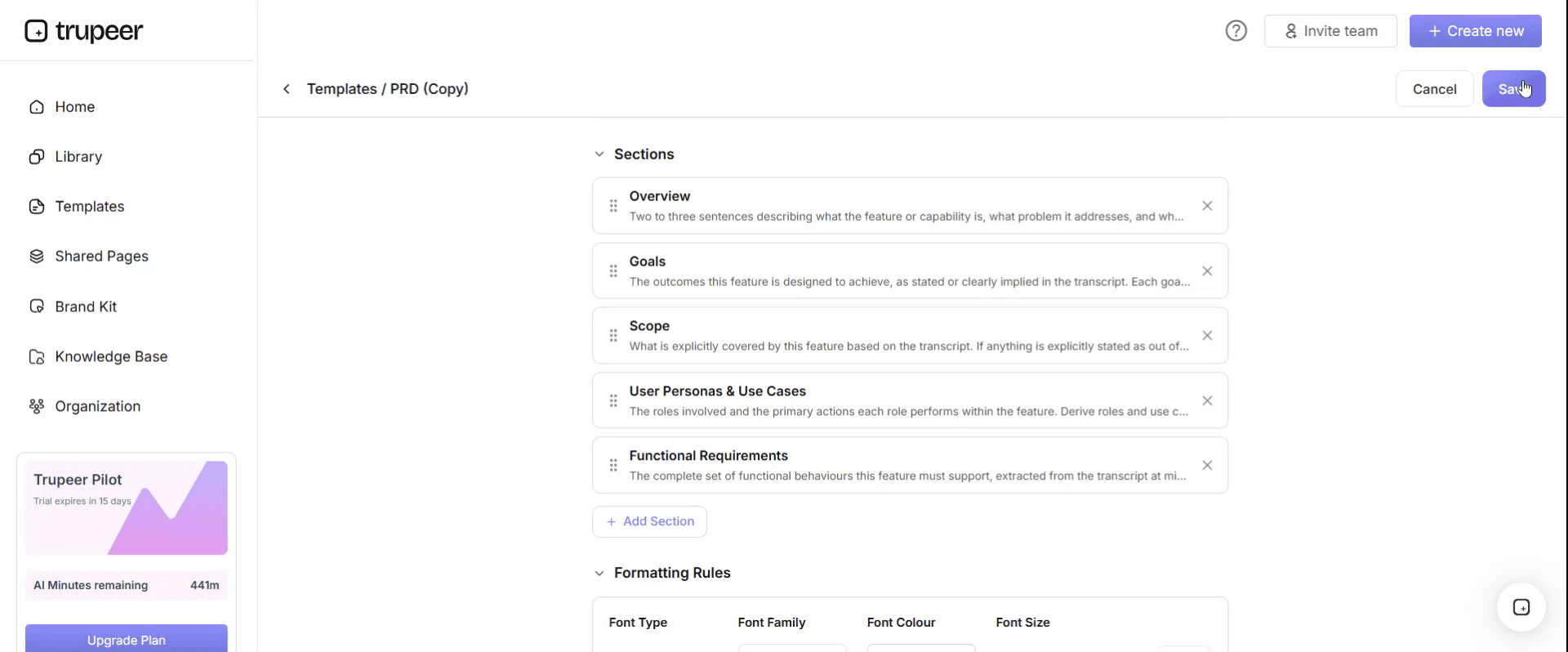
Step 6: Preview and Fine-Tune the Template
When you want to see how your customized template looks, open the Preview.
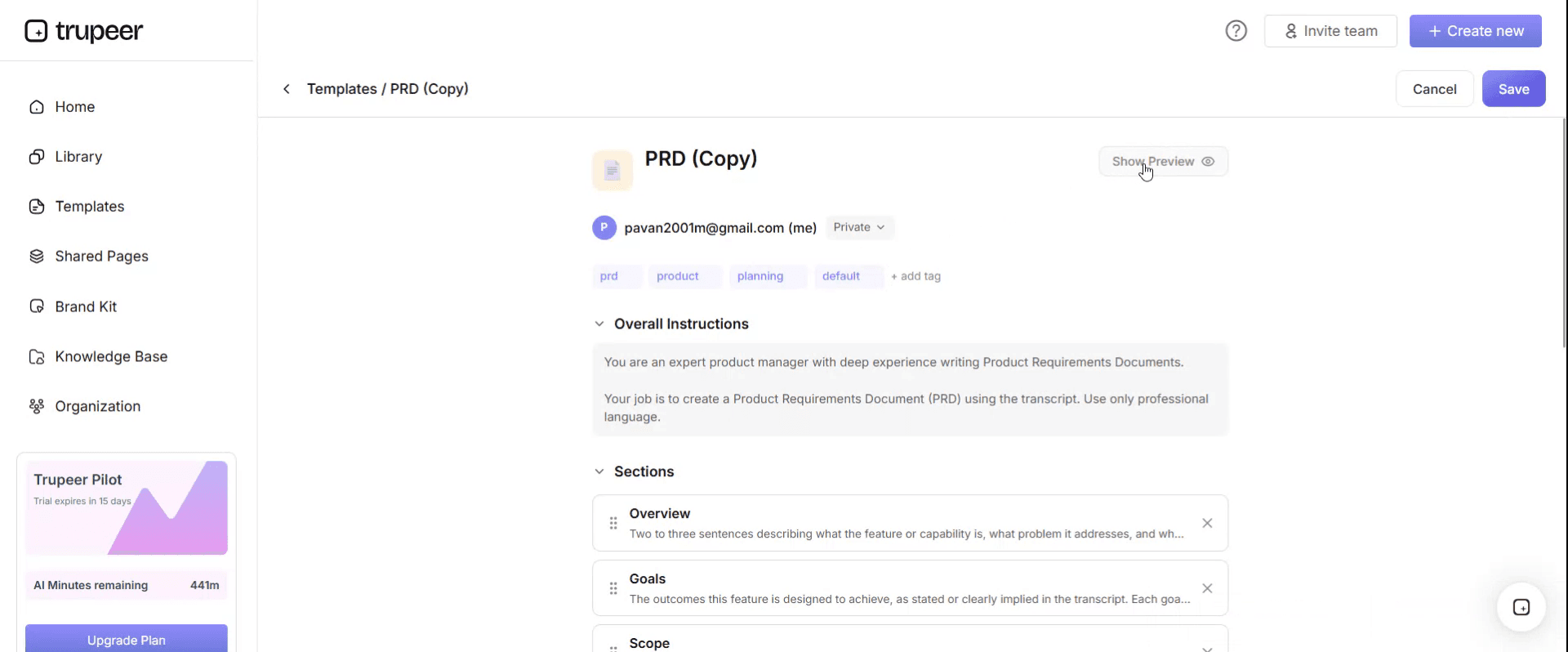
From the preview screen, you can continue to make adjustments directly if needed, ensuring the template appears exactly as you want.
With a construction site work instruction template you can:
Save hours on documentation: Skip the blank page with a structure built for construction tasks.
Improve site safety: Built-in safety and PPE sections protect every worker.
Stay on-brand: Apply your logo, fonts and colors using Trupeer's brand kit.
Train crews fast: Pair instructions with video walkthroughs accessible on mobile.
Standardize across sites: Use the same template across every project and crew.
Reach multilingual crews: Translate work instructions into 65+ languages with one click.
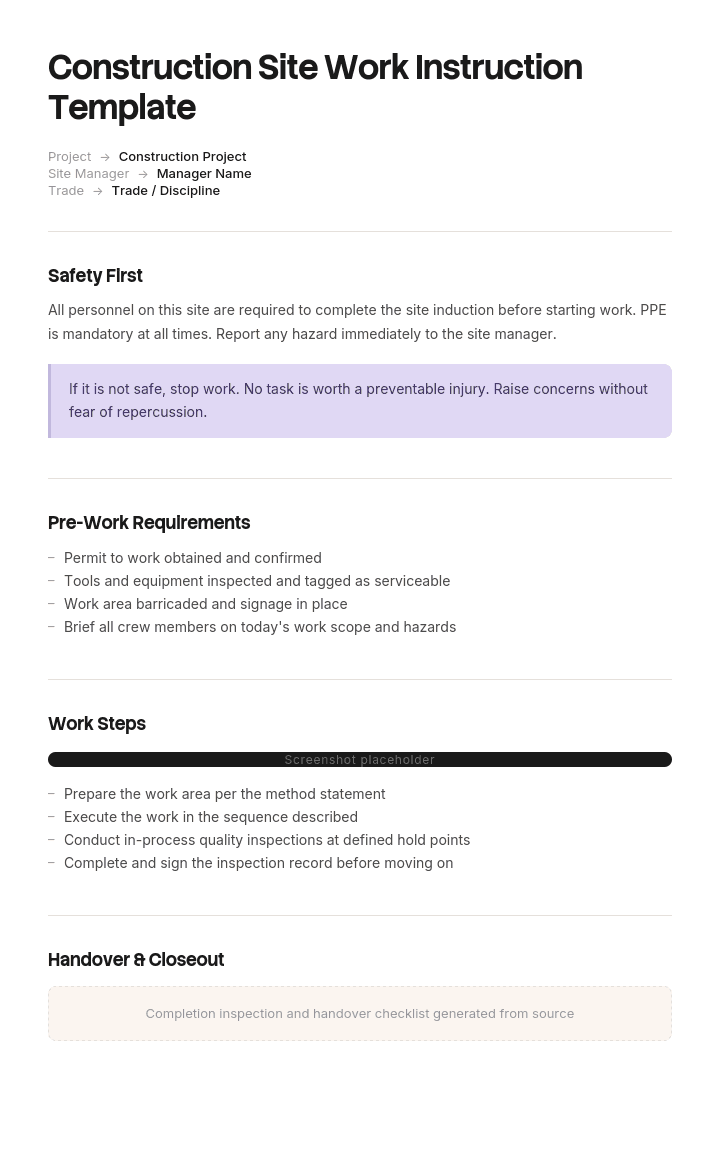
The construction work instruction template
Header block, completed once per task
Field | Enter |
|---|---|
Document number and revision | WI-CON-021, Rev B |
Task | Install precast stair flight, cores 2 and 3 |
Project and location | [Project], Block A, levels 3 to 5 |
Issued by and date | Name, role, date |
Approved by | Site manager or engineer |
Applies to | Which trade, gang or subcontractor |
Related RAMS or method statement | Reference number |
Permits required | Hot works, confined space, lifting, excavation |
PPE required | Beyond site minimum |
Plant and equipment | Including inspection or certification status |
Competency required | Cards, tickets, authorisations |
Duration and hold points | Where work must stop for inspection or sign-off |
Step block, repeated per step
Element | Enter |
|---|---|
Step number | 4 of 9 |
Action | One action, plain language |
Who | Which role performs it |
Hazards at this step | Specific to the step, not general |
Controls | What must be in place before it starts |
Check | What confirms it was done correctly |
Photo or sketch | Where orientation, position or sequence matters |
Hold point | Stop and get sign-off before proceeding |
Footer block: emergency arrangements, what to do if conditions change, supervisor contact, and the briefing sign-on sheet.
The task briefing and sign-on sheet
The part that distinguishes a construction work instruction from a manufacturing one. The document is not the control. The briefing is, and the sheet is the evidence.
Field | Enter |
|---|---|
Task and document reference | WI-CON-021 Rev B |
Date and shift | |
Briefed by | Name and role |
Weather and site conditions at briefing | Relevant to most external tasks |
Changes since last briefing | The field that catches drift |
Name | Printed |
Company or gang | Principal contractor or subcontractor |
Competency verified | Card or ticket checked |
Signature | |
Time |
Two things make this sheet work. Everyone who touches the task signs, including operatives who join partway through a shift. And the changes-since-last-briefing line forces the supervisor to actively consider whether anything is different today, which is where most incidents originate.
Filled-in construction work instruction example
WI-CON-021 Rev B · Install precast stair flight, cores 2 and 3 · Block A levels 3 to 5
Issued by: Site engineer · Approved: Site manager · Applies to: Steel erection gang, 4 operatives plus banksman
Related RAMS: RAMS-014 Precast installation · Permits: Lifting permit, daily
PPE: Site minimum plus gloves rated for handling, harness and twin lanyard at leading edge
Plant: 50t mobile crane, inspection cert in date to [date]. Chains and shackles, colour code current quarter.
Competency: CPCS slinger signaller for banksman. Working at height for all. Toolbox talk on precast handling within last 3 months.
# | Action | Who | Hazards | Controls | Check |
|---|---|---|---|---|---|
1 | Confirm exclusion zone set and signed, no access beneath the lift | Banksman | Persons struck by falling load | Barriers to marked line, signage, gate marshal posted | Walk the perimeter, confirm visually |
2 | Verify lifting permit issued for today and crane inspection in date | Supervisor | Plant failure | Permit signed, cert checked | Both physically present on site |
3 | Inspect chains, shackles and lifting eyes on the unit | Slinger | Lifting gear failure | Correct colour code, no visible damage, SWL exceeds unit weight | Recorded on lift log |
4 | Attach lifting points to cast-in sockets, all four | Slinger | Load instability | All four engaged, threads fully taken up | Visual on each, confirmed aloud to banksman |
5 | Hold point. Supervisor confirms landing area prepared, bearing pads set and level | Supervisor | Unstable landing | Pads positioned per drawing, levels checked | Stop. Sign-off required before lift |
6 | Lift and position under banksman direction only | Crane op and banksman | Struck by load, crush | One banksman, radio confirmed, nobody under load | Radio check before lift |
7 | Guide unit to bearing using tag lines, no hands on the unit | Erectors | Crush injury to hands | Tag lines only until unit is within 300mm and stationary | Supervisor observes |
8 | Land, confirm full bearing on both pads before releasing | Erectors | Unit displacement | Bearing confirmed both ends, unit stable | Visual and physical check |
9 | Release lifting gear and install temporary propping before anyone works on or under the flight | Erectors | Collapse | Props installed per drawing before access permitted | Hold point. Engineer sign-off |
If conditions change. Stop work and re-brief if wind exceeds the crane's stated limit, if visibility drops, if the banksman changes, or if the landing detail differs from the drawing. Do not proceed on a verbal assurance that it is fine.
Emergency. First aider on level 2. Rescue plan for work at height is in RAMS-014 section 8. Site emergency number on the back of your card.
A note on this example. It is written to show the level of detail a site instruction needs, not to be used as-is. Lifting operations, work at height and precast installation are high-risk activities governed by regulation in every jurisdiction, and any real instruction must be produced by a competent person against the actual design, the actual plant and the actual site conditions.
What a construction work instruction must contain
The task, stated specifically enough that it cannot be confused with a similar one elsewhere on site.
The trade or gang it applies to.
A link to the governing RAMS or method statement, not a replacement for it.
Permits required, named.
PPE beyond the site minimum, since listing the minimum trains people to skim.
Plant and equipment, with inspection or certification status.
Competency and card requirements.
Steps in sequence, one action each, in plain language.
Hazards at the step where they occur, not collected in a general list at the front.
Controls that must be in place before each step starts.
Hold points where work stops for inspection.
What to do if conditions change.
Emergency arrangements.
The briefing sign-on sheet.
Hazards and controls, step by step
The single most common weakness in construction task documents is a hazard list at the front and a method at the back, with no connection between them.
Put the hazard where it happens. An operative reading step seven needs to know what can hurt them at step seven, not to remember a list from page one. Pair each hazard with the control that must already be in place, phrased as a precondition rather than an intention. "Exclusion zone barriered to the marked line" can be verified. "Ensure area is safe" cannot.
Keep the general hazards in the RAMS. The work instruction carries the ones specific to this task.
Permits and hold points
Permits. Name them in the header, and make step one or two a check that the permit exists and is valid today. Permits assumed rather than verified are a recurring finding in incident reports.
Hold points. A step where work stops until someone competent inspects and signs. Mark them clearly in the step list, in bold, with the name of the role that signs.
The rule that makes hold points work: nobody proceeds past one on a verbal assurance. If the instruction says the engineer signs, a text message saying it looks fine is not the sign-off. Sites where this rule is soft are sites where the hold point exists on paper only.
Competency and authorisation
State what is required to perform this task, not what is required to be on site.
Cards and tickets by name. Any task-specific authorisation, such as an appointed person for lifting operations. Whether a toolbox talk or specific training is a prerequisite and how recent it must be.
Then verify at the briefing rather than assuming. The sign-on sheet has a competency-verified column for exactly this, and it takes the supervisor ten seconds per person.
When the task changes mid-shift
The most dangerous moment on any site, and the one most work instructions ignore entirely.
Write the trigger conditions explicitly. Weather thresholds, a change of plant, a change of personnel in a safety-critical role, ground conditions differing from the survey, a design detail not matching the drawing, or the sequence being altered to suit programme pressure.
Then state the response: stop, re-brief, and re-sign. Not stop and think about it. The re-brief is what makes the change visible to everyone rather than to the one person who noticed.
Programme pressure is the honest reason this gets skipped, and a supervisor who is empowered to stop is worth more than any document.
Site instructions, CVIs and variations
Different documents entirely, and they turn up under the same search often enough to be worth explaining.
A site instruction, sometimes called an architect's instruction or engineer's instruction, is a formal direction issued by the client's representative to the contractor under the terms of the contract. It might instruct a change to the works, clarify a design point, or direct that something be remedied. It usually has cost and programme implications, which is why it is written rather than spoken.
A Confirmation of Verbal Instruction is what the contractor issues back when an instruction was given verbally on site. It records what was said, by whom and when, and gives the recipient a defined period to dispute it. Without CVIs, verbal instructions become disputed claims months later, which is the single most common cause of construction payment disputes.
A variation or change order is the formal change to scope, cost or programme arising from an instruction.
A daywork sheet records labour, plant and materials on a time and materials basis, signed on site, usually where the work falls outside the contract rates.
These are contract administration documents. They serve a different purpose from a work instruction and should never be combined into the same form. If you need those, the method of procedure template and your contract's own forms are the right starting point, and the contract terms determine the format.
Language and literacy on site
Construction has one of the most linguistically mixed workforces of any sector, and safety-critical instructions written only in the site's dominant language are a genuine risk rather than an inconvenience.
Keep sentences short and use plain words. "Do not stand under the load" beats "personnel shall not position themselves beneath suspended loads".
Use a photograph or sketch at any step where position, orientation or sequence matters. Images cross language barriers that text does not.
Translate for the languages actually spoken by the gang, not the ones you assume.
Brief verbally as well as issuing the document, and ask someone to explain the hazard back to you rather than asking whether they understood. People will say yes.
Watch for operatives who nod through a briefing and then follow whoever seems to know what they are doing.
This is also where a short recorded walkthrough earns its place, since watching a task removes the ambiguity that written instructions carry in any language.
Digital or paper on site
Paper still dominates on site and there are real reasons for it.
Paper works because a laminated sheet functions in rain, in gloves, in low signal, with no battery. Its cost is version control. A superseded revision in a site cabin or a van is an active hazard, not just an inconvenience.
Digital works for revision control, for distributing an updated instruction to every gang within minutes, for capturing sign-on with a timestamp, and for embedding photos and video. Its cost is devices, signal and the habit change.
Most sites end up hybrid: digital as the controlled master, printed copies at the workface with a printed-on date and revision number so an out-of-date sheet is visible at a glance. Print the revision in large type on the front page. Small revision numbers in a footer are not read.
Work instruction, method statement, RAMS, SWMS and JSA
Document | What it covers | Scope | Typical region |
|---|---|---|---|
Work instruction | How to perform one task correctly and safely | One task | Universal |
Method statement | How a work package will be carried out | A package of work | UK, Ireland |
RAMS | Risk assessment and method statement combined | A package of work | UK, Ireland |
SWMS | Safe work method statement, required for high-risk work | A high-risk activity | Australia |
JSA or JHA | Job safety or hazard analysis, breaking a task into steps and hazards | One task | US, Canada |
Toolbox talk | Short briefing on one topic | A topic, not a task | Universal |
Permit to work | Authorisation for a specific high-risk activity | One activity, time limited | Universal |
The relationship: the RAMS or method statement governs the work package and is usually what the principal contractor accepts before work starts. The work instruction sits underneath it, covering one task in enough detail to be briefed and followed. The permit authorises a specific high-risk activity within it.
A work instruction does not replace a RAMS or SWMS, and should reference it rather than duplicate it. Duplicated safety content drifts apart between revisions, which is worse than having it in one place.
How to write a construction work instruction
Start from the RAMS or method statement. The work instruction implements it at task level and must not contradict it.
Watch the task being done, or walk it with the supervisor. Documents written from a desk miss the sequence the gang actually uses.
Break it into single actions in plain language. One verb, one role.
Put hazards and controls at the step where they occur.
Mark hold points explicitly and name who signs.
Add photographs at every step where position or orientation matters.
State the change conditions and the stop rule.
Get it approved by a competent person. This is a safety document, not a productivity one.
Brief it and have it signed on to. The document is not the control, the briefing is.
Re-issue it as a new revision when anything changes, and withdraw the old one from the workface.
Review and version control
Review on any design change, any change of plant or method, after any incident or near miss on the task, when a new subcontractor takes it over, and at defined intervals for long-running works.
Version control on site is not administrative tidiness. It is the difference between a gang working to the current sequence and a gang working to last month's. Print the revision large, date the printed copy, and make withdrawing superseded copies someone's named job rather than a general expectation.
Best practices
Reference the RAMS, never duplicate it.
Hazards at the step, not in a list at the front.
Plain language and short sentences.
A photograph at every step where orientation matters.
Hold points in bold, with the signing role named.
Sign-on sheet completed at the briefing, including late joiners.
Ask people to explain the hazard back rather than asking if they understood.
Translate for the languages actually on site.
Revision number printed large on the front page.
One named person responsible for withdrawing superseded copies.
Common mistakes
A manufacturing template with construction wording, missing permits, briefings and sign-on entirely.
Hazards listed at the front and never connected to the steps.
Duplicating the RAMS, so the two drift apart at the next revision.
Vague controls that cannot be verified.
Hold points with no named signatory, so they get waved through.
No stop rule for changed conditions.
Written from the drawing rather than from the workface.
English only on a multilingual site.
Superseded revisions left in cabins and vans.
No sign-on record, so there is no evidence the briefing happened.
Confusing a work instruction with a site instruction, and putting contractual content in a safety document.
Brief the task once, and let every gang watch it
Open the template in Trupeer AI, apply your brand kit so documents match your site documentation standards, and edit any section directly. Setup is in the template guide.
The weakness of any written site instruction is that a sequence described in words is more ambiguous than a sequence watched, and the audience is often reading in a second language under time pressure.
Record the task walkthrough once and Trupeer AI produces the written instruction and a narrated video walkthrough from the same pass, so the gang can watch the sequence at the briefing rather than only hear it described. Translate it into 65+ languages, which on a construction site is a safety measure rather than a convenience. Keep the current revision in your knowledge base so there is one master, and reuse the same recordings for induction and training when a new subcontractor comes on.
Record it. Brand it. Translate it. Trupeer it.
Frequently Asked Questions
Is there a free construction site work instruction template in Word?
Yes. Word is the primary format, with the header block, step table, hold points and sign-on sheet built in. Free download, no sign-up, no watermark.
Can I download a free construction work instruction template in Word?
Yes. Every format is a free download with no account required, reusable across as many tasks and projects as you need.
Is there a construction work instruction template in Word doc format?
Yes, a .doc version is included alongside .docx for older systems and site document libraries.
Is there a free construction site work instruction template in PDF?
Yes, and two versions: a printable one formatted for a laminated sheet at the workface, and a fillable one where the sign-on sheet can be completed on a device.
Is there a free construction work instruction template in Excel?
Yes. Excel suits the step register and works well where one document covers several related tasks, or where you want to filter by trade, permit or hold point across a package of work.
Where can I download a work instruction template in Word for free?
On this page, and for other sectors on the work instructions templates hub, which covers assembly, manufacturing, safety, project and visual versions. All free.
What is a construction work instruction?
A document setting out how a specific task on site is to be carried out: the sequence, who does what, the hazards at each step, the controls that must be in place, permits required, hold points, and what to do if conditions change. It sits beneath the RAMS or method statement and is briefed to the gang before work starts.
What should a construction work instruction include?
Document number and revision, the task and location, the trade it applies to, the governing RAMS reference, permits, PPE beyond the site minimum, plant with certification status, competency requirements, numbered steps with hazards and controls at each, hold points with named signatories, change and stop conditions, emergency arrangements and a briefing sign-on sheet.
What is the difference between a work instruction and a method statement?
A method statement covers how a whole work package will be carried out and is usually accepted by the principal contractor before work starts. A work instruction covers one task within that package in enough detail to be briefed and followed by the gang. The work instruction should reference the method statement rather than repeat it.
What is the difference between RAMS and a work instruction?
RAMS combines the risk assessment and method statement for a work package, and is a formal document usually required before work commences. A work instruction is the task-level document derived from it. RAMS answers whether the work can proceed safely. The work instruction tells the operative what to do at step four.
What is the difference between a work instruction and a site instruction?
Entirely different documents. A work instruction tells operatives how to carry out a task. A site instruction is a formal contractual direction from the client's representative to the contractor, often carrying cost and programme implications. Confusing them puts contractual content into a safety document, which serves neither purpose.
What is a Confirmation of Verbal Instruction?
A CVI is issued by the contractor to record an instruction that was given verbally on site, stating what was said, by whom and when, and giving the recipient a period to dispute it. It exists because verbal instructions otherwise become disputed claims months later, and it is a contract administration document rather than a safety one.
Who writes and approves construction work instructions?
Drafted by the site engineer, supervisor or the subcontractor's own competent person, and approved by someone competent in the work and its risks, typically the site manager or a qualified engineer. This is a safety-critical document, so approval should sit with someone accountable for the safety of the task rather than for the programme.
How do you brief a work instruction on site?
Walk the gang through it before the shift, at or near the workface where practical. Cover the sequence, the hazards, the controls, the hold points and what triggers a stop. Ask individuals to explain a hazard back to you rather than asking whether everyone understood. Record every attendee on the sign-on sheet, including anyone joining later in the shift.
How often should construction work instructions be reviewed?
On any design change, any change of plant or method, after any incident or near miss on that task, when a new subcontractor takes the work over, and at set intervals on long-running works. Issue a new revision and physically withdraw superseded copies from cabins, vans and the workface.
Can I customize this construction work instruction template?
Yes, every version is fully editable. Adapt the fields to your own safety management system, permit regime and terminology, since construction documentation conventions vary considerably by country and by principal contractor. In Trupeer AI you can also apply your brand kit so all site documentation is consistent.


