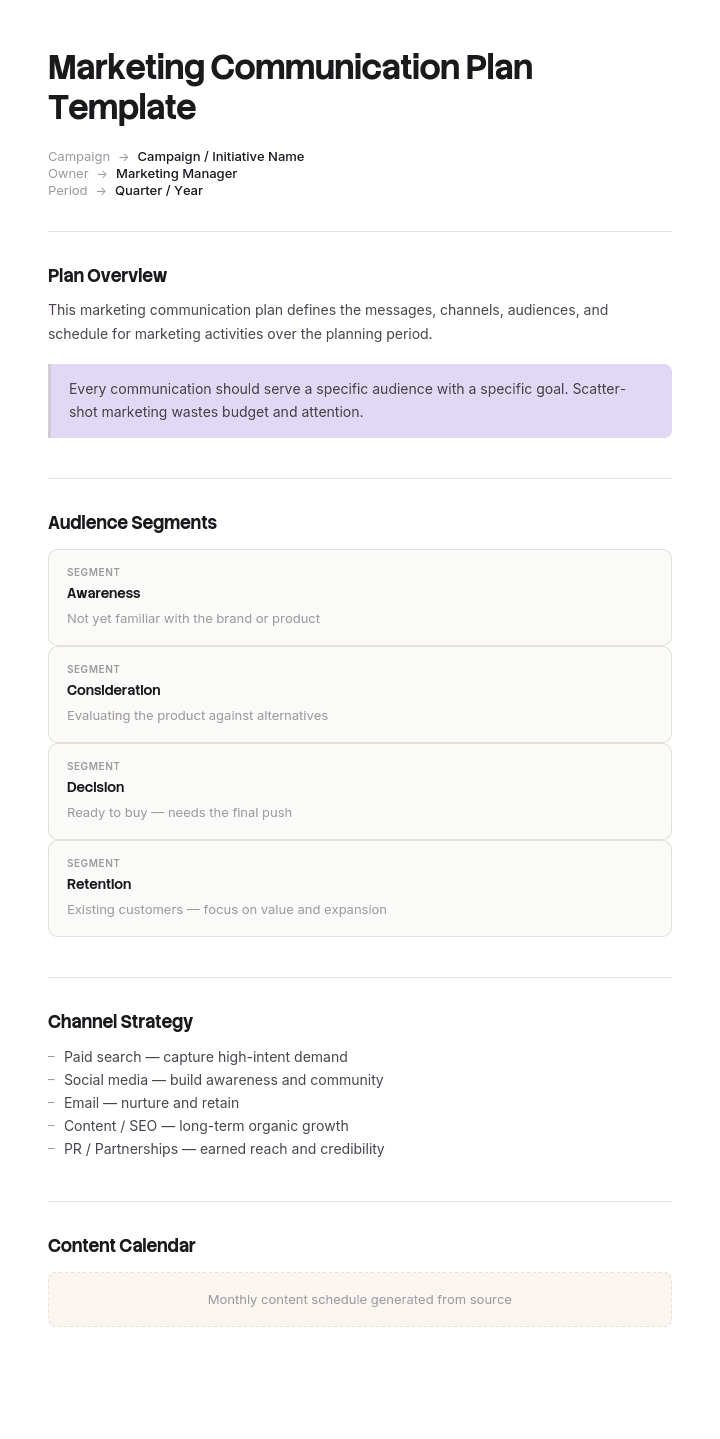
Use this template
A great marketing communication plan turns scattered tactics into integrated impact. With Trupeer, you can save hours on planning by starting with a free marketing communication plan template, customizing it with your brand identity, and turning the plan into video updates that align marketing, sales and stakeholders.
What is a marketing communication plan, and how is it different?
A marketing communication plan sets out what your organisation will say to the market over a period, to whom, through which channels, and when. It sits between strategy and execution: narrower than a marketing plan, which covers positioning, pricing, segments and budget, and broader than a campaign brief, which covers one push.
Two adjacent documents get confused with it constantly.
A communication plan in the project or change sense is about stakeholders. Who needs to know what, by when, so that a change lands. Its unit is the stakeholder group and its purpose is to prevent surprise.
A marketing plan is the commercial document. Where growth comes from, what it costs, what the targets are. The communication plan is downstream of it and answers a different question: given that strategy, what actually reaches people, and in what order.
The last part of that sentence is where almost every template in circulation falls down.
Why channel calendars hide what the customer actually receives
Open any marketing communications template and you will find a grid. Rows for audience or message, columns for channel and date, or the reverse. Email, social, PR, paid, events, web, each with an owner and a schedule.
That structure mirrors how marketing teams are organised, which makes it easy to fill in and easy to review. It also makes one thing structurally invisible: what any individual person on the receiving end experiences.
Because nobody receives a channel. They receive a sequence. Four emails, two ads, a webinar invitation, a direct mail piece and a call, arriving in whatever order the separate calendars happened to produce. Each of those was approved by someone who could see only their own row.
The grid cannot show collisions, because a collision happens between rows. It cannot show total frequency, because frequency accumulates down a column nobody adds up. And it cannot show contradiction, because two messages only contradict each other when the same person sees both.
So the fix is not a better grid. It is to build the plan from a different axis for at least one pass.
How to customize this template in Trupeer
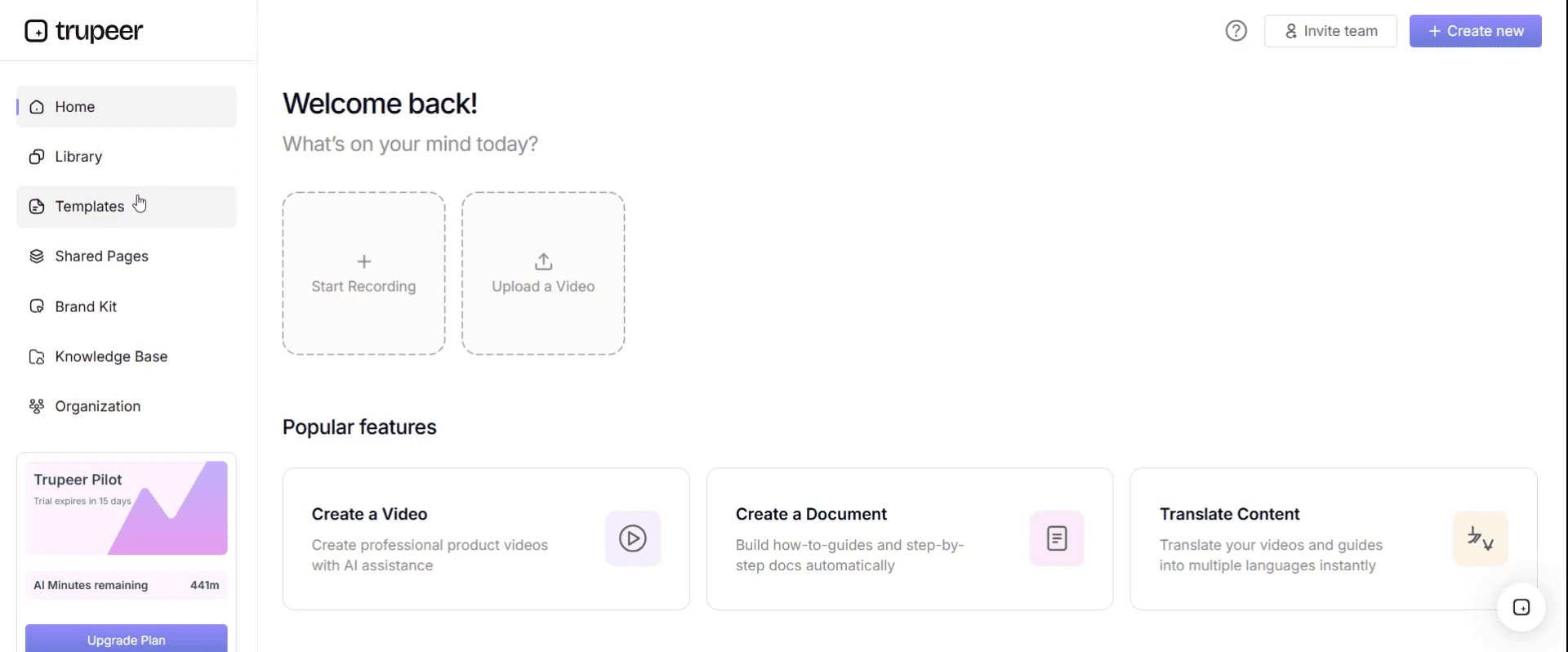
Step 1: Open the Templates Section
Go to the Templates section from the main navigation.
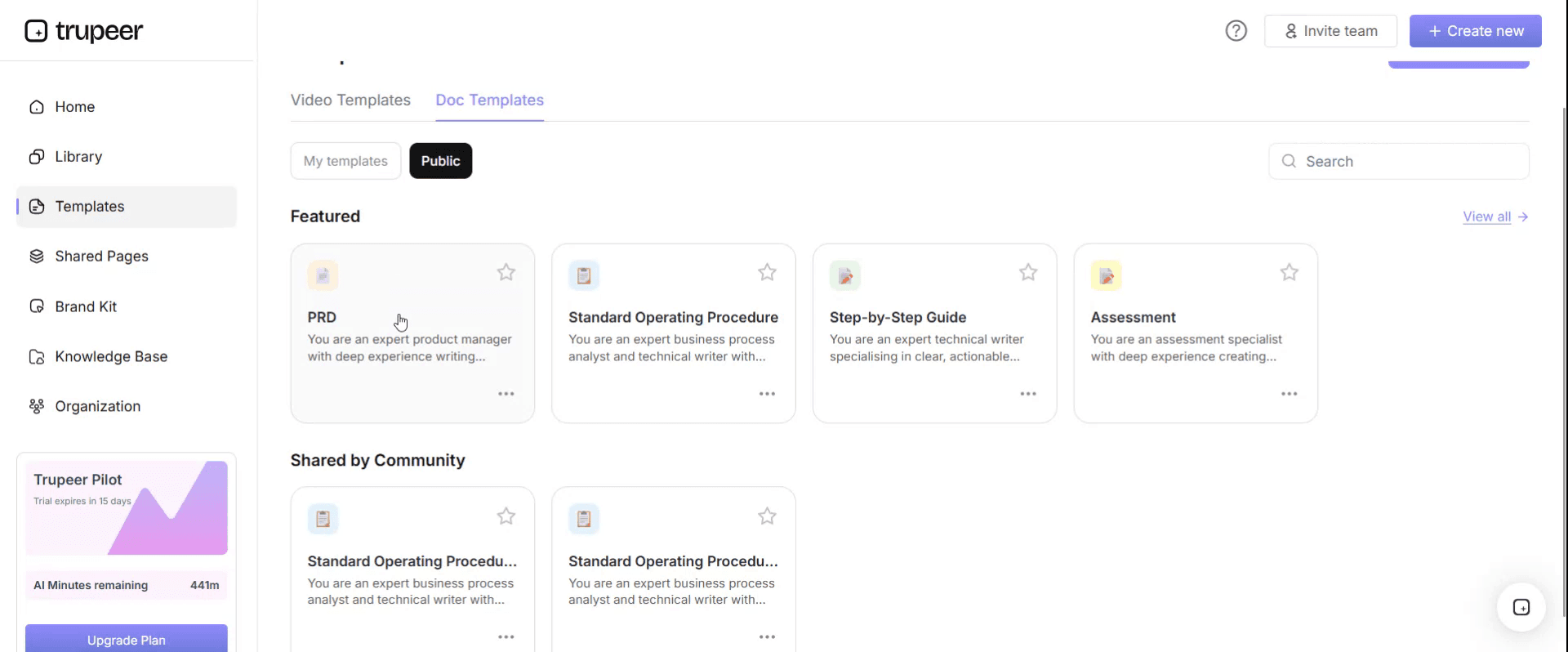
Step 2: Select and Open a Template
Click on any template you want to work with to open it.
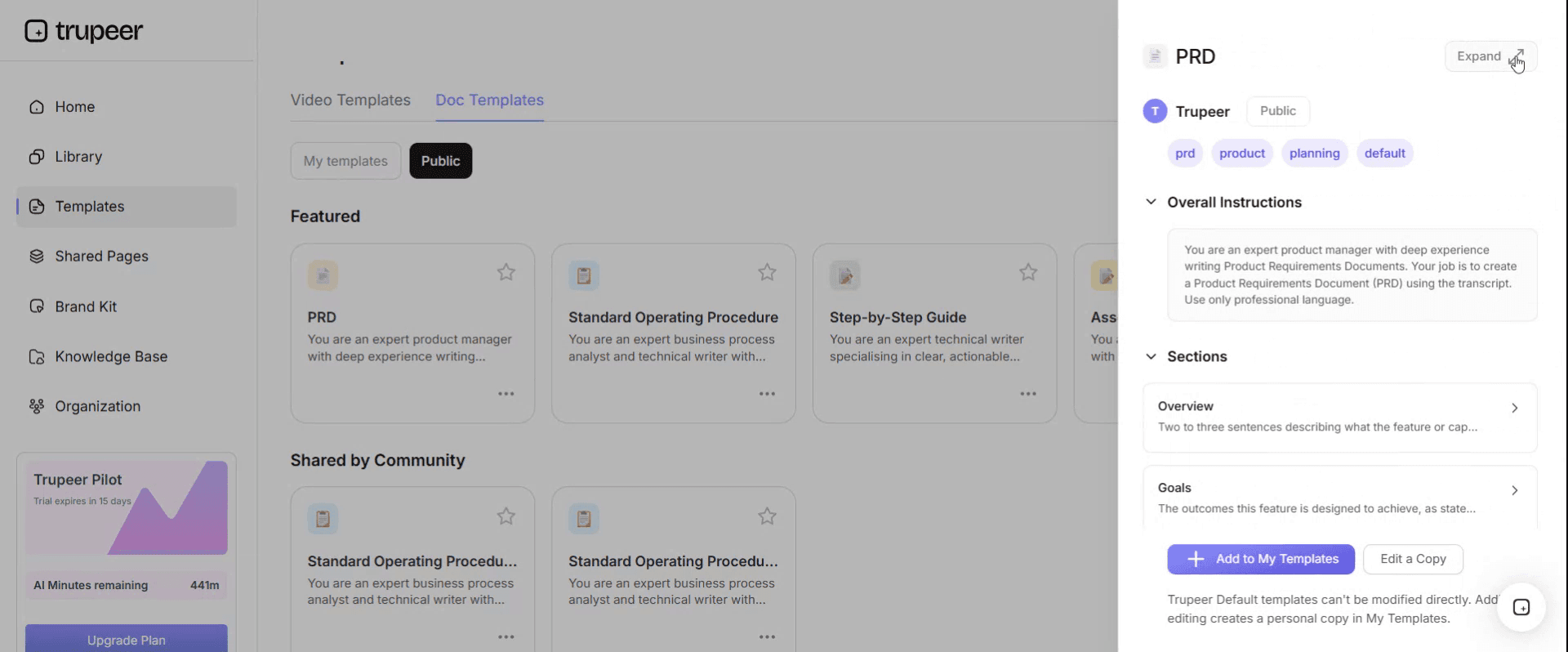
Step 3: Expand the Template View
If needed, expand the template view to see the full layout and details clearly.
Step 4: Edit the Template
Click on Edit to start modifying the selected template.
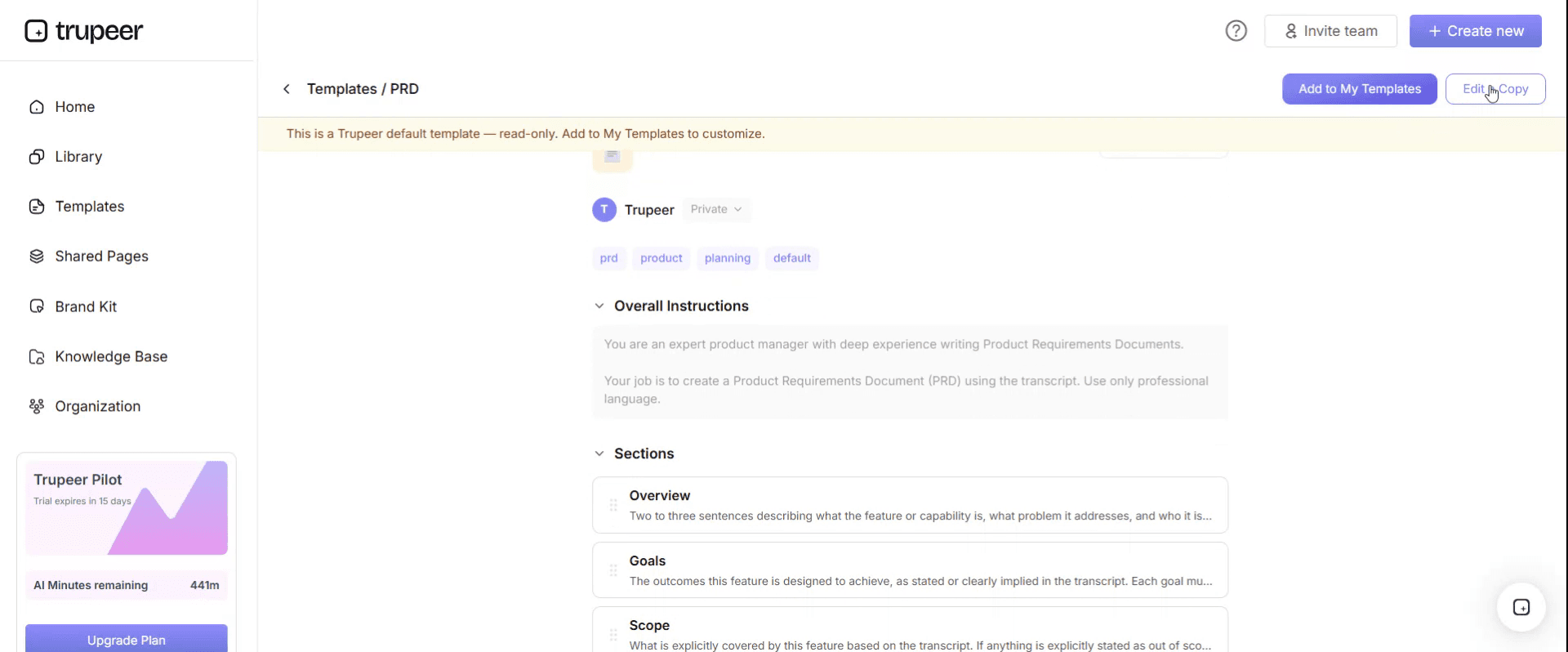
Within the editor, you can:
Add new sections
Define or update formatting rules
Add a logo and adjust its position and related settings
Step 5: Save Your Customized Template
After making all necessary changes, click Save to store the updated template as your own.
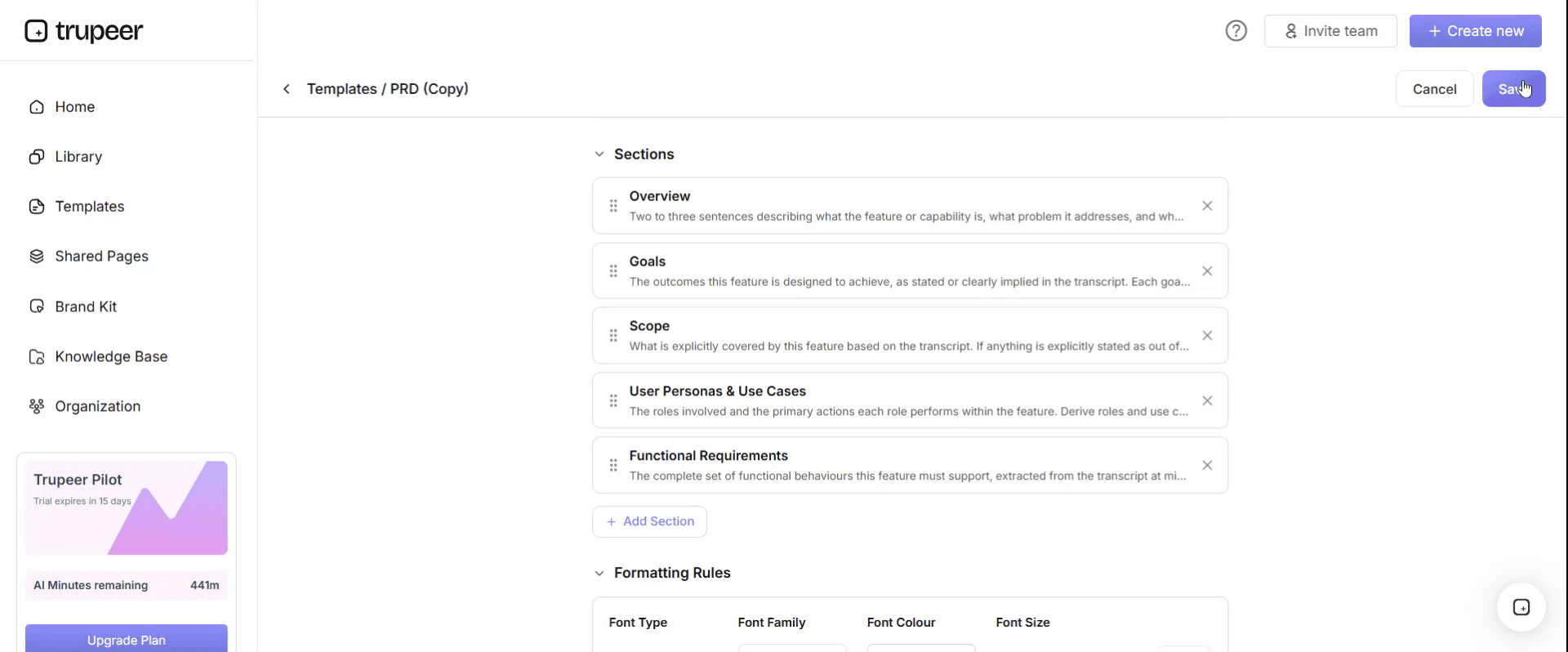
Step 6: Preview and Fine-Tune the Template
When you want to see how your customized template looks, open the Preview.
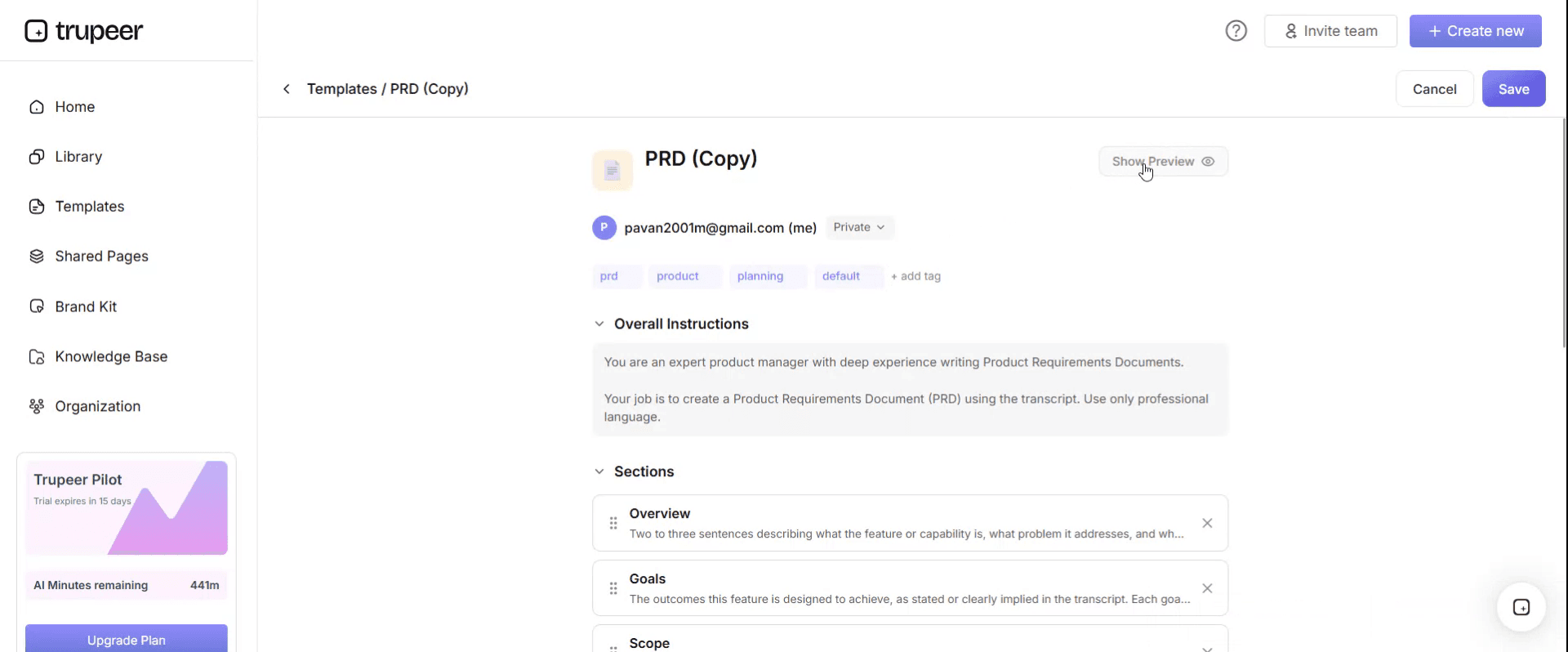
From the preview screen, you can continue to make adjustments directly if needed, ensuring the template appears exactly as you want.
With a marketing communication plan template you can:
Save hours on planning: Skip the blank page with a structure built for integrated marketing.
Align every channel: Built-in fields ensure paid, owned and earned channels reinforce each other.
Stay on-brand: Apply your logo, fonts and colors using Trupeer's brand kit.
Communicate the plan: Convert the plan into video updates marketing, sales and execs can absorb.
Standardize across campaigns: Use the same template for every marketing initiative.
Reach global teams: Translate marketing plans into 65+ languages with one click.
How to build the received sequence for one real person
Pick one person. Not a persona document, an actual named contact in your target segment, or the closest thing you have to one.
Take a ninety day window and list every single thing that person will receive from your organisation. Every nurture email, every product announcement, every ad they are in the audience for, every event invitation, every sales sequence email, every direct mail piece, every notification.
Merge them into one list, in date order, with the channel and the sender beside each.
Read it top to bottom as though you were them.
The first time a team does this, three things reliably fall out. The total is higher than anyone guessed, usually by a factor of two or three. Somewhere in the list two messages say incompatible things about who the product is for. And there is at least one week with four touches and a fortnight with none.
None of that is visible on a channel grid, and all of it is obvious in ten minutes on a received sequence. Do this for each of your two or three main segments and you have the real plan.
How to set a contact cap and a collision rule
Two rules turn the sequence from a diagnostic into a plan.
The contact cap. A maximum number of marketing touches any one person in a segment receives per month, counted across every channel and every team. The number matters less than the fact that it is one number owned by one person. Six a month is a common landing point for B2B, higher for consumer, lower for senior buyers.
The cap only works if it is total. Per-team caps are what produce the problem, because five teams each behaving reasonably within their own limit produce an unreasonable total. If your caps live inside each team's plan, you do not have a cap.
The collision rule. Two campaigns cannot target the same segment in the same week. When they want to, the later one moves, and the decision is made by whoever owns the cap rather than negotiated between the teams.
That second rule is where the plan stops being a schedule and starts being a set of decisions. A marketing communication plan that only records what will go out is a calendar. One that records what will not go out this week, and why, is doing something a calendar cannot.
Free marketing communication plan template: the five tabs to copy
Copy from here. Five tabs, and the order matters because each depends on the one before.
Tab 1, Audiences. One row per segment: who they are, roughly how many, what you want them to do, and the contact cap for that segment. Three segments is usually plenty. Ten means you have listed your database fields rather than your audiences.
Tab 2, Messages. One row per message you intend to land this period, with the single sentence you want the audience to be able to repeat afterwards. If two rows say roughly the same thing, merge them. If two rows contradict, resolve that here rather than discovering it in the sequence.
Tab 3, Received sequence. One tab per segment, one row per contact, all channels merged, in date order. Columns for date, channel, message, owner, and running contact count for the month. This is the tab that does the work and the one no other template has.
Tab 4, Channel view. The conventional grid, generated from tab 3 rather than maintained separately. Teams need this to do their work. It is an output, not the plan.
Tab 5, Decisions and cuts. What was moved or dropped, when, and why. Three lines per entry. This is the institutional memory that stops the same argument recurring each quarter.
Copy to here. If you maintain only one tab, maintain tab 3, and let the channel view be produced from it.
What goes in a marketing communication plan template?
The five tabs above, and specifically three fields that most templates omit.
A contact cap per segment, because without a ceiling the plan has no way of saying no.
A single-sentence message per row, phrased as what the audience should be able to repeat. Marketing plans usually record the asset instead, and an asset is not a message.
And a decisions log. Plans record what was scheduled and almost never record what was cut, which means the reasoning is lost and the cut thing reappears next quarter with the same sponsor.
Everything else, budget, owner, dates, channel, asset link, is standard and any template will give it to you.
The account that received nineteen touches in thirty days
Stanhope Analytics sells data tooling to mid-market financial services. Marketing was nine people across five functions: demand generation, product marketing, content, events and customer marketing. Each ran its own calendar and each calendar was, on its own terms, well run.
In the third quarter someone traced what one target contact had actually received. She was the head of data at a mid-size insurer, squarely in the primary segment.
Over thirty days she received eleven marketing emails: four nurture, three webinar invitations, two content promotions, one event invitation and one product announcement. Two of the three webinar invitations were for the same webinar, sent by different teams from different addresses.
She also saw three LinkedIn ad creatives, two of which contradicted each other. One positioned the product for enterprise data teams. The other positioned it for lean teams without a data engineer.
Plus one direct mail piece, and four emails from an SDR referencing three different content assets.
Nineteen touches in thirty days.
She replied to the SDR saying she had received eleven emails from the company that month and was going to unsubscribe from everything.
The part worth dwelling on is that nobody had broken a rule. Demand generation capped itself at four emails a month. Product marketing capped itself at two. Every team was inside its own guidance, and the guidance was per team.
Unsubscribes in that segment ran at two point nine percent that month against a baseline of nought point six. On a segment of about fourteen thousand, that is roughly three hundred and twenty people who would not otherwise have gone.
They rebuilt the plan as a received sequence, one tab per persona, all channels merged, with a total cap of six contacts per person per month owned by the head of marketing rather than by any team. The collision rule moved whichever campaign asked second.
The following quarter averaged five point two contacts per person per month. Unsubscribes returned to nought point seven percent. Webinar registrations per email sent rose from one point one percent to one point nine, because the invitations were no longer landing in the middle of four other things.
They sent considerably less and got more.
How to create a marketing communication plan, step by step
Start from the commercial plan, not from a blank calendar. If you cannot name the two or three things the business needs the market to believe this quarter, the communication plan will become a list of activity.
Write tab 1 and tab 2 first, audiences and messages, and keep both short. Most plans fail at this point by listing everything marketing intends to do rather than everything the audience needs to hear.
Build the received sequence for your largest segment before scheduling anything. Populate it with what is already committed, then add.
Set the cap, then look at where the sequence exceeds it and decide what moves. This is the actual planning work and it usually takes an afternoon of uncomfortable conversation.
Generate the channel view from the sequence and hand it to the teams.
Then review monthly against the running contact count rather than against the calendar. The question in that review is not whether things went out on time. It is how many touches each segment actually received and whether any week collided.
Types of marketing communication plan: annual, campaign and launch
Type | Covers | Horizon | The field that matters most |
|---|---|---|---|
Annual or always-on | Everything the market receives across the year | 12 months, reviewed quarterly | The contact cap, since this is where accumulation happens |
Campaign | One coordinated push on one message | 4 to 12 weeks | The collision rule against always-on activity |
Product launch | Getting one new thing understood | 6 weeks either side of launch | Sequence, because order changes comprehension |
Integrated marketing communications | Consistency of one message across every channel and partner | Usually annual | The single-sentence message field |
Budget plan | What the communication costs, by channel and period | Financial year | Owner and committed spend |
Nonprofit or member communications | Supporters, members and funders as distinct audiences | Annual | Segment definition, since these audiences overlap heavily |
Most organisations need the annual plan plus a campaign plan per major push, with the campaign sequences merged into the annual received sequence rather than kept separately. Keeping them apart is exactly how the nineteen touches happened.
Which plan you actually need, and where each one lives
If the goal is coordinating one campaign end to end, including creative, phasing and internal readiness, our brand campaign communication plan covers that shape rather than this one.
If the goal is documenting how the marketing team executes recurring work, meaning who does what in what order, that is a procedure rather than a plan, and our digital marketing SOP templates cover it.
If the goal is the commercial plan itself, meaning where growth comes from and what it costs, that is a marketing plan and this document sits underneath it.
And if the goal is telling internal stakeholders about a change, that is a project communication plan, which uses stakeholder groups rather than market segments and is a genuinely different artefact despite the similar name.
How to measure a marketing communication plan
Three numbers, none of which is impressions.
Contacts per person per month, by segment, against the cap. This is the plan's own compliance measure and the only one that tells you whether the document is being followed.
Unsubscribe and opt-out rate by segment, tracked monthly. It is the clearest early signal of over-contact and it moves before anything else does.
Response per contact rather than response in total. A plan that sends thirty percent less and generates the same number of leads has improved, and total-volume reporting will show that as a decline.
Add message recall if you can get it, even informally by asking a handful of customers what they think you do. That is the only measure that tests whether the messages tab was worth writing.
Can I get a marketing communication plan template in Word or Excel?
Excel, for the reason the whole plan depends on: tab 3 counts contacts per person per month and tab 4 should be a pivot off it, and neither survives being maintained by hand in a document. Add conditional formatting that flags any month over the cap and the plan polices itself.
Word suits the parts that are argued about rather than counted, meaning the audiences, the messages and the decisions log. Several teams keep both, with the narrative in a document and the sequence in a sheet linked from it.
PowerPoint is for the version you present to the leadership team, not the version you run, and PDF is for freezing the presented version once the quarter is agreed. The common failure is running the plan from the deck, which quietly drops the counting.
How to keep the message consistent across every channel
The contradiction in the worked example, two ads positioning the same product for opposite audiences, is not unusual and it is not carelessness. It happens because the message lives in a plan document and the assets are made weeks later by different people who each interpreted it.
The single sentence in tab 2 is the defence, and it only works if it reaches everyone producing anything. That includes the SDR writing their own emails, the agency making the ads and whoever writes the webinar description.
Trupeer AI helps at the production end. Record the walkthrough or the explanation once and you get a written version, a video and a document in your knowledge base, all carrying the same words, so the message people encounter in a demo video matches the one in the nurture email. Brand kits keep the look consistent across everything produced without anyone policing it, and translation means a plan built for one market does not fragment into four unrelated messages when it goes international.
Record it. Brand it. Translate it. Trupeer it.
Setup instructions are in the document template setup guide.
Frequently Asked Questions
Is there a free marketing communication plan template in Word?
The five tab structure above works in Word if you prefer a document, though tabs 3 and 4 want a spreadsheet because they involve counting. Word suits the audiences and messages sections and the decisions log. There is no gated download and no form between you and the structure.
Is there a free marketing communication plan template in Excel?
Excel is the right container for this plan and it is not close. Tab 3, the received sequence, needs a running count per person per month, and tab 4 should be generated from it with a pivot rather than maintained by hand. Conditional formatting that flags any month exceeding the cap does more for the plan than any amount of layout work.
Is there a free marketing communication plan template in PowerPoint?
Use slides for the version you present, not the version you run. Five slides is usually right: the audiences and their caps, the two or three messages, the sequence for the main segment shown as a timeline, what was cut and why, and the three measures. Keep the working plan in a spreadsheet.
Is there a free marketing communication plan template in PDF?
Export the presented version once the quarter's plan is agreed, and circulate that. The working plan should stay editable, because the decisions and cuts tab is meant to be added to throughout the period rather than completed in advance.
How far ahead should a marketing communication plan run?
A quarter in detail and a year in outline. Detailed sequences beyond about twelve weeks get rewritten before they are executed, and annual plans with dated sends in month nine are fiction. Review the detailed quarter monthly and the outline year quarterly.
Who should own the marketing communication plan?
One person with the authority to move someone else's campaign, which usually means the head of marketing rather than a coordinator. The contact cap is only real if the person holding it can say no to a colleague, and that is a seniority question rather than an organisational one.
How many marketing contacts per month is too many?
It depends on segment and relationship, but the useful discipline is to pick a number, count against it, and watch the opt-out rate. Six a month across all channels is a reasonable starting point for B2B buyers. What matters far more than the number is that it is counted in total rather than per team.
What is an integrated marketing communications plan?
The same document with an explicit emphasis on one message being consistent across every channel, partner and region, rather than each channel developing its own version. In practice the difference is the single-sentence message field in tab 2 and whether anyone enforces it, which is why the term describes a discipline more than a separate template.


