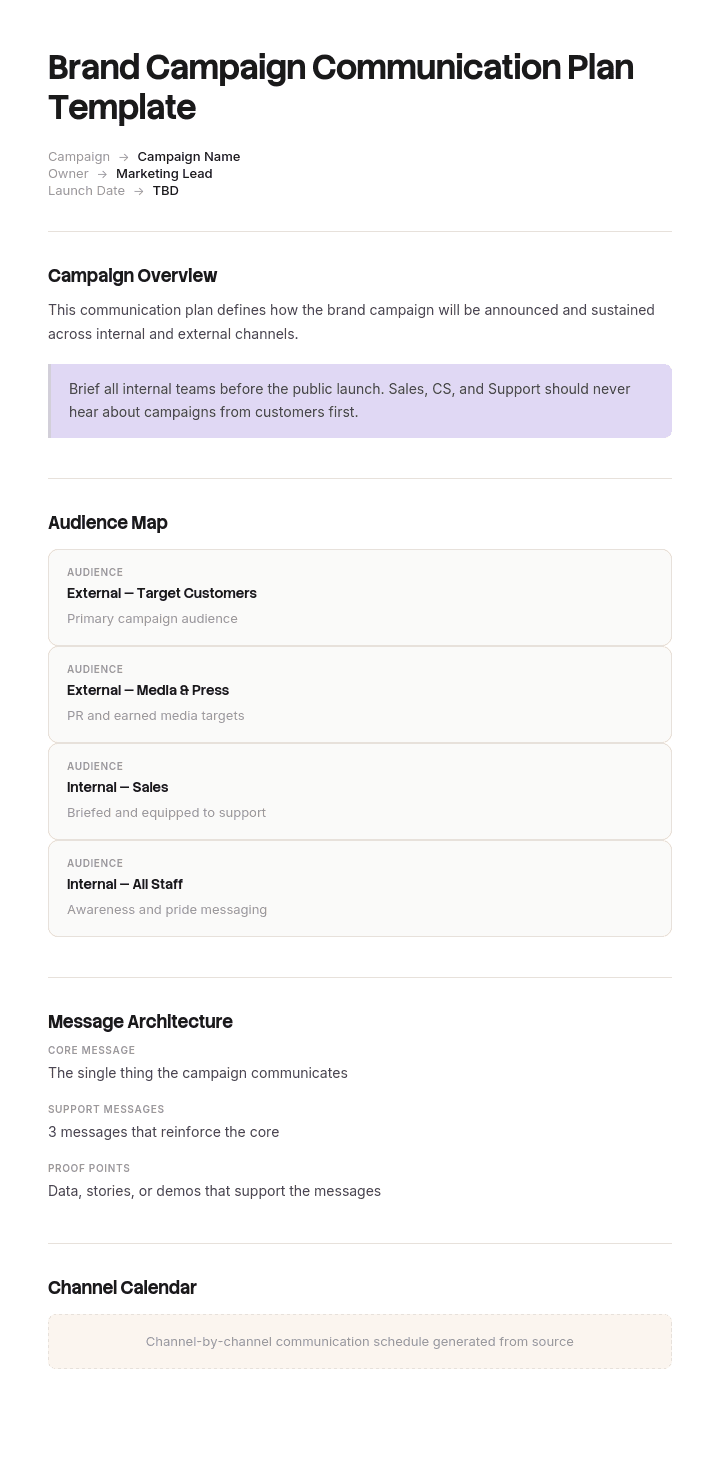
Use this template
A great brand campaign needs more than a creative idea - it needs a clear communication plan. With Trupeer, you can save hours on campaign planning by starting with a free brand campaign communication plan template, customizing it with your brand guidelines, and turning the plan into video updates that align cross-functional teams.
Campaigns rarely fail on creative. They fail because the press release went out before the sales team was briefed, or the paid ads ran a week before the landing page was ready, or nobody told support what was launching.
A brand campaign communication plan prevents that. It maps every audience, the message each one gets, the channel it arrives on, when it lands, and who owns it. This free template gives you that matrix, organised by campaign phase.
Download the template
Format | Best for |
|---|---|
Word (.docx) | The written plan, approvals, sharing with stakeholders |
Excel (.xlsx) | The matrix itself, filtering by audience, channel or owner |
Google Sheets | Live tracking during the campaign |
Google Docs | Collaborative review before sign-off |
Distribution and the final approved version |
Free download, editable, no watermark.
The communication matrix
This is the core of the plan. One row per message, per audience, per channel.
Audience | Message | Channel | Phase | Date | Owner | Asset needed | Success measure |
|---|---|---|---|---|---|---|---|
Eight columns is the full version. If a row has no owner or no date, it isn't a plan entry, it's an idea.
The four phases of a campaign
Most communication plan templates are flat lists. Campaigns aren't flat. Sequence is the thing that goes wrong, so this template is organised by phase.
Phase 1: Pre-launch
Internal alignment, before anything is public. Brief sales, support and leadership. Get assets approved. Confirm the landing page works. The rule is that nobody internal should learn about your campaign from a customer.
Typical rows: leadership briefing, sales enablement session, support FAQ delivered, partner heads-up under embargo, internal announcement.
Phase 2: Launch
The concentrated window where the campaign goes live. Usually a few days. Everything here is time-sequenced to the hour, because a paid ad running before the page is live wastes budget and trust.
Typical rows: press release, website and landing page live, paid ads switch on, organic social, email to customer base, launch post from the founder.
Phase 3: Amplify
The weeks after launch, where most of the actual reach happens and most plans go quiet. This phase is where campaigns underperform, not at launch.
Typical rows: case study, webinar, partner co-marketing, earned media follow-up, retargeting, community engagement, sales follow-up sequence.
Phase 4: Wrap-up
Reporting, learning, and closing the loop with everyone who contributed.
Typical rows: results readout to leadership, retrospective with the team, assets archived, learnings documented, thank-you to partners and contributors.
How to customize this template in Trupeer
Step 1: Open the Templates Section
Go to the Templates section from the main navigation.
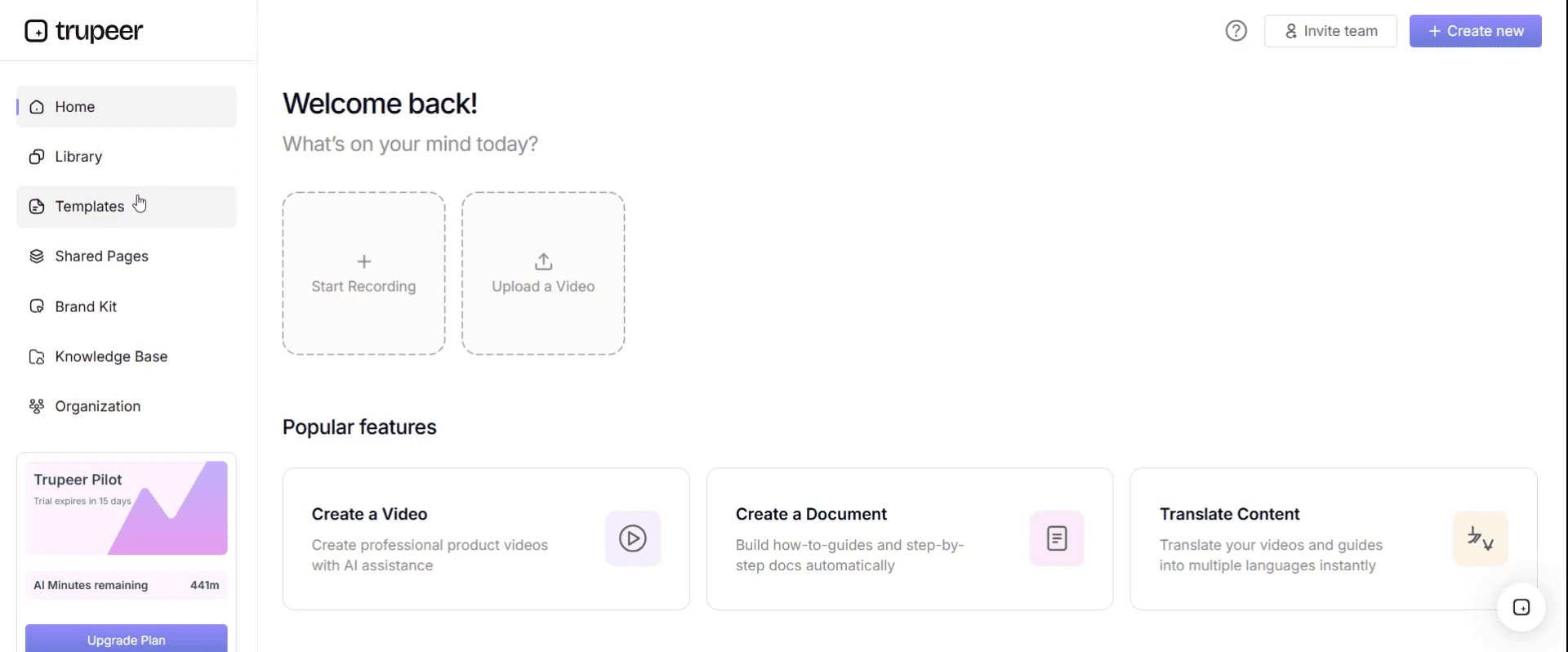
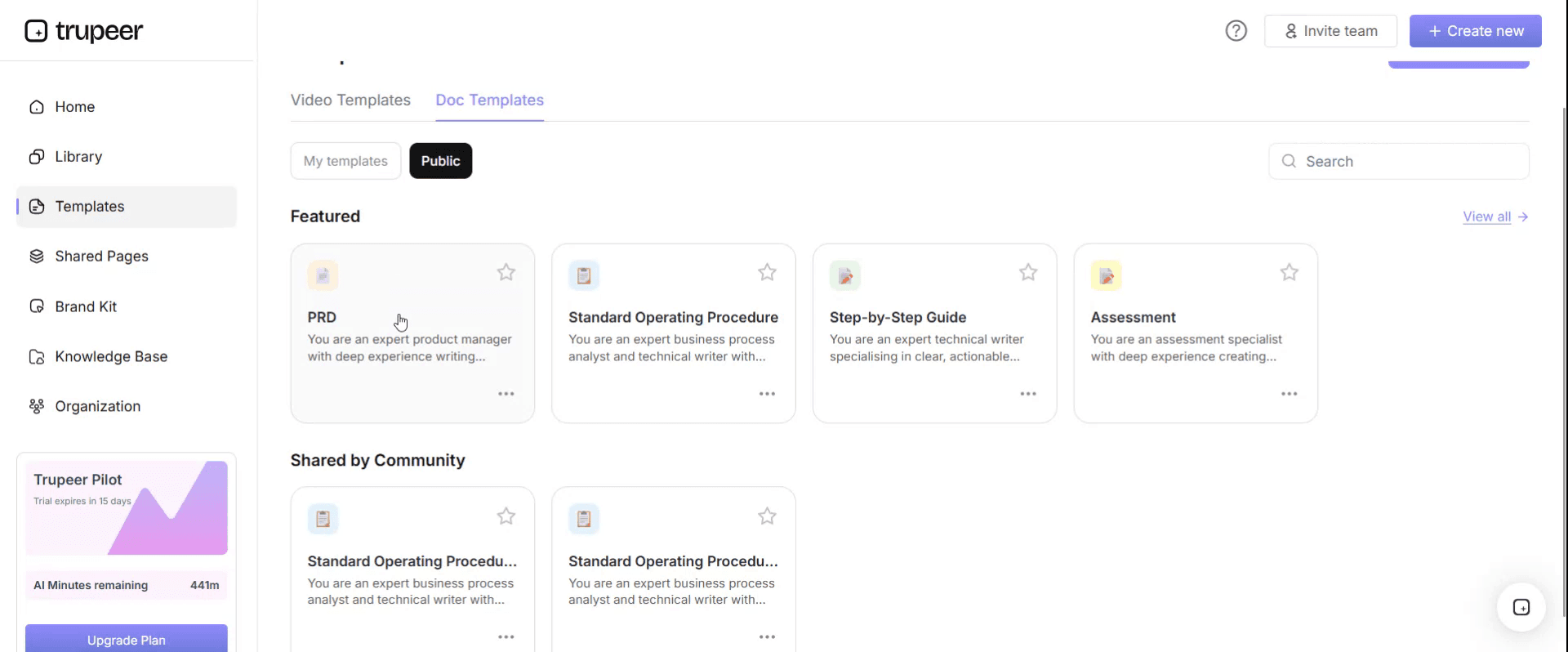
Step 2: Select and Open a Template
Click on any template you want to work with to open it.
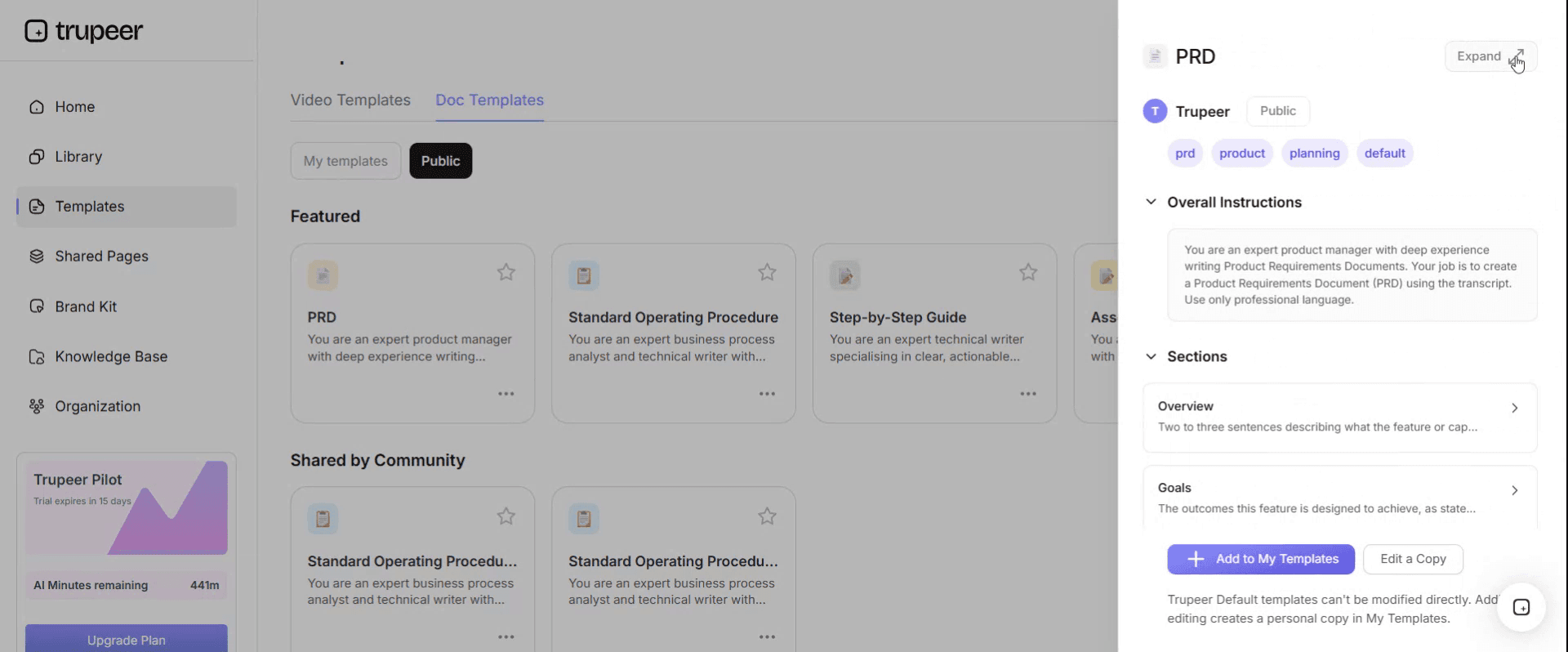
Step 3: Expand the Template View
If needed, expand the template view to see the full layout and details clearly.
Step 4: Edit the Template
Click on Edit to start modifying the selected template.
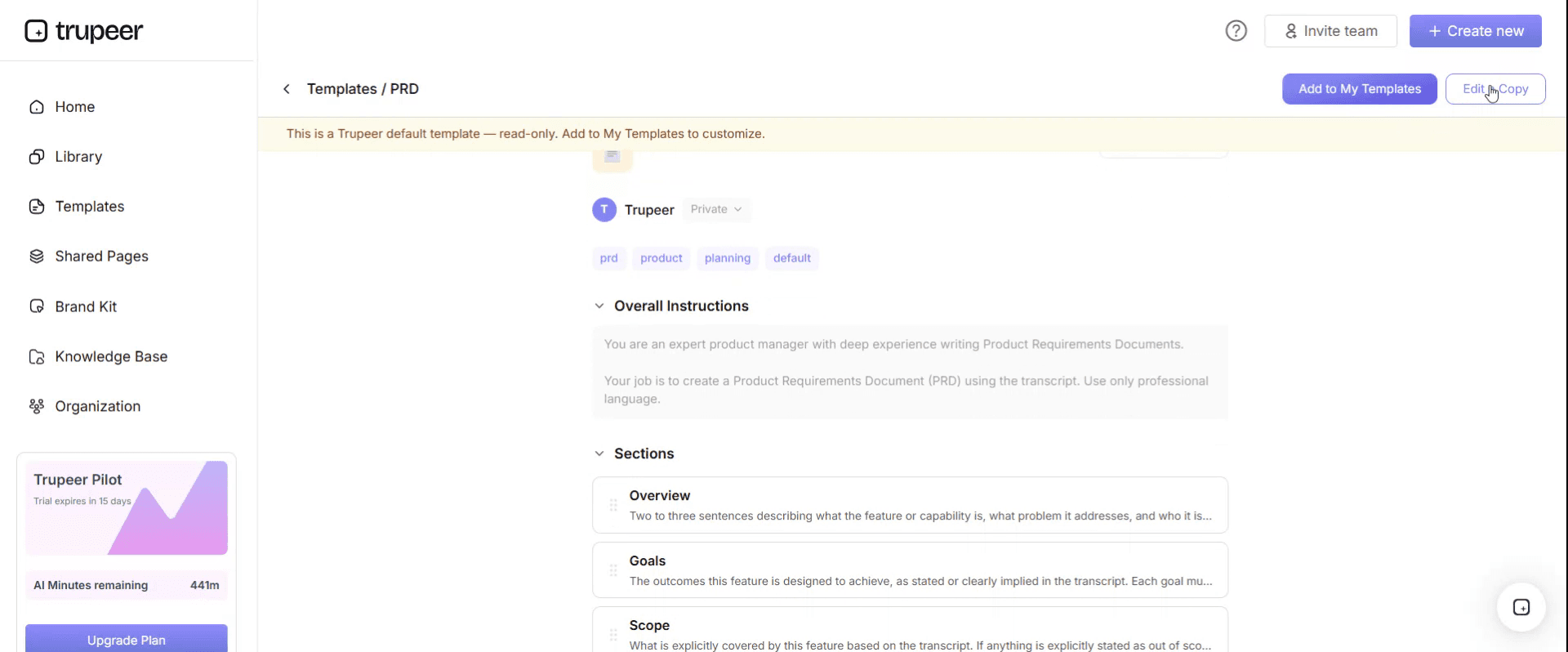
Within the editor, you can:
Add new sections
Define or update formatting rules
Add a logo and adjust its position and related settings
Step 5: Save Your Customized Template
After making all necessary changes, click Save to store the updated template as your own.
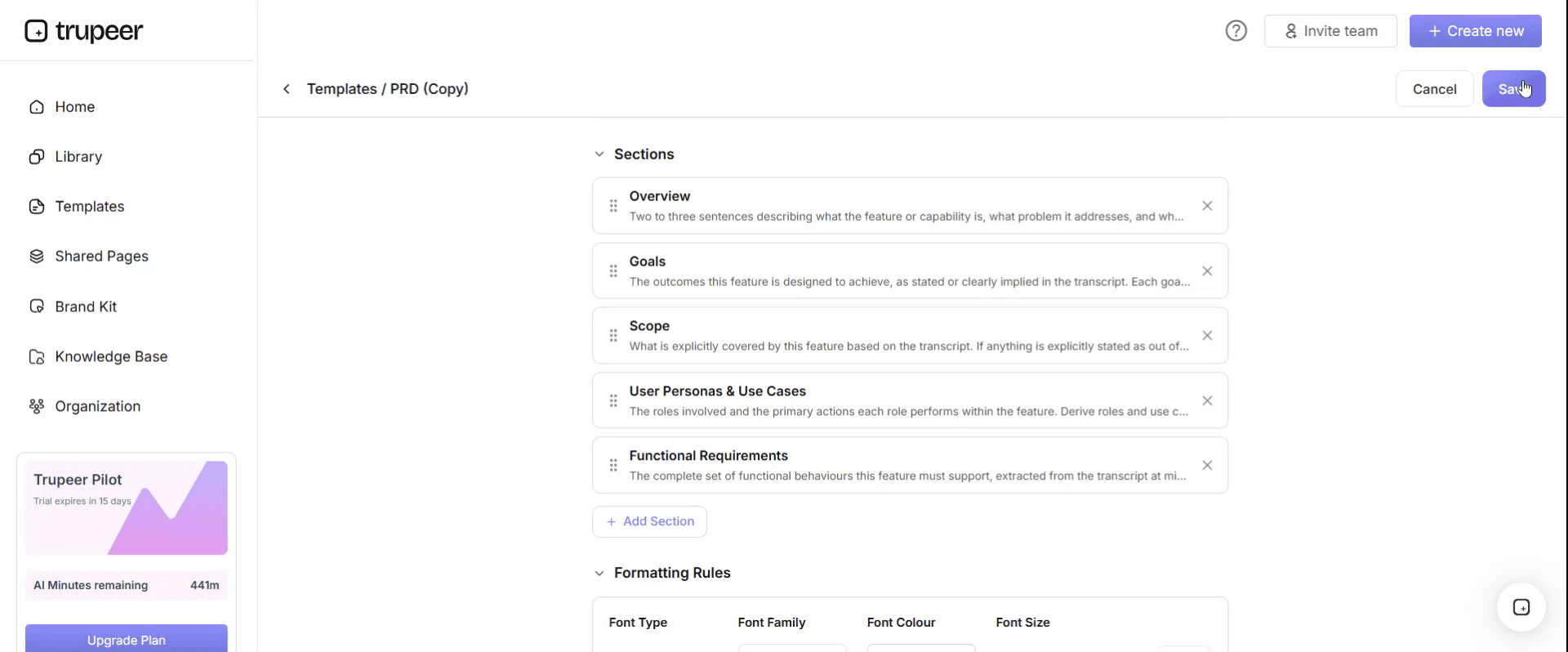
Step 6: Preview and Fine-Tune the Template
When you want to see how your customized template looks, open the Preview.
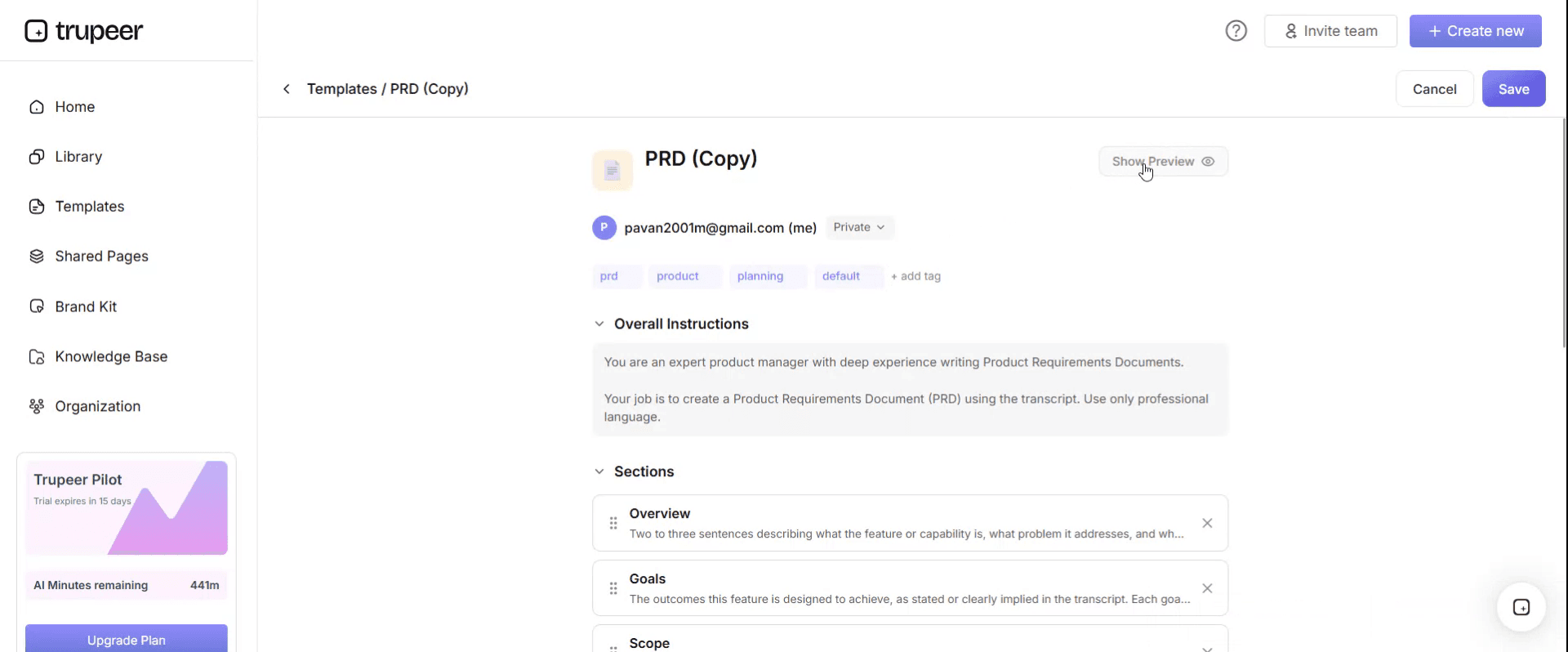
From the preview screen, you can continue to make adjustments directly if needed, ensuring the template appears exactly as you want.
With a brand campaign communication plan template you can:
Save hours on planning: Skip the blank page with a structure built for campaigns.
Reach the right audiences: Built-in audience-channel mapping ensures every segment gets the right message.
Stay on-brand: Apply your logo, fonts and colors using Trupeer's brand kit.
Coordinate teams: Convert plans into video updates marketing, PR and sales can all absorb.
Standardize across campaigns: Use the same template for every brand initiative.
Reach global teams: Translate campaign comms into 65+ languages with one click.
Filled-in campaign example
A brand campaign for a product repositioning, running six weeks.
Audience | Message | Channel | Phase | Date | Owner | Success measure |
|---|---|---|---|---|---|---|
Leadership | Campaign objectives, budget, risks | Deck plus 30 min meeting | Pre-launch | 12 Aug | CMO | Sign-off recorded |
Sales team | New positioning, objection handling | Enablement session plus one-pager | Pre-launch | 14 Aug | Product marketing | 90% attendance, quiz passed |
Support team | What's changing, likely questions | FAQ doc plus video walkthrough | Pre-launch | 15 Aug | Support lead | FAQ published before launch |
All staff | What we're launching and why | All-hands plus Slack post | Pre-launch | 18 Aug | Internal comms | Post viewed by 80% |
Press and analysts | Repositioning announcement | Embargoed release plus briefings | Launch | 19 Aug | PR | 6 briefings booked |
Existing customers | What this means for you | Email plus in-app message | Launch | 20 Aug | Lifecycle marketing | 35% open, under 0.5% unsubscribe |
Prospects | New value proposition | Paid social, search, landing page | Launch | 20 Aug | Demand gen | CPL under target |
Wider market | Launch announcement | Organic social, founder post | Launch | 20 Aug | Social lead | Engagement rate above baseline |
Prospects | Proof, in customer words | Case study plus webinar | Amplify | 3 Sep | Content | 200 webinar registrations |
Partners | Co-marketing pack | Partner portal plus email | Amplify | 5 Sep | Partnerships | 4 partners activate |
Warm leads | Objection-led follow-up | Sales sequence | Amplify | 8 Sep | Sales ops | 15% reply rate |
Leadership | Results against objectives | Report plus readout | Wrap-up | 30 Sep | CMO | Delivered within 5 days of close |
Campaign team | What worked, what didn't | Retrospective | Wrap-up | 2 Oct | Project lead | Learnings documented |
Notice the pre-launch phase carries five rows before anything is public. That's the ratio that prevents the most common campaign failure.
Key elements of a brand campaign communication plan
Objective. One sentence on what the campaign is for, written as an outcome.
Key message and positioning. The single idea every communication ladders up to.
Audiences. Segmented, internal and external. Internal is the one people forget.
Message per audience. Sales needs different words from press, who need different words from existing customers.
Channels. Where each audience actually is, not where you'd prefer them to be.
Timing and sequence. Dates, and the dependencies between them.
Owners. One name per row.
Assets required. What has to exist before the row can happen.
Approval path. Who signs off on messaging, and by when.
Success measures. Per row where possible, plus campaign-level.
Risk and escalation. What could go wrong, and who decides if it does.
Communication plan vs communication strategy
Used interchangeably, and they're different documents at different altitudes.
Communication strategy | Communication plan | |
|---|---|---|
Question it answers | What are we trying to achieve, and how will we position it | Who hears what, when, on which channel |
Time horizon | Annual or campaign-long | Dated, often to the day |
Contains | Objectives, positioning, key messages, audience insight | A matrix of audiences, messages, channels, dates, owners |
Changes | Rarely, deliberately | Constantly, as the campaign runs |
Owner | Marketing or brand leadership | Campaign or project lead |
The strategy decides the message. The plan makes it arrive. If you're writing dates, you're writing the plan. If you're arguing about positioning, you're still in the strategy.
Both also differ from a marketing plan, which covers budget, channel mix and targets across a whole period rather than the communication sequence of one campaign.
How to create a communication plan in six steps
Write the objective as an outcome. "Shift perception among mid-market buyers" beats "run a brand campaign."
List every audience, internal first. Leadership, sales, support, all staff, then press, customers, prospects, partners.
Write one message per audience. Same truth, different words. If every audience gets identical copy, you haven't done this step.
Pick the channel per audience. Where they already are.
Sequence by phase, then by date. Pre-launch dependencies first. Then check nothing public precedes its internal briefing.
Assign an owner and a measure to every row. Then sort by date and look for the week where six things land on one person.
Internal communication is half the plan
Every template in this category treats communication as external. In practice, the campaign failures people remember are internal.
Sales finds out from a customer. Now they're unprepared and the customer knows more than they do.
Support gets no FAQ. Launch day tickets arrive and nobody has answers.
Leadership is surprised by press coverage. Never recovers well.
Employees see the ad before the all-hands. The single fastest way to make a brand campaign feel hollow inside the company.
The fix is scheduling internal rows before external ones and treating them as gating dependencies rather than nice-to-haves. Sales enablement isn't done when the deck is sent, it's done when the team can use it.
Types of communication plan templates
Template | Use it for | Fields that become essential |
|---|---|---|
Brand campaign communication plan | A single brand or product campaign | Phase, key message, asset required |
Marketing communications plan | Ongoing marketing across channels | Channel mix, budget, quarterly targets |
Integrated marketing communications plan | Coordinated multi-channel campaigns | Channel interdependencies, unified messaging |
Annual communications plan | A full year of activity | Quarterly themes, always-on versus campaign |
Communication budget plan | Spend allocation across channels | Cost per channel, forecast versus actual |
Event communication plan | Conferences, launches, webinars | Pre-event, on-site and post-event sequences, registration milestones |
Internal communication plan | Change, restructure, all-staff news | Manager cascade, feedback route, sentiment check |
Crisis communication plan | Incidents and reputational risk | Severity levels, spokesperson, holding statement, escalation |
Project communication plan | Stakeholder updates on delivery | Reporting cadence, RAG status, escalation path |
Nonprofit communications plan | Donor, beneficiary and volunteer comms | Funder reporting, campaign appeals, impact narrative |
Best practices
Internal before external, always. Treat it as a hard dependency.
One owner per row. Shared ownership means nobody does it.
Build in an approval buffer. Legal and brand review always take longer than planned.
Write the message, not the topic. "Announce repositioning" is a topic. The actual sentence is the message.
Plan the amplify phase properly. Most plans stop at launch and most reach happens afterwards.
Keep one live version. Two copies of a campaign plan is how a date gets missed.
Review daily during launch week. Weekly is too slow when the plan is dated to the hour.
Write the retrospective while it's fresh. Within a week, or the useful detail is gone.
Common mistakes
No internal phase. The most common and the most damaging.
Channel before audience. Leads to publishing where it's convenient rather than where they are.
Identical messaging across audiences. Press, sales and customers need genuinely different framing.
Everything dated to launch day. Creates a bottleneck and hides the pre-launch work that makes it possible.
No asset column. Then discovering the day before that the case study doesn't exist.
No success measure. The campaign gets judged on vibes.
Nothing after launch. The plan ends where the opportunity starts.
Never updated once live. A campaign plan is a working document.
Build the plan, then brief the team on video
Open the template in Trupeer AI, apply your brand kit so the plan and every asset around it match your brand, and edit any section directly. Setup is in the template guide.
Then fix the internal phase properly. Sales enablement decks get skimmed. A short video walkthrough of the new positioning gets watched, and you can tell who watched it. Translate it into 65+ languages for international teams and regional partners, and store the campaign pack in your knowledge base so there's one version rather than six in Slack. The same recordings become enablement training for anyone who joins mid-campaign.
Record it. Brand it. Translate it. Trupeer it.
Frequently Asked Questions
What is a brand campaign communication plan?
A document mapping every communication in a brand campaign: which audiences hear what message, on which channel, at what time, and who owns each one. It's organised by campaign phase so the sequence between internal briefings and public launch is explicit.
Is there a brand campaign communication plan template in Word?
Yes. The Word version holds the written plan, objectives and key messages, and is the right format for approvals and stakeholder sharing.
Is there a brand campaign communication plan template for Excel?
Yes, and it's the version most campaign leads use day to day. The Excel matrix lets you filter by audience, channel, phase or owner, and sort by date to spot the week where too much lands at once.
Is the brand campaign communication plan template free?
Yes. Free to download and use, editable, with no watermark. Available in Word, Excel, Google Sheets, Google Docs and PDF.
Is there a communication plan template in Excel?
Yes. The general communication plan template comes in Excel with the same audience, message, channel, timing and owner columns, minus the campaign phase structure. Use that one for ongoing or project communication rather than a dated campaign.
Is there a communication plan template in Word?
Yes. Word suits the narrative version, where objectives, positioning and key messages need to be read and approved rather than filtered. Most teams use both: Word for the plan document, Excel for the matrix.
Where can I find a communication plan example in PDF?
The filled campaign example above is included in the PDF download, so you get a completed plan alongside the blank template. Working from a filled example is faster than starting from empty columns.
Can I download a communication plan template for free?
Yes. Every format is a free download with no account required and no watermark. Use it internally as many times as you need.
Is there an event communication plan template?
Yes, and the same structure adapts well. Replace the four campaign phases with pre-event, on-site and post-event, and add registration milestones to the timing column. Event plans need heavier logistics detail in the asset column, since a missing sign or badge list is as disruptive as a missing message.
What should a communication plan include?
Objective, key message and positioning, segmented audiences including internal, the message per audience, channels, timing and sequence, owners, assets required, the approval path, success measures, and a risk and escalation route.
What's the difference between a communication plan and a communication strategy?
The strategy sets objectives, positioning and key messages. The plan turns those into dated rows with owners and channels. If you're writing dates, you're in the plan. If you're debating positioning, you're still in the strategy.
How far in advance should a campaign communication plan be built?
Long enough for the pre-launch phase to happen properly, which usually means four to six weeks before public launch for a significant brand campaign. The constraint is rarely creative production. It's approvals and internal enablement.
Who owns the campaign communication plan?
One person, typically the campaign or product marketing lead. Individual rows have their own owners, but a plan with shared overall ownership is a plan where nobody notices a slipped date.
How do I customize this template?
Add or remove audiences and channels to match your campaign, and rename the phases if yours run differently. In Trupeer AI you can also apply your brand kit so the plan and its assets carry your fonts, colors and logo automatically.