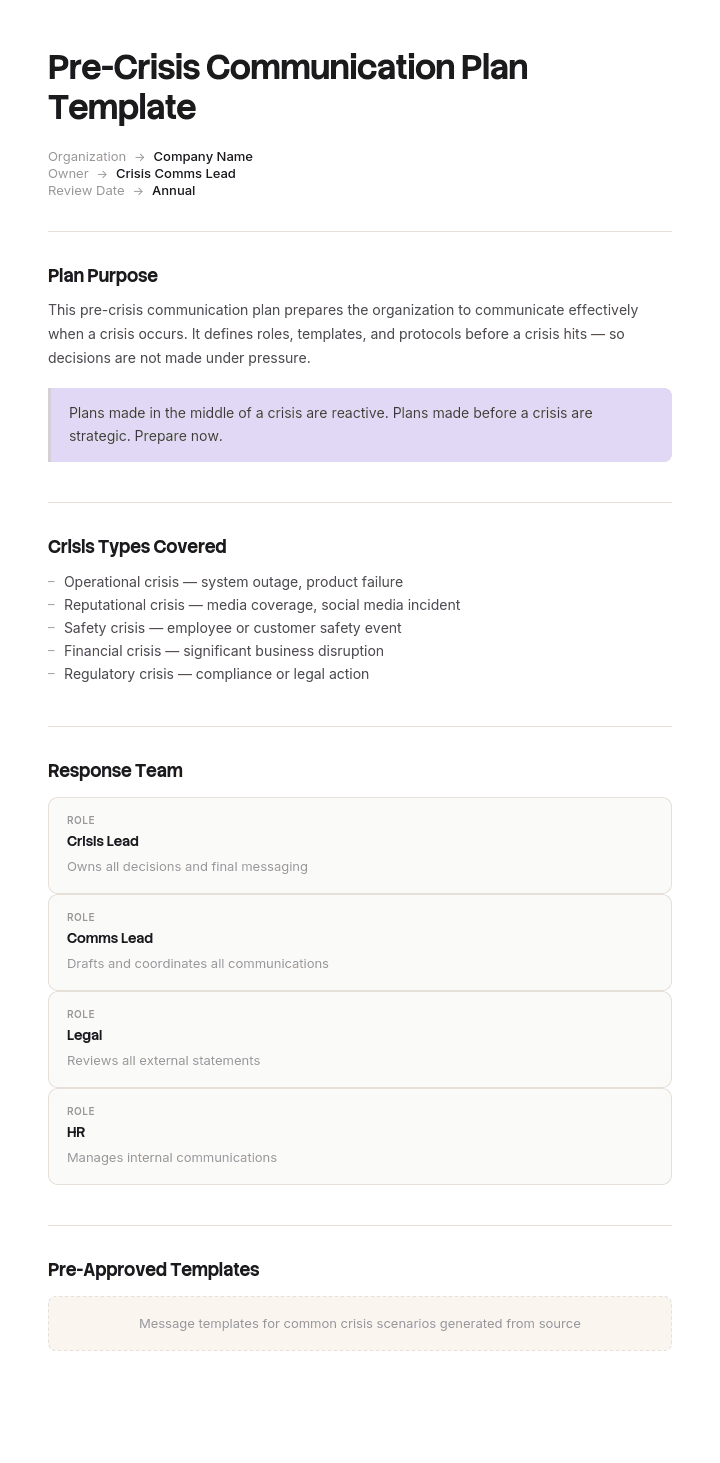
Use this template
The best time to plan crisis communications is before a crisis occurs. With Trupeer, you can save hours on crisis preparation by starting with a free pre-crisis communication plan template, customizing it with your brand guidelines, and turning the plan into video briefings leaders can review during tabletop exercises.
What is a pre-crisis communication plan template?
Crisis communication is usually described in three phases: pre-crisis, meaning everything you do before anything happens; the response itself; and recovery afterwards.
A pre-crisis communication plan covers the first of those. It is not a description of how you will respond. It is the set of decisions taken while everybody is calm, so that the response does not have to wait for them.
That distinction matters because the two documents fail in different ways. A response plan that is slightly wrong gets adapted in the moment by competent people. A pre-crisis plan that is missing its decisions cannot be adapted at all, because the missing part is authority, and authority cannot be improvised at nine on a Sunday evening.
Three decisions carry almost all the value: what triggers activation, who may speak without seeking approval, and what may be said before the facts are confirmed. Everything else in a crisis plan is a contact list.
Why the first hour of a crisis goes to deciding
Read the timeline of any organisation that responded slowly and you will rarely find anyone behaving unreasonably. You will find a sequence of people each doing something sensible, which collectively takes six hours.
Somebody notices. They are not sure whether this counts. They mention it to a manager. The manager says to keep an eye on it. It grows. Somebody else notices independently. Eventually someone senior enough to authorise a statement is found, and by then the question has changed from what should we say to why did nobody say anything.
The bottleneck is not writing. Drafting a holding statement takes twenty minutes. The bottleneck is the decision to treat something as a crisis, and that decision is socially expensive. Escalating means asserting that this is serious, in front of people who may disagree, with the risk of looking alarmist if it turns out to be nothing.
So people wait for certainty, and certainty arrives after the window has closed.
A pre-crisis plan removes the decision by making it in advance, in writing, against observable conditions rather than judgement.
How to customize this template in Trupeer
Step 1: Open the Templates Section
Go to the Templates section from the main navigation.
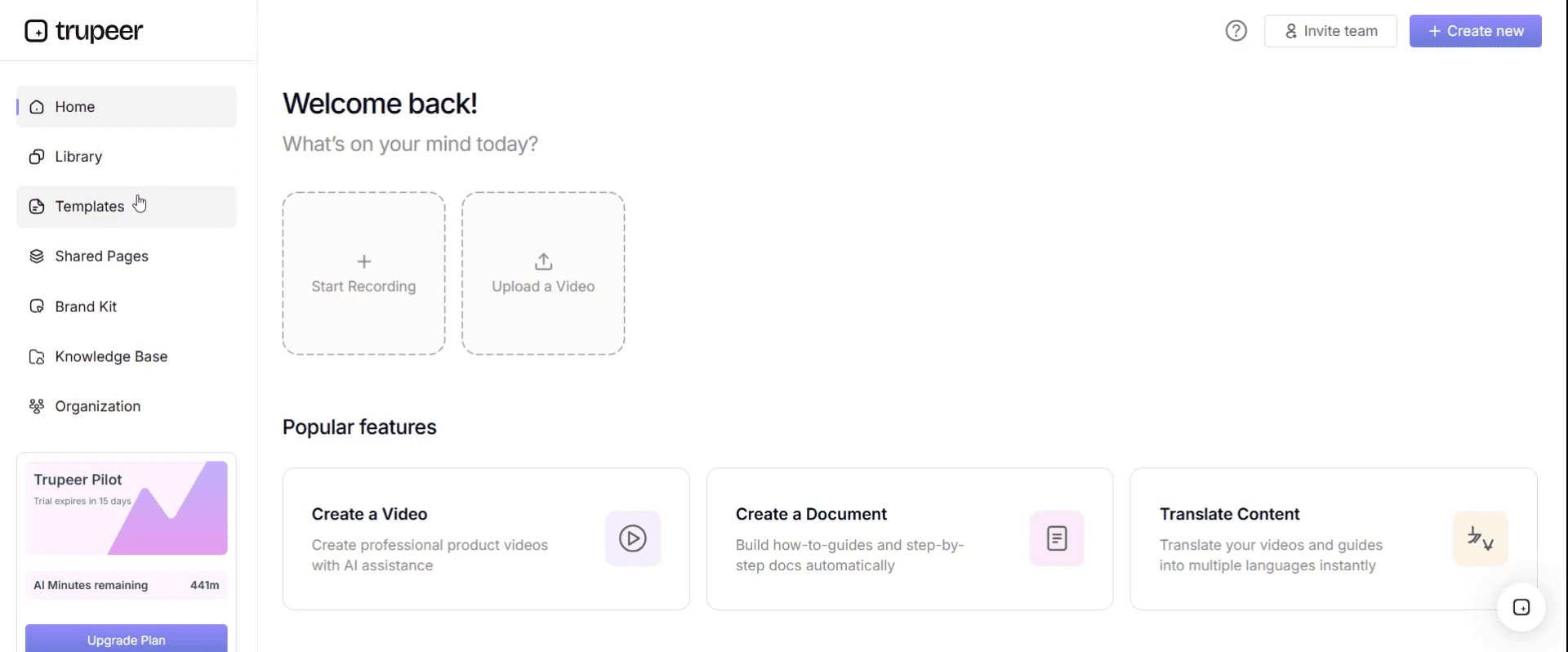
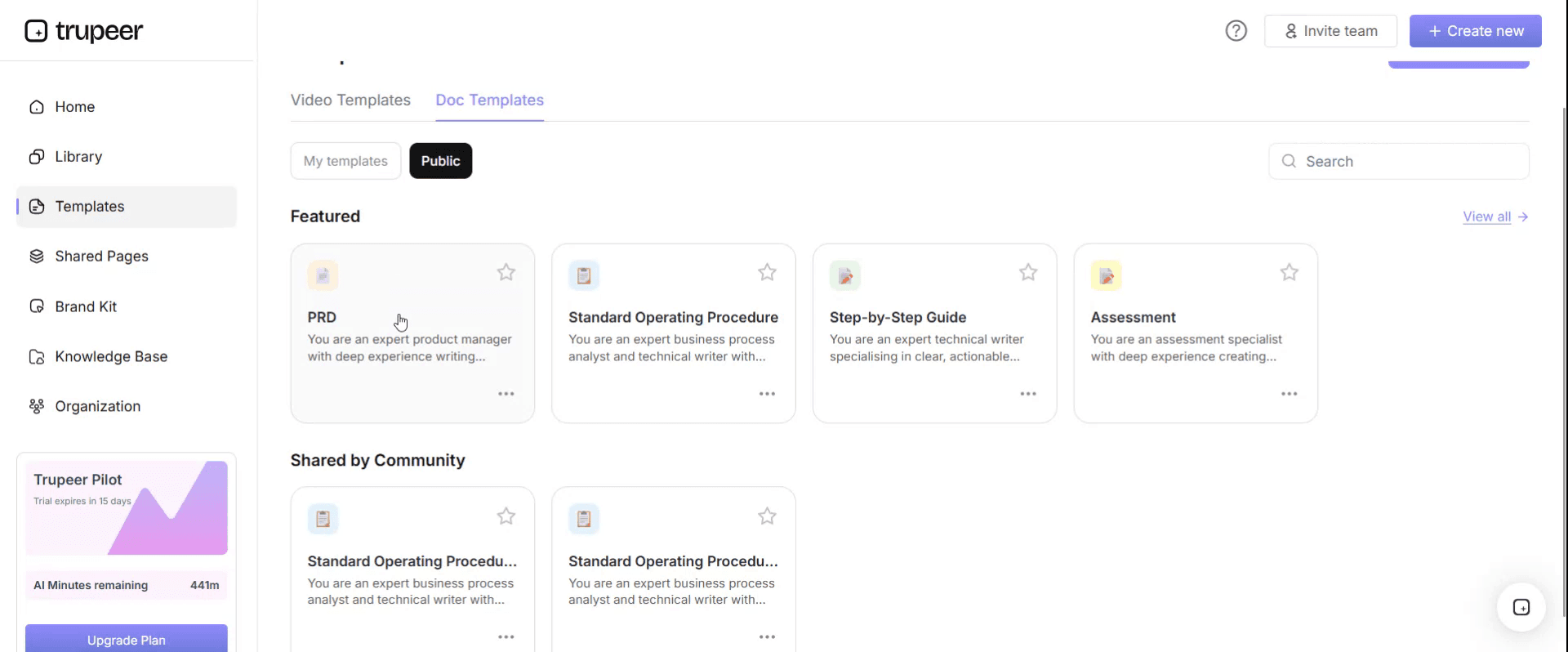
Step 2: Select and Open a Template
Click on any template you want to work with to open it.
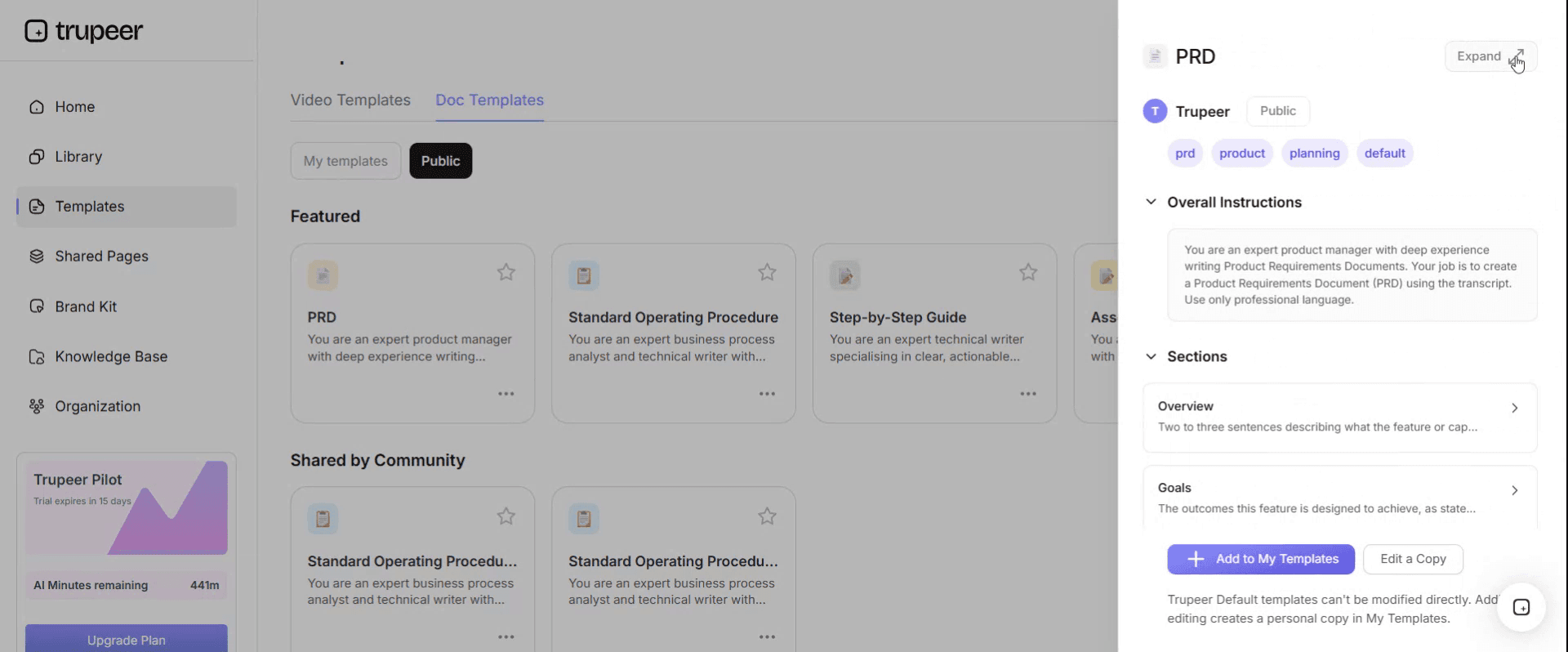
Step 3: Expand the Template View
If needed, expand the template view to see the full layout and details clearly.
Step 4: Edit the Template
Click on Edit to start modifying the selected template.
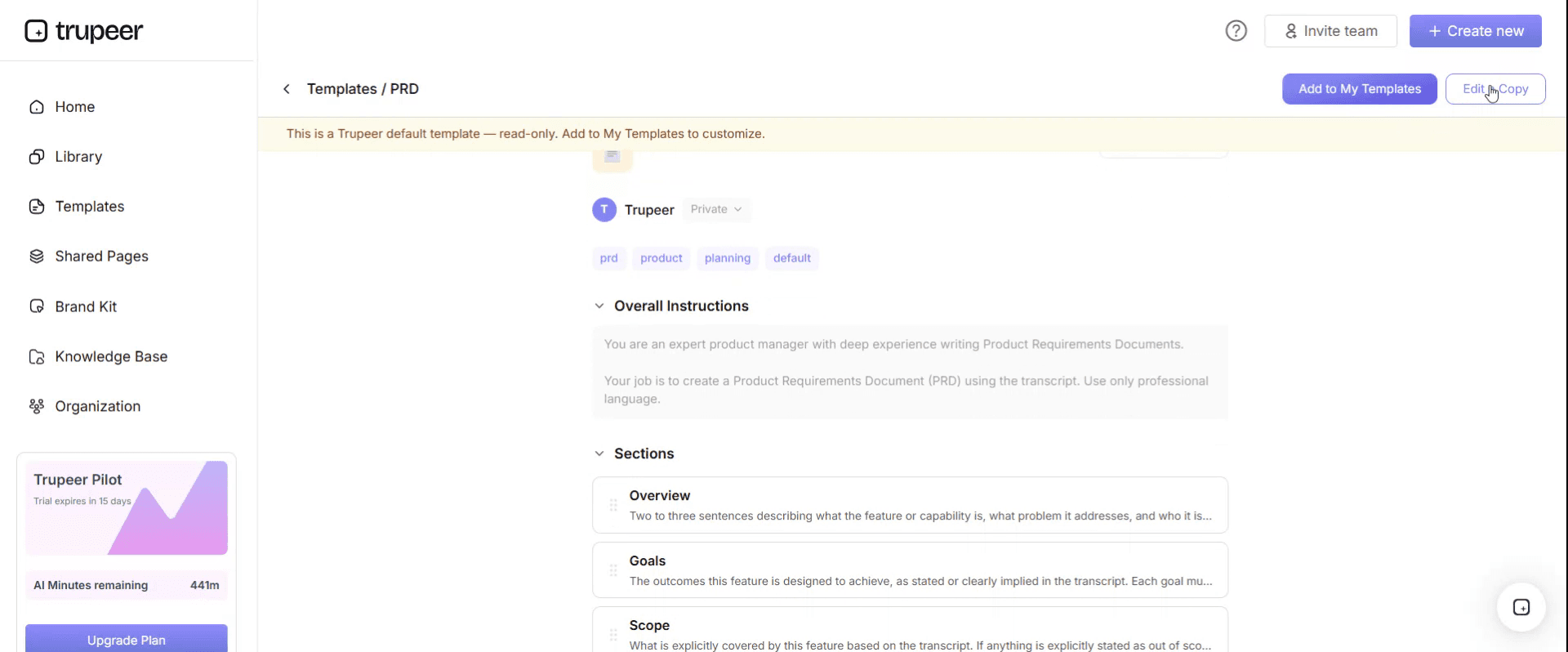
Within the editor, you can:
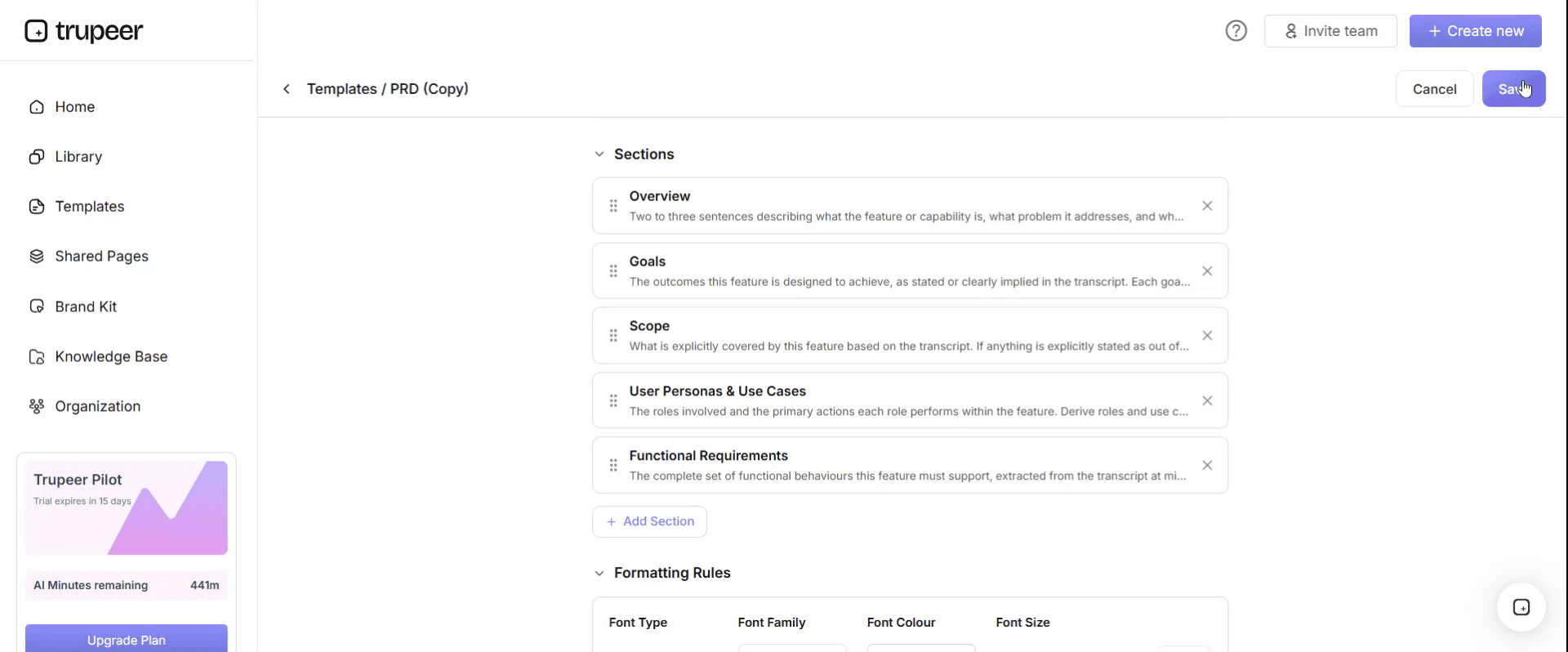
Add new sections
Define or update formatting rules
Add a logo and adjust its position and related settings
Step 5: Save Your Customized Template
After making all necessary changes, click Save to store the updated template as your own.
Step 6: Preview and Fine-Tune the Template
When you want to see how your customized template looks, open the Preview.
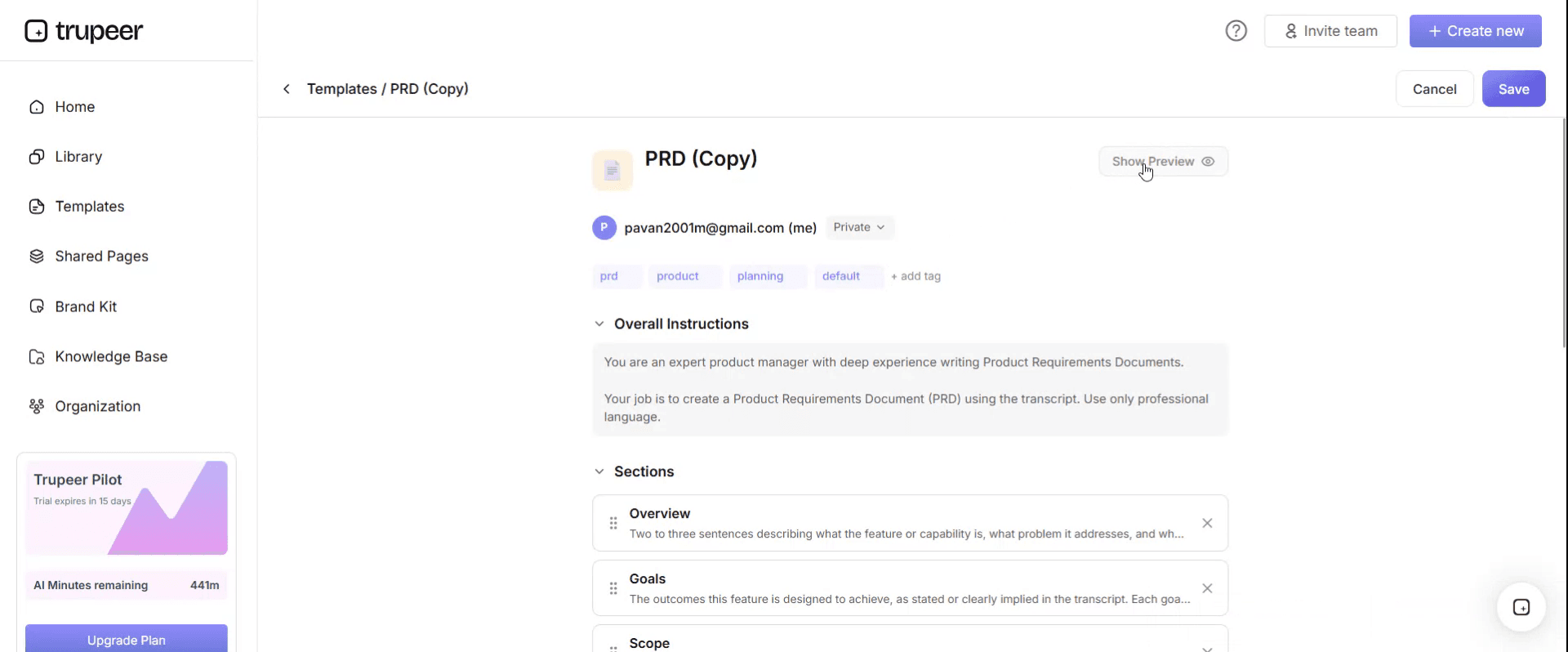
From the preview screen, you can continue to make adjustments directly if needed, ensuring the template appears exactly as you want.
With a pre-crisis communication plan you can:
Save hours when it matters: Pre-built statements cut response time during real crises.
Respond with discipline: Built-in escalation paths prevent panicked decisions under pressure.
Stay on-brand: Apply your logo, fonts and tone using Trupeer's brand kit.
Protect the brand: Coordinated comms protect reputation when crisis hits.
Train leaders before crises: Pair the plan with video briefings for tabletop exercises.
Reach global stakeholders: Translate crisis comms into 65+ languages with one click.
The activation trigger no crisis plan template has
Look at the crisis communication templates in circulation and they will give you a stakeholder matrix, a channel list, a spokesperson list, message principles and an escalation contact tree. All useful. Almost none of them says when the plan starts.
Without that, the plan is dormant precisely during the hours it would be most valuable, because activating it is a judgement somebody has to be brave enough to make.
An activation trigger replaces judgement with a condition. Not "when a significant incident occurs", which is the same judgement in different words, but something observable by whoever is on duty at the time.
A media enquiry from national press. A named regulator making contact. A customer post passing a stated engagement threshold. A retailer, distributor or major client asking about an incident. A system outage passing a stated duration. An employee safety event on site.
Written that way, activation stops being an opinion. The duty manager is not deciding whether this is a crisis. They are observing that a condition on a list has been met, and following the instruction next to it.
How to write triggers, and make standing down free
The second half is as important as the first. If activating is expensive and standing down is embarrassing, nobody activates.
Use tiers, where the lowest one costs almost nothing.
Tier | Trigger examples | Who can call it | What happens |
|---|---|---|---|
1, Monitor | Social post about safety or service passing a stated engagement level; any media enquiry about an incident; unusual complaint volume | Any duty manager | Named group notified, monitoring begins, holding statement located, no external action |
2, Activate | Enquiry from national or trade press; contact from a regulator; a major customer asking questions; outage past a stated duration | Duty manager or comms lead | Core group convened, holding statement issued if needed, spokesperson confirmed |
3, Full response | Confirmed harm, recall, data breach, fatality, or sustained national coverage | Executive on call | Full team stood up, legal engaged, all channels coordinated |
Two rules make the tiers work.
Tier 1 is deliberately cheap. It notifies a small group and starts monitoring. It does not convene anybody, does not require an executive, and does not go on anyone's record.
And standing down is explicitly not a failure. Write that sentence into the plan. Record the number of Tier 1 activations that stood down with no further action and treat a healthy number as evidence the system is working, not as false alarms. An organisation with zero stand-downs in a year is not calm, it is not activating.
Pre-approved crisis holding statements you can write today
The second high value pre-crisis artefact is a small set of holding statements, drafted and approved before anything happens.
The argument for them is simple arithmetic. Roughly eighty percent of a first statement is the same every time: we are aware, we are investigating, here is what we are doing, here is where to get updates, here is who to contact. Only the specifics change. Drafting that eighty percent under pressure, with legal in the room and an executive reading over someone's shoulder, takes hours. Drafting it on a quiet Tuesday takes forty minutes.
Write one for each crisis type you can genuinely anticipate. For most organisations that is five or six: a product or service failure, a safety incident, a data breach, a supply or service interruption, an employee conduct matter, and a site or facility event.
Each statement should have blanks for the facts and no blanks for the position. What you are prepared to say about how seriously you take it, what you are doing, and where people can get updates should already be settled and approved.
Get them approved by whoever would otherwise have to approve them live, and record that approval with a date. An unapproved draft is not a holding statement, it is a document somebody will still have to clear.
Who may speak before anyone has approved it?
Name a chain, not a person. The single most common failure in a real incident is that the named spokesperson is on a plane, on leave, or in surgery.
Three names, in order, each with the authority to issue a Tier 1 or Tier 2 holding statement without further approval. Written down, agreed in advance by whoever holds the risk, and reviewed when anyone in the chain changes role.
Separate the authority to say something from the authority to say anything. The chain can issue the pre-approved holding statement with the facts filled in. Going beyond it, making a commitment, accepting responsibility or speaking on camera is a different decision and stays with the executive.
That split is what lets an organisation respond within the hour without exposing itself. The first statement almost never needs to say anything beyond acknowledgement, and the pre-approval covers exactly that.
Also name who speaks to whom. Press, regulator, customers, employees and suppliers are five different audiences with five different first messages, and a plan that names one spokesperson for all of them will bottleneck immediately.
Free pre-crisis communication plan template: the structure to copy
Copy from here. Keep it to four or five pages and keep a one page summary separately.
Header. Owner. Version and date. Date last tested. Where the current version lives, including an offline copy.
Activation triggers. The tiered table above, with your own conditions and thresholds.
Authority chain. Three names in order, what each may issue without approval, and what remains with the executive.
Core group. Who is convened at Tier 2 and Tier 3, with mobile numbers, and a stated expectation of how quickly they respond out of hours.
Audiences and first messages. Press, regulator, customers, employees, suppliers, and any sector specific body. One line each on who contacts them and what the first message covers.
Holding statements. Five or six, pre-approved, with the approval date on each.
Channels. Which channels you own, who has access to each, and the backup for each. Include what you do if your website or email is the thing that is down.
Facts you will need. A short list of the information a first statement always requires, and where to get it fast. Batch records, incident logs, affected customer counts.
What we will not do. Speculating on cause, naming individuals, commenting on legal matters, blaming a supplier. Agreeing this in advance prevents it happening under pressure.
Stand down. Who calls it, what is recorded, and the explicit statement that standing down is not a failure.
Copy to here.
The food manufacturer that took eleven hours to respond
Rothwell Foods makes chilled products for supermarkets. On a Saturday morning a customer posted a photograph of a foreign object found in one of its products.
Rothwell had a crisis communication plan. Thirty four pages, written three years earlier, reviewed annually, with a stakeholder matrix, a channel list, a spokesperson list and an escalation tree.
It had no activation trigger, no pre-approved holding statement, and no authority below the chief executive to make any public statement.
The post went up at 07:33. The duty quality manager saw it around a quarter past eight and was not sure whether this counted. He called the operations director at half past nine, who said to monitor it. At ten to twelve a national newspaper's consumer desk emailed the general enquiries inbox. At twenty past one the operations director reached the communications lead, who was on leave abroad. The chief executive was reached at twenty to four and a call was convened. The first public statement went out at ten past six in the evening.
Eleven and a half hours from the first post. By then it had reached around three hundred and forty thousand impressions and two retailers had been in touch.
One retailer suspended orders for nine days pending investigation, worth about two hundred and ten thousand pounds. The object was subsequently confirmed as not having originated in Rothwell's process, a conclusion that could have been reached from batch records within about four hours.
The review found nobody at fault. Every individual had acted reasonably at every point. The entire delay sat in deciding whether the situation warranted escalation and in finding somebody permitted to speak.
The changes were all pre-crisis. Three activation tiers with observable triggers. Tier 1 callable by any duty manager, costing nothing, explicitly not recorded against anyone. Six holding statements approved in advance by legal and the chief executive. And a named chain of three people permitted to issue a Tier 1 or Tier 2 statement without further approval.
Fourteen months later a similar situation arose, an allergen labelling query gaining traction on social media. Tier 1 was called by a duty manager twenty two minutes after the first post. Tier 2 was called when a trade publication emailed. The holding statement went out two hours and seven minutes after the first post. No retailer suspended anything, and the original post reached around eleven thousand engagements rather than three hundred and forty thousand.
Over the same period there were nine Tier 1 activations, of which seven stood down within two hours with no further action. That ratio was the point rather than a problem.
How to write a crisis communication plan, step by step
List the crises you can actually anticipate, from your own risk register, your incident history and your sector's recent news. Five or six types covers most organisations.
Write the triggers before anything else, as observable conditions rather than judgements, and test each one by asking whether a duty manager at two in the morning could tell if it had been met.
Set the tiers, and make the lowest one genuinely cheap.
Draft the holding statements and get them approved, with dates.
Name the authority chain, three deep, and agree the split between issuing a holding statement and saying anything beyond it.
Build the contact and channel information last. It is the part every template leads with and the part that goes out of date fastest, so it belongs in an appendix that can be updated without reapproving the plan.
Then test it, which is covered further down and is the step almost nobody completes.
Crisis communication plan examples by sector
The structure holds across sectors and the triggers change substantially.
Schools and universities. Triggers are usually safety, safeguarding or a campus incident, and the first audience is parents or students rather than press. Speed of internal notification matters more than external statement, and the channel plan needs to work when the site network does not.
Healthcare providers. Regulatory notification obligations often have their own clocks that run independently of communication, and those clocks should appear as triggers in their own right.
Food and consumer products. Recall procedures and retailer notification dominate, and the trade audience frequently matters more commercially than the consumer one.
Hospitality and restaurants. Incidents are highly local and highly visual, and the trigger threshold on social engagement should be lower than most organisations set it.
Nonprofits. Funder and trustee notification are audiences that commercial templates omit entirely, and both usually need contacting before the public statement.
Technology and services. Outage duration is the natural trigger, and the status page is a channel that has to work independently of the systems that are down.
Whatever the sector, the pre-crisis decisions are identical. Only the trigger conditions and the audience order change.
What the crisis response and recovery phases need
This page covers the preparation. Two things are worth stating about the phases either side of it.
During the response, the plan's job is to be findable and short. Whoever picks it up may not have written it, may be at home, and may not have access to the network. A one page summary, printed and also stored offline, containing the tiers, the authority chain and the location of the holding statements, is worth more than the full document.
Afterwards, run a review within two weeks while the timeline is still recoverable. Reconstruct it minute by minute from messages and logs rather than from memory, because the useful finding is almost always a gap between two events rather than anybody's decision. Then update the triggers, since a real incident is the best evidence you will ever get about whether your thresholds were set correctly.
For the ongoing communication that follows a crisis, meaning rebuilding a message with customers and the market, our brand campaign communication plan and marketing communication plan template cover the planned side of that work.
Can I get a crisis communication plan template in Word or Excel?
Word for the plan, and print it. This is one of the few documents where a paper copy is not sentimental: if your incident involves your network, your building or your email, an intranet page is inaccessible at exactly the moment you need it. Keep a printed copy with the on-call rota and a copy on personal devices.
Excel for two things. The contact matrix, meaning audiences, owners, channels and out of hours numbers, which changes constantly and needs sorting. And the activation log, recording every Tier 1 and above with the trigger met, who called it, and the outcome. That log is what tells you whether your thresholds are right.
PDF for the approved version and for the one page summary, which should be the thing people actually carry.
How to keep the crisis plan usable when nobody reads it
Every crisis plan has the same underlying problem. It is written once, filed, and read for the first time during an incident by somebody who has never opened it.
Two habits fix most of that, and both are cheap.
Test it twice a year, as a thirty minute tabletop rather than a full exercise. Read out a scenario, ask the duty manager which tier applies, and see whether they can find the holding statement. Most failures surface in the first ten minutes and almost all of them are location and authority problems rather than content problems.
And make the plan something people have seen before they need it. A short recorded walkthrough of what happens at each tier, who gets called and where the statements live, works considerably better than asking people to read thirty four pages. Trupeer AI turns that walkthrough into a written guide and a video from a single recording, so the on-call rota can watch four minutes rather than promise to read the plan later.
Record it. Brand it. Translate it. Trupeer it.
The same material lives in your knowledge base in consistent branding, and where the incident reaches customers directly, our help desk response template covers the front line wording that has to match whatever the holding statement says. For the governance around it, our policy and procedure templates cover approval and review. Setup instructions are in the document template setup guide.
Frequently Asked Questions
Is there a free crisis communication plan template in Word?
The structure above pastes straight into Word or Google Docs, including the trigger tiers and authority chain that standard templates omit. There is no gated download and no form. Print the finished version and keep the one page summary with your on-call rota, because the scenario where you cannot reach the intranet is a real one.
Is there a free crisis communication plan template in PDF?
Export the approved plan and the one page summary to PDF, and store both somewhere reachable without your corporate network. Keep the working version editable, because contact details and thresholds change several times a year and an out of date contact list is the most common practical failure.
Is there a free crisis communication plan template in Excel?
Excel suits the contact matrix and the activation log rather than the plan. The log matters more than people expect: one row per activation with the trigger met, who called it, the tier and the outcome. Reviewing it annually tells you whether your thresholds are set too high, which is the usual direction.
Where can I find a crisis communication plan example in PDF?
Several public bodies, utilities and university systems publish theirs, and they are worth reading for structure. Read them for audience ordering and trigger wording rather than for content, because the thresholds in any published example belong to that organisation's risk profile rather than yours.
What is the difference between pre-crisis and crisis communication?
Pre-crisis is the preparation: triggers, authority, holding statements, channels and testing. Crisis communication is the response itself. The distinction is worth keeping because the preparation is where almost all of the achievable improvement sits, and it is the part that can be done calmly and cheaply.
Who should own the crisis communication plan?
Communications owns the document, and an executive owns the authority decisions inside it. That split matters, because the parts that make the plan work, meaning who may speak and what they may say, cannot be delegated to a communications function. If no executive has signed the authority chain, the plan will not function.
How often should the crisis plan be tested?
Twice a year as a short tabletop, plus a review after any real activation. Full scale exercises are valuable and rare; thirty minute scenario walkthroughs find most of the same problems and actually get scheduled. Update the contact appendix quarterly, since that is what dates fastest.
How long should a crisis communication plan be?
Four or five pages plus appendices, with a one page summary that carries the tiers, the authority chain and where the holding statements live. Thirty page plans are common and are read during an incident by nobody. If only one page survives, make it the summary.