
Use this template
A project management plan is the master playbook for delivering a project successfully. With Trupeer, you can save hours on planning by starting with a free project management plan template, customizing it with your brand identity, and turning the plan into video summaries that align stakeholders fast.
What is a project management plan template?
A project management plan is the document describing how a specific project will be managed: its scope, schedule, cost, quality, resourcing, communications, risk, procurement and stakeholder approach.
In formal method it is the master plan, containing or referencing subsidiary plans for each of those areas. That is what distinguishes it from a project plan, which in ordinary usage often means the schedule alone.
A template for it usually supplies the full set of subsidiary sections, which is why completed versions run to sixty pages and more. That comprehensiveness is not the problem, and this page is not an argument for skipping governance.
The problem is what fills the pages.
The highlight test for any project management plan
Take a completed project management plan from your own organisation. Highlight every sentence that would be different if this were a different project.
Not sentences containing the project's name. Sentences whose content would change: a specific constraint, a named dependency, a decision taken for this project's circumstances, a date that could not move.
Then look at how much of the document is highlighted.
In most organisations it is between fifteen and thirty percent. The remaining seventy to eighty five percent describes how the organisation manages projects generally, and would appear unchanged in the next plan and the one after that.
That is the reason nobody reads these documents. A reader looking for what is specific about this project has to find it inside four times as much material that is not.
How to customize this template in Trupeer
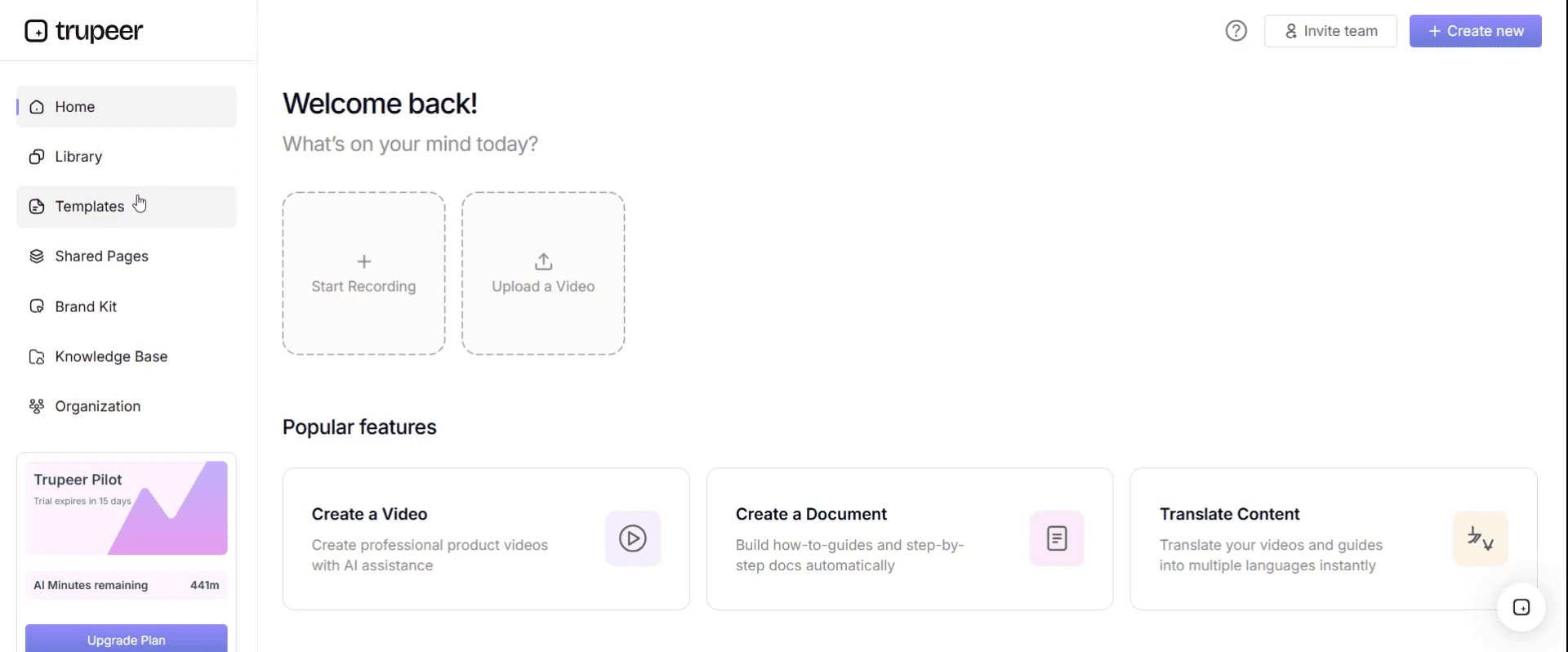
Step 1: Open the Templates Section
Go to the Templates section from the main navigation.
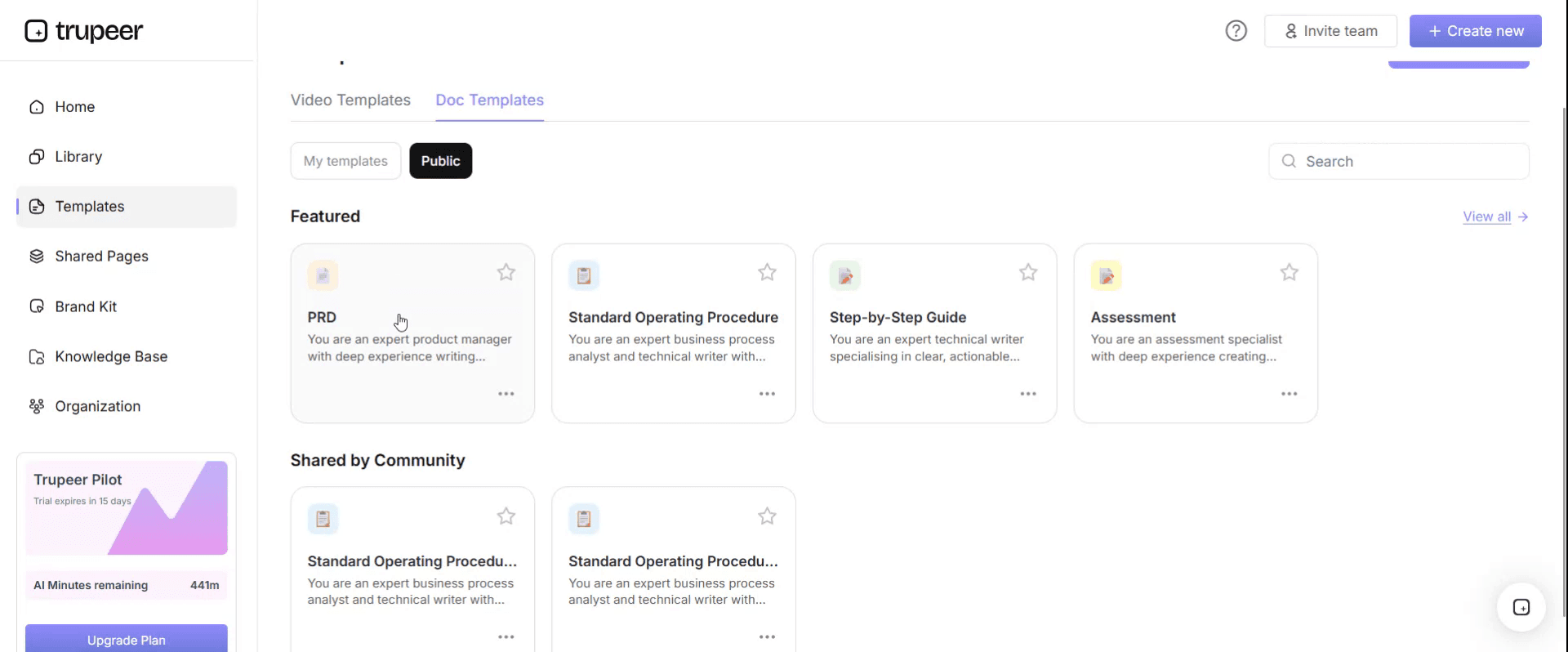
Step 2: Select and Open a Template
Click on any template you want to work with to open it.
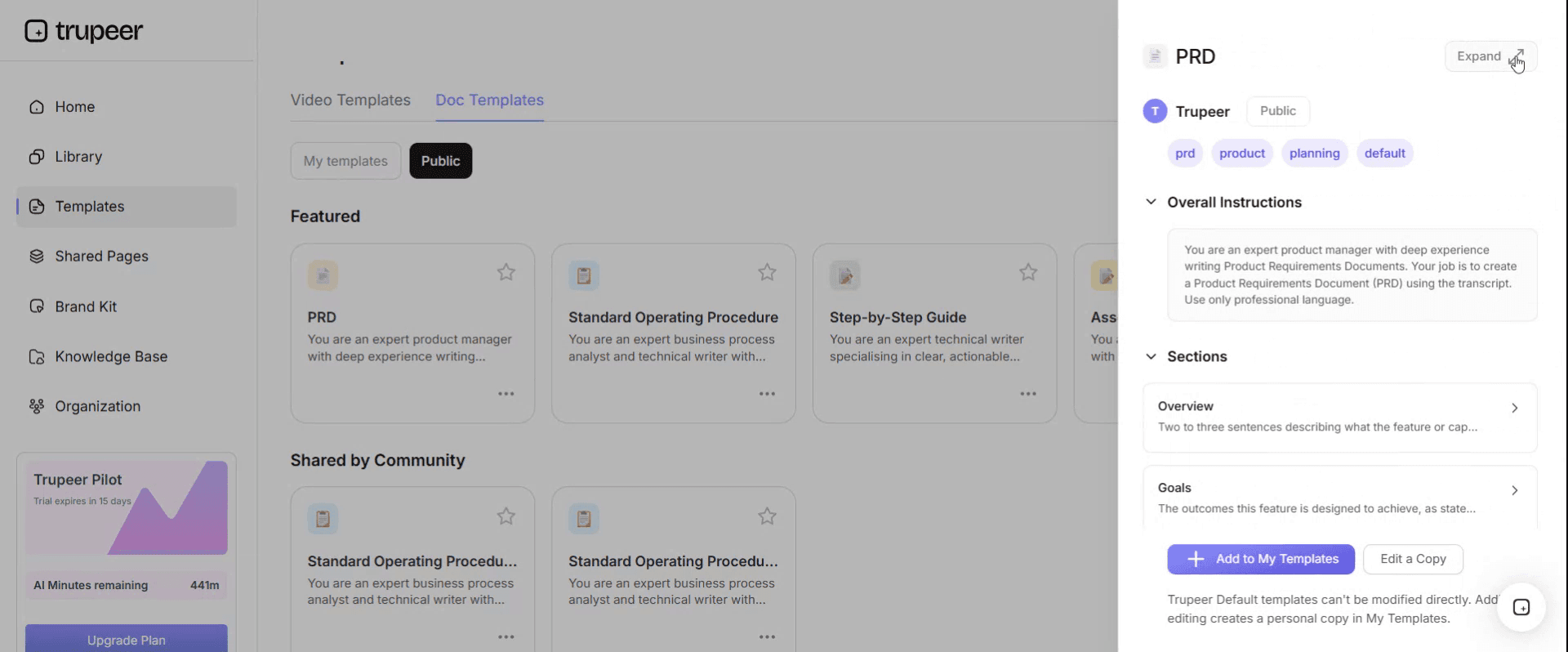
Step 3: Expand the Template View
If needed, expand the template view to see the full layout and details clearly.
Step 4: Edit the Template
Click on Edit to start modifying the selected template.
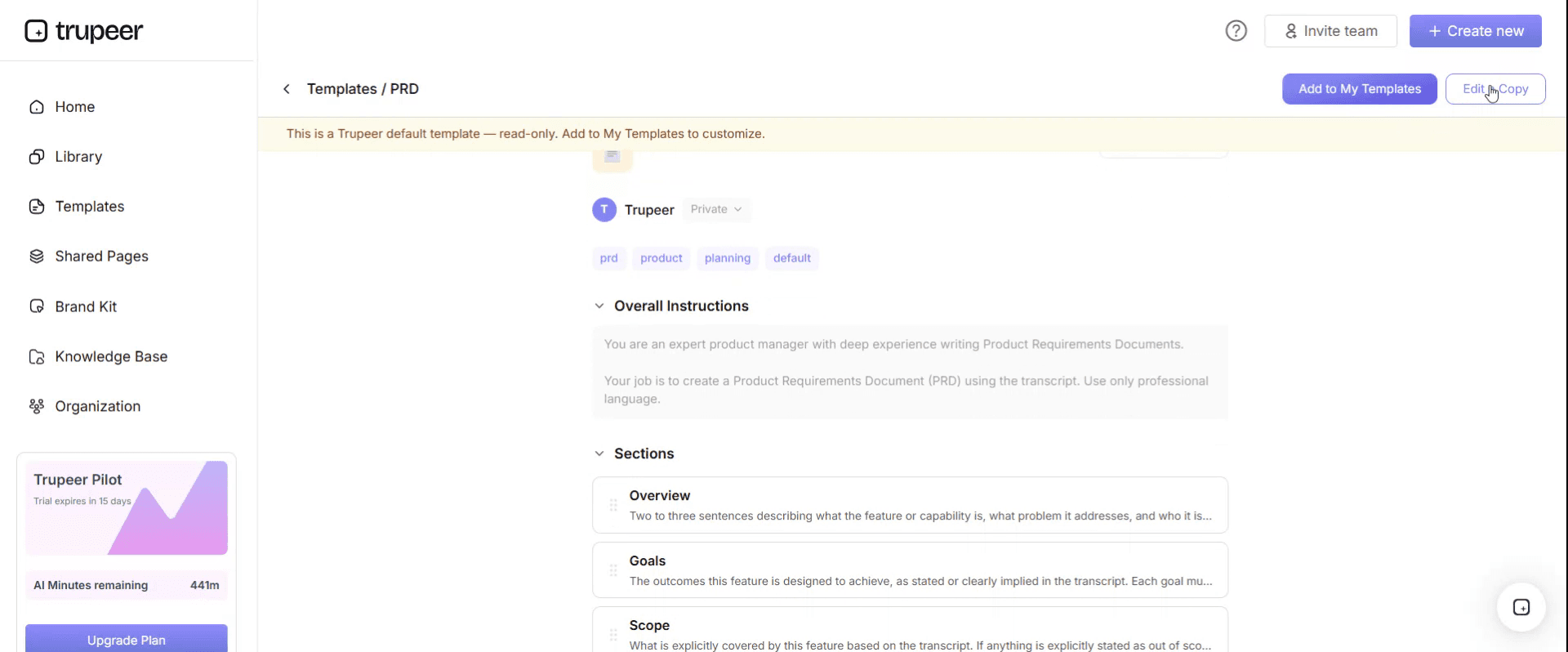
Within the editor, you can:
Add new sections
Define or update formatting rules
Add a logo and adjust its position and related settings
Step 5: Save Your Customized Template
After making all necessary changes, click Save to store the updated template as your own.
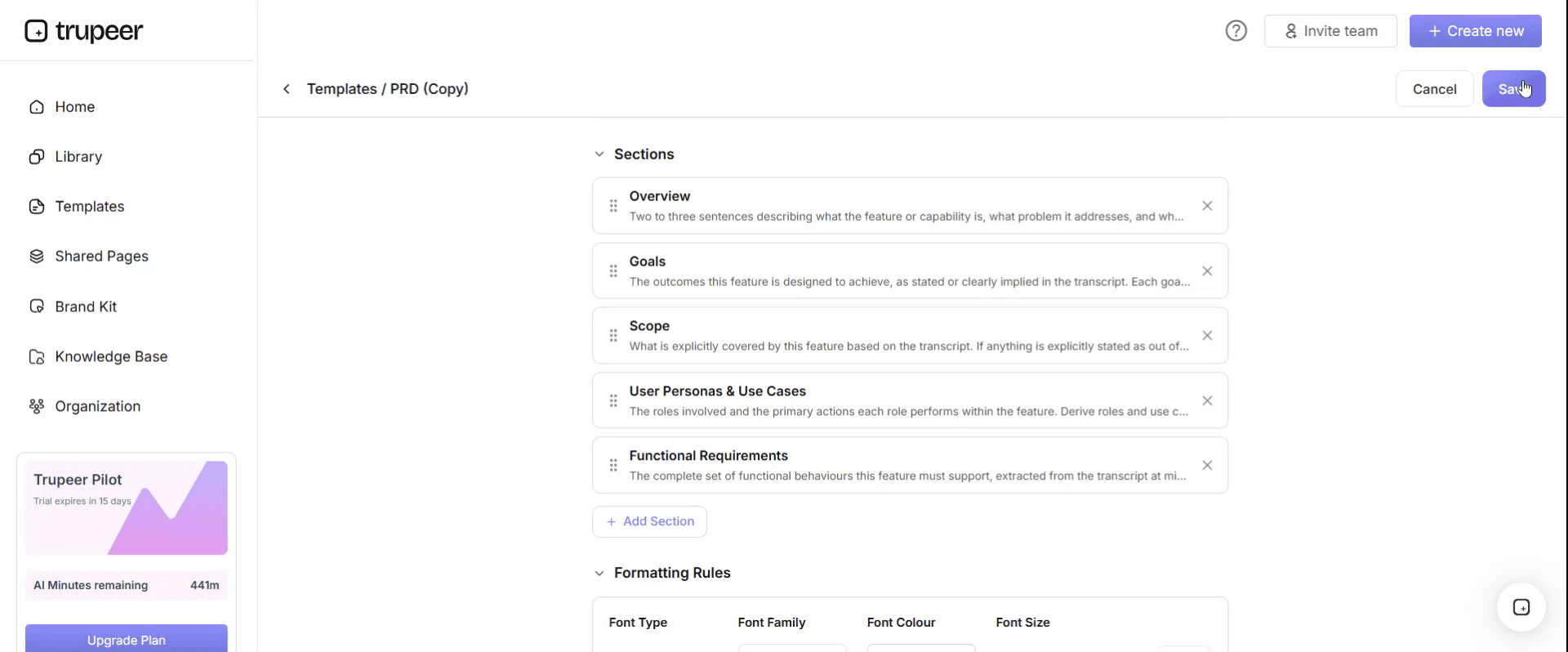
Step 6: Preview and Fine-Tune the Template
When you want to see how your customized template looks, open the Preview.
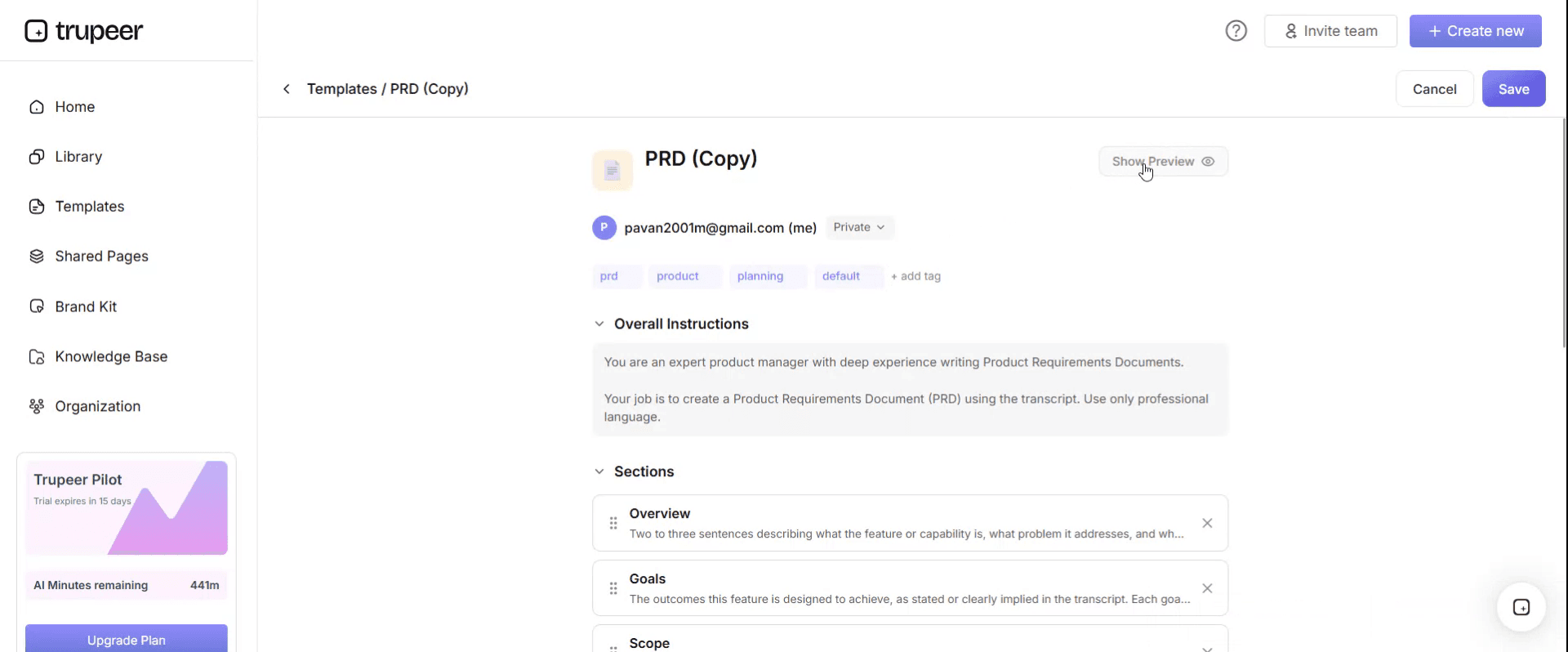
From the preview screen, you can continue to make adjustments directly if needed, ensuring the template appears exactly as you want.
With a project management plan template you can:
Save hours on planning: Skip the blank page with a comprehensive PM structure.
Cover every knowledge area: Built-in sections for scope, schedule, cost, quality and risk.
Stay on-brand: Apply your logo, fonts and colors using Trupeer's brand kit.
Align stakeholders: Convert dense plans into video summaries everyone can absorb fast.
Standardize across projects: Use the same template for every initiative.
Reach global teams: Translate plans into 65+ languages with one click.
Why most of the document would fit any project
The generic content is not there through laziness. It is there because the template asks for it and because governance expects each subsidiary area to be addressed.
So the scope management section says that scope changes will be raised as change requests, assessed for impact and approved by the change board. Which is true, and is how every project at that organisation works, and tells a reader nothing about this project.
The quality management section describes the standard review and testing approach. The communications management section says stakeholders will receive a weekly report. The change control section restates the change control process. All accurate, all identical to the last plan, all consuming the reader's attention.
Meanwhile the genuinely project-specific content, which is what a plan exists to record, sits scattered inside it. A site access restriction. A single-source supplier. A window that cannot move. A stakeholder who has to approve personally. Each of those is a sentence or two, and each is buried.
The fix is not to write less. It is to move the generic material somewhere it can be written once.
How to split the methodology from the plan
Two documents rather than one.
A standing methodology document. How your organisation manages projects. Change control, quality gates, reporting cadence, escalation routes, document standards, roles and their responsibilities. Written once, owned by the project office, referenced by every plan, updated when the method changes rather than when a project starts.
A project management plan. Only what is specific to this project. Every section asks a single question: what is different here?
The rule that keeps the split honest is simple to apply. Any sentence that could appear unchanged in another project's plan gets deleted and replaced with a reference to the methodology.
Applying that rule to an existing sixty page plan typically leaves eight to twelve pages. Those pages are the plan. They are also, for the first time, worth reading.
Two objections come up and both have answers. Auditors and clients sometimes require the full set of subsidiary content, in which case the methodology document satisfies it and the plan references it, which auditors generally accept because the traceability is clearer. And people worry the plan looks thin, which it does, right up until somebody has to use it.
Free project management plan template: the sections to copy
Copy from here. Eight sections, eight to twelve pages, each answering what is different about this project.
Header. Project, sponsor, project manager, budget, dates, methodology document version this plan operates under.
Objectives and success criteria. What this project must achieve, as measures rather than deliverables, taken from the project brief rather than reinvented.
Scope and boundary. What is in, what is out, and specifically what is out that people have asked for. Reference the change process rather than describing it.
Immovable constraints. Dates, windows, freezes, regulatory deadlines, possession or access periods, contract notice dates. Anything the project cannot move, with its owner. Our IT project plan template covers building this properly, and it is the section most worth extracting to a single page.
Resourcing and capacity. Who is committed, for how much of their time, and what they are not doing instead. Name the individuals whose availability the plan actually depends on.
Procurement approach. What is being bought, on what basis, with lead times. Our procurement management plan template covers this as a subsidiary plan where the project warrants one.
Project-specific risks. Only risks particular to this project, each with a trigger and an owner. Generic risks belong in the methodology's standing risk list.
Deviations from methodology. Where this project will do something differently from the standard approach, and why it was agreed. This section is short, and it is the one auditors read first.
Copy to here. Subsidiary plans are attached where the project's scale justifies them, and referenced where it does not.
The rail engineer whose possession window sat on page 41
Kelvedon Rail is an infrastructure engineering business of about sixteen hundred people, running around thirty four projects a year above its two hundred and fifty thousand pound threshold, each of which required a project management plan.
The template carried eleven subsidiary plans and completed versions averaged sixty eight pages.
Somebody ran the highlight test on twelve of them. Median highlighted content: nineteen percent.
The scope, quality, communications and change control sections were near-identical across all twelve, and in nine cases word for word, because each author had started from the previous plan. Two of the twelve still contained another project's name in the body text.
The project office also tracked document opens. Across those twelve plans, the median number of times anyone opened the document after approval was three. Two were never opened again by anybody.
The consequence surfaced on one project. A track possession window, a genuinely immovable date agreed months in advance with the infrastructure owner, was recorded on page forty one of the plan and nowhere else. The delivery team planned work for a week when access was not available. Three weeks were lost, at an estimated cost of a hundred and eighty six thousand pounds.
The information had been documented. It had been approved. It was inside sixty eight pages, four fifths of which described how Kelvedon manages projects in general.
The rebuild produced two documents. A methodology document of about forty pages, written once and owned by the project office. And a project management plan template of eight sections, targeting eight to twelve pages, where every section asks only what is different about this project.
Across the following twenty one projects, median plan length was eleven pages and median opens after approval was fourteen. The highlight test on eight of them returned a median of eighty one percent project-specific content.
The immovable constraints now also sit on a one page annexe, extracted from the plan and circulated separately, because the lesson from the possession window was that important dates should not be findable only by reading.
The subsidiary plans, and which ones you actually need
Subsidiary plan | Needed as a separate document when | Otherwise |
|---|---|---|
Scope management | Scope is genuinely contested or contractual | Reference the methodology, state the boundary in the plan |
Schedule management | Multiple interdependent workstreams | The schedule itself is the artefact |
Cost management | Capital project, staged funding, or client billing | Reference finance's standing process |
Quality management | Regulated output, or a client-specified standard | Reference the methodology |
Resource management | Scarce specialist people are the binding constraint | Name the individuals in the plan |
Communications management | Many external stakeholders or a public-facing change | Reference the standing reporting cadence |
Risk management | High consequence, or a formal risk appetite applies | Project-specific risks in the plan, generic ones in the methodology |
Procurement management | Significant buying, especially where specification maturity varies | Our procurement plan template, referenced |
Stakeholder management | Politically complex, or approval depends on individuals | Name them in the plan |
Change management | Adoption is the main risk rather than delivery | A separate plan is usually justified here |
The honest position is that most projects need two or three of these as separate documents and reference the rest. Producing all ten because the template lists ten is what generates a sixty page plan that nobody opens.
How to create a project management plan, step by step
Start from the brief, so the plan serves an agreed problem rather than restating an approach.
Write the immovable constraints first. They determine what is possible and they are the section most likely to change the rest.
Fill each remaining section by answering only what is different here. If the honest answer is nothing, write the reference and move on.
Name individuals wherever the plan depends on a person's availability, and check with them.
Decide which subsidiary plans warrant separate documents using the table above, and reference the others.
Write the deviations section last, once you know where this project departs from the standard approach.
Then apply the highlight test to your own draft before circulating it. Anything unhighlighted is a candidate for deletion.
The key phases a project management plan must cover
The plan should say something project-specific about each phase, and for most projects that something is short.
Initiation. What authorised this and against what success criteria.
Planning. The constraints, the resourcing and the approach decisions. This is where most of the plan's content sits.
Execution. What is different about how this project will be delivered, including any deviation from the standard method.
Monitoring and control. What will be watched that is unusual for this project, rather than the standard reporting cadence.
Closure and handover. Who receives the output and what they need in order to accept it, which our project handover checklist template covers, and it is worth agreeing at planning rather than at closure.
The phase where plans are weakest is the last one, because it is furthest away when the plan is written. Naming the receiving team and their acceptance criteria at planning is the single most valuable thing the closure section can contain.
Common project management methodologies, and what changes
The plan's shape shifts with method and the highlight test applies to all of them.
Waterfall or stage-gate. The full subsidiary set is conventional here and the discipline of splitting methodology from plan matters most, because the templates are heaviest.
Agile. Much of what a traditional plan documents lives in the way of working instead. The plan still needs the immovable constraints, the resourcing commitment, the procurement approach and the deviations. What it does not need is a scope management plan for a scope that is deliberately emergent.
PRINCE2. The project initiation documentation performs this role and its structure is prescribed. The methodology split still applies, since PRINCE2 explicitly expects tailoring and the tailoring is what a reader needs to see.
Hybrid. The most common reality, and the one where the deviations section earns its place, because a hybrid project is by definition departing from a standard method in specific ways that need recording.
Whichever method applies, the plan's job is the same: record what is particular to this project. The method determines where the generic material lives, not whether it belongs in the plan.
Simple or full: how long should the plan be?
Both extremes appear in what people search for, which suggests the question is genuinely unresolved: some want a simple one-page template, others want a full plan document.
The resolution is that they want different halves of the same thing. A simple project management template is usually the schedule and task list, which is an operational artefact. A full project management plan is the governance document. Both are legitimate and neither is the other.
For the plan specifically: eight to twelve pages for a substantial project, two or three for a small one, plus whichever subsidiary plans genuinely warrant separate documents. If your governance requires more, produce the methodology document and reference it, which satisfies the requirement without producing a document nobody reads.
The number worth tracking is not pages. It is opens after approval, which most document systems will tell you and which almost nobody looks at.
Project management plan or project plan?
The terms are used interchangeably and the distinction is worth keeping.
A project management plan describes how the project will be managed: the approach, the constraints, the governance, the subsidiary plans. It is a governance document, approved once and revised on change.
A project plan, in ordinary usage, usually means the schedule: tasks, dependencies, durations and owners. It is an operational artefact, updated weekly.
Confusing them produces two familiar failures. A governance document with a Gantt chart in it, which is out of date within a fortnight. Or a schedule presented as a plan, which contains no constraints, no resourcing commitment and no acceptance criteria.
Keep them separate and let each be updated on its own cycle. Our IT project plan template covers the planning side including the constraint calendar, and our project documentation template covers which of the resulting documents are worth keeping after closure.
Can I get a project management plan template in Excel?
Excel for the artefacts that are tables and get updated: the schedule, the resource commitment by person, the risk register, the constraint list with owners and dates, and the procurement package list with lead times.
Word or Google Docs for the plan itself, which is prose describing decisions and gets approved rather than tracked.
PDF for the approved version, exported and dated. Because the plan is what people cite when something is disputed, a frozen approved version matters.
Most organisations end up with the plan in a document and four or five linked spreadsheets, which is the right arrangement. What does not work is either extreme: a plan entirely in a spreadsheet loses the decisions, and a plan entirely in a document means the tables go stale.
How to keep the plan's project-specific content visible
The lesson from the worked example is not really about length. It is that important project-specific content becomes invisible when it is surrounded by generic material, and no amount of good writing fixes that.
Two habits help. Extract the immovable constraints onto a single page and circulate it separately, because those are the items where being missed is most expensive. And keep the methodology document genuinely current, since the moment it is out of date people start restating it in plans again.
Trupeer AI is useful for the second of those. The methodology document describes processes, and processes change: a new change control tool, a different reporting route, a revised approval path. Recording the process once produces a written procedure with the steps and screens already captured, so the methodology can be kept accurate cheaply rather than drifting until nobody trusts it.
Record it. Brand it. Translate it. Trupeer it.
That matters because the whole split depends on the methodology being trustworthy. A plan that references a methodology nobody believes is current will start restating it within two projects. The SOP creator covers those procedures and they live in your knowledge base in consistent branding. Setup instructions are in the document template setup guide.
Frequently Asked Questions
Is there a free project management plan template in Excel?
Excel suits the tables the plan depends on: schedule, resource commitment, risk register, constraints with owners, procurement lead times. There is no gated download and no form. Keep the plan itself as a document and link the sheets, since the two are updated on different cycles.
Is there a free project management plan template in Word?
The eight section structure above pastes straight into Word or Google Docs. Apply the highlight test to your first draft before circulating it, since the exercise usually removes more than it adds and produces the version people will actually open.
Is there a free project management plan template in PDF?
Export the approved plan and keep the working version editable. The plan is the document cited when scope or approach is disputed, so a dated frozen version is worth having alongside the live one.
Where can I find a full project management plan in PDF?
Published examples with the complete subsidiary set are easy to find, including from public bodies and universities, and they are useful for seeing the conventional structure. Read one and run the highlight test on it: most published examples are substantially methodology restatement, which is exactly why they are safe to publish.
Is there a simple project management template in Excel?
Yes, and it is usually the schedule and task list rather than the plan. Both are worth having. The schedule tracks the work; the plan records the constraints, resourcing and approach decisions. Reaching for the simple template when you need the plan is how projects end up with no record of what was agreed.
Do I need project plan software?
Not to write the plan, which is a document. Software earns its place for the schedule once you pass roughly thirty live tasks with changing dependencies and more than a handful of people updating status. Below that a spreadsheet is faster and everybody already has one.
Who should write the project management plan?
The project manager, with the sponsor approving and the project office confirming which subsidiary plans are required. Where a subsidiary plan covers another function's work, such as procurement, that function should write it rather than the project manager guessing at their lead times.
How often should the project management plan be updated?
On change rather than on a cycle. When a constraint moves, when resourcing changes, when the approach deviates from what was approved, or when scope changes. The schedule updates weekly and the plan does not, which is the practical reason for keeping them as separate documents.

