Use this template
Strong procurement management protects budgets, manages vendor risk and unlocks better outcomes. With Trupeer, you can save hours on procurement planning by starting with a free procurement management plan template, customizing it with your brand guidelines, and turning the plan into video walkthroughs for project teams and stakeholders.
What is a procurement management plan template?
A procurement management plan sets out how a project or programme will buy what it needs: what is being procured, from whom, under what kind of contract, on what timescale, who approves what, and how suppliers will be managed once appointed.
It sits inside a project plan rather than replacing it, and it is distinct from a procurement policy, which is a standing set of rules applying to all purchasing rather than to one piece of work. Our IT procurement policy template covers that document, including approval routing and thresholds.
The template for a procurement management plan is well established and largely stable across sources. Introduction, approach, definitions, contract types, risks, cost determination, standard documentation, constraints, approval process, decision criteria, vendor management and performance metrics. The version ranking first for this search has fourteen sections in almost exactly that order.
That structure is fine and this page does not argue with it. What it argues is that one of those sections carries almost all the consequence and every template treats it as a box to fill.
Why the contract type section decides everything else
Look at what the other sections do. Approach, definitions, standard documentation and constraints describe the process. Approval and decision criteria describe governance. Risks and vendor management describe monitoring.
Contract type is different. It determines who carries the risk of things you have not thought of, how change is priced, whether you have competitive tension after signature, and what your dispute exposure looks like. Every cost outcome on the project runs through it.
It is also the section most often completed in a single line, at project initiation, for all packages at once, with a rationale along the lines of transferring risk to suppliers and giving cost certainty.
Fixed price feels like the safe answer, and it is the safe answer when you can describe what you want. When you cannot, it does not transfer the risk. It converts the risk into a change control process, and change orders are priced without competition by a supplier who now has you.
How to customize this template in Trupeer
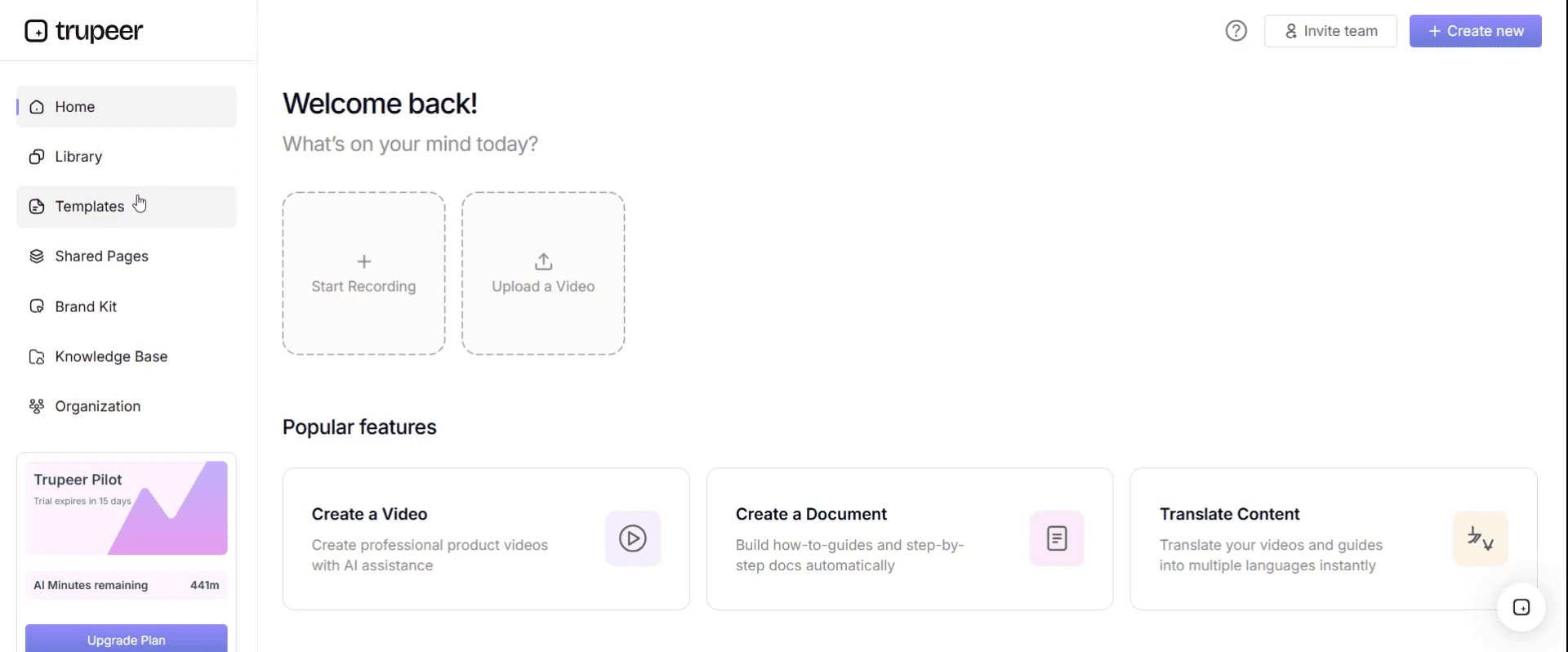
Step 1: Open the Templates Section
Go to the Templates section from the main navigation.
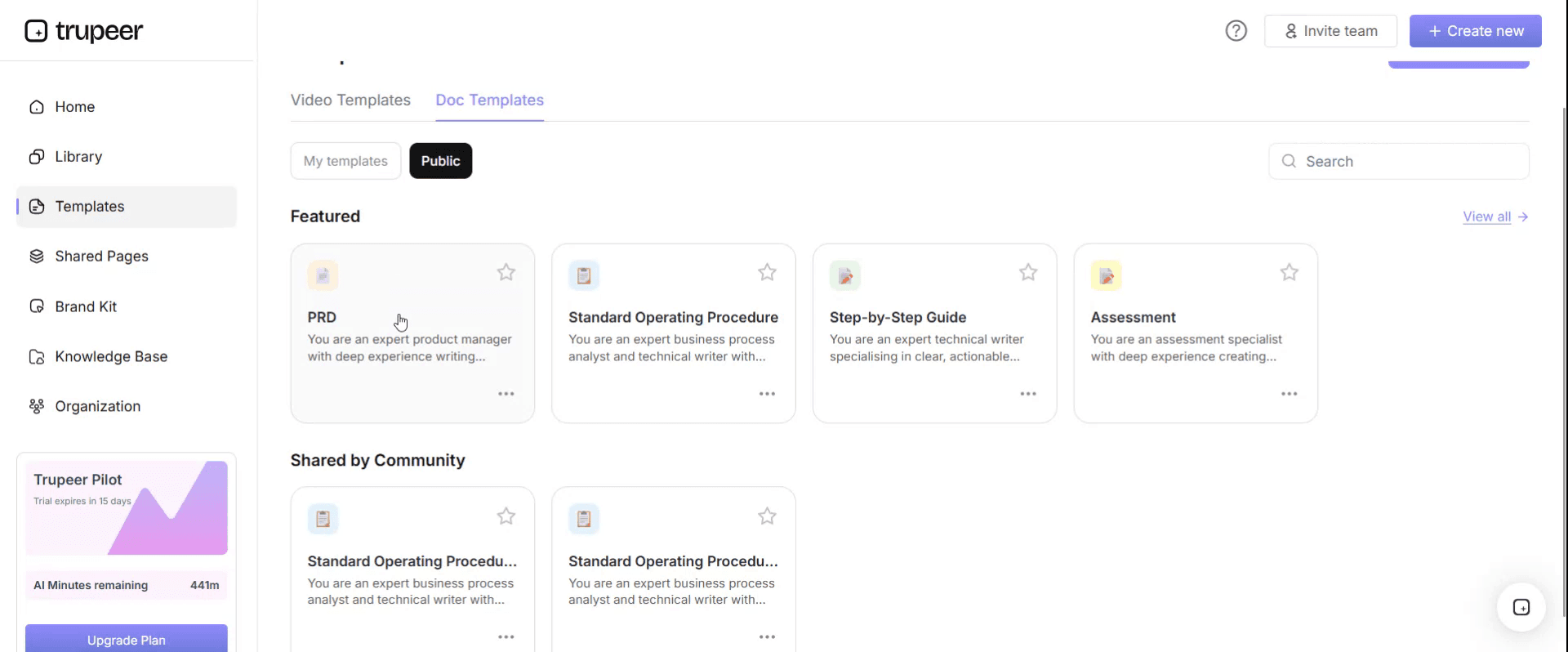
Step 2: Select and Open a Template
Click on any template you want to work with to open it.
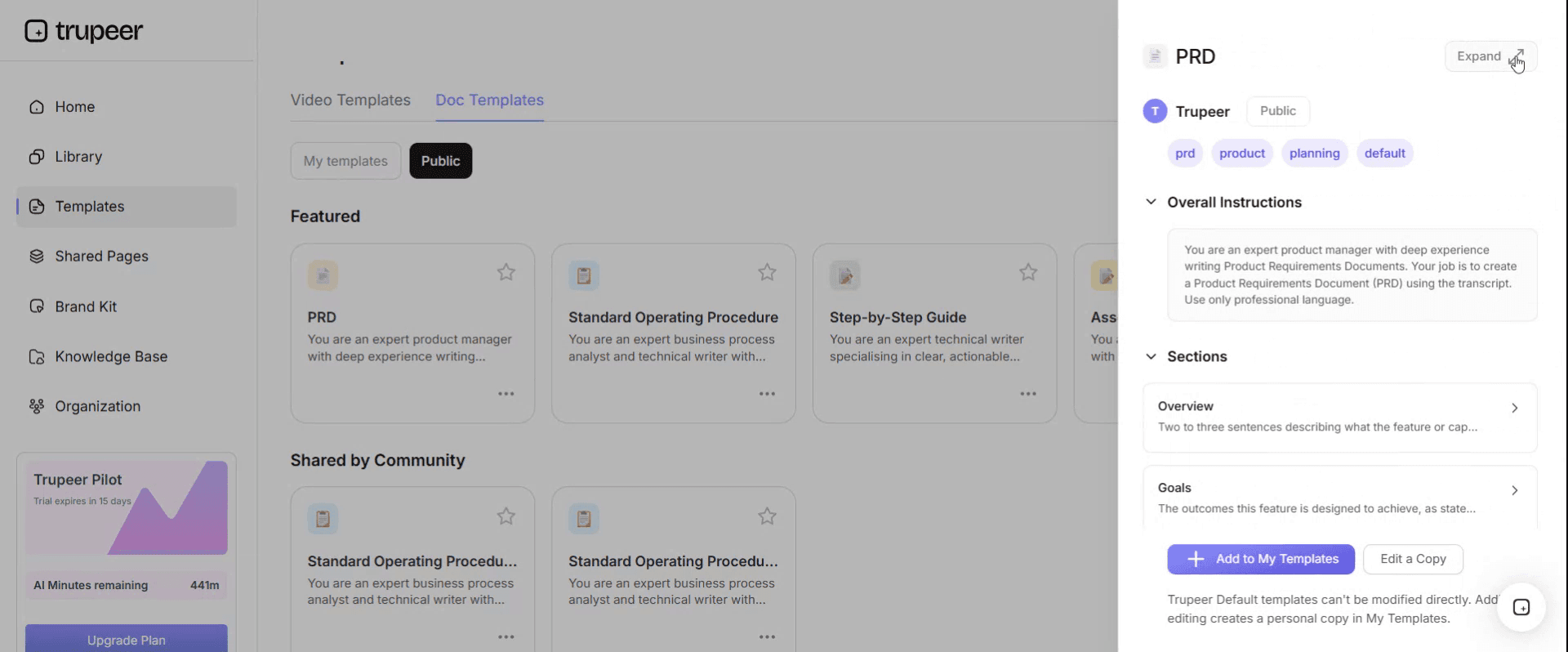
Step 3: Expand the Template View
If needed, expand the template view to see the full layout and details clearly.
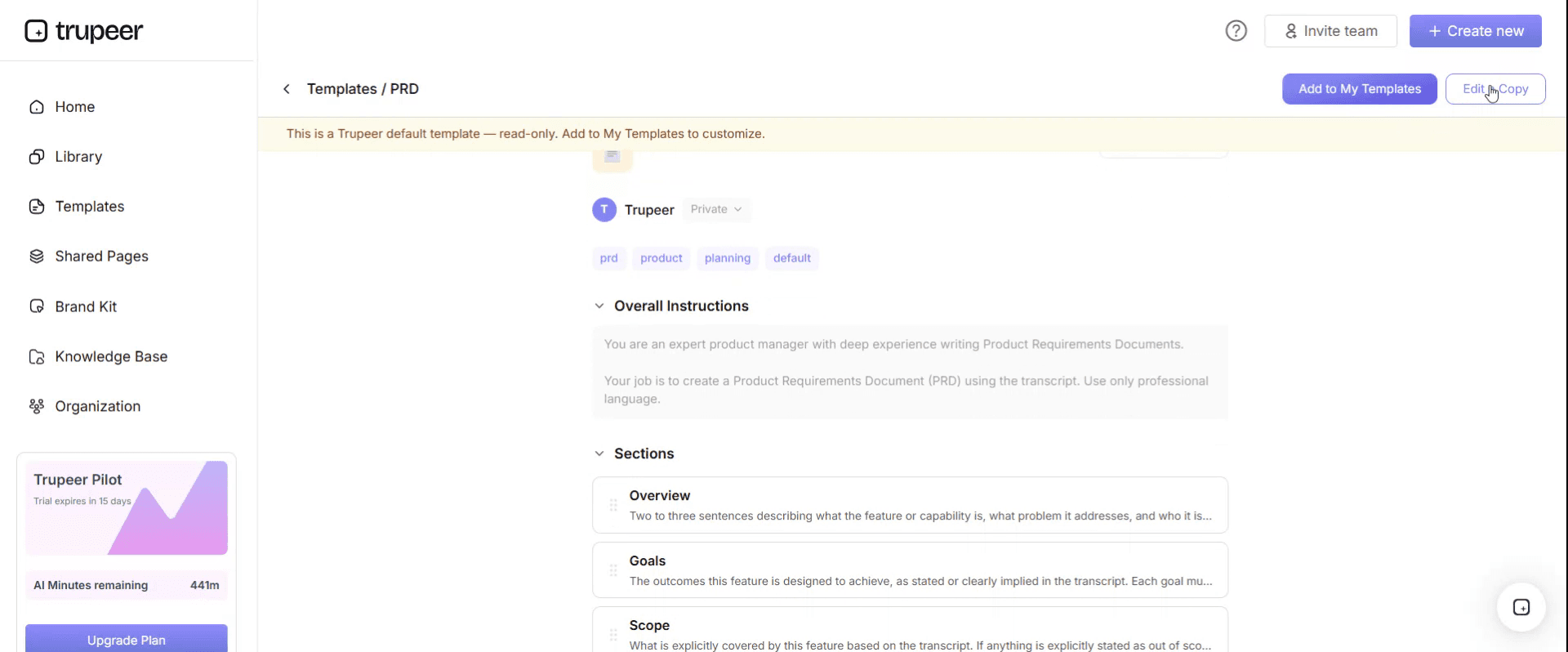
Step 4: Edit the Template
Click on Edit to start modifying the selected template.
Within the editor, you can:
Add new sections
Define or update formatting rules
Add a logo and adjust its position and related settings
Step 5: Save Your Customized Template
After making all necessary changes, click Save to store the updated template as your own.
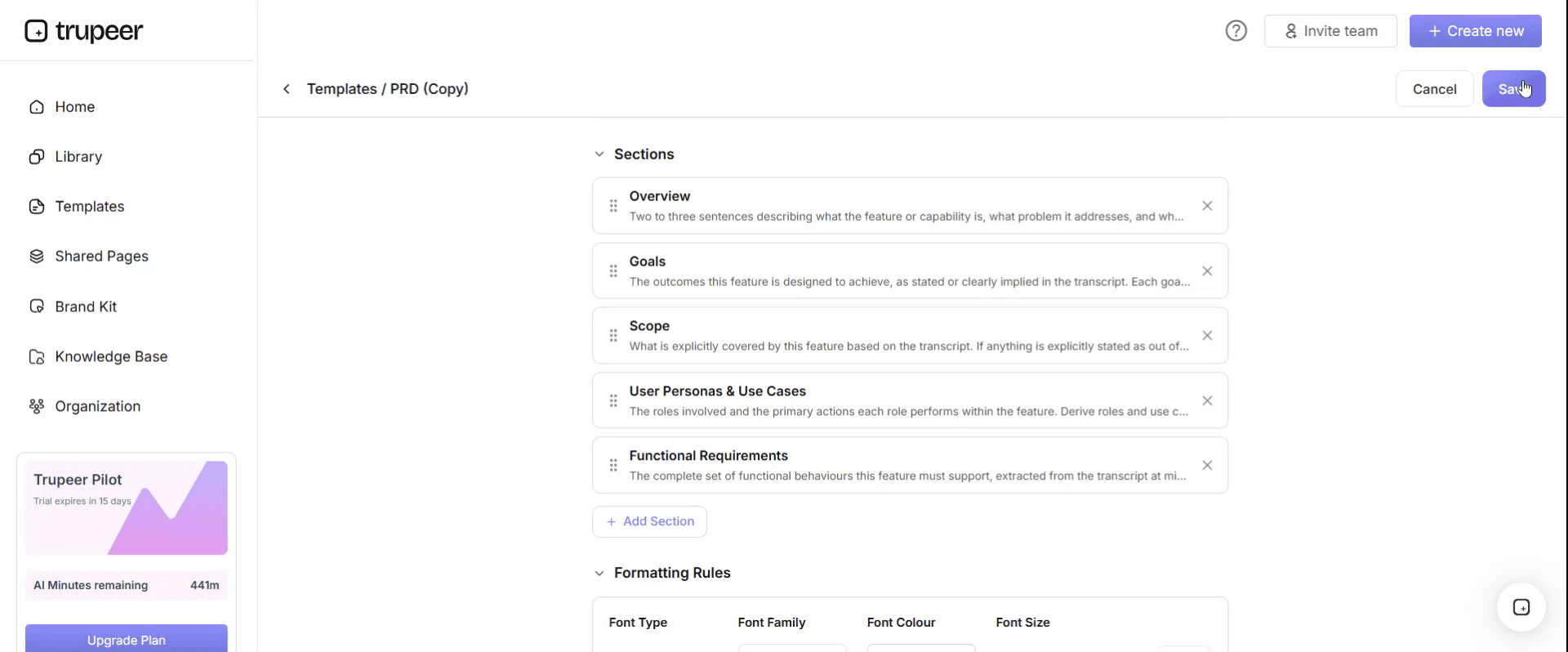
Step 6: Preview and Fine-Tune the Template
When you want to see how your customized template looks, open the Preview.
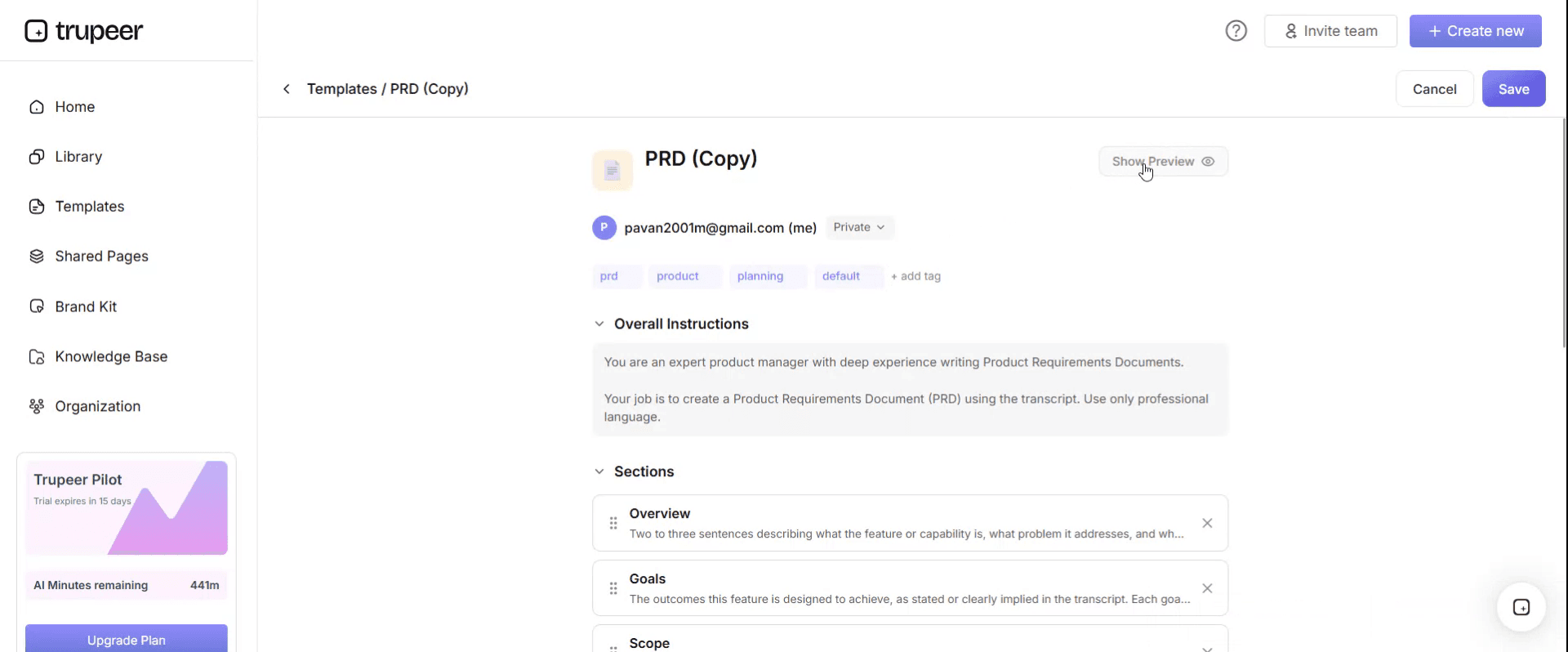
From the preview screen, you can continue to make adjustments directly if needed, ensuring the template appears exactly as you want.
With a procurement management plan template you can:
Save hours on planning: Skip the blank page with a structure built for procurement.
Manage vendor risk: Built-in evaluation criteria reduce vendor-related project risk.
Stay on-brand: Apply your logo, fonts and colors using Trupeer's brand kit.
Improve value: Structured evaluation drives better outcomes than ad-hoc selection.
Standardize across projects: Use the same template for every procurement.
Reach global teams: Translate procurement plans into 65+ languages with one click.
Match contract type to specification maturity, not appetite
The useful question is not how much risk we want to transfer. It is how completely can we describe this thing right now.
That question has an answer per package, and the answers vary enormously within the same project. Building works might be ninety percent designed while the control system that integrates everything is at fifteen percent, because it cannot be specified until the rest is settled.
Choosing one contract type for all of them, at the moment the plan is written, guarantees that the least defined packages are bought on the least suitable basis.
The alternative is straightforward. Rate each package for specification maturity, choose the contract type from that rating, and where the rating is low, say in the plan that the contract type will be decided at a stated design milestone rather than now.
That last part is what most project managers resist, because a plan that defers a decision looks incomplete. A plan that makes the decision on no information looks complete and costs considerably more.
How to rate specification maturity per package
Specification maturity | What it means | Contract approach that fits | Re-decision point |
|---|---|---|---|
Above 80 percent | Scope, quantities and performance are defined and unlikely to move | Fixed price, competitively tendered | None needed |
50 to 80 percent | Core scope defined, detail outstanding | Fixed price for the defined scope with a provisional sum, or target cost with a pain and gain share | At detailed design sign-off |
20 to 50 percent | Direction agreed, solution not settled | Two stage: appoint on capability and rates, convert to fixed price when design firms up | At the stated design milestone |
Below 20 percent | Cannot describe the deliverable | Time and materials with a cap, or defer procurement entirely | Reassess at each design gate |
Rate the packages with the person who will have to write the specification, not with the person who wants the certainty. Those are usually different people and they will give different answers.
Two practical notes. The percentage is a judgement rather than a measurement, and that is fine; what matters is the conversation it forces. And a package that everybody rates differently is itself a finding, because it means the scope is not agreed even internally.
Free procurement management plan template: the sections to copy
Copy from here. The section marked with an asterisk is the addition.
Introduction and scope. What this plan covers, which project, and which purchases fall outside it.
Procurement approach. How buying will be organised: centrally or by workstream, which existing framework agreements or approved supplier lists apply, and what is being made rather than bought.
Procurement packages. One row per package: what it is, estimated value, required by date, and the internal owner.
Specification maturity and contract type. For each package, the maturity rating, the contract approach it implies, and where relevant the date at which the contract type will be confirmed.
Lead times and dates. Working backwards from need-by dates: specification complete, tender issued, responses due, evaluation complete, award, mobilisation, delivery.
Cost determination. How estimates were produced, their confidence level, and what contingency is held and by whom.
Approval and authority. Who approves at what value, referencing your standing procurement policy rather than restating it.
Evaluation and decision criteria. The weighting between price and quality per package, agreed before tenders are issued rather than after they arrive.
Standard documentation. Which templates and contract forms will be used, so that packages do not each invent their own.
Procurement risks and contingency. Including single source exposure and what happens if a supplier fails, covered below.
Vendor management. Who manages each supplier after award, meeting cadence, and how performance is measured.
Constraints and assumptions. Anything that limits choice: existing agreements, regulatory obligations, funder conditions, sustainability requirements.
Copy to here. Twelve sections and four or five pages for most projects. The fourteen section versions in circulation are not wrong, they are just written for large programmes.
The bottling line with forty seven change orders
Ravensgate Beverages built a new bottling line, a capital project of about eight point four million pounds, split into nine procurement packages.
The procurement management plan was written in February at project initiation. Its contract type section said fixed price for all nine packages, with the rationale recorded as transferring risk to suppliers and giving cost certainty.
Specification maturity at that point was not uniform and nobody had asked. Civils and building works were around ninety percent designed. The filler and capper, the main equipment, was about eighty five. Utilities were around seventy, labelling sixty, palletising fifty five, the clean in place system forty five, conveyors and accumulation forty because they depended on the final line layout, controls and integration about fifteen because they depended on everything else, and commissioning support around ten.
All nine were let as fixed price contracts between April and August.
The four packages with the lowest maturity produced forty seven change orders between them over the life of the project. Controls and integration alone accounted for twenty three.
Change order value on those four packages came to one point three one million pounds against an original contract value of two point six million. A fifty percent uplift.
The more expensive part was the rate. Change orders are priced by an incumbent without competition, and the project's own closeout review estimated the effective uplift against tendered rates at around twenty two percent, so something near two hundred and eighty thousand pounds of pure premium on work that would have been cheaper had it been tendered.
There were also two disputes, one reaching mediation, and about eleven weeks of schedule slip attributed to change order negotiation rather than to the work itself.
The five well specified packages generated six change orders in total, worth eighty four thousand pounds, with no disputes.
The root cause was a single decision made once, for everything, in February, on the basis of a general preference rather than on whether anything could actually be specified.
The following project, six point one million pounds, rated every package for specification maturity at plan stage. Packages above eighty percent went fixed price. The two lowest went two stage, appointed on capability and rates, converting to fixed price in month five once the design settled. The plan stated those conversion dates explicitly.
Fourteen change orders, three hundred and ten thousand pounds against six point one million, and no disputes.
Who writes the plan, and who has to agree it
Procurement management plans are usually written by the project manager. That is the wrong author working alone, for a specific reason.
The project's definition of success is getting the thing by the date. Procurement's definition includes a defensible process, genuine competition, a contract that holds up and compliance with whatever rules apply. Both are legitimate and they produce different plans.
A plan written by the project alone assumes procurement will move at project speed, which it will not, and treats the process as an administrative step rather than as work with its own duration and its own constraints.
A plan written by procurement alone tends to be thorough about process and vague about need dates.
Write it jointly and have both sign it before the project schedule is baselined. The specific thing to agree at that meeting is the lead time for each package, because that number, once agreed, cannot then be argued away when the schedule gets compressed.
Where the organisation is bound by public procurement rules, funder conditions or regulated tendering requirements, involve whoever owns that compliance at the same meeting rather than at tender stage. Nothing here is legal advice, and public sector and grant funded procurement in particular carries obligations that vary by jurisdiction and can invalidate an award if missed.
How to create a procurement management plan, step by step
List the packages first, at the level you will actually contract at. Too granular and you create administrative load; too coarse and you bundle things with different maturity into one contract, which is how the problem in the worked example happens.
Rate each package for specification maturity with the person who will write the specification.
Choose the contract approach from the rating, and where you are deferring, write the date at which the decision will be made.
Work backwards from need-by dates through the full procurement cycle, and be realistic about evaluation and approval, which are the steps most often underestimated.
Set evaluation criteria and weightings before any tender is issued. Agreeing them after responses arrive is both slower and, in regulated procurement, potentially fatal to the process.
Identify single source exposure and decide what you will do about it.
Then agree the whole thing with procurement and get the lead times locked into the schedule.
What to do about single source and supplier failure
The section almost every procurement plan omits is what happens when a supplier does not deliver.
Three questions are worth answering in the plan rather than in the moment.
Where are you single sourced, and is that a choice or an accident? Some packages genuinely have one credible supplier. Others end up single sourced because nobody looked. Record which is which, because the mitigation differs.
What is the fallback for each critical package? Another supplier, a different technical solution, doing it in house, or delaying. Naming it costs nothing at plan stage and takes weeks to work out under pressure.
What are the early warning signs and who is watching? Missed milestones, changes in the supplier's own team, payment behaviour, press coverage. Assign this to the person managing the supplier relationship rather than leaving it to be noticed.
For packages where failure would stop the project, consider paying for optionality: a second supplier on a smaller scope, a longer notice period, or staged commitment rather than a single award.
A simple procurement plan for smaller projects
The fourteen section versions in circulation are written for large capital programmes, and using one on a two hundred thousand pound project produces a document nobody reads. Two of the most common searches around this term ask specifically for a simple version, which suggests the mismatch is widely felt.
The short version is one page and five things.
A package list with values and need-by dates. A specification maturity rating and contract approach per package. The lead time working back from each need-by date. Who approves at what value. And the single source exposures with their fallbacks.
That is a genuine procurement management plan. It contains every decision that changes an outcome and none of the process description that a policy already covers.
Scale up from there when the project's value or its governance requires it, rather than starting from the full structure and cutting.
Procurement management plan or procurement policy?
Two documents, frequently confused, with different owners and lifespans.
A procurement policy is standing. It applies to all buying across the organisation, sets thresholds and approval routes, and changes rarely. It exists whether or not there is a project. Our IT procurement policy template covers a worked example of one, and our policy and procedure templates cover the wider governance set.
A procurement management plan is project specific. It applies to one piece of work, describes how that work's buying will be organised within the policy, and ends when the project does.
The plan should reference the policy rather than restate it. Where a plan repeats approval thresholds, the two go out of step the first time the policy changes, and people follow whichever document is nearer.
If you find yourself writing rules that would apply to purchases outside this project, you are writing policy and it belongs elsewhere.
Can I get a procurement management plan template in Excel?
Excel for the package table, which is the operational heart of the plan. Columns for package, value, need-by date, specification maturity, contract approach, re-decision date, lead time, owner, and current status. Dates calculating backwards from need-by is the part that earns its keep, because it makes an impossible schedule visible at plan stage rather than at tender stage.
Word or Google Docs for the narrative sections: approach, constraints, risks, vendor management. These get circulated for agreement between the project and procurement, and comments matter.
PDF for the version signed off, exported from both. Keep the package table live, since maturity ratings change and contract approaches get confirmed as design progresses, which is the whole point of recording a re-decision date.
PowerPoint suits the approval paper rather than the plan. Four slides: the packages and their values, the maturity ratings with the contract approach for each, the critical lead times, and the single source exposures.
How to keep the procurement process itself documented
Everything above concerns one project. The procurement process underneath it, meaning how a tender actually gets issued, evaluated, approved and awarded in your organisation, is the thing every project manager rediscovers from scratch.
That knowledge usually sits with two or three people in procurement, and it is the reason lead times get quoted as guesses. Nobody has written down what the steps actually are, how long each takes, or what commonly holds things up.
Trupeer AI makes documenting it cheap. Whoever runs a tender records themselves doing it once, and the output is a written procedure with the steps and screens already captured, ready to check rather than compose. The lead times in your next plan then come from a documented process rather than from an estimate.
Record it. Brand it. Translate it. Trupeer it.
The SOP creator covers those procedures, documentation keeps them alongside the policy they implement, and the output lives in your knowledge base in consistent branding. Setup instructions are in the document template setup guide.
Frequently Asked Questions
Is there a free procurement management plan template in Excel?
Excel is right for the package table, which carries the maturity ratings, contract approaches, lead times and dates. There is no gated download and no form. The single most useful formula is the one that works backwards from each need-by date through the procurement cycle, because it shows you at plan stage which packages are already impossible.
Is there a free procurement management plan template in Word?
The twelve sections above paste straight into Word or Google Docs. Keep the package table in a spreadsheet and reference it rather than embedding it, since it changes throughout the project while the narrative sections do not.
Is there a free procurement management plan template in PDF?
Export at sign-off for the approved version, and keep the working copies editable. Contract approaches for the lower maturity packages are meant to be confirmed later, and a frozen plan makes that look like a change rather than the plan working as intended.
Is there a simple procurement plan template in Excel?
Yes, and for most projects it is the better starting point. One sheet: package, value, need-by date, specification maturity, contract approach, lead time, owner, single source yes or no, and fallback. That is a complete plan for a project under a few hundred thousand pounds and it fits on one screen.
Who should own the procurement management plan?
The project manager and the procurement lead jointly, signed by both before the schedule is baselined. Sole ownership by either produces a predictable failure: the project version underestimates process time, and the procurement version is vague about need dates.
Procurement plan or procurement strategy: what differs?
A strategy sets the organisation's overall approach to buying: what it sources, from what kind of supply base, on what commercial terms, over years. A procurement management plan applies that to one project. Strategy is owned by procurement leadership, the plan by the project, and the plan should be consistent with the strategy rather than reinventing it.
How detailed should a procurement management plan be?
One page for a small project and four or five for a large one. Detail should concentrate in the package table and the contract approach decisions. Long procurement plans usually contain process description that belongs in the policy, and that content is what makes them go unread.
When should the procurement management plan be written?
At project initiation, with the explicit acceptance that the contract approach for low maturity packages will be decided later at stated milestones. Writing it later means procurement lead times get discovered after the schedule is fixed. Writing it as though everything can be decided now is what produces the change orders in the example above.