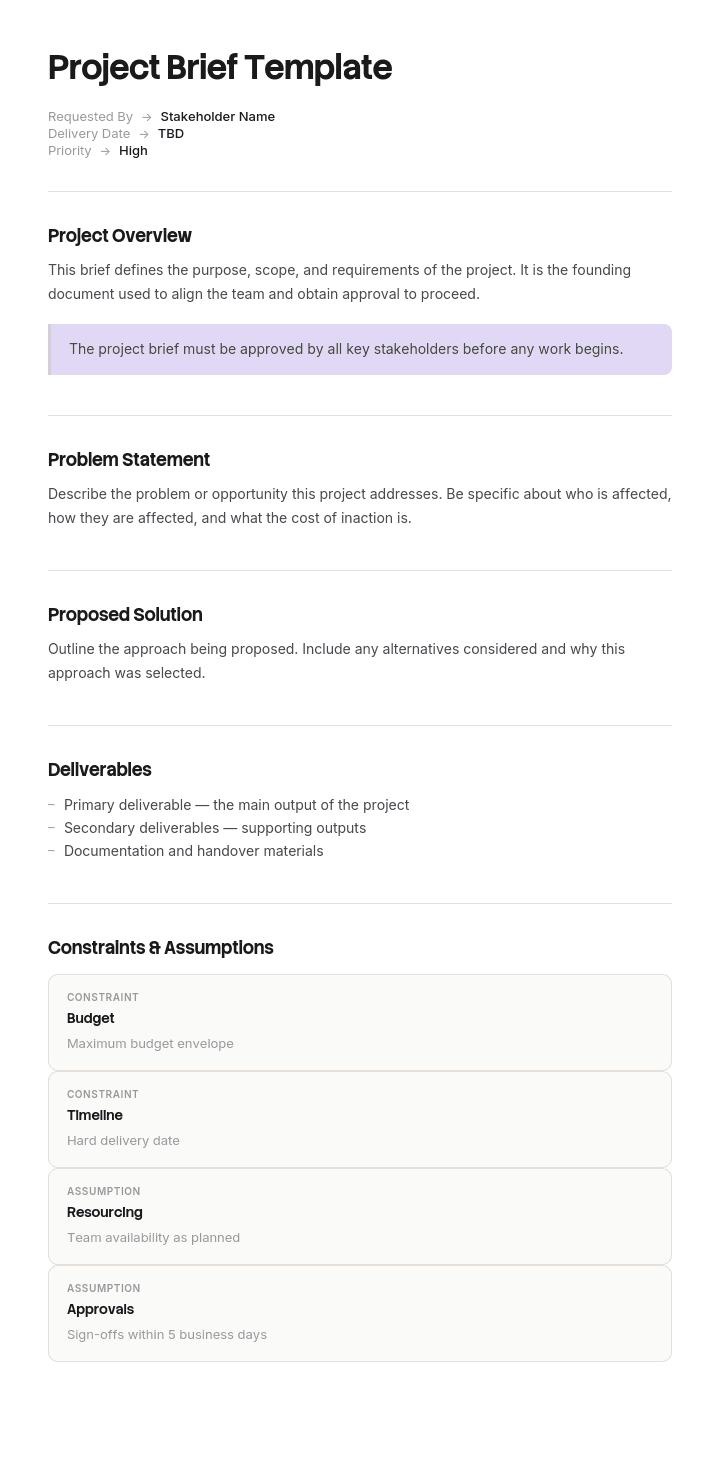
Use this template
A great project brief gets everyone on the same page before a project starts - what's being built, why it matters, who's involved and how success will be measured. With Trupeer, you can save hours on writing project briefs by starting with a free project brief template, customizing it with your brand identity, and turning the brief into a short video summary stakeholders can watch in 3 minutes.
What is a project brief template, and when is it written?
A project brief is the short document written at the very start of a project, before the plan exists, that says what the project is for, why it matters now, who it affects, what success looks like and what constrains it.
It is the thing people sign to authorise the work, and it becomes the reference point everybody argues against six months later. It is deliberately short, usually one or two pages, because it is written at the moment of least information.
A template gives you the sections. Background, objectives, scope, deliverables, timeline, budget, stakeholders, success criteria. Every version you will find offers roughly those, and there is nothing wrong with them.
The problem with briefs is almost never the sections. It is what goes in them.
Most briefs state a solution, not a problem
Here is the complaint every delivery team, agency and engineering group makes about briefs, expressed the same way in every industry: we were briefed on the solution.
"Build a customer portal." "Create a new intranet." "Deliver a mobile app." "Redesign the onboarding flow." Each of those is a thing to build, arriving as though it were a requirement, when it is actually somebody's answer to a question the brief never states.
That happens for a reasonable reason. Whoever commissions a project has usually been thinking about it for weeks and has arrived at a conclusion. Writing the conclusion feels like clarity and writing the problem feels like vagueness.
The cost is that the cheapest solutions are eliminated before anybody looks at them. Once the brief says portal, the project is a portal project, and the option that would have solved eighty percent of the problem for five percent of the money is never evaluated, because nobody was asked to evaluate anything.
A brief stating a problem invites answers. A brief stating a solution invites estimates.
How to customize this template in Trupeer
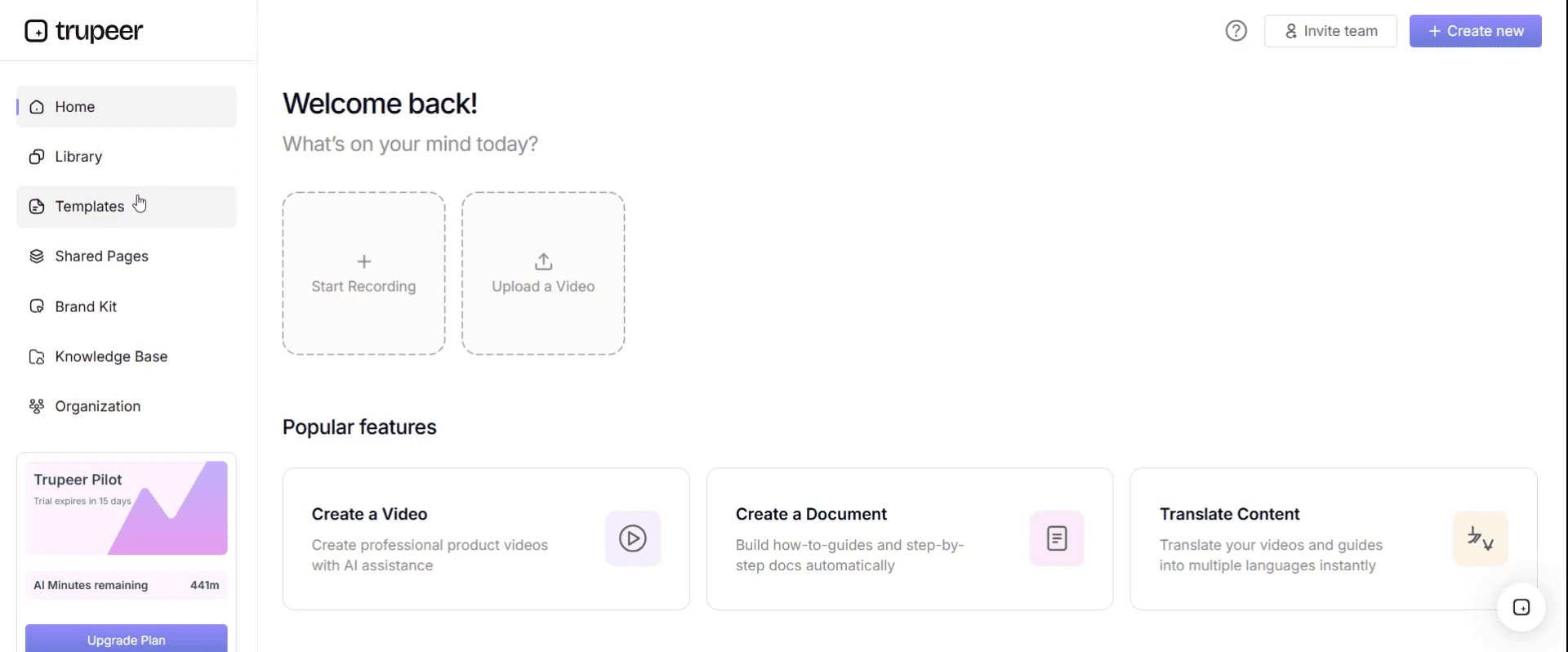
Step 1: Open the Templates Section
Go to the Templates section from the main navigation.
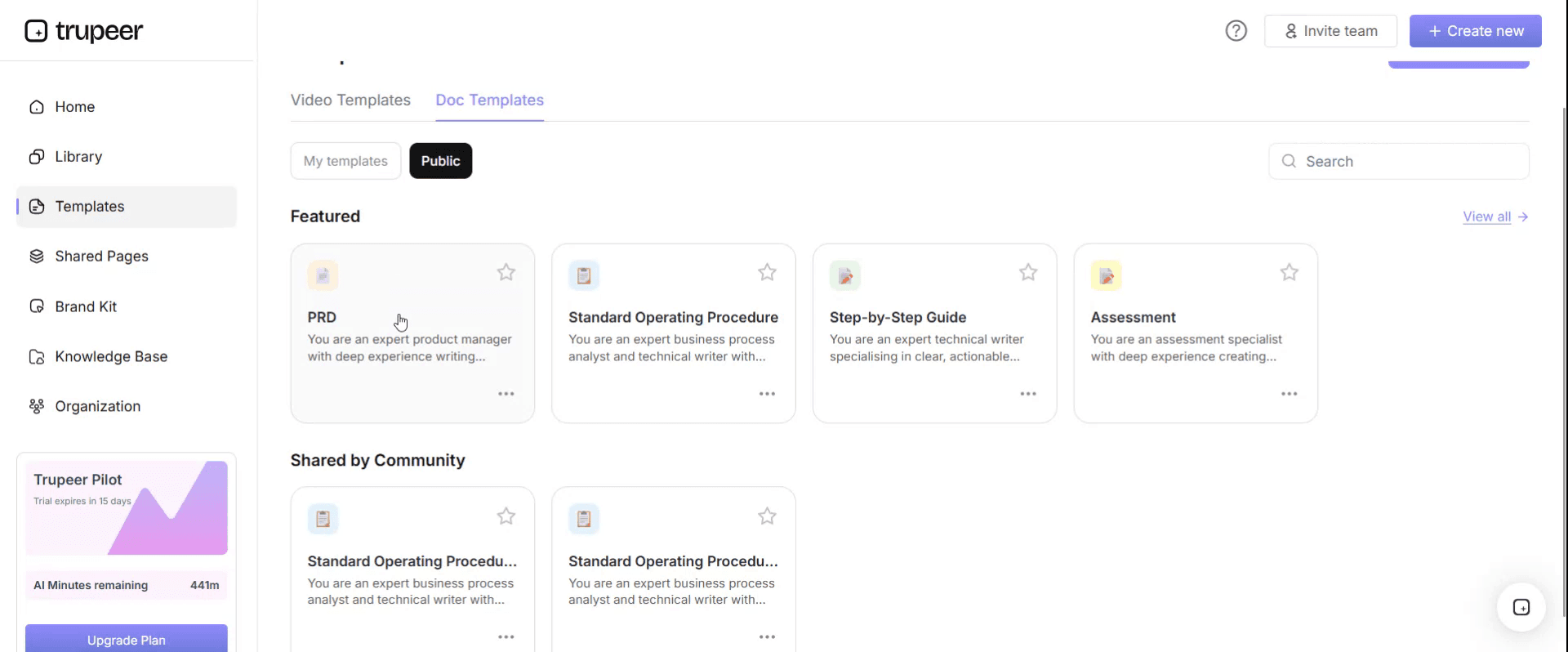
Step 2: Select and Open a Template
Click on any template you want to work with to open it.
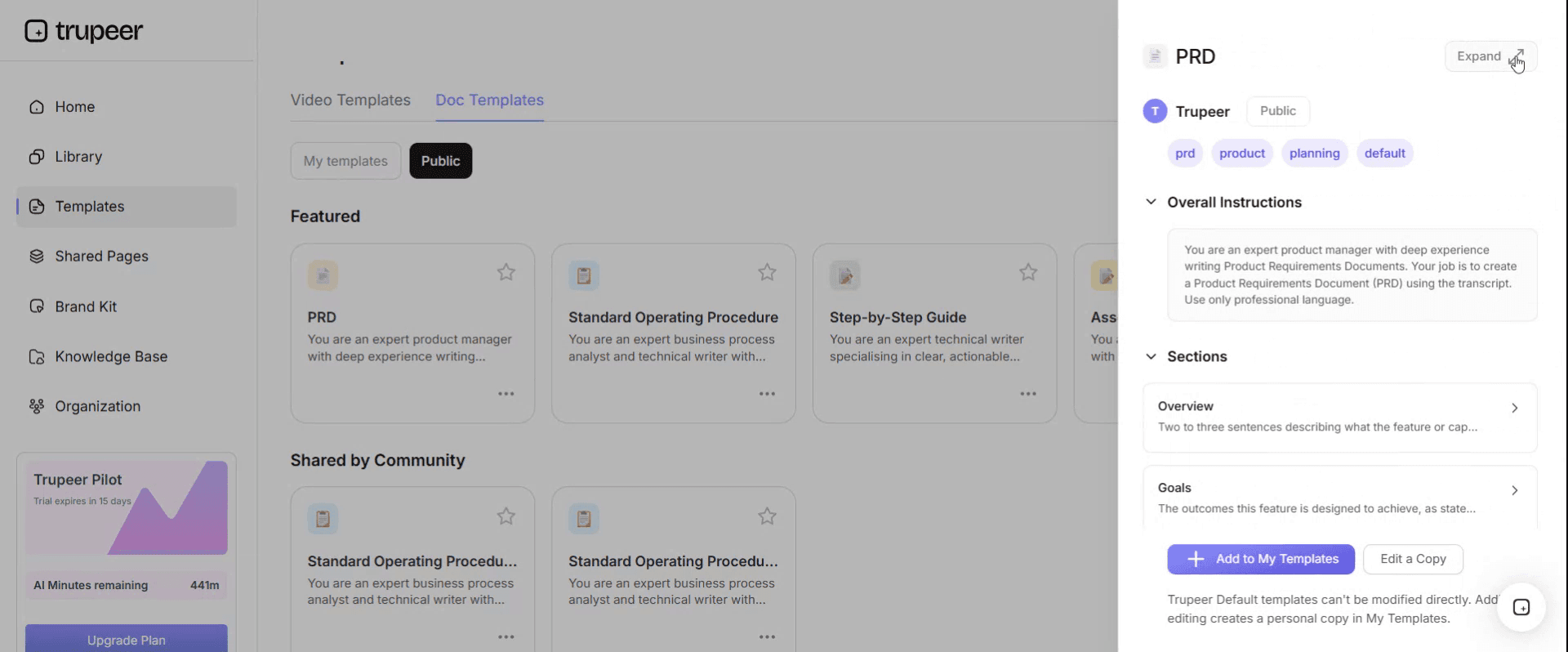
Step 3: Expand the Template View
If needed, expand the template view to see the full layout and details clearly.
Step 4: Edit the Template
Click on Edit to start modifying the selected template.
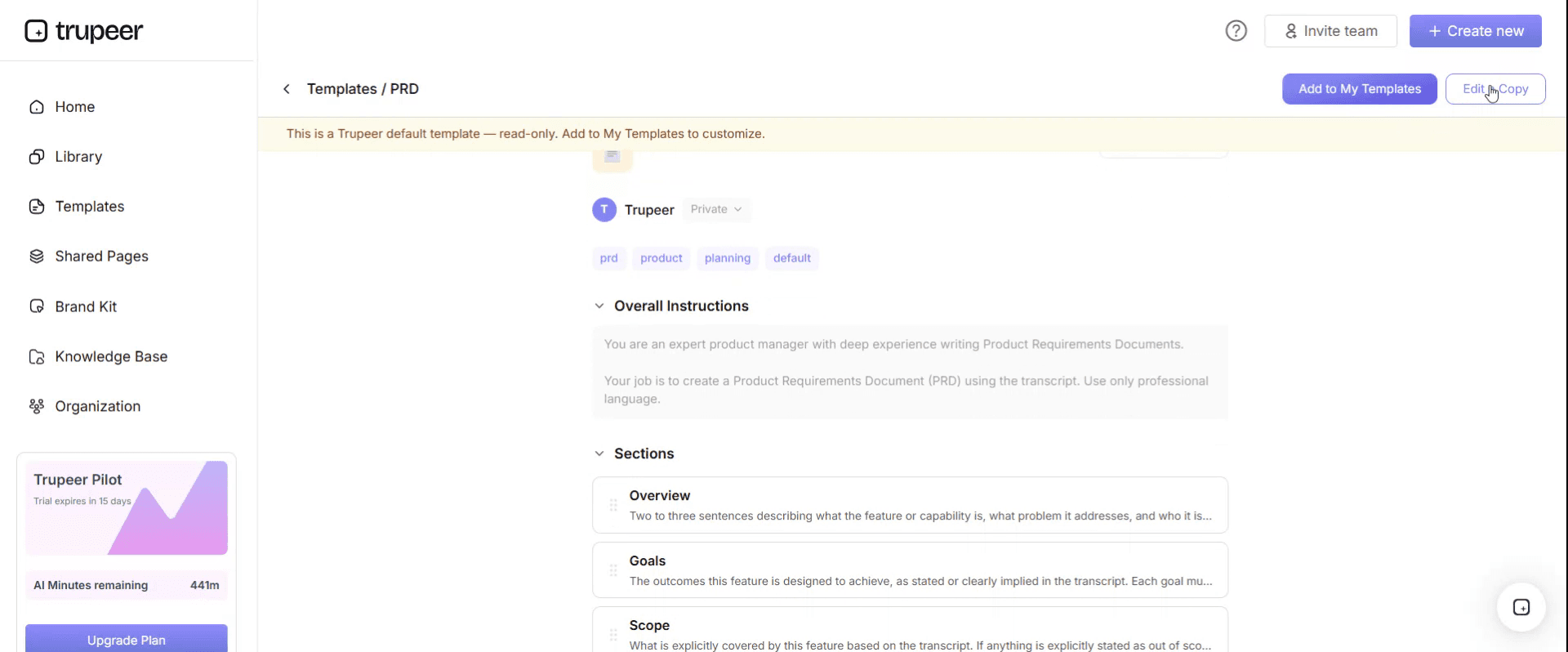
Within the editor, you can:
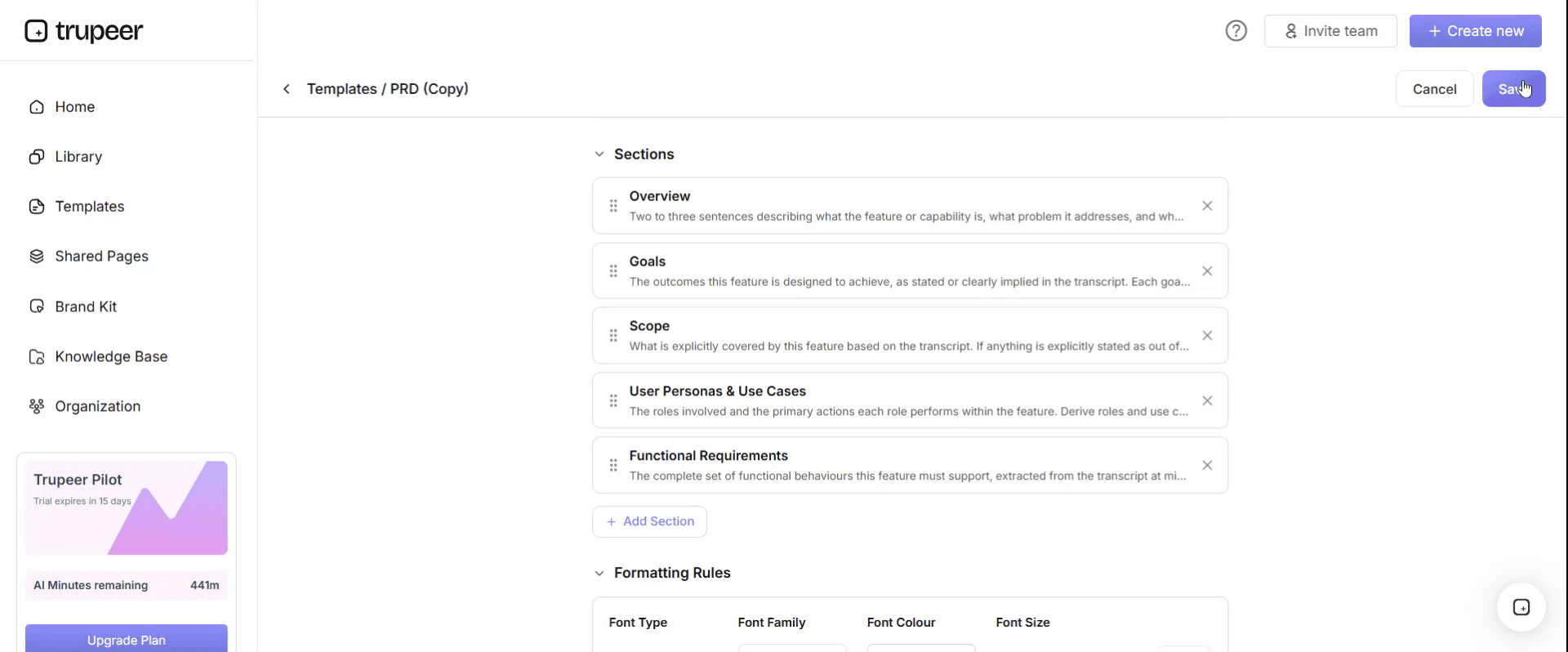
Add new sections
Define or update formatting rules
Add a logo and adjust its position and related settings
Step 5: Save Your Customized Template
After making all necessary changes, click Save to store the updated template as your own.
Step 6: Preview and Fine-Tune the Template
When you want to see how your customized template looks, open the Preview.
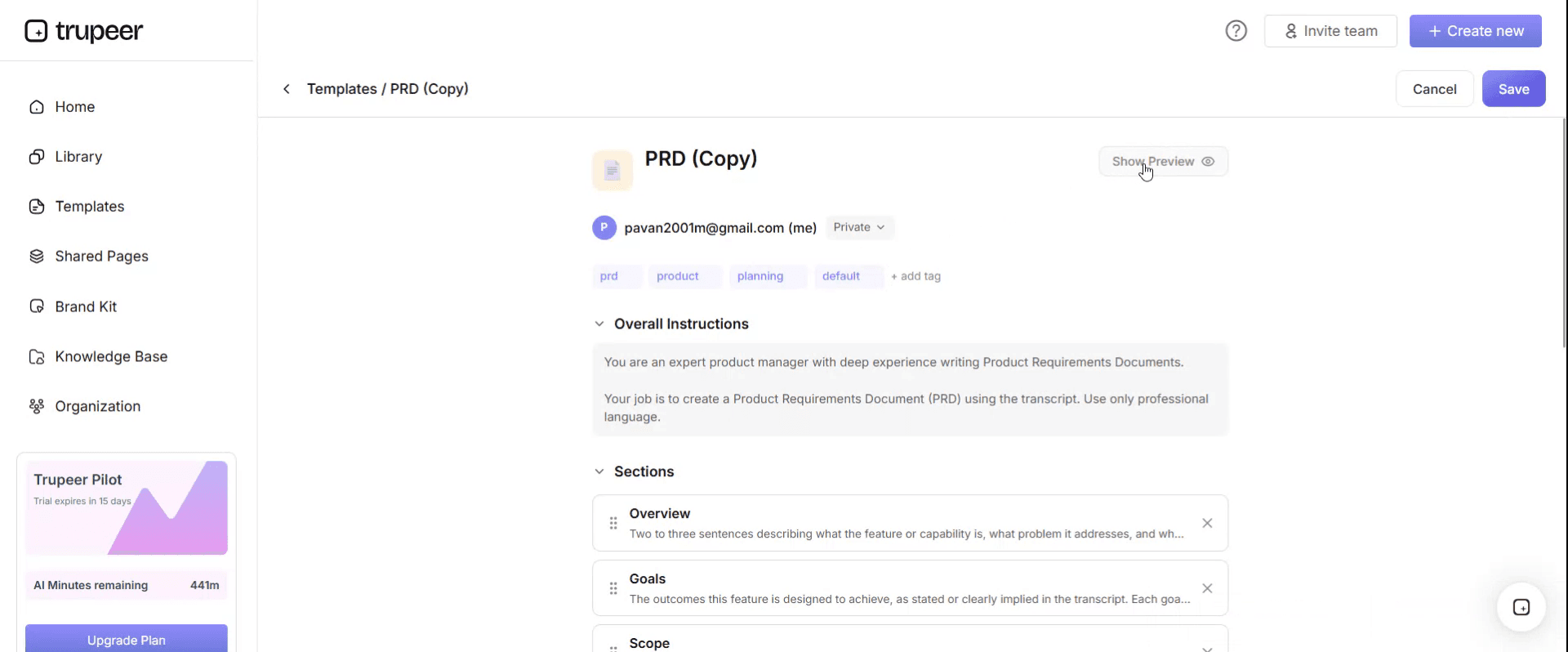
From the preview screen, you can continue to make adjustments directly if needed, ensuring the template appears exactly as you want.
With a project brief template you can:
Save hours on writing: Skip the blank page with a proven brief structure.
Align stakeholders fast: One-page briefs make approvals and alignment quicker.
Stay on-brand: Apply your logo, fonts and colors using Trupeer's brand kit - perfect for agency and client briefs.
Pitch with impact: Convert the brief into a video summary - great for sales enablement and stakeholder pitches.
Standardize across projects: Use the same brief format for every initiative.
Reach global teams: Translate briefs into 65+ languages with one click.
The three answers test for any project brief
Two minutes, and it is the only brief test worth running.
Read the brief and name three genuinely different things that would satisfy it.
Not three variations of the same thing. Three different approaches: build something, change a process, buy something, remove a step, communicate differently, do less.
If you can name three, the brief describes a problem and the project has a real decision in front of it.
If you can only name one, the brief describes a solution. That is not automatically wrong, because sometimes the decision genuinely has been taken for good reasons, and in that case the honest thing is to say so and call the document a specification rather than a brief. What is not honest is presenting a foregone conclusion as an open question and then being surprised that nobody challenged it.
Run this test on the brief before it is circulated, with somebody who was not involved in writing it. The person who wrote it can always name three, because they know what they rejected. Nobody else can, because the brief does not contain it.
How to write the problem instead of the deliverable
Four habits, and none of them takes longer than writing the solution would.
Lead with an observation and a number. Not "customers find it hard to check their orders" but "customers contacted us six thousand seven hundred times last month to ask where their order was". The number does two things: it establishes the problem is real, and it sizes what a solution is worth.
State what happens now. How the problem is currently handled, badly, including the workaround people have invented. Current-state description is what lets somebody propose a cheaper answer.
Separate constraints from requirements. A budget is a constraint. A deadline is a constraint. Must integrate with the existing warehouse system is a constraint. "Must have a login" is a requirement disguised as one, and it usually arrives from somebody's mental picture of the solution.
Define success as a change in the number, not as the existence of a deliverable. Reduce those contacts by half within six months is a success criterion. Launch a portal is a milestone.
Where you genuinely do have a solution in mind, put it in a clearly labelled section saying so, as one candidate rather than as the brief.
Free project brief template: the structure to copy
Copy from here. One or two pages, and resist expansion.
Header. Project name, sponsor, author, date, version, and the decision being sought.
The problem. An observation with a number, how often it occurs, and what it costs. Two or three sentences.
How it is handled now. The current process, including the workaround, and why it is not good enough.
Why now. What has changed that makes this worth doing this quarter rather than next year.
Who is affected. The people or customers involved, and roughly how many.
Success criteria. What number moves, by how much, by when. One or two, expressed as outcomes.
Constraints. Budget, deadline, systems that cannot change, regulatory or contractual obligations, people not available. Everything genuinely fixed, and nothing that is actually a preference.
Out of scope. What this project will not address, named specifically enough to be contentious.
Candidate approaches, if any. Solutions already considered, clearly labelled as candidates rather than as the brief, with the reason each is on the list.
Decision sought and by whom. What you are asking for and who is authorising it.
Copy to here. If the brief runs past two pages the usual cause is background, which belongs in an appendix nobody will read and that is fine.
The retailer who built a portal nobody registered for
Ashfold Group is a specialist retailer with about ninety stores and a substantial online business.
The brief was two pages, well written, and approved without difficulty. It said: build a customer self-service portal where customers can log in to view order status, download invoices and raise queries. Budget three hundred and forty thousand pounds. Nine months.
It was delivered on time and close to budget, at three hundred and seventy one thousand.
Six months after launch there were three thousand one hundred registered accounts against roughly forty six thousand active customers, so under seven percent. Contact volume to the service centre was unchanged.
The post-implementation review asked a simple question: what problem was this built to solve. Nobody could point at it in the brief, because the brief had described a solution.
So somebody went and found the problem. The service centre handled around eleven thousand contacts a month. A sample of five hundred showed sixty one percent were some version of where is my order, which is about six thousand seven hundred contacts a month.
Of those customers, eighty four percent had already received a dispatch email containing a tracking link. Either they had not seen it, or they had come back to it after the link expired at fourteen days.
The dominant problem was therefore not that customers had no way to check. It was that the way they already had did not work.
Three cheaper approaches had never been evaluated, because the brief had not invited any. Extending the tracking link validity. Re-sending the link on a schedule until delivery. Adding order status to the account area that already existed, estimated afterwards at around eighteen thousand pounds.
The portal was a legitimate solution to a real problem. It was not the biggest problem, and it required registration, which ninety three percent of customers never did.
The brief for the follow-up project was written differently. Customers contact us six thousand seven hundred times a month to ask where their order is. Eighty four percent of them already received a tracking link. Reduce these contacts by half within six months. Constraints: no change to the carrier integration, one hundred and fifty thousand pounds, and it must work without requiring customers to register.
Three teams proposed three genuinely different answers. The chosen one cost sixty two thousand pounds and reduced those contacts by fifty eight percent within five months.
The difference between the two briefs is that the second could be answered three ways. The first could be answered one way, and that way had already been chosen.
The key elements every project brief needs
Element | What it must contain | The common failure |
|---|---|---|
Problem | An observation with a number and a frequency | A solution described as a need |
Current state | How this is handled today, including workarounds | Omitted, so cheap fixes stay invisible |
Why now | What changed to make this urgent | Absent, so the project has no priority argument |
Success criteria | A number moving by an amount by a date | A deliverable existing |
Constraints | Only genuinely fixed things | Preferences smuggled in as constraints |
Out of scope | Named specifically, including things people have asked for | Empty, or "future phases" |
Decision sought | What is being authorised, and by whom | Implied, so nothing gets decided |
The two rows that carry the most weight are current state and constraints, and both are usually thin. Current state is what lets somebody propose the cheap answer. Constraints, honestly separated from preferences, are what stop a brief becoming a specification by accident.
How to write a project brief in five steps
One. Write the problem with a number. If you cannot get a number, spend an afternoon getting one. A brief without a number is a preference.
Two. Describe the current state, including how people work around it today.
Three. Set success as a change in that number, with a date.
Four. List constraints and challenge each one. For every item, ask who fixed this and could it move. Roughly a third usually can, and each one that moves widens the range of possible answers.
Five. Run the three answers test with somebody who did not write it. If it fails, either open the brief up or relabel the document honestly.
Then circulate it, and expect the answers you get back to include at least one you had not thought of. If none of them surprises you, the brief was probably a specification.
Constraints, and how they get smuggled in as requirements
This is where most briefs quietly become specifications, and it happens without anybody intending it.
A genuine constraint is something outside the project's control. The budget is what it is. The regulatory deadline is fixed. The warehouse system is not being replaced this year. The team has four people.
A preference dressed as a constraint sounds identical. It must be a mobile app. It needs a dashboard. Users should have a login. Each of those is somebody's mental image of the answer, and once it is in the constraints section it is treated as immovable by everyone downstream.
The test is to ask, for each item, who decided this and what happens if it changes. A real constraint has an owner outside the project and a consequence if breached. A preference has neither, and usually the person who wrote it will cheerfully drop it if asked directly.
Run that conversation before the brief is circulated. It takes twenty minutes and it is frequently the highest value twenty minutes in the whole project, because each constraint removed adds a possible answer.
Project brief, business case or project plan?
Three documents at the start of a project, in sequence, with different jobs.
The brief states the problem, the constraints and the success criteria. It is written first, it is short, and it authorises investigation or delivery.
The business case justifies the spend. It contains options with costs and benefits, and it is what a finance function or an investment board approves. A brief that has become long and full of numbers is usually a business case wearing the wrong name.
The project plan covers how the chosen approach will be delivered: scope, schedule, resources, dependencies and risk. Our IT project plan template covers that layer.
The sequence matters. Brief, then options, then business case, then plan. Writing the plan before the brief, which happens more often than anyone admits, means the approach was chosen before the problem was stated.
Once the plan exists, the brief should be explicitly superseded rather than left on file as a second source of agreed scope. Two documents claiming authority is how scope disputes become unresolvable.
Project brief variants: creative, design, software and construction
The structure holds across types and the emphasis shifts.
Creative and marketing briefs need the audience and the message, and they are the most prone to solution-briefing, because a client arrives with a format in mind. The problem here is usually a behaviour you want to change rather than a thing you want to make.
Design briefs need the user, the context of use and the constraints of the existing system. Nearly every brief in this category benefits from the three answers test, because a design brief that specifies a layout has removed the design.
Software project briefs need the problem and the current workaround more than anything else, and they should stay clear of features entirely. Once features are in scope you are writing a requirements document, which our lean PRD template covers.
Construction and design briefs carry constraints that genuinely are constraints: site, planning, regulation, budget. Here the constraints section is the substance rather than the risk.
Procurement-heavy projects need the brief to state what is being bought as an outcome rather than a specification, since the specification maturity decision comes later and our procurement management plan template covers it.
Can I get a project brief template in Word or Excel?
Word or Google Docs. A brief is prose, it is one or two pages, and it gets commented on before approval. There is nothing in it that wants a spreadsheet.
Excel earns a place only if you are running many projects and want a register: project, sponsor, problem in one line, success criterion, constraint on budget, status and date approved. That register is genuinely useful for spotting the pattern nobody sees otherwise, which is how many of your projects have a success criterion expressed as a deliverable rather than as a number.
PDF for the approved version, exported at sign-off. Because a brief is the reference point for later disputes, freezing the approved version with a date matters more here than for most documents.
PowerPoint is a poor container. A brief presented as slides tends to lose the problem statement and keep the solution, for the same reason described throughout this page.
How to show the problem rather than describe it
The hardest part of a good brief is making a problem feel real to people who do not experience it. A number helps. A paragraph rarely does.
There is a cheap alternative almost nobody uses: record the problem happening.
Two minutes of a service agent handling a where-is-my-order call, or of somebody working around a broken step with three browser tabs and a spreadsheet, communicates more than a page of description and is very difficult to argue with. Attach it to the brief.
Trupeer AI makes that straightforward, since a screen recording becomes both a video and a written walkthrough of the current process, which is exactly what the current state section of the brief needs. It also gives the delivery team something to refer back to when they are deciding between approaches, rather than relying on the brief's wording months later.
Record it. Brand it. Translate it. Trupeer it.
The same recording is useful afterwards as the before state when you measure whether the project worked. The material lives in your knowledge base in consistent branding, and setup instructions are in the document template setup guide.
Frequently Asked Questions
Is there a free project brief template in Word?
The structure above pastes straight into Word or Google Docs. There is no gated download and no form. The two sections to write first are the problem with its number and the constraints, since everything else follows from them and they are the two most templates handle weakest.
Is there a free project brief template in Excel?
Excel suits a register of briefs across a portfolio rather than an individual brief. Columns for project, sponsor, the problem in one line, the success criterion, the budget constraint, status and approval date. Scanning that register for success criteria expressed as deliverables is a quick way to find which projects have no measurable outcome.
Where can I find a project brief sample in PDF?
Published samples are easy to find, including from public sector bodies and health organisations, and they are worth reading for section order. Read them critically, since a large proportion of published briefs are solution briefs and reading them uncritically reinforces the habit this page is about.
How long should a project brief be?
One or two pages. Longer briefs are usually carrying background that belongs in an appendix, or they have absorbed the business case. If the brief cannot be read in five minutes by a sponsor, it will be skimmed, and the section skimmed first is the problem statement.
Who should write the project brief?
The sponsor or the person who owns the problem, with somebody from delivery reading it before it is circulated. That second reader is what catches solution-briefing, because they are the person who will otherwise spend nine months building the wrong answer.
What is the difference between a project brief and a creative brief?
Largely domain rather than structure. A creative brief adds audience, message, tone and channel, and it is usually written by a client for an agency. Both suffer identically from solution-briefing, and the three answers test applies to both without modification.
When should the project brief be signed off?
Before any planning or estimating begins, and specifically before anybody has committed to an approach. A brief signed off after the approach is chosen is a formality, and it will not help when scope is disputed later, because everybody will remember the approach rather than the document.
What happens to the brief once the project plan exists?
It should be explicitly superseded and marked as such, with the plan becoming the single source of agreed scope. Leaving the brief live as a second authority is what makes scope disputes unresolvable, since both parties can cite a document. Keep the brief as a record of what problem was being solved, which is genuinely useful at closure.