Use this template
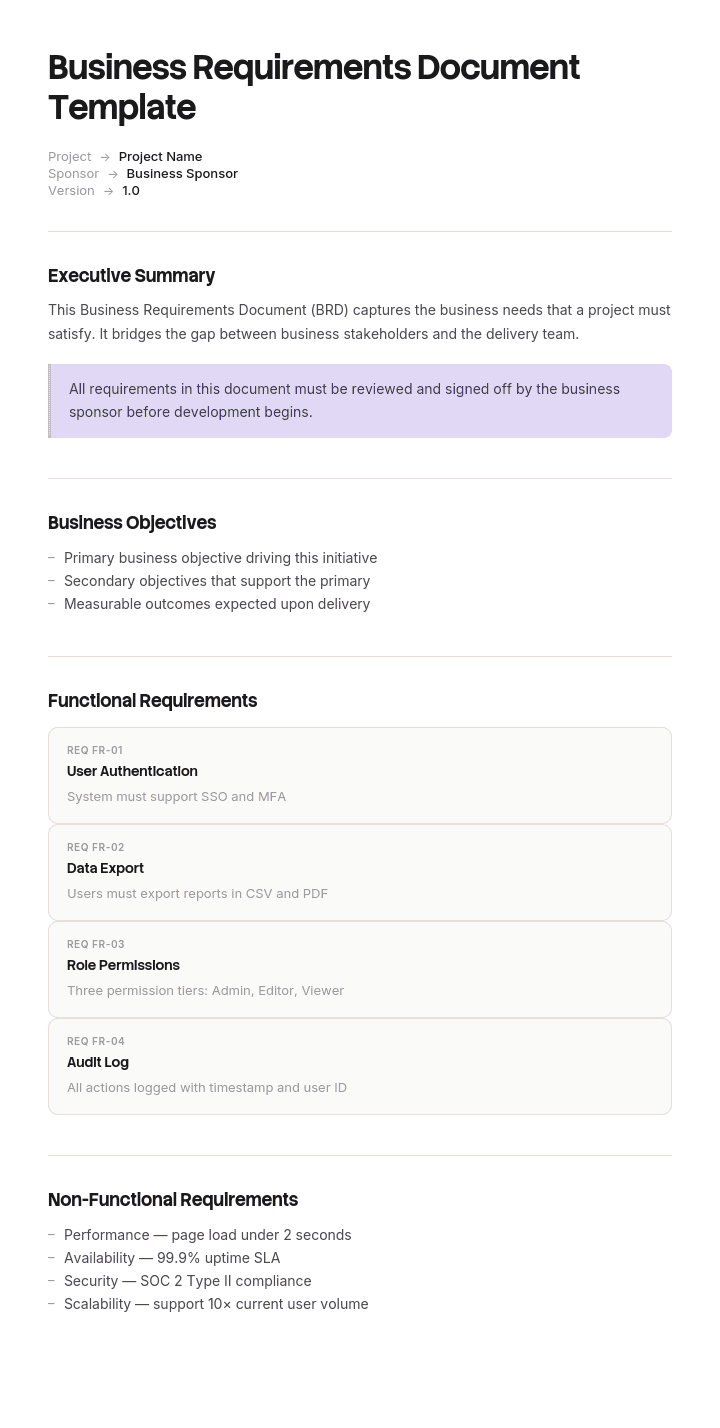
A business requirements document (BRD) is the bridge between business stakeholders and technical teams - it captures what the business needs and translates it into requirements developers can build. With Trupeer, you can save hours on writing BRDs by starting with a free business requirements document template, customizing it with your brand guidelines, and turning long BRDs into video walkthroughs that everyone can actually consume.
Projects rarely fail because nobody wrote the requirements down. They fail because what got written down was too vague to disagree with. Everyone signed a document saying the system should be "user-friendly and fast", and four months later they discover they meant three different things.
A business requirements document is worth writing when it makes disagreement possible before build starts, rather than after. This template is built for that: every requirement numbered, prioritised and given acceptance criteria specific enough to argue about now.
Download the business requirements document template
Format | Best for |
|---|---|
Word (.docx) | The BRD itself. Free download, no sign-up. The format most teams write and circulate in |
Google Docs | Collaborative review with stakeholders, where comments and version history matter |
The signed, approved baseline | |
Excel (.xlsx) | The requirements table and traceability matrix, where filtering and sorting help |
.doc | Older document systems and legacy libraries |
Free, editable, no watermark. Most teams use Word for the document and Excel for the requirements table once the count passes about thirty.
What is a business requirements document?
A business requirements document, or BRD, states what a business needs from a project and why, before anyone decides how to build it. It defines the problem, the scope, the stakeholders, the requirements themselves and the criteria by which the result will be judged.
Its real function is agreement. A BRD is the artifact everyone signs to confirm they understand the same thing, which is why the useful test of a BRD is not whether it reads well but whether it is specific enough that someone could object to it.
How to customize this template in Trupeer
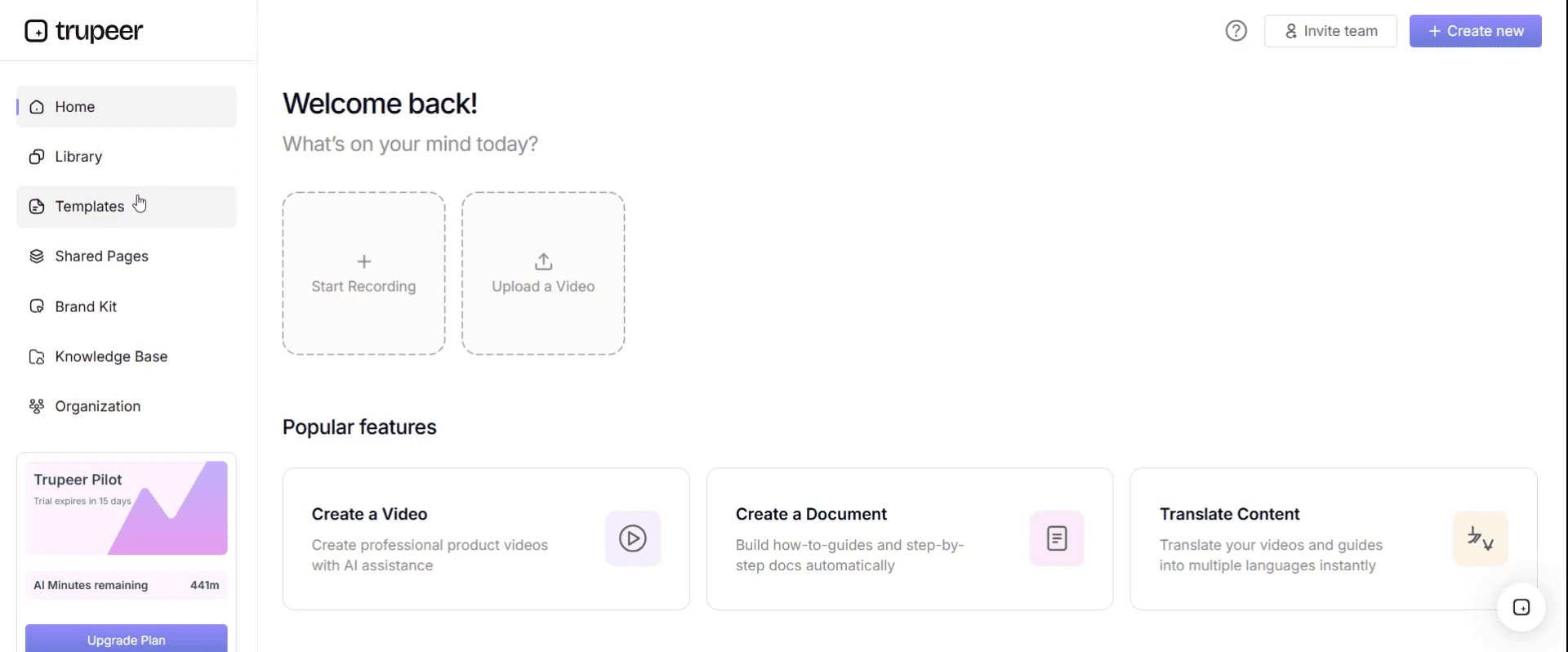
Step 1: Open the Templates Section
Go to the Templates section from the main navigation.
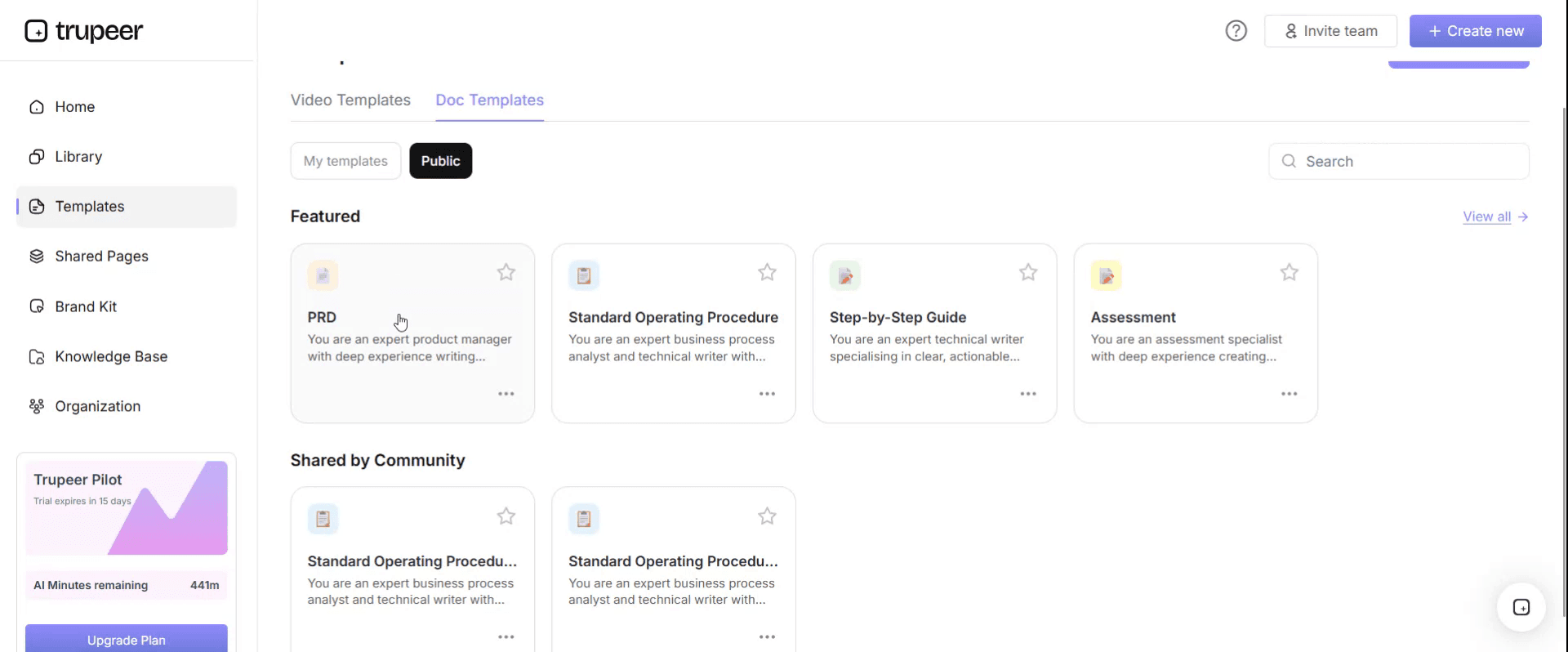
Step 2: Select and Open a Template
Click on any template you want to work with to open it.
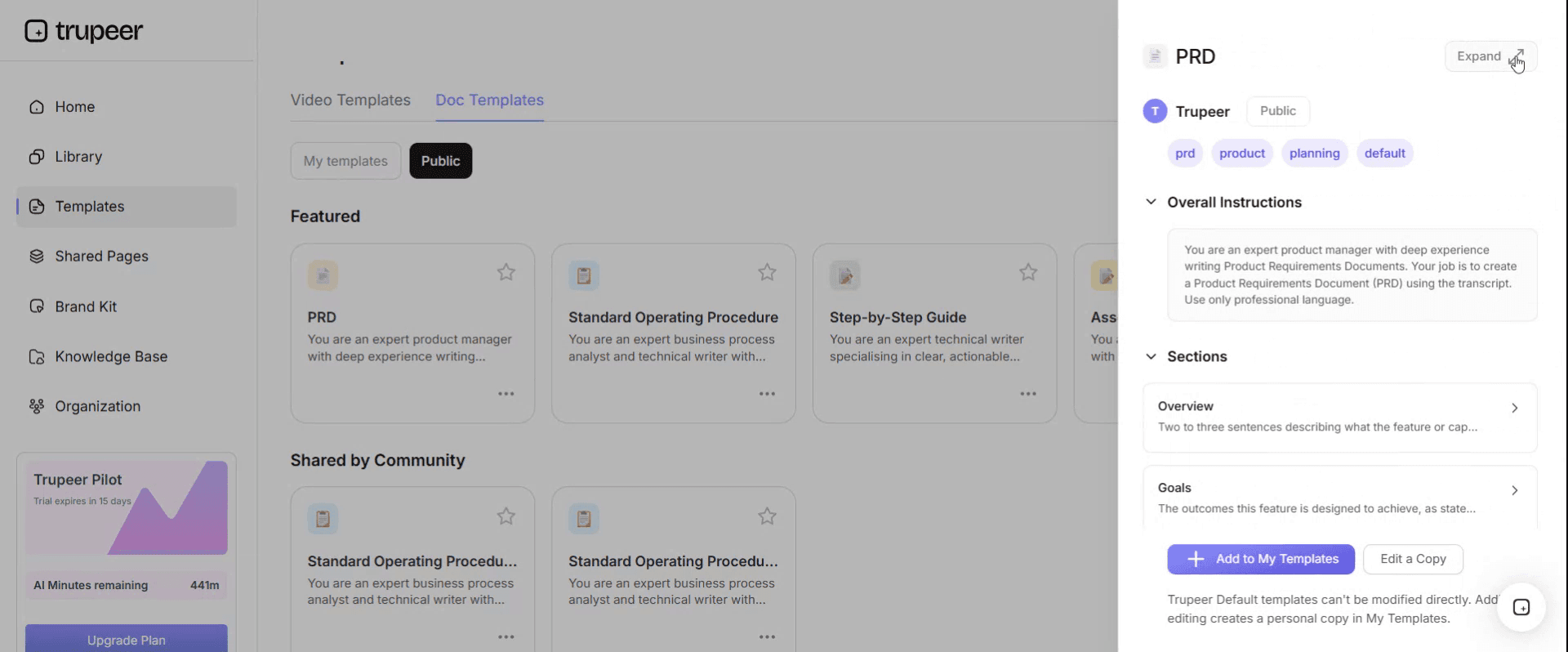
Step 3: Expand the Template View
If needed, expand the template view to see the full layout and details clearly.
Step 4: Edit the Template
Click on Edit to start modifying the selected template.
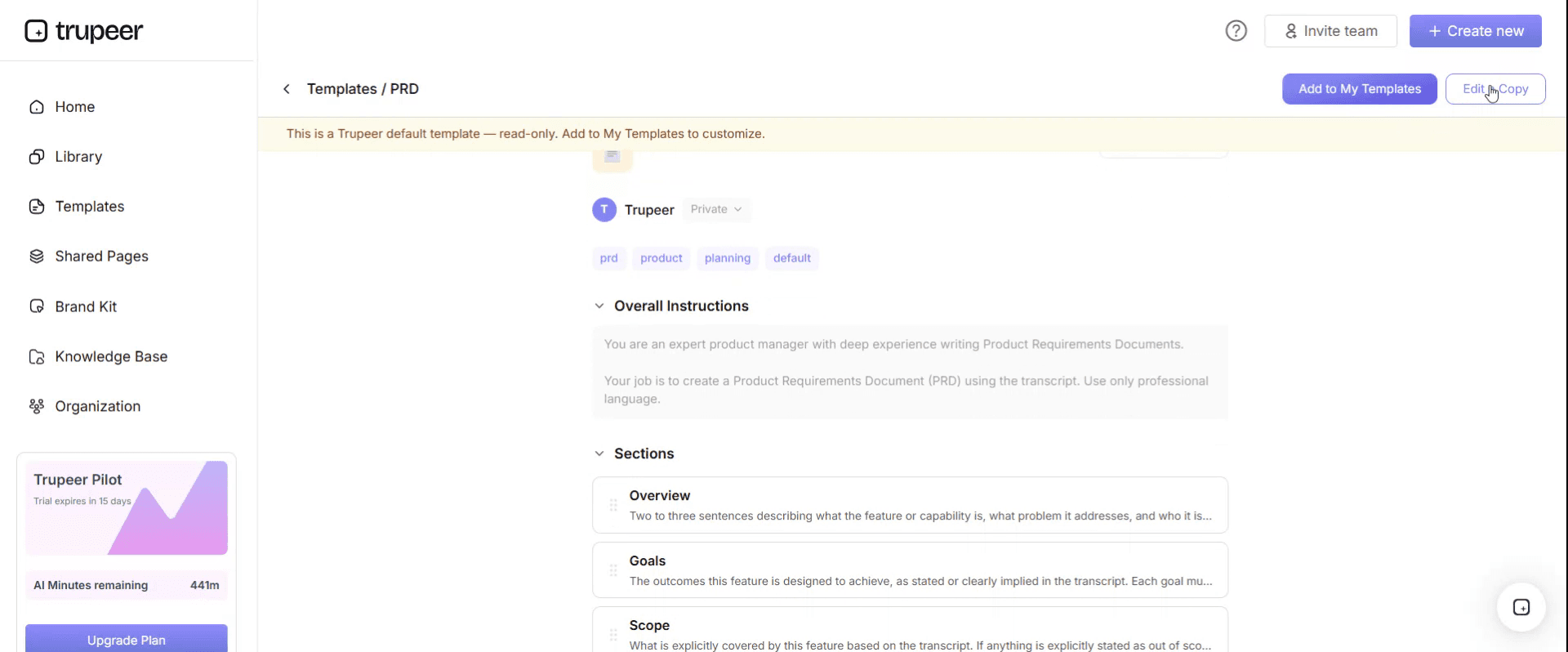
Within the editor, you can:
Add new sections
Define or update formatting rules
Add a logo and adjust its position and related settings
Step 5: Save Your Customized Template
After making all necessary changes, click Save to store the updated template as your own.
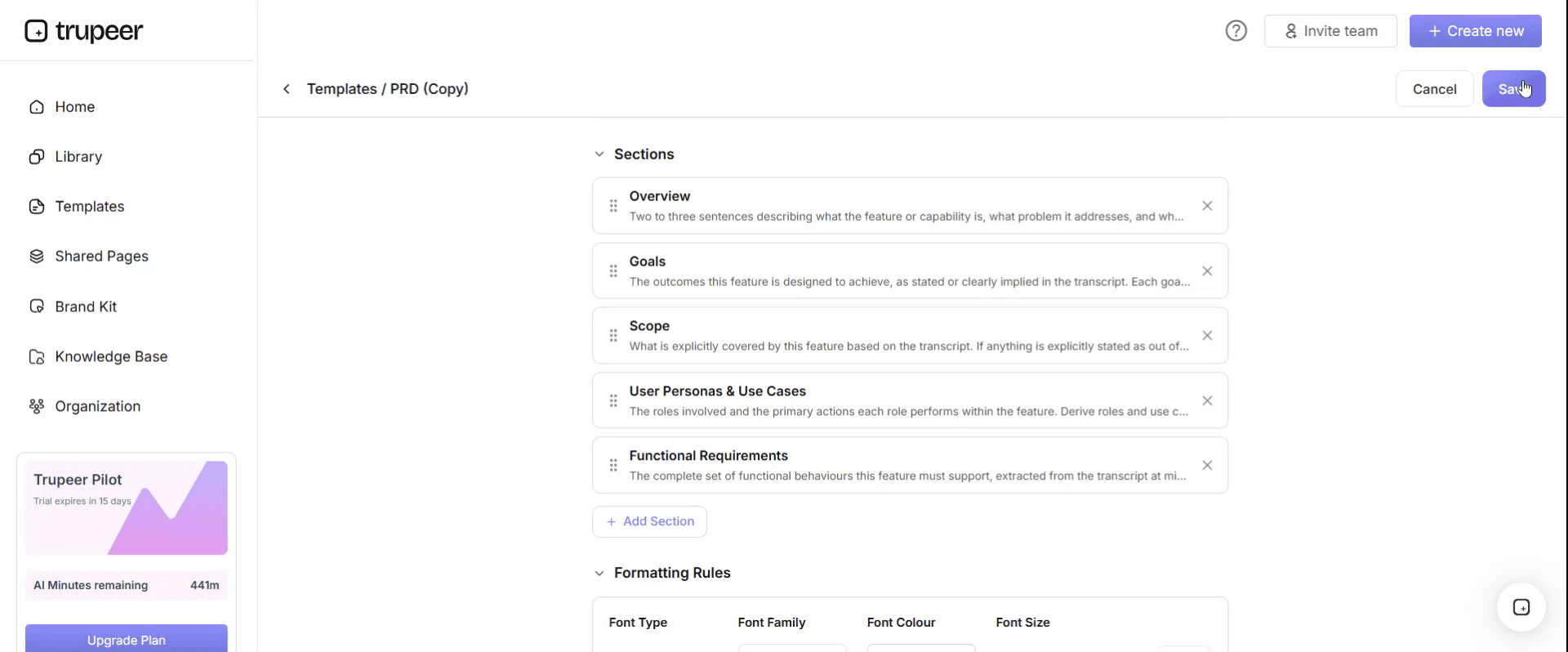
Step 6: Preview and Fine-Tune the Template
When you want to see how your customized template looks, open the Preview.
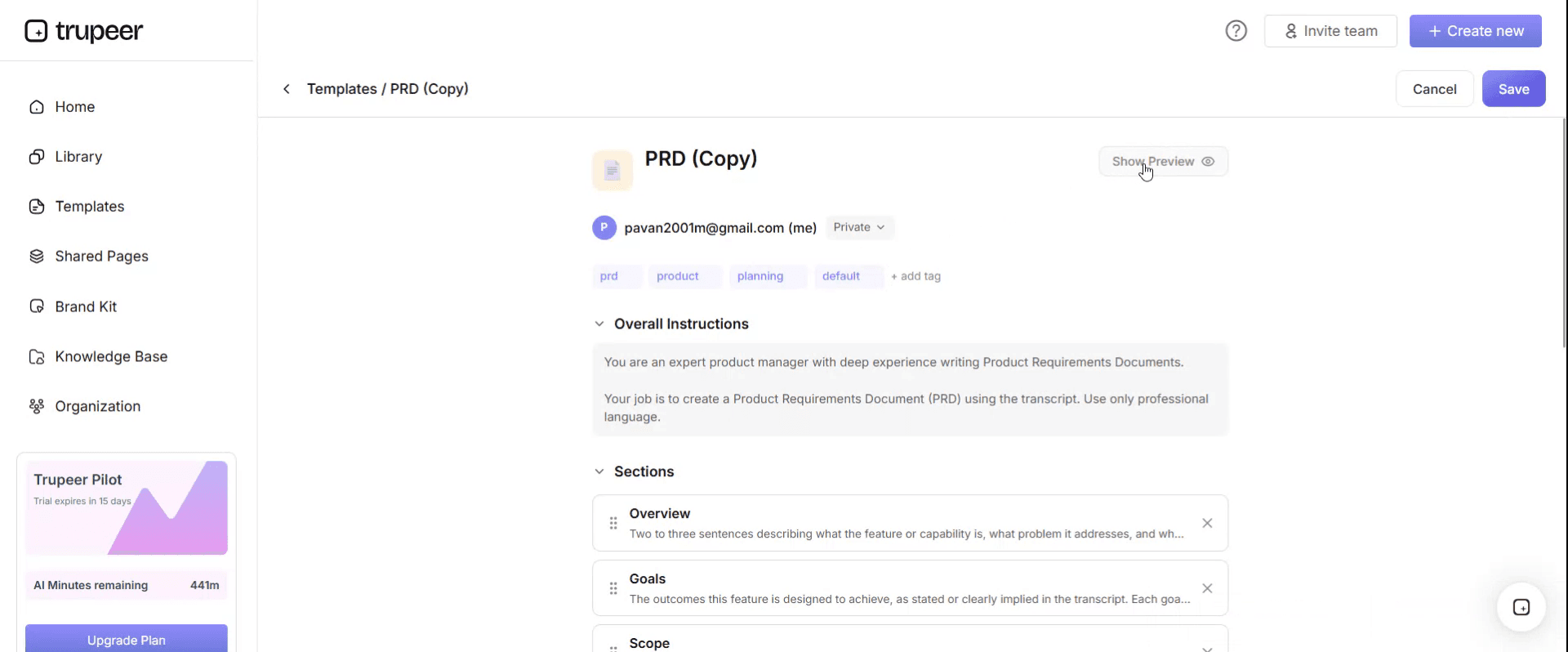
From the preview screen, you can continue to make adjustments directly if needed, ensuring the template appears exactly as you want.
With a business requirements document template you can:
Save hours on writing: Skip the blank page with a structure used by experienced BAs and PMs.
Align business and tech: Built-in sections bridge business goals to functional requirements.
Stay on-brand: Apply your logo, fonts and colors using Trupeer's brand kit.
Communicate clearly: Convert dense BRDs into video walkthroughs for stakeholder reviews.
Standardize across projects: Use the same BRD template for every initiative.
Reach global teams: Translate BRDs into 65+ languages with one click.
Why you need a business requirements document
Scope becomes something you can point at rather than remember. Most scope disputes are documentation failures, not bad faith.
Requirements get priorities, so when time runs short you cut deliberately rather than cutting whatever is left over.
Assumptions get written down, which is when someone notices the wrong one.
Acceptance criteria exist before build, so "done" is not decided by whoever is loudest at the end.
Handover survives people leaving. Projects that lose their business analyst mid-flight are the ones where a BRD pays for itself outright.
Vendors can quote against something real. A vague BRD produces a wide quote and a change-request-heavy project.
What a business requirements document includes
Document control: version, author, date, distribution and approval status.
Executive summary: what the project is and why, in a paragraph.
Business objectives, expressed as measurable outcomes rather than activities.
Background and problem statement: what is happening now and what it costs.
Scope: what is in, and explicitly what is out.
Stakeholders: who is affected, who decides, who signs.
Current state, as it actually is.
Business requirements, numbered, prioritised, each with acceptance criteria.
Assumptions, constraints and dependencies.
Risks, with owners.
Cost and benefit summary, and the expected return.
Timeline and key milestones.
Success criteria for the project as a whole.
Glossary, because half of all requirements disputes are vocabulary disputes.
Sign-off block.
Appendices: process maps, data, screens, supporting analysis.
The template structure
Section | What goes in it | Length |
|---|---|---|
Document control | Version, author, approvers, revision history | Half a page |
Executive summary | The project in one paragraph, written last | Half a page |
Business objectives | Two to five measurable outcomes | Half a page |
Problem statement | Current situation and its cost | 1 page |
Scope | In scope, out of scope, explicitly | 1 page |
Stakeholders | Role, interest, decision rights | Half a page |
Current state | How it works today | 1 to 2 pages |
Requirements | The numbered table | 2 to 6 pages |
Assumptions and constraints | Stated plainly | Half a page |
Risks | With owners and mitigation | Half a page |
Cost and benefit | Investment and expected return | 1 page |
Timeline | Milestones and dependencies | Half a page |
Success criteria | How the project gets judged | Half a page |
Glossary | Every term that could be read two ways | As needed |
Sign-off | Names, roles, dates | Half a page |
Ten to twenty pages is normal for a mid-sized project. Beyond thirty, the requirements table has usually absorbed design decisions that belong in a functional specification.
How to write a requirement that survives review
This is the whole skill. A requirement is well written when two people who disagree would both know they disagree from reading it.
Weak: The system should be user-friendly.
Better: A new user must be able to submit a claim without training, measured by 8 of 10 test users completing submission unaided in under 3 minutes.
Weak: Reports should load quickly.
Better: The monthly summary report must render within 4 seconds for a dataset of up to 50,000 rows.
Weak: Managers need visibility of approvals.
Better: A manager must be able to see all claims awaiting their approval, sorted by submission date, on a single screen without filtering.
Weak: The system should integrate with finance.
Better: Approved claims must post to the accounting system within 15 minutes, including cost centre and VAT code, with failures logged and retried automatically.
The pattern in every improvement is the same. Name who needs it, what specifically, and the condition under which you would agree it had been achieved. Words to distrust in your own drafts: user-friendly, robust, seamless, intuitive, fast, flexible, scalable, easy. Each one hides a decision somebody will make later without you.
Prioritising requirements with MoSCoW
Requirements without priorities all become mandatory by default, and then the first schedule pressure forces arbitrary cuts.
Priority | Meaning | Test |
|---|---|---|
Must have | No launch without it | Would you delay go-live for this? If no, it is not a Must |
Should have | Important, painful to omit, survivable | There is a workaround, even an ugly one |
Could have | Desirable if capacity allows | Nobody would notice its absence in week one |
Won't have this time | Explicitly out of this release | Recorded so it stops being reraised |
The discipline that makes MoSCoW work: no more than about 60% of requirements should be Must have. If everything is a Must, you have a wish list with a priority column. And the Won't-have list is the most valuable one, because it is the written record of what was consciously deferred rather than forgotten.
The requirements table
ID | Requirement | Priority | Source | Acceptance criteria | Owner |
|---|---|---|---|---|---|
BR-01 | Must | ||||
BR-02 | Should |
Every requirement needs an ID, because "the reporting requirement" is ambiguous the moment there are two. Source matters because in month four somebody will ask who asked for this, and "the business" is not an answer.
Traceability matrix
The check that nothing has been quietly dropped, and that nothing is being built for no reason.
Requirement ID | Business objective | Functional spec ref | Test case | Status |
|---|---|---|---|---|
BR-01 | OBJ-1 | FS-3.2 | TC-14 | Verified |
BR-02 | OBJ-1 | FS-3.5 | TC-18 | In test |
BR-03 | OBJ-2 | Not yet specified | None | Gap |
Two failures show up immediately. A requirement with no test case will not be verified, and a functional spec item tracing to no requirement is something being built that nobody asked for. Both are common and both are cheap to find this way.
Sample business requirements document
An abbreviated worked example, so you can see the level of specificity.
Project: Expense claim system replacement. Version: 1.2. Author: Business analyst. Approvers: Finance Director, IT Director, HR Director.
Business objectives. Reduce average claim reimbursement time from 24 working days to 10. Reduce finance team time spent on claim processing by 50%, currently 14 hours weekly. Achieve 95% policy compliance on submitted claims, currently 71%.
Problem statement. Claims are submitted on a spreadsheet and emailed. Approval routing is manual, receipts arrive separately, and 29% of claims breach policy without being caught before payment. Finance spends roughly 14 hours a week chasing, and reimbursement averages 24 working days against a 10 day commitment in the staff handbook.
In scope. Claim submission, receipt capture, policy validation, approval routing, accounting system posting, employee notification.
Out of scope. Corporate card reconciliation, mileage rate setting, payroll integration, historic claim migration beyond 12 months.
Requirements.
ID | Requirement | Priority | Source | Acceptance criteria |
|---|---|---|---|---|
BR-01 | Employees must submit a claim from a mobile device including photographing receipts | Must | Staff survey, 2026 | 8 of 10 test users complete a 3-line claim with receipts on mobile in under 4 minutes, unaided |
BR-02 | The system must validate each line against policy limits at submission | Must | Finance Director | Claims breaching a limit cannot reach Submitted status without a flagged justification field completed |
BR-03 | Claims must route to the correct approver based on the reporting line | Must | HR Director | 100% of test claims route correctly across 12 org-structure scenarios including vacancies |
BR-04 | Claims over £500 must require a second approval | Must | Delegated authority matrix | No claim over £500 reaches Approved with a single approval recorded |
BR-05 | Approved claims must post to the accounting system with cost centre and VAT code | Must | Finance Manager | 100% of approved claims appear correctly coded within 15 minutes, failures logged and retried |
BR-06 | Approvers must see all claims awaiting them on one screen, oldest first | Should | Approver interviews | A manager with 20 pending claims sees all 20 without paging or filtering |
BR-07 | Employees must receive notification at submission, approval and payment | Should | Staff survey | Notifications delivered within 5 minutes of each status change |
BR-08 | Finance must export a monthly claims report by cost centre | Should | Finance Manager | Report generates in under 30 seconds for 5,000 claims |
BR-09 | The system must support delegated approval during absence | Could | Approver interviews | An approver can nominate a delegate for a date range |
BR-10 | Multi-currency claims | Won't, this release | Regional managers | Deferred to phase 2, recorded for the roadmap |
Assumptions. The current org structure in the HR system is accurate and maintained. The accounting system exposes a supported API. Policy limits will not change during implementation.
Constraints. Budget of £85,000. Must go live before the new financial year. No additional finance headcount.
Risks. HR reporting-line data proves unreliable, owned by HR Director, mitigated by an audit before build. Approver adoption is slow, owned by Finance Director, mitigated by manager training and a two-week parallel run.
Success criteria. Average reimbursement at or under 10 working days within one quarter of go-live. Finance processing time at or under 7 hours weekly. Policy compliance at or above 95%.
Business requirements vs functional requirements vs technical requirements
The most common source of confusion in this topic, and the reason many BRDs are actually specifications wearing the wrong title.
Business requirement | Functional requirement | Technical requirement | |
|---|---|---|---|
Answers | What does the business need, and why | What must the system do | How will it be built |
Written by | Business analyst, with stakeholders | Business analyst or product owner | Solution architect or engineer |
Audience | Sponsors, stakeholders, vendors | Designers, developers, testers | Engineers |
Example | Claims must be reimbursed within 10 working days | The system routes claims to the approver named in the HR reporting line | Approval routing calls the HR API, cached for 24 hours, with a fallback to the last known manager |
Changes when | The business need changes | The solution design changes | The architecture changes |
Lives in | BRD | FRD or functional spec | Technical design document |
The test: if a requirement mentions a screen, a field, a button or a system component, it has drifted into functional territory. Business requirements should survive a complete change of solution. If you switched vendors and half your BRD became invalid, half of it was never a business requirement.
Who prepares a business requirements document, and who signs it
Prepared by the business analyst, or the product owner or project manager where no analyst exists. Written with stakeholders rather than for them, because a BRD produced in isolation gets signed without being read, which is worse than no BRD at all.
Signed by the people who can be held to it: the business sponsor, the budget holder, and the leads of every function whose work changes. Add IT or the delivery lead, confirming the requirements are understood rather than that they are achievable.
The signature that matters most is the one from the person who will be asked in month four whether this was agreed.
How to write a business requirements document
Establish the business objective first, as a number. If nobody can state the measurable outcome, requirements gathering will produce a feature list rather than a document.
Identify stakeholders and decision rights before gathering anything. Knowing who can say yes prevents most late reversals.
Document the current state honestly, including the workarounds. This is where the real requirements hide.
Gather requirements through interviews and observation, not just a workshop. Workshops surface what people say they need. Watching surfaces what they do.
Write each requirement with acceptance criteria attached, in the same sitting. Adding criteria later means writing them from memory.
Prioritise with MoSCoW, and hold the line on the Must-have proportion.
Record assumptions, constraints and dependencies explicitly. Unwritten assumptions become disputes.
Build the traceability matrix as you go rather than at the end.
Circulate for review with a deadline and a named reviewer per section. "Any comments?" to a distribution list produces silence.
Walk stakeholders through it in a session before asking for signatures, then baseline the version and manage changes formally from that point.
Variants of the business requirements document template
Variant | Use it when | What changes |
|---|---|---|
Simple BRD | Small projects, single team | Objectives, scope, requirements table, sign-off only |
Agile BRD | Iterative delivery | Requirements as epics and user stories, priorities revisited per sprint, lighter baseline |
Software development BRD | Building or buying software | Heavier on integrations, data, non-functional requirements |
IT BRD | Infrastructure and systems change | Security, access, availability, migration and cutover |
Technical BRD | Where the audience is engineering | Explicit non-functional requirements, interfaces, standards |
Business analysis BRD | Formal BA practice | Full traceability, stakeholder analysis, as-is and to-be process models |
Project management BRD | Where the BRD feeds the project plan | Milestones, dependencies, resource implications |
Requirements checklist | Reviewing a BRD before sign-off | Completeness check rather than content |
A note on the Agile version: a BRD and a backlog are not in competition. The BRD captures why and what the business needs, which changes slowly. The backlog captures what gets built next, which changes constantly. Teams that abandon the BRD entirely tend to lose the thread on why, and rediscover it as an argument.
Best practices
Write requirements someone could refuse. Vagueness reads as agreement and produces disputes later.
One requirement per row. Anything containing "and" is probably two.
Attach acceptance criteria immediately, never later.
Number everything and never renumber. Retire IDs instead.
Record the source of each requirement.
Keep solutions out of it. The moment you name a screen or a field, you have started designing.
Define every ambiguous term in the glossary. Words like "claim", "user" and "approved" mean different things to different departments.
Baseline the version at sign-off and manage changes formally afterwards.
Keep the out-of-scope list visible. It prevents more scope creep than any other section.
Common mistakes
Unfalsifiable requirements. "Intuitive" and "robust" cannot be tested, so they get interpreted at build time by whoever is closest.
No priorities, so everything is mandatory until the deadline forces arbitrary cuts.
Solutions disguised as requirements. Constrains the design before anyone has assessed the options.
No acceptance criteria, so "done" becomes a negotiation.
Missing out-of-scope section. The single cheapest scope-creep prevention there is.
Written for stakeholders instead of with them. Gets signed unread.
Assumptions left unwritten. Every project has them, and the unrecorded ones are the ones that break it.
Never updated after sign-off. Requirements do change, and an unmaintained baseline stops being the reference anyone trusts.
No traceability, so quiet drops are discovered in user acceptance testing.
Capture the current state by recording it
Open the template in Trupeer AI, apply your brand kit so the BRD matches your other project documents, and edit any section directly. Setup is in the template guide.
The current-state section is where BRDs are weakest, because writing down how something works today takes longer than anyone budgets and always misses the workarounds. Record the existing process once instead and Trupeer AI produces the written current-state documentation with screenshots captured automatically, plus a narrated video walkthrough you can attach as an appendix. Vendors quoting against your BRD understand a two-minute recording faster than four pages of prose.
Record it. Document it. Translate it into 65+ languages for offshore delivery teams. Store it in your knowledge base. Trupeer it.
Frequently Asked Questions
Is there a free business requirements document template in Word?
Yes. Word is the primary format, with guidance notes in each section that you delete as you write, plus the requirements table and sign-off block pre-built. Free download, no sign-up, no watermark.
Can I download a business requirements document template in Word for free?
Yes. Every format is a free download with no account required. Use it across as many projects as you like.
Is there a business requirements document template in Word doc format?
Yes, a .doc version is included for older document systems and libraries that do not handle .docx cleanly.
Is there a free business requirements document template in PDF?
Yes. The PDF is the read-only baseline format, which is what you circulate after sign-off so the approved version cannot be edited by accident.
Is there a business requirement document sample in PDF?
Yes. The worked expense-system example above is included as a complete PDF sample, with ten requirements, acceptance criteria, MoSCoW priorities, assumptions and risks. Reading a finished BRD is the fastest way to calibrate how specific yours needs to be.
Where can I download a requirements document template in Word?
On this page, in Word, .doc, Google Docs, Excel and PDF. All free. If you need the functional specification rather than the business requirements, that is a separate document, and the distinction is explained above.
What is a BRD?
A business requirements document. It states what a business needs from a project and why, before decisions are made about how to build it, and serves as the artifact stakeholders sign to confirm shared understanding.
What should a business requirements document include?
Document control, executive summary, measurable business objectives, problem statement, scope with explicit exclusions, stakeholders, current state, numbered requirements with priorities and acceptance criteria, assumptions, constraints, dependencies, risks, cost and benefit, timeline, success criteria, glossary and sign-off.
What is the difference between business requirements and functional requirements?
Business requirements state what the business needs and why, independent of any solution. Functional requirements state what the system must do to meet them. "Claims must be reimbursed within 10 working days" is a business requirement. "The system routes claims to the approver named in the HR reporting line" is functional. A business requirement should survive changing vendors.
How long should a business requirements document be?
Ten to twenty pages for a mid-sized project. Small projects can be done in five. Past thirty, the requirements section has usually absorbed functional design that belongs elsewhere.
Who writes the business requirements document?
The business analyst, or the product owner or project manager where there is no analyst. It should be written with stakeholders rather than for them, since a BRD produced in isolation gets signed without being read.
Who signs off a BRD?
The business sponsor, the budget holder, and the lead of every function whose work changes, plus the delivery or IT lead confirming the requirements are understood. Sign-off should follow a walkthrough session, not a distribution email.
How many requirements should a BRD have?
However many the scope genuinely needs, but if you are past about eighty, check whether functional detail has crept in. A useful signal is the Must-have proportion: above roughly 60%, the prioritisation has not been done properly.
What is a traceability matrix?
A table linking each requirement to the business objective it serves, the functional specification that addresses it, and the test case that verifies it. It catches requirements that will never be tested, and work being built that traces to no requirement.
Can I customize this business requirements document template?
Yes, every version is fully editable. Delete sections that do not apply rather than leaving empty headings, and adapt the requirements table to your own priority scheme if you do not use MoSCoW. In Trupeer AI you can also apply your brand kit so the BRD matches your other project documentation.