Use this template
A clear project schedule keeps every team member aligned on what needs to happen, when and by whom. With Trupeer, you can save hours on schedule communication by starting with a ready-to-use project schedule template - available in Excel, Word and editable formats - applying your brand identity, and turning it into a video walkthrough that makes timelines easy to understand and act on.
What is a free project schedule template?
A free project schedule template is a reusable table of the tasks in a project, each with a duration, an owner, and a link to whatever has to finish before it can start. Dates are the output of that table rather than the input.
That last sentence is the whole definition, and it is where most templates diverge from it. A file that asks you to type a start date and an end date into every row is a schedule-shaped list. A file that asks for a duration and a predecessor is a schedule, because it can recalculate.
The template is not the schedule. The template is the empty structure, and it becomes a schedule the moment it is filled in and someone starts maintaining it weekly.
Why most free project schedule templates fail the slip test
There is one question a project schedule has to be able to answer, and most templates cannot.
A supplier calls on Tuesday and says they need four more days. What does that cost?
If your schedule can answer that in under a minute, it is doing its job. If it takes a meeting, several phone calls and somebody's memory of what was supposed to follow that task, what you have is a wall chart. It records intentions. It does not respond to change, which is the only thing a schedule is for.
Almost every free project schedule template fails this test, for a structural reason rather than a cosmetic one. The grids are built out of dates typed in by hand, one row at a time, and those dates have no relationship to each other. Move one and nothing else moves, because nothing in the file knows that the second task cannot begin until the first one finishes.
The rest of this page is the four columns that fix that, and how to add them to a schedule you have already built.
Apply the test whatever format you found the file in. A free project schedule template Word layout, a project schedule template Excel free download, a free project schedule template PowerPoint slide and a free project schedule template PDF are the same document in different clothing, and only one of those four can calculate. That is the difference that decides whether you have a control or a picture.
How to customize this template in Trupeer
Step 1: Open the Templates Section
Go to the Templates section from the main navigation.
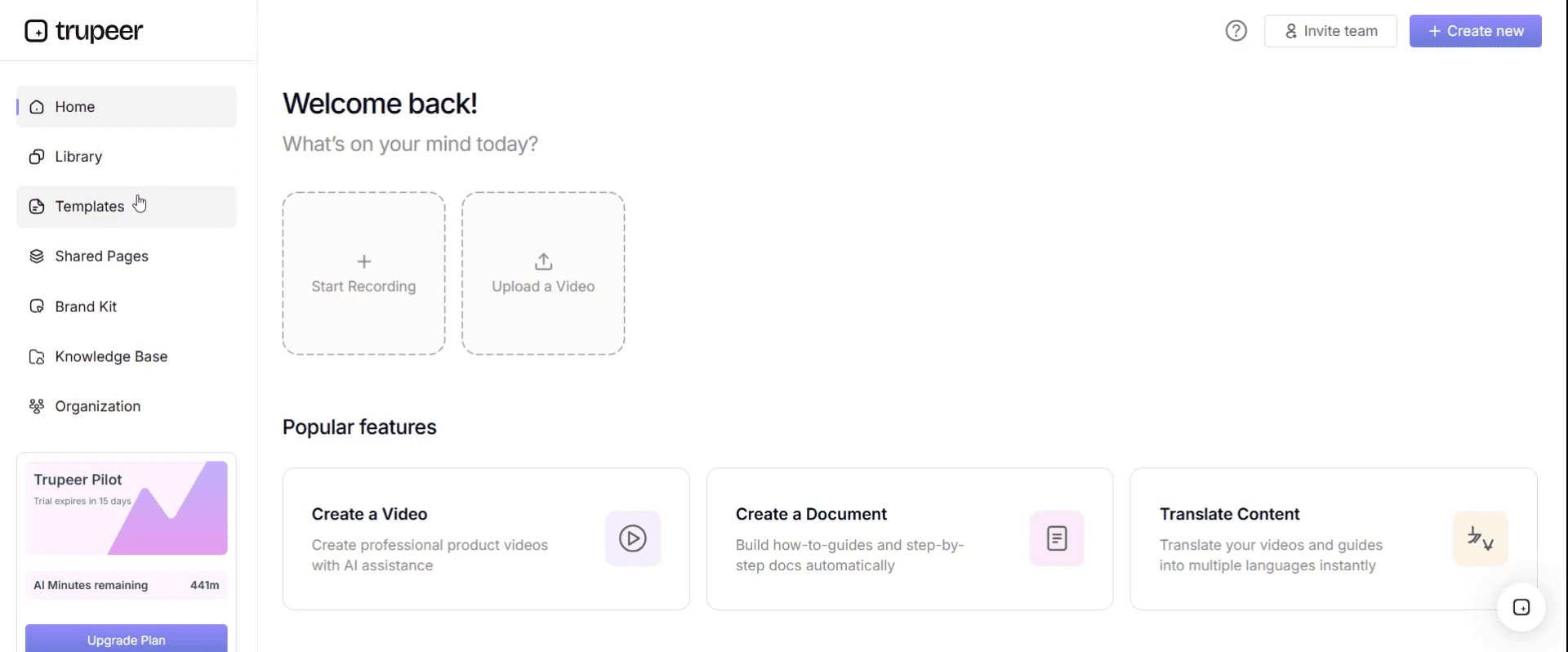
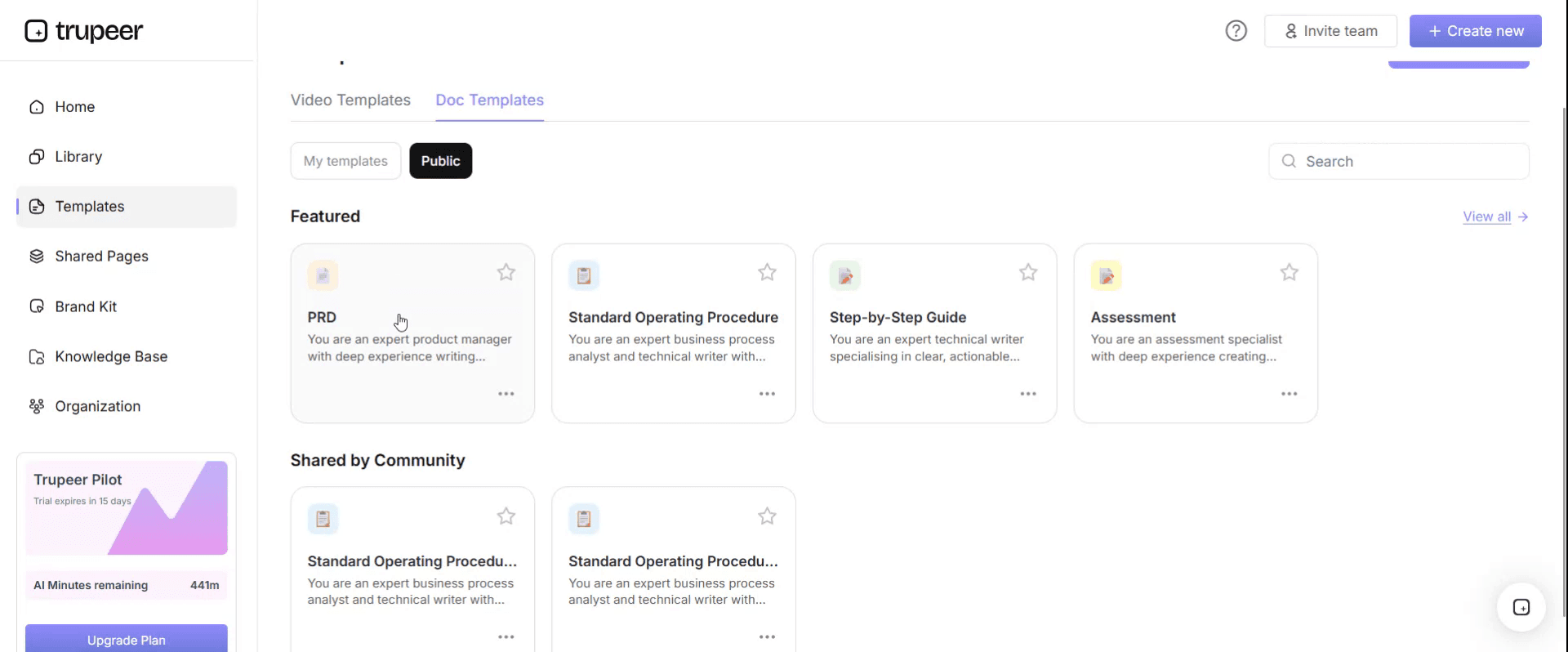
Step 2: Select and Open a Template
Click on any template you want to work with to open it.
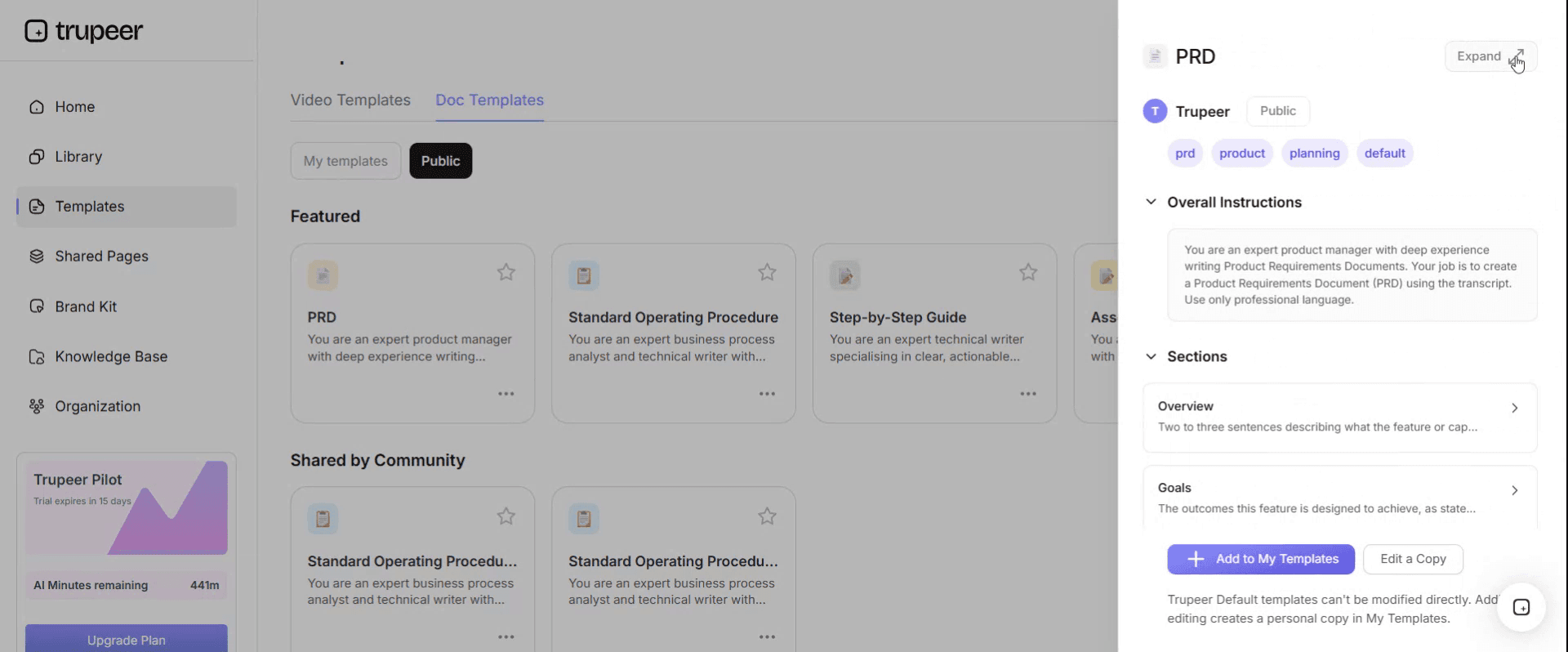
Step 3: Expand the Template View
If needed, expand the template view to see the full layout and details clearly.
Step 4: Edit the Template
Click on Edit to start modifying the selected template.
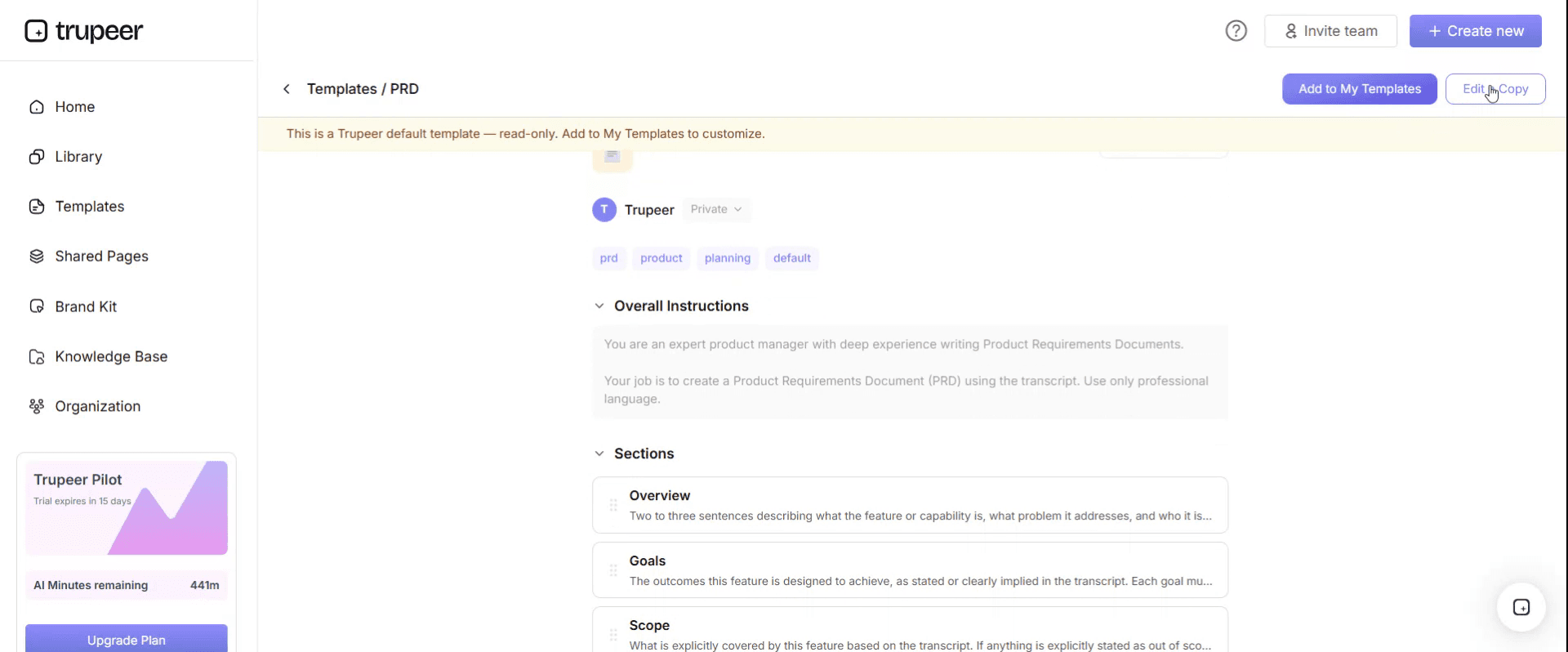
Within the editor, you can:
Add new sections
Define or update formatting rules
Add a logo and adjust its position and related settings
Step 5: Save Your Customized Template
After making all necessary changes, click Save to store the updated template as your own.
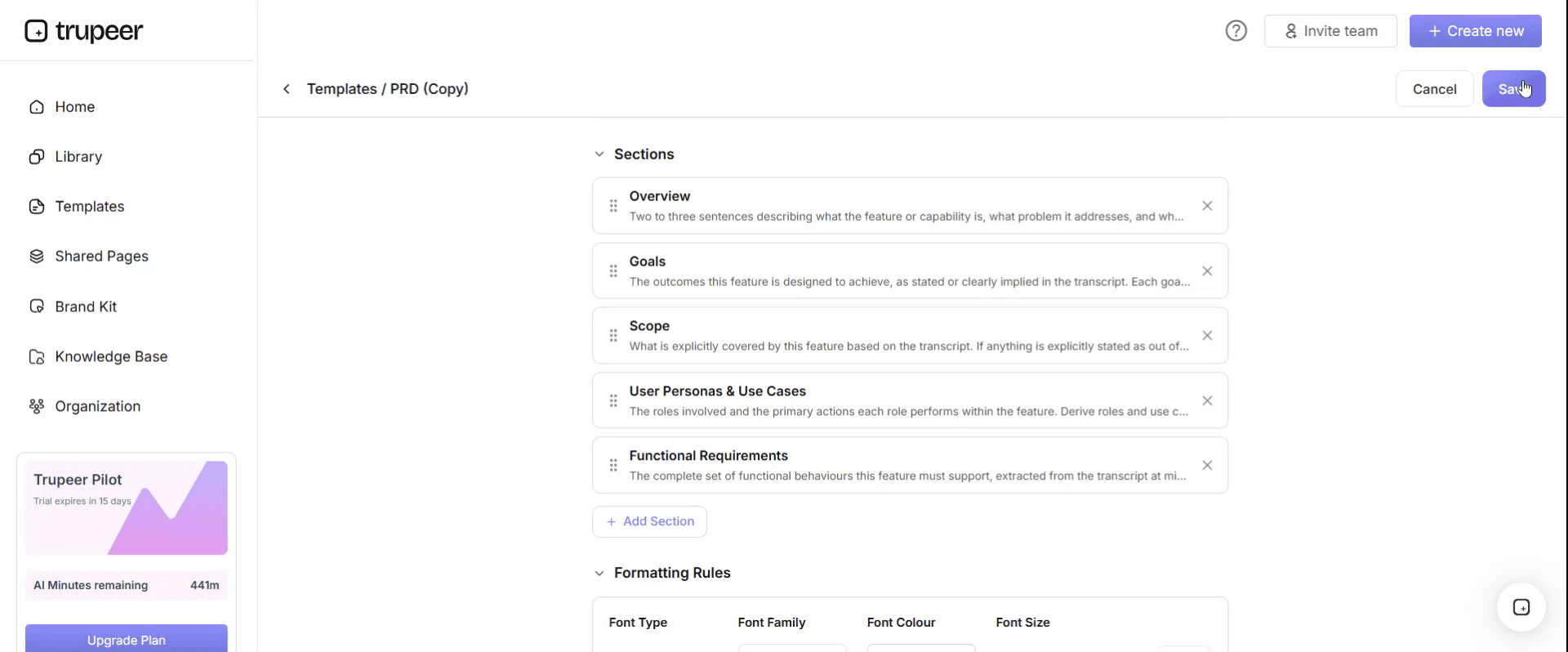
Step 6: Preview and Fine-Tune the Template
When you want to see how your customized template looks, open the Preview.
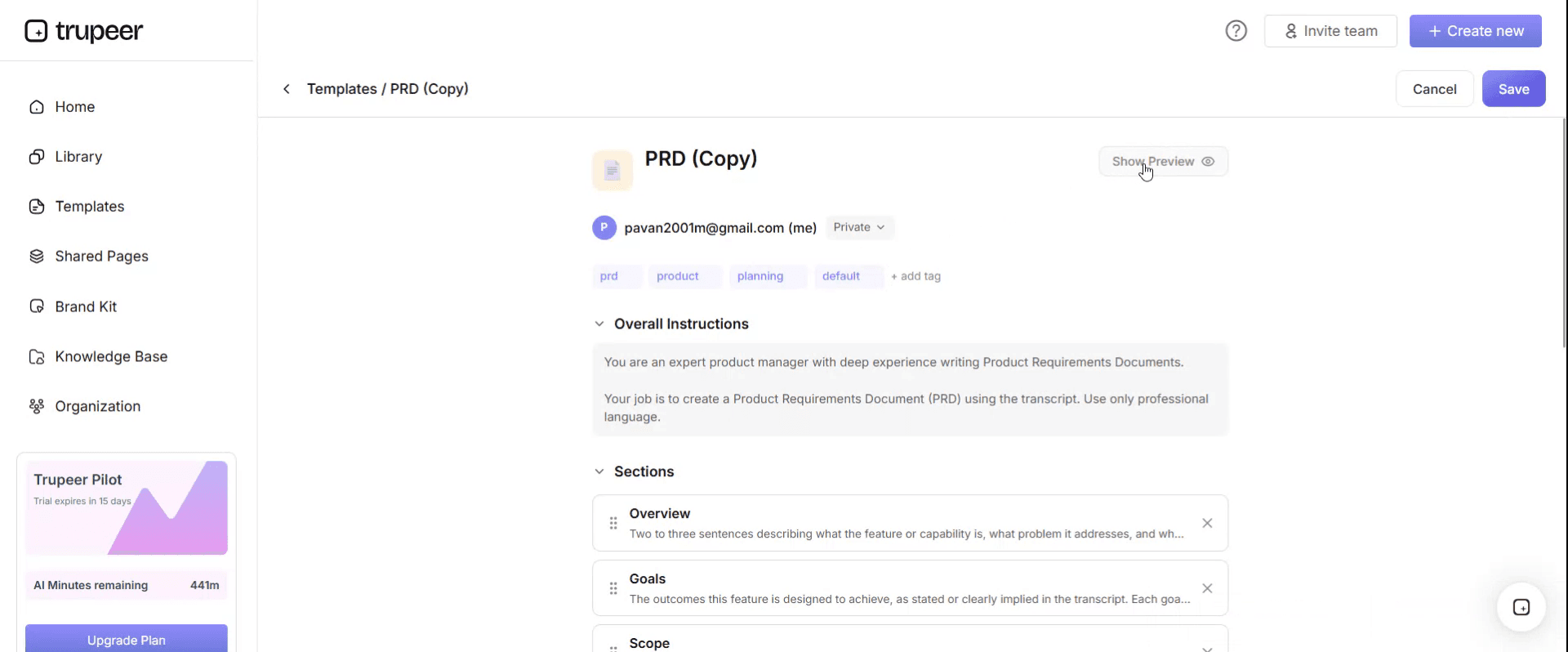
From the preview screen, you can continue to make adjustments directly if needed, ensuring the template appears exactly as you want.
With a project schedule template you can:
Plan with structure: Capture phases, tasks, owners and deadlines in a single, easy-to-follow format.
Save hours on updates: Skip the blank page and use a proven framework that's easy to customize for any project.
Stay on-brand: Apply your logo, colors and fonts using Trupeer's brand kit - so schedules shared internally or with clients look consistent.
Communicate clearly: Replace lengthy status updates with short, focused video walkthroughs - ideal for change management initiatives and team alignment.
Reach global teams: Translate schedule videos into 65+ languages with a single click.
What most free project schedule templates leave out
A schedule that answers the slip test needs four things per task. Most templates have one and a half of them.
Column | What it holds | Why it matters |
|---|---|---|
Duration | How many working days the task takes | Durations survive a slip. End dates do not, so a schedule built on typed end dates has to be retyped every time anything moves. |
Predecessor | The ID of the task that must finish first | This is the column that turns a list into a network. Without it, nothing downstream knows it has been pushed. |
Float | How many days this task can slip before the end date moves | The single most useful number in scheduling and the one almost no free template contains. |
Owner | One named person, not a team | A task owned by "Facilities" is owned by nobody, and unowned tasks are where slippage hides. |
Duration and predecessor between them do the mechanical work. Enter those and the dates calculate themselves, which means a four day slip on Tuesday redraws the whole downstream schedule instead of sitting in one cell.
Float is the column that changes behaviour. Without it, every task on the schedule looks equally urgent, so attention goes to whichever supplier is least responsive to chasing rather than to whichever task actually controls the end date. Those are frequently not the same task. Float tells you which delays to absorb quietly and which to escalate the same day.
Free project schedule template: the structure to copy
Below is a filled nine task extract from a real schedule rather than a blank grid. The project is an office relocation with a fixed end date, because the lease on the old building expires and cannot be extended. Day numbers are working days from the start.
Copy from here.
Schedule header. Project, version, baseline date, date of this version, schedule owner by name, and the fixed external constraint with its source.
Project: Head office relocation. Version 6. Baselined 12 March. This version 4 June. Owner: Priya Raman, Operations. Hard constraint: old building must be vacated by 30 September, lease expiry, no extension available.
Task table.
ID | Task | Owner | Duration | Predecessor | Earliest start | Earliest finish | Float | Status |
|---|---|---|---|---|---|---|---|---|
A | Landlord consent for alterations | P Raman | 10 | none | 1 | 10 | 0 | Complete |
B | Electrical first fix | J Okonkwo | 15 | A | 11 | 25 | 0 | In progress |
C | Data cabling | J Okonkwo | 8 | B | 26 | 33 | 0 | Not started |
D | Network hardware install and test | S Byrne | 5 | C | 34 | 38 | 0 | Not started |
E | Partition walls | J Okonkwo | 12 | A | 11 | 22 | 6 | Complete |
F | Decoration | J Okonkwo | 6 | E | 23 | 28 | 6 | In progress |
G | Desk delivery and build | P Raman | 4 | F | 29 | 32 | 6 | Not started |
H | Move weekend | P Raman | 2 | D and G | 39 | 40 | 0 | Not started |
I | Old building handover | P Raman | 3 | H | 41 | 43 | 0 | Not started |
Milestones. A short separate list. Each one carries a date and states what it gates, because a milestone that gates nothing is a decoration.
Day 38, network live and tested, gates the move weekend. Day 40, staff working in the new building, gates the old building handover. Day 43, keys returned, gates the end of rent liability.
Assumptions, numbered. The ones worth writing down are the ones somebody else controls.
Landlord consent covers the electrical specification as submitted, with no rework.
The cabling contractor can start within two days of first fix completion.
Desk delivery is a single drop, not phased.
The move happens over one weekend with no phased occupancy.
Excluded from this schedule. Explicit, because the gaps cause the arguments. Nothing about the old building's dilapidations claim. Nothing about IT equipment procurement, which runs as its own schedule.
Change log. Date, what changed, who agreed it, what it did to the end date. Three columns and a line per change is enough.
Copy to here.
How to create a project schedule in seven steps
The order matters more than the tooling, and step one is the one most often skipped.
Fix the end constraint and where it comes from. A lease expiry, a regulatory date, a trade show. Write down the source, because a date nobody can attribute is usually negotiable and a date with a source usually is not.
List the tasks at one level of detail. Twenty to forty for most projects. Resist the urge to break down distant work.
Give each task one named owner. A person, not a department.
Ask each owner for a duration, not an end date. Durations survive a slip. End dates have to be renegotiated every time anything moves.
Add the predecessor for every task. This is the step that turns the list into a schedule, and it takes about twenty minutes on a forty task project.
Calculate forward, then find the float. Covered in full in the next section.
Baseline it, then never edit the baseline. Work in a current version alongside it.
Only steps two and three appear in most free templates, which is why so many schedules are built in the wrong order. Tasks and owners get filled in carefully, then dates are typed in at the end to fit the deadline somebody has already promised. A schedule assembled that way cannot tell you it is impossible, because nothing in it was calculated.
How to calculate float in a project schedule template
Float has a reputation for requiring project management software. It requires arithmetic and about ten minutes.
Work forward through the table. The first task starts on day 1. Every other task starts the day after its predecessor finishes, and finish equals start plus duration minus one. That gives you both date columns above without typing a single date.
Now find the longest route to your final task. H cannot begin until both D and G are done. The route through A, B, C and D reaches day 38. The route through A, E, F and G reaches day 32. The longer route wins, so H starts on day 39.
The difference between those routes is the float. Six days, sitting on the E, F, G chain.
One thing about those six days matters more than the number. The float is shared across the whole chain, not held separately by each task. If decoration runs four days late, the desk build does not still have six days spare. It has two. Float is consumed by whichever task reaches it first, which is why a schedule has to be recalculated after a slip rather than annotated.
The tasks with zero float are your critical path. On this extract that is A, B, C, D, H and I. Any slip on any of those moves the end date by the full amount of the slip, on the day it happens.
Project schedule example: the relocation that slipped eleven days
Pentland Rowe, an insurance broker of about two hundred and ten people, moved its head office in the year its lease expired. The old building had to be empty by 30 September and there was no extension to be had.
The schedule was a sixty row spreadsheet. Task name, owner, start date, end date, a status column with a colour. It had been through six versions and was genuinely maintained, in the sense that somebody updated the status colours every Friday.
The electrical first fix slipped eleven days. The contractor had told them, in writing, in week three.
Nobody noticed for three weeks. Not because the message was missed, but because the spreadsheet absorbed it without complaint. The electrical row was updated and every row after it still showed its original dates, because no column in the file connected them. The cabling date, the network install date and the move weekend all still said what they had said in March. The end date still said 30 September.
The discovery came when the network installer arrived on site and found no cabling to install.
What made the debrief uncomfortable was where the attention had gone. Through those same three weeks, the weekly project meeting spent most of its time on the furniture supplier, who was slow to confirm the delivery slot and slow to answer email. The electrical contractor was responsive, so the electrical work took up very little meeting time.
The desk delivery chain had six days of float. The electrical first fix had none. The meeting had been managing the task that could safely slip and ignoring the one that could not, and the schedule offered nothing that would have told anybody otherwise.
The eleven days cost a two week overlap on both leases at twenty four thousand pounds a month on the old building, weekend overtime to compress the cabling, and a temporary reception arrangement for a fortnight. Around thirty one thousand pounds, all of it avoidable.
They rebuilt the same sixty tasks with duration, predecessor, float and a named owner per row. Nothing was added to the schedule and nothing removed. It took an afternoon.
Nine of the sixty tasks had zero float. The weekly review now covers those nine plus anything that has dropped below three days of float, which takes about fifteen minutes, and the remaining fifty one tasks are read rather than discussed.
Eighteen months later they consolidated two branch offices into one. A partition supplier lost nine days. The end date did not move, because the nine days landed on a chain that had eleven days of float and the schedule said so within a minute of the call. Nobody escalated it and nobody worked a weekend.
Project schedule template variants: simple, construction, agile and weekly
Search for a project schedule template and you will be offered a simple one, a construction one, an agile one, a weekly one, a multi project one, a one page one and a dozen more. The differences are much smaller than the naming implies. Most are the same table at a different level of granularity.
Simple schedule. Ten to thirty tasks, one owner each. Correct for most projects under three months. Adding rows beyond that adds maintenance rather than control.
Weekly look ahead. Not a different schedule but a filtered view of the same one, showing the next two or three weeks. It only works if the underlying schedule has predecessors, otherwise the filter has nothing to sort by.
Construction programme. More rows, longer durations, more sequencing constraints, often a required submission format. Health and safety sequencing in construction is not a scheduling preference but a statutory duty in most jurisdictions, and the programme is one of the documents evidencing it. Have someone qualified review the sequence rather than treating it purely as a scheduling exercise.
Agile schedule. Something of a contradiction. The honest version is a fixed cadence of sprints with scope that moves, rather than fixed scope with dates that move. If you are asked for both a sprint backlog and a dated Gantt chart, you are being asked to commit to scope and date at once, which is worth naming rather than solving with a template.
Multi project schedule. The one variant that genuinely needs different structure, because the constraint stops being sequence and becomes shared people.
One page schedule. A reporting artefact. Produce it from the real one and do not run the project from it.
Pick the granularity that matches the decisions you make weekly. Everything else is presentation.
Three neighbouring documents get searched for alongside this one and are not variants of it. A construction schedule template Excel free download is this document with statutory sequencing obligations attached, covered above. A simple project plan template Excel free download is the project plan, which answers scope and approach rather than dates. A work schedule template Excel free download is a staff rota, which is a different document entirely despite the shared word. Reaching for the wrong one of those is a common and expensive start.
Gantt chart template or project schedule: the difference that matters
These get used interchangeably and they are not the same kind of thing.
The schedule is the data. Tasks, durations, dependencies, owners, float. The Gantt chart is one way of drawing it, with time along the horizontal axis and a bar per task.
That distinction has a practical consequence. Search for a free project schedule template Gantt chart and most of what comes back is a picture. A Gantt chart drawn by hand, where the bars are shapes positioned by eye rather than objects driven by dates, contains no dependency information at all. It looks like a schedule and it fails the slip test completely, because moving a bar moves a picture. A surprising number of Gantt charts in circulation are exactly this, produced in presentation software for a board pack and then reused as though they were the plan.
Draw the Gantt chart from the table. Never the other way round. Any Gantt chart template will serve if the bars are generated from durations and predecessors underneath.
Do AI project management tools solve this?
Partly, and it is worth being precise about which part.
What the current generation of AI project management tools does well is the tedious half. Generating a task list from a description of the project, suggesting durations from comparable work, spotting that two tasks share an owner in the same week, and redrawing the chart after a change. That is real time saved, particularly on step two above.
What they do not do is supply the constraint. The end date and its source, the durations the people doing the work will actually stand behind, and the judgement about which of two sequences is safer are inputs. A tool that generates a plausible schedule from a prompt produces plausible durations, and plausible is the specific failure mode that float exists to expose.
The useful test is the same one. Whatever tool you use, ask it what a four day slip on a given task costs. If the answer is a recalculated end date, the tool is doing scheduling. If the answer is a redrawn chart with the same end date, it is doing layout.
Who owns the project schedule and how often to update it
One named person owns the schedule. Not a committee and not whoever is free. That person does not own the work or decide the durations. They own the accuracy of the file, and their weekly job is to ask the owner of every zero float task whether the finish date has moved, then recalculate. It is not a status meeting. It is a short set of questions to a small number of people, followed by arithmetic.
Weekly suits most projects, daily during a cutover or a move weekend. Monthly is a report rather than a schedule, and on a project with two week tasks it means most slips surface after the recovery window has closed.
Freeze the first agreed version as the baseline and never edit it, because schedules slip in single days and get rewritten in place, so each version looks reasonable while the cumulative movement stays invisible. The interesting number is the gap between baseline and current, and whether it is growing at a steady rate. A schedule that has drifted four days in each of the last four months will not stop drifting because the remaining durations were shortened on paper. Keep a change log for the same reason, since a slip somebody agreed to is a different thing from a slip that happened.
What a free project schedule template cannot fix
Worth being direct about, since the format of the file is rarely the actual problem.
Optimistic durations. No structure improves an estimate. What helps is asking whoever will do the work rather than whoever is writing the schedule, and asking for a duration rather than an end date.
Resource contention. Dependencies model sequence, not availability. Two tasks can be sequenced perfectly and still be impossible because the same person is named on both, and float will not warn you. Sort by owner occasionally and look for overlaps.
Scope that has not been agreed. No amount of dependency structure survives a change of scope. That is a job for the plan, not the schedule.
Nobody reading it. The most common failure. A well built schedule that is not part of a weekly decision is a document rather than a control, and fifteen minutes a week is cheaper than one avoidable slip. No free project schedule template free download fixes this one, because the problem is the meeting rather than the file.
Project schedule template, project plan or project timeline?
Three terms used loosely, and the differences decide which document you should actually be building.
The project schedule answers when. Tasks, durations, dependencies, owners, dates. It is the working file that changes weekly.
The project plan answers how and who and how much. Approach, scope, governance, budget, risks, roles. It contains the schedule or points at it, and it changes rarely. Our project plan template covers that document, and if you are building both, build the plan first, because the schedule inherits its scope. For technology projects, the IT project plan template adds the environments, cutover and rollback sections a general plan leaves out.
The project timeline is a presentation of the schedule for people who are not running it. Fewer rows, milestones rather than tasks, no float column.
If your schedule and your timeline disagree, the timeline is wrong, because it is a copy. Generate it rather than maintaining it. Decisions taken and versions agreed belong with your project documentation rather than in the schedule, which should stay a working instrument.
Show your scheduling method rather than describing it
The part of scheduling that does not survive a written handover is the mechanics. How the float column calculates in your file. Which view the weekly review uses. What the schedule owner actually does on a Monday morning.
Written procedures for this are unusually hard to follow, because the reader has to reconstruct a sequence of clicks from prose. Most people abandon the document and ask a colleague, and the procedure decays from there.
Trupeer AI closes that gap. Whoever runs the schedule records the weekly update once, and the output is a written walkthrough with screenshots and a video, in your own branding, ready to sit in your knowledge base next to the schedule itself. Where the project team spans several languages, the same recording produces the same walkthrough in each of them, so a site team and a head office team work from one procedure rather than two translations of it.
Record it. Brand it. Translate it. Trupeer it.
It earns its keep twice. The recording that taught the team to maintain the schedule becomes the training material for whoever inherits it, which is where most scheduling discipline is lost. Consistency with your other project documents is a matter of setting the brand kit once, and setup is covered in the document template setup guide.
Frequently Asked Questions
Is there a free project schedule template Excel free download?
Excel is the right tool for this, and the honest answer is that a project schedule template Excel free download will usually hand you a formatted grid of typed dates with no predecessor column and no float column, so you inherit the maintenance problem along with the formatting.
Build it instead. Create the nine columns from the task table above, then let Excel do the arithmetic rather than typing dates. Earliest start is the predecessor's earliest finish plus one working day, and earliest finish is start plus duration minus one. Use WORKDAY so weekends are handled. Once those two columns calculate, a changed duration updates everything downstream, which is the whole point. It takes about ten minutes and leaves you with a file you understand.
Is there a free project schedule template Word version?
You can build the table in Word and for a small project it is fine, with one significant limitation. Word will not calculate, so every date is typed and every slip means retyping the rows below it. That is the exact failure the float column exists to prevent.
Use a free project schedule template Word layout when the schedule is a section inside a larger document that has to read as prose, and keep the working version in a spreadsheet. Do not maintain both.
Is there a free project schedule template free download on this page?
No, and that is deliberate. There is no gated file and no form. The structure above is on the page to copy, because a free project schedule template free download that you have to reverse engineer is slower to adopt than ten minutes of laying out your own columns.
If you do use a download from elsewhere, check one thing before you trust it. Click a date cell. If it contains a typed value rather than a formula, the file cannot answer the slip test and you will be retyping it every week.
Is there a free project schedule template PowerPoint version?
PowerPoint suits the timeline, not the schedule. Bars positioned by eye contain no dependency information, so a free project schedule template PowerPoint slide cannot tell you what a delay costs.
Build the schedule in a spreadsheet, then produce the slide from it for reporting. Treat the slide as a rendering that gets regenerated, never as the file you edit.
Is there a free project schedule template PDF?
PDF is for circulating a version, not for working in. Export the current schedule as a free project schedule template PDF when you send it out, with the version number and date in the header so recipients can tell whether they are reading the current one.
Do not use PDF as the master. A schedule that cannot be recalculated has stopped being a schedule.
Is there a free project schedule template Gantt chart?
Yes, and the order matters. Build the table with durations and predecessors first, then generate the chart from it. In Excel, a stacked bar chart with a transparent first series gives you a working free project schedule template Gantt chart in a few minutes.
If you start with the chart, you end up with a picture of a schedule rather than a schedule, which is the most common version of this mistake.
Which Gantt chart template should you use?
Almost any Gantt chart template will do, because the chart is the least important part. What separates a useful one from a decorative one is whether the bars are driven by a table of durations and predecessors underneath, or drawn by hand.
Check before you commit to one. Change a duration in the underlying data. If the bar moves and everything after it moves too, the Gantt chart template is worth keeping. If only that one bar moves, it is an illustration.
How many tasks should a project schedule template have?
As few as will let you see a slip in the week it happens. For most projects under three months that is twenty to forty tasks.
Task duration is the better guide than task count. If a task is longer than your update cycle you cannot tell whether it is on track, so a two week task on a weekly review should be split. Anything shorter than a day is usually detail that belongs in the work instructions rather than the schedule. Distant work gets phases and milestones rather than fake precision, and gets broken down as it approaches.
Is a construction schedule template the same as a project schedule template?
Structurally yes, and legally no. A construction schedule template Excel free download gives you the same table of tasks, durations, predecessors and float, usually with more rows and longer durations.
The difference is that sequencing in construction carries statutory health and safety duties in most jurisdictions, and the programme is one of the documents that evidences them. Treat it as a compliance artefact as well as a scheduling one, and have the sequence reviewed by someone qualified rather than relying on the template alone.
What are the best AI project management tools for scheduling?
The category is moving quickly enough that a list here would be out of date before you read it, so the useful thing is the selection test rather than the names.
Ask any tool what a four day slip on a specific task does to the end date. A tool that recalculates and tells you is doing scheduling. A tool that redraws the bars and leaves the end date alone is doing layout, however good the generated task list was. Most of the current tools are genuinely strong at drafting the task list and weak at the constraint, so plan to supply the durations and the end date yourself.
What is the difference between a project schedule and a project timeline?
The schedule is the working file with tasks, durations, dependencies and float, and it changes weekly. The timeline is a simplified view of it for people who are not running the project, usually milestones only.
The schedule is maintained. The timeline is generated. If they disagree, the timeline is out of date.