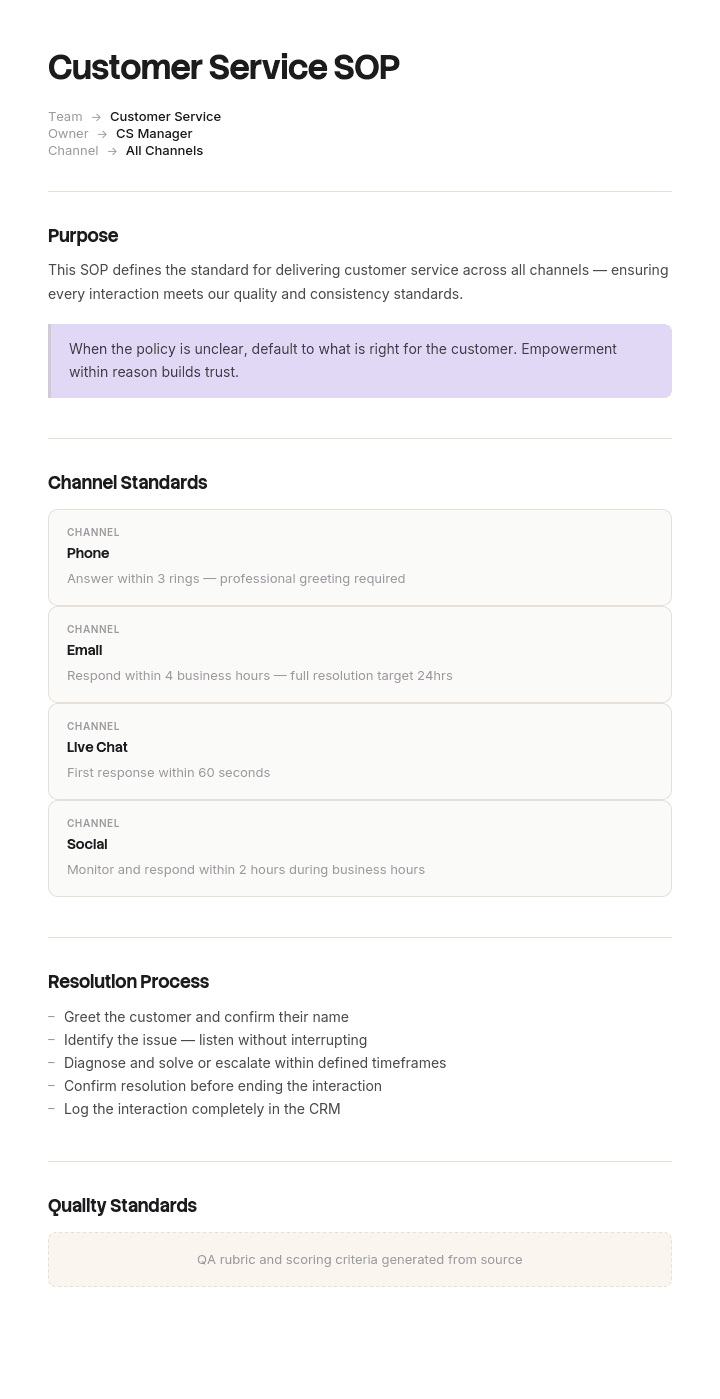
Use this template
A great customer service SOP is what separates teams that delight customers from teams that just get by. With Trupeer, you can save hours on writing customer service SOPs by starting with a free template, customizing it with your brand guidelines, and using our AI SOP creator to turn each procedure into a clear video walkthrough.
This customer service SOP template provides a structured framework to capture purpose, scope, channel-specific procedures (phone, email, chat, social), escalation paths, response time SLAs and quality metrics. Pair it with our SOP creator for related procedures, generate AI video walkthroughs, and translate into 65+ languages for global support teams.
Most SOPs are written to be read at a desk with time to think. Customer service SOPs are read with someone on hold, or a chat window open, or an angry email half-drafted.
That changes what a good one looks like. The decision has to be visible in the first few lines, the wording has to be given where wording matters, and anything longer than a page will not be opened twice. This template is built for that moment.
Download the customer service SOP template
Format | Best for |
|---|---|
Word (.docx) | Writing and editing procedures. Free download, no sign-up |
The approved version, printing for a support desk, and sharing | |
Google Docs | Collaborative drafting with the team who use them |
Excel (.xlsx) | The SOP register and the escalation matrix |
.doc | Older systems and legacy document libraries |
Free, editable, no watermark.
The customer service SOPs you actually need
Write these six before anything else. They cover most of what goes wrong.
# | SOP | Trigger | Why it matters most |
|---|---|---|---|
1 | Complaint handling | Customer expresses dissatisfaction | Highest stakes, most variation between agents |
2 | Escalation | Issue exceeds agent authority or severity threshold | Undocumented escalation is the top cause of delay |
3 | Refunds, replacements and goodwill | Customer requests money back or compensation | Inconsistency here is visible and expensive |
4 | First response and triage | New ticket arrives | Sets the tone and the SLA clock |
5 | Difficult or abusive customers | Conversation becomes hostile | Agents need permission and a script, not improvisation |
6 | Handover between agents or shifts | Ticket changes owner | Customers repeating themselves is the most common complaint about support |
Then add channel-specific ones, outage and incident communication, cancellation and retention, and account or data requests as they become necessary.
How to customize this template in Trupeer
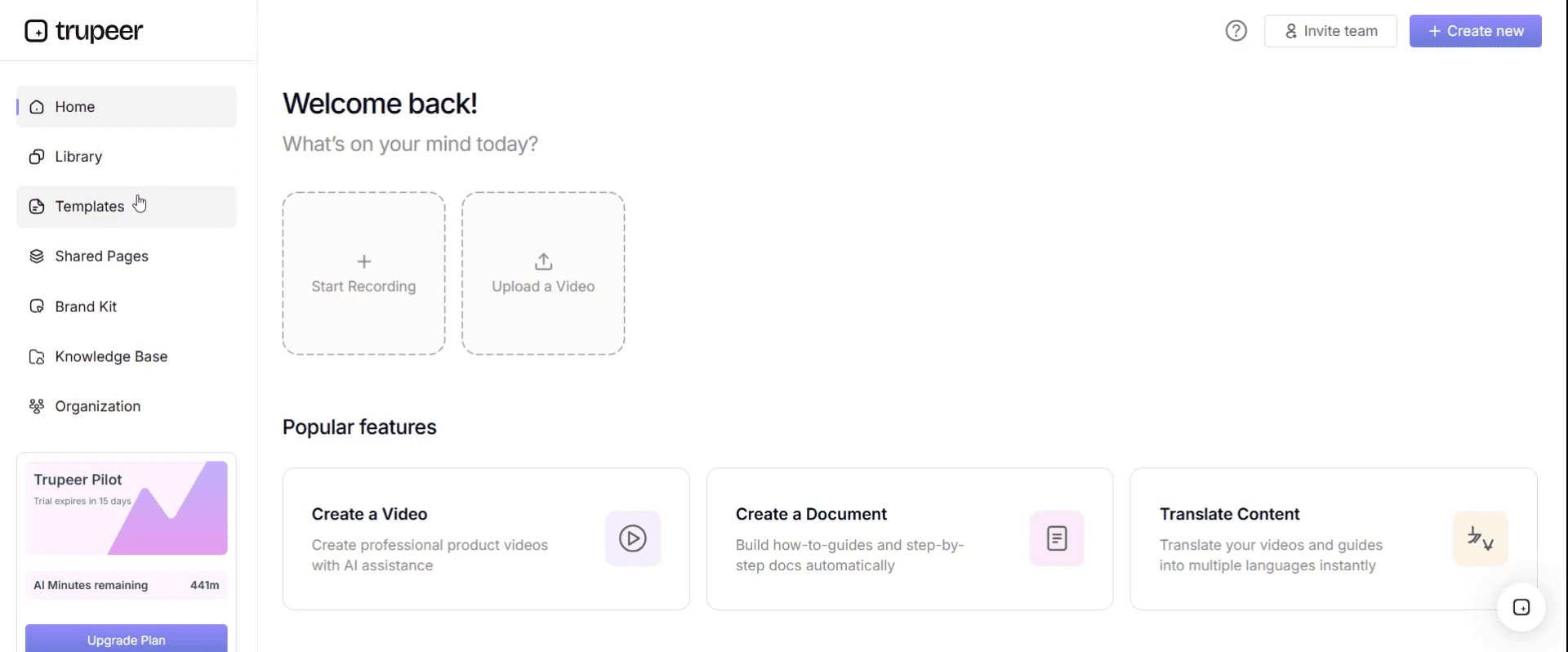
Step 1: Open the Templates Section
Go to the Templates section from the main navigation.
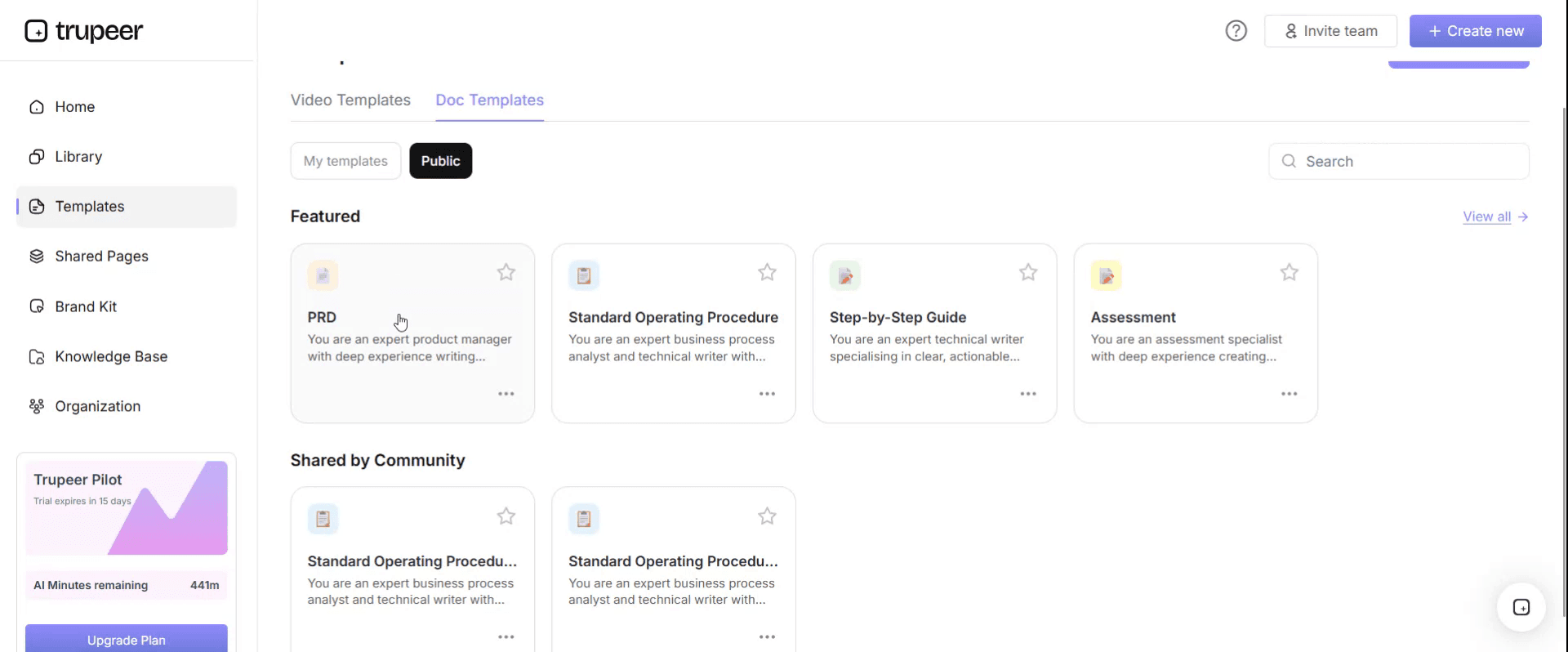
Step 2: Select and Open a Template
Click on any template you want to work with to open it.
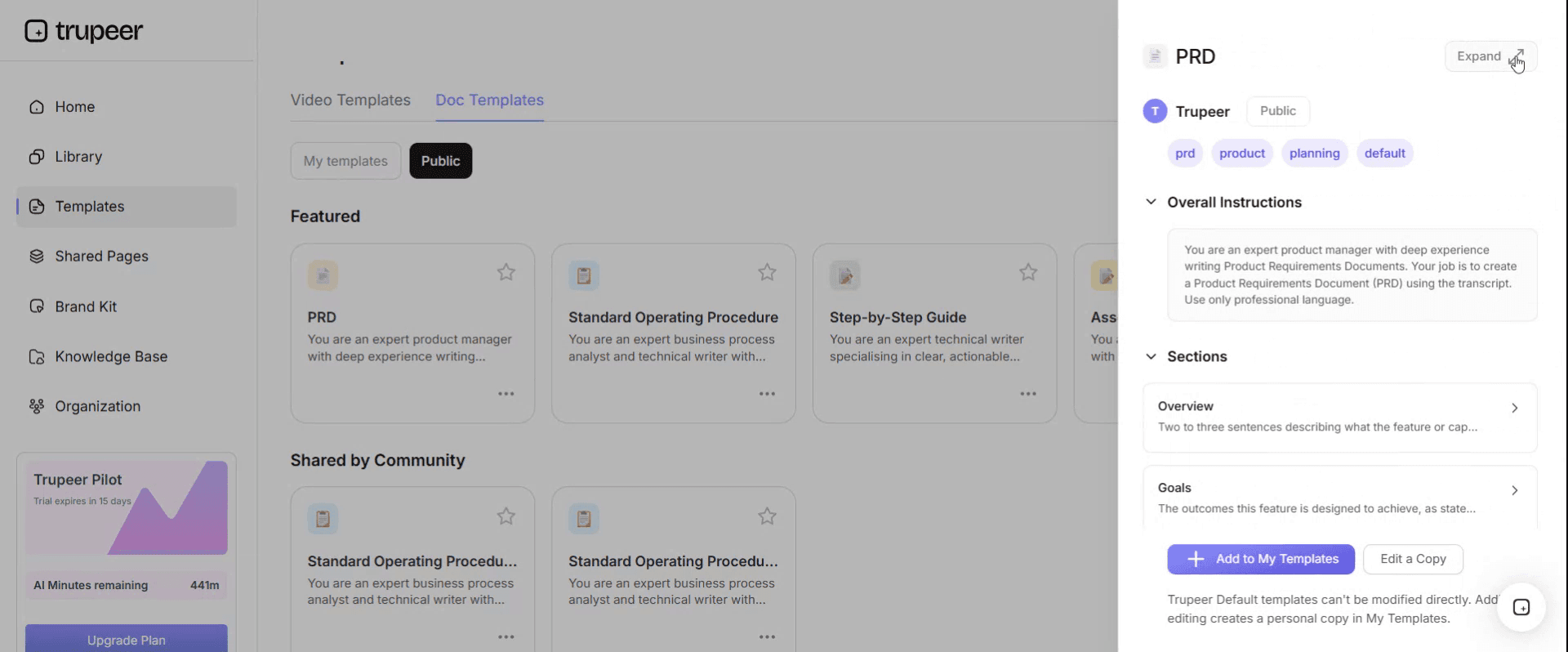
Step 3: Expand the Template View
If needed, expand the template view to see the full layout and details clearly.
Step 4: Edit the Template
Click on Edit to start modifying the selected template.
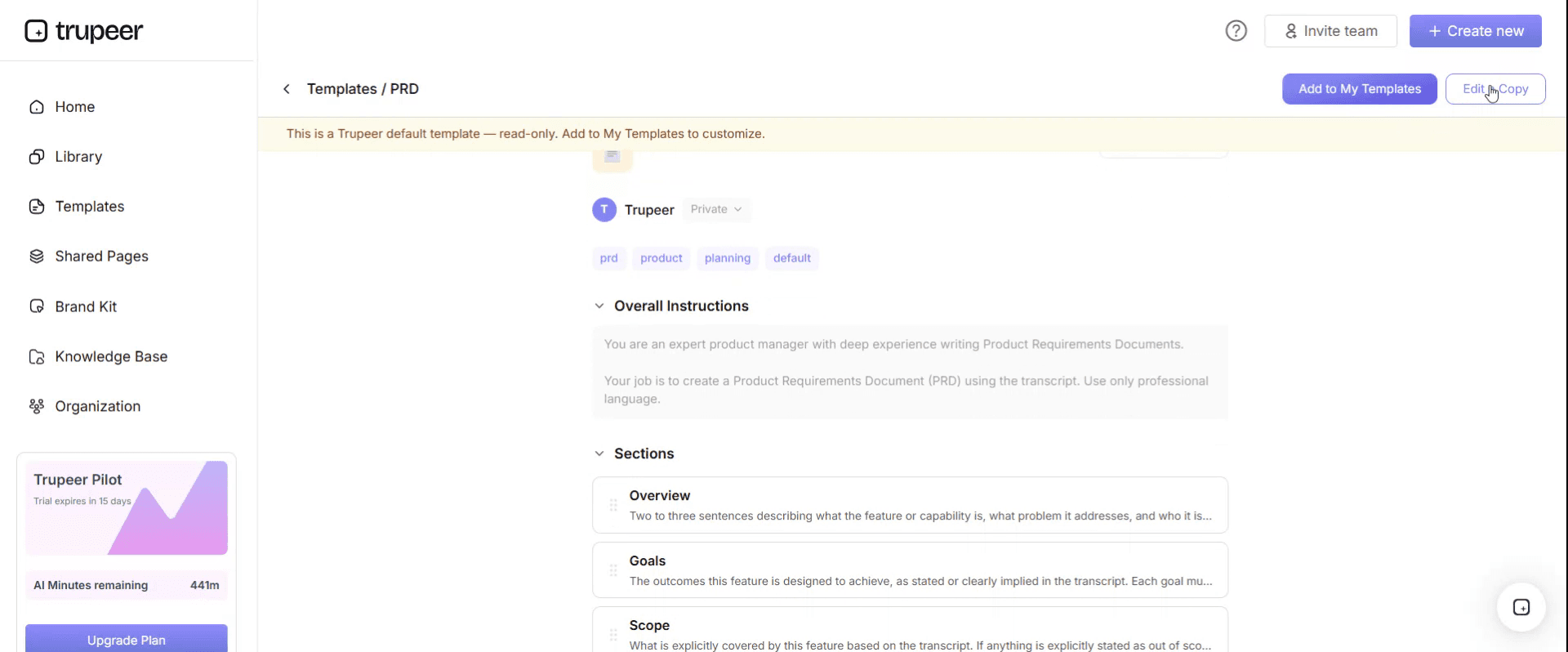
Within the editor, you can:
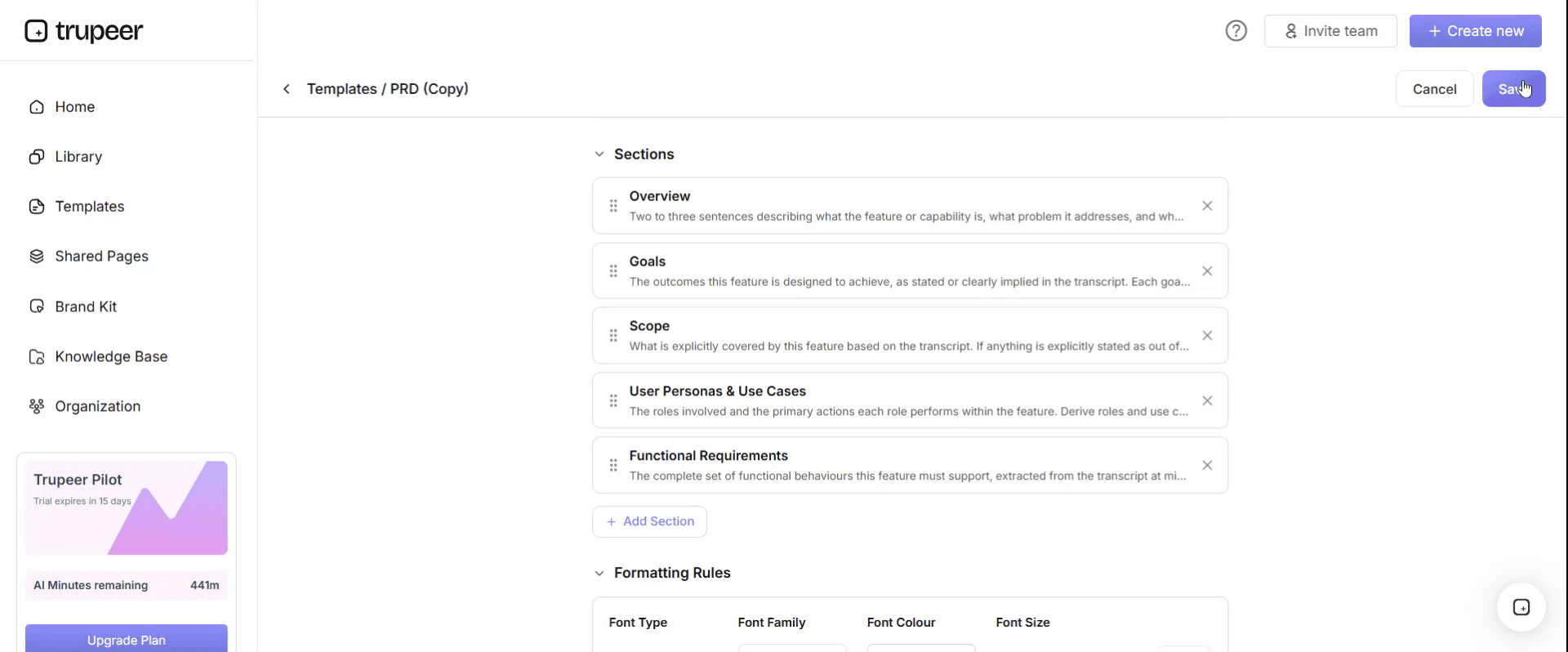
Add new sections
Define or update formatting rules
Add a logo and adjust its position and related settings
Step 5: Save Your Customized Template
After making all necessary changes, click Save to store the updated template as your own.
Step 6: Preview and Fine-Tune the Template
When you want to see how your customized template looks, open the Preview.
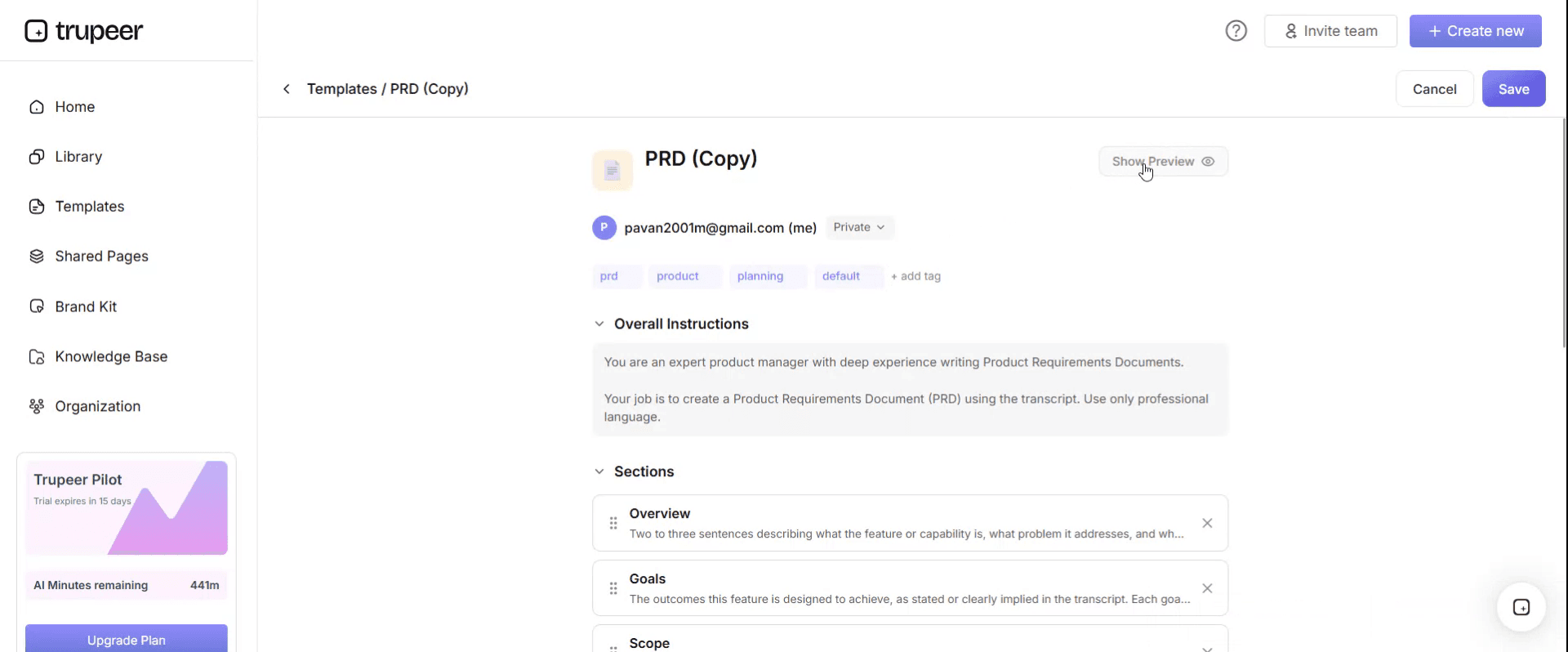
From the preview screen, you can continue to make adjustments directly if needed, ensuring the template appears exactly as you want.
With a customer service SOP template you can:
Save hours on writing: Skip the blank page with a proven SOP structure.
Standardize service quality: Built-in standards ensure every agent delivers consistent service.
Stay on-brand: Apply your logo, tone of voice and colors using Trupeer's brand kit.
Cut response times: Clear procedures help agents resolve issues faster.
Onboard agents faster: Pair SOPs with video walkthroughs to ramp new hires quickly.
Reach global teams: Translate customer service SOPs into 65+ languages with one click.
Why customer service SOPs are different
They are read under time pressure, so the decision must come before the explanation.
Exact wording matters. In most procedures the outcome is what counts. Here, how something is phrased changes whether a customer escalates.
The customer is present. An agent cannot pause to find the right document without the silence being noticed.
Judgement is unavoidable. Every case differs slightly, so the SOP has to define boundaries rather than prescribe every action.
Emotional load is high. Agents need explicit permission for the hard decisions, particularly ending an abusive call.
Turnover is high. Support teams change often, so procedures are the main mechanism by which quality survives.
Practically, that means one page per procedure, decision tables rather than paragraphs, scripts in quotation marks, and boundaries stated in numbers.
The customer service SOP template
Field | Enter |
|---|---|
SOP title and reference | Complaint handling, CS-001 |
Version and date | v2.1, [date] |
Owner and approver | Support Manager, Head of Customer Service |
Applies to | Which team, channel or tier |
Trigger | The event that starts it |
Target time | Response and resolution targets |
Decision points | With both branches named |
Steps | Numbered, one action each |
Scripts | Exact wording where it matters |
Agent authority | What this role can decide without approval |
Escalation | Who, when, and how |
Record | What must be logged, and where |
Definition of done | What closes the interaction |
Review date | And who owns it |
A complete customer service SOP
Written out fully, because seeing one at the right level of detail is more useful than a blank template.
CS-001 · Complaint handling · v2.1
Purpose. Resolve customer complaints consistently, at the first point of contact wherever possible.
Applies to. All support agents, all channels.
Trigger. A customer expresses dissatisfaction with the product, service or an interaction, whether or not they use the word complaint.
Target. Acknowledge within 1 hour on chat and phone, 4 working hours on email. Resolve or provide a next step within 1 working day.
Agent authority. Refunds up to [£100]. Goodwill credit up to [£50]. Replacement shipping at no charge. Anything above these goes to a team lead.
Steps.
Acknowledge before diagnosing. Say back what has happened in your own words and confirm you have understood. Do not explain, defend or ask for a reference number first. Script: "That's not the experience we want you to have, and I'm sorry. Let me make sure I've understood: [restate]. Is that right?"
Ask what outcome they want. Before proposing anything. Customers frequently want less than you would have offered, and asking prevents you offering the wrong thing. Script: "What would a good outcome look like for you?"
Check the account and history while they are talking, not before. Look for previous contacts about the same issue, since a repeat complaint is a different situation and escalates faster.
Decision point. Is this within your authority?
Situation | Action |
|---|---|
Within authority, customer's request is reasonable | Resolve now, step 5 |
Within authority, request is unreasonable | Offer the alternative in step 6 |
Above authority | Escalate per CS-002, tell the customer who and when |
Second complaint about the same issue | Escalate to team lead regardless of value |
Legal, regulatory, safety or media threat | Escalate immediately to Head of Customer Service |
Resolve and confirm. State what you are doing, when it will happen, and what they will see. Then confirm in writing within the hour. Script: "I'm going to [action]. You'll see [outcome] by [time]. I'll email you a confirmation in the next hour."
If you cannot give them what they asked for, say what you can do rather than leading with what you cannot. Script: "I'm not able to [X], and I want to be straight with you about that. What I can do is [Y]. Would that help?"
Log it. Category, root cause if known, resolution, value of any goodwill given, and whether it was a repeat. This is what turns individual complaints into a pattern anyone can act on.
Follow up on anything not resolved on first contact, at the promised time, even if there is no progress. Silence is what turns a complaint into an escalation.
Definition of done. Customer has acknowledged the resolution, written confirmation sent, ticket categorised and logged, follow-up scheduled if outstanding.
Never. Blame another department to the customer. Promise a timeframe you do not control. Say "that's our policy" without explaining the reason. Close a ticket without the customer confirming.
Review. Quarterly, and after any complaint that escalated beyond the team.
The escalation matrix
The document that stops escalation being a judgement call made differently by every agent.
Level | Trigger | Owner | Response target | Customer told |
|---|---|---|---|---|
1 | Standard issue within agent authority | Agent | Immediate | Resolution and timing |
2 | Above agent authority, repeat contact, or unresolved after 2 attempts | Team lead | 4 working hours | Who is now handling it, and when |
3 | Service failure affecting the account materially, or a request above lead authority | Support Manager | 1 working day | Named owner and a call if appropriate |
4 | Legal threat, regulatory issue, safety concern, media contact, or a major account at risk | Head of Customer Service | Immediate | Acknowledged same day by the escalation owner |
Two rules make it work. The customer is always told an escalation has happened and who owns it, because silent escalation feels identical to being ignored. And escalation is never a punishment for the agent, or agents will avoid it and problems will grow.
Scripts, and where wording actually matters
Scripting the whole conversation produces agents who sound like a phone tree. Scripting nothing produces inconsistency exactly where it costs most.
Script these:
The apology. The difference between "I'm sorry you feel that way" and "I'm sorry, that shouldn't have happened" is the difference between an escalation and a resolution.
Refusals. Leading with what you can do rather than what you cannot.
Escalation handoffs. So the customer knows what is happening rather than hearing hold music.
Ending an abusive call. Agents need the exact words and explicit permission.
Anything with legal or regulatory implications.
Do not script: diagnosis, small talk, or the resolution itself. Those depend on the case, and agents reading a script through them sound insincere.
Write scripts as suggested wording rather than mandatory text, unless compliance requires otherwise. The goal is a starting point for a nervous new agent, not a cage for an experienced one.
Refunds, replacements and goodwill
The area where inconsistency is most visible, because customers compare notes.
Set authority limits by role and state them numerically. Agent up to a figure, team lead up to a higher one, manager above that. Vague guidance like "use your discretion for small amounts" produces a tenfold variation between the most and least generous agents.
Define what triggers goodwill separately from what triggers a refund. A refund corrects a failure. Goodwill acknowledges inconvenience, and confusing the two either overcompensates or feels grudging.
Log the value every time. Without it you cannot see that one product line is generating three times the goodwill spend of any other, which is usually a product problem rather than a support one.
And write down what is never refundable, so agents are not negotiating a fixed rule.
First response and triage
Set a first response target per channel and publish it internally. Chat in minutes, email in hours, and be honest about which you actually meet.
Triage on impact rather than arrival order. A customer completely blocked outranks one with a cosmetic issue that arrived earlier.
Acknowledge before resolving. A holding response that says who owns it and when they will come back is worth more than silence while someone investigates.
Never let an automated acknowledgement stand in for a human one past your stated target.
Categorise at first touch, because retrospective categorisation is always wrong and it is the data your improvement work depends on.
Difficult and abusive customers
The SOP that agents most need and that most teams have not written.
Distinguish between an angry customer and an abusive one. Anger is a reaction to a problem and is part of the job. Abuse is personal, and no agent should have to absorb it.
Give the exact wording for a warning and for ending the contact.
Warning: "I want to help you, and I need us to keep this respectful. If the language continues I'll have to end the call."
Ending: "I'm ending the call now. You can reach us again by [channel] when you're ready to continue."
Then state clearly that ending an abusive contact is supported, will not be counted against the agent's metrics, and should be logged so patterns are visible. Without that explicit protection, agents stay on abusive calls because they fear the consequences of hanging up, which is a wellbeing failure the SOP can prevent.
Include a decompression step: the agent takes ten minutes, tells a lead, and the interaction is reviewed rather than filed.
Channel differences
Channel | What changes | Watch for |
|---|---|---|
Phone | Real time, tone carries most of the meaning | Dead air while looking things up. Narrate what you are doing |
Asynchronous, written record, easily forwarded | Length and formality. Long emails read as evasive | |
Chat | Real time, expectation of speed, informal | Handling several at once and losing thread. Cap concurrency |
Social | Public, brief, watched by others | Take it private fast, but answer publicly first so others see you responded |
In person | Immediate, high emotional load | Other customers listening. Have a private space |
Write one procedure and note the channel differences within it rather than writing four near-identical SOPs that then drift apart.
What goes into a customer service SOP
Title, reference, version and owner.
Trigger, stated as an observable event.
Response and resolution targets.
Decision points with every branch named.
Numbered steps, one action each.
Scripts where wording changes the outcome.
The agent's authority, in numbers.
Escalation route, with who and when.
What must be logged and where.
A definition of done.
A short list of things never to do.
Review date.
How to write an SOP for customer service
Start with the procedure that goes wrong most. Usually complaints or escalation.
Listen to real interactions before writing. Recordings and transcripts show what agents actually say, and the good ones are your source material.
Ask your best agent how they handle it, then ask your newest what they find hardest. The gap between those answers is the SOP.
Put the decision first. A decision table near the top, explanation below.
Write one action per step, in the order it happens.
Add scripts only where wording matters, and mark them as suggested.
State authority limits numerically.
Define the escalation trigger and route.
Test it with a new agent on a real ticket. Every question they ask is a gap.
Keep it to one page, then assign an owner and a review date.
Can ChatGPT write an SOP?
It can draft one, and that is genuinely useful for getting past a blank page. What it produces is a plausible generic procedure: the right sections, sensible structure, reasonable wording.
What it cannot know is your authority limits, your escalation route, your actual product failures, the workaround your team invented last month, or the phrasing that works with your customers. Those are the parts that make an SOP worth following, and they are the majority of its value.
The failure mode to avoid is publishing a generated SOP unedited. Agents recognise a document that does not describe their job, and once they conclude the procedures are theatre they stop consulting any of them, including the good ones.
A better sequence is to record the process being done well, generate the procedure from that recording, then add the judgement, limits and exceptions yourself. That way the source is what actually happens rather than what a model assumes happens.
How to measure customer service SOPs
Consistency. Variation in outcomes for similar cases between agents. Falling variation is the clearest sign the SOPs are working.
First contact resolution. Should rise as procedures reduce hesitation and unnecessary escalation.
Escalation rate, split into appropriate and avoidable.
Time to competence for new agents. The metric SOPs affect most directly.
Goodwill and refund spend per agent. Wide spread means authority limits are unclear.
Repeat contact rate. People coming back about the same issue points at a procedure that closes tickets rather than solving problems.
CSAT or CES by procedure type, so you can see which SOP is underperforming rather than only that satisfaction fell.
Best practices
One page per procedure.
Decision table before explanation.
Scripts only where wording changes the outcome.
Authority limits in numbers.
Escalation always visible to the customer.
Ending abusive contact explicitly supported and never penalised.
Written by the people who do the work.
Stored where the agent is working, not in a separate wiki.
Reviewed quarterly and after every serious escalation.
Categorisation at first touch, so the data is usable.
Common mistakes
Procedures too long to read mid-conversation.
Explanation before decision, so agents scroll while a customer waits.
Everything scripted, producing agents who sound automated.
Vague authority limits, producing wide inconsistency.
No escalation SOP, so escalation depends on who is asked.
No procedure for abusive contacts, leaving agents unprotected.
Written by managers who have not taken a customer contact in years.
Stored somewhere agents cannot reach in seconds.
Never updated after a product or policy change.
Measuring adherence rather than outcomes, which produces box-ticking.
Publishing an AI-generated draft unedited.
Show the interaction, do not just describe it
Open the template in Trupeer AI, apply your brand kit so procedures match your internal documentation, and edit any section directly. Setup is in the template guide.
Two things in a support SOP resist being written down. The first is any step involving your systems, since a written description of a screen is always more ambiguous than watching someone do it. The second is tone, which cannot be conveyed in a script at all.
Record the process once and Trupeer AI produces the written procedure and a narrated video walkthrough together, so a new agent can watch a complaint being handled properly rather than reading about it. Translate it into 65+ languages for distributed support teams, and keep the set in your knowledge base where agents already work. Use the same recordings for agent onboarding, which is where SOPs pay for themselves given support turnover.
Record it. Brand it. Translate it. Trupeer it.
Frequently Asked Questions
What are SOPs in customer service?
Documented procedures for the recurring situations a support team handles: complaints, escalations, refunds, first response, difficult customers and handovers. They exist so the same situation gets the same standard of response regardless of which agent picks it up.
How do you write an SOP for customer service?
Start with the procedure that goes wrong most often, listen to real interactions before writing, put the decision table at the top, write one action per step, add scripts only where wording matters, state authority limits in numbers, define the escalation route, then test it with a new agent on a live ticket and fix every gap they find.
Are there free SOP templates available?
Yes. Everything on this page is free with no account required and no watermark, in Word, PDF, Google Docs, Excel and .doc. The general SOP template covers any procedure, and there are versions for account management, HR, IT, product support and business development.
Can ChatGPT write an SOP?
It can produce a competent generic draft, which is useful for getting started. It cannot know your authority limits, escalation route, product failures or the phrasing that works with your customers, and those are most of what makes an SOP worth following. Generate the structure, then supply the judgement. Publishing an unedited AI draft is the fastest way to teach agents that procedures are theatre.
Is there a free customer service SOP template?
Yes, on this page, including the complete complaint handling procedure, the escalation matrix and the response scripts rather than just a blank shell.
Is there a free customer service SOP template in Word?
Yes. Word is the format most support teams write in, since procedures change often. Free download, no sign-up.
Is there a customer service SOP in PDF?
Yes. The PDF version is the approved format, and it prints cleanly for a support desk, which still matters where agents work across two screens and do not want a third document open.
Is there a free customer service SOP template in PDF?
Yes, both a printable version and a version formatted for on-screen reading with the decision tables at the top of each procedure.
Is there a free customer service SOP in .doc format?
Yes, a .doc version is included for older systems and legacy document libraries.
Where can I get a free SOP template?
Here, and on the SOP template hub for procedures outside customer service. All free, editable, no watermark and no attribution required.
Is there a standard operating procedure template in Word and PDF?
Yes, both formats are included for every SOP on this page and on the general SOP template page. Word for writing and revising, PDF for the approved version you circulate.
What should a customer service SOP include?
Title, reference, version and owner, the trigger, response and resolution targets, decision points with all branches named, numbered steps, scripts where wording matters, the agent's authority in numbers, the escalation route, what must be logged, a definition of done, a short list of things never to do, and a review date.
How many customer service SOPs do you need?
Start with six: complaint handling, escalation, refunds and goodwill, first response and triage, difficult customers, and handover. Those cover most of what goes wrong. Add channel-specific procedures, outage communication and cancellation handling once the first six are being followed.
How long should a customer service SOP be?
One page. Support procedures are read mid-conversation with a customer waiting, and anything longer will not be opened a second time. If it runs over, you are documenting more than one procedure.
Should customer service SOPs include scripts?
Only where the wording changes the outcome: apologies, refusals, escalation handoffs, ending abusive contact, and anything with legal implications. Script the diagnosis and the small talk and your agents will sound automated, which costs more than the inconsistency you were trying to prevent.
How often should customer service SOPs be reviewed?
Quarterly, plus immediately after any serious escalation, product change, policy change or pricing change. Support procedures go stale faster than most because they depend on the product, and an SOP describing last quarter's returns policy is worse than none.
Can I customize this customer service SOP template?
Yes, all versions are fully editable. Change the authority limits, the escalation levels and the scripts to fit your business, since those are the parts that have to be yours. In Trupeer AI you can also apply your brand kit so all procedures match your internal documentation.


