
Use this template
Great sales training is one of the highest-leverage investments any go-to-market team can make. With Trupeer, you can save hours on training design by starting with a free sales training guide template, customizing it with your brand guidelines, and turning the guide into engaging video modules sales reps actually finish.
What is a free sales training guide template?
A free sales training guide template is a reusable structure for the document a sales team learns from: what to say, when to say it, and what to do in the situations that decide whether a deal closes.
Almost every published version organises itself the same way. Product knowledge, prospecting, discovery, objection handling, closing, administration. It is a sensible taxonomy and it is the taxonomy of the subject rather than of the job.
A salesperson does not experience their week as topics. They experience it as moments. The point where the buyer asks what it costs. The week where the only contact stops replying. The call where procurement appears for the first time. The conversation where a competitor's name comes up. Those moments are where deals are won and lost, and a guide organised by topic requires the reader to translate from their moment into your chapter, which they will do twice before giving up.
The template is not the guide. It gives you a structure, and the structure is the easy part. What decides whether a guide is used is whether it covers the situations your reps are actually losing in, and most guides have never been checked against that.
Format follows use. A free sales training guide template Word file suits the guide itself. A free sales training guide template PowerPoint deck suits the sessions delivered from it. A free sales training guide template Excel version suits the situation analysis described below, and a free sales training guide template PDF is the issued version circulated to a cohort.
Why sales training guides get read once
The completion rate is not the problem. Sales teams complete training. They sit the sessions, they pass the quizzes, and they say it was useful.
Then nothing measurable changes, and the conclusion drawn is usually about motivation or reinforcement.
The more common cause is allocation. The guide spends its pages where the subject has traditionally spent its pages rather than where this team is losing money. Closing gets a chapter because sales training has always had a chapter on closing. In most business to business cycles, closing is not where deals die. Deals die months earlier, quietly, in ways nobody writes a chapter about because the failure has no dramatic moment to hang it on.
The second cause is that generic content is available everywhere and free. A rep can find objection handling technique in ten seconds. What they cannot find anywhere is how your product handles the objection your market actually raises, at your price point, against the competitor you actually lose to. That knowledge exists inside your best two or three people, almost entirely verbally, and it is the only genuinely scarce content in the whole document.
A guide made of general technique competes with the internet. A guide made of your own situations competes with nothing.
How to customize this template in Trupeer
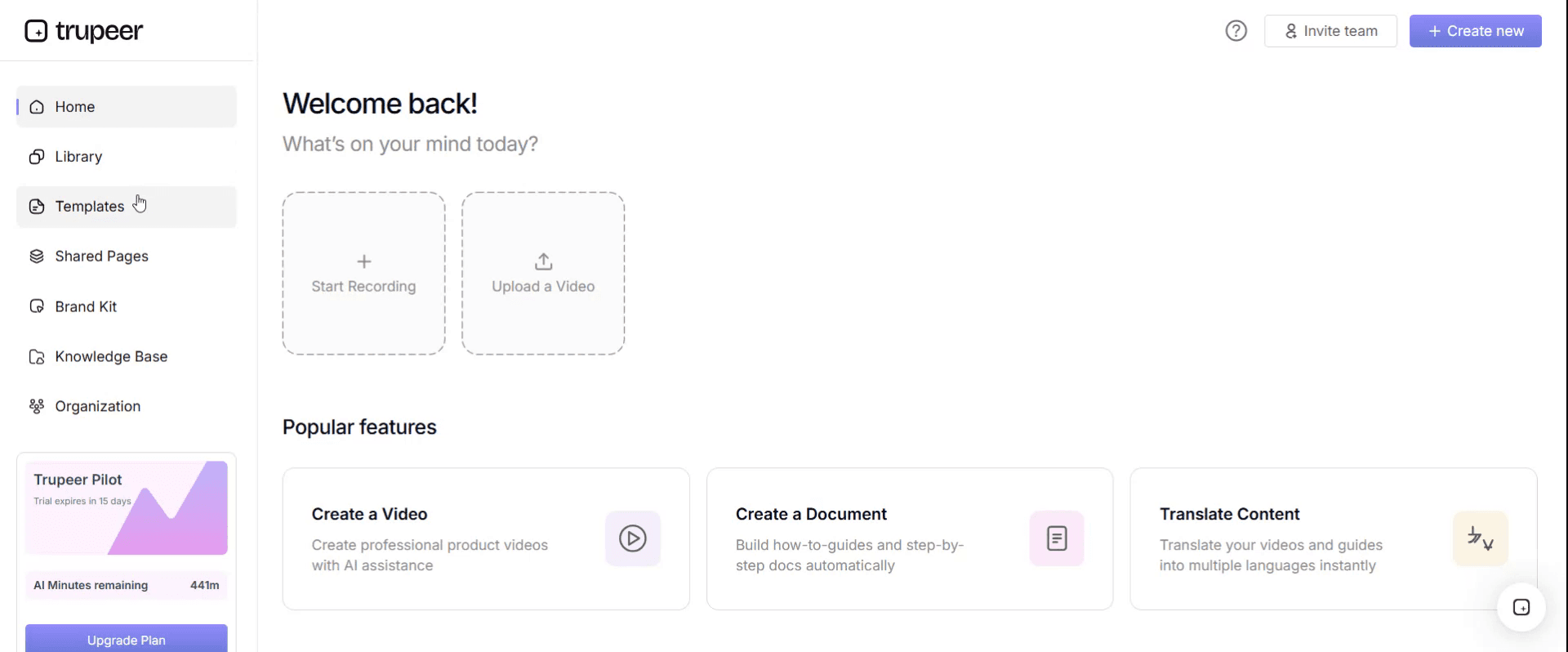
Step 1: Open the Templates Section
Go to the Templates section from the main navigation.
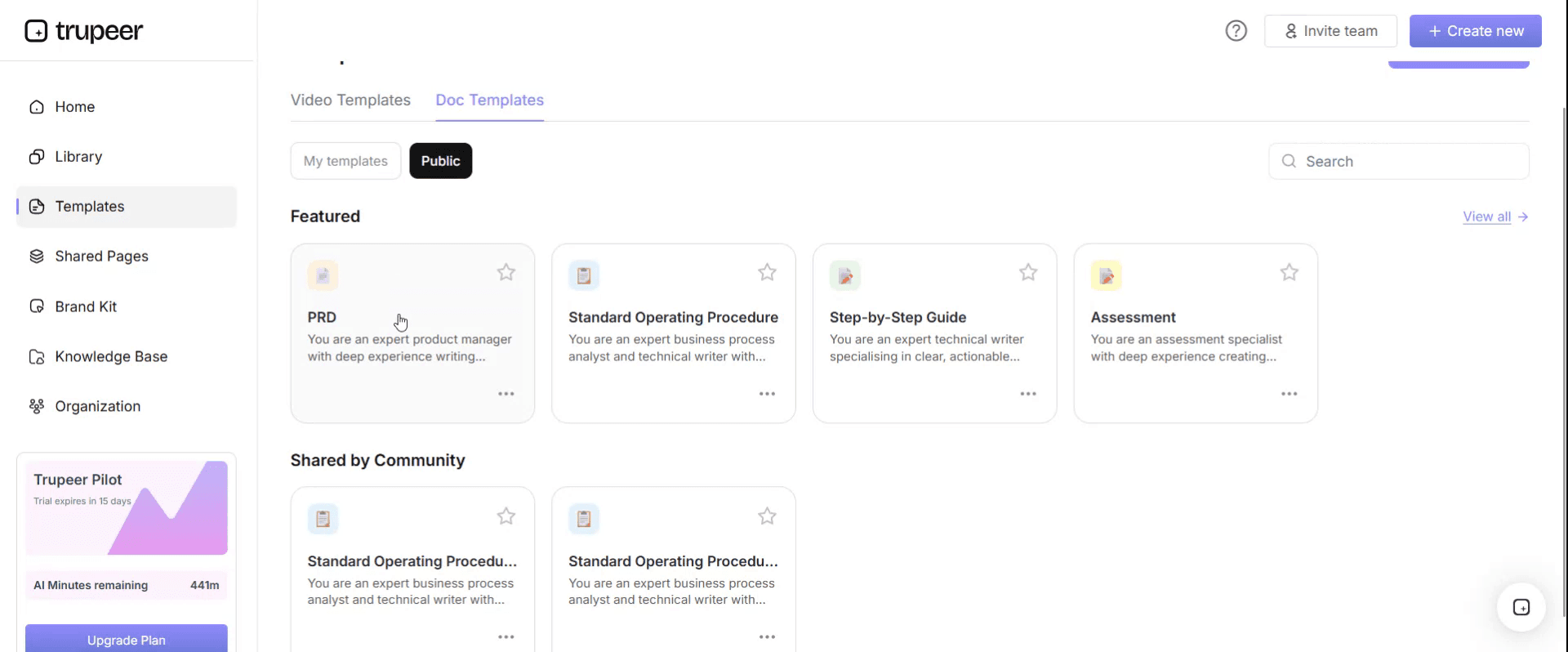
Step 2: Select and Open a Template
Click on any template you want to work with to open it.
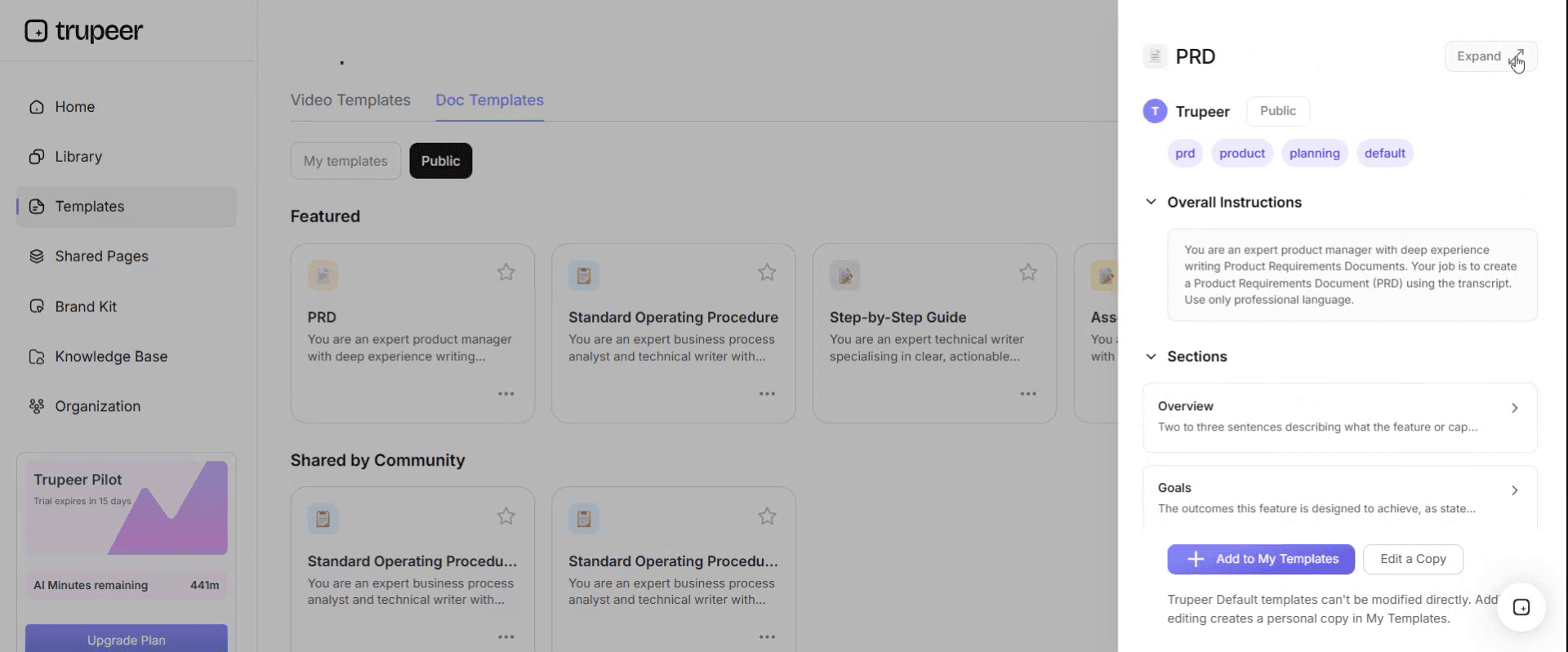
Step 3: Expand the Template View
If needed, expand the template view to see the full layout and details clearly.
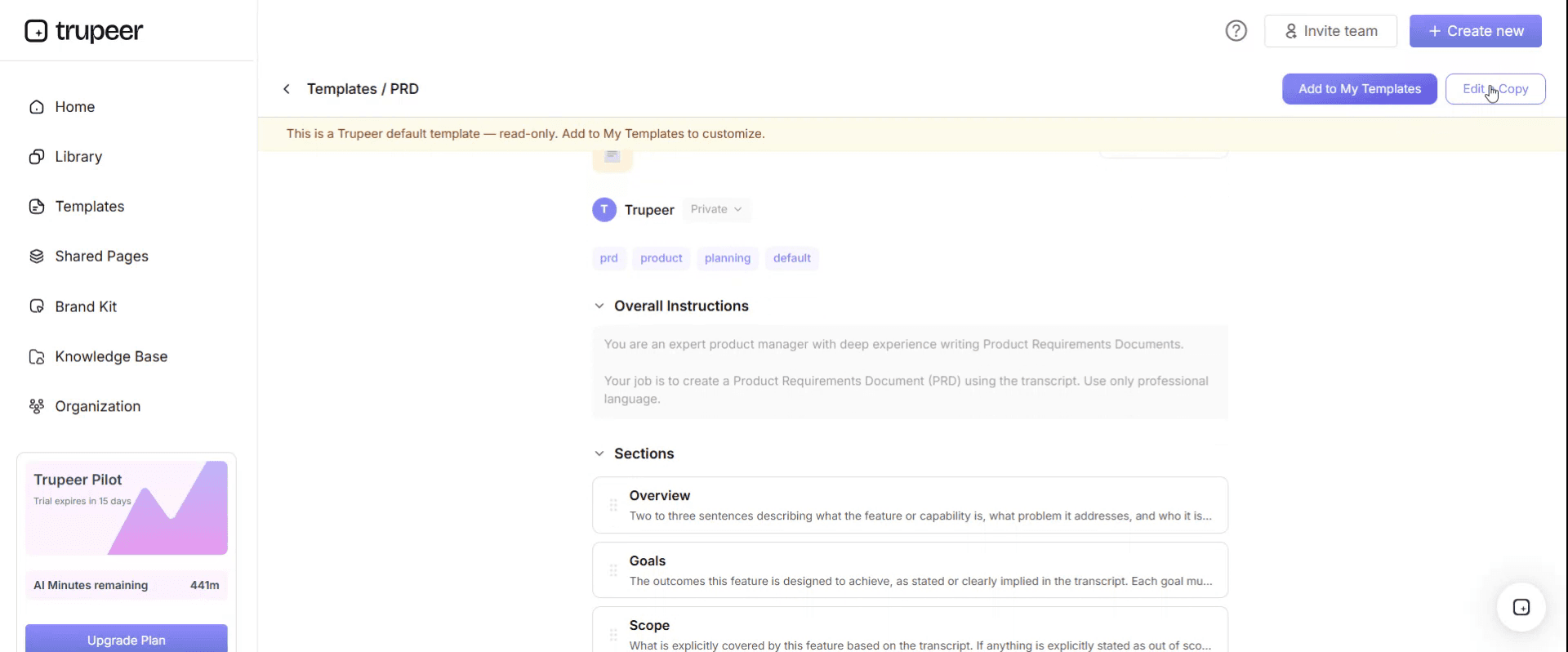
Step 4: Edit the Template
Click on Edit to start modifying the selected template.
Within the editor, you can:
Add new sections
Define or update formatting rules
Add a logo and adjust its position and related settings
Step 5: Save Your Customized Template
After making all necessary changes, click Save to store the updated template as your own.
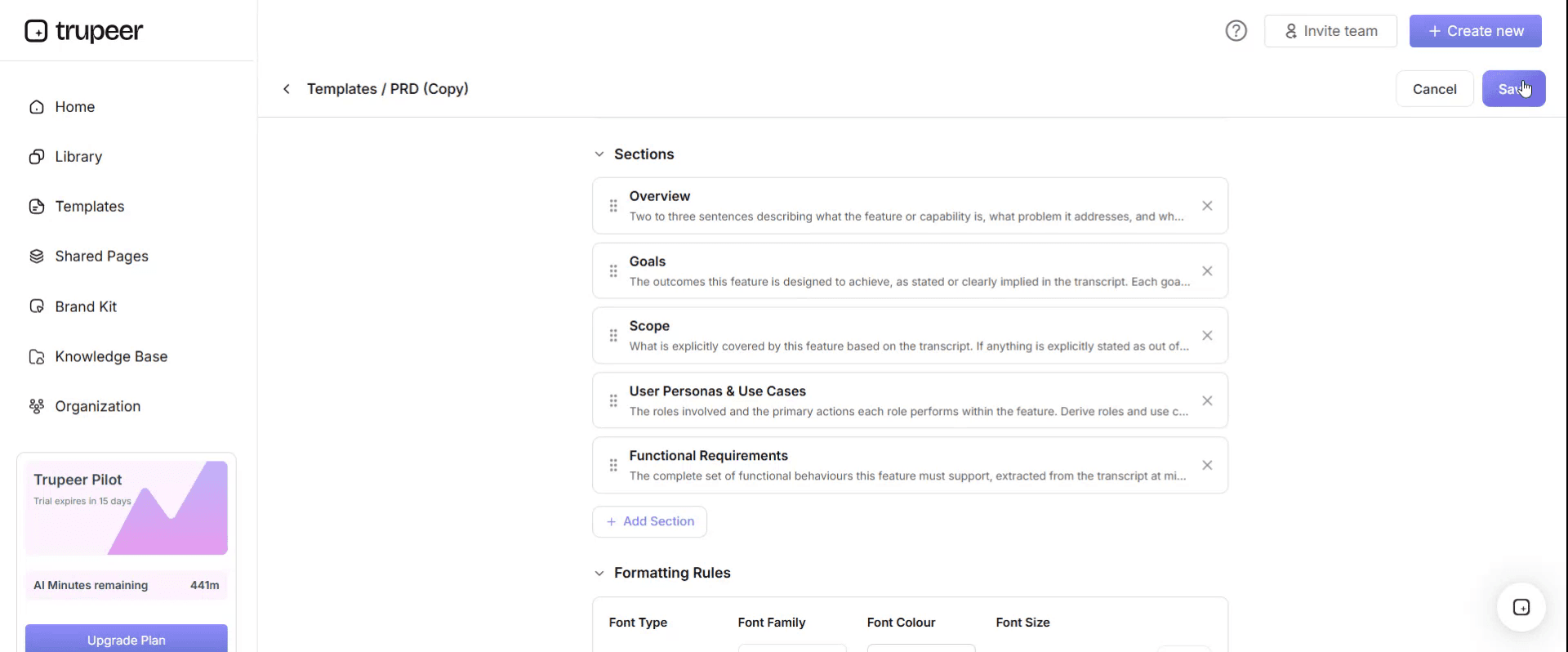
Step 6: Preview and Fine-Tune the Template
When you want to see how your customized template looks, open the Preview.
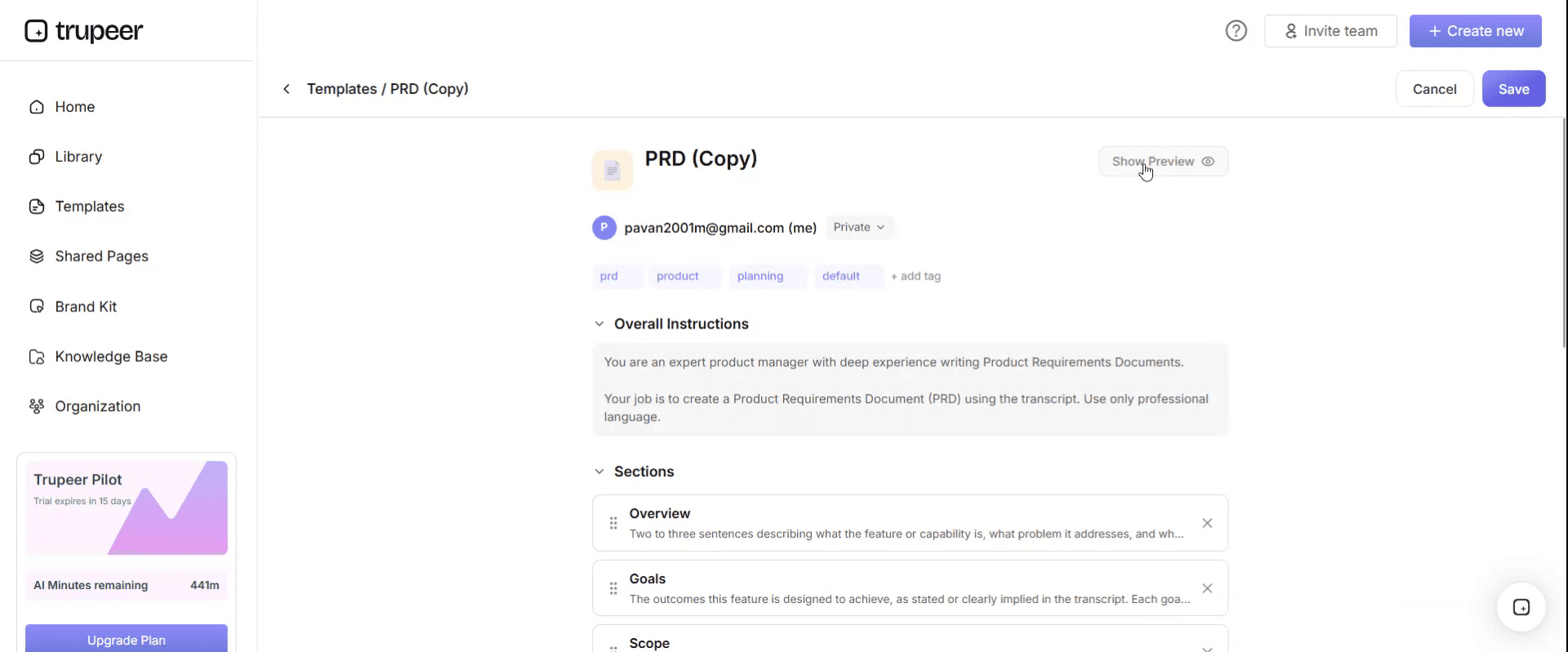
From the preview screen, you can continue to make adjustments directly if needed, ensuring the template appears exactly as you want.
With a sales training guide template you can:
Save hours on design: Skip the blank page with a structure built for sales enablement.
Ramp reps faster: Clear training cuts new-hire time-to-quota significantly.
Stay on-brand: Apply your logo, fonts and colors using Trupeer's brand kit.
Engage reps: Convert dense content into video modules reps actually watch.
Standardize the team: Use the same training across regions, channels and partners.
Reach global teams: Translate sales training into 65+ languages with one click.
Build the guide from your lost deals
Here is the exercise that decides what goes in the document, and it takes an afternoon.
Take every deal lost in the last twelve months. Not the ones people remember, all of them. For each, record the situation where it was actually lost, in one line, in plain terms. Not the CRM close reason, which will say price for most of them and be wrong for most of those.
Then count. You will get somewhere between six and twelve recurring situations, and the distribution will surprise you.
Now put each situation on two axes.
How often does it occur? Not how often it loses, how often reps face it. A situation faced weekly and handled adequately still deserves attention if handling it well is worth something.
What does getting it wrong cost? Average deal value where this situation appeared, times how often it turns into a loss.
Train the top right. Those are the situations that are both frequent and expensive, and there are usually three or four of them. Give each a section. Give the rest a paragraph. Give the situations that are neither frequent nor expensive nothing, however traditional they are as training topics.
The output is a guide whose table of contents looks nothing like a sales curriculum and everything like your pipeline.
One caution about the analysis. Reps will attribute losses to price, because price is the reason buyers give and it is the least uncomfortable answer. Ask instead what the buyer said in the two weeks before the loss, and what the rep would do differently. The real situation usually appears in the second answer.
What a sales training guide template must contain
Seven components. The situation sections are the guide and the rest is scaffolding.
Component | What it does |
|---|---|
Who this is for and what it assumes | New starter, experienced hire, or existing team. A guide serving all three serves none. |
The situations | One section each for the situations that matter, ordered by frequency, not by where they fall in the cycle. |
What good looks like, in your words | Actual language your team uses that works. Not principles, phrasing. |
Why it works here | The reasoning, so a rep can adapt it rather than reciting it. |
Practice | What the rep does to build the behaviour, and with whom. Reading alone changes nothing. |
Reference material | Product, pricing, competitors, process. Kept separate, because it is looked up rather than learned. |
Owner and review date | Sales guides decay faster than most documents, since pricing, product and competitors all move. |
The separation in the last two rows matters more than it sounds. Product and pricing detail is reference material, consulted at the moment of need, and it belongs in a lookup format rather than in a learning document. Mixing them produces a guide too long to learn from and too slow to look things up in.
Free sales training guide template: the structure to copy
Filled with a real example rather than placeholders. The team sells process equipment to industrial buyers.
Copy from here.
Who this is for. New sales hires in their first ninety days, and existing reps as reference. Assumes technical product training is complete and covered separately.
The situations, ordered by frequency.
# | Situation | How often | Cost when handled badly | Section length |
|---|---|---|---|---|
1 | Only contact stops replying | Most deals over eight weeks | Highest single loss category | Longest section |
2 | Price raised before value established | Most first calls | High | Long |
3 | Buyer says they will do nothing for now | Roughly a third of deals | High | Long |
4 | Named competitor comes up | Roughly a quarter | Medium | Medium |
5 | Procurement enters late | Larger deals only | Medium | Medium |
6 | Technical objection about compatibility | Occasional | Low, usually recoverable | Short |
Section example: only contact stops replying.
Why this matters here. Over a twelve month review this appeared in fifty one of a hundred and forty lost deals, more than any other situation. In every one of those, the deal had exactly one relationship inside the account.
What good looks like. On the second call, before any proposal, ask: "When you take this to your team, who will have the strongest opinion, and what will it be?" Then ask to meet that person. Reps who ask this on every deal average three contacts per account. Reps who do not average one point two.
Why it works. It is a question about their process rather than a request for access, which is easier to say yes to. It also surfaces internal opposition early, which is information you need regardless.
What to do when it has already happened. Do not send a fourth follow up to the same person. Go sideways, with a reason that helps them rather than you.
Practice. Role play the question in week one, on a real account, with your manager listening. Then use it on your next three live calls and report back what the answer was.
Reference material. Product specifications, current price list, competitor comparison sheet, approval thresholds. Held separately and linked, not embedded, because they change monthly.
Owner and review. Owned by the sales director. Reviewed quarterly, and immediately on any pricing change, product release, or new competitor appearing in more than three deals.
Copy to here.
Sales training guide example: seventy eight pages and fourteen on closing
Whitmoor Industrial, a distributor of process equipment with a thirty four person sales team, had a sales training guide of seventy eight pages.
It was a competent document. Thirty one pages of product knowledge, eighteen on objection handling, fourteen on closing techniques, nine on prospecting, six on administration. Every new hire worked through it, everyone completed the sessions, and the quiz scores were good.
Win rate did not move over twelve months.
The sales director then did something most organisations skip. She pulled every deal lost in the previous year, a hundred and forty of them, and read the notes rather than the close reasons.
Fifty one had been lost when a single contact stopped replying and there was no second relationship in the account. Twenty nine were lost on price after a discovery call where budget had never been established. Twenty two were lost to no decision. Eighteen were lost to a competitor on a specific comparison. Twenty were genuinely various.
The seventy eight page guide had fourteen pages on closing techniques and no pages at all on what to do when your only contact goes quiet, which was the largest single loss category by a wide margin.
That absence was not negligence. Closing is a topic with a literature, and it is what sales training guides contain. A single contact going quiet is not a topic. It is a situation, and situations do not appear in a taxonomy built from topics.
The rebuild produced twenty two pages covering nine situations, each carrying its frequency and its cost. The longest section was on building a second and third relationship inside an account, which had previously not existed.
Twelve months on, deals lost to a single contact going quiet fell from fifty one to twenty three. Win rate moved from twenty two percent to twenty seven.
Nothing was added that was not already known inside the team. Two reps had been asking the second call question for years. It had simply never been written down, because nobody had asked what the best people did differently, only what the subject traditionally contains.
How to build a sales training guide in six steps
Analyse the losses before writing anything. An afternoon with twelve months of lost deals decides the entire contents. Skipping this is why guides look like curricula.
Name the situations in the words reps use. "They went dark" is a better section heading than "maintaining stakeholder engagement", because it is what somebody will search for.
Interview your top two performers per situation. Ask what they actually say. Record it. They will not be able to write it down and they can always say it.
Write the language, not the principle. "Establish value before discussing price" is a principle everybody already agrees with. The sentence your best rep uses when price comes up on minute four is content.
Attach practice to every section. What the rep does, with whom, by when. A section with no practice is a section that will be read and forgotten.
Cut everything neither frequent nor expensive. Including topics that feel obligatory. A guide that covers everything gets used for nothing.
Step three is where the value is. Your best rep's phrasing is the only content in the guide that cannot be found anywhere else, and it is the hardest to extract because they do not experience it as knowledge.
Sales training guide, sales training plan or sales playbook?
Three documents that get used interchangeably and answer different questions.
A sales training guide is the content. What to say and do in the situations that matter, with the reasoning. It is learned from and it changes when the market changes.
A sales training plan template is the schedule. Who is trained on what, in which order, over what period, with what assessment. It answers when and to whom rather than what. If you are building a programme for a cohort of new hires, that is the document you need, and the general training plan template covers the structure.
A sales playbook is the reference. Segments, personas, qualification criteria, pricing rules, process stages, templates. It is looked up rather than learned, and it belongs in a format built for lookup rather than for reading.
The common failure is producing one seventy page document that tries to be all three. It is too long to learn from, too slow to look things up in, and out of date within a quarter because pricing changed on page fifty one.
Keep them separate. The guide teaches, the plan schedules, the playbook is consulted.
Sales training program example: a six week structure
A sales training program example worth copying, for a new hire in a business to business team with a cycle measured in weeks.
Week one. Product and market, delivered rather than read. Ends with the new hire explaining the product back to somebody who has not seen it.
Week two. The top situation from your analysis, one section of the guide, plus role play. Then live calls with the manager listening.
Week three. The second and third situations. Live calls continue. First independent discovery call, recorded and reviewed.
Week four. Pricing, competitors and the harder objections, informed by what went wrong in week three rather than by the curriculum.
Weeks five and six. Live pipeline with weekly review against the situations rather than against activity metrics. The review question is which situations they have faced and what happened, not how many calls they made.
Two design points make this work. Content is introduced immediately before it is needed rather than front loaded, since anything taught in week one and first used in week six has been forgotten. And every week has a live component, because the gap between knowing what to say and saying it under pressure is not closed by more explanation.
Making it stick: practice, not reading
Sales knowledge is not the constraint. Almost every rep who handles a situation badly could describe the correct approach if asked in a quiet room.
The gap is performance under conditions: on the phone, unprepared, when the buyer says something unexpected and there are four seconds to respond. That gap closes through repetition with feedback and through nothing else.
Three practical mechanisms, in ascending order of effectiveness.
Role play, which is uncomfortable and works, provided the person playing the buyer is difficult rather than accommodating.
Call review, where the rep and manager listen to a real call together and stop at the moment the situation appeared. Considerably more effective than role play because the stakes were real.
Live coaching, where the manager is on the call. The most effective and the most expensive, worth reserving for the situations at the top of your matrix.
What does not work is reading followed by a quiz. It measures whether the guide was read, which was never the question.
Measuring whether it worked
Completion rates and satisfaction scores measure whether training happened. They will both be high and they will tell you nothing.
Measure against the situations instead. Take the loss analysis you built at the start, and run it again twelve months later. If the largest loss category has not moved, the training did not address it, whatever the feedback said.
Two supporting measures are worth the effort. Ramp time to first closed deal, for new hires, which is the cleanest single number for onboarding effectiveness. And win rate by situation encountered, which requires tagging deals with the situations that arose and is the most informative thing most sales teams do not track.
Give it twelve months before judging. Sales cycles mean any change to behaviour takes a full cycle plus a quarter to appear in closed business, and programmes get abandoned at month four on the basis of noise.
What a free sales training guide template cannot fix
A product or price problem. If deals are lost because the product does not do what the market needs, better training makes reps more effective at losing. The loss analysis will tell you which you have, which is a good reason to do it before writing.
No manager time. Every mechanism that works requires a manager listening to calls. If managers have no capacity, the guide will be read and nothing further will happen.
Generic content. No free sales training guide template free download contains your situations or your best rep's phrasing, and those are the only parts that are scarce.
A guide nobody maintains. Pricing, product and competitors all move. An unowned sales guide is wrong within two quarters, and reps who find one wrong section stop trusting the rest.
Show how your best reps actually do it
The hardest content to produce is also the most valuable, and the reason it does not get produced is that it is verbal.
Ask a top performer to write down how they handle a buyer going quiet and you get three bullet points of received wisdom. Ask them to do it, and you get the actual question, the actual pause, the actual tone. The knowledge is in the performance, not in their description of it.
Trupeer AI captures it directly. Record the call or the walkthrough once, and the output is a video plus a written step by step version with screenshots already captured and placed, in your own branding. The written version goes into the guide. The video is what a new hire watches, and what they take from it is the delivery, which is the part no document conveys.
Record it. Brand it. Translate it. Trupeer it.
Two things follow that matter here. Sales content decays fast, and re-recording after a pricing or product change is faster than rewriting, so the guide is more likely to be current when somebody relies on it. And where a team sells across regions, the same recording produces the same guidance in each language, so a rep in one market is not working from a two year old translation of a superseded approach.
The material sits in your knowledge base and doubles as training for every hire after the first. What the customer was told during the sale belongs in the sales to service handoff, and the same recordings serve both. Consistency with your other documents is a matter of setting the brand kit once, and setup is covered in the document template setup guide.
Frequently Asked Questions
Is there a free sales training guide template Word version?
Word suits the guide, because it is prose organised into sections that get revised regularly. Build the free sales training guide template Word file with one section per situation, ordered by frequency, and the reference material linked rather than embedded.
Keep product and pricing detail out of the document. It changes monthly, and a guide that has to be reissued every time a price moves stops being reissued.
Is there a free sales training guide template PDF?
PDF suits the issued version circulated to a cohort. Export a free sales training guide template PDF with a version and date, so a rep who finds an old copy can tell it is old.
Do not treat it as the master. Sales guides need frequent revision, and a format that discourages editing produces a guide that quietly goes out of date rather than one that stays stable.
Is there a free sales training guide template PowerPoint version?
Slides suit delivery rather than the guide itself. A free sales training guide template PowerPoint deck is what you present in a session, and it should carry considerably less text than the guide, because the value of a session is the discussion and the practice.
Build the guide first and generate the deck from it. Decks built first tend to become the guide by default, and a deck read as a document is a poor document.
Is there a free sales training guide template Excel version?
Excel is the right tool for the analysis rather than the guide. A free sales training guide template Excel file works well for the lost deal review: one row per lost deal, the situation, the value, and the stage it was lost at.
That spreadsheet is what tells you which sections to write and how long each should be. It takes an afternoon and it is the highest value part of the whole exercise.
Is there a free sales training guide template free download worth using?
The structure takes twenty minutes to build, so a free sales training guide template free download saves little, and what it contains will be generic technique available anywhere.
If you adopt one, keep the scaffolding and replace the content. The parts worth keeping are the section headings for practice and review. The parts to replace are every example, because examples from another company's market teach your reps to sound like another company.
Is a sales training plan template the same thing?
No. A sales training plan template is the schedule: who is trained, on what, in what order, over what period, and how it is assessed. It answers when and to whom.
A sales training guide is the content itself. You usually need both, and building the plan first is a common error, since a schedule for content that has not been written tends to be filled with whatever content already exists.
What is a good sales training program example?
The six week structure above is one, and the two features that make it work are worth copying regardless of length. Content is introduced immediately before it is needed rather than front loaded, and every week includes live calls with someone listening.
Judge any sales training program example you find by one question. Does it include a mechanism for practising under pressure, or does it only include a mechanism for delivering information? Most published examples do the second and describe it as the first.
How long should a sales training guide be?
Shorter than you expect. Whitmoor's guide went from seventy eight pages to twenty two and performed better, because the twenty two pages covered situations reps actually faced.
Length is a poor proxy for coverage. The question worth asking is whether every section corresponds to a situation that appears in your loss analysis, and whether the longest section corresponds to the largest loss category. In most guides it does not.


