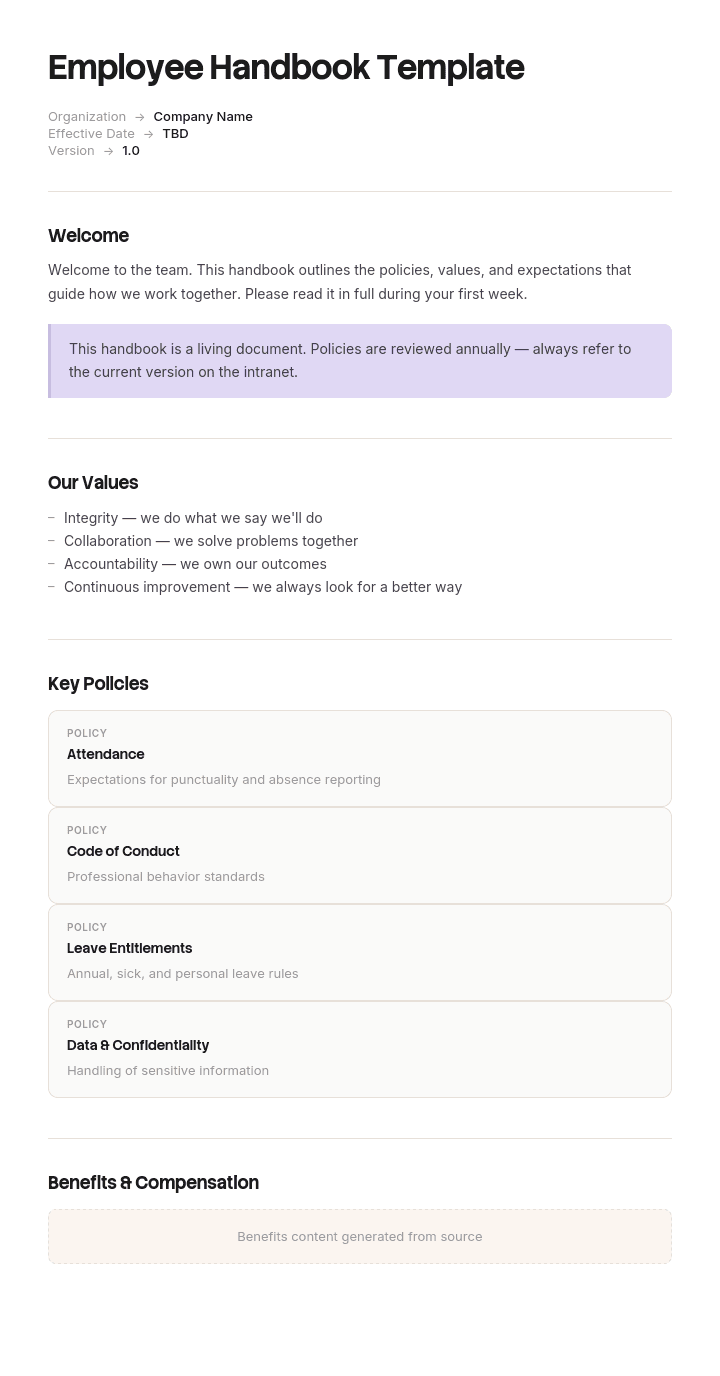
Use this template
An employee handbook is one of the most important documents your company will ever produce - it sets expectations, captures policies and introduces new hires to your culture. With Trupeer, you can save hours on creating an employee handbook by starting with a free employee handbook template, customizing it with your brand identity, and turning the handbook into a video walkthrough that new hires actually watch.
An employee handbook has to do three things that pull against each other. Tell people what they need to know, protect the organisation, and make somebody want to work here. Most handbooks do the second, badly, and nobody reads them.
This template covers all three, and flags the wording that turns a friendly statement into a commitment a tribunal can enforce.
Download the employee handbook template
Format | Best for |
|---|---|
Word (.docx) | Writing and editing. Free download, no sign-up |
Google Docs | Review with HR, legal and leadership before issuing |
The issued version, with the acknowledgment page | |
.doc | Older HR systems and legacy document libraries |
Free, editable, no watermark. Word for building it, PDF for issuing it, because a handbook people can edit is a handbook you cannot rely on.
How to customize this template in Trupeer
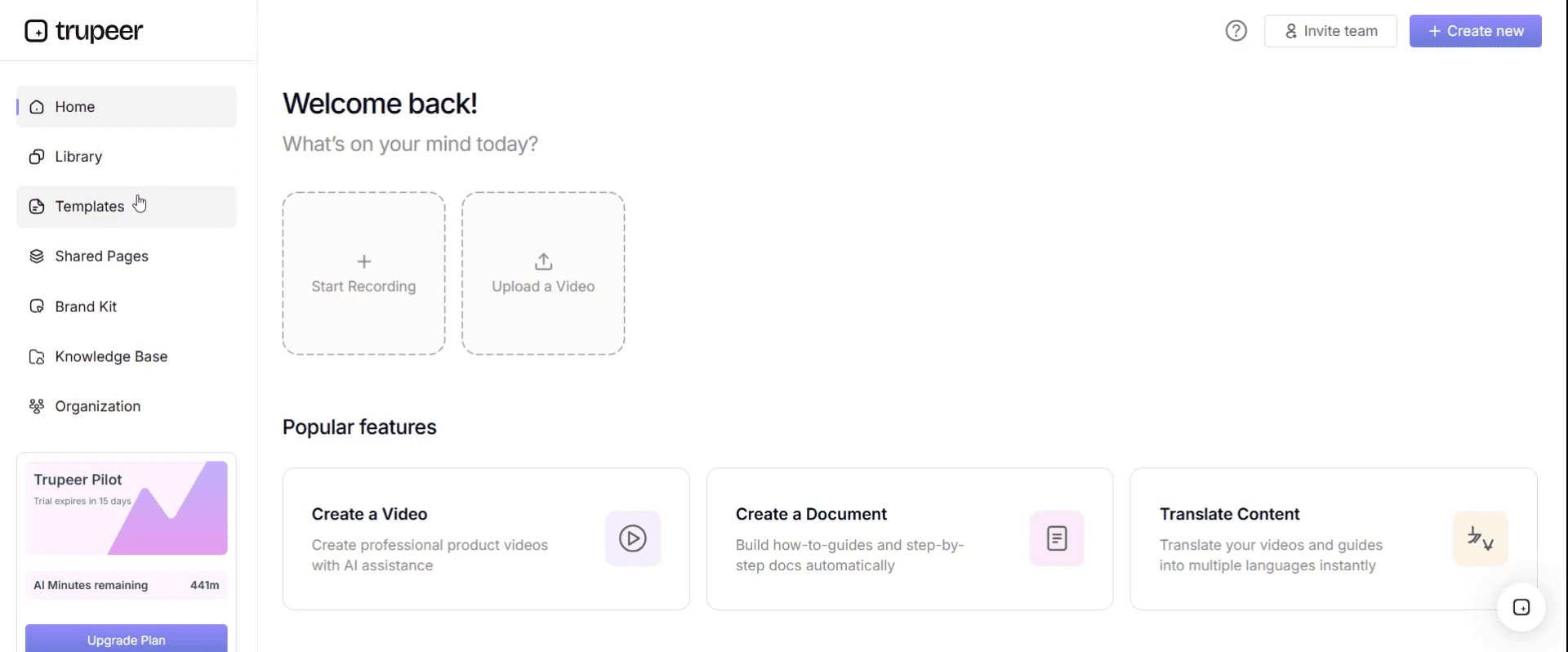
Step 1: Open the Templates Section
Go to the Templates section from the main navigation.
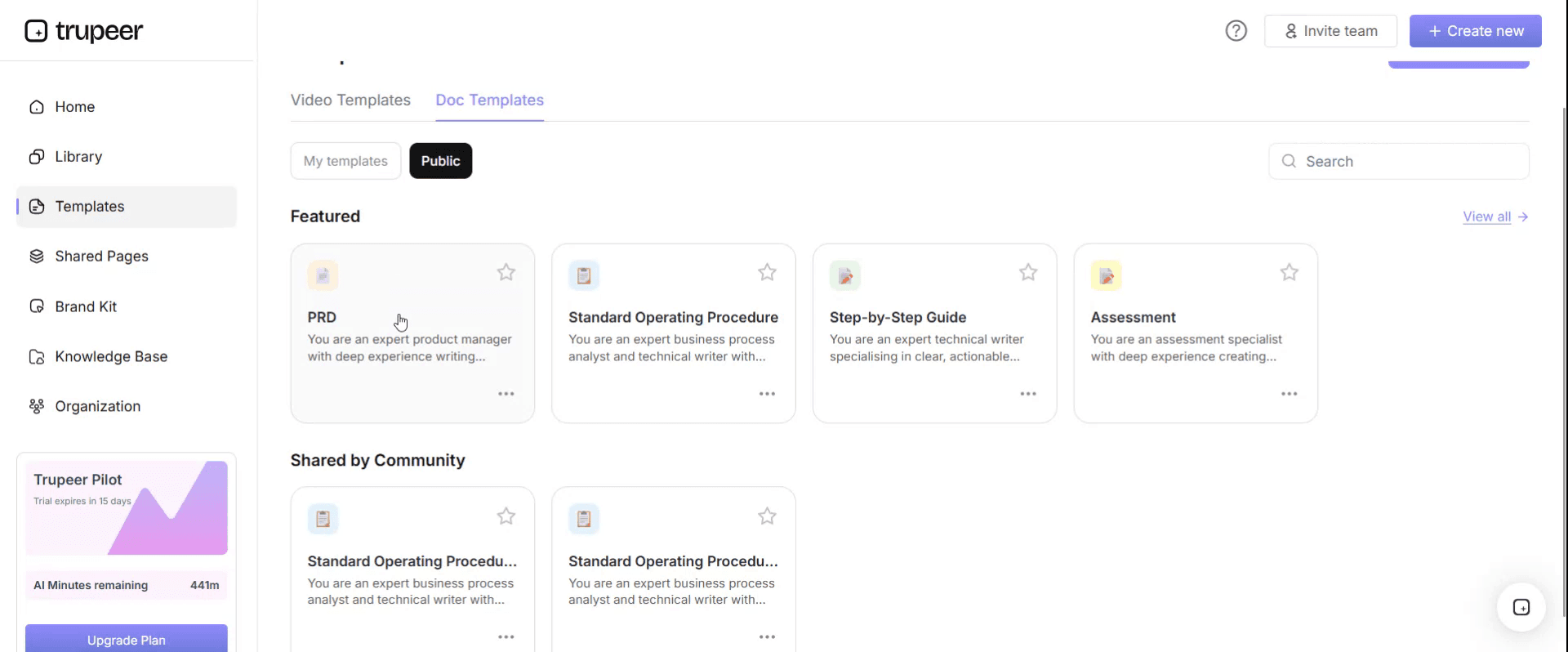
Step 2: Select and Open a Template
Click on any template you want to work with to open it.
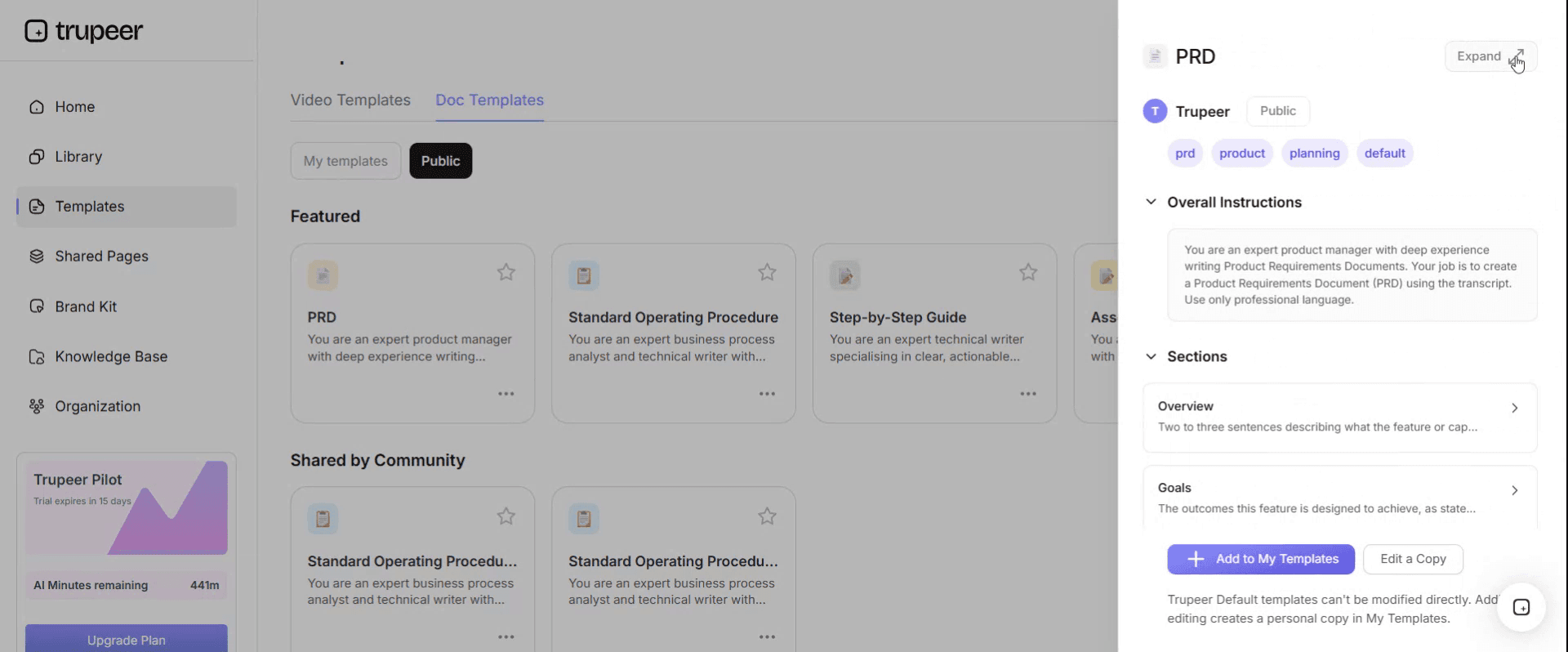
Step 3: Expand the Template View
If needed, expand the template view to see the full layout and details clearly.
Step 4: Edit the Template
Click on Edit to start modifying the selected template.
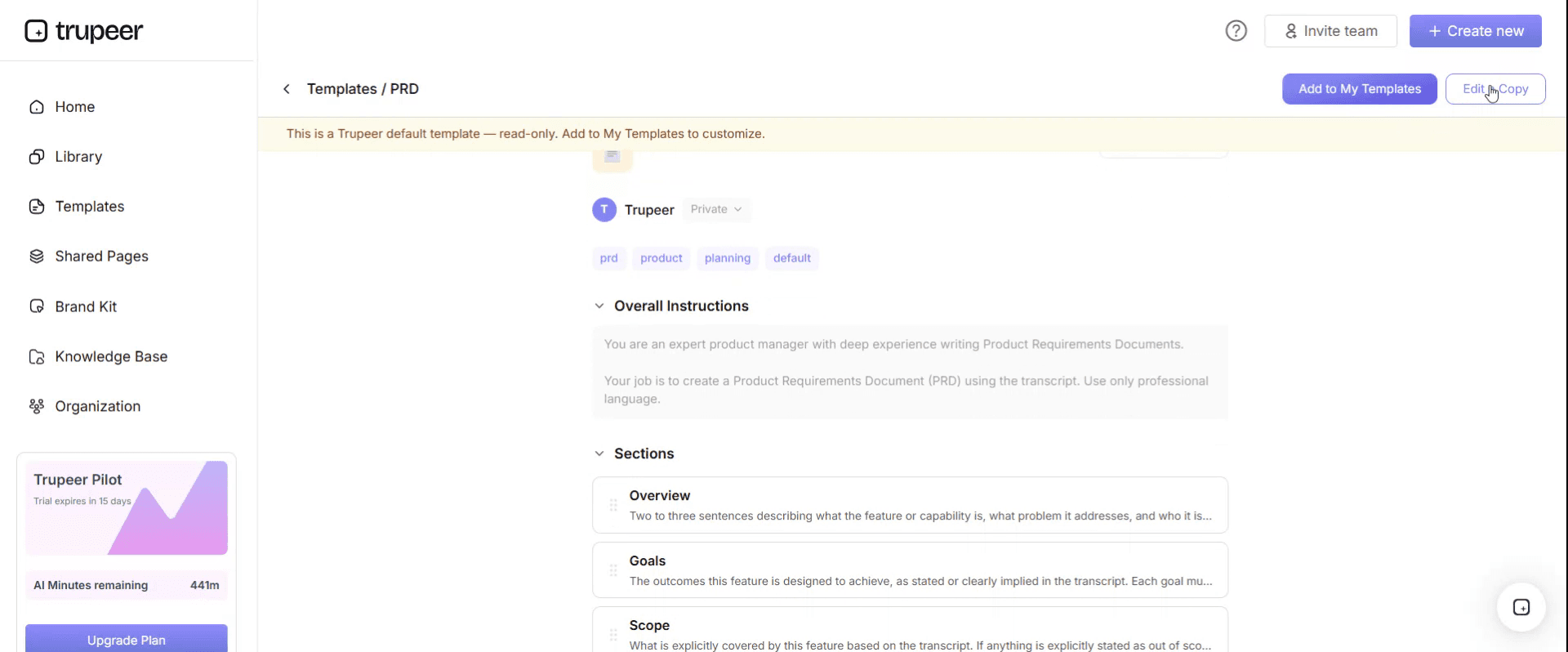
Within the editor, you can:
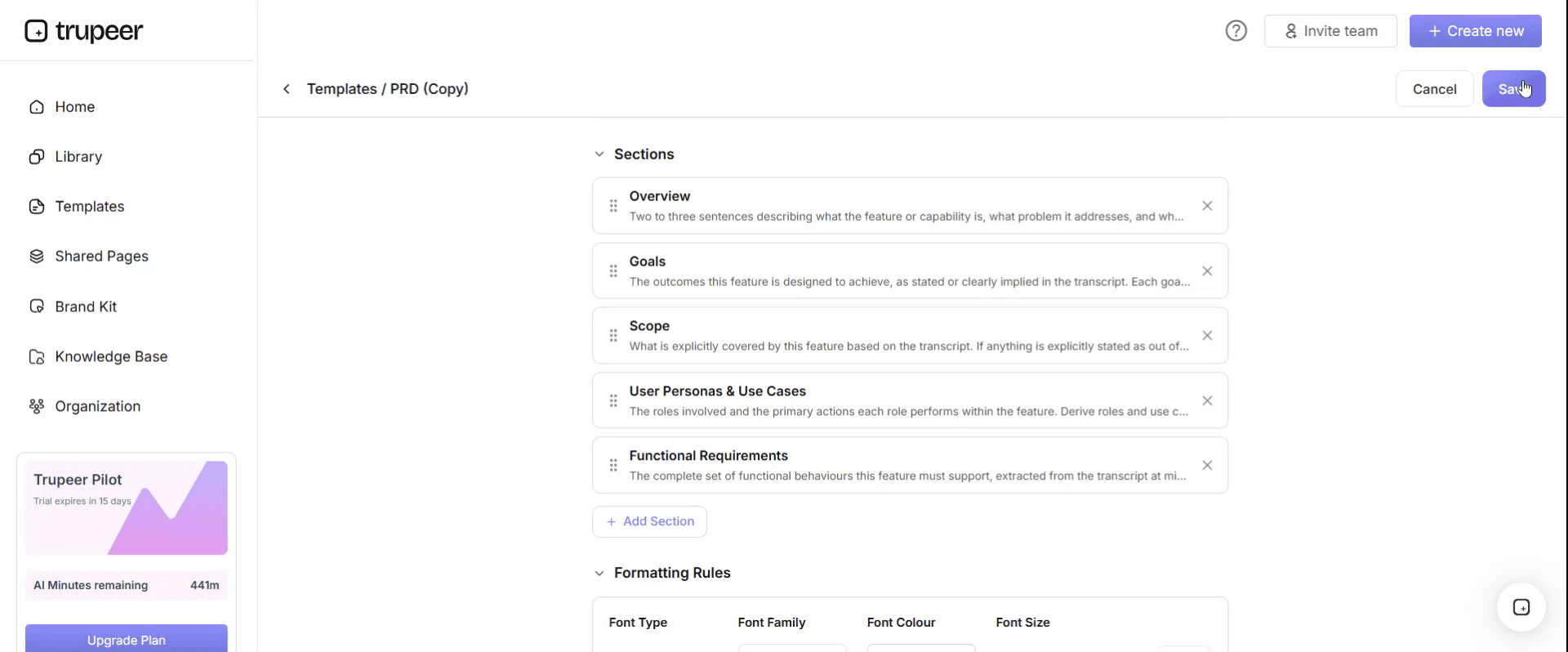
Add new sections
Define or update formatting rules
Add a logo and adjust its position and related settings
Step 5: Save Your Customized Template
After making all necessary changes, click Save to store the updated template as your own.
Step 6: Preview and Fine-Tune the Template
When you want to see how your customized template looks, open the Preview.
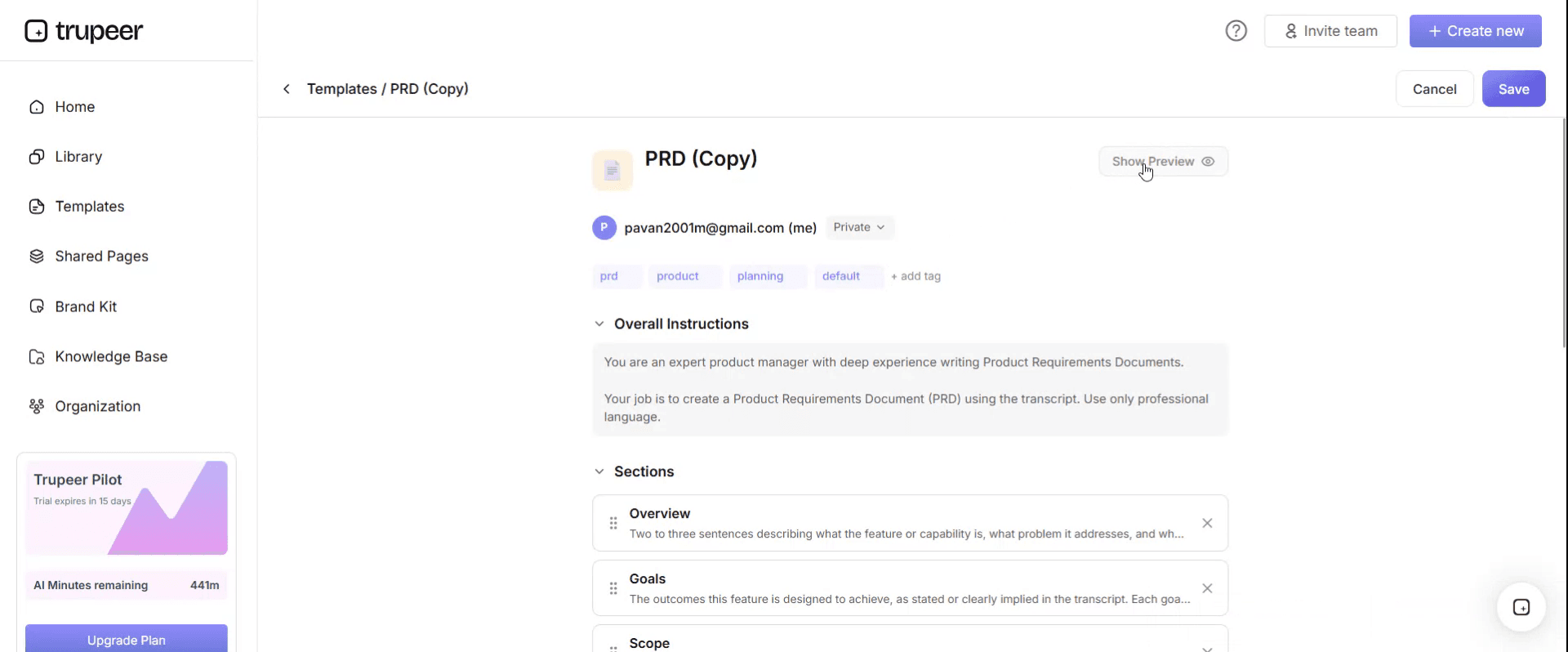
From the preview screen, you can continue to make adjustments directly if needed, ensuring the template appears exactly as you want.
With an employee handbook template you can:
Save hours on writing: Skip the blank page with a comprehensive structure built for HR teams.
Stay compliant: Built-in sections cover the policies most jurisdictions require.
Stay on-brand: Apply your logo, fonts, colors and tone using Trupeer's brand kit - so the handbook reflects your culture.
Onboard with video: Replace 80-page PDFs with a clear video walkthrough - ideal for employee training videos.
Standardize globally: Use the same handbook template across regions and adapt for local laws.
Reach every employee: Translate the handbook into 65+ languages with one click.
The three jobs of a handbook
Understanding which job each section is doing explains most handbook problems.
Inform. Tell employees what they need to know: how to book leave, who to tell when they are sick, what the hours are, how to raise a concern. This is what employees actually open it for.
Protect. Document that expectations were communicated, so that if something goes wrong you can show the person knew. This is what HR and legal care about.
Set tone. Convey what kind of organisation this is. This is the part that gets cut first and is the reason anyone reads past page two.
The tension is real. Legal protection pushes toward exhaustive, conditional language. Readability pushes toward brevity and warmth. A handbook that only optimises for protection is unreadable and therefore does not inform anyone, which weakens the protection it was optimising for.
Job one: inform
The sections employees actually look things up in. Get these right and the handbook earns its place.
Leave and how to book it. Sickness reporting, including who to tell and by when. Working hours, flexibility and remote work. Pay dates and expenses. Who to go to with a problem. Notice periods. Benefits and how to claim them.
Write these as instructions rather than as policy. "Request annual leave through [system] at least two weeks in advance, and your manager will respond within three working days" is useful. "The Company operates an annual leave entitlement scheme" is not.
Job two: protect
The sections that exist so the organisation can show expectations were communicated.
Code of conduct. Anti-harassment and discrimination. Disciplinary and grievance procedures. Confidentiality and IP. Data protection. Health and safety. Acceptable use of systems. Attendance expectations.
The protection comes from three things together: the content, the acknowledgment signature, and the ability to show which version the person received. Any one of those missing weakens the other two.
Job three: set tone
Who you are, how decisions get made, what behaviour is actually rewarded rather than merely stated.
This is where handbooks either become a document people read on their first morning or a PDF they scroll past to reach the signature page. It costs very little: a genuine welcome, a paragraph on how the company started, a plain statement of what you care about that is specific enough to be false if it were untrue.
The test for a values section: could a competitor put their name on it? If yes, it says nothing.
What goes in an employee handbook
Introduction
Welcome. About the company. How to use this handbook. The disclaimer and acknowledgment note.
Employment basics
Employment types and status. Probation. Working hours. Attendance and punctuality. Remote and hybrid working. Timekeeping. Job descriptions and changes to role.
Pay and benefits
Pay dates and method. Deductions. Overtime, where applicable. Expenses and how to claim. Pension. Health and other benefits. Bonus or commission, described carefully. Salary review process.
Time off
Annual leave and how to book. Public holidays. Sickness absence and reporting. Family leave: maternity, paternity, parental, adoption. Bereavement. Jury service. Unpaid leave. Sabbaticals.
Code of conduct
Expected behaviour. Dress code, if you need one. Conflicts of interest. Gifts and hospitality. Use of company property. Social media. Confidentiality. Drugs and alcohol.
Workplace policies
Anti-harassment and discrimination. Equal opportunities. Health and safety. Data protection. IT and acceptable use. Whistleblowing. Anti-bribery, where relevant.
Performance and development
Review cycle. Development and training. Promotion and internal moves. Feedback expectations.
Leaving
Resignation and notice. Retirement. Redundancy, in outline. Return of property. Final pay. References policy.
Procedures
Disciplinary. Grievance. Appeals. Who to contact.
Closing
Acknowledgment form. Version and date. Where to find the current version.
Not every organisation needs every section. A ten-person company including a formal redundancy procedure is describing a process it does not have.
What must not go in
The section that matters most and appears nowhere in this SERP.
Do not make promises you are not prepared to keep. A handbook stating that employees "will receive an annual pay review" may create an expectation you have to honour. "Pay is reviewed annually at the company's discretion" says something different.
Do not describe a procedure you will not follow. If your handbook sets out a four-stage disciplinary process and you use three, the gap is a problem. Either follow it or do not write it.
Avoid absolute language. "Always", "guarantee", "will never" and "permanent" create obligations. Discretionary language protects flexibility.
Do not embed detail that changes. Specific benefit providers, exact figures, named individuals, system names. Put those in a separate document the handbook references, or you will be reissuing the handbook every quarter.
Be careful with progressive discipline. In some jurisdictions, a handbook committing to a specific escalating sequence limits your ability to dismiss for serious misconduct at first instance. Reserve the right to skip stages.
Do not contradict the employment contract. The contract prevails, and inconsistency between the two is a gift to the other side in any dispute.
Do not include anything unlawful in your jurisdiction. Blanket bans on discussing pay, for instance, are unlawful in several places, and handbook templates from other countries commonly contain them.
The disclaimer and acknowledgment
Two short pieces of text that carry most of the legal weight.
The disclaimer, near the front, typically states that the handbook is not a contract of employment, that it may be amended at the organisation's discretion, that where it conflicts with the employment contract the contract prevails, and in the United States that employment is at will where applicable.
At-will language is US-specific and meaningless or actively wrong elsewhere. Handbook templates circulate internationally and this is the single most common thing that arrives in the wrong country's document.
The acknowledgment, at the back, records that the employee received the handbook, has read it, understands they are expected to follow it, and understands it is not a contract.
Practical points on the acknowledgment. Record the version number alongside the signature, because "they signed the handbook" is worth much less than "they signed version 3.2, dated March". Collect it for every reissue, not just at induction. And keep it somewhere retrievable, since the copy that matters is the one you can produce two years later.
A worked section
Showing the difference between the version that reads well and the version that is safe. The good ones do both.
Sickness absence
If you are unwell and cannot work, tell your manager as soon as you can and no later than [9:00am] on your first day of absence. Call or send a message directly. Please do not rely on a colleague passing it on.
Let us know each day you are away unless you have agreed a likely return date with your manager.
If you are away for more than [seven] calendar days, including weekends, you will need a fit note from your doctor covering the period from the eighth day onwards.
You will be paid [statutory sick pay / company sick pay of X, subject to the conditions in section Y] during sickness absence. [Company sick pay is discretionary and may be withheld where absence is not properly reported.]
If you have a health condition that affects your work, please talk to your manager or [HR contact]. We will consider adjustments, and nothing in this section limits your rights under [applicable disability legislation].
Note what that does. It gives instructions a person can follow. It states the reporting requirement clearly enough to be enforceable. It uses discretionary language on company sick pay. And it explicitly preserves statutory rights, which prevents the section being read as limiting them.
Handbook, policy or contract?
Employment contract | Employee handbook | Individual policy | |
|---|---|---|---|
Status | Legally binding | Usually expressly non-contractual | Usually non-contractual |
Changes | Requires agreement | At the employer's discretion, with notice | At the employer's discretion |
Contains | Role, pay, hours, notice, key terms | Everything an employee needs to know | One subject in depth |
Signed | Yes | Acknowledgment only | Sometimes |
If they conflict | Prevails | Yields to the contract | Yields to the contract |
The handbook is the container. Individual policies live inside it or are referenced from it, and the company policy template covers writing those.
The practical decision: put policies in the handbook when everyone needs to know them, and reference them separately when they are long, change often, or apply to only some people. Attendance belongs in the handbook. A detailed data protection policy is usually better referenced than embedded.
Keeping it current
Handbooks go stale faster than any other HR document because they aggregate everything.
Structure for change. Keep volatile content, benefit providers, exact figures, named contacts, in appendices or referenced documents so the main body survives.
Review annually as a minimum, and immediately whenever employment law changes in a jurisdiction where you employ people, when you introduce or change a benefit, when you enter a new country or state, or after any dispute where the handbook was relied on.
Version everything. Number the version, date it, keep a change log, and record which version each employee acknowledged. Reissue rather than quietly editing the file on the intranet, because an employee who signed for a different version can reasonably say so.
Multi-state and multi-country
Where handbook templates cause the most trouble.
Within the United States, employment law varies significantly by state: leave entitlements, final pay timing, meal and rest breaks, pay transparency. The usual approach is a core handbook plus state-specific addenda, and the core must not contradict the addenda.
Across countries, do not attempt one handbook. Employment law differs so fundamentally that a document valid in one country can be void or unlawful in another. At-will employment, notice periods, statutory leave, dismissal protection and works council requirements have almost nothing in common. Produce a local handbook per country, sharing only the culture and conduct content.
The most common error is a US-drafted template deployed internationally with the company name changed, leaving at-will language in a jurisdiction with statutory dismissal protection.
Making it readable
The handbook is one of the few HR documents where readability genuinely affects whether it works, because an unread handbook informs nobody and its protective value depends partly on the person having understood it.
Second person. "You can book leave through" rather than "Employees may request annual leave via".
Short sentences and plain words. Utilise, commensurate and heretofore have no place in a document meant for everyone.
A real table of contents, with links in the digital version.
Front-load what people look for. Leave, sickness, pay and hours in the first third.
One page per topic where possible.
Say why, briefly, for anything unusual. Rules with reasons get followed.
Under fifty pages. Above that, split it and reference.
Design and format
Design matters more here than for other HR documents, for the same reason readability does.
A well-designed handbook signals that the organisation cares about the employee experience, and it makes the document navigable. If you want a designed, branded publication rather than a Word document, a design tool such as Canva is genuinely the right choice for that step, and the content on this page is what you would pour into it.
The sequence that works: draft the content in Word where editing and legal review are easy, get it reviewed and approved, then lay it out. Designing first makes every subsequent legal amendment painful, and there will be amendments.
AI-generated handbooks
Several tools will now generate a handbook from a few prompts, and they are a reasonable way to get a first draft of the structure and the uncontroversial sections.
What they cannot do is know your actual practices, your benefits, your jurisdiction's requirements, or whether the procedure they have described is one you will follow. A generated handbook describing a four-stage disciplinary process you do not operate is worse than no handbook, because it documents a commitment you are breaching.
The specific risk with AI-generated handbooks is that the output reads authoritative and is jurisdictionally generic. At-will language appearing in a UK handbook is the obvious tell. The less obvious ones are leave entitlements, notice periods and dismissal procedures that quietly reflect a different legal system.
Use generation for structure and first-pass wording. Then replace every substantive section with what your organisation actually does, and have it reviewed by someone qualified in your jurisdiction.
How to create your employee handbook
List what already exists. Contracts, policies, informal practices. The handbook aggregates rather than invents.
Decide what goes in and what is referenced. Volatile and long-form content gets referenced.
Check your jurisdictional requirements before writing, since some content is mandatory and some is prohibited.
Draft the informing sections first. They are the easiest and they are what employees use.
Write the protective sections carefully, with discretionary language and no procedures you will not follow.
Add the tone. Welcome, context, values that are specific enough to be falsifiable.
Write the disclaimer and acknowledgment, correct for your jurisdiction.
Have it reviewed by an employment lawyer or qualified HR advisor. This is not optional for a document with this legal weight.
Design it, once the content is approved.
Issue with notice, collect acknowledgments against the version number, and set a review date.
Legal notice
This template and the guidance on this page are provided for general information and do not constitute legal advice. Employment law varies substantially between countries and, within the United States, between states. Some content described here is mandatory in some jurisdictions and unlawful in others.
Have your handbook reviewed by a qualified employment lawyer or HR advisor in each jurisdiction where you employ people, before issuing it.
Best practices
Write in the second person, to the employee.
Front-load leave, sickness, pay and hours.
Discretionary language on anything you might need to vary.
Never describe a procedure you will not follow.
Volatile content in appendices, not the main body.
Correct jurisdictional disclaimer, not a borrowed one.
Acknowledgment recorded against the version number.
Reissue and re-acknowledge on material change.
One handbook per country.
Under fifty pages, or split it.
Common mistakes
At-will language in a country where it means nothing.
A US or UK template deployed internationally unchanged.
Promises of pay reviews, bonuses or progression stated as entitlements.
A disciplinary procedure documented and not followed.
Benefit details and figures embedded in the body, requiring constant reissue.
Handbook contradicting the employment contract.
No acknowledgment, or acknowledgment with no version recorded.
Written in third-person legalese nobody reads.
Eighty pages, so the useful parts are unfindable.
Values that any competitor could claim.
Never updated after a change in the law.
Designed before it was legally reviewed, making amendments painful.
Give people something they will actually take in
Open the template in Trupeer AI, apply your brand kit so the handbook matches your other materials, and edit any section directly. Setup is in the template guide.
The uncomfortable truth about handbooks is that the acknowledgment proves receipt rather than understanding. Everyone signs. Very few read past the leave section, and the sections that matter most in a dispute are the ones least likely to have been absorbed.
The parts worth reinforcing are the procedural ones: how to report sickness, how to raise a grievance, how to claim expenses, what to do if you spot a data incident. Record those once and Trupeer AI produces the written guidance and a narrated video walkthrough from the same pass, so a new starter watches the two-minute version of the parts they will actually need. Translate it into 65+ languages, which matters where people are being held to rules with real consequences. Keep the current version in your knowledge base so nobody is working from last year's, and use it in induction with a completion record.
Record it. Brand it. Translate it. Trupeer it.
Frequently Asked Questions
Is there a free employee handbook template in Word?
Yes. Word is the main format, with every section drafted and bracketed placeholders for your specifics. Free download, no sign-up, no watermark. Draft and review in Word, then issue as PDF.
Is there a free employee handbook template in Word and PDF?
Yes, both. Word for editing and legal review, PDF for the issued version with the acknowledgment page. Most organisations need both, since a handbook employees can edit is not one you can rely on in a dispute.
Is there a free employee handbook template in PDF?
Yes, as the issued version including the acknowledgment form, plus a completed sample handbook so you can see a finished document.
Is there a free employee handbook template in Google Docs?
Yes. Google Docs suits the review stage, where comments from HR, legal and leadership are easier to manage than emailed versions. Make a copy rather than editing the original.
Is there an employee handbook template in .doc format?
Yes, included alongside .docx for older HR systems and legacy libraries.
Is there an employee handbook template for Canva?
Not from us, and Canva is genuinely the better tool for that step. Handbook design matters more than for most HR documents, because a document nobody reads informs nobody. The sequence that works is to draft and legally review the content in Word, then lay it out in a design tool. Designing first makes every legal amendment painful, and there will be amendments.
Is there a free AI employee handbook generator?
Several exist and they produce reasonable structure and first-pass wording. What they cannot know is your actual practices, your benefits, or your jurisdiction's requirements, and generated handbooks tend to read authoritative while being jurisdictionally generic. The common tell is at-will language appearing in a country where it has no meaning. Use generation for the shell, replace every substantive section with what you actually do, and have it reviewed locally.
Is there a free handbook template?
Yes, everything on this page is free with no account required and no attribution. For individual policies rather than the full handbook, see the company policy template.
What is an employee handbook?
A document setting out what employees need to know about working for your organisation: hours, pay, leave, benefits, expected conduct, workplace policies and the procedures for raising problems. It also documents that expectations were communicated, which is where much of its value sits.
What should an employee handbook include?
An introduction and disclaimer, employment basics, pay and benefits, time off, code of conduct, workplace policies, performance and development, procedures for leaving, disciplinary and grievance procedures, and an acknowledgment page. Not every organisation needs every section.
Is an employee handbook legally binding?
Usually it is expressly stated not to be a contract, and that disclaimer is one of the most important pieces of text in it. But wording can still create enforceable expectations, particularly promises about pay reviews, bonuses or procedures. This varies by jurisdiction, which is why the document needs local legal review.
What should not be in an employee handbook?
Promises you are not prepared to keep, procedures you will not follow, absolute language such as guarantee or always, detail that changes frequently, anything contradicting the employment contract, and anything unlawful in your jurisdiction. Blanket restrictions on discussing pay are a common example of the last one.
How long should an employee handbook be?
Under fifty pages for most organisations, and considerably shorter for small ones. Length is not a measure of thoroughness. If it runs longer, move detailed policies into referenced documents rather than embedding them.
Do employees need to sign the employee handbook?
They should sign an acknowledgment confirming receipt and that they understand they are expected to follow it. Record the version number alongside the signature, and collect a new acknowledgment on each material reissue, since a signature against an older version proves less than people assume.
Can one handbook cover multiple countries?
No. Employment law differs too fundamentally between countries for a single document to work, and a handbook valid in one place can be unlawful in another. Produce a local handbook per country, sharing only the culture and conduct content. Within the United States, a core handbook with state-specific addenda is the usual approach.
How often should an employee handbook be updated?
Annually at minimum, and immediately when employment law changes in a jurisdiction where you employ people, when benefits change, when you enter a new state or country, or after any dispute where the handbook was relied on. Structure it so volatile content sits in appendices, or you will be reissuing constantly.
Can I customise this employee handbook template?
Yes, and you must. A generic handbook describes an organisation that does not exist and commits you to procedures you may not operate. Fill every placeholder, delete what does not apply, and have the result reviewed by a qualified advisor in your jurisdiction.


