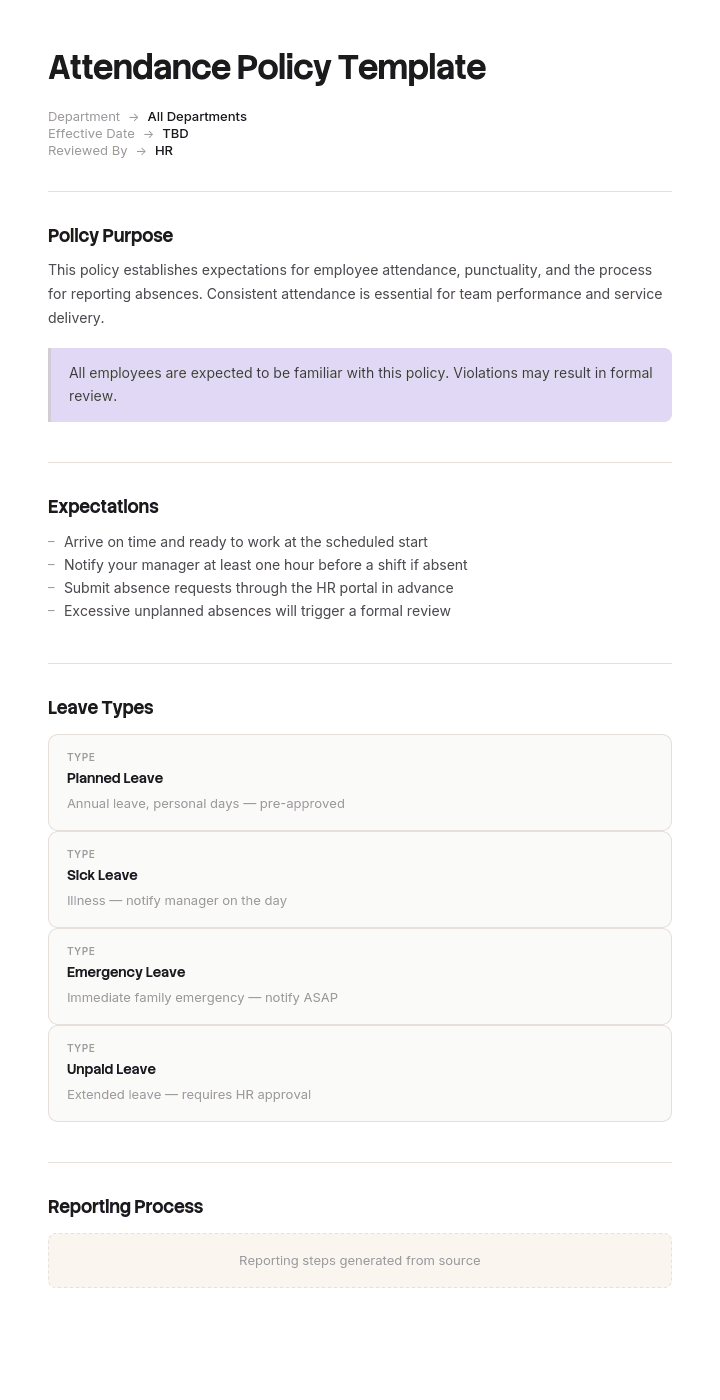
Use this template
A well-written attendance policy keeps everyone on the same page about working hours, time off, tardiness and absences. With Trupeer, you can save hours on HR documentation by starting with an employee attendance policy template, customizing it with your brand guidelines, and turning the policy into a clear video explainer your team can actually watch instead of skim.
Most attendance problems are definition problems. Nobody wrote down what counts as late, how far in advance an absence must be reported, or what happens on the fourth occurrence. So managers improvise, employees compare notes, and the inconsistency becomes the actual policy.
Below is the full text of an attendance policy you can copy straight into your handbook. Every company-specific detail is marked in brackets. Fill them in, choose your enforcement model, have it reviewed, and issue it.
Download the attendance policy template
Format | Best for |
|---|---|
Word (.docx) | Editing the policy and pasting into your handbook |
Distribution and signed acknowledgment | |
Google Docs | Collaborative review with HR and legal |
Google Doc (.doc) | Older systems and legacy handbook formats |
Free, editable, no watermark, no attribution required.
How to customize this template in Trupeer
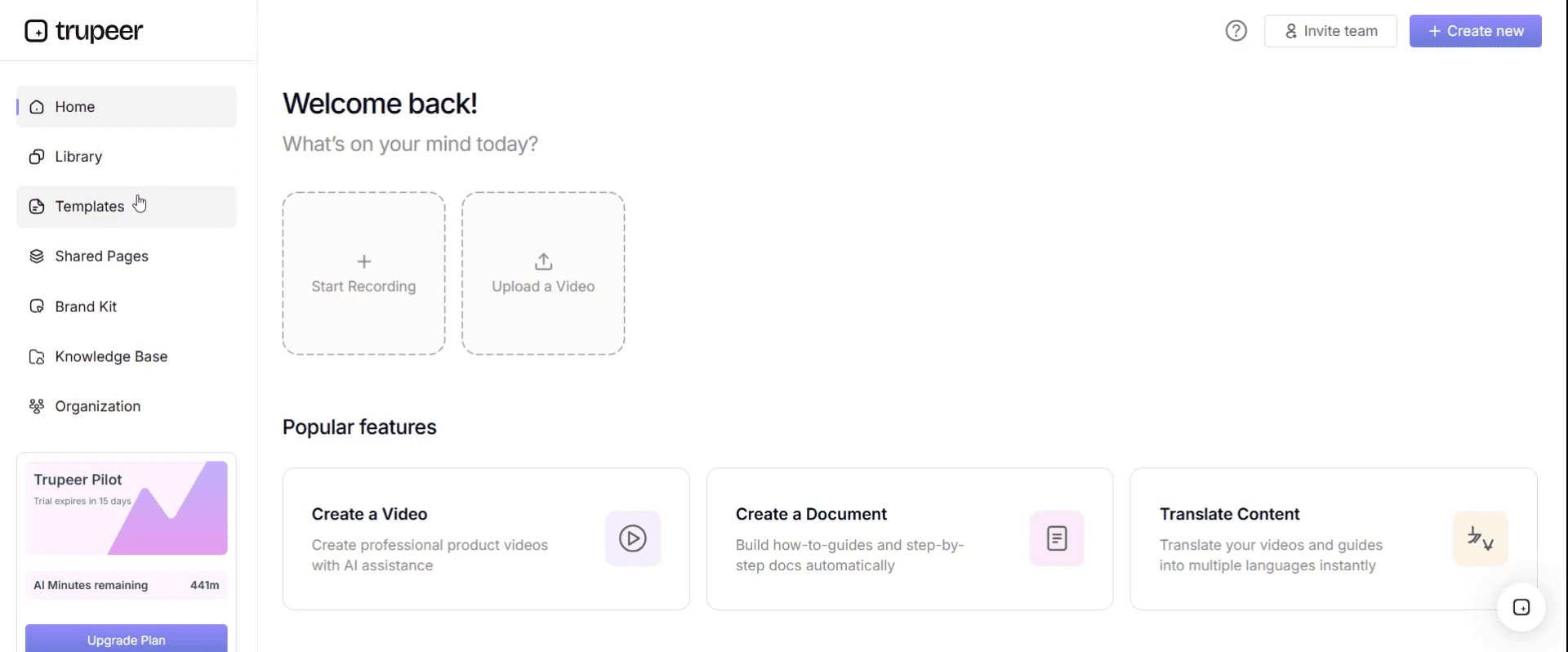
Step 1: Open the Templates Section
Go to the Templates section from the main navigation.
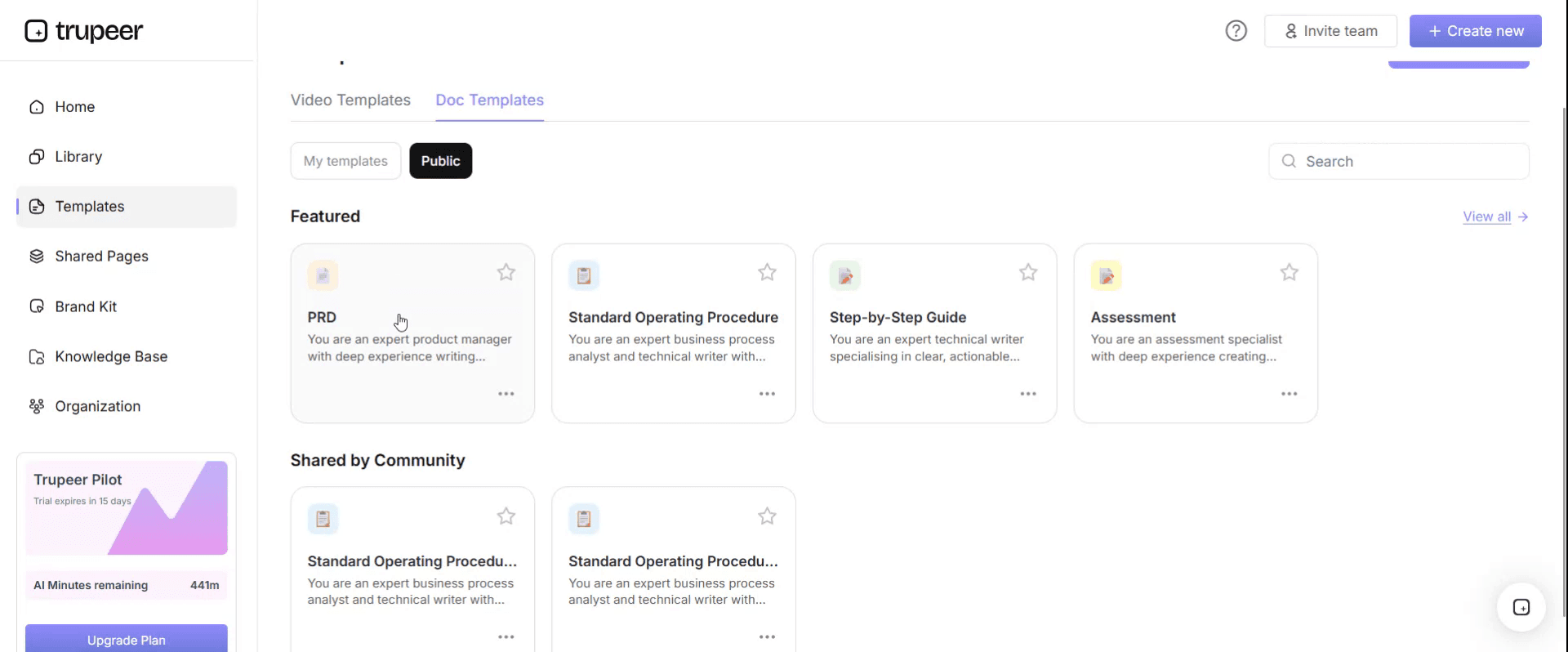
Step 2: Select and Open a Template
Click on any template you want to work with to open it.
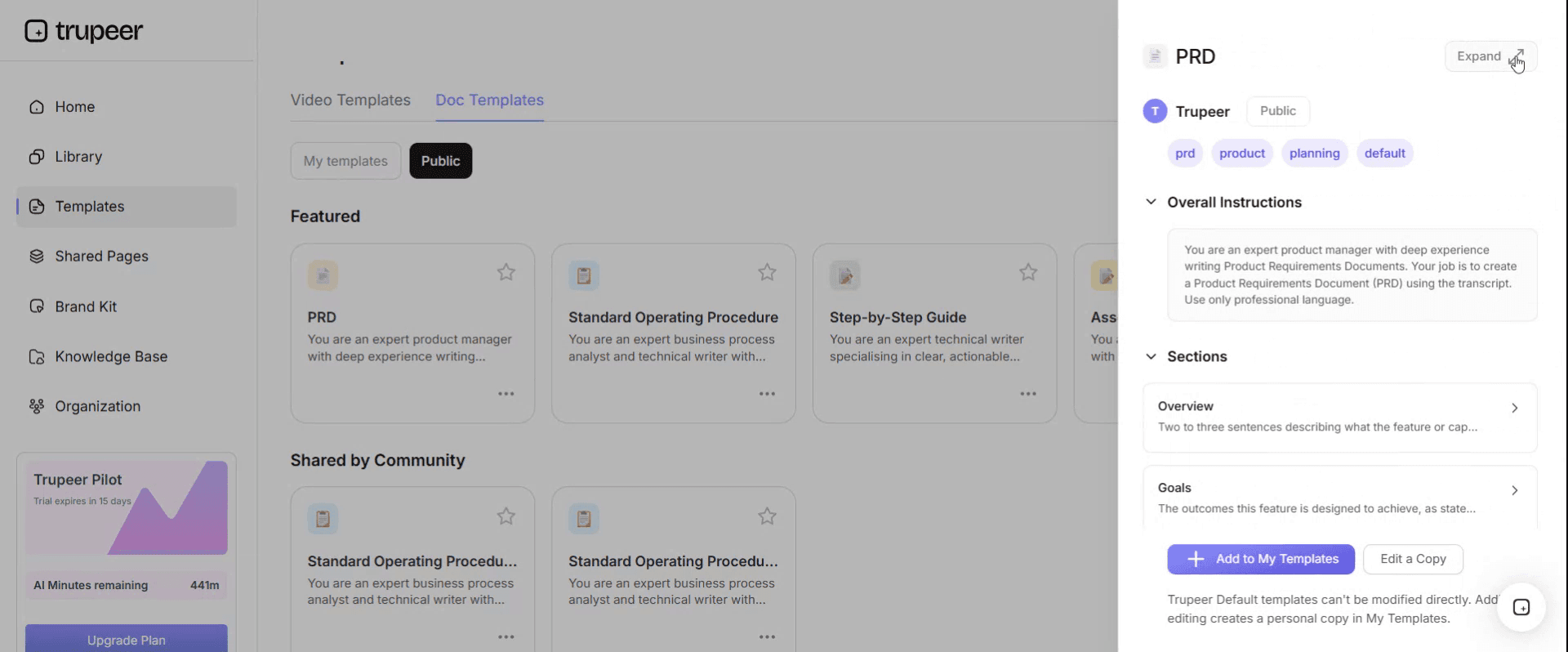
Step 3: Expand the Template View
If needed, expand the template view to see the full layout and details clearly.
Step 4: Edit the Template
Click on Edit to start modifying the selected template.
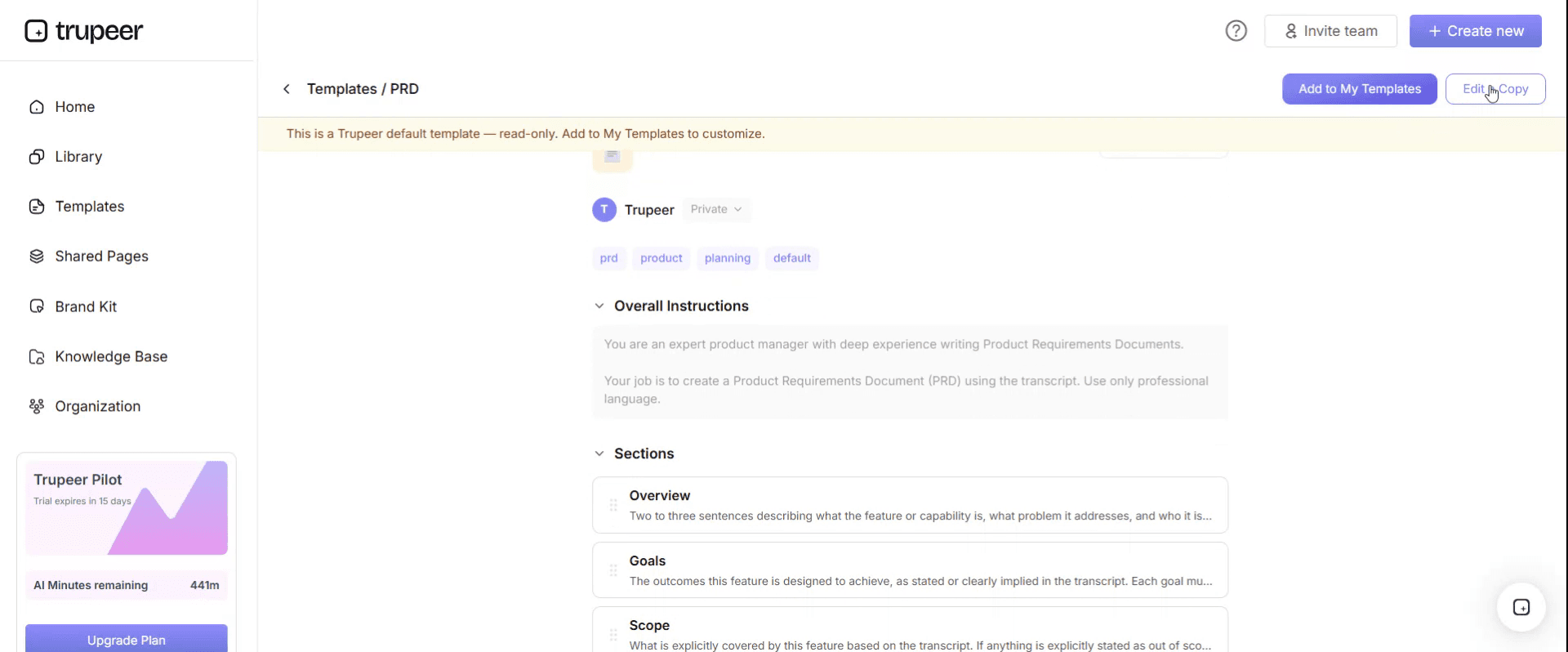
Within the editor, you can:
Add new sections
Define or update formatting rules
Add a logo and adjust its position and related settings
Step 5: Save Your Customized Template
After making all necessary changes, click Save to store the updated template as your own.
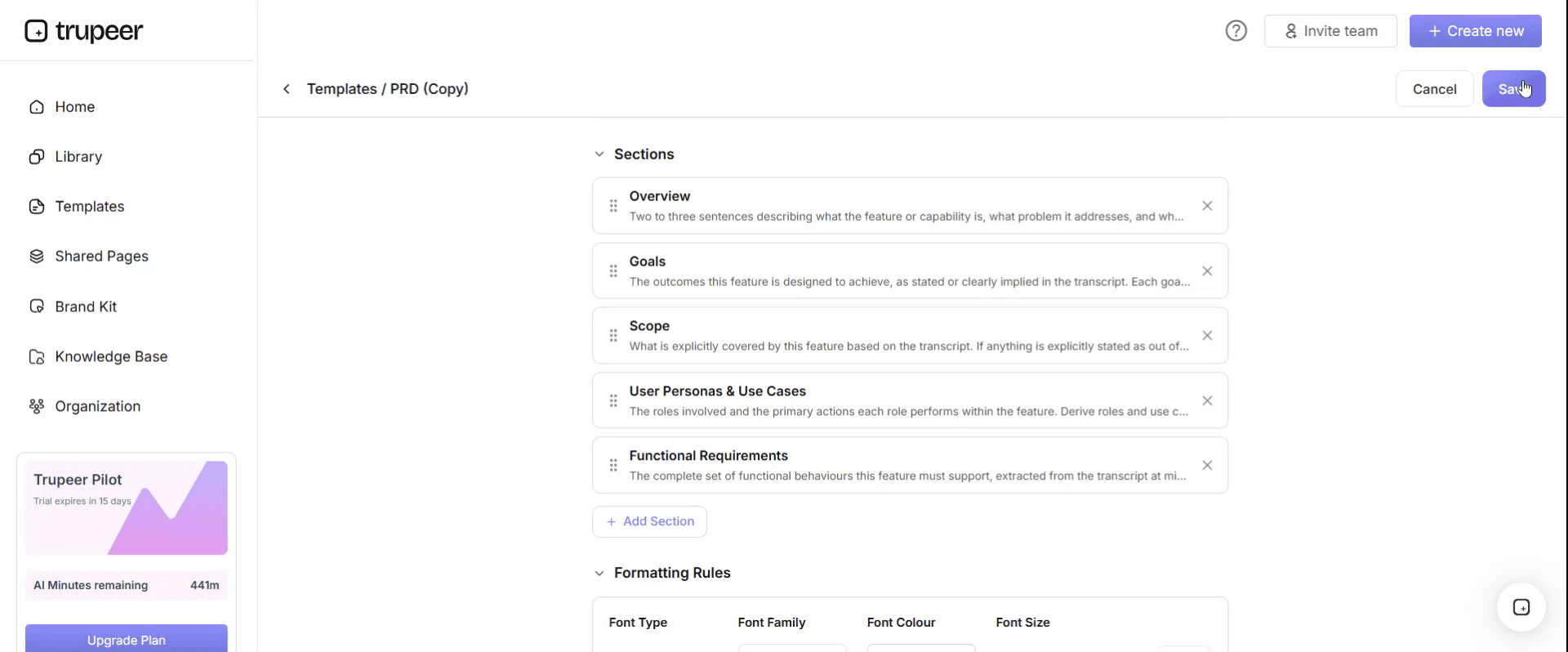
Step 6: Preview and Fine-Tune the Template
When you want to see how your customized template looks, open the Preview.
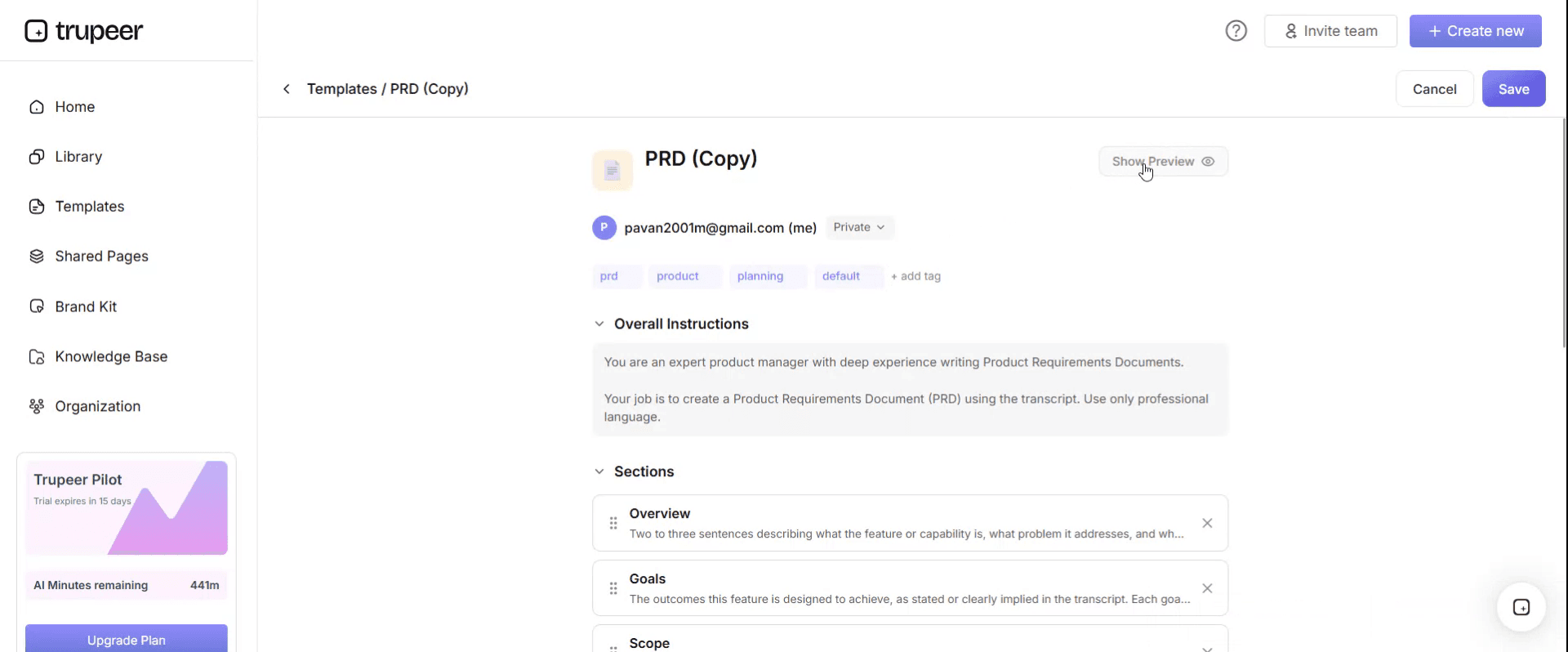
From the preview screen, you can continue to make adjustments directly if needed, ensuring the template appears exactly as you want.
Full policy text
Copy everything below. Replace bracketed text with your details. Delete sections that don't apply.
[COMPANY NAME] ATTENDANCE POLICY
Effective date: [date] · Applies to: [all employees / hourly employees / specified locations] · Policy owner: [HR Manager] · Version: [1.0]
1. Purpose
Regular and reliable attendance is essential to [Company Name]'s operations and to the workload of colleagues who depend on one another. This policy sets out our expectations for attendance and punctuality, how to report an absence, and the consequences of failing to meet these expectations. It exists so that expectations are clear and applied consistently.
2. Scope
This policy applies to all employees of [Company Name], including full-time, part-time, temporary and seasonal staff [and contractors, where specified in their agreement]. Where a collective bargaining agreement applies, the terms of that agreement take precedence.
3. Definitions
Scheduled shift: The hours an employee is rostered to work as published in [scheduling system].
Tardiness: Arriving more than [5] minutes after the scheduled start time.
Early departure: Leaving more than [5] minutes before the scheduled end time without prior approval.
Absence: Failure to work a scheduled shift.
Excused absence: An absence approved in advance, or an unforeseen absence reported in line with Section 5 and supported by documentation where required.
Unexcused absence: An absence not approved in advance and not reported in line with Section 5.
No-call/no-show: Failure to report for a scheduled shift without notifying [Company Name] within [2] hours of the shift start.
Occurrence: A single instance of tardiness, early departure or absence, regardless of length. [Consecutive days of absence for a single continuing reason count as one occurrence.]
4. Attendance expectations
Employees are expected to:
Report to their assigned work location, or be available remotely where applicable, at their scheduled start time and ready to work.
Work their full scheduled shift, including observing scheduled break lengths.
Obtain approval from [their manager] before any schedule change, shift swap or early departure.
Record time accurately in [timekeeping system]. Recording time for another employee, or asking a colleague to do so, is a serious disciplinary matter.
5. Reporting an absence or lateness
Foreseeable absence must be requested at least [14] days in advance through [system or process].
Unforeseeable absence must be reported to [manager / attendance line / system] at least [2] hours before the scheduled start time, or as soon as practicable in an emergency.
Notice must come from the employee unless they are physically unable, in which case a family member or representative may report on their behalf.
Text message [is / is not] acceptable notice. Voicemail alone [is / is not] acceptable notice.
Employees must report each day of a continuing absence unless a return date has been agreed with [their manager].
6. Documentation
[Company Name] may request supporting documentation for:
Absence of more than [3] consecutive scheduled shifts.
Absence adjacent to a holiday, weekend or previously denied time-off request.
A pattern of absence that raises a reasonable concern.
Documentation requirements will be applied consistently and will not exceed what is permitted by applicable law. Medical information will be kept confidential and stored separately from the personnel file.
7. Excused and unexcused absence
Absences are excused when approved in advance, reported in line with Section 5, taken as accrued paid time off, or protected by law under Section 10. Absences are unexcused when they are not reported in line with Section 5, when documentation is requested and not provided within [5] business days, or when the employee has exhausted available paid time off and no protected leave applies.
8. No-call/no-show and job abandonment
A no-call/no-show is treated as an unexcused absence and is subject to immediate disciplinary action.
[Two] consecutive no-call/no-show occurrences will be treated as voluntary resignation and job abandonment, unless the employee provides evidence that they were unable to give notice. [Company Name] will make [one] documented attempt to contact the employee before treating employment as ended.
9. Enforcement and disciplinary steps
[Company Name] uses the [points-based / progressive discipline / written warning] model set out in Section 9a below. Disciplinary action will be applied consistently and documented in writing. Nothing in this section alters the at-will nature of employment where applicable.
9a. [Select and keep one model, delete the others]
Option A: Points-based (no-fault) system
Occurrence | Points |
|---|---|
Tardiness under 30 minutes | [0.5] |
Tardiness over 30 minutes | [1] |
Early departure without approval | [1] |
Absence reported in line with Section 5 | [1] |
Unexcused absence | [2] |
No-call/no-show | [3] |
Points accumulated | Action |
|---|---|
[4] | Verbal counselling, documented |
[6] | Written warning |
[8] | Final written warning [and suspension] |
[10] | Termination of employment |
Points [expire 12 months after the date of the occurrence / roll off on a rolling 12-month basis].
Option B: Progressive discipline
Occurrence within [12] months | Action |
|---|---|
[3rd] | Verbal counselling, documented |
[5th] | Written warning |
[7th] | Final written warning |
[8th] | Termination of employment |
Option C: Written warning process
Attendance concerns are addressed through a documented conversation, followed by a written warning, a final written warning and then termination if the pattern continues. Managers must consult [HR] before issuing any written warning.
10. Protected leave and accommodation
Nothing in this policy limits an employee's rights under applicable law. Absences protected by law will not be counted as occurrences or points under Section 9. Protected absences may include, depending on jurisdiction and eligibility:
Leave under the Family and Medical Leave Act (FMLA).
Reasonable accommodation under the Americans with Disabilities Act (ADA), including modified schedules or additional leave.
State and local paid sick leave, family leave and domestic violence leave.
Jury duty, voting leave and military leave.
Workers' compensation absence.
Pregnancy-related absence and accommodation.
Employees who need an accommodation should contact [HR contact]. Managers who receive a request must refer it to [HR] rather than deciding it themselves.
11. Employee rights and appeals
An employee may request review of any attendance action by contacting [HR contact] within [10] business days. [Company Name] will not retaliate against any employee for reporting a concern under this policy, requesting protected leave or requesting an accommodation.
12. Acknowledgment
I confirm that I have received, read and understood the [Company Name] Attendance Policy. I understand that failure to meet these expectations may result in disciplinary action up to and including termination of employment.
Employee name: [ ] · Signature: [ ] · Date: [ ] · Manager: [ ]
End of policy text.
Please read: This template is provided for general informational purposes and is not legal advice. Attendance policies interact with FMLA, ADA, state and local leave laws and, in some cases, collective bargaining agreements. Have this policy reviewed by qualified employment counsel or your HR advisor before issuing it.
What the policy covers
Purpose and scope, including which employment types it applies to.
Definitions, so "late" and "absence" mean one thing rather than several.
Attendance expectations, including timekeeping.
Absence reporting, with notice periods and acceptable notification methods.
Documentation, and the limits on requesting it.
Excused and unexcused absence, defined against the reporting rules.
No-call/no-show and job abandonment, including the contact attempt requirement.
The disciplinary ladder, in three selectable models.
Protected leave and accommodation, so protected absence isn't counted.
Appeals and anti-retaliation.
Signed acknowledgment, which is what makes the policy enforceable in practice.
Choose your enforcement model
Section 9a offers three models. This is the most consequential decision in the document, and picking the wrong one causes most attendance policy failures.
Model | How it works | Suits | Watch out for |
|---|---|---|---|
Points-based (no-fault) | Each occurrence carries points, with thresholds triggering action. Reason is irrelevant. | Shift work, larger hourly workforces, multi-site operations | Rigid application can penalise protected absence. Requires an explicit carve-out and a rolling expiry. |
Progressive discipline | A defined sequence of warnings triggered by occurrence count, with room for judgement. | Salaried teams, smaller organisations | Consistency depends on managers. Document everything or the pattern breaks. |
Written warning | Documented conversations escalating to warnings, largely at manager discretion. | Small teams, professional and flexible cultures | Least defensible if a decision is challenged, because the standard is unwritten. |
The points-based model is the most common in hourly environments because it removes the need to judge whether a reason is good enough. That's also its risk: a system that ignores reasons will count an FMLA-protected absence unless you explicitly stop it from doing so. Section 10 exists for that reason and should not be deleted.
Sample attendance policy for hourly employees
Hourly and shift-based workforces need tighter rules than salaried teams, because a missing person on a shift is an immediate operational problem rather than a rescheduled meeting. If your workforce is hourly, adjust as follows.
Shorten the notice window. Two hours before shift start rather than the same business day, since cover has to be arranged.
Name the notification channel precisely. A single attendance line or app, not "tell your supervisor." Shift handovers lose messages.
Use the points-based model. It scales across sites and shifts, and it removes the inconsistency of different supervisors judging the same reason differently.
Define tardiness in minutes, not impressions. Five minutes, measured by the timekeeping system.
Address shift swaps explicitly. Who approves them, how far in advance, and whether a swap that falls through counts against the person who arranged it.
Cover early departure separately from absence. In hourly environments, leaving early is as disruptive as not arriving.
Be careful with the meal break rule. Extended unpaid breaks are an attendance matter, but wage and hour law governs break entitlement, so keep the two separate.
Be precise on rounding. If your timekeeping system rounds, say how, since it affects when tardiness is recorded.
What is an attendance policy?
An attendance policy is a written document setting out when employees are expected to be at work, how to report when they can't be, and what happens when expectations aren't met. It usually sits in the employee handbook and is acknowledged in writing.
An attendance policy template is that document with the structure and clauses already drafted, leaving you to fill in your notice periods, thresholds and contacts. The terms attendance management policy, absenteeism policy and tardiness policy describe the same document.
What is a reasonable attendance policy?
Reasonable means enforceable and defensible, not lenient. A policy is reasonable when:
The thresholds match the work. A five-minute tardiness rule fits a production line. It's petty in a salaried role with flexible hours.
It accounts for real life. Everyone occasionally hits traffic or has a sick child. A policy with no tolerance gets ignored, and an ignored policy is worse than none.
Occurrences expire. A rolling 12-month window is standard. Points that never expire eventually terminate people for things that happened two years ago.
Protected absence is carved out. Non-negotiable, and the most common serious error.
It's applied consistently. The same conduct receiving different responses from different managers is what turns an attendance dispute into a discrimination claim.
It's clear enough to predict. An employee should be able to read it and know where they stand.
Why you need an attendance policy
Consistency. The same conduct gets the same response, which is both fairer and far more defensible.
Managers stop improvising. Without a policy, every supervisor invents their own and employees notice.
Absence becomes measurable. You can see patterns rather than reacting to individual incidents.
Legal defensibility. A written, acknowledged, consistently applied policy is your evidence if a decision is challenged.
Fairness to the reliable. Unaddressed absenteeism shifts work onto the people who show up, and they eventually leave.
Clear expectations reduce anxiety. Most people would rather know the rule than guess it.
Who should use this template
HR teams writing or refreshing a handbook.
Small business owners without an HR function who need something defensible.
Operations and shift managers in hourly environments needing consistent site rules.
Franchise and multi-site operators standardising across locations.
Startups formalising attendance for the first time as headcount grows.
Skip it if you're covered by a collective bargaining agreement that already governs attendance, or if you operate a genuinely unlimited flexible-hours model where attendance is measured by output.
How to customize this template
Fill in every bracket. An unfilled bracket in a published policy undermines the whole document.
Pick one enforcement model in Section 9a and delete the other two.
Set your numbers deliberately. Notice period, tardiness threshold, points values and expiry. These are the policy.
Check your state and local law. Paid sick leave entitlements vary considerably and some jurisdictions restrict counting protected sick time as an occurrence.
Keep Section 10. Delete anything else, not that.
Have it reviewed by employment counsel or your HR advisor.
Issue it and collect acknowledgments. Unacknowledged policies are difficult to enforce.
Train managers on it. A policy applied inconsistently by managers is worse than no policy, because the inconsistency is now documented.
Set a review date. Annually, and whenever leave law changes in a jurisdiction you operate in.
Best practices for rolling it out
Announce it before it takes effect. Give at least [30] days' notice of a new or changed policy.
Explain the reasoning, not just the rules. People comply with policies they understand.
Start the clock fresh. Don't apply a new points system retroactively.
Put it where people can find it. Handbook, intranet, and the break room if you're a shift operation.
Train every manager the same way. This is where consistency is won or lost.
Record the acknowledgments. Signature, date, and the policy version.
Review the data quarterly. If one site or shift shows very different numbers, the cause is usually scheduling or management rather than the workforce.
Common mistakes
Counting protected absence. The most serious error and the most common one in points-based systems.
Points that never expire. Eventually produces terminations for ancient history.
Vague definitions. "Excessive absenteeism" is unenforceable. "[8] points in a rolling 12 months" is not.
No acknowledgment on file. Hard to enforce a policy nobody signed.
Inconsistent application. Turns an attendance matter into a discrimination exposure.
Ignoring state law. Paid sick leave rules differ significantly and some override your thresholds.
No accommodation route. Employees need somewhere to raise a disability-related need, and managers need to know to refer it rather than decide it.
Never reviewed. Leave law changes. A policy from four years ago may no longer be compliant.
Roll it out with Trupeer AI
A policy nobody reads is a policy nobody follows. Once the text is final, apply your brand kit so it matches the rest of your handbook, and edit it directly in Trupeer AI. Setup is in the template guide.
Then handle the part a PDF can't. Record a short video walkthrough explaining how absence reporting works, so new hires watch the process rather than skimming clause five. Translate it into 65+ languages, which matters more here than almost anywhere else, since an employee who misunderstands the reporting rule in their second language can lose their job over it. Store it in your knowledge base so the current version is the only one people can find, and use it in onboarding.
Record it. Brand it. Translate it. Trupeer it.
With an attendance policy template you can:
Save hours on writing: Skip the blank page with a structure built for HR policies.
Improve compliance: Clear rules reduce ambiguity and protect both employees and the company.
Stay on-brand: Apply your logo, colors and fonts using Trupeer's brand kit - perfect for HR handbooks and onboarding.
Onboard with video: Replace dense PDFs with a 5-minute video walkthrough - ideal for employee training videos.
Standardize globally: Use the same policy template across regions and adapt for local laws.
Reach every employee: Translate the policy into 65+ languages with one click.
An attendance policy is the foundation of fair workforce management. Use this template to make yours clear, consistent and easy for every employee to understand.
Frequently Asked Questions
What is an attendance policy?
An attendance policy is an HR document that defines expectations around employee attendance - including working hours, paid and unpaid leave, tardiness, no-call/no-shows and the disciplinary process for repeated violations. It's a core part of the employee handbook.
What should an attendance policy include?
A good attendance policy covers standard working hours, definitions of absence and tardiness, procedures for requesting time off, leave types (sick, personal, vacation, bereavement), no-call/no-show rules, attendance tracking methods and a clear disciplinary process for violations.
How do you write an attendance policy?
Start with the company's working hours and shift patterns. Define what counts as an absence, tardiness or early departure. Document leave entitlements and how to request them. Outline a fair disciplinary process. Have HR or legal review the draft to ensure it's compliant with local employment laws.
What is a no-call/no-show policy?
A no-call/no-show policy defines what happens when an employee fails to show up for work without notifying their manager. Most policies treat consecutive no-call/no-shows (typically 3 days) as voluntary resignation, but the exact rules vary by company and jurisdiction.
Are attendance policies legally required?
While not always legally required, having a written attendance policy is strongly recommended. It protects the company in disputes, ensures consistent treatment of employees and helps comply with leave-related laws. Always have a lawyer review any HR policy before rolling it out.


