Use this template
Clear company policies set expectations, protect the business and create a fair workplace. With Trupeer, you can save hours on policy writing by starting with a free company policy template, customizing it with your brand guidelines, and turning each policy into a video walkthrough employees actually watch instead of skim.
Writing a company policy is the easy part. Most organisations manage it, then end up three years later with forty policies where a dozen are out of date, nobody can say who owns them, and there is no record of who ever read them.
This free company policy template gives you the clause structure that works for any policy, and the two things that keep a library usable: a register and a review cycle.
Download the company policy template
Format | Best for |
|---|---|
Word (.docx) | Writing and editing policies. Free download, no sign-up |
The approved, issued version, and signature-based acknowledgment | |
Excel (.xlsx) | The policy register: owner, version, approval and review dates, acknowledgment tracking |
Google Docs | Collaborative drafting with HR, legal and the policy owner |
.doc | Older document systems and legacy handbook formats |
Free, editable, no watermark. Word plus the Excel register is the combination that matters, because the register is what prevents the library problem.
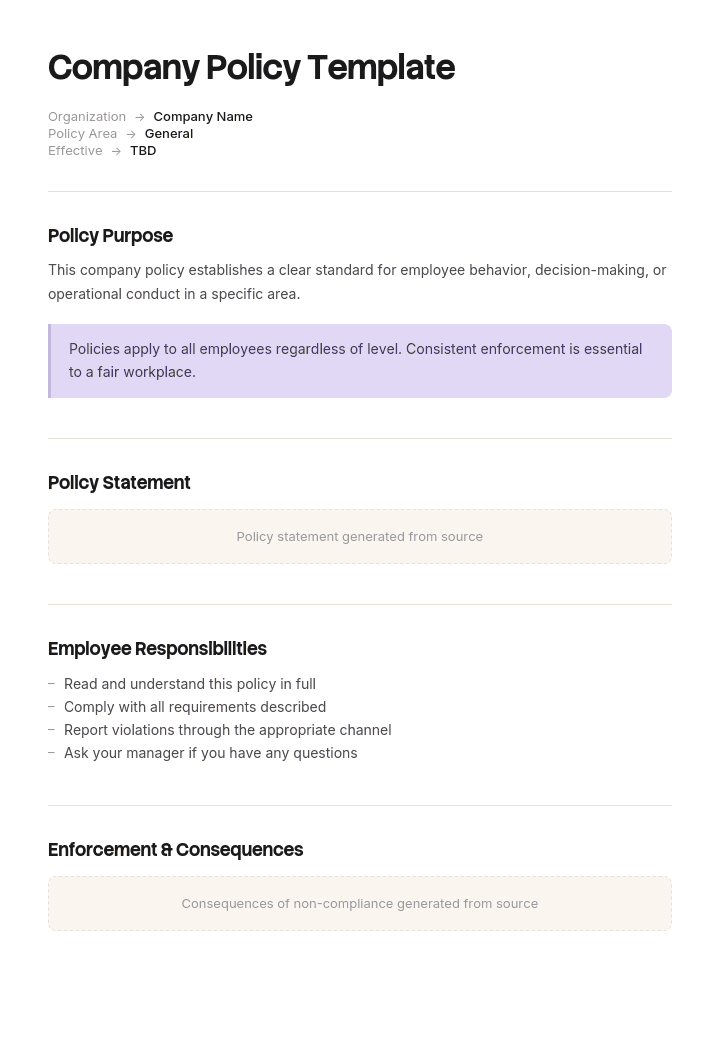
The company policy template
The same structure works for every policy. Consistency across a library is worth more than tailoring each document.
Section | What goes in it |
|---|---|
Policy title and reference | Remote Work Policy, POL-014 |
Version and effective date | v2.1, effective 1 October |
Policy owner | The role accountable for keeping it current |
Approved by and date | Who signed it off |
Next review date | A date, not "annually" |
Applies to | Which employees, locations, contract types |
Purpose | Why the policy exists, in one or two sentences |
Scope | What it covers, and explicitly what it does not |
Definitions | Every term that could be read two ways |
Policy statement | The rules themselves, numbered |
Responsibilities | What employees, managers, HR and leadership must each do |
Procedure | How the policy is carried out, or a link to the SOP |
Exceptions | What can be varied, by whom, and how to request it |
Non-compliance | What happens when the policy is breached |
Related documents | Other policies, procedures and forms |
Revision history | Date, version, what changed, who approved |
Acknowledgment | Signature block, where required |
How to customize this template in Trupeer
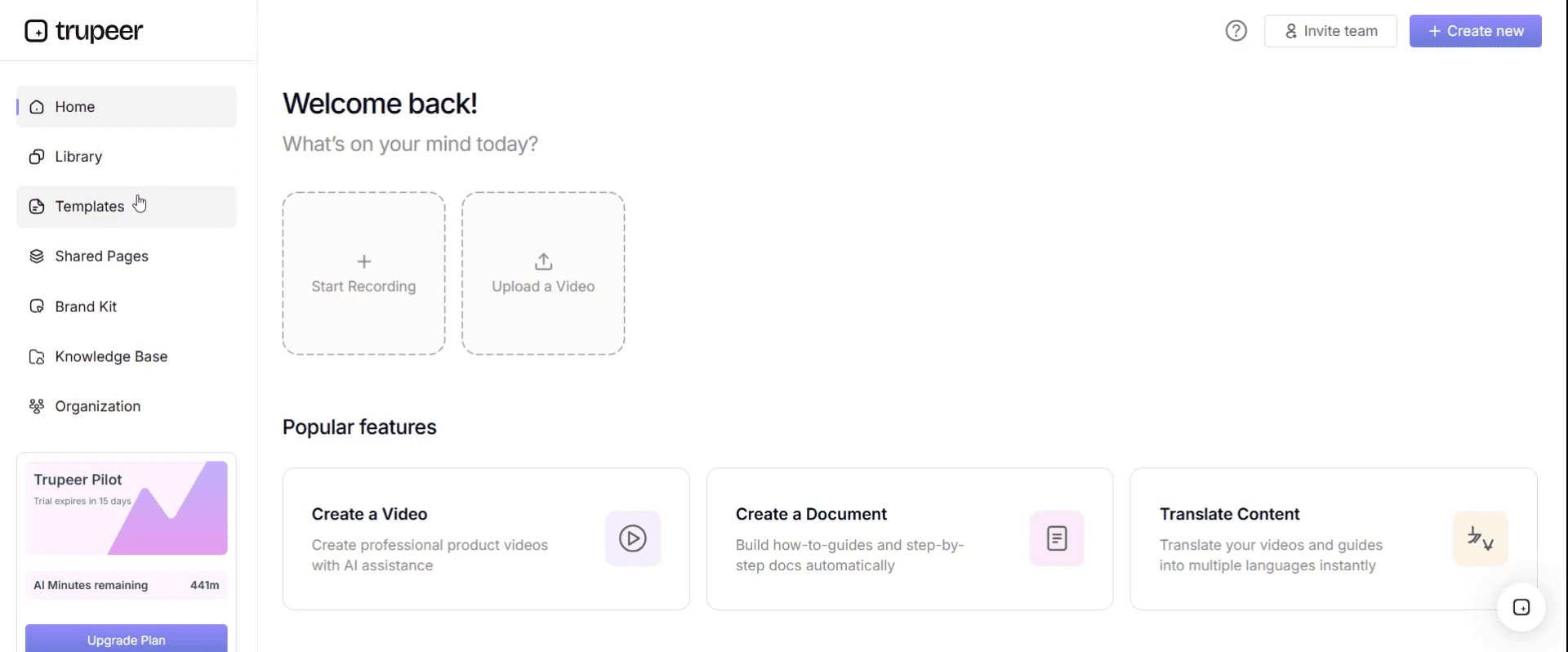
Step 1: Open the Templates Section
Go to the Templates section from the main navigation.
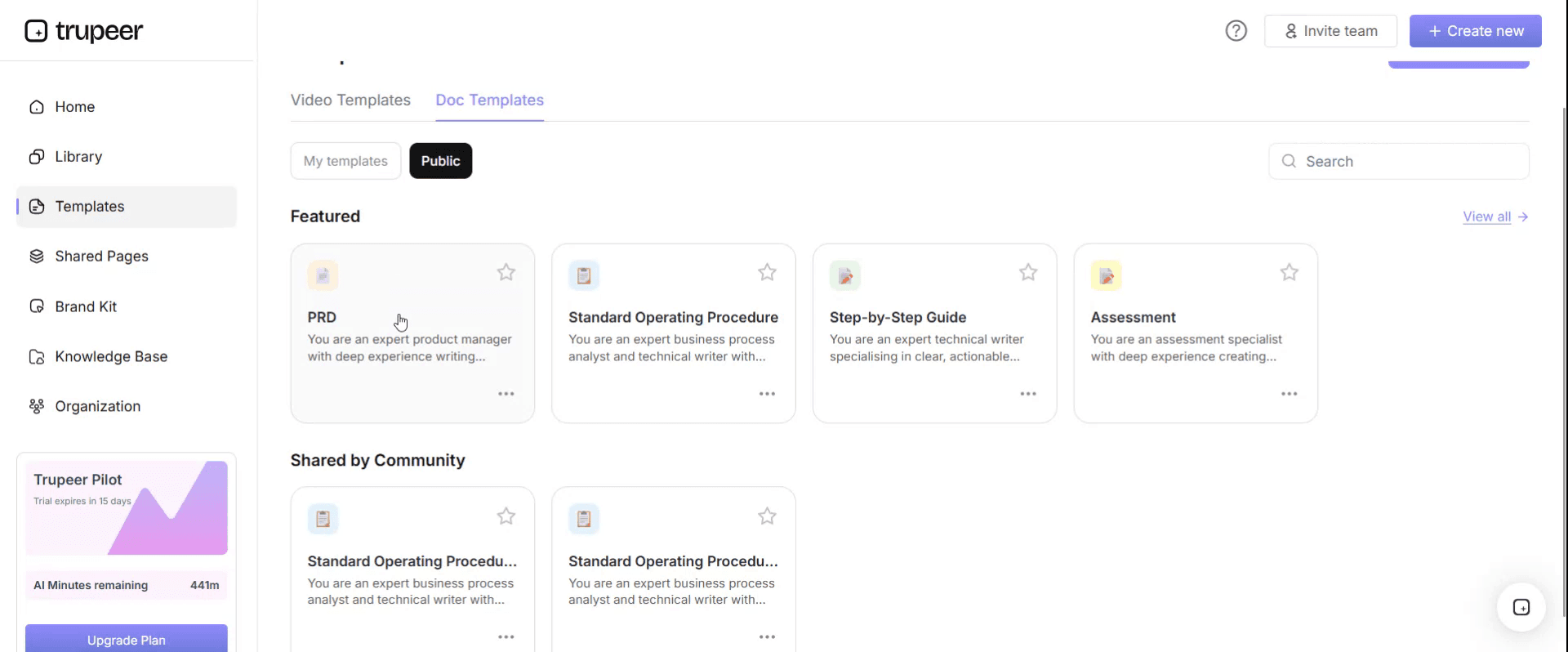
Step 2: Select and Open a Template
Click on any template you want to work with to open it.
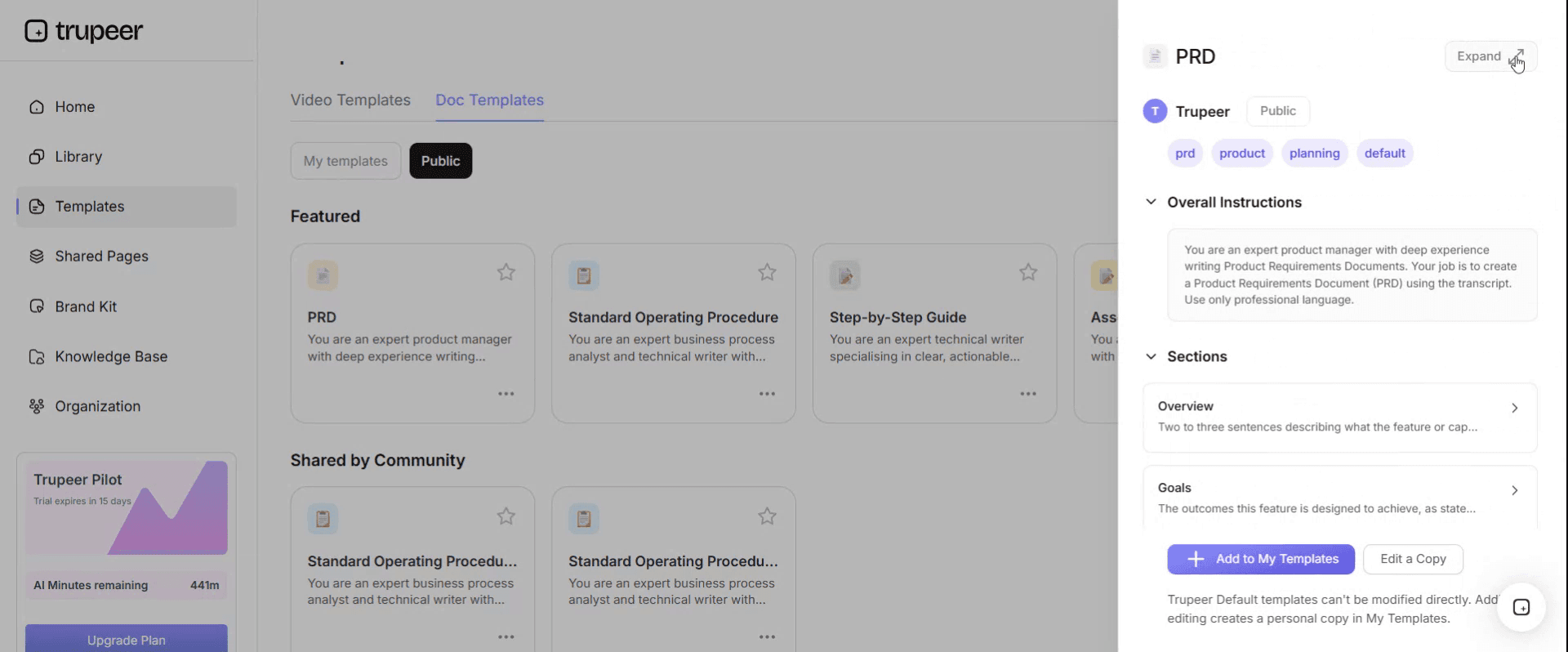
Step 3: Expand the Template View
If needed, expand the template view to see the full layout and details clearly.
Step 4: Edit the Template
Click on Edit to start modifying the selected template.
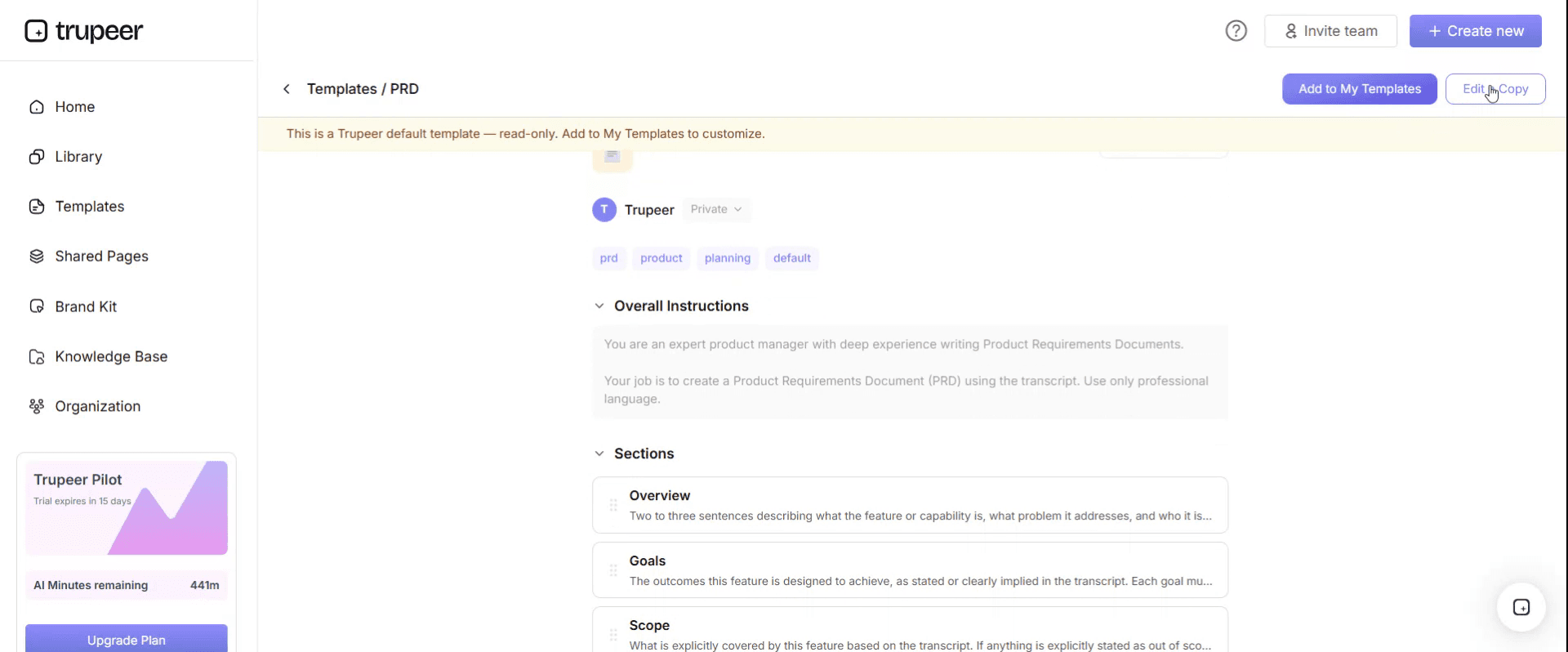
Within the editor, you can:
Add new sections
Define or update formatting rules
Add a logo and adjust its position and related settings
Step 5: Save Your Customized Template
After making all necessary changes, click Save to store the updated template as your own.
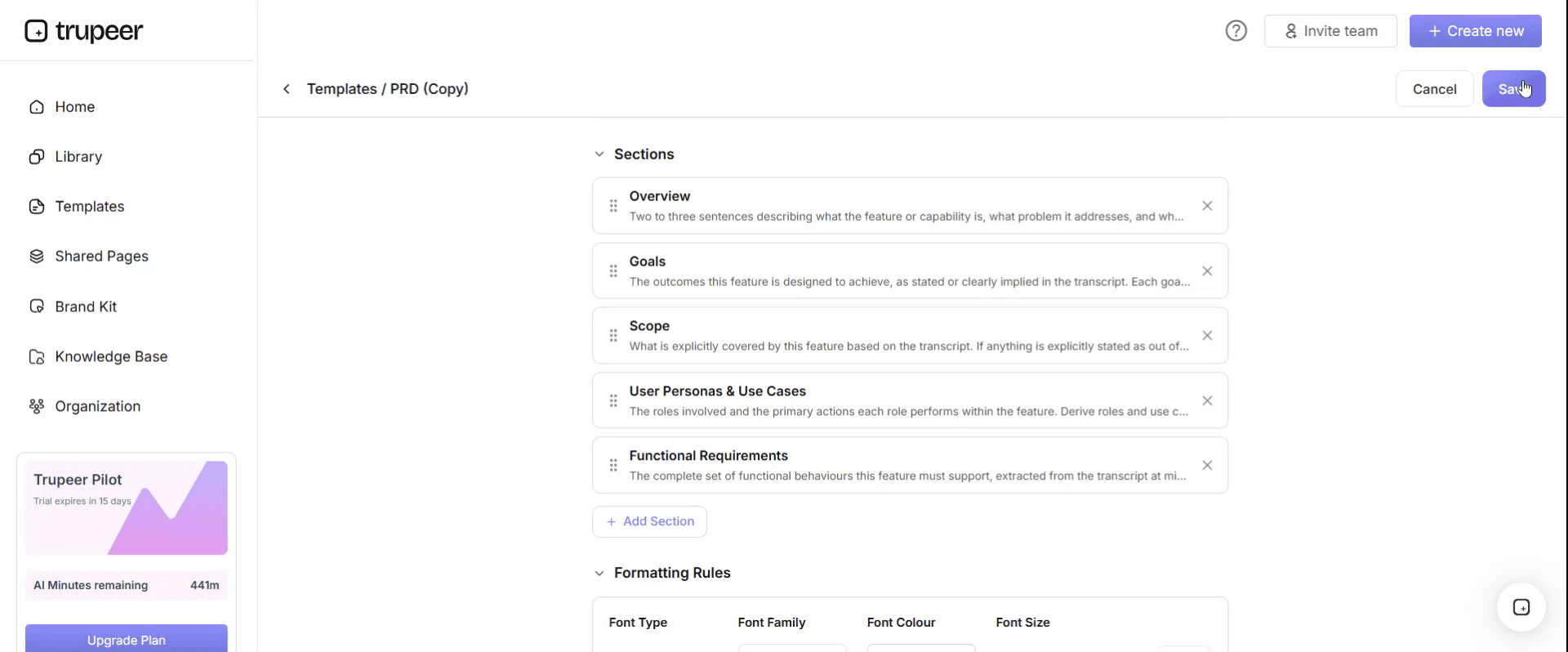
Step 6: Preview and Fine-Tune the Template
When you want to see how your customized template looks, open the Preview.
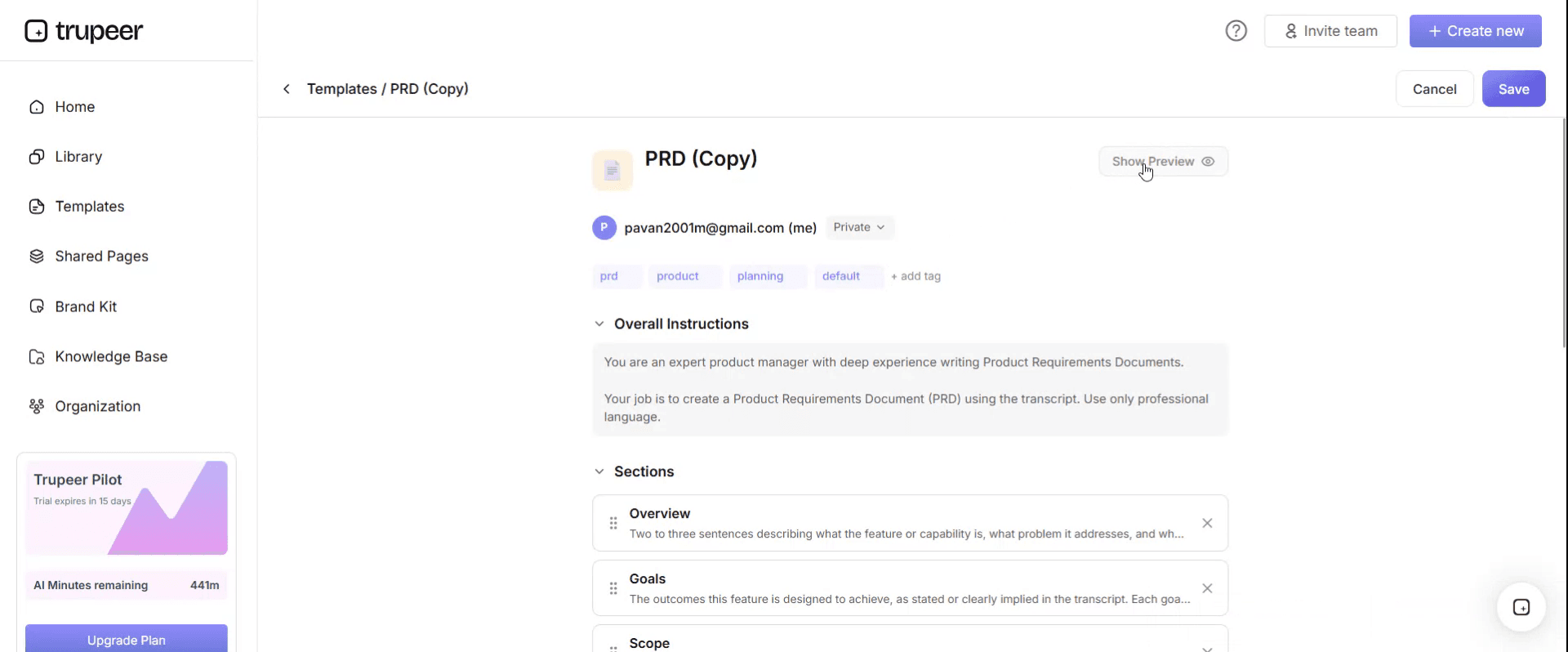
From the preview screen, you can continue to make adjustments directly if needed, ensuring the template appears exactly as you want.
With a company policy template you can:
Save hours on writing: Skip the blank page with a proven policy structure.
Standardize policies: Use the same format across every policy area.
Stay on-brand: Apply your logo, fonts and colors using Trupeer's brand kit.
Train every employee: Pair policies with video walkthroughs - far more effective than email.
Stay compliant: Built-in sections support employment law and audit readiness.
Reach global teams: Translate company policies into 65+ languages with one click.
Great company policies make expectations clear and the workplace fair. Use this template to make every policy clear, consistent and on-brand.
Key clauses every company policy contains
Four of those sections are the ones people omit, and each omission causes a predictable problem.
Scope, including exclusions. Policies that say who they apply to but not who they do not apply to generate constant questions from contractors, part-timers and overseas staff.
Definitions. Half of all policy disputes are vocabulary disputes. If a remote work policy does not define "remote", someone will interpret it as another country.
Exceptions and who can grant them. Every policy gets exceptions. Undocumented, they get granted inconsistently by whoever is asked, which is worse than having no policy because it creates precedent nobody agreed to.
Non-compliance. A policy with no stated consequence is guidance. If you intend to enforce it, say what enforcement looks like.
Filled-in company policy example
An abbreviated remote work policy, showing the level of specificity that makes a policy usable.
[COMPANY NAME] REMOTE WORK POLICY · POL-014 · v2.1
Effective: 1 October · Owner: HR Manager · Approved by: COO, 12 September · Next review: 1 October next year · Applies to: All permanent employees in office-based roles. Does not apply to site-based, retail or contractor roles.
1. Purpose. To set out when and how employees may work remotely, so arrangements are consistent, fair and compatible with operational needs.
2. Scope. Covers regular and occasional remote working within [country]. Does not cover working from another country, which requires separate approval under the International Working Policy, or full-time remote contracts, which are agreed at hire.
3. Definitions.
Remote working: Performing your role from a location other than a company office, agreed in advance.
Core hours: 10:00 to 16:00 local time, when employees are expected to be contactable.
Occasional remote working: Fewer than [4] days per month, arranged with your manager.
4. Policy statement.
4.1 Eligible employees may work remotely up to [2] days per week with manager approval.
4.2 Remote working days must be agreed at least [24] hours in advance, except in urgent circumstances.
4.3 Employees must be contactable and available during core hours.
4.4 Employees must have a suitable working environment, including a reliable internet connection and a workspace allowing confidential calls.
4.5 Team-wide in-office days take precedence over individual remote arrangements. These will be published at least [2] weeks ahead.
4.6 Remote working is not a substitute for sick leave or caring leave.
4.7 Company equipment must be used for company work. Company data must not be stored on personal devices, in line with the data protection policy.
5. Responsibilities.
Employees: Agree arrangements in advance, remain contactable in core hours, maintain a suitable environment, follow data security requirements.
Managers: Apply this policy consistently across their team, ensure operational cover, and refer any request for a permanent variation to HR.
HR: Maintain this policy, advise on exceptions, and handle accommodation requests.
6. Exceptions. Variations beyond [2] days per week require HR approval and, where relating to a disability or health condition, will be handled as a reasonable accommodation request rather than under this policy.
7. Non-compliance. Failure to follow this policy may be addressed under the disciplinary procedure. Persistent unavailability during core hours will be treated as a performance matter.
8. Related documents. Data protection policy, IT acceptable use policy, attendance policy, disciplinary procedure.
9. Revision history. v2.1, 12 September, core hours narrowed and team in-office days added, approved by COO. v2.0, previous year, initial post-pandemic revision.
Please read: This template and example are provided for general information and are not legal advice. Company policies interact with employment law, health and safety obligations, data protection law and, in some cases, collective agreements, and requirements vary by jurisdiction. Have any policy reviewed by qualified employment counsel or your HR advisor before issuing it.
Which company policy do you need?
Start with the ones where the absence of a policy is already causing inconsistency. That is usually a shorter list than a full library.
Something keeps being decided differently by different managers. Write the policy.
A legal or regulatory requirement applies. Write it, and get it reviewed.
An incident happened and you want to prevent a recurrence. Write it, but check whether the real gap was a procedure rather than a policy.
A single employee is doing something you would rather they did not. Have the conversation. A company-wide policy aimed at one person is visible to everyone and rarely lands well.
Someone suggested you should have one. Ask what problem it solves first.
Core policies most companies need
Policy | Why | Priority |
|---|---|---|
Code of conduct | Sets baseline behavioural expectations | Essential |
Consistency on lateness and absence | Essential | |
Leave and time off | Entitlements, requests, approvals | Essential |
Legal requirement in most jurisdictions | Essential | |
IT acceptable use | Devices, accounts, personal use | Essential |
Health and safety | Statutory in most jurisdictions | Essential |
Anti-harassment and discrimination | Legal exposure, and the one you need before an incident | Essential |
Disciplinary and grievance | Process fairness | Essential |
Remote or hybrid work | Where applicable | High |
Expenses and travel | Limits, approvals, receipts | High |
Equipment and BYOD | Ownership, return, security | Medium |
AI usage | Increasingly requested, often absent | Medium and rising |
Social media | Personal use, company representation | Medium |
Whistleblowing | Statutory in some jurisdictions | Check locally |
DEI | Commitment and practice | Medium |
Bereavement and compassionate leave | Reduces case-by-case judgement in difficult moments | Medium |
Workplace conduct policies
Code of conduct, anti-harassment and discrimination, disciplinary and grievance, drugs and alcohol, dress code, conflicts of interest, gifts and hospitality, and whistleblowing.
These are the policies most likely to be examined if something goes wrong, which means they need consistent structure, documented approval and acknowledgment records more than any other group.
Leave and time-off policies
Annual leave, sick leave, parental and family leave, bereavement, unpaid leave, sabbaticals, jury duty and public holidays.
The common failure here is entitlement stated without process. "Employees receive 25 days" leaves the request, approval, carry-over and notice rules unanswered, and those are what generate the questions.
Data, privacy and technology policies
Data protection, IT acceptable use, information security, BYOD and device management, password and access control, email and internet use, AI usage, and software procurement.
AI usage is the notable gap in most libraries right now. Employees are already using these tools with company data, and a policy after the fact is harder than one before. For procurement specifically, see the IT procurement policy template.
Health, safety and environment policies
Health and safety, accident and incident reporting, fire and emergency, first aid, lone working, display screen equipment, mental health and wellbeing, and environmental or sustainability policy.
Several of these are statutory rather than optional, and requirements differ by jurisdiction and headcount. This is the group where a template most needs local review.
Operations and expense policies
Expenses and travel, procurement and purchasing, company vehicles and fleet, asset management, and business continuity.
These are the policies with the clearest financial consequence when they are vague. "Reasonable expenses" is the single most expensive phrase in the category.
The policy register
The artifact that separates a policy library from a folder of documents. One row per policy.
Policy | Ref | Version | Owner | Approved by | Approved date | Next review | Acknowledgment required | Location |
|---|---|---|---|---|---|---|---|---|
Code of conduct | POL-001 | v3.0 | HR Manager | CEO | Jan | Jan next year | Yes, all staff | Handbook, intranet |
Attendance | POL-002 | v2.1 | HR Manager | COO | Mar | Mar next year | Yes, all staff | Handbook |
Data protection | POL-008 | v1.4 | DPO | COO | Jun | Jun next year | Yes, all staff | Intranet |
Remote work | POL-014 | v2.1 | HR Manager | COO | Sep | Sep next year | No | Intranet |
AI usage | POL-021 | Draft | IT Director | Pending | Yes, planned | Not yet issued |
Two columns do the work. Next review, because policies without a dated review go stale invisibly. And owner, because a policy owned by "HR" rather than a role means nobody notices when it needs updating.
Sort the register by next review date once a quarter. Anything overdue is either out of date or was never needed, and both are worth knowing.
The policy lifecycle
Draft. Written by the person closest to the subject, using the standard structure.
Review. HR, legal and any affected function. This is where jurisdictional problems get caught.
Approve. By someone with the authority to be held to it. Record who and when.
Issue and distribute. With notice before the effective date, not on it.
Acknowledge. Collect and record, where the policy will be enforced.
Operate. Answer questions, note where it is unclear, track exceptions granted.
Review on schedule. On the register date, and immediately after any incident it failed to prevent or any relevant legal change.
Retire or supersede. Withdraw the old version from circulation. A superseded policy still on the intranet is an active liability.
Approval and sign-off
Approval should sit with someone accountable for the outcome, not with whoever wrote it. In practice that means an executive for company-wide policies, a function head for functional ones, and legal review for anything with statutory implications.
Record the name, the role and the date on the policy itself. If a decision is ever challenged, the first question is whether the policy was properly approved and in force at the time.
Distribution and acknowledgment
Give notice before the effective date. Thirty days for anything materially affecting employees.
Explain the change, not just publish it. A policy landing with no context invites resistance.
Store one version in one place. The most common cause of an unenforceable policy is three versions in circulation.
Collect acknowledgment for anything you intend to enforce, and record the policy version alongside the signature.
Include policies in onboarding, or every new starter dilutes the library.
Tell managers first, so they can answer questions.
Review and retirement
Review annually as a default, and immediately when law changes, after an incident, following a reorganisation, or when the same question keeps arriving.
Retire deliberately. Mark the document superseded, remove it from the intranet and handbook, keep an archived copy with dates for the record, and note the change in the revision history of the replacement. Policies that quietly disappear leave employees uncertain about what applies.
What is a company policy?
A written statement of the rules and expectations governing some aspect of how an organisation operates and how its people behave. It states what must or must not happen, who it applies to, who is responsible, and what follows from non-compliance.
Its function is consistency. Without a policy, the same situation gets handled differently depending on who is dealing with it, which is unfair to employees and difficult to defend if challenged.
Policy, procedure, SOP, handbook or guideline
Frequently confused, and the confusion produces documents that fit nothing.
Policy | Procedure or SOP | Guideline | Handbook | |
|---|---|---|---|---|
Answers | What is the rule, and why | How is it carried out, step by step | What is recommended | Where do I find everything |
Tone | Must, may, will not | Numbered steps | Should, consider | Explanatory |
Binding | Yes | Yes, for the method | No | Contains policies, is not one |
Changes | Rarely, with approval | When the method changes | Freely | On revision cycle |
Example | Expenses over £500 require director approval | How to submit a claim in the system | Tips for keeping travel costs down | The staff handbook containing both |
The practical rule: if you are writing numbered steps in a system, you have moved from policy into procedure. Split them, and have the policy reference the SOP. Policies that absorb procedures need reapproving every time a tool changes.
When you need a company policy
A legal or regulatory obligation applies.
The same decision is being made inconsistently.
The cost of getting it wrong is high enough to justify a written rule.
You are growing past the point where the founder or manager can decide everything case by case, usually somewhere between fifteen and thirty people.
An incident has revealed there was no agreed position.
An insurer, client or auditor asks to see one.
You do not need a policy for everything. A library of forty policies in a company of twenty people is unmaintainable, and unmaintained policies are worse than absent ones because they create expectations nobody is meeting.
How to write a company policy
Define the problem it solves in one sentence. If you cannot, you may not need the policy.
Check what already exists. Overlapping policies contradict each other eventually.
Establish the legal position first. Some content is not yours to decide, and this varies by jurisdiction.
Use the standard structure. Consistency across the library is worth more than bespoke formatting.
Write the scope, including exclusions. Contractors, part-timers, overseas staff.
Define every ambiguous term.
Write the rules with must, may and will not. Avoid should in a binding policy, since it invites interpretation.
Keep procedure out of it. Reference the SOP instead.
State exceptions and who grants them.
State the consequence of non-compliance, if you intend to enforce it.
Get it reviewed by HR, legal and the affected function.
Approve it, register it, issue it with notice, and collect acknowledgment.
Set the review date on the register before you publish.
Writing style for policies
Short sentences. A policy read under pressure needs to be unambiguous rather than elegant.
Active voice with a named role. "Managers must approve" beats "approval must be obtained".
Must, may, will not. Not should, wherever the rule is binding.
Numbers rather than adjectives. "Within 5 working days" rather than "promptly".
No jargon, and no internal system names that will change.
Define anything a reasonable person could read two ways.
One page where possible. Two to four for complex subjects. Anything longer usually contains a procedure.
Best practices
One structure across the whole library.
A named role as owner for every policy, never a department.
A dated next review on every policy and on the register.
Procedure kept separate from policy.
Notice before the effective date.
Acknowledgment recorded with the version.
One version in one place.
Register sorted by review date quarterly.
Superseded versions withdrawn, not just replaced.
Common mistakes
Policy and procedure merged, so a tool change requires reapproval.
No scope exclusions, generating constant questions about who is covered.
Undefined terms, which is the root of most policy disputes.
Exceptions undocumented, so they get granted inconsistently and become precedent.
No consequence stated for a policy you intend to enforce.
No acknowledgment record, making enforcement difficult.
Multiple versions in circulation.
No owner, so nothing gets updated.
No review date, so the library goes stale invisibly.
Too many policies for the size of the organisation.
A company-wide policy written to address one individual.
Published without explanation, which reads as distrust.
Explain the policy, do not just publish it
Open the template in Trupeer AI, apply your brand kit so every policy matches your handbook and internal documents, and edit any section directly. Setup is in the template guide.
Policies get signed without being read, which is why acknowledgment records prove receipt rather than understanding. The policies with the highest cost of misunderstanding are usually the operational ones: how to report an absence, how to raise an expense, what to do when you spot a data incident.
For those, record a short walkthrough. Trupeer AI produces the written procedure and a narrated video walkthrough from one recording, so the policy states the rule and the video shows the process. Translate it into 65+ languages, which matters here because an employee who misunderstands a policy in their second language can face consequences for it. Keep the library in your knowledge base so there is one current version, and include it in onboarding.
Record it. Brand it. Translate it. Trupeer it.
Frequently Asked Questions
Is there a free company policy template in Word?
Yes. Word is the primary format, with the full clause structure and guidance notes you delete as you write. Free download, no sign-up, no watermark.
Can I download a free company policy template in Word?
Yes. Every format is a free download with no account required, and reusable for as many policies as you need.
Is there a company policy template in Word doc format?
Yes, a .doc version is included alongside .docx for older systems and legacy handbook formats.
Is there a free company policy template in PDF?
Yes. The PDF is the issued version, with the acknowledgment block on the final page for signature, which is what you need if you intend to enforce the policy.
Is there a free company policy template in Excel?
Yes, and it is genuinely useful rather than a format for its own sake. The Excel file is the policy register: one row per policy with owner, version, approval date, next review date, acknowledgment status and location. Sorting it by review date is the single most effective thing you can do to keep a policy library current.
What is the best free company policy template?
The one you use for every policy rather than a different structure each time. Consistency across a library matters more than tailoring individual documents, because employees learn where to look and reviewers can compare versions. Take the Word template for writing and the Excel register for managing, since most policy problems are maintenance problems rather than drafting problems.
Where can I find company policies for employees in PDF?
The PDF version of this template is the issued format, and the filled remote work example is included as a complete PDF so you can see a finished policy. If you want the whole set in one document for employees, that is a handbook rather than a policy, and the employee handbook template is built for it.
What is a company policy?
A written statement of the rules and expectations governing an aspect of how an organisation operates, covering what must or must not happen, who it applies to, who is responsible, and what follows from non-compliance. Its purpose is consistency, so the same situation is handled the same way regardless of who deals with it.
What should a company policy include?
Title and reference, version and effective date, owner, approver, next review date, who it applies to, purpose, scope with exclusions, definitions, the numbered policy statement, responsibilities by role, exceptions and who grants them, consequences of non-compliance, related documents, revision history and an acknowledgment block.
What is the difference between a policy and a procedure?
A policy states the rule and the reason. A procedure states how it is carried out, step by step. "Expenses over £500 require director approval" is a policy. The steps for submitting and routing that claim are a procedure. Keep them in separate documents, or every system change forces you to reapprove the policy.
How many policies does a company need?
Fewer than most template libraries suggest. Start with code of conduct, attendance, leave, data protection, IT acceptable use, health and safety, anti-harassment, and disciplinary and grievance. Add others when the absence of one is causing inconsistency or a requirement applies. Forty policies in a twenty-person company will not be maintained, and unmaintained policies create expectations nobody is meeting.
How long should a company policy be?
One page where possible, two to four for complex subjects. If it runs longer, check whether procedure has crept in, since that is almost always the cause.
Who should write and approve company policies?
Drafted by whoever is closest to the subject, reviewed by HR and legal, and approved by someone with authority to be held to it. Record the approver's name, role and date on the policy itself, because the first question in any challenge is whether the policy was properly approved and in force at the time.
Do employees need to sign company policies?
For any policy you intend to enforce, yes. Record the signature, the date and the policy version. Acknowledgment proves receipt rather than understanding, which is why the operational policies also deserve a short explanation rather than only a document.
How often should company policies be reviewed?
Annually as a default, and immediately when relevant law changes, after any incident the policy failed to prevent, following a reorganisation, or when the same question keeps arriving. Track review dates in the register and sort by them quarterly.
Can I customize this company policy template?
Yes, every version is fully editable. Delete sections that do not apply to a particular policy rather than leaving them blank. In Trupeer AI you can also apply your brand kit so the whole library looks consistent.


