4.8/5
BPO Transitions Documentation Tool
The BPO transitions documentation tool that turns knowledge-transfer sessions into SOPs, desk procedures and exception guides your receiving team can run from day one.
Book a Demo
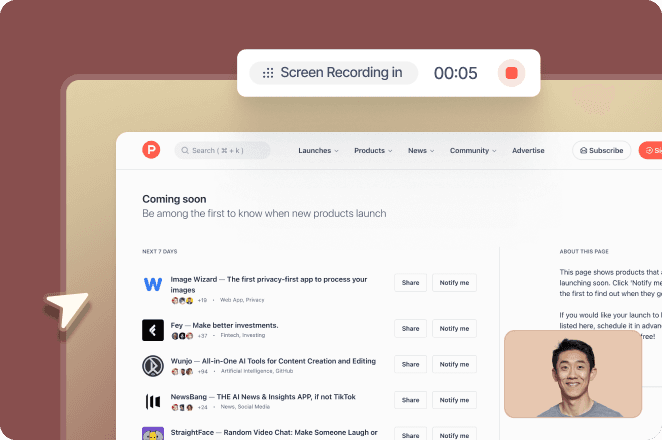
Trupeer's BPO transitions documentation tool turns knowledge-transfer sessions into the SOPs, desk procedures and exception guides a receiving team needs to run a process from day one.
In a BPO transition, documentation is the deliverable everyone depends on and nobody has time to write. The client's experts are busy running the process, the provider's team is learning it, and knowledge transfer happens in long calls that are recorded and rarely watched again. When the sending team rolls off, whatever wasn't written down goes with them. A BPO transitions documentation tool captures the process during knowledge transfer itself, so the documentation is built as the work is explained, not weeks later.
This page is about the documentation itself: what a BPO transition needs, how to capture it and how to keep it current. For the full transition approach, see Trupeer for transitions.
What is a BPO transitions documentation tool?
A BPO transitions documentation tool helps outsourcing providers and their clients document processes as they move from the client's team to the provider's delivery centre. Subject matter experts record themselves doing each process during knowledge transfer, narrating the checks, decisions and exceptions. The tool turns each recording into a step-by-step SOP with screenshots and a short video, which the receiving team reviews, signs off and uses to run the process.
What documentation does a BPO transition need?
Document | What it covers | When it's needed |
|---|---|---|
Process inventory | Every process in scope, with owners, volumes and complexity | Planning |
SOPs and desk procedures | Step-by-step instructions for each process, with screenshots and video | Knowledge transfer |
Exception and escalation guide | What to do when cases don't follow the standard path, and who to contact | Knowledge transfer |
System access and tools list | Applications, access rights and environments per role | Before shadowing |
SLA and quality standards | Targets, measures and quality checks | Before go-live |
Shadow and reverse-shadow evidence | Proof the receiving team can run each process | Stage gates |
Handover sign-off | Formal acceptance of documentation and readiness | Go-live |
Most transition delays come from the second and third rows: SOPs that were never finished and exceptions nobody wrote down.
How to document a BPO transition with Trupeer
Step 1: Record the knowledge-transfer session
The SME records the process exactly as they would explain it on a live KT call, narrating the checks and decisions as they go, including the exceptions they handle. Already have recorded KT sessions? Upload them instead.
Step 2: Generate the SOP and video
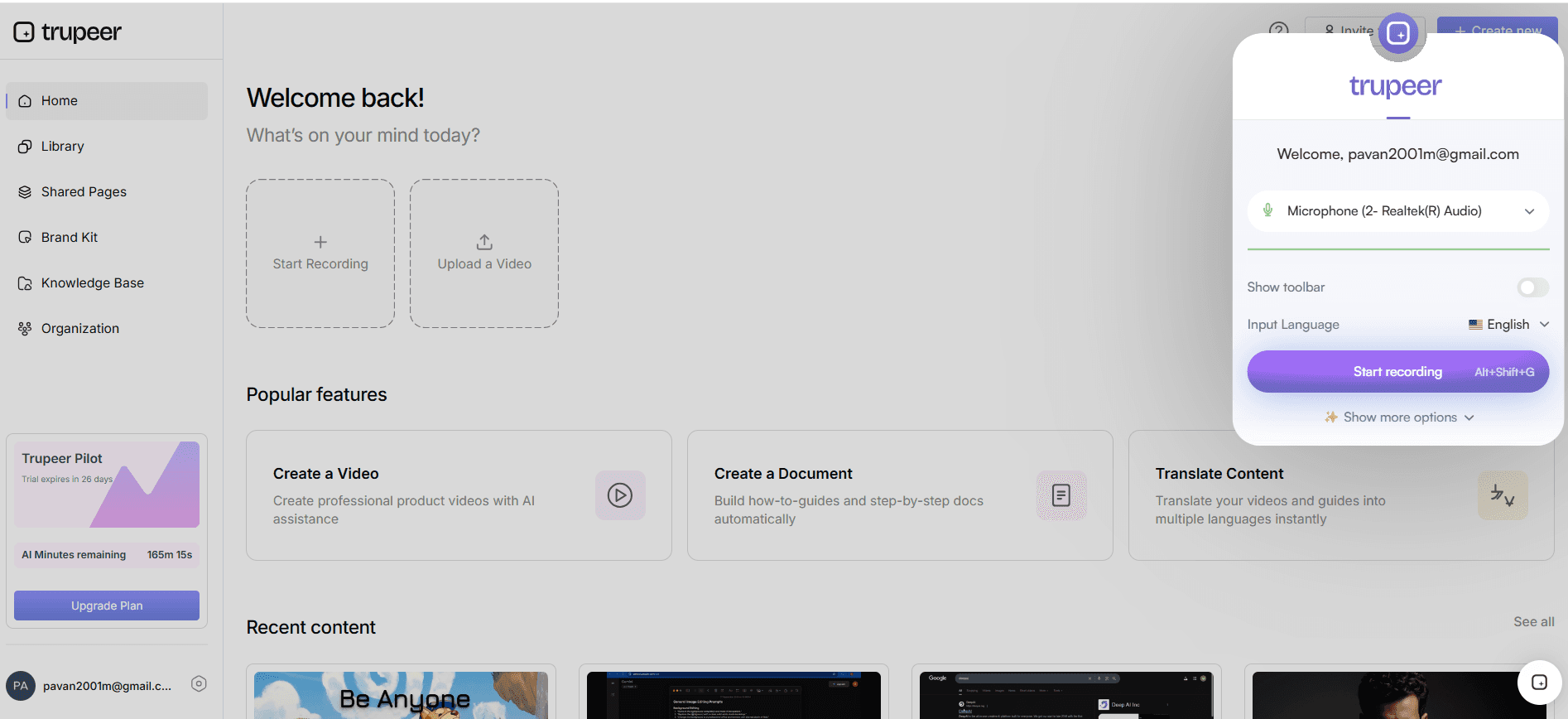
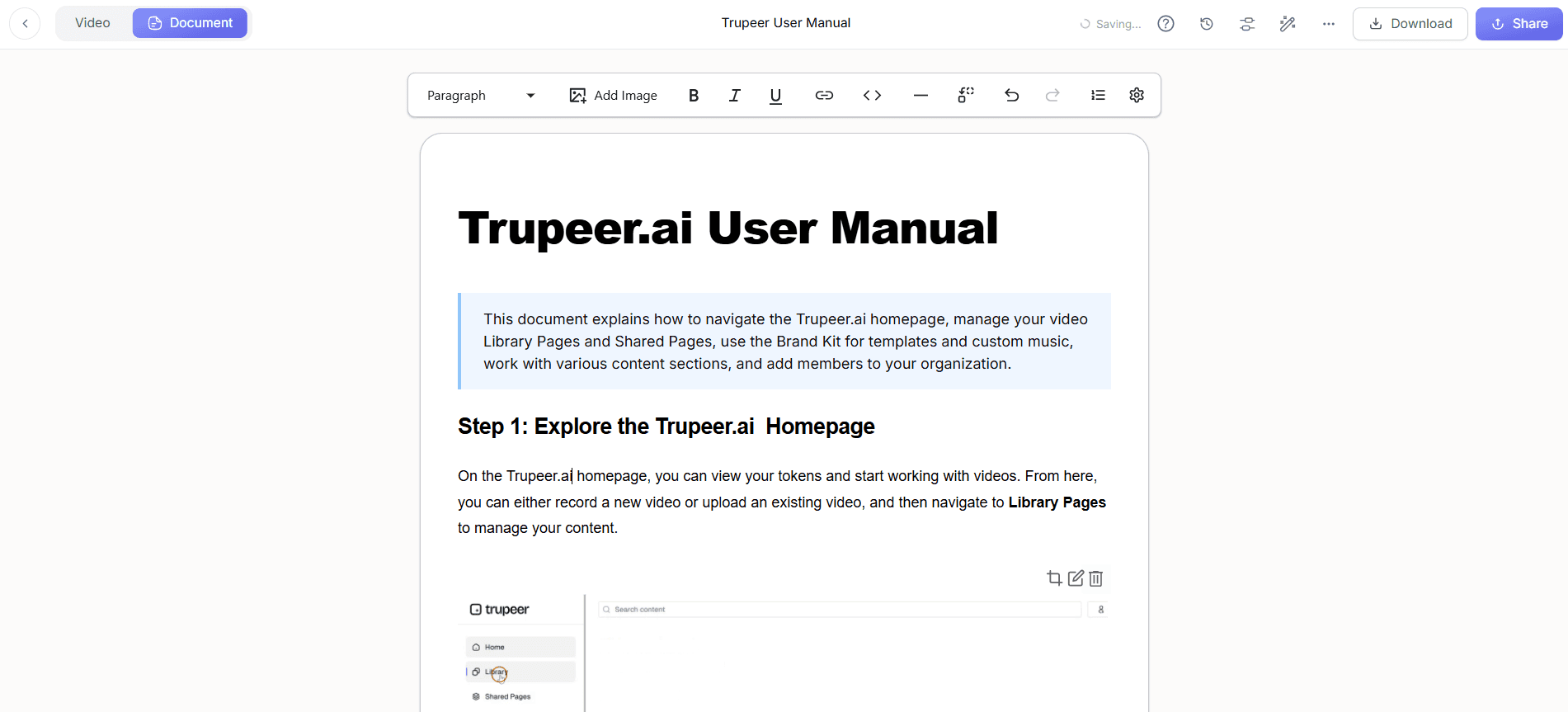
Trupeer turns the recording into a step-by-step SOP with captioned screenshots and a narrated video, ready for the receiving team to review.
Step 3: Review, translate and hand off
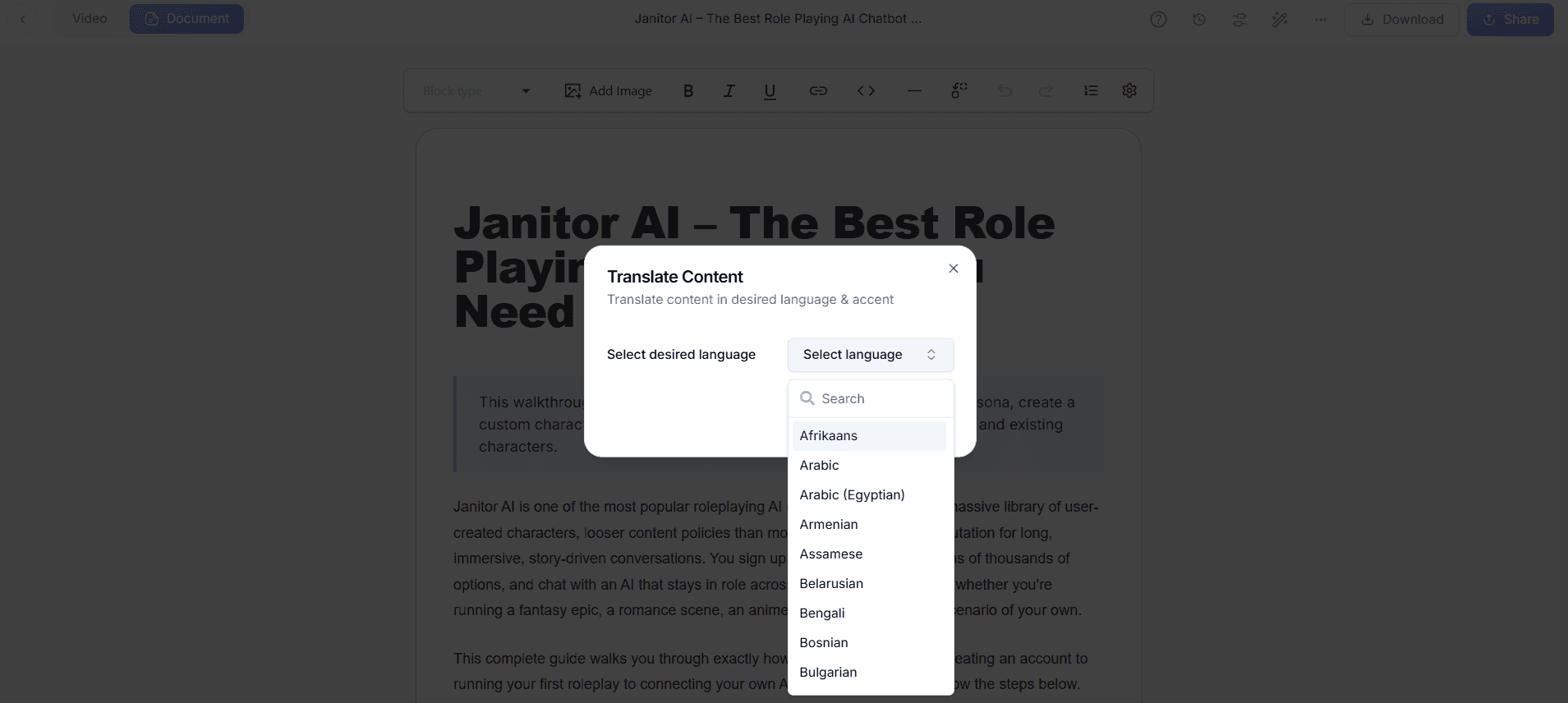
The receiving team reviews each SOP during shadowing, adds anything that was mentioned in passing and flags gaps. Translate the documentation for each delivery centre, publish it in one searchable library and use it as evidence at handover sign-off.
Documentation through each phase of a BPO transition
Phase | Documentation activity |
|---|---|
Planning | Build the process inventory and agree documentation standards |
Knowledge transfer | SMEs record each process; SOPs and videos are generated and reviewed |
Shadowing | Receiving team works alongside the SME using the SOPs, and notes gaps |
Reverse shadowing | Receiving team runs the process; SMEs check it against the SOPs |
Go-live and hypercare | SOPs are the reference for the floor; repeated questions become new guides |
Steady state | SOPs are updated as the process changes and used to onboard new agents |
Use the knowledge transfer plan generator to plan the KT phase.
Check readiness before each gate with the transition readiness assessment.
Why BPO providers and clients use a documentation tool
KT and documentation happen at once. The recording made during knowledge transfer becomes the draft SOP.
Exceptions are captured while the SME is still available, before the sending team rolls off.
Every delivery centre works from one master, in its own language, instead of local copies drifting apart.
Handover sign-off has evidence: documented, reviewed SOPs for every process in scope.
Attrition hurts less. New agents learn from the SOP and video, not another live shadowing session.
Clients keep visibility of how their processes are documented and run.
Scaling documentation across hundreds of processes
Large transitions cover hundreds of processes across several delivery centres. Documenting them by hand doesn't scale; recording them does. Teams record each process once, generate SOPs and short job aids, and index everything so agents can find the right guide in seconds. For how large providers do this, see how Genpact-style BPOs create job aids for 300+ processes using AI video tools.
For organising a large library so agents can find what they need, see the BPO knowledge base strategy for indexing 1,000 process videos.
Proof: Genpact
Genpact used Trupeer for a company-wide Workday rollout, turning recorded process sessions and SME walkthroughs into more than 500 training collaterals across 20 workstreams in five languages, for 140,000 employees in 40 countries, in 3 months instead of 12.
*"We needed to train 140,000 people across 40 countries on a completely new system. Trupeer gave us a way to actually get there."* Davetta Harper, VP Organisational Change Leader, Genpact
Read the Genpact customer story.
BPO transitions documentation tool vs transitions accelerator software
This tool focuses on one job: documenting the processes that move in a BPO transition. If you're looking to speed up the whole transition programme, including planning, readiness, waves and ramp, see Trupeer's transitions accelerator software.
Best practices for documenting a BPO transition
Record one process per session, end to end, so each SOP stays focused.
Narrate the why, including validations, decisions and what to do when something looks wrong.
Capture exceptions early, while the outgoing SMEs can still explain them.
Review with the receiving team during shadowing, and close every gap before reverse shadowing.
Keep one master per process, translated for each site, and update it when the process changes.
When comparing tools for large operations, see the best SOP software for large teams and BPO operations.
See it on your own transition
Planning a transition or struggling with KT documentation on one already underway? Book a demo and bring a recorded KT session.
Related templates and tools
Why Transition Teams Use Trupeer's BPO Transitions Documentation Tool
Documentation Built During KT
The recording made in the knowledge-transfer session becomes the draft SOP, so documentation and KT happen at once
One Master for Every Delivery Centre
Translate each SOP for every site from a single source, so offshore and nearshore teams follow the same procedure
Evidence for Handover Sign-Off
Reviewed SOPs, exceptions and videos for every process in scope give clients and providers proof of readiness
How to Document a BPO Transition with Trupeer
Step 1
Record the knowledge-transfer session
Step 2
Generate the SOP, screenshots and video
Step 3
Review, translate and hand off at sign-off
Frequently Asked Questions
What is a BPO transitions documentation tool?
It's a tool that helps outsourcing providers and their clients document processes as they move to a new delivery centre. SMEs record each process during knowledge transfer, and the tool turns each recording into an SOP with screenshots and video for the receiving team.
How do I document a process during a BPO transition?
Have the SME record the process during knowledge transfer, narrating checks, decisions and exceptions. Trupeer generates the SOP and video, the receiving team reviews it during shadowing, and the final version is used at handover sign-off.
What documentation does a BPO transition need?
A process inventory, SOPs and desk procedures, an exception and escalation guide, system access lists, SLA and quality standards, shadow and reverse-shadow evidence, and a handover sign-off.
Can the documentation be used across several delivery centres?
Yes. Each SOP is translated from a single master, so every site follows the same procedure in its own language, and updates reach all sites together.
How is this different from transitions accelerator software?
This tool focuses on documenting the processes that move. Transitions accelerator software covers speeding up the whole transition programme, including planning, readiness and ramp.
More Tools