Use this template
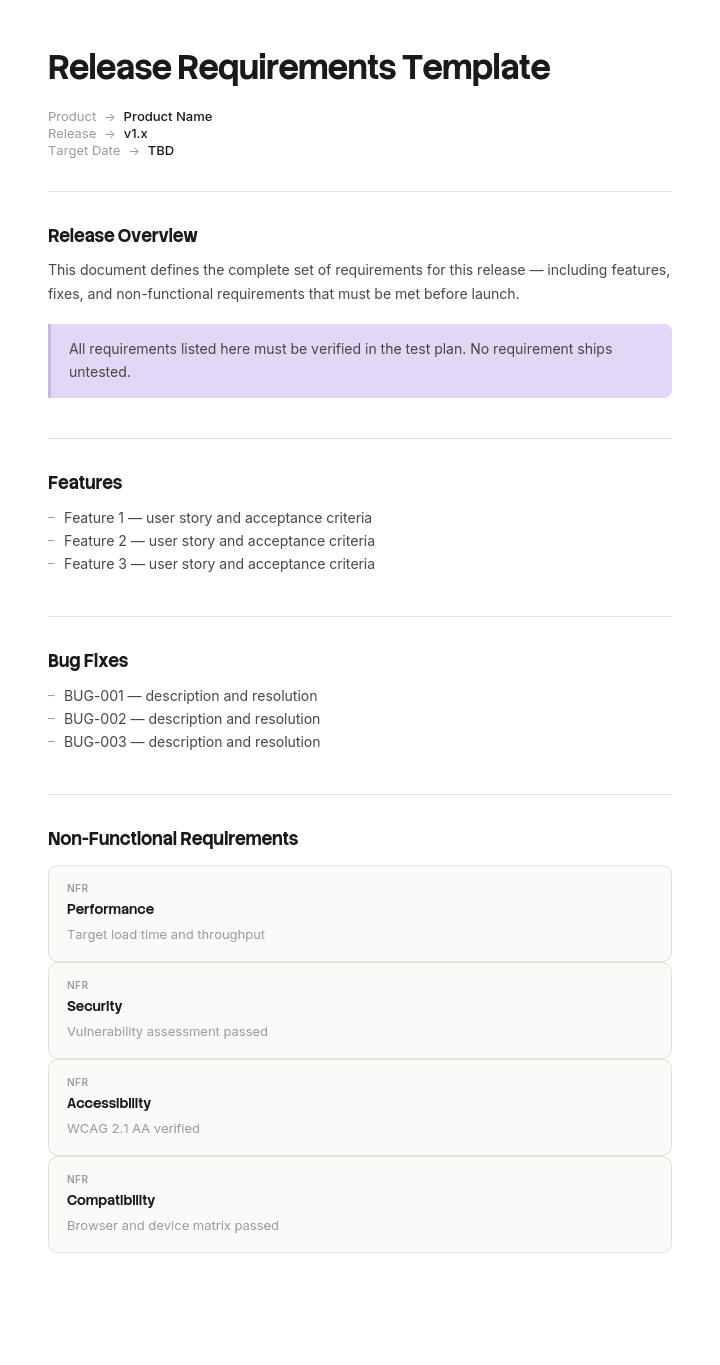
A great release plan is what turns code-complete into customer-impact. With Trupeer, you can save hours on release planning by starting with a free release requirements template, customizing it with your brand guidelines, and turning release plans into video updates that align engineering, QA, support and customers.
What is a free release requirements template?
A free release requirements template is a reusable structure for stating everything that must be true before a specific release can go out.
The phrase everything that must be true is doing deliberate work there. Most documents of this kind list what the product has to do, and stop. That is a feature specification. A release requirement is broader: it is any condition whose absence should stop the release, and a large proportion of those conditions have nothing to do with the code.
The template is not the requirements. It gives you a table, which takes minutes to build. What determines whether a release goes well is whether anyone thought to write down that support needs training, that the billing report needs a new column, or that the rollback has never actually been run.
Format follows use. A free release requirements template Excel file suits the requirement table, which is the bulk of the document and is genuinely tabular. A free release requirements template Word version suits the narrative sections, the scope statement and the sign off. A free release requirements template PDF is the version attached to the release record.
Release requirements are not product requirements
Worth separating clearly, because the two get merged and the merge is what causes the omission.
Product requirements describe what the thing does. Written before or during development, owned by product, and answering the question of what we are building. A product requirements document or a business requirements document covers this ground, and both are written once per product area rather than once per release.
Release requirements describe what must be true for this specific release to ship. Written before the release, owned by whoever is accountable for it, and answering the question of whether we can go. They include the product requirements for whatever is in this release, and they include a great deal else.
The distinction matters because the two documents have different failure modes. A product requirements document fails by being ambiguous, so the wrong thing gets built. A release requirements document fails by being incomplete, so the right thing ships into an organisation that is not ready for it.
If you are looking for the first of those, you want a requirements document rather than this one. If you are about to ship something, read on.
How to customize this template in Trupeer
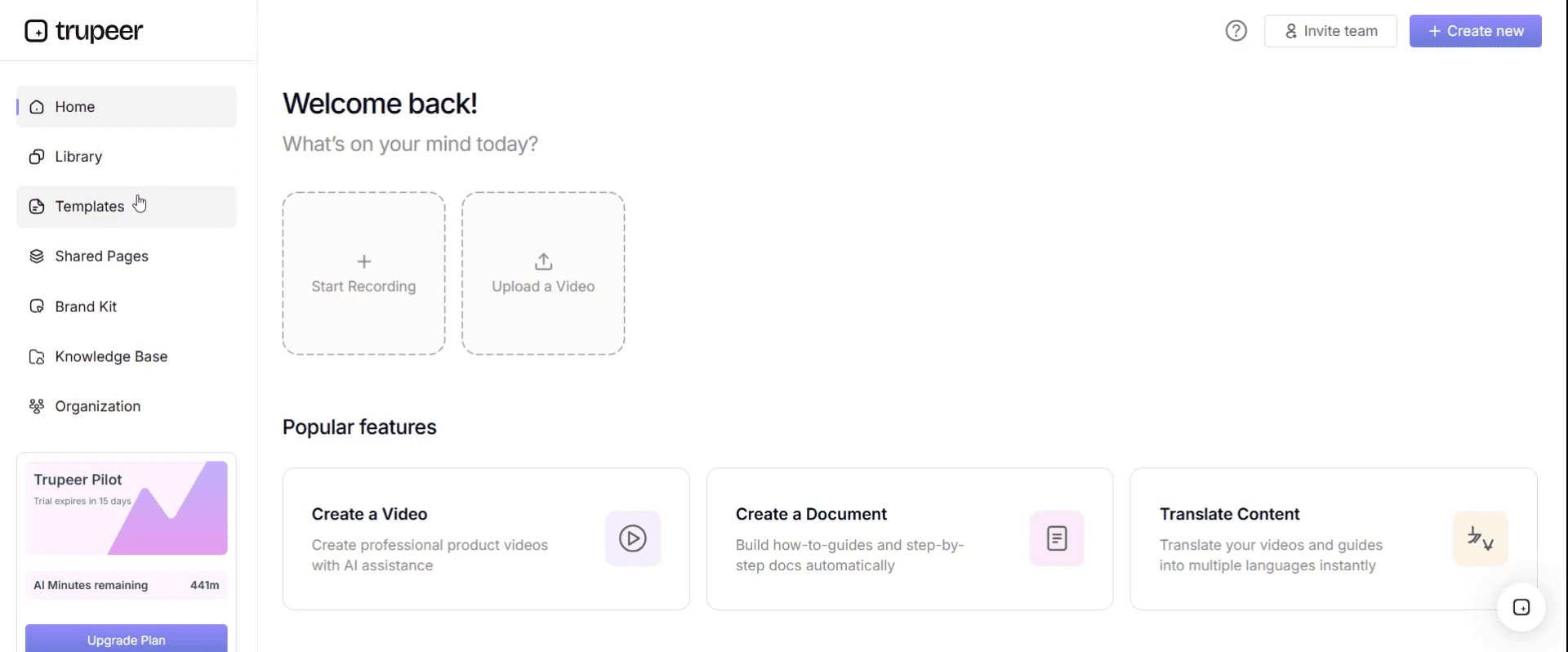
Step 1: Open the Templates Section
Go to the Templates section from the main navigation.
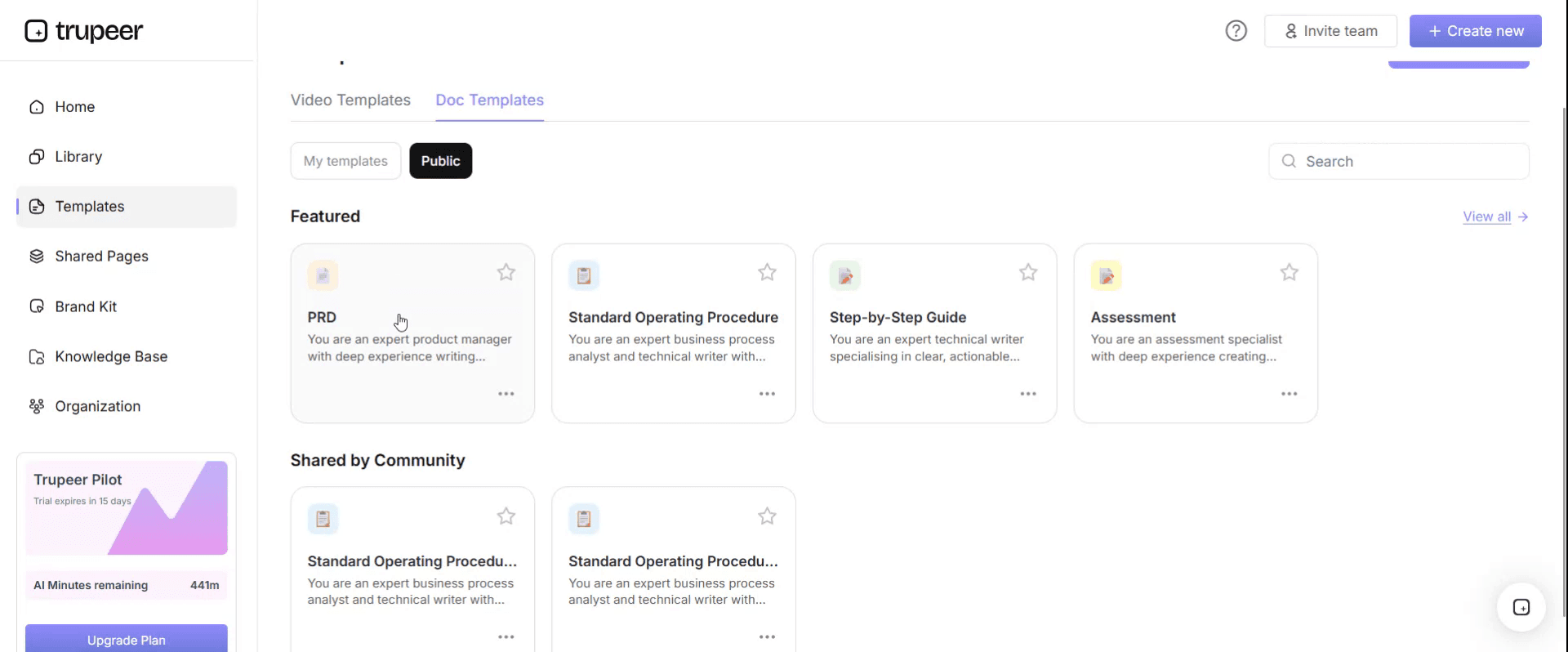
Step 2: Select and Open a Template
Click on any template you want to work with to open it.
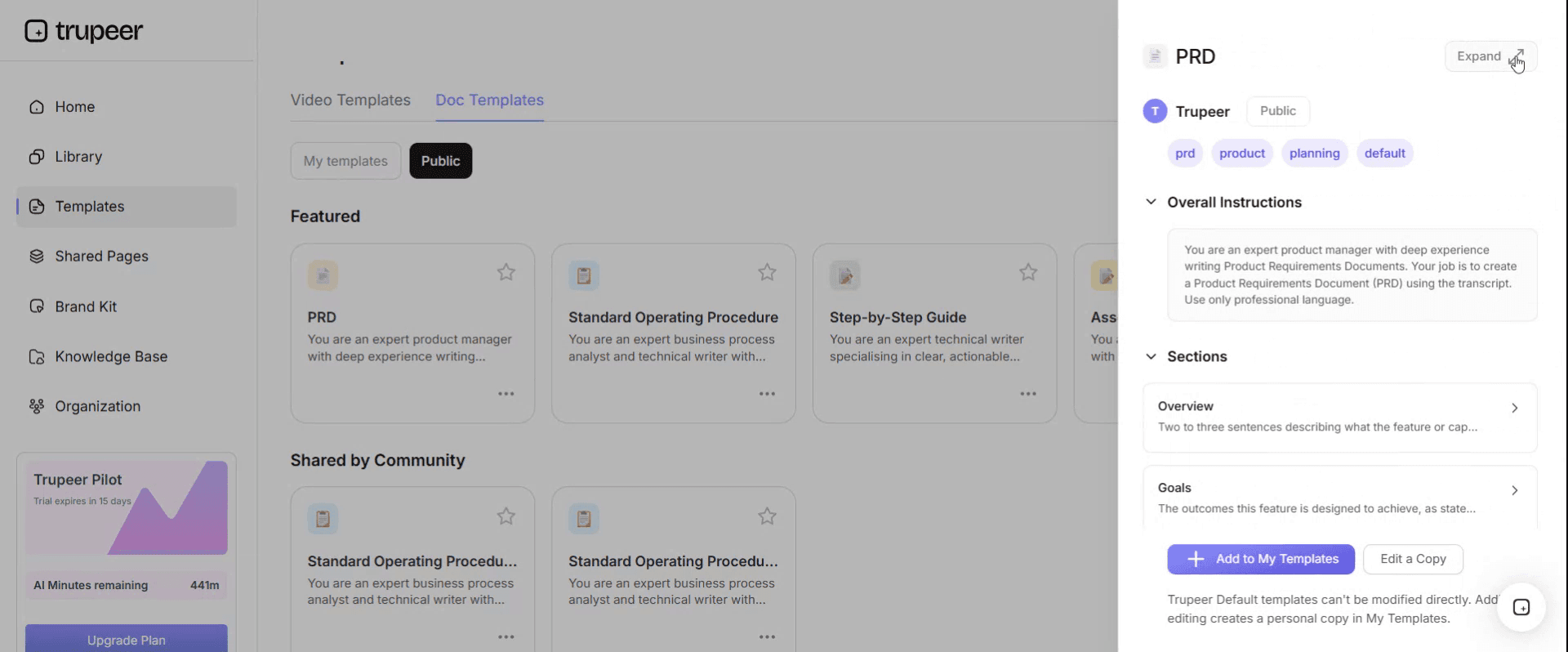
Step 3: Expand the Template View
If needed, expand the template view to see the full layout and details clearly.
Step 4: Edit the Template
Click on Edit to start modifying the selected template.
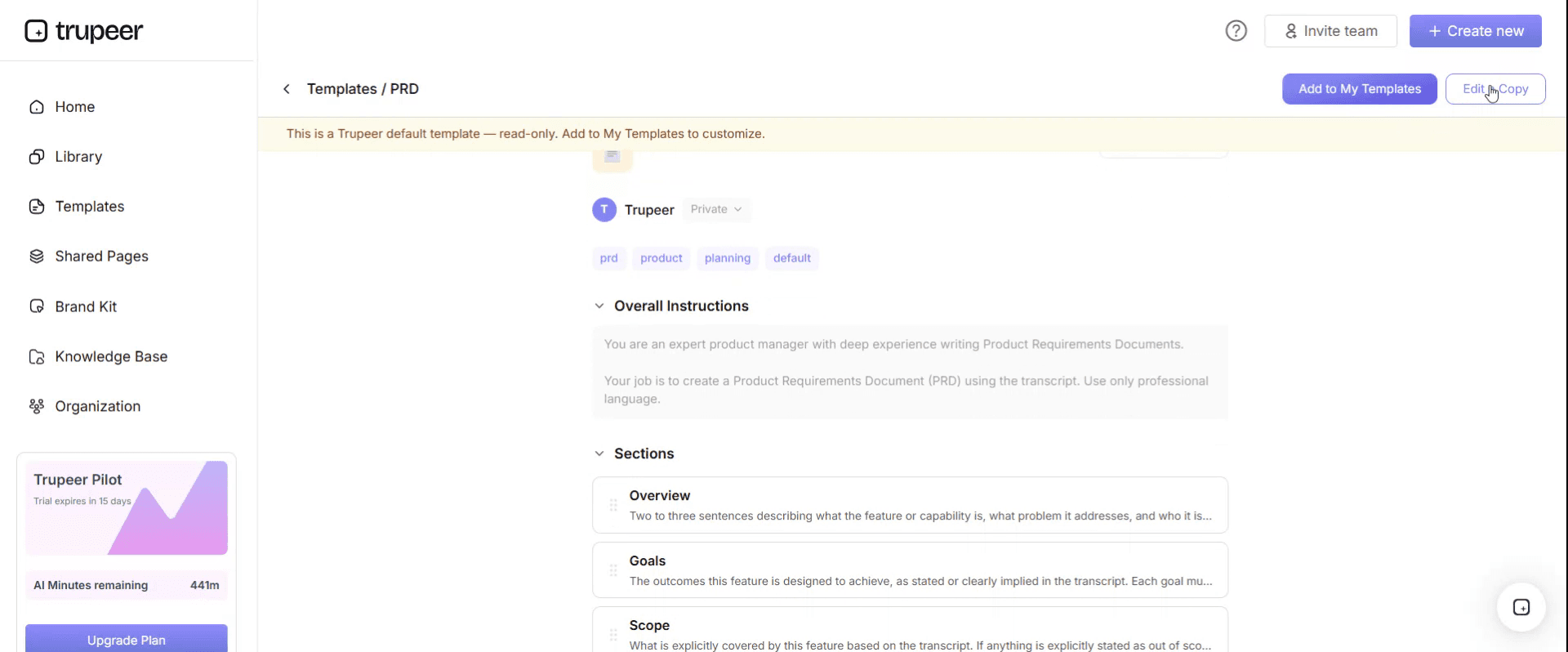
Within the editor, you can:
Add new sections
Define or update formatting rules
Add a logo and adjust its position and related settings
Step 5: Save Your Customized Template
After making all necessary changes, click Save to store the updated template as your own.
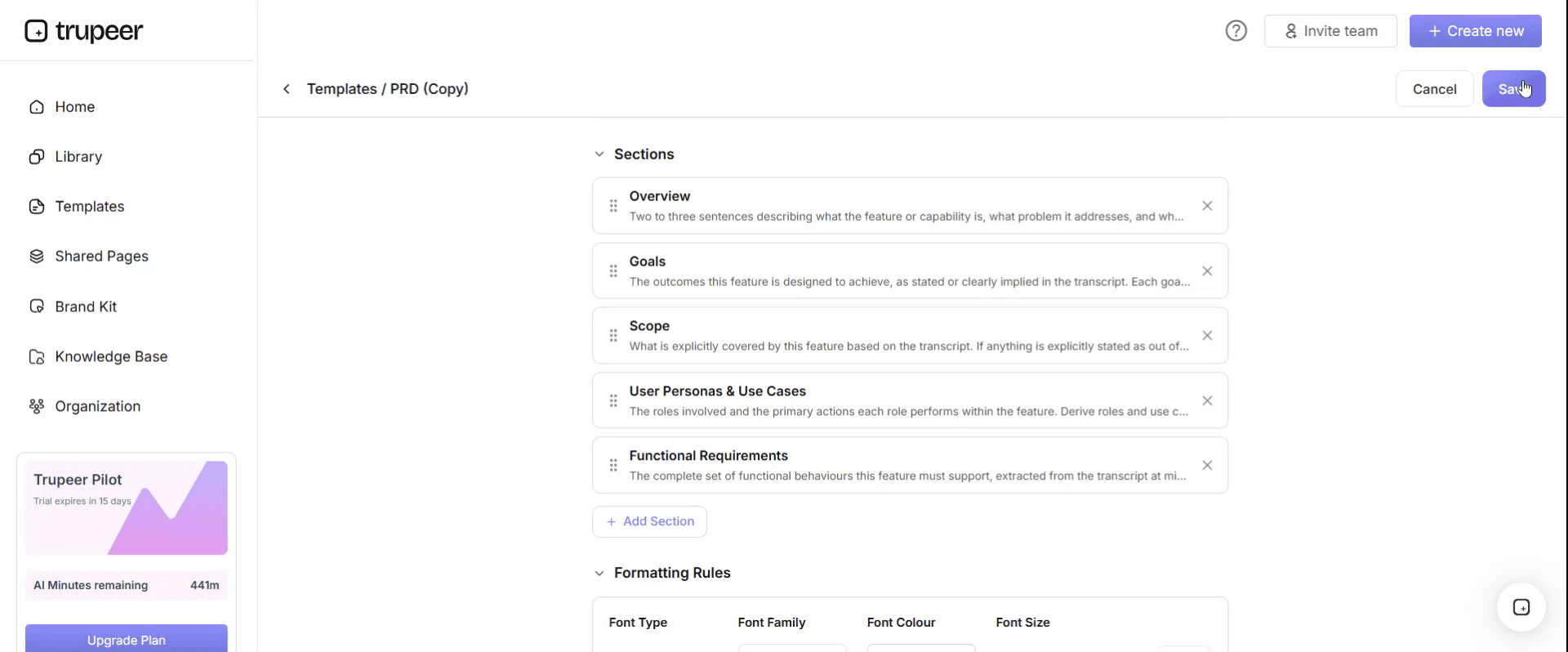
Step 6: Preview and Fine-Tune the Template
When you want to see how your customized template looks, open the Preview.
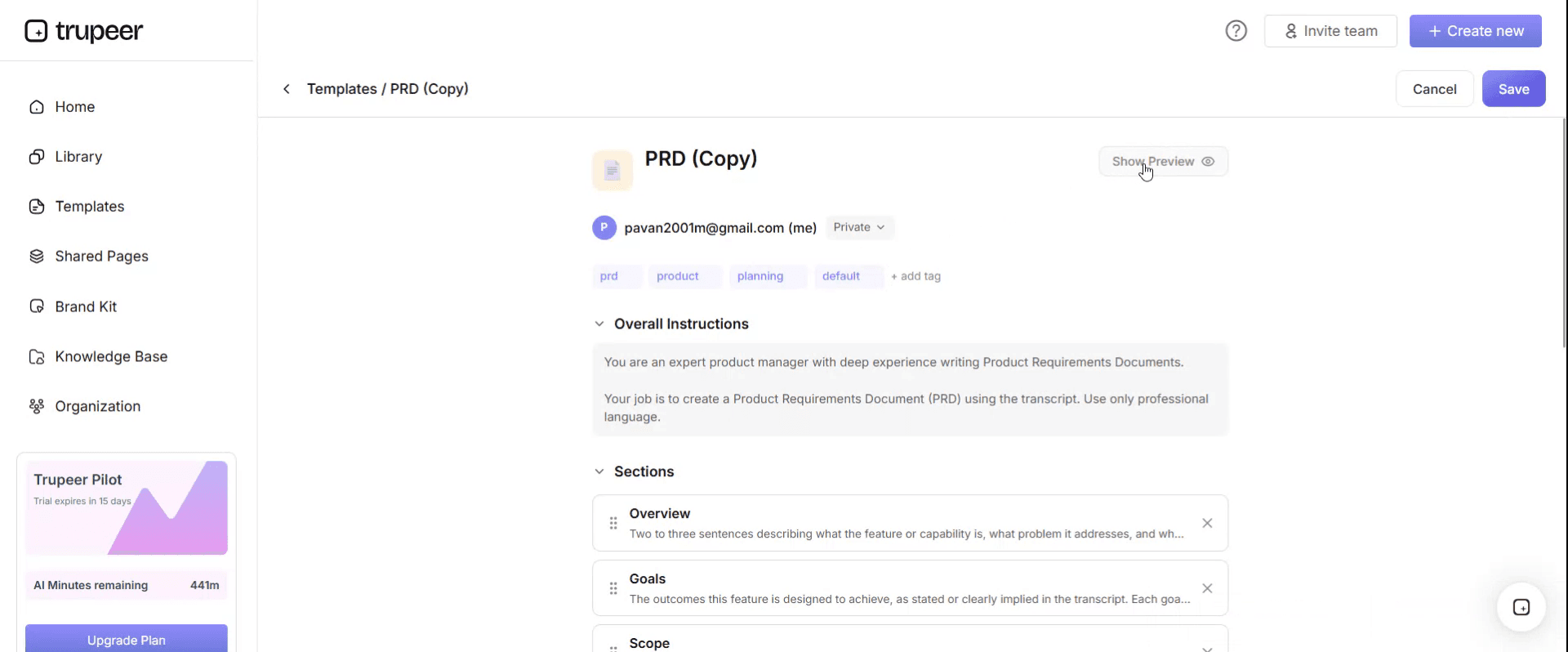
From the preview screen, you can continue to make adjustments directly if needed, ensuring the template appears exactly as you want.
With a release requirements template you can:
Save hours on planning: Skip the blank page with a structure built for releases.
Reduce release risk: Built-in sections for testing, rollback and dependencies.
Stay on-brand: Apply your logo, fonts and colors using Trupeer's brand kit.
Communicate releases clearly: Convert plans into video updates for cross-functional teams.
Standardize across releases: Use the same template for every release.
Reach global teams: Translate release plans into 65+ languages with one click.
The requirements that block a release are usually not about the product
Take the last release that went badly in your organisation and ask what actually went wrong.
In most cases the software worked. What failed was something adjacent. Support did not know the feature existed. The help centre still described the old behaviour. The pricing was not configured in the billing system. The sales team could not quote it. The migration ran but nobody had tested the rollback. Legal had not reviewed the terms change. The email announcing it went to the wrong segment.
Every one of those is a release requirement. None of them is a product requirement, and none of them will appear in a document written by the people who built the feature, because each belongs to somebody else.
That is the structural cause. Product requirements are written by product and engineering, who are competent and thorough within their own domain and have no visibility of the billing reconciliation report. So the document is complete with respect to the thing being built and silent with respect to the organisation receiving it.
The correction is to split the document in two and give the second half equal weight. Product requirements: what it must do. Readiness requirements: what must be true elsewhere before it can go out. In a mature release the second list is usually longer than the first, which surprises people the first time they write it.
What a release requirements template must contain
Eight components. The readiness section is the one that separates this document from a feature list.
Component | What it does |
|---|---|
Release identity | What is being released, version, target date, and what is explicitly not in it. |
Product requirements | What the release must do, each stated so that it can be verified rather than debated. |
Readiness requirements | What must be true elsewhere. Support, documentation, billing, sales, legal, operations, comms. |
Owner per requirement | One name each, and for readiness requirements that name is usually outside engineering. |
Verification method | How each requirement is confirmed met. A test, a demonstration, a document, a sign off. |
Blocking or not | Whether the release stops without it. Decided in advance rather than at the go or no go meeting. |
Rollback | What happens if it goes wrong, who decides, and confirmation that the rollback has been performed rather than documented. |
Sign off | Who can authorise release, and what evidence they are signing against. |
The blocking column is the one that changes behaviour. Marking requirements as blocking or non blocking in advance forces the argument to happen a week early, when it is a discussion, rather than at the go or no go meeting, when it is a negotiation under time pressure with everyone already committed to the date.
Free release requirements template: the structure to copy
Filled with a real example rather than placeholders. The release introduces a new usage based pricing tier in a business software product.
Copy from here.
Release identity. Name, version, target date, and explicit exclusions.
Usage based tier. Release 4.9. Target 14 October. Not included: migration of existing customers onto the new tier, which follows in 4.10, and the self service upgrade flow, which is deferred.
Product requirements.
# | Requirement | Owner | Verified by | Blocking |
|---|---|---|---|---|
P1 | New tier selectable at signup with correct limits applied | A Bellamy | Automated test suite plus manual check in staging | Yes |
P2 | Usage metered hourly and visible to the customer within one hour | A Bellamy | Metering test, twenty four hour soak in staging | Yes |
P3 | Overage calculated and displayed before it is charged | A Bellamy | Manual test against five sample accounts | Yes |
P4 | Existing customers see no change to their plan or billing | A Bellamy | Regression suite plus check of one hundred live accounts in staging | Yes |
Readiness requirements. The half that gets left out.
# | Requirement | Owner | Verified by | Blocking |
|---|---|---|---|---|
R1 | Billing reconciliation report includes the new tier as a category | S Achebe, Finance | Report run against staging data and checked | Yes |
R2 | Pricing configured in the billing system and reconciled with the published price | S Achebe, Finance | Two person check against the pricing page | Yes |
R3 | Support macros and help centre articles updated | D Yilmaz, Support | Six articles published, four macros live | Yes |
R4 | Support team briefed, with the top ten expected questions answered | D Yilmaz, Support | Session held, attendance recorded | Yes |
R5 | Sales quoting tool produces a correct quote for the new tier | M Rowntree, Sales | Three test quotes reviewed | Yes |
R6 | Terms of service change reviewed and published | Legal | Written confirmation | Yes |
R7 | Customer announcement drafted, segmented and scheduled | Marketing | Draft approved, send list checked | No |
R8 | Internal announcement to all staff | Marketing | Scheduled | No |
Eight readiness requirements against four product requirements. That ratio is normal and is the point of the document.
Rollback. What happens if it goes wrong.
Feature flag disables the new tier at signup within five minutes, leaving existing signups unaffected. Metering continues to record but no charge is applied. Rollback performed in staging on 7 October by A Bellamy, not merely documented. Decision to roll back sits with the on call engineering lead without needing approval.
Sign off. Release authorised by the product lead and the support lead jointly, against the completed table with every blocking requirement marked verified. No verbal confirmations.
Copy to here.
Release requirements example: thirty four requirements met and nine hundred tickets
Merrivale Software, a business software company with around four thousand customers, released a new usage based pricing tier.
The release requirements document listed thirty four requirements. Every one was functional, every one was met, every one was tested, and the release shipped on the target date. By the standard the team was measuring itself against, it went perfectly.
Support ticket volume in the first week was nine hundred, against a normal baseline of about two hundred and ten.
Three things had been left out of the document, and all three belonged to somebody outside the team that wrote it.
The help centre still described the old plans, so support answered questions using material that was wrong, confidently, for four days.
The billing reconciliation report had no category for the new tier, so forty one customers were invoiced on their old rate for two months before anyone noticed. Sixty two thousand pounds under billed, and recovering it from customers who had already been told what they owed was an unpleasant conversation that damaged several accounts.
The sales quoting tool could not produce a quote for the new tier, so eleven deals were sold on manually built quotes containing three different structures, two of which did not match what the product actually did.
The review found that nobody had made a mistake in the ordinary sense. The document had been written by product and engineering, thoroughly, about the thing they were building. Nobody in that room knew the reconciliation report existed.
What Merrivale changed was the shape of the document rather than its rigour. Two sections instead of one. Product requirements and readiness requirements. And one rule: a readiness requirement is not complete until it has a named owner outside engineering who has agreed to it.
The next release had nineteen product requirements and twenty three readiness requirements. Ticket volume in release week was two hundred and forty against the baseline of two hundred and ten.
The second list took about ninety minutes to write, in a meeting that included support, finance and sales. That is the entire intervention.
How to write release requirements in six steps
State what is in the release and what is not. Exclusions prevent the most common argument at sign off, which is about something everyone assumed was included.
Write the product requirements so each can be verified. Covered in the next section.
Get the readiness requirements from the people who own them. Not by imagining what they might need. Put support, finance, sales, legal and operations in a room for ninety minutes and ask what breaks for them if this ships.
Give every requirement a named owner and a verification method. An unverified requirement is an intention.
Mark blocking or non blocking now. Doing this in advance converts a negotiation into a decision.
Test the rollback rather than documenting it. A rollback plan that has never been executed is a hypothesis, and release night is a poor time to test one.
Step three is the whole exercise, and ninety minutes is genuinely enough for most releases. The people who own readiness requirements know what they are without preparation, because they are the ones who suffer when they are missing.
How to write a requirement that can be verified
Most requirement defects are not omissions but ambiguities, and they share a small number of shapes.
Adjectives of degree. Fast, intuitive, reliable, scalable. These are ratings without a scale. Replace with a number and a condition: responds within two seconds at fifty concurrent users.
Passive obligations with no actor. The report should be updated. By whom, and how will anyone know it happened. Every requirement names an owner.
Compound requirements. Anything containing "and" is usually two requirements that will be half met. Split them, because a single line cannot be half verified.
Requirements phrased as solutions. Add a dropdown to the settings page. That specifies an implementation and hides the actual requirement, which is that the user must be able to change something. Solutions belong in design, not in requirements, unless the solution genuinely is the requirement for a reason worth stating.
The practical test is to read each line and ask what evidence would settle a disagreement about whether it is met. If you cannot name that evidence in a sentence, the requirement is not finished.
Release requirements template variants
The structure holds and the readiness list changes considerably.
Software release. The example above. Readiness is dominated by support, documentation, billing and comms, and the most commonly missed item is anything touching money.
Mobile app release. Adds app store review timelines, which are external and unpredictable, plus the fact that users on old versions persist for months. Backwards compatibility becomes a requirement rather than a courtesy.
Hardware or physical product release. Adds manufacturing readiness, packaging, spares, distribution and returns handling. Lead times mean readiness requirements have to be met far earlier than in software.
Regulated release. Medical devices, financial products, pharmaceuticals, safety critical systems. Content and evidence are frequently mandated, sign off authority is defined externally, and records must survive audit. Nothing on this page substitutes for the applicable standard, and any release in a regulated sector should be run under your quality system with qualified review.
Marketing or campaign launch. The product half shrinks and readiness expands. Assets, legal review, channel scheduling, tracking, and the ability of whoever answers the phone to speak about it.
Internal system release. Readiness is almost entirely training, access and support routes, and the temptation to skip it is strongest because the audience is colleagues rather than customers. Internal releases produce a disproportionate share of avoidable disruption for exactly this reason.
Release requirements, PRD, BRD or requirements document?
These get searched interchangeably and cover different ground, so it is worth naming which one you need before adopting a template.
A business requirements document states what the business needs and why, in business terms. Written early, owned by the business side, and largely free of implementation detail.
A product requirements document states what the product must do to meet those needs. Owned by product, written per product area or per initiative.
A functional or software requirements specification states behaviour in detail sufficient to build and test against. Owned by engineering or business analysis.
Requirements gathering is the activity that produces the first three. A requirements gathering template Excel free download is a collection instrument, useful for capturing and categorising input from stakeholders, and it is not a release document.
Release requirements are the shipping gate. They draw on all of the above for whatever is in this release, and they add the readiness half that none of the others cover.
Search results for release requirements will mostly return the other four, because the term is less established. If what you actually need is a specification of behaviour, use a requirements document template Word file and work from that tradition. If you need to decide whether you can ship, this page is the right one. Scope boundaries for the wider piece of work sit in the project scope.
Who signs off a release and what done means
Two signatures, not one, and they should represent different interests.
The first is whoever is accountable for the product working. The second is whoever is accountable for the organisation coping with it, which is usually support or operations. A release authorised only by the people who built it has no independent check on readiness, which is precisely the gap the readiness section exists to close.
Sign off is against evidence rather than against confidence. Every blocking requirement marked verified, with the verification method recorded. A requirement marked done by the person responsible for it, with nothing attached, is a self report.
Run the meeting from the requirement table itself, or from a free release requirements template PowerPoint view generated out of it, never from a separately maintained deck. Hold it early enough that a no is actionable. A meeting held the afternoon before release can only approve, because by then the cost of stopping is higher than the cost of most problems. Two working days is usually enough to make a genuine decision possible.
Quality gates and test evidence sit alongside this in the QA plan, which covers how the verification itself is assured.
What a free release requirements template cannot fix
A team that has never asked other functions what they need. The template provides a section. Filling it requires a conversation, and no free release requirements template free download will have that conversation for you.
A date that cannot move. If the release is going out regardless, the requirements document becomes a record rather than a gate. That is a legitimate choice occasionally and should be stated rather than pretended otherwise.
A template that only covers the product half. Every free release requirements template Word free download I have seen does exactly this, so plan to add the readiness section yourself.
Sign off with no authority to say no. A gate that has never stopped anything is not a gate.
Documentation that does not exist. Support briefing and help centre updates are the readiness requirements most often marked non blocking, not because they do not matter but because producing them is expensive. That is a cost problem rather than a priority problem, and it is addressed below.
Show the change rather than describing it
Two readiness requirements appear on almost every release list and are almost always the ones that slip: documentation updated, and support briefed.
They slip for a practical reason rather than a cultural one. Writing a help centre article for a changed flow, capturing the screenshots, updating them again when the design shifts before launch, and then briefing a support team is several days of work, landing in the week when everyone is busiest. So it gets marked non blocking, and the release ships with support answering from material that describes the old behaviour.
Trupeer AI changes the cost of that. Somebody walks through the new flow once while recording, and the output is a written article with screenshots already captured and placed, alongside a video, in your own branding. The article goes into the help centre. The video is the support briefing. Both are produced in the time it previously took to gather the screenshots.
Record it. Brand it. Translate it. Trupeer it.
Two consequences matter for releases specifically. When the flow changes late, which it does, re-recording is faster than editing, so the documentation can be regenerated rather than abandoned. And where you support customers in several languages, the same recording produces the same article in each, so a release does not go out documented in one language and unsupported in the others.
The material sits in your knowledge base and doubles as training for support and sales. Once documentation is cheap enough to produce inside a release cycle, it can be marked blocking, which is where it belongs. Consistency with your other documents is a matter of setting the brand kit once, and setup is covered in the document template setup guide.
Frequently Asked Questions
Is there a free release requirements template Excel version?
Excel suits this document better than most, because the core of it is a table with an owner, a verification method and a blocking flag per row, and you will want to filter it.
Build the free release requirements template Excel file with product and readiness requirements as one table with a type column rather than two sheets. Keeping them in one place is what makes the ratio visible, and the ratio is the most informative thing on the page.
Is there a free release requirements template Word version?
Word suits the surrounding narrative: what is in the release, what is excluded, the rollback plan and the sign off. Build the free release requirements template Word file with the requirement tables embedded and keep the exclusions on the first page.
If the requirement list is long, keep it in a spreadsheet and reference it from the document rather than maintaining two copies. The document is what people read and the spreadsheet is what they work from.
Is there a free release requirements template Word free download?
What a free release requirements template Word free download gives you is a section list, and it will almost certainly contain only the product half. Almost every published template treats requirements as feature specification.
Add the readiness section by hand. Support, documentation, billing, sales, legal, operations and comms, each with a named owner outside the delivery team. That addition takes ten minutes and is the difference between a feature list and a release gate.
Is there a requirements document template Word version?
Yes, and it is a different document from this one. A requirements document template Word file specifies what a product or system must do, in enough detail to build and test against, and it is written per initiative rather than per release.
Use one if you are defining behaviour. Use a release requirements document if you are deciding whether you can ship. The second draws on the first and adds everything the first does not cover.
Where can I find a requirements gathering template Excel free download?
Requirements gathering is the activity of collecting needs from stakeholders, and a requirements gathering template Excel free download is a capture instrument: source, stakeholder, need, priority, status.
It is genuinely useful at the start of a piece of work and it is not a release document. If you are gathering, use one. If you are about to ship, you need the verification and readiness columns instead, which gathering templates do not have.
Is there a free release requirements template PDF?
PDF is the signed and archived version. Once every blocking requirement is verified and the release is authorised, export a free release requirements template PDF with the sign off names and date, and attach it to the release record.
This matters more than it does for most documents, because the question of what was agreed before a release is asked far more often after a release goes wrong than before.
Is there a free release requirements template PowerPoint version?
Slides suit the go or no go meeting rather than the document. A free release requirements template PowerPoint deck showing blocking requirements, their status and the outstanding items is a good way to run a fifteen minute decision.
Generate it from the table rather than maintaining it separately. A deck that has drifted from the requirement list is worse than no deck, because it is the version people remember.
Is there a free release requirements template free download worth using?
The table structure is worth about ten minutes to build yourself, which is less time than evaluating a free release requirements template free download.
If you do adopt one, check two things. Whether it has a place for requirements owned outside the delivery team, and whether it distinguishes blocking from non blocking. Almost no published template has either, and those two columns carry most of the value.