
Use this template
A solid test plan is what stops bugs from reaching production. With Trupeer, you can save hours on test planning by starting with a free test plan template, customizing it with your brand guidelines, and turning test plans into video walkthroughs that align engineering, product and QA.
What is a free test plan template?
A free test plan template is a reusable structure for the document that says what will be tested on a particular release or project, in which environments, by whom, to what schedule, and how you will know testing is finished.
The section list is standard and uncontroversial. Scope, approach, environments, resources, schedule, entry criteria, exit criteria, risks, deliverables. Every published template has it and it has been broadly stable since the ISO and IEEE traditions established it decades ago.
The template is not where test plans fail. They fail at one specific moment, months after the plan was approved, and the failure is always the same shape.
Format follows use. A free test plan template Word file suits the plan itself, which is prose that gets reviewed and agreed, and for a small release a simple test plan template Word layout of one or two pages is enough. A free test plan template Excel version suits the schedule, the coverage matrix and the resourcing. A free test plan template PDF is the approved copy attached to the release record, and a test plan document sample PDF from a published source is the best way to see one done properly.
Test plans are read once and argued about later
A test plan is written weeks before testing starts, when nobody is under pressure. It is reviewed calmly, agreed, and filed.
It is then read again on exactly one occasion: the day somebody wants to ship and the testing is not finished.
At that moment everybody in the room is invested. The date has been communicated. Customers are expecting it. Marketing has scheduled something. The engineering team has been working towards this for weeks and would like it to be over. And somebody opens the test plan, reads the exit criteria, and discovers they do not settle anything.
All high priority defects resolved. Regression suite passed. UAT sign off obtained.
Each of those sounds firm and none of them holds under pressure, for reasons covered in the next section. So the decision gets made the way it was always going to be made, by whoever is most senior and most invested, and the test plan provides a document to point at rather than a constraint.
The whole value of writing a test plan in advance is that decisions made calmly are better than decisions made at nine in the evening on a Thursday. That value is only realised if the decisions were actually made, and in most plans they were only described.
How to customize this template in Trupeer
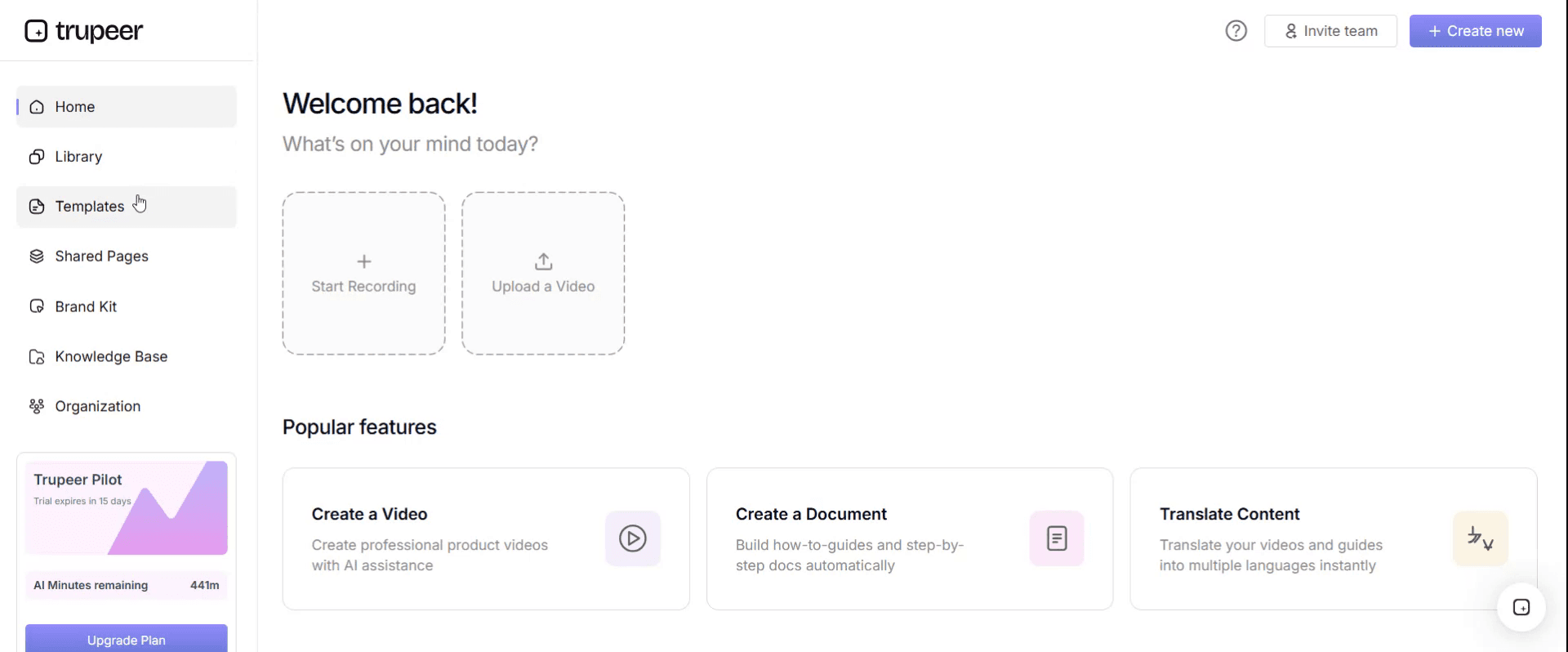
Step 1: Open the Templates Section
Go to the Templates section from the main navigation.
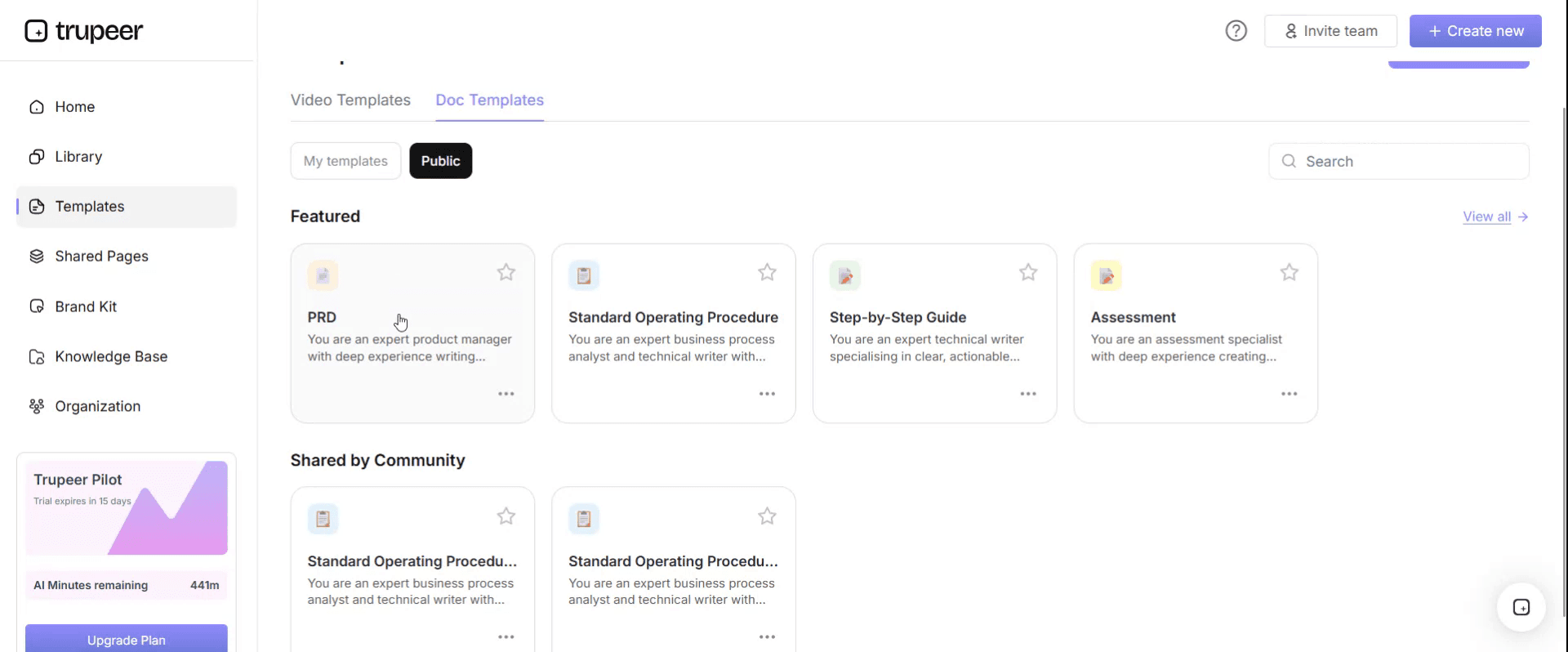
Step 2: Select and Open a Template
Click on any template you want to work with to open it.
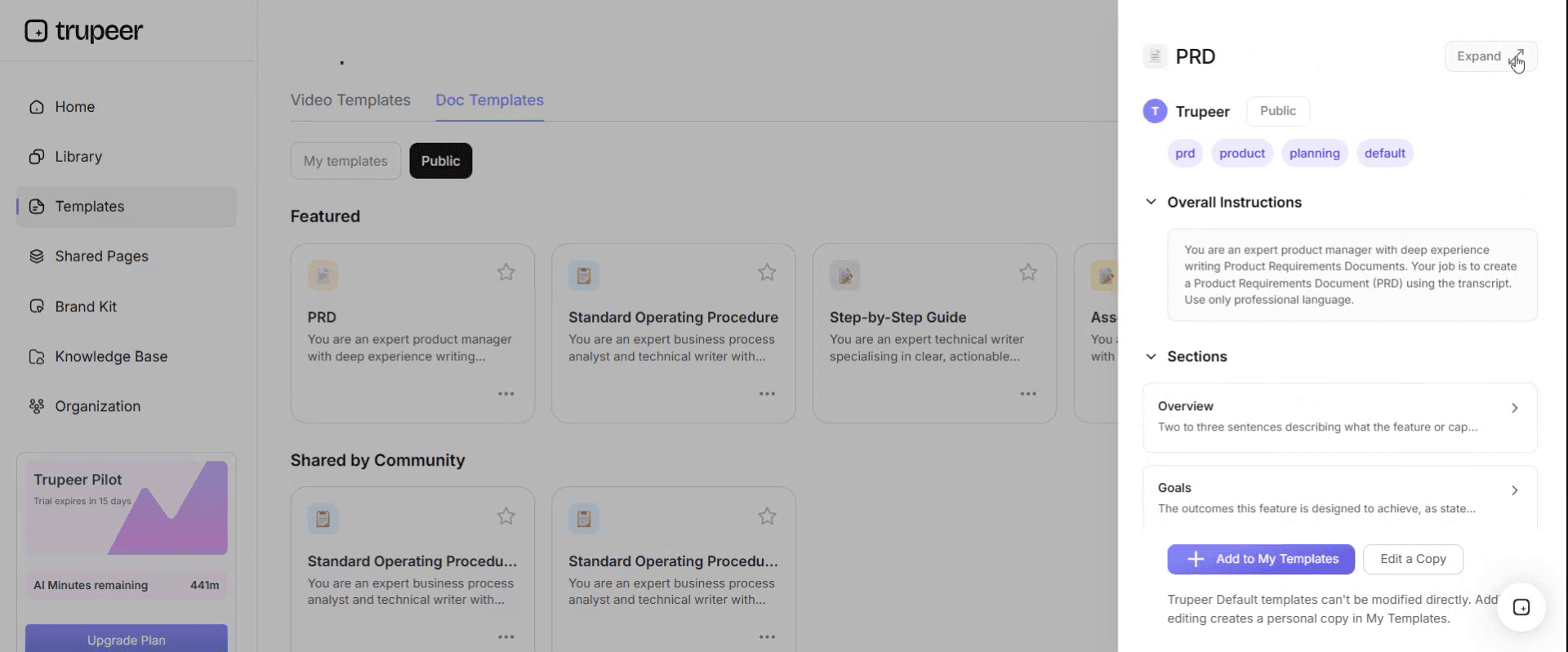
Step 3: Expand the Template View
If needed, expand the template view to see the full layout and details clearly.
Step 4: Edit the Template
Click on Edit to start modifying the selected template.
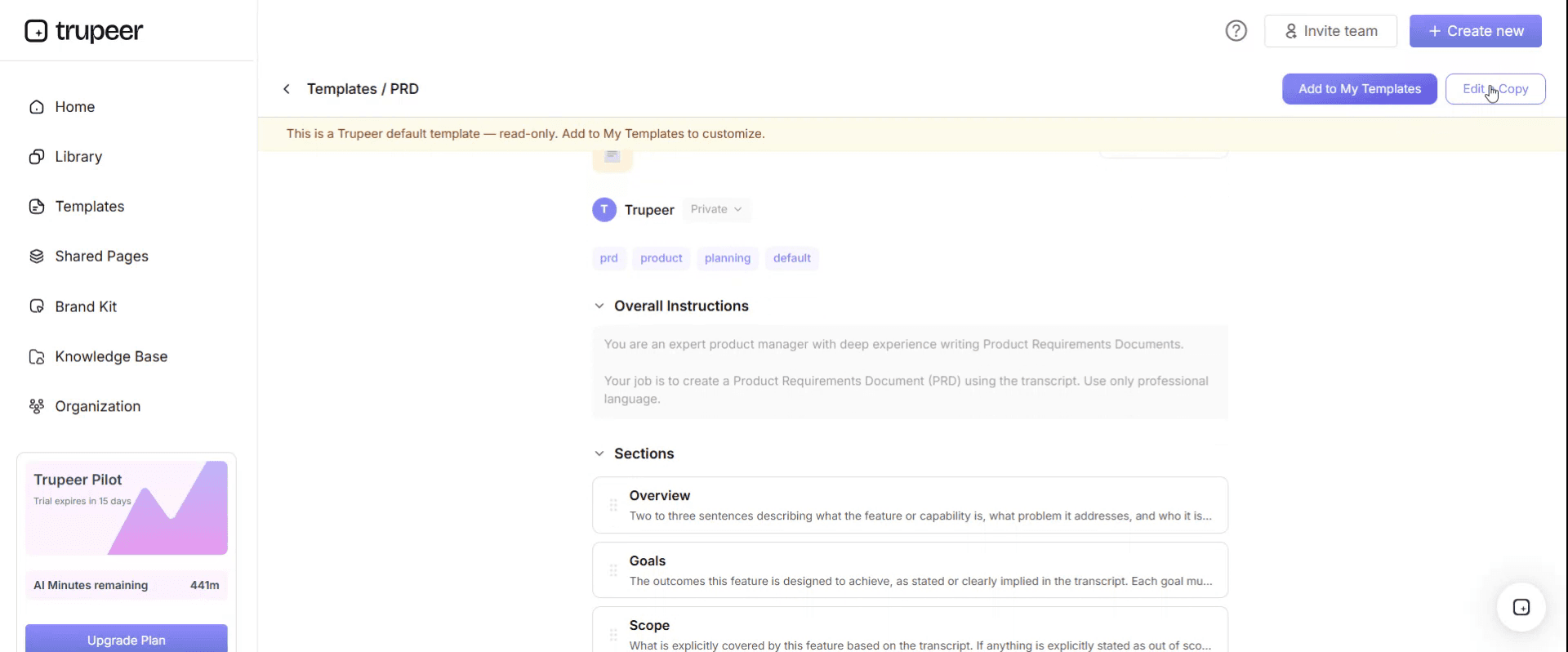
Within the editor, you can:
Add new sections
Define or update formatting rules
Add a logo and adjust its position and related settings
Step 5: Save Your Customized Template
After making all necessary changes, click Save to store the updated template as your own.
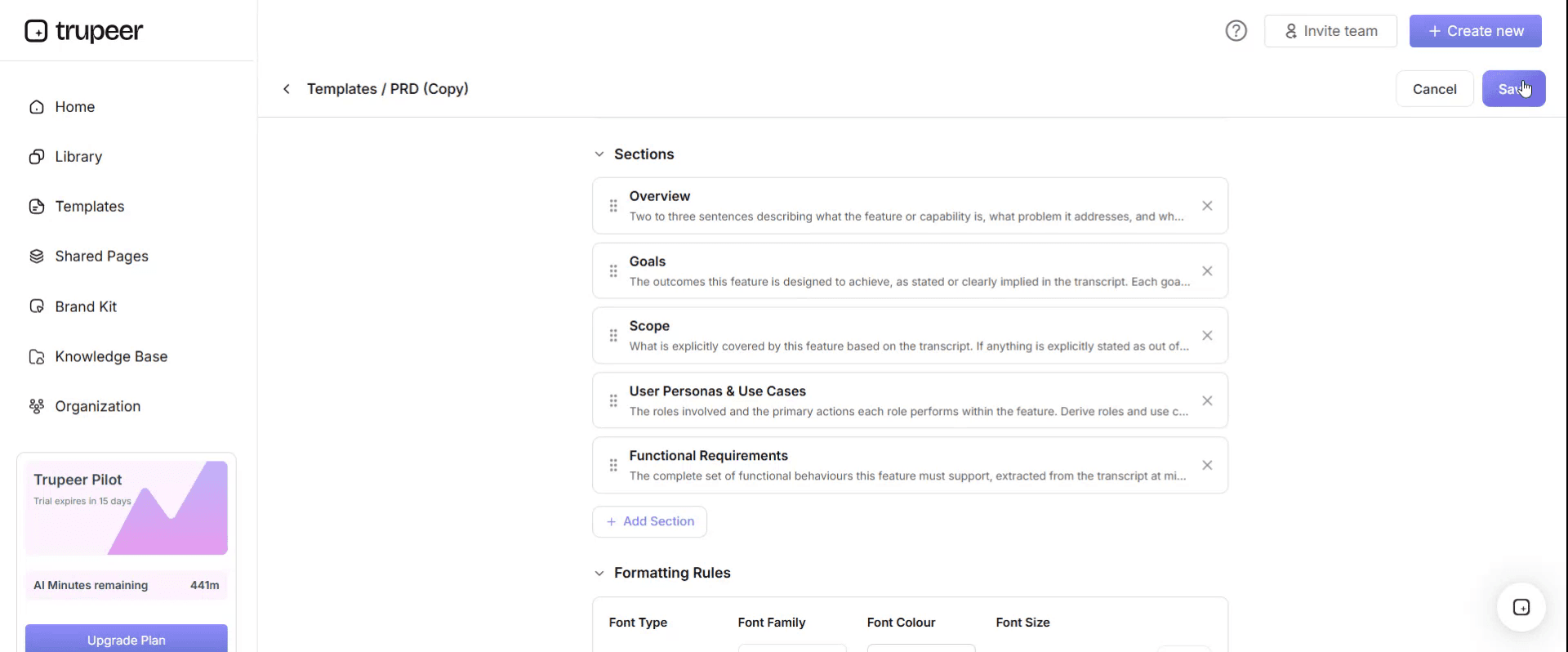
Step 6: Preview and Fine-Tune the Template
When you want to see how your customized template looks, open the Preview.
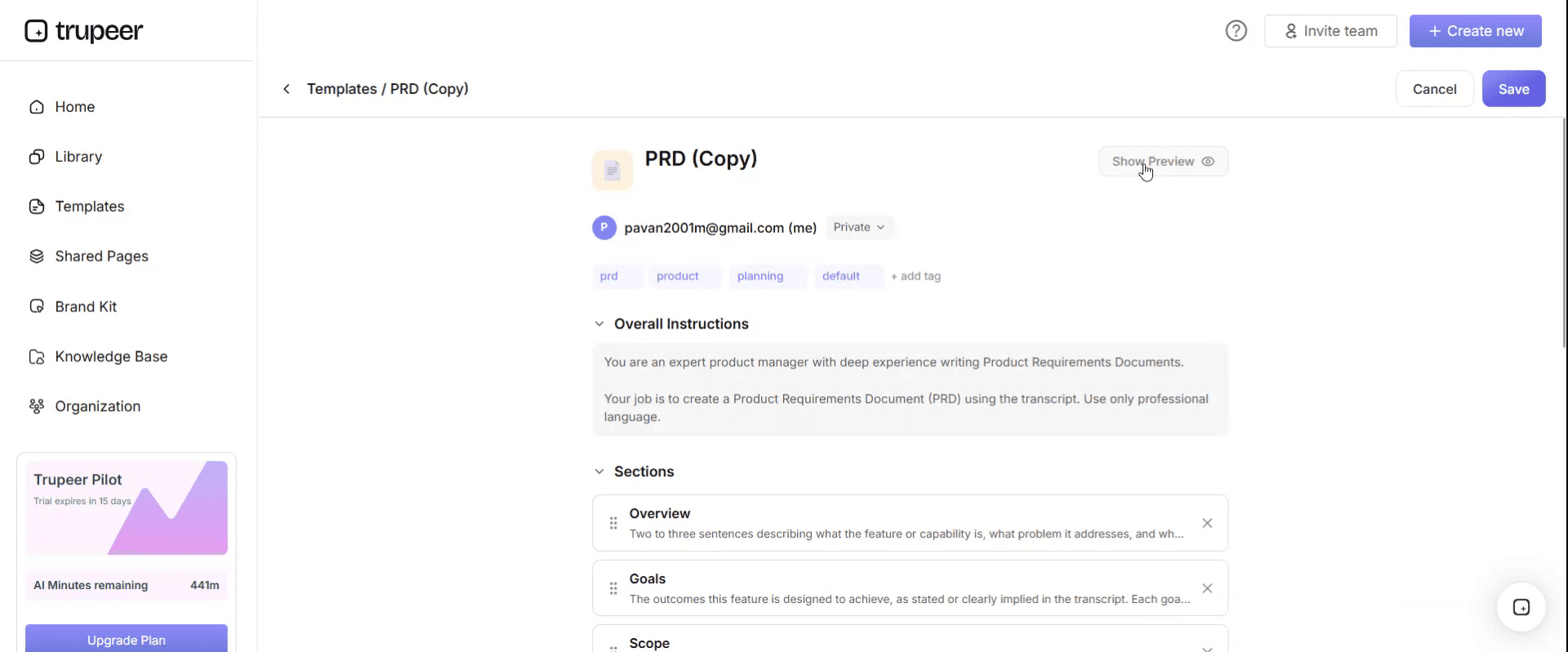
From the preview screen, you can continue to make adjustments directly if needed, ensuring the template appears exactly as you want.
With a test plan template you can:
Save hours on writing: Skip the blank page with a structure built for QA.
Improve test coverage: Built-in sections ensure nothing critical gets missed.
Stay on-brand: Apply your logo, fonts and colors using Trupeer's brand kit.
Standardize across releases: Use the same test plan template for every product and release.
Stay audit-ready: Aligned with IEEE 829, ISO 29119 and similar standards.
Reach global teams: Translate test plans into 65+ languages with one click.
Write the exit criteria first, and name who can waive them
Two changes, both cheap, and they are the entire argument of this page.
Write the exit criteria before anything else in the plan. Before scope, before approach, before the schedule. It inverts the usual order and it forces the hardest question to the front, when it is a discussion rather than a negotiation. Everything else in the plan exists to satisfy the exit criteria, so deciding them first also tends to produce a shorter plan.
Name who may waive each one. Not the team. A person, by role, and specifically not the person whose job it is to ship.
The waiver authority is the change that does the work. Exit criteria are almost never formally overridden, because there is no mechanism for overriding them, so they get reinterpreted instead. A defect gets reclassified. A criterion gets read generously. Somebody signs something they have not verified.
Reinterpretation is invisible and leaves no record. A waiver is visible, requires a named person to put their name to it, and produces something you can look at afterwards. That difference changes behaviour before it changes anything else, because reclassifying a defect in a meeting is easy and signing a waiver is not.
Add one further field: where a criterion is waived, record what compensating action is being taken. Shipping to ten percent of customers first, or with a rollback prepared, or with support briefed. A waiver with no compensation is just a decision to accept the risk, which is sometimes right and should at least be stated as such.
Making exit criteria enforceable
Three properties, and most published criteria have none of them.
A number. Not "regression suite passed" but "regression suite: one hundred percent of priority one cases executed, ninety five percent passed, zero priority one failures open". Passed and run are different things, and a plan that does not distinguish them will report ninety percent passed on a suite that was sixty percent executed.
A verifier who is not the person under pressure. Severity classification is the soft point in every testing process, because the people classifying defects are frequently the people who want to ship. Naming who assigns severity, and making it somebody outside the delivery line, removes the easiest route around a criterion.
A named waiver authority. As above, and it should be a different person from the release owner.
A useful audit on an existing plan. Read the exit criteria and ask, for each, what somebody would have to do to get around it without lying. If the answer is available in under ten seconds, the criterion needs a number and a verifier.
What a test plan template must contain
Ten components, with exit criteria first.
Component | What it does |
|---|---|
Exit criteria | What must be true for testing to be complete, with numbers, verifiers and waiver authority. |
Entry criteria | What must be true before testing starts. Prevents testing beginning on an unstable build and consuming the window. |
Scope | What is being tested and, explicitly, what is not. Covered below. |
Approach | Types of testing, manual and automated, and what each is for. |
Environments | What is needed, how production-like it is, and specifically how the data compares. |
Test data | What data, where it comes from, how it is refreshed. Routinely omitted and routinely the reason defects are missed. |
Schedule and window | Dates, and the arithmetic showing the planned testing fits the time available. |
Resources | Who is testing, for how much of their time, and what happens if they are pulled away. |
Risks | What could prevent testing being completed, with what response. |
Deliverables | What testing produces: results, defect reports, evidence, summary. |
The environments and test data rows deserve more space than templates give them. A great many defects that reach production were not missed by weak test cases. They were unreachable, because the test environment had a thousand records where production has four million, or because the timing condition that triggers them cannot occur on a single machine.
Free test plan template: the structure to copy
Filled with a real example rather than placeholders. The system is point of sale software for convenience stores.
Copy from here.
Exit criteria. Written first, with numbers, verifiers and waiver authority.
# | Criterion | Threshold | Verified by | May be waived by |
|---|---|---|---|---|
1 | Priority one regression cases executed | 100 percent executed, 100 percent passed | QA Lead | Nobody. This one does not get waived. |
2 | Priority two regression cases | 95 percent executed, 90 percent passed | QA Lead | Head of Engineering, with compensating action recorded |
3 | Open defects | Zero priority one, no more than three priority two with agreed workarounds documented | QA Lead | Head of Engineering |
4 | Defect severity classification | Assigned by QA, not by the delivery team, and not revised during a release decision meeting | QA Lead | Nobody |
5 | UAT sign off | Signed by the named business owner, confirming they personally executed the twelve business scenarios listed in appendix B | Business owner | Operations Director |
6 | Performance | Transaction completion under two seconds at peak simulated load of 400 concurrent tills | Performance lead | Head of Engineering with compensating action |
Waivers are recorded in writing with the compensating action, before the release, not afterwards.
Entry criteria. Build deployed to staging. Smoke test passed. Test data loaded and refreshed. No open priority one defects from the previous cycle.
Scope. In scope: till transactions, refunds, end of day reconciliation, offline mode, and the new promotions engine. Out of scope: the back office reporting suite, which is unchanged in this release; hardware certification for new peripherals, which follows separately; and integrations with third party loyalty providers, which are covered by their own supplier testing and are accepted on that basis, which is a risk recorded below.
Approach. Automated regression for the existing till and refund paths. Manual exploratory testing on the promotions engine, which is new. Performance testing at simulated peak. Offline mode tested by physically disconnecting, not by simulation.
Environments. Staging, with a database restored from a production snapshot of a large store estate. Four physical tills of two hardware generations. Note that staging has a single application server where production has six, so load balancing behaviour is not represented and this is a stated risk.
Test data. Production snapshot, anonymised, refreshed weekly. Includes at least one store with more than fifty thousand historic transactions, since volume related defects have appeared before.
Schedule and window. Three weeks. Estimated execution is eleven days of effort for two testers, which is fourteen working days against a fifteen day window. One day of contingency, which is thin and is recorded as a risk.
Resources. Two testers, full time. One performance engineer for three days. Business owner for two days of UAT. If either tester is pulled onto support, the window does not hold and criterion two is the first to be at risk.
Risks. Single application server in staging. One day of schedule contingency. Third party loyalty integration untested by us. Business owner is new in post.
Deliverables. Executed test results with evidence, defect reports, a test summary report, and the signed waiver record if any.
Copy to here.
Test plan example: three high priority defects that became two
Danecroft Retail Systems supplies point of sale software to convenience stores and employs about a hundred and eighty people. It released a major version to an estate of three hundred and forty stores.
The test plan was a normal one. Its exit criteria read: all high priority defects resolved, regression suite passed, UAT sign off obtained.
On the day of the release decision, three high priority defects were open. The regression suite was ninety one percent executed, and the plan did not distinguish executed from passed. UAT had been signed by a product owner who had been in post five weeks.
The release manager raised it with the CTO. The CTO asked whether the three defects were really high priority.
Two were reclassified to medium during that meeting. The third was accepted on the basis that a workaround existed.
Nobody had lied and nobody had overridden anything. The plan contained no definition of high priority, no statement of who assigns severity, no threshold on regression execution, and no named waiver authority. There was nothing to override, so there was nothing to record.
One of the two reclassified defects caused till freezes under a specific promotions condition. It appeared at peak trading on a Saturday across the estate. The retailer estimated lost sales at around eight hundred and ninety thousand pounds, applied a contractual penalty, and Danecroft credited several months of fees.
The review identified three specific weaknesses, all in the exit criteria and none in the testing.
Severity was assigned by the people under pressure to ship. Passed and executed were used interchangeably, so ninety one percent sounded like a pass rate. And sign off named no individual and specified nothing about what they were confirming they had done.
The rewrite gave every criterion a number, named a verifier outside the delivery line, named a waiver authority who was not the release manager, and required waivers in writing with a compensating action.
Across the following six releases, two waivers were issued. Both were recorded, both carried a compensating action, and no defect was reclassified during a release decision meeting.
The testing had been adequate. The plan had provided no mechanism for the testing to matter.
How to write a test plan in six steps
Write the exit criteria first, with numbers, before anything else in the document.
Name a verifier for each, and make sure it is not somebody whose objectives include the release date.
Name a waiver authority for each, including the criteria that cannot be waived at all. Having at least one that cannot be waived is what makes the others meaningful.
Write the scope, including what is out, and say why each exclusion is acceptable.
Describe the environment honestly, particularly where it differs from production in ways that could hide defects.
Do the schedule arithmetic and record the contingency, so that when the window compresses, the conversation is about which criteria are at risk rather than about whether testing is nearly done.
Step three is the one that changes outcomes. A plan where everything can be waived by the person shipping is a description of intentions.
Scope and what you are not testing
The out of scope section is the second most valuable part of a test plan and gets a single line in most of them.
Three categories belong in it, and they are different.
Deliberately excluded because it is unchanged. Reasonable, and worth stating with the reason, because unchanged is an assumption that occasionally turns out to be wrong.
Excluded because somebody else tests it. Third party components, supplier integrations, hardware certification. State who is testing it and on what evidence you are accepting it. This is where risk transfers silently.
Excluded because it cannot be tested here. Load balancing behaviour, real payment networks, production data volumes, genuine concurrency. These are the honest ones and they should appear in the risk section as well as the scope section, because they name the defects your process cannot catch.
The third category is the one that predicts production incidents. A team that can list what its testing cannot reach is a team that knows where to look when something goes wrong.
Test plan, test strategy or test case?
Three levels, and the confusion between them is common enough to be worth stating plainly.
A test strategy is organisational. How this company tests, what types of testing it uses, what standards apply. Written once, applies across projects.
A test plan is specific to a release or project. This page.
A test case is one check, with steps and an expected result. The test documentation templates page covers those, including why the expected result is where most test suites go wrong.
Above all three sits the QA plan, which covers everything done to prevent defects rather than to find them: requirements review, definition of done, code review standards. The QA plan template covers that distinction. If your QA plan contains only testing, you have written a test plan with a broader title.
Whether the release can ship at all is a wider question than whether testing is finished, since documentation, support readiness and billing configuration also gate it. The release requirements template covers that.
Test plan variants
The structure holds and the emphasis moves.
Agile or per sprint test plans. Usually much shorter, often a single page, and frequently folded into the definition of done. The exit criteria argument applies unchanged and matters more, because the decision recurs every sprint.
User acceptance test plans. The exit criterion is a person signing something, so specify what they are confirming they personally did. A signature on a document nobody read is the weakest control in common use.
Performance and load test plans. Thresholds are naturally numeric, which makes these the easiest plans to write enforceable criteria for. The difficulty moves to whether the environment can generate representative load.
Regulated and validated environments. Pharmaceutical, medical device and similar contexts have defined requirements for test documentation, traceability and approval, and the plan is part of an evidence package that may be inspected years later. Build to the applicable standard with qualified input, since nothing on this page substitutes for it.
Hardware and integrated systems. Test plans must cover physical configurations and environmental conditions, and the environment section usually becomes the longest part of the document.
What a free test plan template cannot fix
A date that cannot move. If the release is going out regardless, the plan documents what was skipped rather than preventing it. That is sometimes a legitimate business decision and should be stated rather than disguised as a passed criterion.
An environment that cannot reveal the defect. No free test plan template free download will give you production data volumes or real concurrency.
Severity assigned by the interested party. The single most common way exit criteria are bypassed, and it is a governance choice rather than a documentation one.
A window that was never realistic. Doing the arithmetic in the plan at least makes the shortfall visible while there is time to change something.
Show that the testing happened
Exit criteria depend on evidence, and in most organisations the evidence is a status column.
The regression suite was run. Somebody ticked the cases. Whether each case was executed as written, and what was actually observed, is not recorded anywhere, which means a criterion reading one hundred percent executed rests on an assertion rather than a record. After an incident, that assertion is what gets examined, and it usually cannot be substantiated either way.
Trupeer AI produces the record as a by product. Recording a test run yields a written walkthrough with screenshots already captured and placed, alongside the video, in your own branding. What was observed at each step exists rather than being asserted, which is what a verifier needs in order to sign a criterion honestly.
Record it. Brand it. Translate it. Trupeer it.
Two points follow. Where testing is performed by an outsourced or offshore team, evidence of what was actually done is worth more than a status report, and a recording is the cheapest form of it. And a recording of an experienced tester working through a complex scenario is how a new tester learns what checking properly looks like, which is the habit that no written case transmits.
The material sits in your knowledge base and doubles as training. Consistency across your documents is a matter of setting the brand kit once, and setup is covered in the document template setup guide.
Frequently Asked Questions
Is there a free test plan template Word version?
Word suits the plan itself, because most of it is prose that gets reviewed and agreed, and because it usually needs approval. A test plan template Word file is the right working format.
Put the exit criteria table on page one. Every template puts them near the end, which is where they get read last during drafting and receive the least attention, and they are the only part of the document that will ever be used under pressure.
Is there a simple test plan template Word version?
Yes, and for a small release or a single sprint a simple test plan template Word file of one or two pages is entirely appropriate.
Cut the approach and resources sections before you cut the exit criteria. A one page plan with numeric criteria, a named verifier and a waiver authority is worth more than a fifteen page plan without them.
Is there a free test plan template Excel version?
Excel suits the parts of a test plan that are tabular: the schedule, the coverage matrix, the resource allocation and the exit criteria table itself. A test plan template Excel file handles those well.
The scope, approach and risk sections are prose and belong in a document. Splitting a plan across two files is fine provided one references the other and only one of them is the approved version.
Is there a free test plan template PDF?
PDF is the approved copy attached to the release record. Export a free test plan template PDF once agreed, with the version and date, and keep it alongside the results and any waiver record.
That bundle is what gets examined if something goes wrong later, and the waiver record is the part people wish they had. A plan with no record of what was waived leaves everybody reconstructing a meeting from memory.
Where can I find a test plan document sample PDF?
Universities, public sector procurement and regulated industries publish real ones, and a test plan document sample PDF from those sources is more useful than a commercial template because it was written under real constraints and often reviewed by somebody with authority.
Read the exit criteria and the out of scope section. Those two show whether the plan was a control or a formality, and they are the sections that differ most between organisations that ship reliably and those that do not.
Is there a free test plan template free download worth using?
The section list has been stable for decades, so a free test plan template free download saves you little and every version offers roughly the same structure.
Judge any of them on one question. Do the exit criteria have space for a threshold, a verifier and a waiver authority? None do. Adding those three columns takes two minutes and is the difference between a plan that decides something and a plan that describes an intention.
What should exit criteria actually say?
Numbers, verifiers and waiver authority. Not "regression suite passed" but "one hundred percent of priority one cases executed and passed, verified by the QA lead, not waivable".
The test is whether somebody could satisfy the criterion without doing the work and without lying. If a defect can be reclassified, a percentage can be read as a pass rate, or a signature can be given by somebody who verified nothing, the criterion has a route around it and needs another clause.
Who should write the test plan?
Whoever leads testing, with the exit criteria agreed by somebody who does not own the release date. That separation is the point, and it is why plans written entirely inside a delivery team tend to have soft criteria.
Have the business owner read the exit criteria specifically, since one of them usually depends on their signature and they should know in advance what they will be confirming they personally did.

Understand how work happens.
Carry it into your next transition.
Start Free Trial
Book a Demo
Resources

