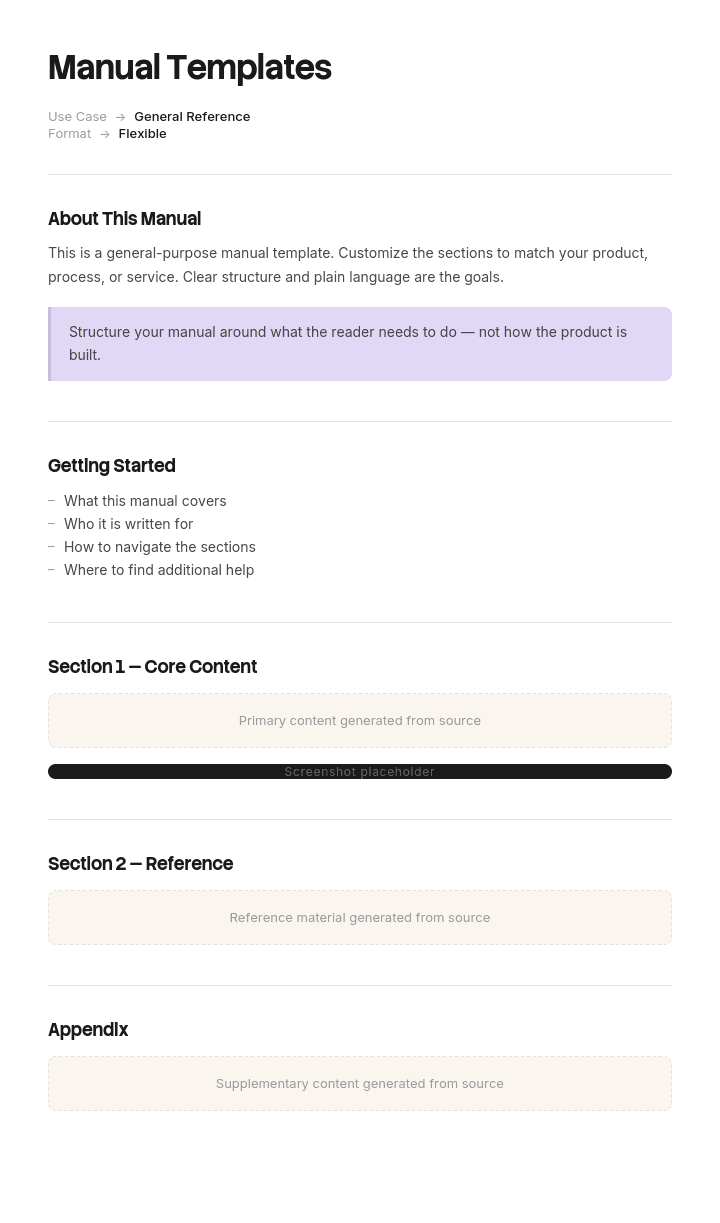
Use this template
A great manual is one of the highest-leverage assets a company can produce - it scales knowledge to anyone who needs it. With Trupeer, you can save hours on writing manuals by starting with free manual templates, customizing them with your brand guidelines, and using our AI manual creator to turn any manual into a video walkthrough.
What is a manual template, and which one do you need?
A manual is a document someone consults to do something correctly: operate a machine, use software, follow a process, or learn a job. A manual template is the reusable structure behind it, covering the sections, the front matter and the conventions that make one manual look like the next.
The harder question is which manual you are writing, because the word covers at least eight different documents with different readers, different lifespans and different legal weight. A user manual for a web application and an operating manual for industrial equipment have almost nothing in common beyond the name.
Getting that wrong is expensive in a specific way. It does not produce a bad document. It produces one document trying to be four, which is the failure mode described below.
A manual with two signatories is not one manual
Here is the test, and it takes about a minute.
List everyone who would have to approve a change to your manual. Not review it. Approve it, in the sense that the document cannot be reissued without them.
If that list has one name, you have one manual. If it has four, you have four manuals that somebody has bound together, and the binding is the reason none of them will be kept current.
The mechanism is simple and it defeats good intentions completely. Content owned by different people changes at different rates. Safety declarations change rarely and need compliance. Operating instructions change every release and need product. Troubleshooting changes weekly and needs the service team. Bind them into one document and the cheapest possible change inherits the slowest possible approval path, so the nine page fix waits on the two hundred page review.
Everyone involved behaves reasonably at every step and the manual still goes out of date. That is what makes this failure so common: nobody does anything wrong.
So the first decision in any manual project is not the template. It is how many manuals there are, and the answer is the number of signatories.
How to customize this template in Trupeer
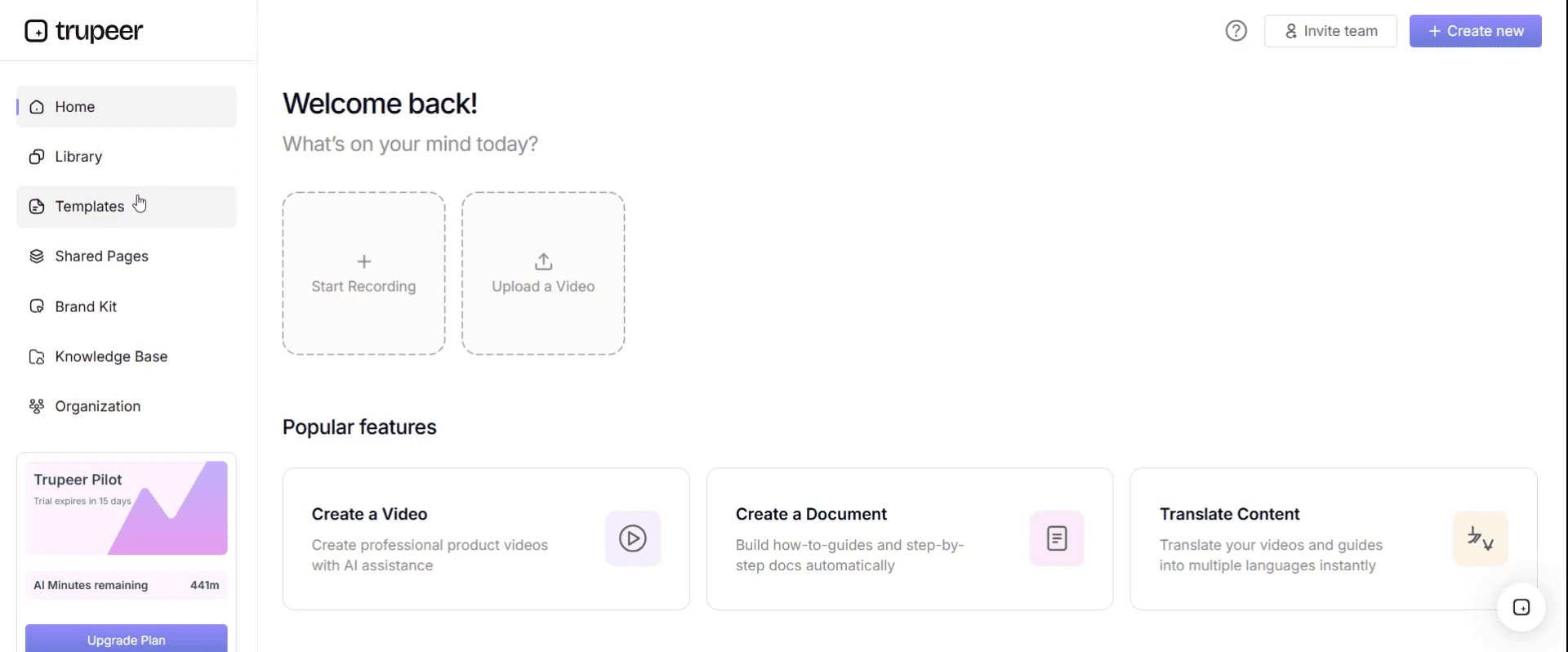
Step 1: Open the Templates Section
Go to the Templates section from the main navigation.
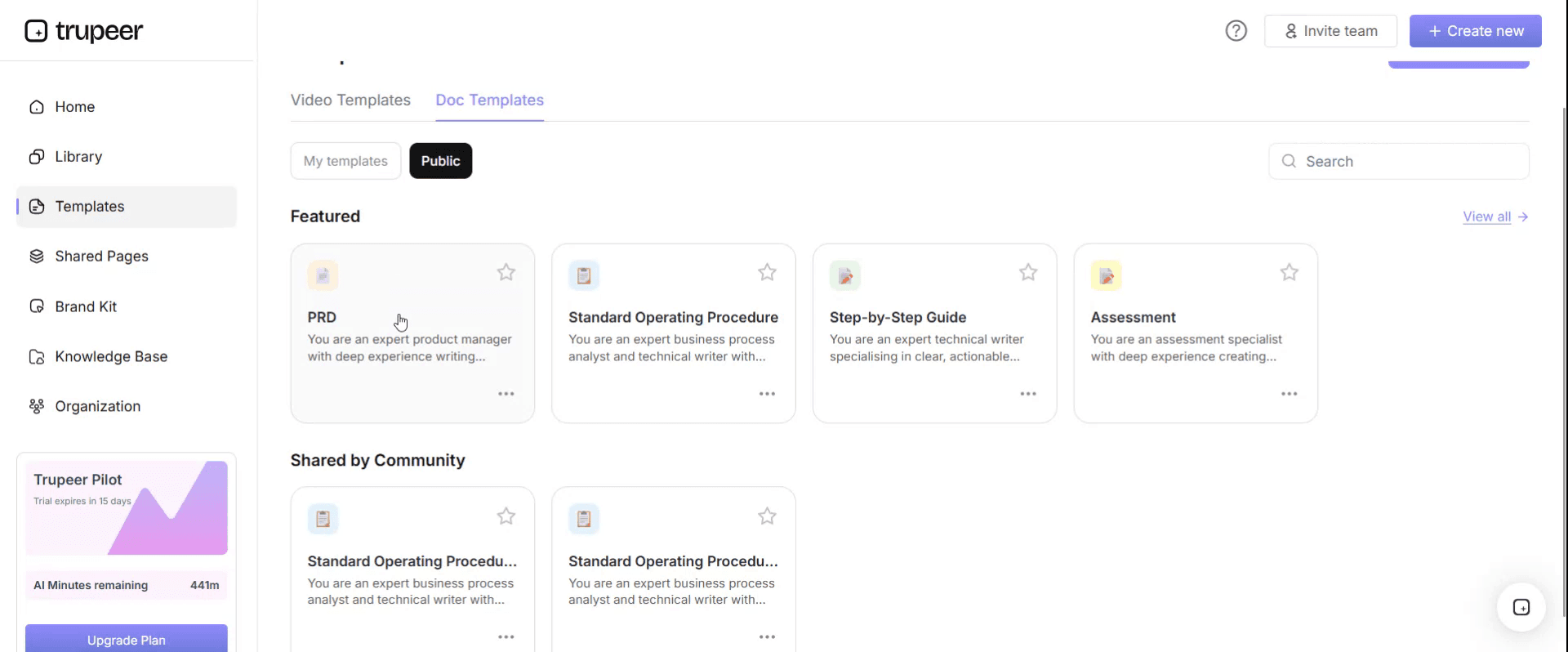
Step 2: Select and Open a Template
Click on any template you want to work with to open it.
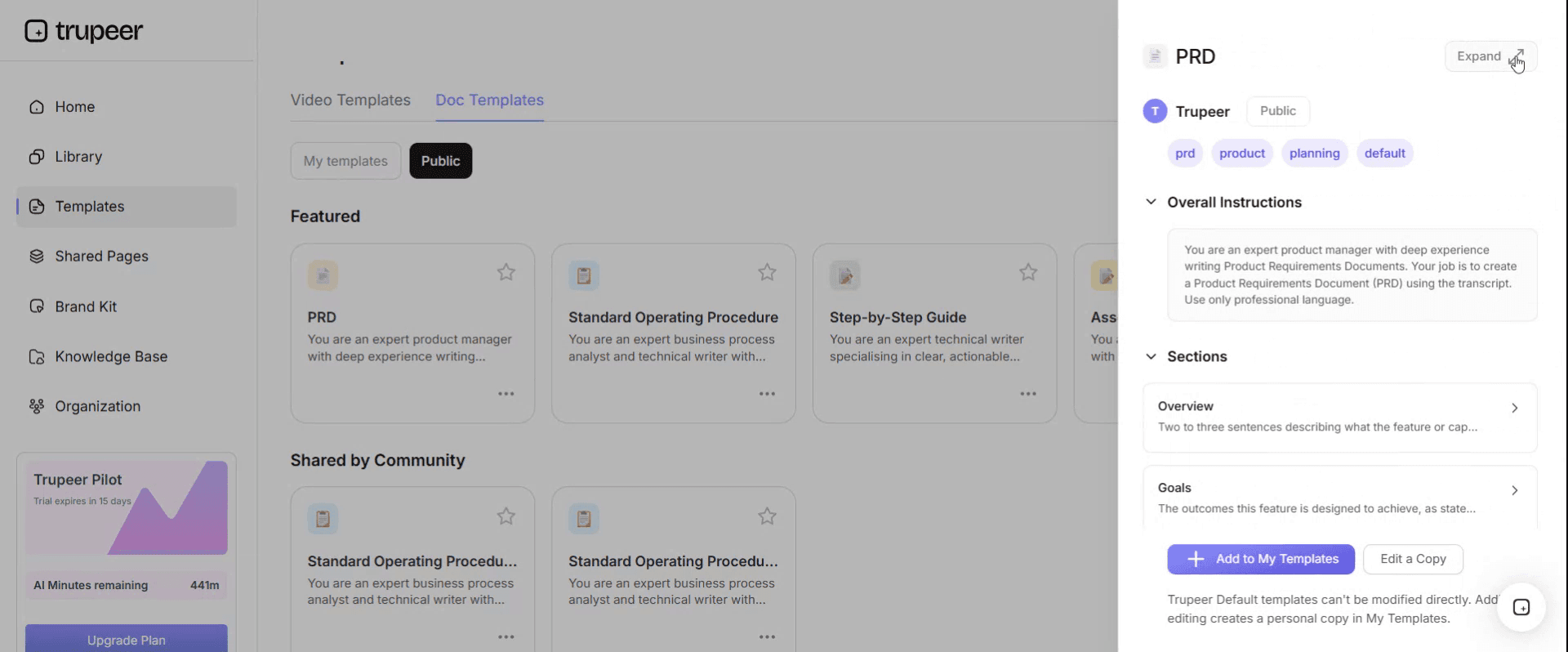
Step 3: Expand the Template View
If needed, expand the template view to see the full layout and details clearly.
Step 4: Edit the Template
Click on Edit to start modifying the selected template.
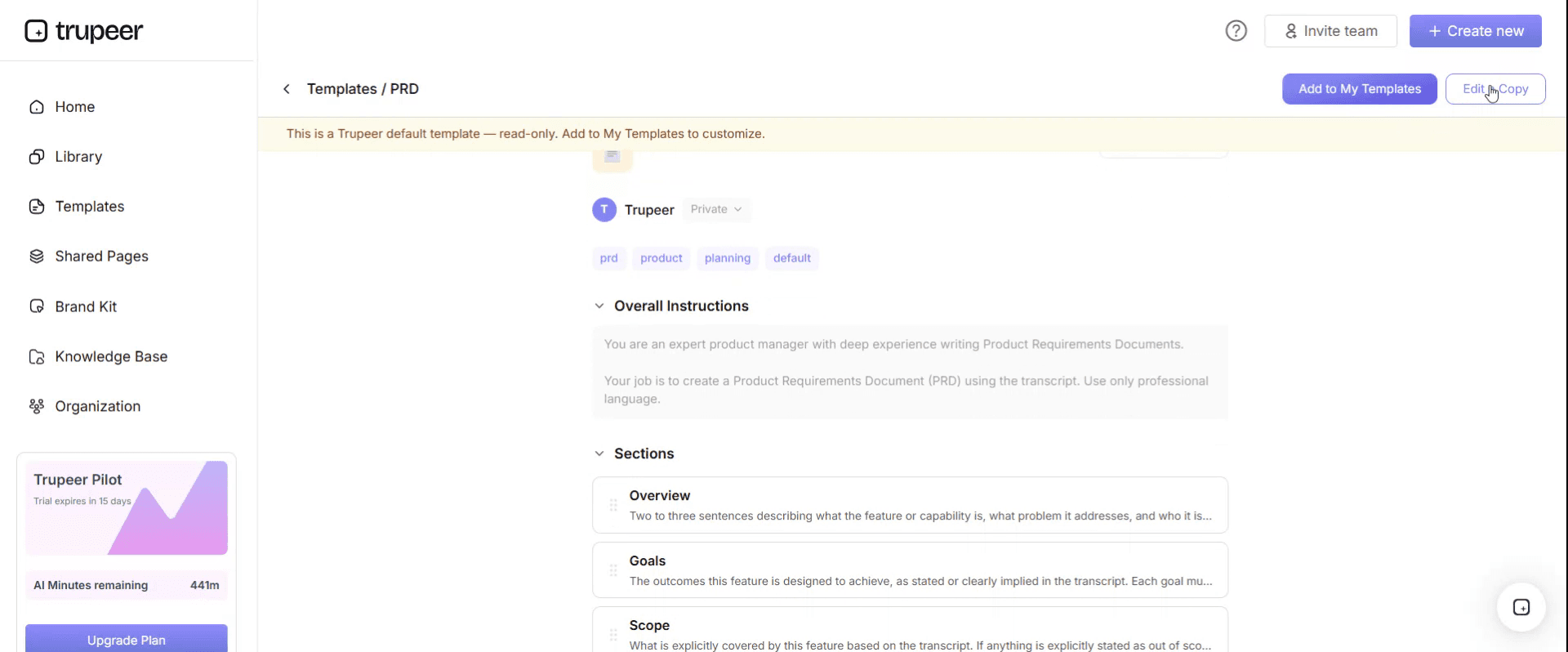
Within the editor, you can:
Add new sections
Define or update formatting rules
Add a logo and adjust its position and related settings
Step 5: Save Your Customized Template
After making all necessary changes, click Save to store the updated template as your own.
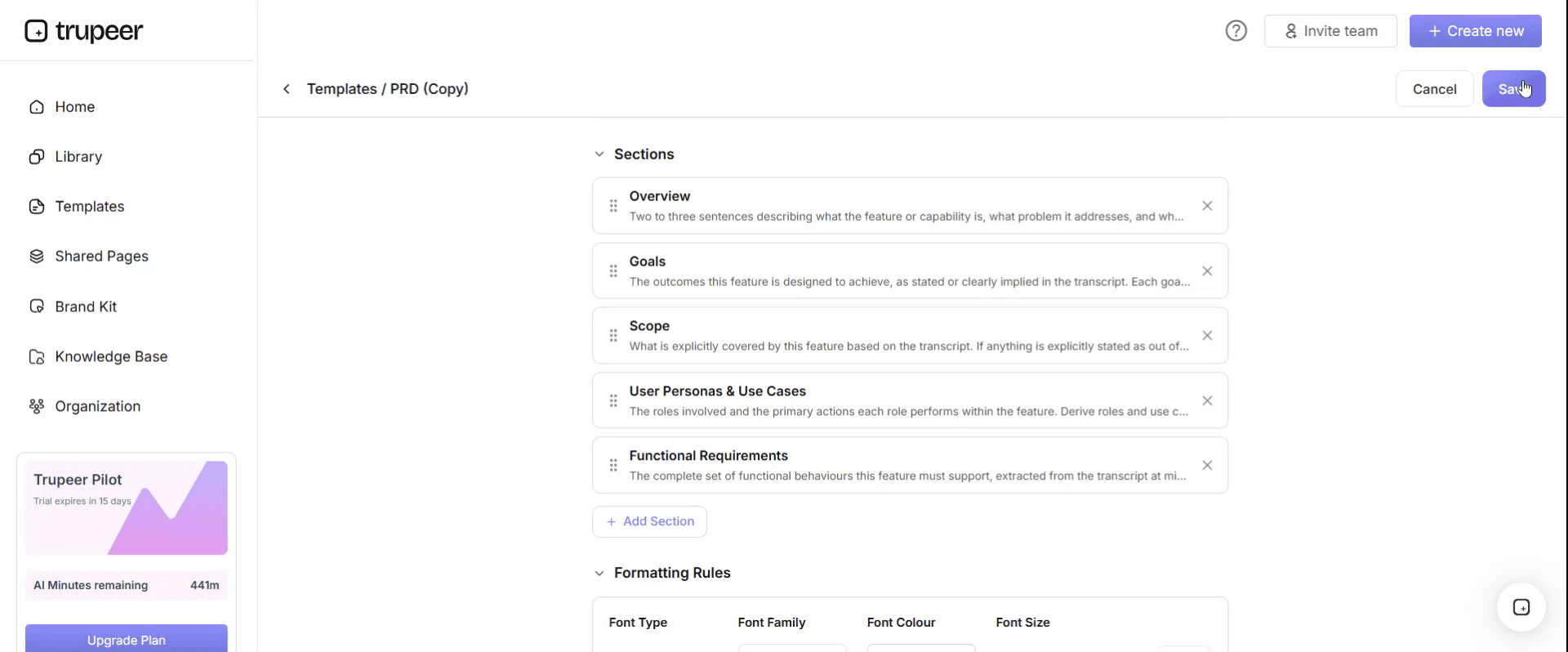
Step 6: Preview and Fine-Tune the Template
When you want to see how your customized template looks, open the Preview.
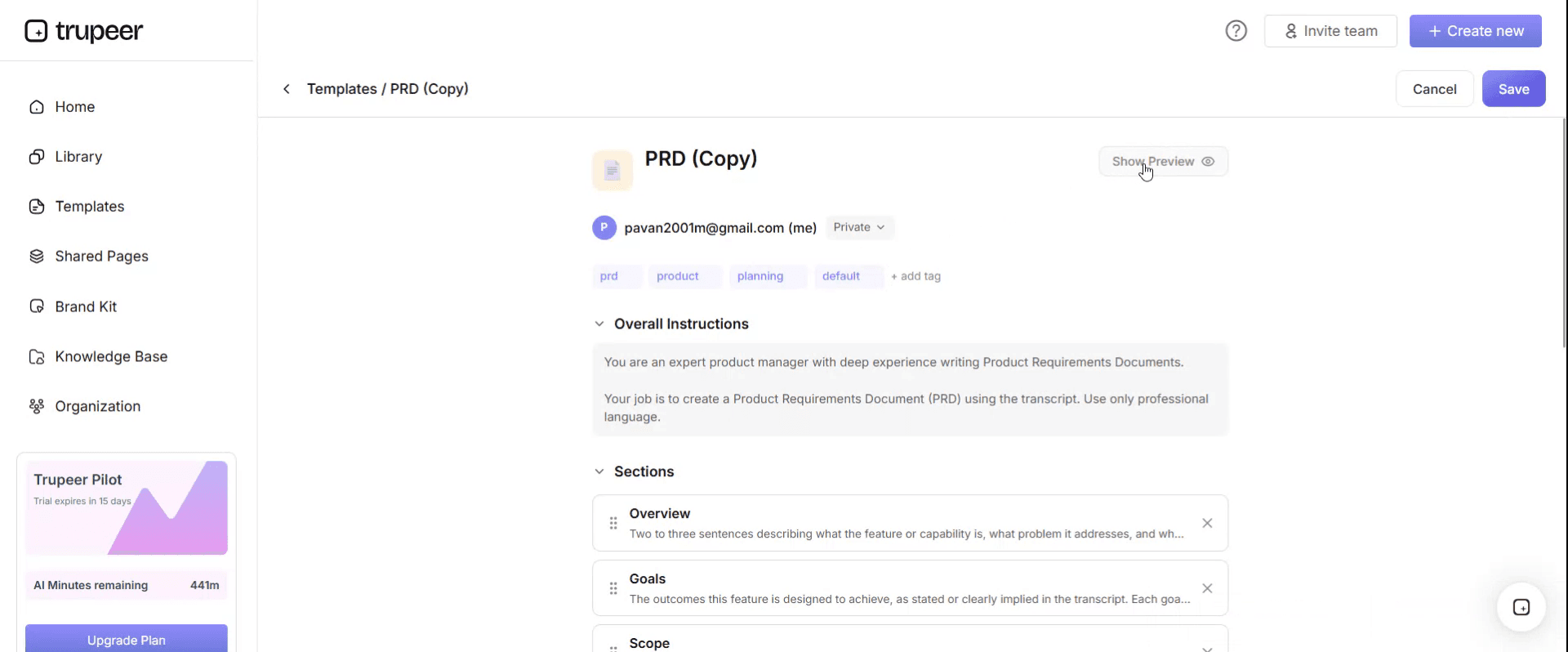
From the preview screen, you can continue to make adjustments directly if needed, ensuring the template appears exactly as you want.
With Trupeer's manual templates you can:
Save hours on writing: Skip the blank page with proven structures for any manual type.
Cover every use case: Templates for user manuals, training, operations, instruction and policy.
Stay on-brand: Apply your logo, fonts and colors using Trupeer's brand kit.
Reduce support load: Clear manuals help users self-serve - cutting tickets and rework.
Add video tutorials: Embed video for steps that are hard to explain in text.
Reach global users: Translate manuals into 65+ languages with one click.
The manual types, who signs each, and how often they change
Manual | Reader | Who approves a change | Changes | Lives |
|---|---|---|---|---|
User manual, software | Someone using the product now | Product owner | Every release | Help centre, in-product |
User manual, physical product | Owner of the thing, often once | Product and compliance | Per product revision | Printed and PDF, in the box |
Operating manual, equipment | Trained operator at the machine | Operations and compliance | Yearly or on modification | At the machine, laminated |
Installation manual | Installer or engineer, once | Engineering and compliance | Rarely | With the product, PDF |
Service and troubleshooting manual | Technician diagnosing a fault | Service team | Continuously | Searchable, internal |
Training manual | New starter learning the job | Department head or L and D | When the process changes | Learning system |
Instruction manual for a task | Someone doing the task now | The team doing it | Continuously | At the point of work |
Policy manual or handbook | Employee checking a rule | HR and legal | Yearly | Intranet, versioned |
Read down the approvals column. Almost every organisation that thinks it has a manual problem actually has three or four of these fused together.
The two rows most often wrongly fused are the training manual and the user manual. They have different readers doing different things: one is learning away from the task, the other is stuck in the middle of it. A document serving both is too long to consult and too shallow to learn from.
Free manual template: the structure every manual shares
Whichever type you are writing, the front matter is the same and it is the part most drafts skip. Copy from here.
Title and what this covers. The product, version or process this applies to, stated precisely enough that a reader with a slightly different one knows to stop.
Who this is for. The role and the assumed starting knowledge. "For trained operators" and "for a first-time user" produce very different documents and the reader should be able to tell within five seconds which they are holding.
Owner and approver. One name for each. If those are different people, note it, because that difference is what governs how fast this can be changed.
Version and date. Version number, date issued, and what changed since the last one, in one line.
Safety and limitations. Only where the work carries risk, and placed before the instructions rather than in an appendix.
How to use this manual. Two or three lines: is it read through or dipped into, where the index is, what to do if it does not cover your case.
Body. The type-specific part, structured according to the row you picked above.
What to do if this does not help. A named route, not a general support address.
Copy to here. The version line and the two names are the fields that separate a manual from a document, and they are the first things cut when someone is in a hurry.
How to split a manual that has already been written
Most people arrive at this page holding an existing document rather than a blank page, so this matters more than the template.
Print it, or open the contents page. Against each section write one name: who has to approve a change to this. Not who wrote it.
Group the sections by that name. Those groups are your manuals. In practice you will usually find three or four groups and one orphaned section that nobody will own, and the orphan is normally out of date already.
Split in the order that hurts most, which is almost always whichever content changes most often while sitting behind the slowest approver. That is where the value is and it is usually the operating or troubleshooting content trapped behind compliance.
Do not rewrite while splitting. Move the text unchanged, republish, and fix the content afterwards. Splitting and rewriting at the same time is how these projects stall at forty percent and get abandoned.
Leave a cross-reference in each document pointing at the others, because your reader still thinks of it as one manual and always will.
The manual that cost eleven weeks to change nine pages
Kilnmore Systems makes commercial laundry equipment for hotels and hospitals. Every machine shipped with an Operating and Maintenance Manual running to a hundred and forty eight pages.
It contained installation instructions approved by engineering, safety warnings and conformity declarations approved by compliance, operating instructions written by product, cleaning schedules also from product, troubleshooting from the service team, a spare parts list from supply chain, and warranty terms from legal. Seven contributors, four approvers, one PDF.
In 2024 a firmware release changed the operating menu. About nine pages of the manual became wrong.
Updating those nine pages meant reissuing the document, and reissuing the document triggered a full compliance review, because the conformity declarations were bound into the same file. That review took eleven weeks.
During those eleven weeks around three hundred and forty machines shipped with a manual whose operating section did not match the machine. Service calls about the menu went from roughly four a month to about thirty, and stayed there for two quarters. That is somewhere near a hundred and sixty avoidable calls at about eighty five pounds each, so a little under fourteen thousand pounds, before counting what it did to the launch.
Nothing in the manual was badly written. The document was accurate, thorough and well produced. It simply could not be changed cheaply, and a document that cannot be changed cheaply will be wrong for most of its life.
The fix was structural. Four documents split by approver: installation and safety under compliance, the operating guide under product, service and troubleshooting under the service team, parts and warranty under supply chain and legal. Cross-references between them and a single cover sheet listing all four.
At the next firmware release the operating guide was updated and republished in four days. The compliance document was not touched, because nothing in it had changed.
How to write a manual people will actually open
Write the contents page first and show it to someone who will use the manual. Half the structural mistakes surface in that conversation, before any writing has been wasted on them.
Write the section a reader is most likely to need first, not the section that comes first logically. In most manuals those are different, and the ordering that follows the product's architecture is almost never the ordering that follows the reader's problem.
Use the reader's words for headings. People search a manual for the thing that is happening to them, not for the name of the subsystem responsible.
Number steps only where order genuinely matters. A numbered list implies a sequence, and readers follow implied sequences even when they are wrong.
Put every warning immediately before the step it applies to. A warnings chapter at the front is a legal artefact, not an instruction, and it is read once and never again.
Test it by watching one person use it without helping them. Every hesitation is a defect. This takes forty minutes and finds more than three rounds of review.
What should be included in a manual template?
At minimum: what this covers, who it is for, an owner and an approver, a version with a date, a body structured for the reader's situation, and a named route for when the manual does not answer the question.
Everything beyond that is type specific. A software user manual needs screenshots and a search-friendly structure. An operating manual needs warnings placed inline, a maintenance schedule and conformity information. A training manual needs objectives and a way of checking the reader has understood, which none of the others need at all.
The field people leave out and should not is the approver's name, for the reason the whole of this page is about.
Software and web application user manual templates
Software manuals have one property the others do not: the product changes underneath the document continuously, so anything you write is decaying from the day it ships.
That argues for three things. Structure by task rather than by menu, because menus get reorganised and tasks do not. Keep each topic short enough to update alone, which means a searchable set of articles rather than a bound document. And do not screenshot anything that changes often, naming the control instead of showing where it sits.
For a web application in particular, the manual has largely been replaced by in-product help and a searchable help centre, and treating it as a downloadable PDF is usually a mistake. The structures for that live in our knowledge base article templates, which handle the versioning problem better than a manual template can.
Where you genuinely need a single document, for procurement, accessibility conformance or an enterprise customer who asks for one, generate it from the articles rather than maintaining it separately.
Training manual templates and how they differ from user manuals
A training manual is read once, in order, away from the work, by someone who cannot yet do the job. A user manual is dipped into, at the point of work, by someone who mostly can.
That single difference changes almost everything. Training manuals need context, worked examples and a way of checking understanding. User manuals need findability and brevity, and context in them is noise.
The practical consequence is that you cannot make a training manual by adding an introduction to a user manual, which is what most attempts amount to. Write the user manual first, then write the training manual around it, referring outward rather than repeating.
Our customer service training manual template covers the training side in detail for one function, and the same structure adapts to others.
Operating manual templates for equipment and regulated work
Operating manuals carry weight the others do not. Where equipment is covered by machinery, pressure, electrical or medical device regulation, the manual is part of the product's compliance, not documentation about it. Content, language, retention and the conformity information it carries may all be specified.
Practical consequences worth knowing before you start. The manual usually has to be supplied in the language of the country of use, which makes translation a compliance question rather than a nice-to-have. Warnings must sit with the step, and their wording may be prescribed. Records of which version shipped with which serial number may need retaining for years. And any modification to the equipment may require the manual to be reissued and reassessed.
None of this is legal advice and the requirements vary by jurisdiction and by product class. Have your compliance function or an external specialist confirm what applies before you publish, and keep the compliance-approved content in its own document so a routine operating change does not drag it back through review.
Can I get a manual template in Word, Canva or Google Docs?
Word suits long-form manuals that will be printed or shipped as a PDF, because it handles numbered sections, cross-references and a generated contents page, which are the three things that get painful past about thirty pages.
Google Docs suits manuals written collaboratively and consumed online, and the comment threads are genuinely useful during review. It becomes awkward at length, so it fits training manuals and short user guides better than a two hundred page operating manual.
Canva suits manuals where appearance carries some of the meaning: quick-start guides, single-sheet operating instructions, anything going on a wall. It is the wrong tool for a document with a hundred cross-references.
Choose by length and destination rather than by preference. And whichever you pick, keep the compliance-approved content wherever your approver can sign it, which is usually not the same place as the rest.
How to keep a manual current without a rewrite project
Splitting the document solves the approval problem. It does not solve the writing problem, which is that updating a manual means somebody screenshotting, cropping and rewriting steps they already know, and that work never wins against anything urgent.
Trupeer AI removes most of that cost. Whoever knows the current process records themselves doing it once, and the output is a formatted manual section with the steps and images already in place, ready to edit rather than write. A nine page operating change becomes an afternoon.
Record it. Brand it. Translate it. Trupeer it.
The manual creator is built for exactly this, and the same recording produces a video for training and a document for your knowledge base in consistent branding. Translation matters here more than on most documents, because for equipment sold across borders the local language version is often a requirement rather than a courtesy. Setup instructions are in the document template setup guide.
Frequently Asked Questions
Is there a step-by-step user guide template in Word for free?
The front matter structure above pastes into Word and works as a house shell for any manual type. For the body of a step-by-step guide, keep each step to one action with its expected result, and stop at around nine steps before splitting into a second topic. There is no gated download and no form.
Is there a free training manual template in Word?
Use the same front matter, then structure the body around what the reader will be able to do rather than around the product's features. Objectives, then a worked example, then practice, then a check. Word suits this well because training manuals are usually read in order and often printed.
Is there a user manual template for Canva?
Canva works well for short visual manuals: quick-start sheets, single-page operating instructions, anything that will be pinned up. Take the front matter fields from this page and lay them out there. For anything long enough to need a contents page or cross-references, use Word or Google Docs instead.
Is there a user manual template for Google Docs?
Copy the structure above into a Google Doc and save it to your team drive as a template. It suits collaborative drafting and online reading, and the review comments are a genuine advantage. Watch the length, since Docs becomes slow and unwieldy on very long manuals.
What is the difference between a manual, a guide and an SOP?
A manual is comprehensive and covers a whole product or job. A guide covers one task from start to finish. An SOP is the authoritative procedure for how your organisation does something, written for internal compliance rather than for a reader learning. Manuals often contain guides. SOPs sit alongside rather than inside, because they have a different approver.
How long should a manual be?
As long as its type requires, which is not a useful answer, so here is a better test. Any manual you cannot update in under a week is too long, because it will not be updated. That is usually a signal to split it rather than to cut content.
Who should write the manual?
Whoever does the work, edited by whoever owns the document. Manuals written entirely by a documentation function from interviews tend to be well structured and subtly wrong in the details, and manuals written entirely by practitioners tend to be accurate and unusable. The combination is what works.
How often should a manual be reviewed?
On triggers rather than a schedule. When the thing it describes changes, when a support or service pattern suggests the manual is failing, when a regulation changes, and when its owner leaves. A calendar review arrives when nothing has changed and misses the moment something did.