
Use this template
A knowledge base is only as useful as the articles inside it. With Trupeer, you can save hours on writing knowledge base articles by starting with ready-to-use knowledge base article templates, customizing them with your brand guidelines, and turning text-heavy articles into clear video walkthroughs that customers and employees can actually engage with.
What is a knowledge base article, and what does a template fix?
A knowledge base article is a single self-contained answer, written for someone who arrived from a search box with a problem already in mind. It is not documentation, which describes a system, and it is not a manual, which is read in order.
A template fixes three things. It stops writers reinventing a structure every time, which is where the hours go. It makes articles consistent enough that readers learn where to look. And it forces the fields writers skip when left alone, which are almost never the steps.
What it cannot fix is a library nobody can search, an article about the wrong topic, or a team that never updates anything.
Why knowledge base articles fail at their edges, not in the middle
Read a bad knowledge base article and the writing is usually fine. The steps are right, the screenshots current, someone clearly knew the subject.
What fails is the boundary. The article describes one version of the situation, the reader has a slightly different one, and nothing tells them so. They follow it, it silently does not work, and they raise a ticket anyway, now more annoyed than if they had found nothing.
In the data this looks like the strangest pattern in any help centre: articles with high views and high ticket volume on the same topic. The article is found. It is read. It ends nothing.
The fix is not better writing. It is two lines most templates have no field for, above everything else, saying what this article covers and where to go if that is not you.
How to customize this template in Trupeer
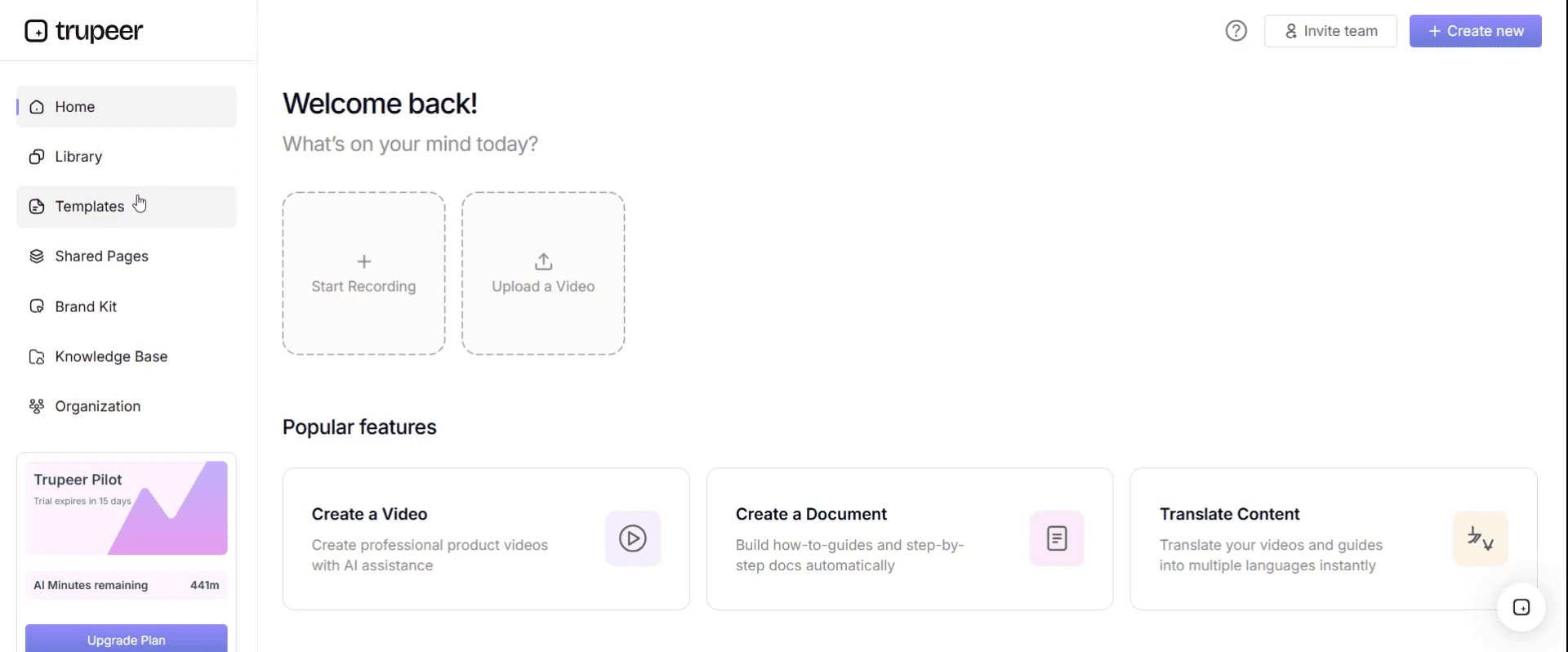
Step 1: Open the Templates Section
Go to the Templates section from the main navigation.
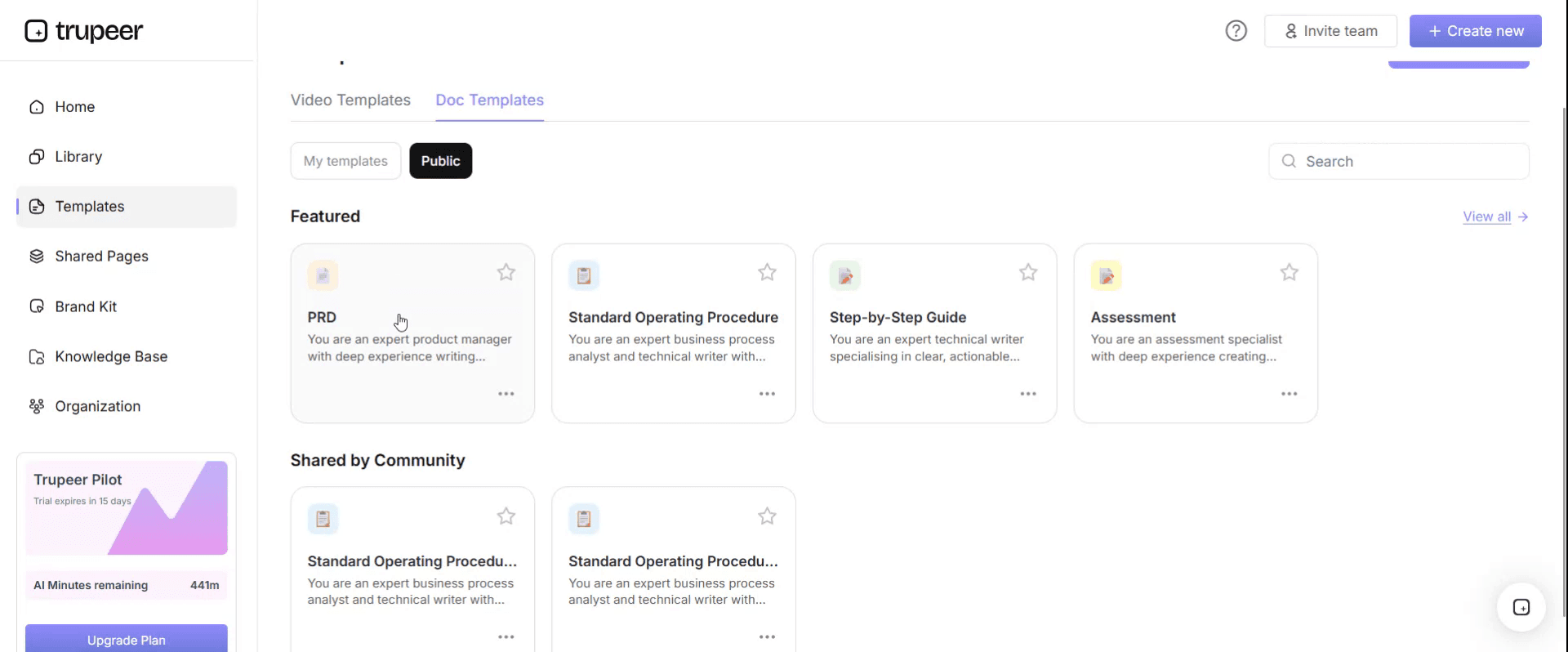
Step 2: Select and Open a Template
Click on any template you want to work with to open it.
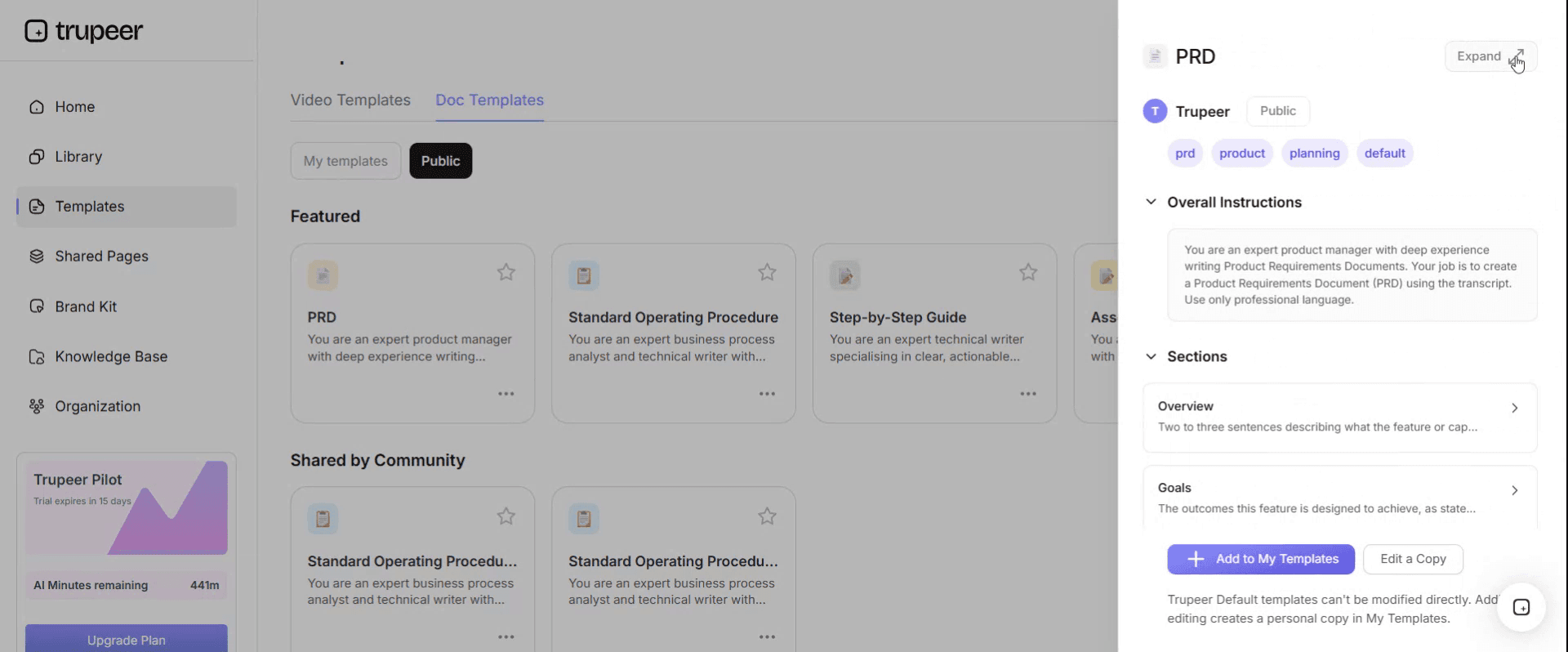
Step 3: Expand the Template View
If needed, expand the template view to see the full layout and details clearly.
Step 4: Edit the Template
Click on Edit to start modifying the selected template.
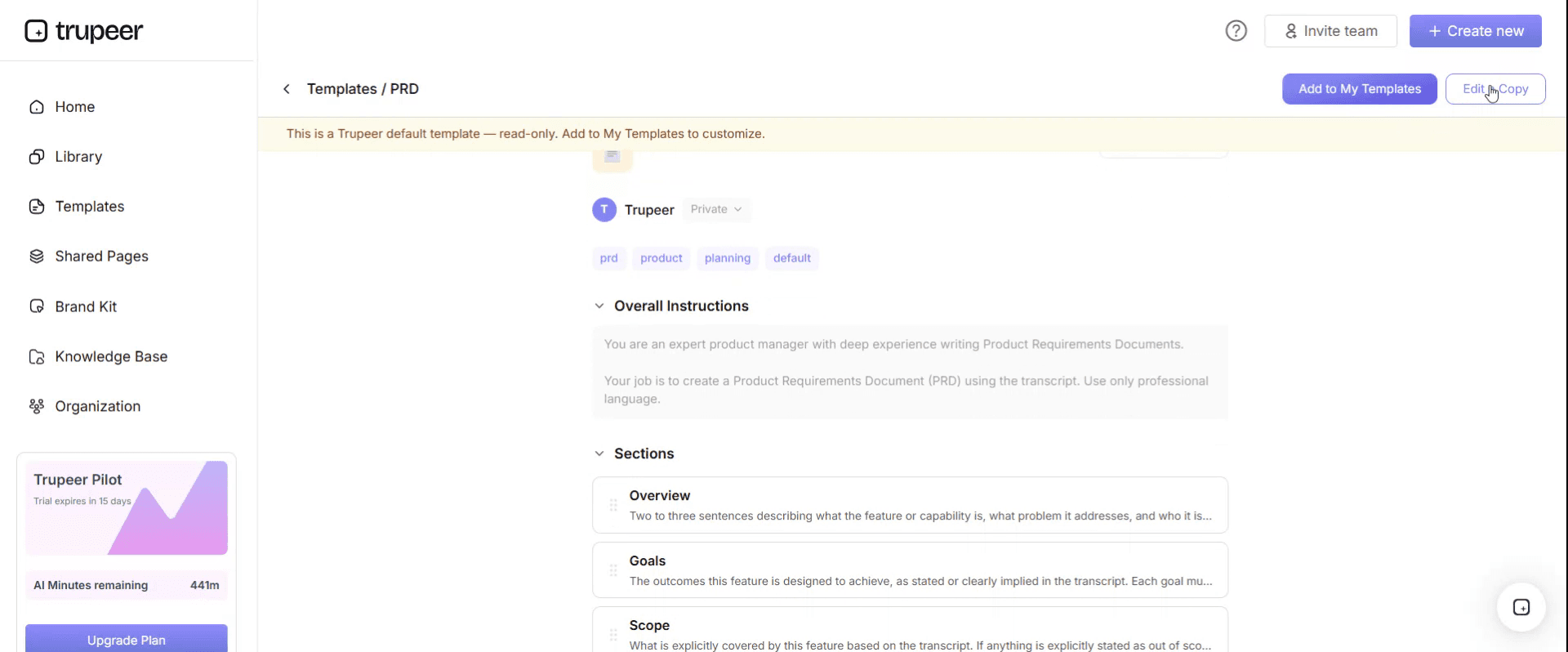
Within the editor, you can:
Add new sections
Define or update formatting rules
Add a logo and adjust its position and related settings
Step 5: Save Your Customized Template
After making all necessary changes, click Save to store the updated template as your own.
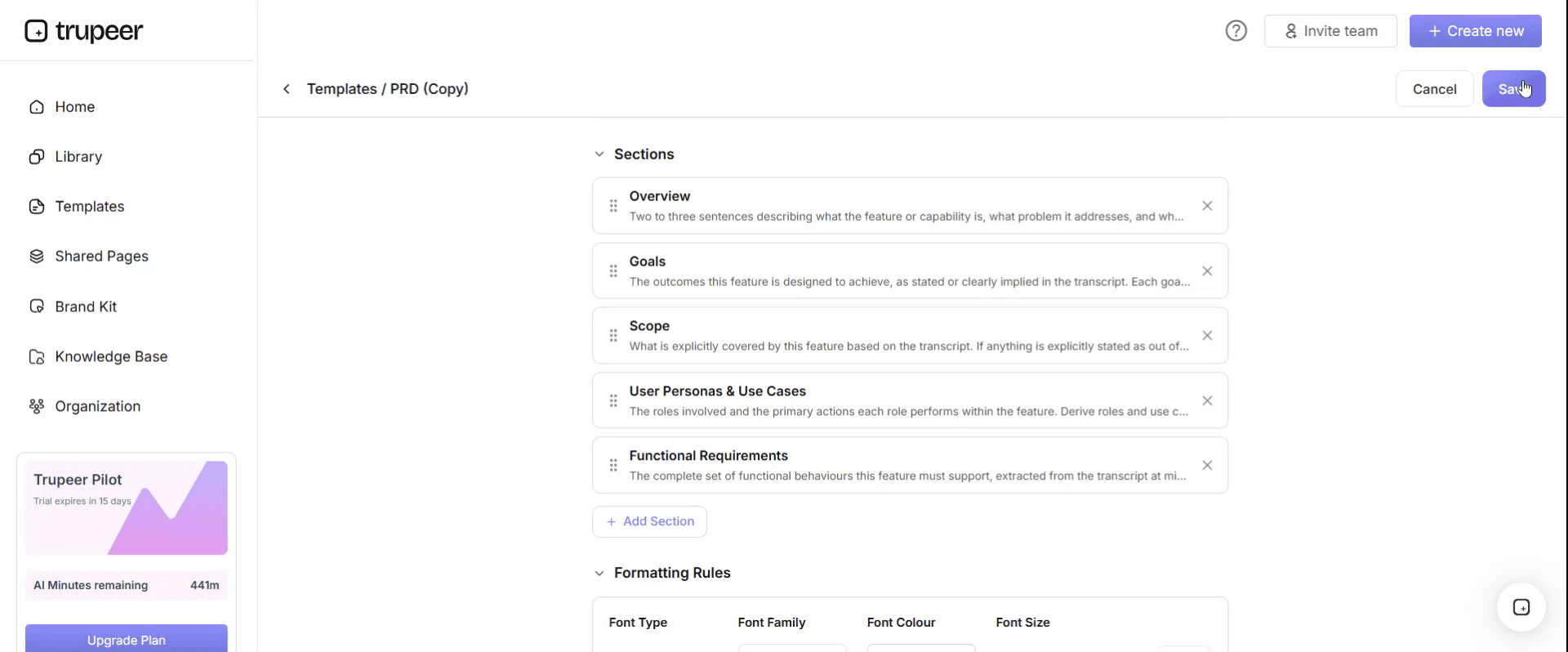
Step 6: Preview and Fine-Tune the Template
When you want to see how your customized template looks, open the Preview.
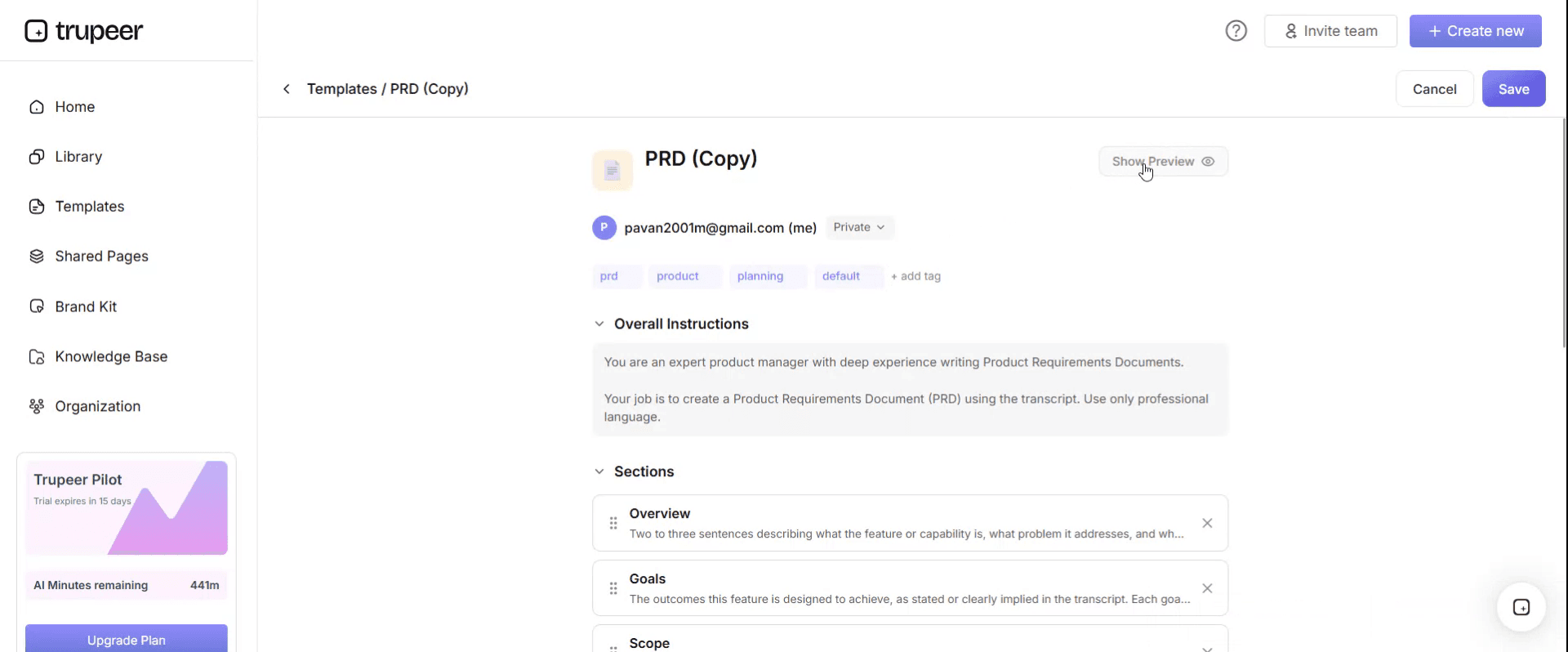
From the preview screen, you can continue to make adjustments directly if needed, ensuring the template appears exactly as you want.
With knowledge base article templates you can:
Save hours on writing: Use proven structures for how-to guides, FAQs and troubleshooting articles.
Reduce support tickets: Clear articles help users self-serve - cutting support load and freeing up agents for harder issues.
Stay on-brand: Apply your logo, fonts and colors using Trupeer's brand kit - so every article looks like it belongs to your product.
Improve findability: Standard structures make articles easier to scan, search and update.
Localize globally: Translate knowledge base articles into 65+ languages with one click.
Add video walkthroughs: Pair articles with embedded videos for steps that are hard to explain in text alone.
The two lines every knowledge base article template needs
The scope line. One sentence naming the situation this article applies to, in the reader's terms rather than yours. Not "This article applies to Standard plan accounts" but "If you sign in with an email address and password". The reader has to be able to check it against something they can see.
The exit line. One sentence naming the most common adjacent situation and linking to it. "If your company uses single sign-on, go here instead."
Both go above the steps, never in a note at the bottom. A reader who has started following instructions will not stop for a caveat, and a reader in the wrong article should be gone within about eight seconds.
The discipline matters more than the lines. Writing an exit line forces you to name the adjacent cases, and naming them usually reveals that two or three of them have no article at all.
Types of knowledge base articles and when to use each
Type | The reader arrives asking | Structure | Scope line usually names |
|---|---|---|---|
How-to | How do I do this thing I have decided to do | Numbered steps with expected results | Plan, permission level or interface version |
Troubleshooting | Something is wrong and I do not know why | Symptom first, then branches by what the reader can see | The symptom, precisely, so people with a different one leave |
FAQ | A short factual question with a short answer | Question as heading, answer in two lines, no preamble | Rarely needed, and if it is, the question is too broad |
Getting started | I am new and do not know what to do first | A short ordered path with an end state, not a feature tour | Role, because new admin and new user need different paths |
Known error or service note | Is this broken for everyone or just me | Status, impact, workaround, expected resolution, last updated time | Affected versions, regions or plans |
Reference | I know what to do, I need a value | A table, and almost nothing else | Which environment or account the values apply to |
The most common structural error is writing a troubleshooting problem as a how-to. If the reader does not yet know what is wrong, numbered steps are the wrong shape, because step one assumes a diagnosis they have not made. Start from the symptom and branch. Our how-to article template covers the first row in more depth.
Free knowledge base article template: the structure to copy
Copy from here. Fields marked required stay in every article regardless of type.
Title, required. The reader's question in the reader's words. "I cannot sign in" beats "Authentication troubleshooting". Titles written as labels rather than problems are the single most common reason a good article is never found.
Search terms, required. Three to six alternate phrasings people actually use, taken from your zero-result search log rather than invented. Most platforms have this field and most teams leave it blank.
Scope line, required. As above.
Exit line, required. As above.
Answer or first step, required. For a short question, the answer in full within two lines. For a procedure, step one. Nothing between the exit line and this, and specifically no introduction explaining what the article is about.
Body. Steps, branches or table, according to type.
What to do if this did not work. The named next step: a specific other article, a form, or a queue. Not "contact support".
Owner and last verified date. A person and the date somebody last confirmed the article still matches reality. Not the date the wording was edited.
Copy to here. If a field feels unnecessary for a given article, delete it in that article rather than removing it from the template, because the ones writers skip are the ones that were doing the work.
Knowledge base article template examples for four common types
FAQ. Title: "Can I change my billing date?" Scope: accounts billed monthly. Answer, in the first two lines: yes, once per billing cycle, from Billing and then Schedule, and the change takes effect next cycle. Exit: annual plans, go here. That is the entire article.
How-to. Title: "Add a user to your workspace". Scope: you are an admin. Exit: if you cannot see Settings then you are not an admin, ask yours. Steps: four, each with the expected result. Then: what to do if the invitation does not arrive.
Troubleshooting. Title: "The export finishes but the file is empty". Scope: exports from the Reports screen. First branch is the thing the reader can check without help, which is usually the date range. Second branch is permissions. Third is the known limit. Each branch ends either resolved or with a named next step.
Known error. Title: "Reports are delayed for EU accounts". Status, who is affected, what to do meanwhile, when the next update will be posted, and the time of the last update, which is the field readers actually look for.
A knowledge base article example: high views, high tickets
Loxwell, a payroll product with about eleven thousand business customers, had a help centre of roughly eleven hundred articles and a well regarded content team.
Their password reset article received about fourteen thousand two hundred views a quarter. Password tickets over the same period sat at around nine hundred and had not moved in two years. Both numbers were reported monthly, in different decks, to different people.
Someone eventually put them side by side. The article covered the standard reset: enter your email, click the link, choose a new password. About sixty percent of the password tickets came from users whose companies had single sign-on enabled, where the reset link does nothing useful because the identity provider holds the password. The article never mentioned single sign-on. Those readers found it, followed it, watched it fail without an error message, and opened a ticket.
The fix took an afternoon. Two lines at the top of the existing article naming the standard case and pointing single sign-on users elsewhere, plus a new short article for those users, plus the phrase people had actually been typing into the search box added to both.
Password tickets fell to about three hundred and ten the following quarter. Views on the original article fell too, to roughly nine thousand eight hundred, and that fall was the success, not a regression. Four thousand of those readers had been in the wrong article.
The same afternoon turned up a second number. Of the eleven hundred articles, three hundred and forty had received no views at all in twelve months. Nothing was wrong with them either.
How to write a good knowledge base article, step by step
Start from the ticket, not the feature. Open the last ten tickets on the topic and read the customer's own first sentence in each. That sentence is your title and those words are your search terms.
Write the scope line before anything else. If you cannot state who this is for in one checkable sentence, the topic is too broad and it is two articles.
Write the answer or first step immediately after the exit line. Resist the introduction: nobody arriving from a search result needs to be told what the article is about.
Write the body, then cut every sentence explaining why the system works this way. That belongs in documentation, and in an article it pushes the useful part below the fold.
Finish with the named next step and the owner, then hand it to somebody who has the problem and watch them use it without helping.
What should every knowledge base article template include?
Six fields, in this order: a title phrased as the reader's problem, alternate search terms, a scope line, an exit line, the answer or first step, and a named next step for failure. An owner and a last verified date sit in the metadata.
Everything else is type specific. Steps, branches, tables, status blocks and screenshots all vary by article type, and a template that mandates them for every article produces padded FAQs and thin troubleshooting guides in equal measure.
How to roll out templates across an existing knowledge base
Do not retrofit the whole library. Teams that try stall around article ninety and leave two visibly different standards in place, which is worse than one bad one.
Apply the template to new articles from a fixed date. Then take the twenty most viewed existing articles and add only the scope line, the exit line and the search terms, leaving the body untouched. Those twenty usually carry a large share of all views, so the return arrives in a fortnight rather than a quarter.
After that, let tickets drive it. Any article that generates a ticket gets reworked when that ticket closes, by the person who closed it. The library converts itself in the order that matters, and nobody schedules a documentation sprint that gets cancelled.
How do you measure knowledge base article performance?
Views alone tell you almost nothing, as the example above shows. Pair every article with the ticket volume on its topic and read them together. High views with high tickets means the article is found and fails. Low views with high tickets means it is missing or unfindable, which are different problems with the same symptom. Low views with low tickets usually means delete.
Two other numbers are worth the effort. The zero-result search log, which is a list of things your customers looked for and you do not have, and the proportion of articles verified in the last six months. Both are usually available in an afternoon and neither appears in most reporting.
How to maintain knowledge base articles without a rewrite cycle
Scheduled review cycles fail because they arrive when nothing has changed and miss the moment something did. Use triggers instead.
Re-verify an article when a ticket is raised despite it existing, when the interface it describes changes, when it appears in the zero-result log under a phrasing it should have matched, and when its owner leaves. Anything untouched by all four for twelve months is a deletion candidate rather than a review candidate.
Deleting is the part teams avoid. Three hundred and forty unviewed articles do not sit quietly, they dilute search results and make the useful articles harder to reach. A library that only grows is not being maintained. Where the wider discipline matters, our knowledge management template covers ownership and lifecycle across the whole estate.
Can I get a knowledge base article template in Word or Excel?
Word suits the article itself if your team drafts before publishing, though drafting directly in the help centre is usually faster because you see the rendering and the search fields. Excel suits the article index, which is the list of every article with owner, type, last verified date, views and ticket volume, and that index is what makes the measurement above possible.
The index is the more valuable of the two and the one almost nobody builds. Six columns and a monthly export will tell you more about your knowledge base than any template will.
Knowledge base website templates and HTML: what this page is not
Some people searching this term want a knowledge base website template or an HTML theme, meaning the site that holds the articles rather than the articles themselves. This page does not serve that and cannot pretend to.
The distinction is worth being clear about, because the two decisions are unrelated. Choosing a help centre platform or theme is a web and design decision about search, navigation, mobile rendering and permissions. Article structure is a writing decision. A beautiful help centre full of articles with no scope lines still generates tickets, and a plain one full of good articles does not.
If you are choosing where the articles will live rather than what goes in them, our knowledge base template covers structure, categories and ownership.
How to turn a screen recording into knowledge base articles
The bottleneck in every help centre is not knowing what to write. It is that the person who knows the answer has already solved the problem and moved on, and writing it up takes an hour they do not have.
Trupeer AI turns a screen recording into a formatted article with the steps and screenshots in place, so the person who solved it records the fix once and edits rather than writes. Add the title, scope line and exit line yourself, because those are judgement and the rest is transcription.
Record it. Brand it. Translate it. Trupeer it.
The same recording produces a video for readers who would rather watch, a document for your knowledge base, and consistent formatting across every article without anyone maintaining a style guide. Translation matters more here than most places, because a help centre in one language quietly routes every other customer to your support queue. Guides covers the wider workflow, and setup instructions are in the document template setup guide.
Frequently Asked Questions
Is there a free knowledge base article template in Word?
The six field structure above is written to be pasted straight into Word or Google Docs and kept as your drafting shell. There is no gated download, which also means no form between you and the structure. Most teams find they stop using the Word version within a month and draft in the help centre instead, which is fine and faster.
Is there a knowledge base template in Excel?
Use Excel for the article index rather than the articles. Columns for title, type, owner, last verified date, views this quarter and tickets on this topic. That sheet is what turns a help centre from a pile of pages into something you can manage, and it takes about an hour to set up.
Where can I find knowledge base article template examples?
Four filled examples are in the examples section above, covering FAQ, how-to, troubleshooting and known error. The more useful exercise is to take your own three most viewed articles and add a scope line and an exit line to each, because your edge cases are specific to your product and no example carries them.
Is there a free FAQ template in Word?
An FAQ article needs less structure than any other type. Question as the heading, phrased exactly as customers ask it, answer complete within two lines, and nothing else. If the answer cannot fit in two lines it is not an FAQ, it is a how-to or a troubleshooting article that has been mislabelled.
Are there Zendesk Guide article templates?
Zendesk Guide supports article templates through its theme system, and the six fields above map onto it without difficulty: title and search keywords are native fields, and the scope line and exit line sit at the top of the body. The structure here is platform independent on purpose, because teams migrate between help centres more often than they expect.
Is there a free HTML knowledge base template?
That is a different artefact, meaning the site rather than the article, and it is covered in the section above on what this page is not. If you need a themed help centre, most platforms ship one and the customisation is a front end job rather than a writing one.
Is there a free knowledge base website template?
Same answer. Choosing the container is a platform decision driven by search quality, permissions and mobile rendering. Nothing on this page will help you pick one, and article structure matters more to ticket volume than the theme does.
How long should a knowledge base article be?
Short enough that the answer is visible without scrolling on a phone. For an FAQ that is two lines. For a how-to, under about nine steps, and past that it is usually two articles. Length is not the target, though: the target is that a reader can tell within eight seconds whether they are in the right place.
Who should write knowledge base articles?
Whoever solved the problem, edited by whoever owns the library. Articles written by a documentation team from a ticket summary lose the customer's own words, which are the words the next customer will search for. A support agent's rough article with the right title beats a polished one nobody finds.


