4.8/5
Free GitBook Alternative for SaaS Documentation
The GitBook alternative for SaaS docs teams who need video walkthroughs and matching written articles from one screen recording, not just text on a hosted wiki.
Try Trupeer Free

Trupeer AI is the GitBook alternative for SaaS documentation teams who need video walkthroughs and matching written articles paired together, not just text on a hosted wiki site. To set expectations clearly: GitBook is excellent at hosting traditional SaaS documentation (custom domain, block editor, wiki structure with nested pages, OpenAPI reference auto-generation, full-text search). Trupeer doesn't replace any of that. Trupeer replaces a different layer: the production of walkthrough videos and matching written guides that customers actually use to learn the product. A SaaS doc team uses Trupeer to generate the content from screen recordings, then either ships it via Trupeer's Shared Pages or embeds it into the GitBook (or Mintlify, or ReadMe) docs site they already have. The gap in most SaaS documentation is that text-only docs without video walkthroughs are losing engagement against video-first competitors.
Trupeer is not a docs hosting platform. GitBook (custom domain, wiki structure, OpenAPI reference) still does that better.
Trupeer is the generator for the walkthrough videos and matching written articles that most SaaS docs need but GitBook cannot produce.
One screen recording produces both an MP4 walkthrough video and a PDF or Word article ready for the help center.
Translate SaaS docs into 65+ languages for international users, both video voiceover and written article in the same job.
Ship via Shared Pages (Trupeer-hosted, embeddable) or download the MP4 and PDF and host wherever the docs site lives.
What Trupeer produces that GitBook does not
A SaaS docs team opens Trupeer and starts a screen recording of the product flow they want to document: the user signup flow, the integration setup, the feature configuration, the API key generation. Trupeer AI handles the post-production. Filler words go. Zoom and cursor effects highlight the UI elements that matter. A draft walkthrough video and a draft written article arrive in the editor together, both pulled from the same source recording. The written article has screenshots and numbered steps inline. The walkthrough video has captions, zoom effects on critical clicks, and brand-kit-applied intro and outro slides. From there, the saas implementation is a natural next step, since the walkthrough is already captured.
What ships at the end is two assets from one recording: an MP4 walkthrough video ready for embedding in the GitBook docs site, posting to YouTube, or hosting on Trupeer's Shared Page; and a written article (PDF, Word, or pasted into the docs platform) with the same content as the video. SaaS docs that have both formats get used in two different modes: customers in the docs site read the article first and watch the video when they get stuck, customers in onboarding emails get the video link, customers in support tickets get the relevant Shared Page link. GitBook is good at the first mode and absent from the second; Trupeer is built for both. This is why it pairs well with the loom alternatives the walkthrough and the documentation come from the same source.
How this GitBook alternative works in three steps
Three steps cover the production flow from screen recording to embeddable assets. No video editor, no separate writer, no separate translation step.
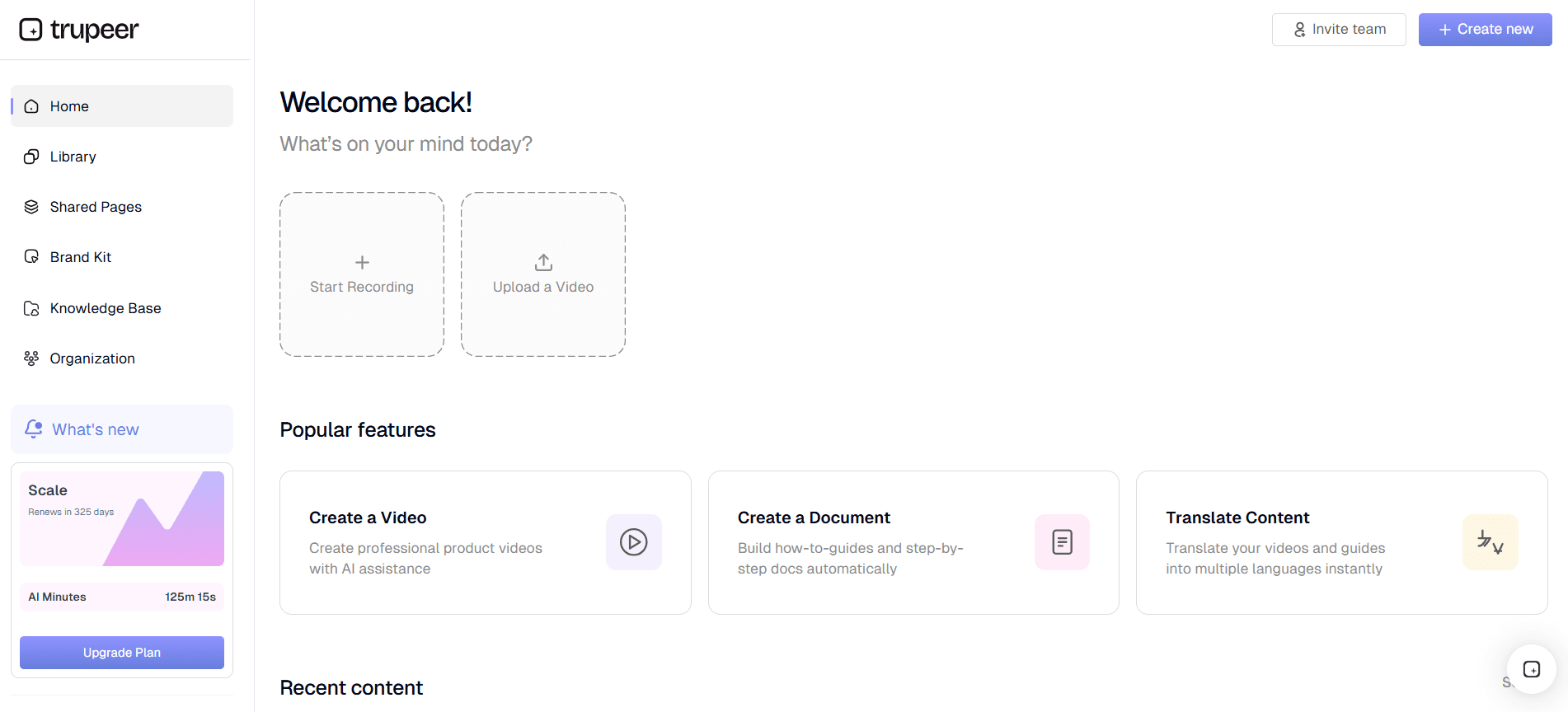
Step 1: Record the product flow
Hit record in the browser and walk through the product flow the customer needs to learn. SaaS docs use cases that work well: signup and onboarding, integration setup, API key generation and authentication, common feature configurations, troubleshooting walkthroughs. For SaaS teams without an internal recorder in mind, an AI avatar with a typed script delivers the same walkthrough as a talking-head video, useful when no one on the team wants to be on camera.
Step 2: AI generates the walkthrough video and written article
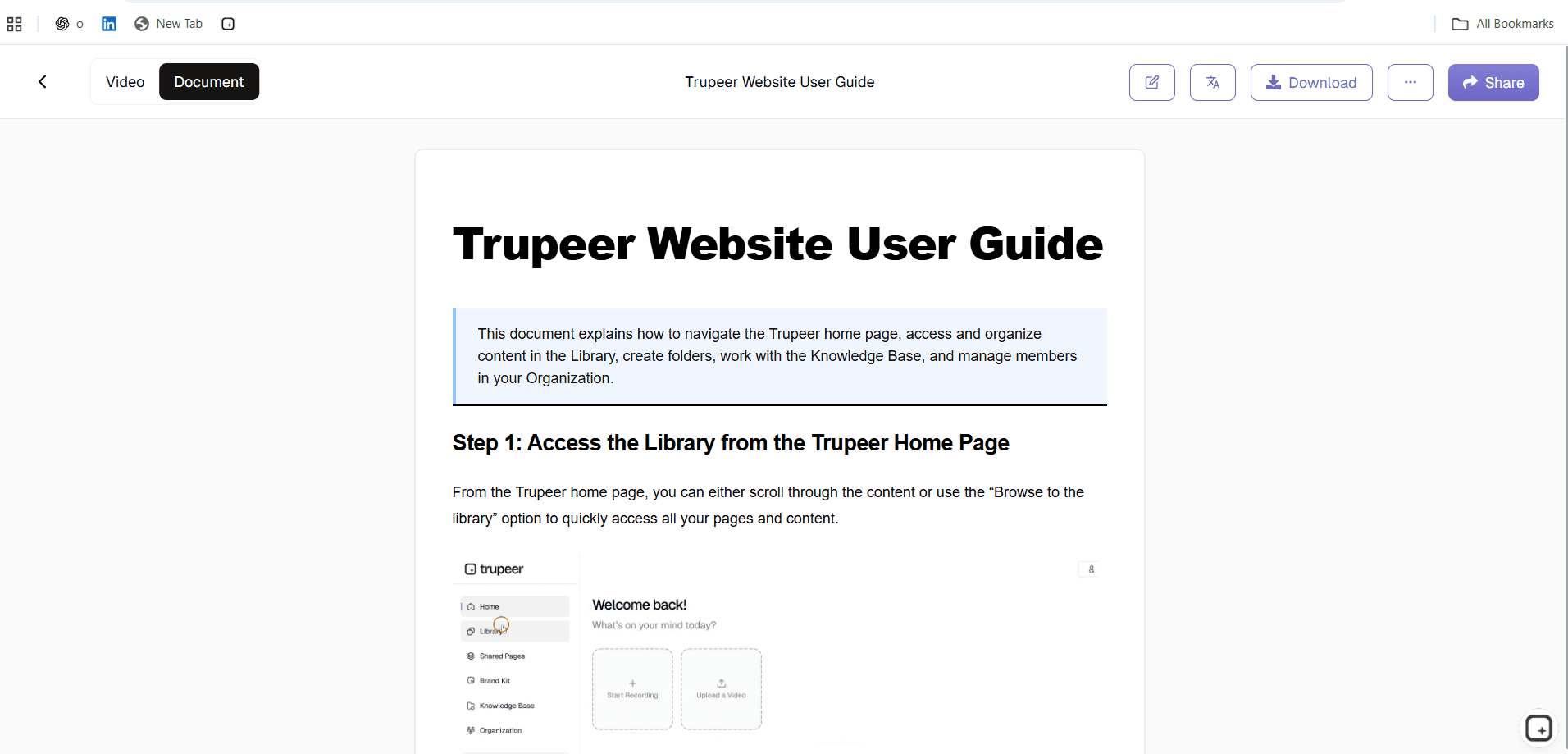
Filler words and pauses get removed. Zoom and cursor effects highlight where the user needs to click or what they need to read on screen. Brand kit applies the company logo, colors, intro and outro slides. A draft walkthrough video and a draft written article arrive in the editor together. The custom glossary catches product feature names, integration names, and API endpoint names that the AI wouldn't otherwise spell or transcribe correctly.
Step 3: Embed in the docs site or ship via Shared Page
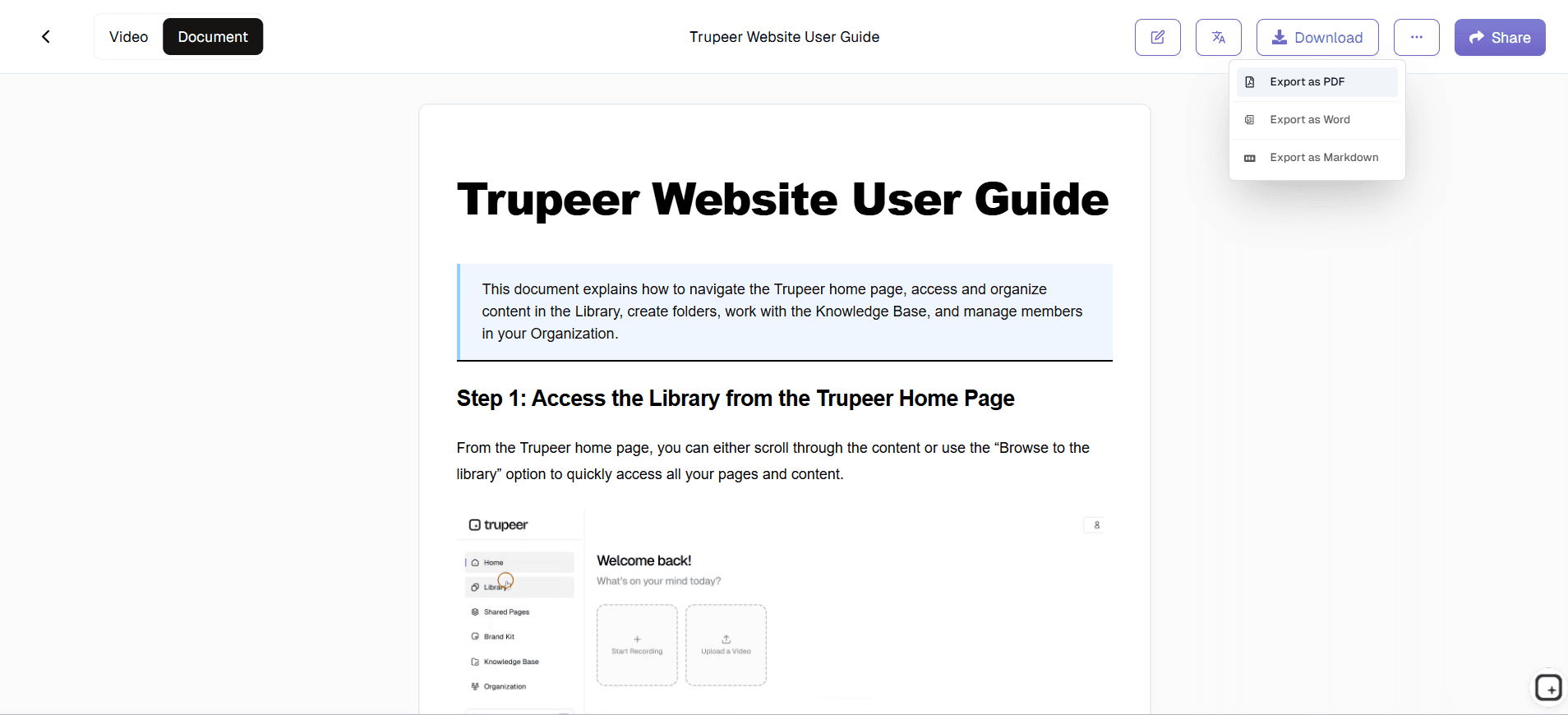
Embed the MP4 video into the GitBook docs page (or Mintlify, ReadMe, Notion, Confluence, Document360, or wherever the SaaS docs actually live) using the standard video embed code. Post the written article alongside it in the docs site's editor. Or skip the docs site entirely and ship via a Trupeer Shared Page link, which combines the video player, the transcript, the written article, and embed options into one branded URL the team can paste in onboarding emails or support replies. Translation across 65+ languages applies to both formats in the same job.
Who uses Trupeer alongside (or instead of) GitBook
The person who lands on this page is usually a SaaS docs lead, a developer relations manager, a product marketing manager, or a customer education specialist evaluating GitBook as a SaaS documentation platform for a docs rebuild and realizing the team also needs video walkthroughs that GitBook can't produce. They've looked at the alternatives to GitBook in the docs hosting category: Mintlify (modern, dev-focused, strong OpenAPI), ReadMe (API documentation focused), Docusaurus (open source, Meta-built), Document360 (knowledge base with workflows), Notion (general-purpose, used as a SaaS documentation tool by some teams), Confluence (enterprise wiki). Each of these handles the hosting and editor problem. None of them generates the video walkthroughs or the matching written articles from a screen recording, which is the gap Trupeer fills as a different category of SaaS documentation software.
The pattern that actually works for most SaaS docs teams: use GitBook (or Mintlify, or ReadMe) for the docs site itself, with the API reference, the conceptual overviews, the troubleshooting articles, and the general structure. Use Trupeer for the per-article walkthrough videos and the auto-generated matching written articles when a new feature ships, an integration changes, or the team realizes the existing text-only doc isn't enough. The two tools combine into a docs experience that has both the searchable hosted text content (GitBook's strength) and the visual walkthrough content (Trupeer's strength). Teams who try to use just one of these consistently find themselves missing the other half.
What SaaS documentation Trupeer handles well
The SaaS documentation types that benefit most from a video plus written article pairing: onboarding and product tour content (first 15 minutes inside the app), feature-specific walkthroughs (how to set up a webhook, how to invite a team member, how to configure single sign-on), integration setup guides (how to connect Slack, how to authenticate with the API, how to set up the data export), troubleshooting walkthroughs (what to do when X breaks), and feature update announcements (here's what changed in the latest release). Trupeer AI handles all of them from the same recording-to-doc flow.
Generally speaking, SaaS product documentation that benefits from showing the actual product running benefits from Trupeer. SaaS documentation that's about concepts, design principles, glossaries, FAQs, or API reference that doesn't show a UI flow is better off staying as text in GitBook or whichever documentation platform the team uses. The honest version of the value prop: Trupeer adds the video walkthrough layer to whatever SaaS docs platform the team already has. The team gets the documentation hosting from GitBook (or its alternatives) and the walkthrough production from Trupeer, instead of choosing between one or the other and missing capabilities either way. Treating Trupeer as a documentation tool that produces content, paired with a docs platform that hosts content, gives most SaaS product documentation libraries the best of both layers.
Where Trupeer fits next to GitBook and the rest of the docs platform market
Trupeer is not a replacement for GitBook's hosting layer. GitBook still owns the docs site at the custom domain, the wiki structure with nested pages, the block-based collaborative editor, the version control on individual pages, the public and private permissions, the full-text search, and the OpenAPI reference auto-generation. Trupeer doesn't try to compete on any of those features. Teams shopping the GitBook alternatives market for a like-for-like docs platform replacement (Mintlify, ReadMe, Docusaurus, Document360) should pick from that list. Teams looking for an alternative to GitBook because their actual gap is missing walkthrough videos and missing technical documentation in video form are looking at the right page.
Trupeer is also not a replacement for the API reference layer. Mintlify, ReadMe, Stoplight, and Postman build interactive API reference documentation from OpenAPI specs with try-it-now consoles, code samples in multiple languages, and authentication testing. Trupeer handles the human walkthrough of how to integrate with an API (the conceptual flow, the typical setup, the gotchas) but not the endpoint-by-endpoint reference. Most SaaS teams pair both: API reference docs in Mintlify or ReadMe, integration walkthrough videos and matching written articles in Trupeer.
What Trupeer replaces, faster and at lower production cost than the alternatives, is the manual labor of producing walkthrough content. Video editors, technical writers, and freelance documentation specialists all do this work today; the team that buys Trupeer reduces the per-asset cost from several hundred dollars (writer plus editor time) down to under $50 per asset (subject expert's recording time plus AI processing). Across a SaaS doc library with 100+ articles, the labor savings compound.
Translation and updates for global SaaS user bases
Most SaaS products run with international users from day one. The docs that ship in English work for the English-reading half of the user base and underperform for everyone else. Translation in GitBook (and most docs platforms) requires either manual rewriting or external translation services, both expensive enough that most SaaS docs teams skip translation entirely. Trupeer translates both the video voiceover and the matching written article in the same job, into Spanish, Portuguese, Hindi, Mandarin, French, German, Japanese, Arabic, or any of 65+ languages the user base speaks. Voice cloning carries the original presenter's voice across translated versions, so the localized docs feel intentional rather than dubbed.
Updates are the other axis where SaaS docs rot fast. A UI change breaks last quarter's walkthrough video, a feature update makes the existing written article misleading, an integration change breaks the entire setup guide. Most SaaS docs teams handle this by quietly letting the docs drift and answering the questions in support tickets each time a customer hits a now-stale article. Trupeer handles updates by re-recording just the changed step. The AI re-processes only that segment, both the video and the written article update in place, and the customer in the docs site (or in the embed inside GitBook) sees the current version automatically. Pairing this workflow with the Trupeer AI SOP builder covers both customer-facing SaaS documentation and the internal standard operating procedures that sit alongside it.
What Trupeer does that GitBook does not
Video plus written article from one recording
One screen recording produces both an MP4 walkthrough video and a PDF or Word written article, ready for embedding in the docs site or shipping via a Shared Page link.
Pairs with GitBook, does not replace it
Trupeer generates the walkthrough content; GitBook (or Mintlify, ReadMe, Notion, Confluence) hosts the docs site. The two combine into a docs experience with both searchable text and visual walkthroughs.
Translation for global SaaS user bases
65+ languages applied to both the video voiceover and the written article in the same job. Voice cloning carries the original presenter's voice across translated versions.
Generate SaaS docs in three steps
Step 1
Record the product flow or use an AI avatar with a typed script
Step 2
AI generates the walkthrough video and written article together
Step 3
Embed in GitBook (or alternative) or ship via Shared Page link
Frequently Asked Questions
Is this GitBook alternative free to use?
The core flow is free: record a SaaS product walkthrough, generate the video and written article, share via a Shared Page link. Paid tiers add brand kits, custom voice cloning, AI avatars from the full catalog, team workspaces, translation across 65+ languages, and longer recording limits. Pricing details on the pricing page.
Is Trupeer actually a GitBook alternative, or does it pair with GitBook?
Both, depending on what the team needs. If the SaaS docs team's current pain is "we have GitBook but our docs are text-only and customers want video walkthroughs," Trupeer is the alternative they actually need, because GitBook cannot produce the videos. If the team's pain is "we want a different docs hosting platform than GitBook," then they should look at Mintlify, ReadMe, Document360, or Docusaurus, all of which host docs sites with different feature sets than GitBook. Trupeer doesn't host docs sites at custom domains; it generates the walkthrough content that lives inside whichever docs site the team chooses.
Does Trupeer host SaaS docs at a custom domain like docs.yourcompany.com?
No. Trupeer's Shared Pages are branded URLs (Trupeer-hosted), useful for individual walkthroughs and integration guides. For a hosted docs site at docs.yourcompany.com with navigation, search, and a wiki structure, the team needs GitBook (or Mintlify, ReadMe, Document360, Docusaurus). Most SaaS teams pair both: a docs site for the structured content, Trupeer Shared Pages or embeds for the walkthrough videos and matching articles.
Can Trupeer auto-generate API documentation from OpenAPI specs?
No. Trupeer doesn't parse OpenAPI specs or auto-generate API reference docs. Tools like Mintlify, ReadMe, Stoplight, and Postman handle that work, with interactive try-it-now consoles, multi-language code samples, and authentication testing. Trupeer handles the human walkthrough layer: how to set up the integration, how to authenticate, what the typical workflow looks like, the gotchas the reference docs don't surface. Most SaaS teams pair Mintlify or ReadMe for API reference with Trupeer for integration walkthroughs.
How is updating SaaS docs different in Trupeer vs GitBook?
In GitBook, updating a doc means editing the markdown and republishing. In Trupeer, updating a walkthrough means re-recording just the changed step; the AI re-processes only that segment, and both the video and the written article update in place. The Shared Page link stays the same, so any docs site that embeds the link automatically shows the current version. Customers see the updated walkthrough without the docs team manually pushing a republish across multiple formats.
More Tools