4.8/5
Free Documentation Tool for Remote Engineering Teams
The walkthrough documentation tool for distributed engineering teams. Senior engineer records the explanation once, Trupeer AI generates video plus written engineering document, the rest of the team consumes async.
Try the Engineering Documentation Tool
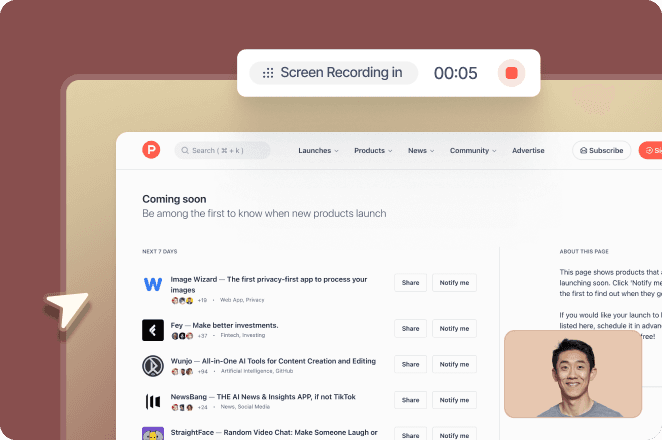
Trupeer AI is the walkthrough documentation tool for remote engineering teams who can't lean over and ask the person next to them. A senior engineer records the explanation once (how the deploy pipeline actually works, why this service handles retries the way it does, what the gnarly part of the codebase does and why it's gnarly), and Trupeer AI generates both a video and a written engineering document in the same job. Other engineers, working in different time zones and different offices, watch and read async. Distributed engineering teams don't suffer from missing READMEs so much as from missing the explanation behind the README, which is the part that takes a senior engineer an afternoon to write and which nobody ever has the bandwidth for.
Senior engineer records the walkthrough. Video and written engineering document arrive together.
Built for the asynchronous, multi-timezone workflow distributed engineering teams already live in.
Translate documentation into 65+ languages for engineering teams spanning the US, India, Europe, and LATAM.
Sits alongside the team's existing wiki, code repo, and API docs. Doesn't replace any of them.
Update by re-recording the changed step. The architecture explainer doesn't drift out of date.
What Trupeer AI produces for engineering teams
A senior engineer opens a screen recording. They walk through deploying the production service, debugging the staging environment, or explaining the message-queue design choice the team made in 2024. Trupeer AI handles the post-production. Filler words go. Zoom effects highlight the terminal command, the IDE region, or the dashboard the next engineer needs to look at. A draft video and a draft written engineering document show up in the same place, with screenshots and numbered steps inline.
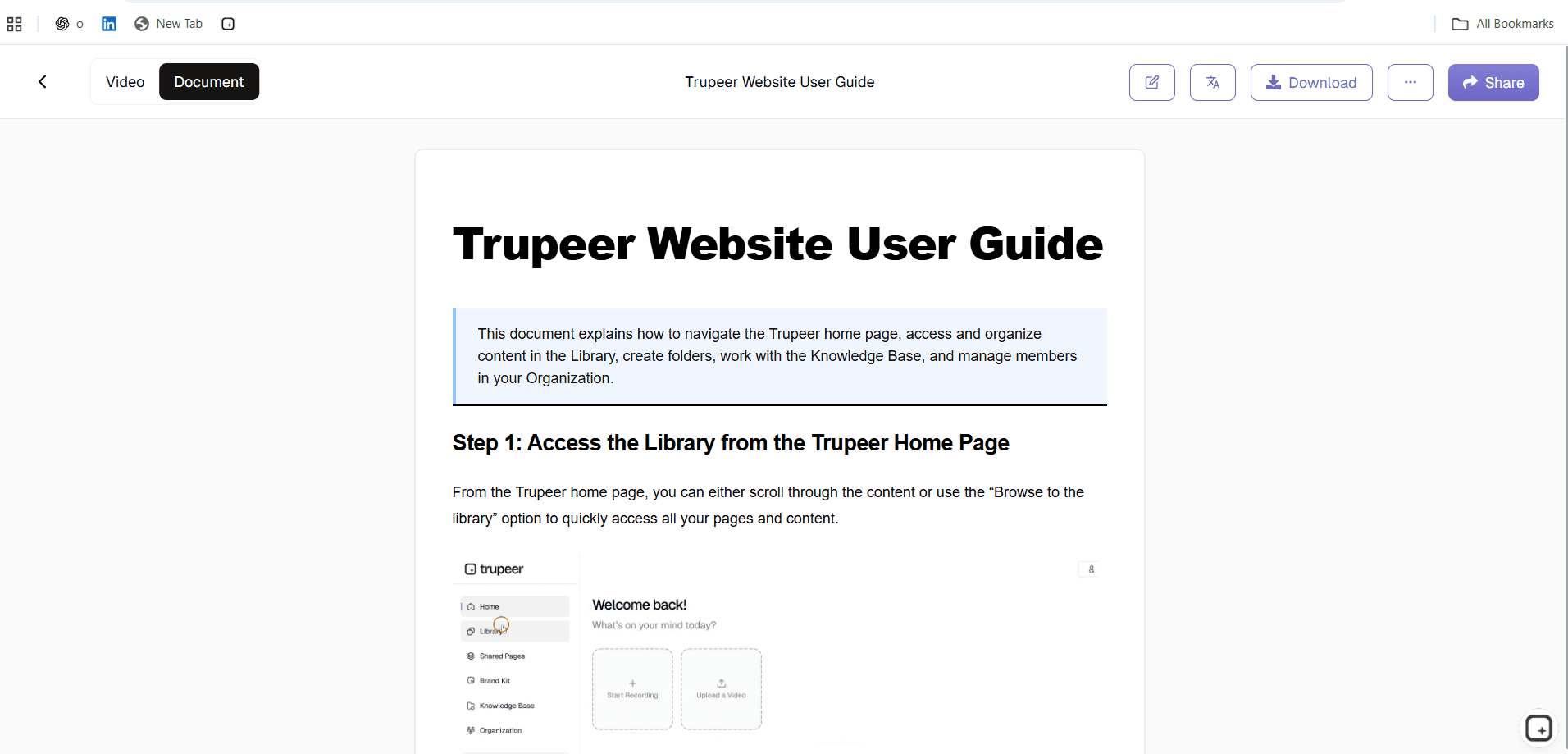
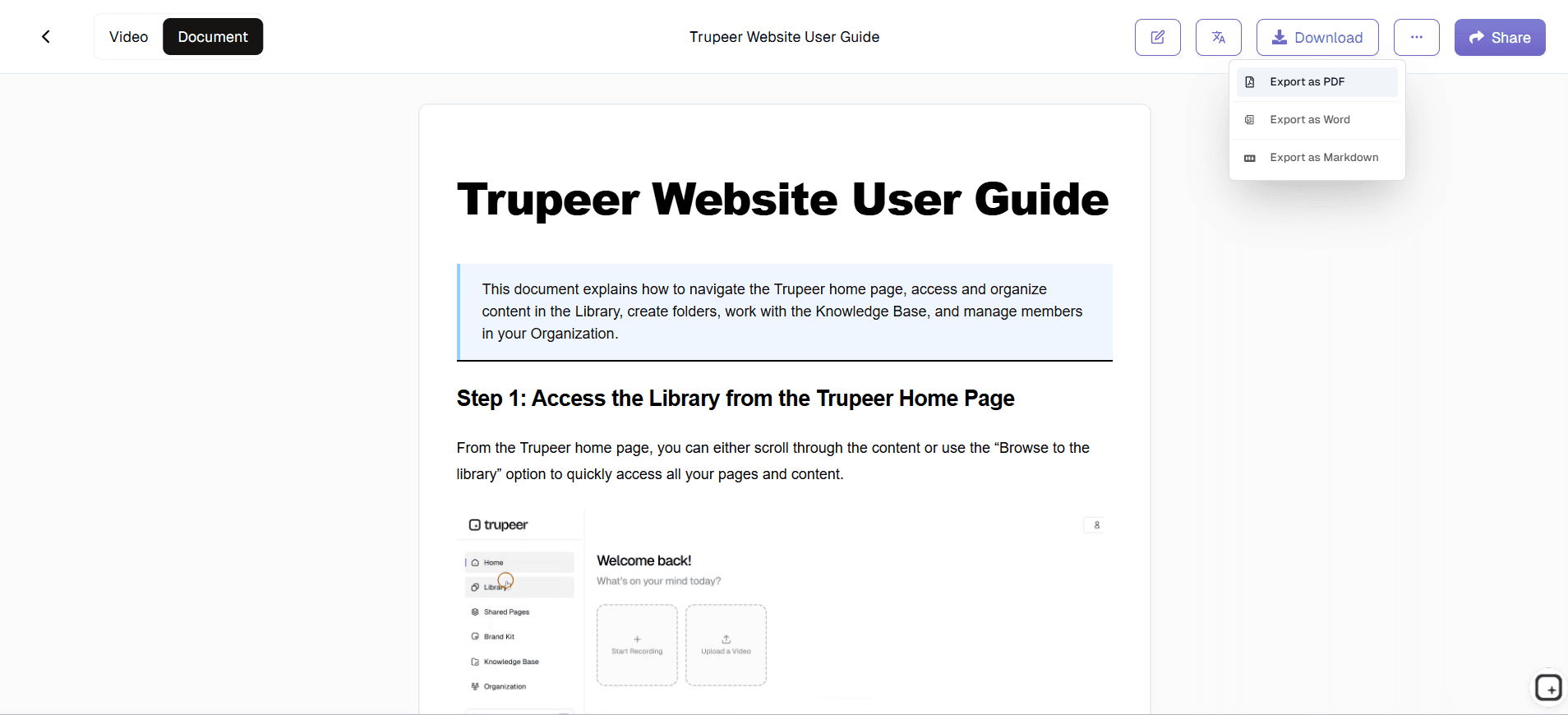
Outputs ship as MP4 video and PDF or Word document. The document is what someone reads in a wiki or pastes into Notion or Confluence. Videos are what someone watches in the help center, embedded in a Linear ticket, or shared via a Shared Page link. Both come from the same recording with no second pass. The brand kit applies engineering-team-specific intro and outro slides, and the custom glossary handles internal service names, infrastructure component names, and acronyms the AI wouldn't otherwise spell correctly.
How the engineering documentation tool works in three steps
Three steps cover the full flow: record what the senior engineer already does in their head, let the AI generate both formats, and ship via a link the rest of the team can find regardless of time zone.
Step 1: Record the explanation
Start a screen recording in the browser, in the engineering team's IDE, or over the terminal. The senior engineer talks through the work the same way they would in a 1:1 with the new hire. Five to ten minutes of recording is usually enough for an architecture explainer or a deployment walkthrough. The AI works on what's recorded, so the senior engineer doesn't need to write a draft or prepare slides.
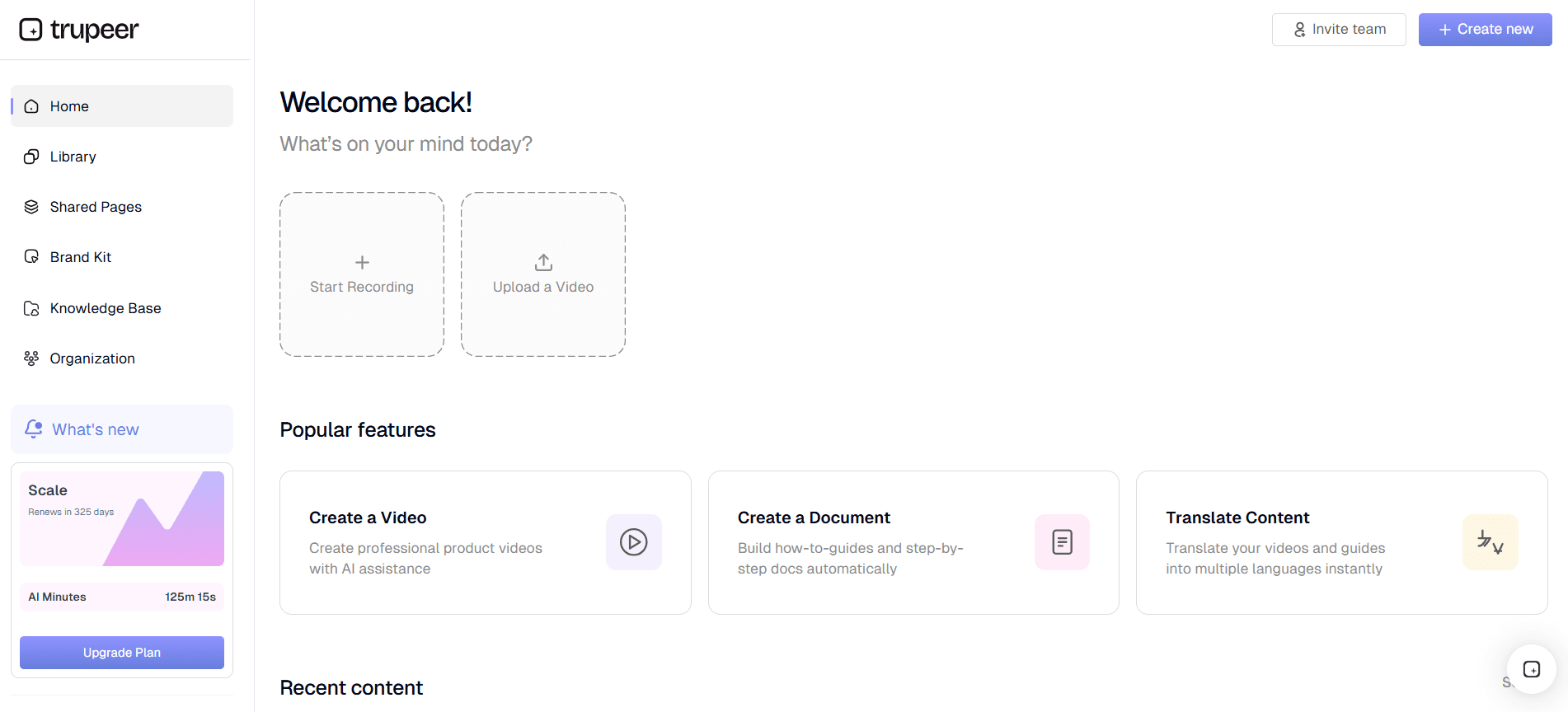
Step 2: AI generates the video and written engineering document
Filler words and "let me find that file" moments get removed. Zoom effects highlight the parts of the screen that matter (the file path, the terminal output, the diff in the PR review). A draft video and a draft written engineering document show up in the editor together. The custom glossary catches internal service names and component acronyms before they get transcribed wrong.
Step 3: Brand, translate, share
Apply the brand kit so engineering-internal documents look consistent across the team's library. Translate into the languages the team actually works in: Spanish for the Mexico City office, Hindi for the Bangalore team, Portuguese for São Paulo. Ship via a Shared Page link that lives in the wiki, in the team's onboarding doc, or pasted directly into Slack threads where engineers can find it without breaking flow.
Who opens this engineering documentation tool
The person who opens this tool is usually a staff engineer, an engineering manager, or a tech lead at a remote-first or hybrid engineering org with people across at least two time zones. They open it when a new hire joins and the README isn't enough, when the team makes a non-obvious architectural decision worth recording the reasoning for, or when the on-call runbook needs to actually explain what to do at 3am instead of just listing commands. Some teams use it routinely for every major design decision; others reach for it only when the explainer-shaped gap shows up.
The same workflow shows up across roles. DevOps and SRE leads record incident retros and infrastructure walkthroughs that get shared to the broader engineering org. Engineering managers record onboarding walkthroughs for new hires so the same questions don't get asked in DMs every week. Tech leads record architecture decisions so future engineers know why a system looks the way it does. Heads of engineering record the cross-team rollouts (a new internal platform, a service migration, a change to the deploy process) that would otherwise require a 50-person all-hands meeting nobody wants to attend.
Engineering content types this tool handles
The content types that come up most often: architecture and design walkthroughs (why this system looks like this), deployment and infrastructure runbooks (how to ship to production, how to roll back), onboarding walkthroughs (the codebase tour, the local dev setup, the first PR walkthrough), incident retros and post-mortems (what happened, what we learned, what we're changing), and code review explainers (the why behind a non-obvious PR). Trupeer AI handles all of them with the same recording-to-document flow. The format adjusts: a runbook wants numbered steps with screenshots, an architecture explainer wants the video with the written summary, an onboarding tour wants both.
For engineering documentation more broadly, Trupeer AI fills the explainer layer that text-only wiki tools leave empty. Software engineering documentation typically falls into three layers: code-generated reference docs (Sphinx, javadoc, OpenAPI), team wiki content (Confluence, Notion, Slab), and human-recorded walkthroughs. Most engineering teams have the first layer because it's automatic and the second because someone got paid to write it. The third layer (system documentation in software engineering, engineering project documentation, internal documentation in software engineering) is the one that always lags. Trupeer AI makes producing that third layer fast enough that a senior engineer can do it on a Friday afternoon between meetings.
Where Trupeer fits next to wikis, code-doc tools, and API documentation generators
Trupeer AI doesn't replace the team's wiki. Confluence, Notion, Slab, GitBook, and the internal team wiki keep doing what they do. Trupeer AI produces the recorded explainer content that gets embedded into those wikis as a Shared Page, alongside the written articles the team already writes.
Trupeer AI also doesn't replace API documentation generators. Swagger, Stoplight, Redoc, Postman, and any auto-generated OpenAPI reference keep handling the endpoint-level reference docs. Trupeer AI sits at a different layer: the human walkthrough of how the API was designed, how to actually integrate against it, and what the gotchas are that the reference docs don't surface. An engineering team's documentation library typically wants both, the auto-generated reference and the human-recorded explainer. Trupeer AI handles only the second; the first stays where it lives. The same logic applies to code-level tooling like Doxygen, javadoc, and inline comment systems, which Trupeer AI complements rather than competes with. For engineering documentation management and technical documentation more broadly, this means the team adds an explainer layer without ripping out anything they already have.
Updates and translation for globally distributed engineering teams
Engineering documentation rots faster than non-engineering teams expect because the underlying systems change weekly. A deploy pipeline change breaks last quarter's runbook, an architecture refactor makes the design doc misleading, a renamed service makes the onboarding walkthrough confusing. Most teams handle this by quietly letting the docs drift and answering the questions on Slack each time someone hits the now-stale doc. Trupeer AI handles updates by re-recording just the changed segment. The AI re-processes only that part, both video and written engineering document update in place, and the next engineer to look at the wiki sees the current version.
For globally distributed engineering teams, translation reduces the friction nobody mentions in standup. The same architecture explainer reaches the Bangalore team in Hindi, the Berlin team in German, and the São Paulo team in Portuguese, from the same source recording, in the same week. Translation applies to both the video voiceover and the written engineering document, with brand kit, glossary, and on-screen text carried through. Pairing this engineering team documentation workflow with the Trupeer AI SOP builder covers both the engineering-facing walkthroughs and the cross-functional standard operating procedures engineering teams hand off to other parts of the org.
Why remote engineering teams use Trupeer AI
Video plus written engineering doc in one pass
Senior engineer records once. Trupeer AI generates both an MP4 walkthrough video and a written engineering document with screenshots and numbered steps, from the same source recording.
Async by design, built for time-zone gaps
Output ships as a Shared Page link engineers in different time zones consume on their own schedule. No live attendance required. No scheduling across Pacific, India Standard, and Central European time zones.
Translation for globally distributed engineering
65+ languages applied to both video and written engineering document in the same job. The Bangalore team, the Berlin team, and the São Paulo team all read the same architecture explainer in their own language.
Document engineering work in three steps
Step 1
Senior engineer records the explanation (deployment, architecture, debugging, onboarding)
Step 2
Trupeer AI generates video and written engineering document together
Step 3
Brand, translate, share via a Shared Page link the whole team can reach async
Frequently Asked Questions
Is the engineering documentation tool free to use?
Yes for the core flow. Record an engineering walkthrough, generate the video and written engineering document, share via a Shared Page link without paying. Paid tiers add brand kits, custom voice cloning, AI avatars, team workspaces, translation across 65+ languages, and longer recording limits. Pricing details on the pricing page.
Does Trupeer AI auto-generate API documentation from code?
No. Trupeer AI is not an API documentation generator. It doesn't parse OpenAPI specs, scan source code, or auto-build reference docs from comments. Tools like Swagger, Stoplight, Redoc, Postman, and ReadMe handle that work. Trupeer AI handles the human-recorded walkthrough layer (the architecture explainer, the deployment runbook, the onboarding tour) that sits alongside auto-generated API reference docs, not as a replacement for them.
What inputs and outputs does the engineering documentation tool support?
Inputs: screen recordings (browser-based), webcam recordings, video uploads (including Zoom recordings of architecture discussions), audio files, and text scripts. Outputs: video as MP4 and engineering document as PDF or Word (DOCX). Both also ship as a Shared Page, which is a branded link engineers can paste into wiki articles, embed in onboarding docs, or drop into Slack and Linear.
Can my team translate engineering documentation into other languages?
Yes. Translation covers 65+ languages and applies to both the video voiceover and the written engineering document in the same job. A team with engineers in San Francisco, Bangalore, Berlin, and São Paulo can ship the same architecture explainer in English, Hindi, German, and Portuguese from one source recording. Brand kit, glossary, and on-screen text carry through translation.
Does Trupeer integrate with our existing engineering tools (Confluence, Notion, Linear, GitHub)?
Trupeer AI doesn't pipe content directly into Confluence, Notion, Linear, or GitHub. Output ships as a Shared Page link (which embeds into any of those tools), a downloadable MP4 video file, or a PDF/Word document the team can attach to a wiki page or link from a code repo README. The integration layer for engineering teams is the link, not a native API connection. Teams that want native CMS integration usually rely on the Shared Page embed paired with their existing internal docs platform.
More Tools