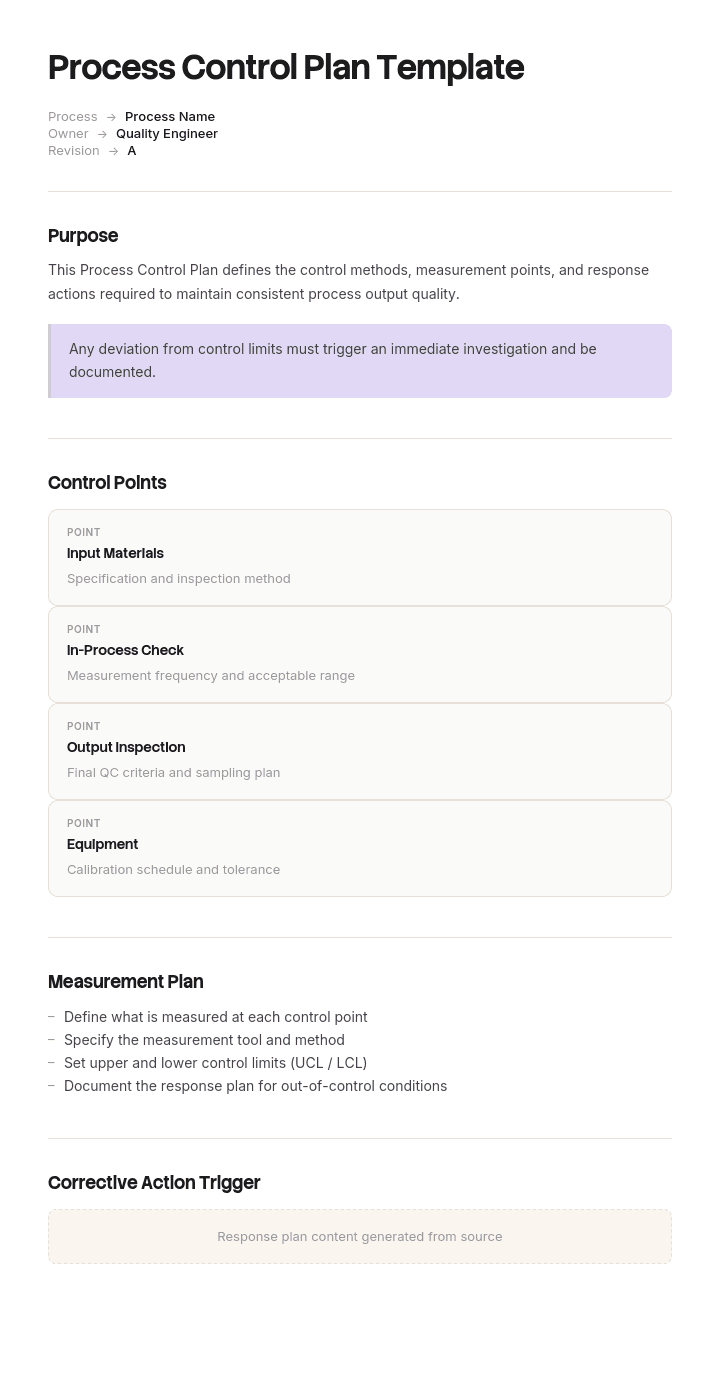
Use this template
A process control plan is a core quality tool - especially in manufacturing, automotive, aerospace and medical devices. With Trupeer, you can save hours on quality documentation by starting with a free process control plan template, customizing it with your brand guidelines, and turning control plans into video walkthroughs operators can reference at the line.
What is a process control plan template?
A control plan is the document listing, for every step of a process, what is being controlled, to what specification, how it is measured, how often, by whom, and what happens when it is out of tolerance.
In automotive and aerospace supply chains it is a formal deliverable, sitting in the core quality planning set alongside the process flow diagram and the process FMEA, and it is one of the first documents a customer or auditor asks for. Elsewhere it goes by other names and does the same job: turning what you have decided matters into something checked on a schedule.
A process control plan template is the reusable format. It is almost always a spreadsheet, and that is correct rather than a compromise, because the document is a table with thirty rows and fifteen columns and it needs sorting, filtering and totalling.
Templates for it are easy to find and they all carry the same columns. The two things they get wrong are how frequency is chosen and what the reaction plan actually says.
Why sampling frequency is a containment decision
Ask why a characteristic is checked every four hours and the honest answer is usually that four hours suits the shift pattern, or that it was set during launch and never revisited, or that it is what the customer's template suggested.
Frequency gets treated as a detection question: how often do we need to look in order to catch a problem. Framed that way, less frequent checking looks like a saving.
It is not a detection question. It is a quantity question. The interval between checks defines how much product becomes suspect the moment a check fails, because everything made since the last conforming result is unverified.
At two hundred parts an hour, a four hour interval means eight hundred parts sit between checks. That is the real cost of the frequency decision, and it is invisible because it only materialises on the day something goes wrong.
So the useful question when setting frequency is not how often should we measure. It is how many parts are we willing to put in quarantine, and the answer follows from what those parts are worth and where they will have got to by the time you find out.
How to customize this template in Trupeer
Step 1: Open the Templates Section
Go to the Templates section from the main navigation.
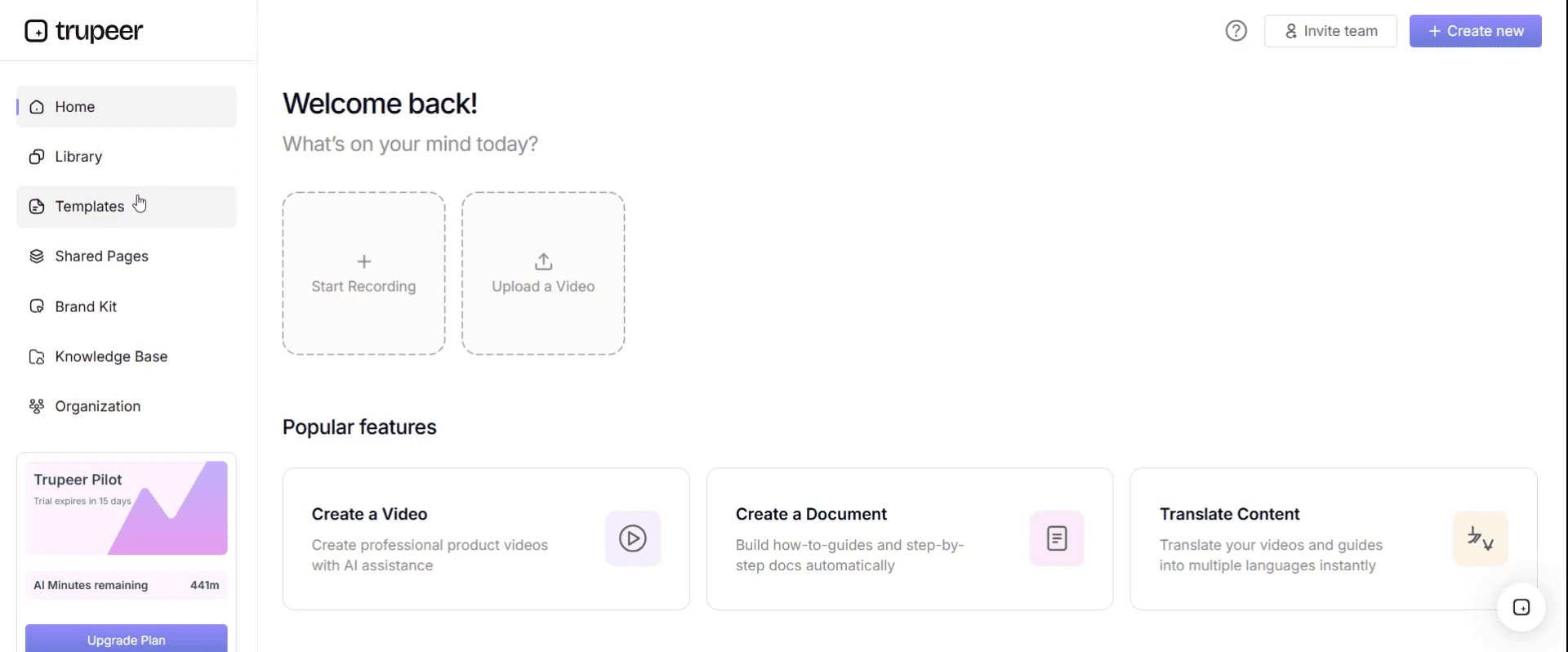
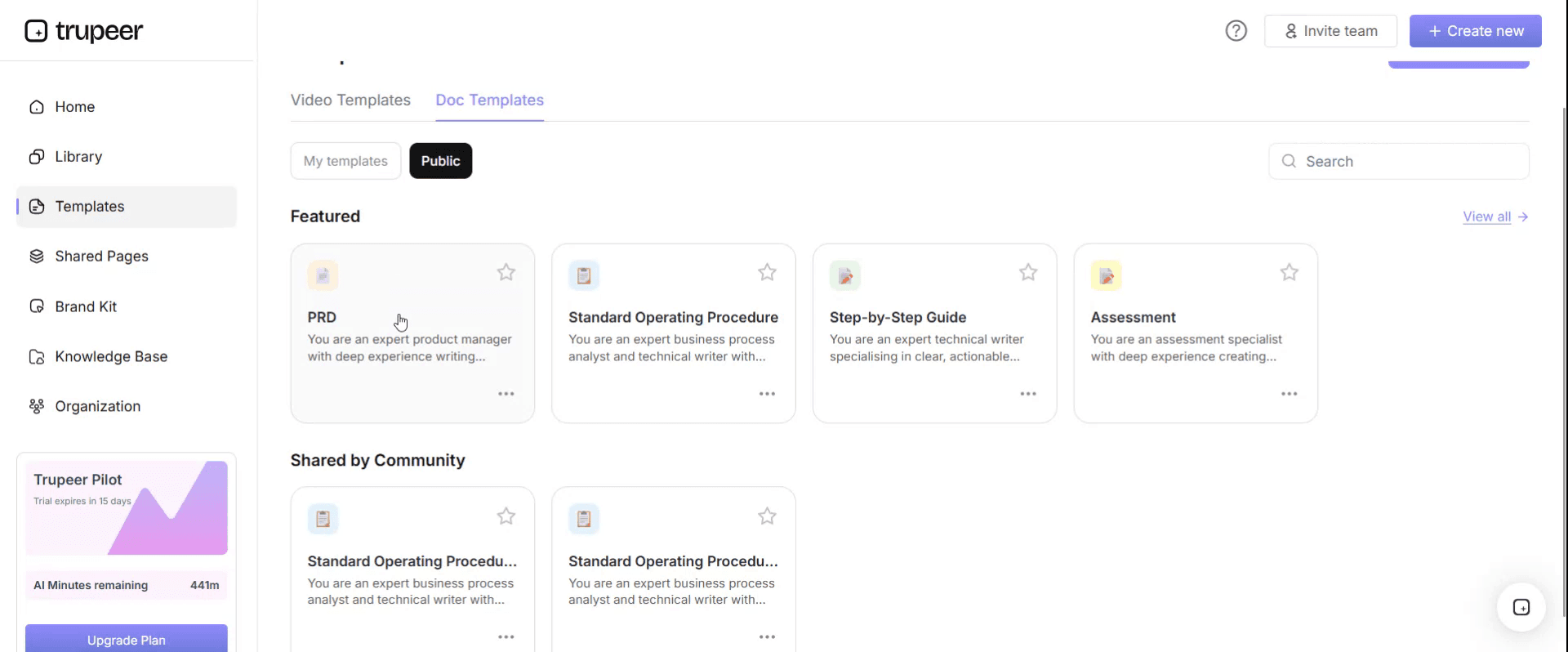
Step 2: Select and Open a Template
Click on any template you want to work with to open it.
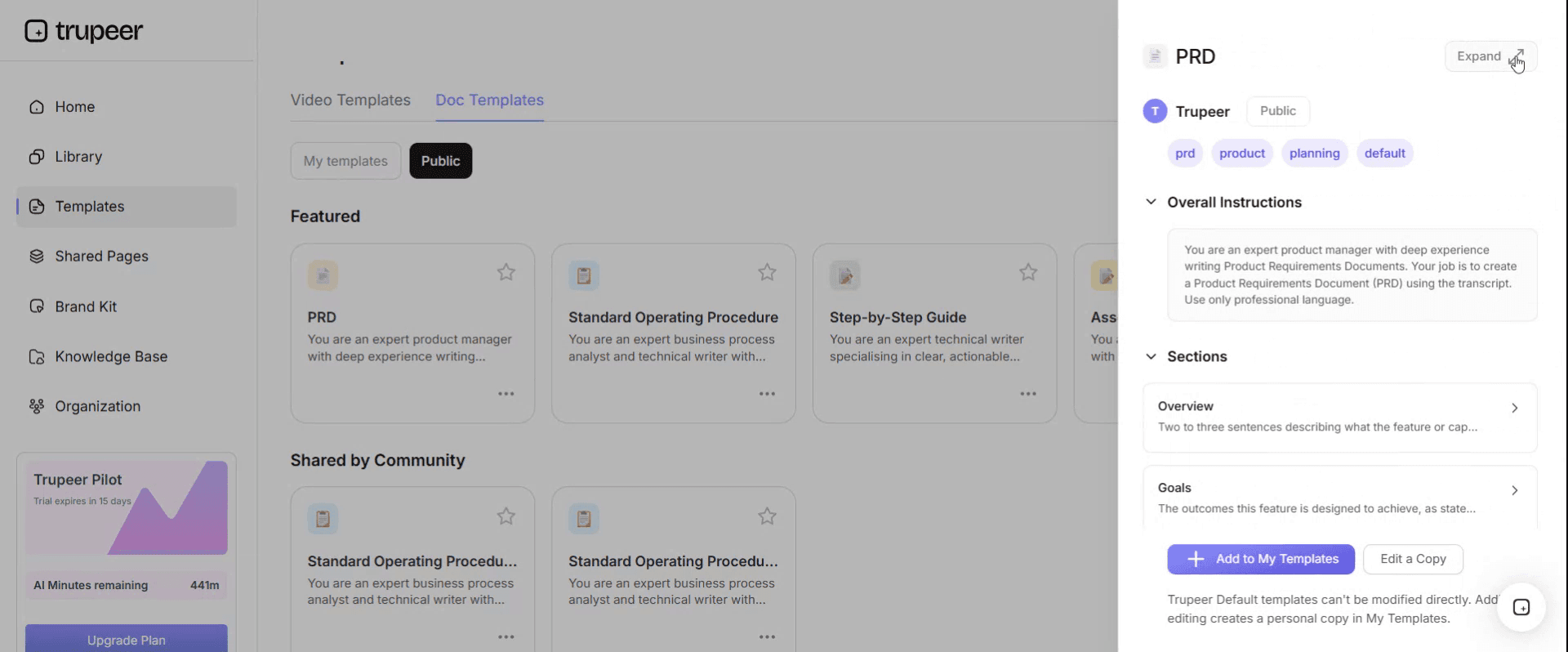
Step 3: Expand the Template View
If needed, expand the template view to see the full layout and details clearly.
Step 4: Edit the Template
Click on Edit to start modifying the selected template.
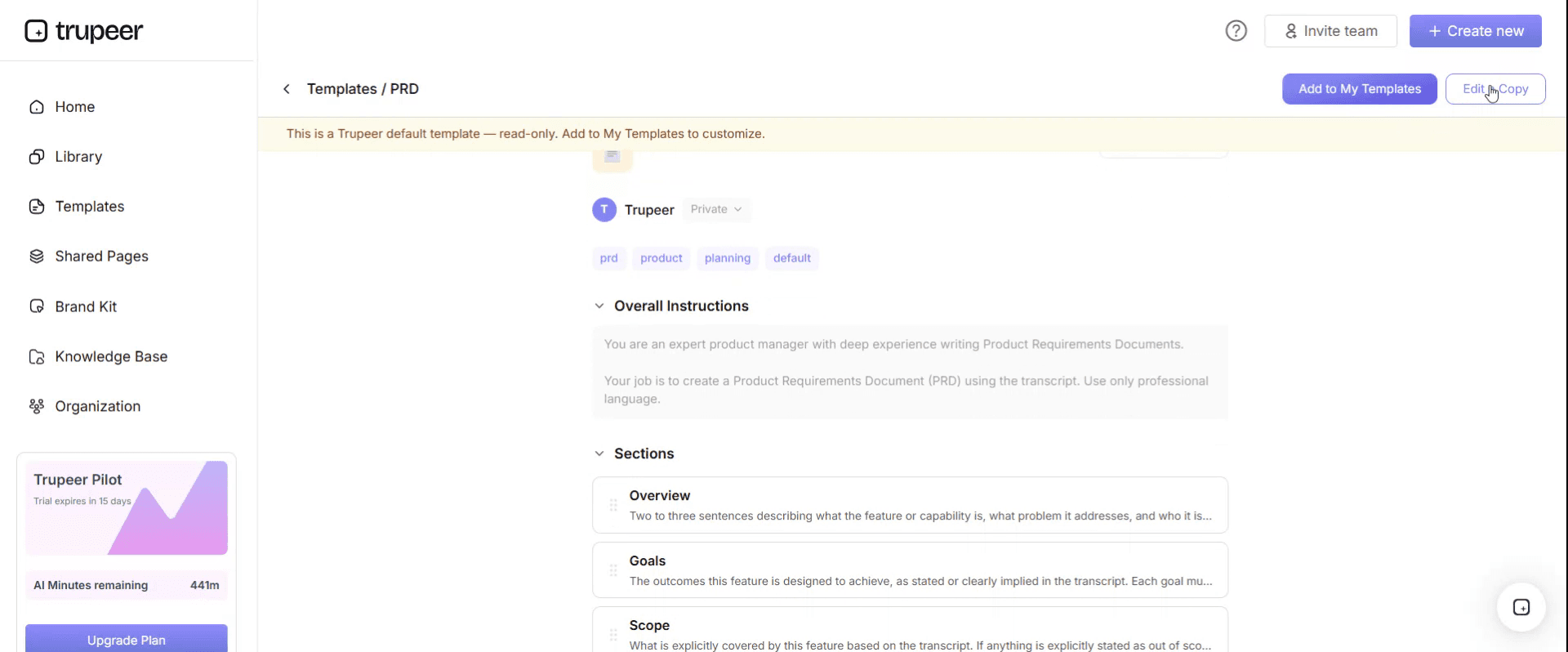
Within the editor, you can:
Add new sections
Define or update formatting rules
Add a logo and adjust its position and related settings
Step 5: Save Your Customized Template
After making all necessary changes, click Save to store the updated template as your own.
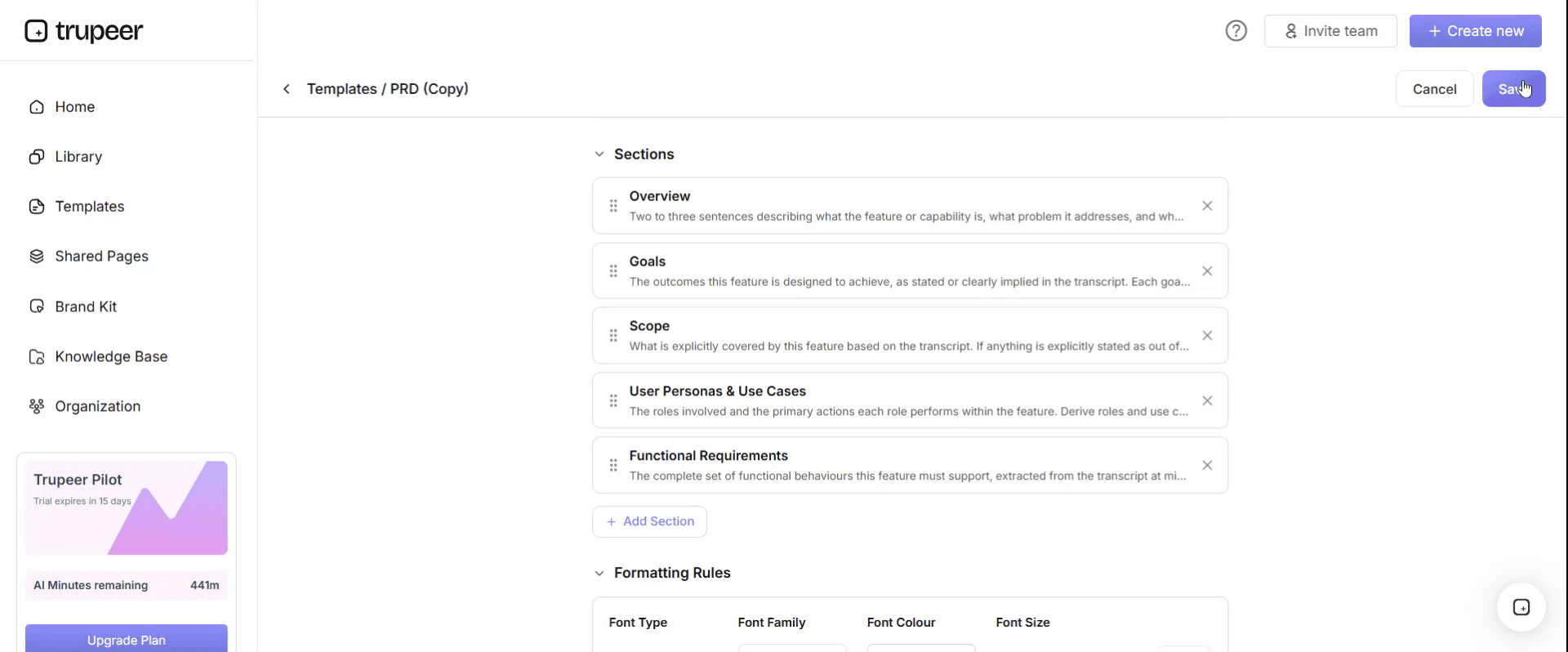
Step 6: Preview and Fine-Tune the Template
When you want to see how your customized template looks, open the Preview.
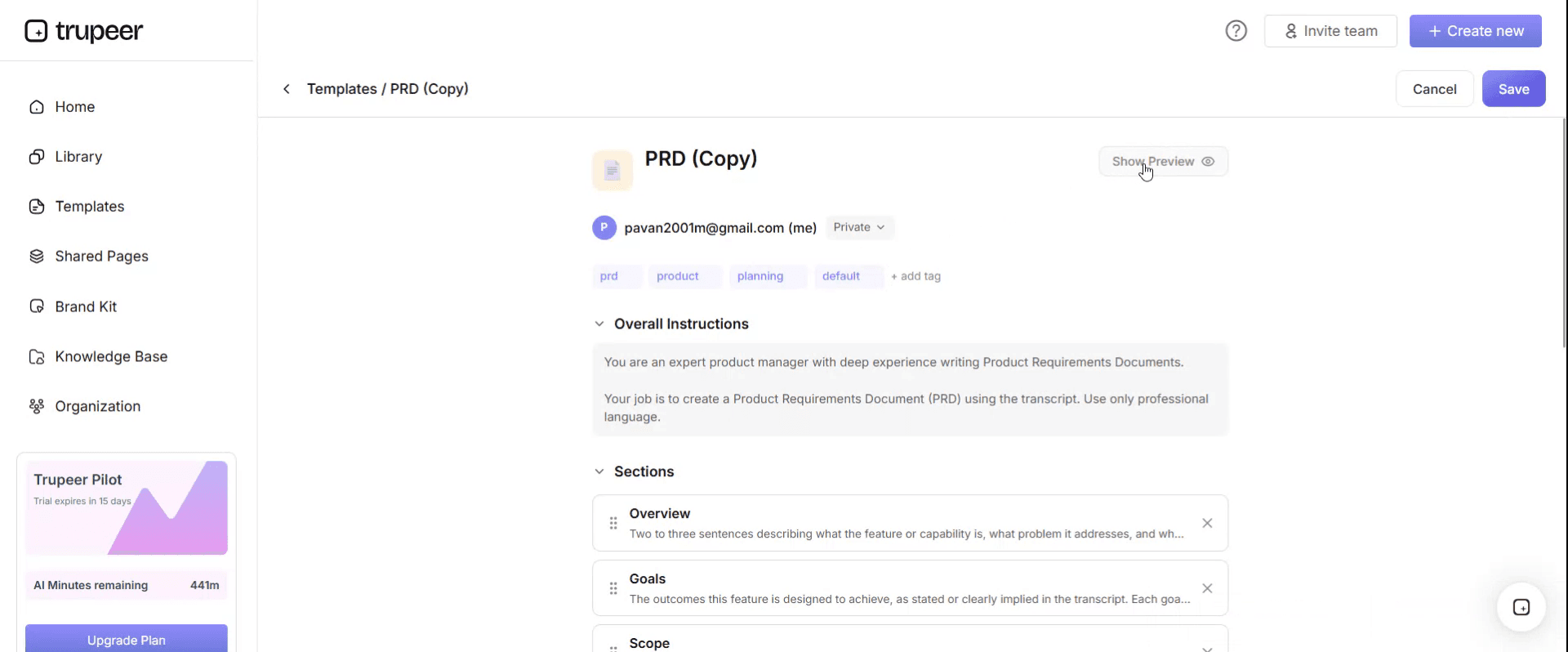
From the preview screen, you can continue to make adjustments directly if needed, ensuring the template appears exactly as you want.
With a process control plan template you can:
Save hours on documentation: Skip the blank page with a quality-aligned structure.
Improve quality: Clear control plans cut variation, defects and rework.
Stay on-brand: Apply your logo, fonts and colors using Trupeer's brand kit.
Train operators faster: Pair control plans with video walkthroughs at the line.
Stay audit-ready: Aligned with IATF 16949, APQP and other quality standards.
Reach global plants: Translate control plans into 65+ languages with one click.
How to size check frequency by parts at risk
Work backwards from exposure. For each characteristic, decide the maximum quantity you are prepared to have unverified, then set the frequency that delivers it.
Characteristic type | Consequence of an escape | Maximum parts at risk | Frequency at 200 per hour |
|---|---|---|---|
Safety or regulatory | Recall, injury, regulatory action | 50 or continuous monitoring | Every 15 minutes, or 100 percent automated |
Customer significant characteristic | Line stop, chargeback, controlled shipping | 200 to 250 | Hourly |
Fit or function, internal detection likely | Rework at next operation | 400 to 800 | Every two to four hours |
Cosmetic or low consequence | Sort, minor scrap | 1,000 plus | Per shift |
The numbers in that table are illustrative and your own thresholds should come from what an escape actually costs you, which most quality functions can estimate within an hour from past chargebacks and sort costs.
Add a column to your control plan showing parts at risk, calculated from the rate and the interval. It costs nothing, it makes the decision visible, and it turns an argument about checking frequency into an argument about exposure, which is a much more productive conversation to have with production.
Two refinements are worth making. Where a process is stable and capable, longer intervals are defensible and the calculation still tells you the exposure you are accepting. And where product moves quickly to the next operation or to despatch, the practical exposure is larger than the count suggests, because recovery becomes harder rather than just more numerous.
The reaction plan column everybody fills in wrong
Open almost any control plan and read the reaction plan column. It will say some combination of quarantine suspect product, inform the supervisor, adjust the machine, and raise a nonconformance.
None of that answers the only question that matters at the moment a check fails, which is what happens to everything made since the last good result.
A reaction plan that works answers four things.
What is quarantined, defined by boundary rather than by feeling. All product back to and including the last conforming check, identified by a specific traceability marker such as a batch label, a counter reading or a time stamp. Not "the last hour", which is a judgement made under pressure by whoever is nearest.
Where it goes and who moves it. A named location and a named role, because product that stays where it is gets used.
Whether the last conforming check is itself in doubt. If the failure suggests a gauge or method problem rather than a process problem, the previous result is not evidence and the boundary moves back further.
Who is told, and what stops. Whether production continues while the investigation runs, and who decides.
Write those four into every row where the consequence justifies it. For low consequence characteristics, a short reaction is fine. For anything customer facing, the row that says only "inform supervisor" is the row that will cost you.
Free process control plan template: the columns to copy
Copy from here. Adapt the terminology to your sector.
Header block. Part number and revision. Part name. Control plan number and revision. Phase: prototype, pre-launch or production. Key contact. Core team. Customer approval date if required. Supplier code and plant.
Per row:
Process step number and name, matching the process flow diagram exactly.
Machine, device or tooling used at that step.
Characteristic number, cross-referenced to the process FMEA.
Product characteristic and process characteristic, kept in separate columns. Product is what the part must be. Process is what the machine must do.
Special characteristic classification, using your customer's symbols where they specify them.
Specification and tolerance, with the source document referenced.
Evaluation and measurement technique, naming the gauge or method and its identification.
Sample size and frequency.
Parts at risk, calculated from rate and frequency. This is the column standard templates do not have.
Control method, meaning how the result is used: chart, gauge, poka-yoke, automated inspection, visual check against a boundary sample.
Reaction plan, written to the four points above.
Responsible role for performing the check.
Copy to here. Keep the revision history at the bottom with the reason for each change, since the control plan is one of the documents where an auditor will ask why something moved.
How the control plan should link to the PFMEA
The linkage is what makes a control plan a control plan rather than a checking schedule, and it fails in both directions in most organisations.
Every control on the plan should exist because a failure mode was identified in the process FMEA. Every failure mode above your action threshold should have a control on the plan. Those are two separate audit tests and they find different things.
Run both as a table exercise. List characteristic numbers from the FMEA down one column and from the control plan down another, and match them.
Orphans on the control plan, meaning characteristics being checked with no corresponding failure mode, are usually harmless in effect and expensive in practice: somebody is spending measurement time on something nobody has identified as a risk. Often it is a legacy check that survived a product change.
Gaps in the other direction are the serious ones. A high severity failure mode with no control is exactly what an auditor looks for and exactly what produces an escape.
Do this whenever either document changes, and specifically after any FMEA review following a customer complaint, because that is when new failure modes get added and the control plan update gets forgotten.
The supplier that quarantined the wrong hour
Draycote Precision machines housings for automotive customers. One characteristic on its control plan was a bore diameter, a customer significant characteristic, checked on a CMM with a sample size of one every four hours. The line ran at about two hundred and ten parts an hour, so eight hundred and forty parts sat between checks.
The reaction plan column read: quarantine suspect product, inform cell leader, adjust machine.
A tool wore faster than expected after a coolant concentration drift. The two o'clock check passed. The six o'clock check came in oversize.
The cell leader now had eight hundred and forty unverified parts and a reaction plan that did not say how far back to go. He quarantined the last hour, which felt proportionate.
By that point six hundred and twenty of the eight hundred and forty had already moved to the next operation, and three hundred and forty of those had gone out on the afternoon collection.
The customer found oversize bores at their assembly line six days later. Their line stopped for three hours forty minutes. Chargeback and sorting came to around forty seven thousand pounds, and the account went to controlled shipping for ninety days, which cost roughly eleven thousand more in one hundred percent inspection.
The eight D found two things.
The reaction plan had not defined the quarantine boundary, so it had been set by judgement at six in the evening by somebody with a line to keep running.
And the four hour frequency had been set at launch in order to match the shift pattern. Nobody had ever asked what four hours of that product was worth.
The changes were narrow. The reaction plan for every customer significant characteristic was rewritten to specify quarantine back to and including the last conforming check, identified by the traceability label, with the previous result verified before it is relied on. Frequencies were reset against a maximum of two hundred and fifty parts at risk for that class of characteristic, which made this one hourly. A parts at risk column was added to the format.
They also ran the FMEA linkage check. Of thirty four characteristics on the control plan, nine had no corresponding failure mode in the PFMEA, and four failure modes above the action threshold had no control listed at all.
Over the following eighteen months there were three out of tolerance events on that family. Average quarantine was around a hundred and eighty parts rather than eight hundred and forty. There were no customer escapes, and controlled shipping was lifted at ninety days and not reimposed.
Prototype, pre-launch and production control plans
Three versions of the same document, and the difference is how much you trust the process.
Prototype. Heavy on dimensional and material verification, often one hundred percent inspection, because nothing is proven yet. The purpose is to establish whether the design and the process can produce the part at all.
Pre-launch. Still tighter than production, with increased frequencies and additional checks, because capability has not yet been demonstrated at rate. This is where most of the evidence for the production plan is generated.
Production. Frequencies relaxed to what capability and exposure justify, with statistical methods where the data supports them.
The transition between pre-launch and production is where control plans quietly go wrong. Frequencies get relaxed on a schedule rather than on evidence, and the relaxation is rarely recalculated against exposure. If you take one thing from this page into an existing plan, revisit the frequencies that were set at launch and were never revisited, which in most plants is most of them.
How to write a control plan, step by step
Start from the process flow diagram and the PFMEA. A control plan written without them is a list of checks somebody thought sensible, and it will not survive an audit or a customer escape.
Take every failure mode above your action threshold and decide the control that addresses it. Prevention beats detection wherever it is available: a poka-yoke that makes the error impossible removes the need for the row entirely.
For each remaining control, write the specification, the measurement method and the gauge before you set the frequency, because the measurement method often constrains what frequency is achievable.
Set frequency by exposure using the table above, and record the parts at risk.
Write the reaction plan to the four points, and write it for the person who will be reading it at six in the evening with a line running.
Assign a responsible role rather than a name.
Then walk it at the station with the operator and the team leader. Ask them to show you where each check happens and what they would do if it failed. Every gap between the document and their answer is a defect, and it is the same exercise as the deviation walk in our manufacturing work instructions template.
Control plan or work instruction: which does the operator use?
Both exist and they serve different readers, which is why they diverge.
The control plan is the quality document. It says what is controlled and how, it is customer facing, it is referenced in audits, and it is owned by quality engineering.
The work instruction is the operator's document. It says how to perform the operation, including the check, and it lives at the station.
The failure is that the check appears in both, maintained separately, and one of them gets updated. In practice the operator follows the work instruction, so a control plan change that never reaches the work instruction changes nothing on the line.
The fix is a single rule: any change to a control plan row triggers a check on the corresponding work instruction, in the same change record. Not a separate task, part of the same one. Where the check is fiddly or easily got wrong, a job aid at the station is usually more effective than lengthening the work instruction.
Common control plan mistakes auditors find
Frequencies with no rationale. Nobody can say why every four hours, and there is no record of the decision.
Reaction plans that are not plans. Inform supervisor, quarantine suspect product, with no boundary defined.
Broken FMEA linkage. Characteristics on the plan that no failure mode requires, and high severity failure modes with no control.
Gauge references that do not exist. Named gauges that were replaced or recalibrated under a different identifier.
Process steps that do not match the flow diagram. Renumbering on one document and not the other.
Special characteristics missing their classification. Or classified inconsistently between the FMEA, the plan and the drawing.
No evidence the plan is followed. Records that do not match the stated frequency, which is the finding that turns a documentation observation into a major.
None of these is about the template. They are all about whether the document is maintained as part of a set rather than as a form to be produced when asked.
Can I get a control plan template in Excel or Word?
Excel, and it is not close. A control plan is a wide table with calculated columns, it needs filtering by characteristic class and by process step, and it needs the parts at risk figure to update when a rate or frequency changes. Word cannot do any of that and the resulting document becomes unmaintainable at about twenty rows.
Build it as one sheet per part number, with a header block above the table. Add a second sheet for the FMEA cross reference, listing characteristic numbers from both documents side by side, so the linkage check is a filter rather than a project.
PDF for the version issued to a customer or presented at audit, exported from the live workbook with the revision stamped on it.
Word suits only the surrounding procedure, meaning the document that says how control plans are created, approved and revised in your organisation. That belongs with your policy and procedure templates rather than with the plan itself.
How to keep the control plan and the line in step
The control plan describes a set of checks. Whether those checks happen the way the plan says depends on documents the plan does not control, and on people who have never read it.
That gap is where most of the risk sits, and closing it means the work instruction, the job aid and the check itself have to be updated whenever the plan changes. In practice they are not, because updating them means somebody re-photographing a gauge setup and rewriting steps for a check they already know how to do.
Trupeer AI makes that cheap enough to actually happen. The person who performs the check records it once, and the output is a written instruction with the images already captured, ready to review rather than rebuild. A frequency change or a new reaction plan reaches the station in the same week rather than the same quarter.
Record it. Brand it. Translate it. Trupeer it.
Where the plant runs several first languages, one recording produces the instruction in each of them, which is where multilingual sites usually give up. The manual creator covers longer operating documents, the SOP creator covers the procedures behind the checks, and the results live in your knowledge base in consistent branding. Where a control plan change comes out of an improvement cycle, our PDCA method template covers closing that loop properly. Setup instructions are in the document template setup guide.
Frequently Asked Questions
Is there a free process control plan template in Excel?
Excel is the right format and the structure above pastes into a sheet directly. There is no gated download and no form. The two columns worth adding to whatever template you already use are parts at risk, calculated from rate and frequency, and a reaction plan written to a defined quarantine boundary rather than to a general instruction.
Is there a free control plan template to download?
The columns, the frequency sizing table and the four point reaction plan on this page are free to copy and adapt. Several customers and industry bodies publish their own required formats, and where a customer specifies one you should use theirs, adding the parts at risk column alongside rather than replacing anything.
Is there a process control plan example in PDF?
Published examples are easy to find, including from major manufacturers' supplier portals, and they are worth reading for column structure. Read them for format rather than content, since the characteristics, frequencies and tolerances in any real plan belong to one part and one process.
Is there a control plan template in Word?
Word is a poor fit for the plan itself, which is a wide calculated table. It is the right place for the procedure governing how control plans are written, approved and revised, which is a separate document most organisations do not have and auditors increasingly ask for.
Who should own the control plan?
Quality engineering owns the document, with the process owner accountable for the controls being performed. The core team that produced it, usually including manufacturing engineering and production, should be named on it, because changes need the same people who set the original rationale.
How often should a control plan be reviewed?
On triggers rather than a calendar. When the process, tooling, material or gauge changes. When the PFMEA is revised. After any customer complaint, internal escape or nonconformance on that characteristic. And at the transition from pre-launch to production, which is the review most often skipped.
What is the difference between a control plan and a quality plan?
A quality plan is broader, covering how quality is managed for a product, project or contract, including responsibilities, standards and documentation. A control plan is narrower and more specific: the characteristics, methods and frequencies for controlling one process. The control plan is usually one component of the quality plan.
Does a control plan need customer approval?
In automotive and aerospace supply chains, frequently yes, as part of the production part approval submission, and the customer may specify the format. Check the customer specific requirements before designing your own template, because a format mismatch at submission is an avoidable delay.


