Trupeer Blog
Summarise
Imagine you're tasked with creating documentation templates for a new software rollout. You've got a reference document that's complex and full of details. You know hand-building these templates is slow and risks inconsistency across departments. But with the power of AI, you can generate working templates in minutes, directly from the reference document. This saves time and ensures accuracy. According to a recent study,
AI can reduce documentation creation time by up to 60%.
Companies that adopt AI-driven solutions often see quicker onboarding and fewer errors. The stakes? Without AI, you're spending unnecessary hours that could be better used elsewhere, and risking the chance of outdated or incorrect documentation filtering through your organization. If your role involves simplifying processes or ensuring compliance, using AI for documentation template generation is a game changer. Teams weighing tools often start with a Loom alternatives comparison before standardizing on a workflow.
Why does generating documentation templates from a reference document matter?
Creating documentation templates manually is a labor-intensive process that opens the door to errors and inconsistencies. For businesses, especially those in regulated industries or those with extensive documentation needs, this can lead to costly mistakes. Imagine a software development company releasing a new tool: every department from engineering to customer support needs consistent, accurate documentation to ensure smooth operations. Yet, manual template creation is slow and prone to human error, which can result in departments using outdated information, leading to miscommunication and inefficiencies.
This problem is particularly acute in large organizations where documentation requirements are vast and varied. Teams often have to collaborate across different regions, each with their specific needs and compliance requirements. The risk of inconsistency grows with each manual touchpoint. AI-driven documentation template generation addresses these issues head-on by automating the creation process, using your reference document as a blueprint. This ensures that everyone has access to the most up-to-date information, reducing the risk of errors and improving overall operational efficiency. AI adoption workflows have shown that integrating AI solutions into documentation processes not only boosts efficiency but also enhances the quality of output, providing a strategic edge.
What are the benefits of generating documentation templates from a reference document?
Automating the generation of documentation templates offers numerous advantages for businesses looking to improve efficiency and accuracy in their operations.
Improved Consistency. Automatically generated templates ensure uniformity across all documents, which reduces the risk of discrepancies and errors that manual processes often introduce.
Time Efficiency. By using AI, teams can cut down documentation creation time significantly. This efficiency allows staff to focus on higher-value tasks rather than the repetitive task of manual template creation.
Cost Reduction. Automating documentation processes can save companies substantial amounts in labor costs. When using the best documentation software, organizations can allocate resources more effectively.
Enhanced Accuracy. AI tools minimize human error by accurately interpreting and replicating information from reference documents. This leads to better accuracy and reliability in the final templates.
Scalability. As businesses grow, the demand for documentation increases. AI-generated templates can easily scale to meet these growing demands without a proportional increase in workload.
smooth Integration. Many AI tools, like an AI-powered video tool, integrate smoothly into existing workflows, enabling teams to use existing technologies without disruption.
Which Trupeer features help you generate documentation templates from a reference document?
Trupeer offers a suite of features specifically designed to assist with generating documentation templates directly from reference documents. These capabilities simplify the process, ensuring efficiency and accuracy.
Automatic SOP generation from any recording
Trupeer's automatic SOP generation feature transforms your screen recordings into edit-ready, exportable standard operating procedures. This capability is particularly valuable when your reference document is a complex process that can be visually demonstrated. It simplifies what would otherwise be a painstaking manual process, automatically converting steps into structured documentation. For businesses that need to frequently update their SOPs, this feature ensures the latest processes are always captured accurately.
Auto-updating documentation tied to the underlying recording
One of the standout features of Trupeer is its ability to create auto-updating documentation. This feature ensures that any changes made in the source recording are reflected in the documentation. It eliminates the common problem of outdated information and reduces the administrative burden of manually updating documents. This is particularly beneficial for dynamic environments where processes frequently change.
Multi-format export: MP4, HTML, PDF, SCORM
Trupeer's multi-format export capability ensures that your documentation can be shared across different platforms and formats, catering to diverse needs. Whether you need to integrate into an e-learning system with SCORM or share simple PDFs, Trupeer handles it all, making it a versatile choice for organizations with varied documentation requirements. This flexibility ensures that all stakeholders can access the information in their preferred format.
AI-searchable knowledge base with timestamp deep-links
The AI-searchable knowledge base feature allows businesses to index their documentation with precision, using timestamp-level deep links. This ensures that users can quickly find the exact information they need without sifting through entire documents. It's particularly useful for large organizations where time is of the essence and quick access to information can significantly improve productivity. AI-searchable knowledge base capabilities make this possible.
Silent screen recording with automatic AI narration
Trupeer's silent screen recording feature captures your processes without any noise, supplemented by automatic AI narration. This is especially useful for creating step-by-step guides that are both visually and audibly clear. The AI narration can be customized in terms of tone and pace, ensuring that it aligns with your brand's voice. This feature not only enhances the quality of your documentation but also ensures that it's accessible to a wider audience, including those who prefer auditory learning.
Trupeer's diverse functionalities make it an effective solution for businesses looking to simplify their documentation processes. Whether it's through automatic SOP generation or creating a document generation workflow automation software, Trupeer is a solid platform that can enhance your documentation strategy.
How do you generate documentation templates from a reference document step by step with Trupeer?
Step 1: Prepare Your Reference Document
Begin by ensuring your reference document is comprehensive and well-organized. This preparation is crucial as it forms the foundation for the AI-generated templates. Open Trupeer and select the "Documentation" module from the dashboard. Upload your reference document, whether it's a PDF, Word document, or a video recording. Trupeer's platform supports various formats, making it versatile for different types of documentation. The system takes a few moments to process the document, analyzing its structure and content. If your document is a video, make sure it's properly segmented to aid the AI in understanding the context of each part. This step is critical to ensure that the AI captures the correct details and organizes them effectively.
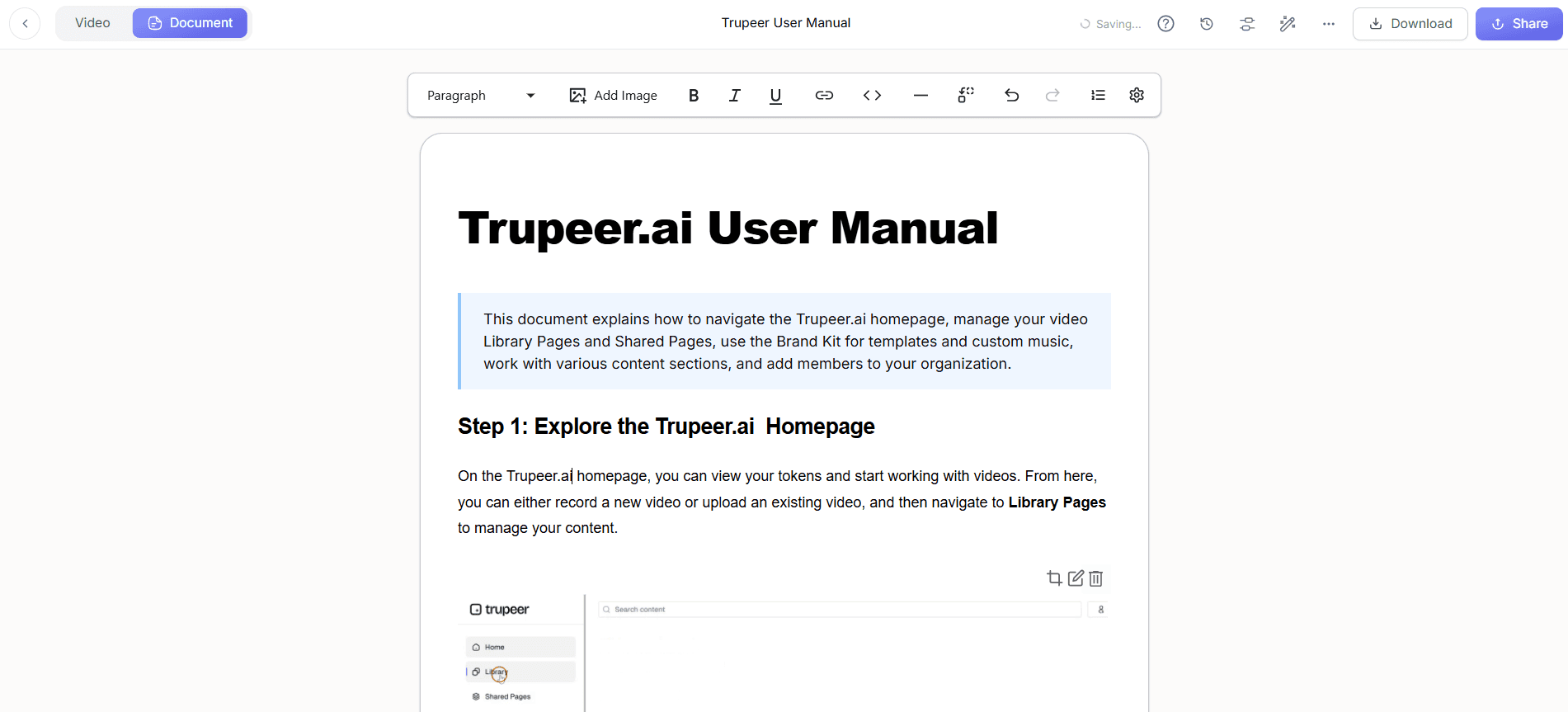
Step 2: Capture Key Processes with Screen Recording
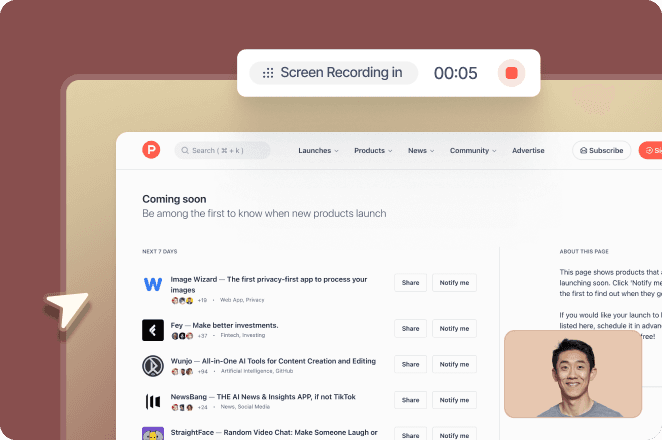
Next, use Trupeer's AI screen recording with auto-zoom and click detection to capture any dynamic processes that need to be documented. Launch the screen recorder directly from your browser or the desktop app. As you navigate through the process, the AI captures your actions, automatically zooming in on key areas and detecting clicks. This feature ensures that important details aren't missed, and the end result is a clear, detailed recording. Once finished, stop the recording and let Trupeer process the video. This typically takes a few minutes, depending on the length of the recording. The AI will then generate a draft document based on the captured actions, ready for further refinement.
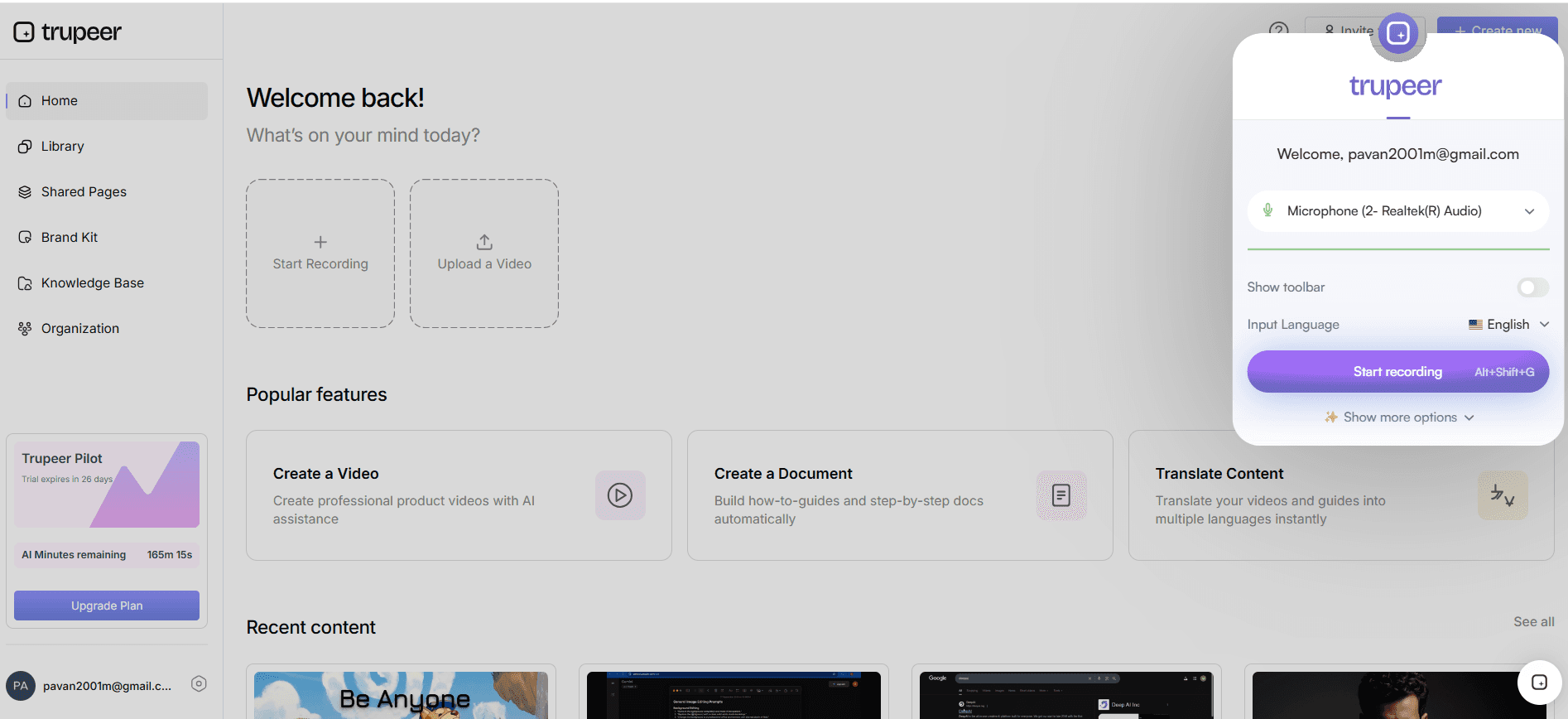
Step 3: Generate Initial Documentation Template
With your reference document and captured screen recording in place, head to the "Generate Template" option. Trupeer automatically compiles the information into a structured template, using AI to align the content with best practices for documentation. This step involves the AI analyzing each segment and drafting sections that can be customized later. The process is quick, often taking less than 10 minutes for an average-length document. If needed, you can manually adjust the structure to better fit your organization's standards. This initial template serves as a solid starting point, ensuring you don't start from scratch. For a deeper look, our guide on ai documentation generator covers the adjacent playbook.
Step 4: Customize and Review the Template
After the initial draft is ready, you can refine the template to meet specific requirements. Use Trupeer's editing tools to modify text, add or remove sections, and incorporate any company-specific branding elements. This customization is important for ensuring the template aligns with your organization's voice and standards. The AI suggestions are based on common documentation practices, but they can be adapted to fit unique needs. Take your time to review each section, making sure that the language and format are consistent throughout. This step is crucial for ensuring that the final document is both professional and functional.
Step 5: Apply AI Voiceover for Narration
Enhance your documentation by adding AI voiceover, which can be especially useful for video-based guides. Navigate to the "Voiceover" feature and select from over 65+ natural voices available. You can adjust the pace and tone to suit the style of your documentation. This feature is particularly beneficial for training materials where audio guidance can enhance understanding. The AI voiceover integrates smoothly, providing clear instructions that complement the visual elements of your documentation. If you have specific pronunciation needs, Trupeer allows for customization, ensuring the narration meets your exact requirements.
Step 6: Export and Distribute the Template
With the template finalized, it's time to export and share it with your team. Trupeer supports multiple formats such as MP4, HTML, PDF, and SCORM, making it easy to distribute across different platforms. Choose the format that best suits your needs and initiate the export. This process is quick, typically taking less than two minutes. Once exported, you can integrate the documentation into your organization's knowledge base or share it via email. For enhanced collaboration, consider hosting the document on a shared platform where team members can access and provide feedback. This ensures everyone is aligned and has the most up-to-date information.
What tips help you generate documentation templates from a reference document?
Creating effective documentation templates requires strategic planning and execution. Here are some tips to help you maximize the efficiency and accuracy of your template generation process using Trupeer.
Start with a Clear Outline. Before diving into AI tools, draft a basic outline of the template to guide the AI in organizing information effectively.
Use High-Quality Source Material. Ensure your reference documents are well-written and comprehensive to optimize AI outputs.
use AI Features Fully. Take advantage of Trupeer's Scribe alternative comparison for SOPs to explore all available AI capabilities.
Regularly Update Templates. Keep your templates current by scheduling regular reviews and revisions based on feedback and changes in processes.
Customize AI Suggestions. Tailor AI-generated content to better fit your organization’s standards and ensure it aligns with your branding.
Train Your Team. Provide training on how to use Trupeer’s features effectively to ensure consistent and accurate documentation creation.
use HR Document Generators. For specific needs, like HR policies, ai/tools/hr-document-generator">hr document generator tool to meet compliance requirements.
Frequently asked questions
How do AI tools generate documentation templates?
AI tools generate documentation templates by analyzing and extracting key information from reference documents. They use natural language processing to understand the structure and content of the document, then organize this information into a coherent template. This process involves identifying headings, subheadings, and key points. AI tools can also use machine learning algorithms to improve over time, learning from previous templates to enhance future outputs. This means that the more you use the tool, the better it gets at producing accurate and relevant documentation templates.
What is the benefit of using AI for documentation?
Using AI for documentation offers several benefits, including increased efficiency, consistency, and accuracy. AI automates the tedious aspects of documentation, allowing for faster creation and updating of documents. It reduces human error by standardizing the format and content across all templates. This ensures that all team members are working from the same information, reducing confusion and improving overall productivity. AI tools also allow for real-time updates and integration with other systems, ensuring that documentation is always current and relevant.
Can AI-generated documentation be customized?
Yes, AI-generated documentation can be customized to meet specific organizational needs. While AI provides a solid starting point by creating a structured template, users can modify the content, format, and branding to align with company standards. This flexibility is crucial for businesses that need to maintain a consistent voice and style across all documents. Customization options typically include editing text, adding sections, and incorporating company-specific branding elements such as logos and color schemes. This ensures that the final document is both professional and tailored to the organization's unique requirements.
Does Trupeer support multi-language documentation?
Yes, Trupeer supports multi-language documentation through its AI translation feature. This capability allows users to translate documents into over 40 languages, complete with lip-sync for video content. This is particularly useful for multinational organizations that operate in diverse linguistic environments. The translation process is automated, ensuring consistency and accuracy across different languages. By using a video translation platform, businesses can effectively reach a global audience while maintaining the integrity of their original content.
Is it necessary to review AI-generated templates?
Yes, it's essential to review AI-generated templates to ensure they meet your specific requirements. While AI can accurately generate templates based on a reference document, human oversight is needed to customize and validate the content. This review process helps catch any nuances or specific details that the AI might have missed. It also allows you to tailor the document to fit your organization's voice and standards, ensuring that the final product is both accurate and relevant. Regular reviews also provide an opportunity to update templates as processes and requirements change over time.
Can you over-document? When does more documentation backfire?
Yes, too many overlapping, outdated docs erode trust as fast as none, because readers cannot tell what is current. Trupeer's AI documentation tool generates the write-up straight from a recording and version history keeps it matched to the live process.
Related Blogs