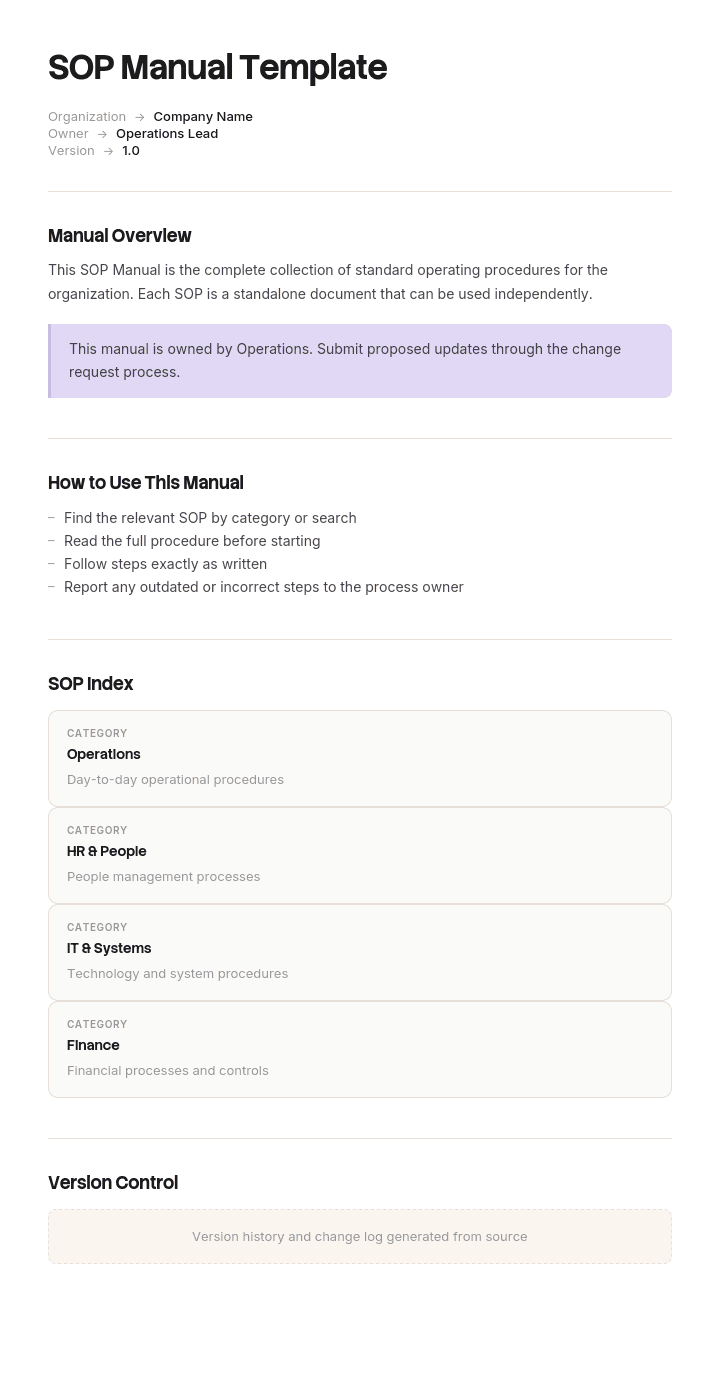
Use this template
An SOP manual is the operating system of a well-run business. With Trupeer, you can save hours on building your SOP manual by starting with a free template, customizing it with your brand guidelines, and using our AI SOP creator to turn each procedure into a video walkthrough.
What is a free SOP manual template?
A free SOP manual template is a reusable structure for a collection of standard operating procedures: the register that holds them, the numbering that identifies them, the ownership that keeps them current, and the individual procedures themselves.
The distinction between one procedure and a collection of them matters more than it sounds. Writing a single good SOP is a writing problem, and the SOP template covers it. Running a manual of eighty of them is a maintenance problem, and it fails in a completely different way.
A single SOP fails by being unclear. A manual fails by being out of date, and it fails all at once, because a reader who follows one procedure and finds it wrong stops trusting every other procedure in the collection. Credibility in a document set is not divisible.
The template is not the manual. What decides whether yours works is a calculation almost nobody performs, covered two sections down.
Format follows use. A free SOP manual template Word doc suits individual procedures, and most publishers offer a Standard Operating Procedure template Word PDF pairing where the document is for revision and the PDF is the issued copy. A free SOP manual template Excel version is the right home for the register, which is the part that actually keeps a manual alive. A free SOP manual template PDF suits controlled copies, particularly in regulated environments, and no free SOP manual template free download will contain the register you actually need.
An SOP manual is a collection, not a document
Most published SOP manual templates give you the structure of one procedure with a cover page attached. That is not a manual, and the difference shows up in year two.
A collection has problems a document does not have.
Identity. Which procedure is this, which version, and is it the current one. Two copies of a procedure with different dates in different folders is the normal state of an unmanaged manual.
Coverage. Which processes have a procedure and which do not. Nobody can answer this without a register, and without an answer the manual grows by whoever felt like writing something.
Currency. When was each one last checked against what people actually do. This is where manuals die.
Ownership. Who is responsible for each one being right. A manual owned collectively is owned by nobody.
Findability. A person with a question needs to reach the right procedure in under a minute, which at eighty documents means a real index rather than a folder.
The register solves four of those five and is the single most valuable artefact in a manual. It is also the one most templates omit entirely, because a template of one procedure has nothing to register.
How to customize this template in Trupeer
Step 1: Open the Templates Section
Go to the Templates section from the main navigation.
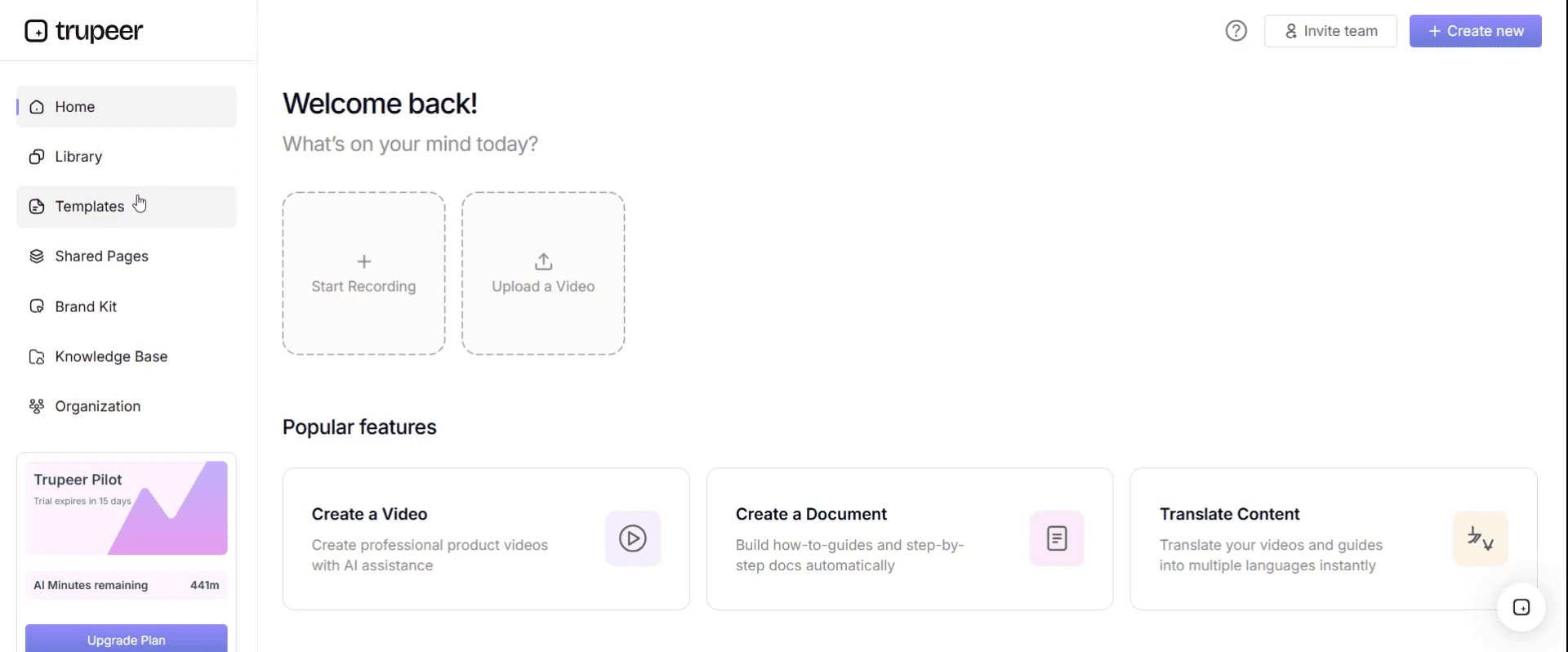
Step 2: Select and Open a Template
Click on any template you want to work with to open it.
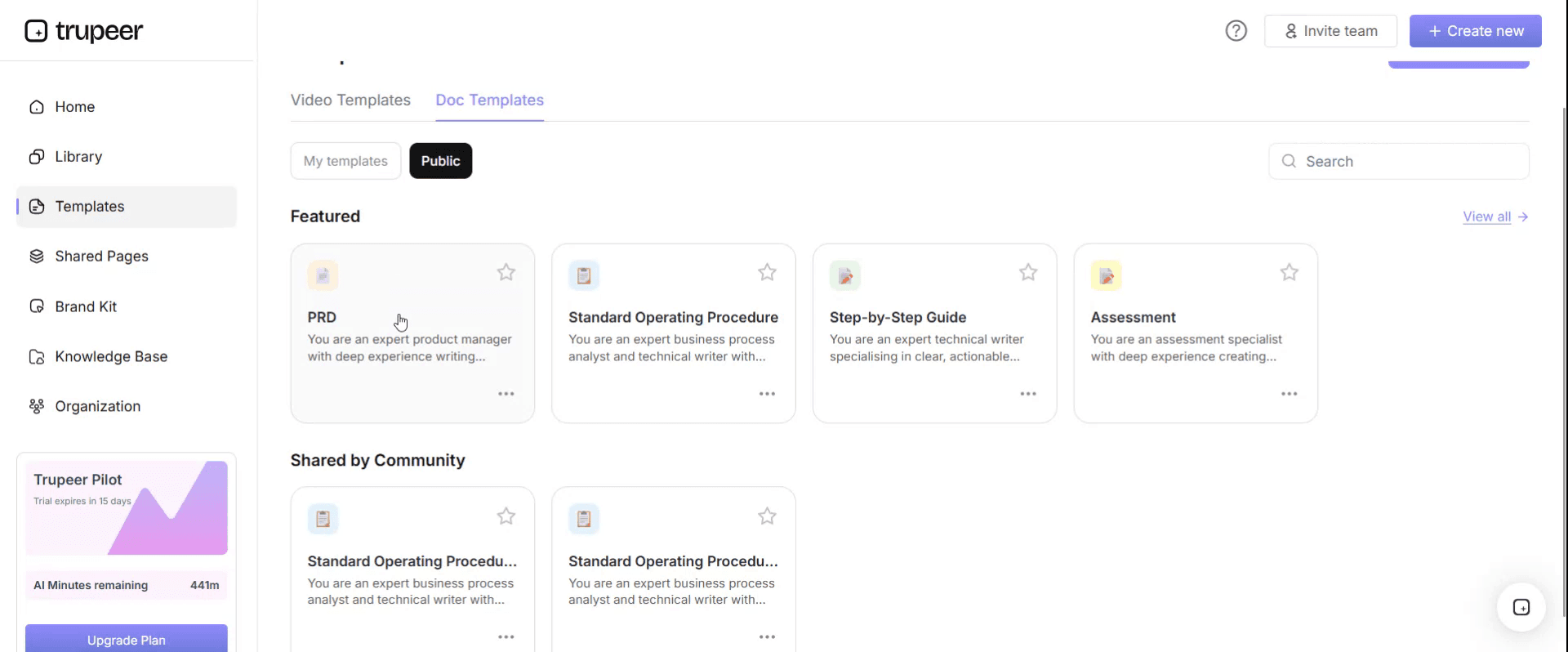
Step 3: Expand the Template View
If needed, expand the template view to see the full layout and details clearly.
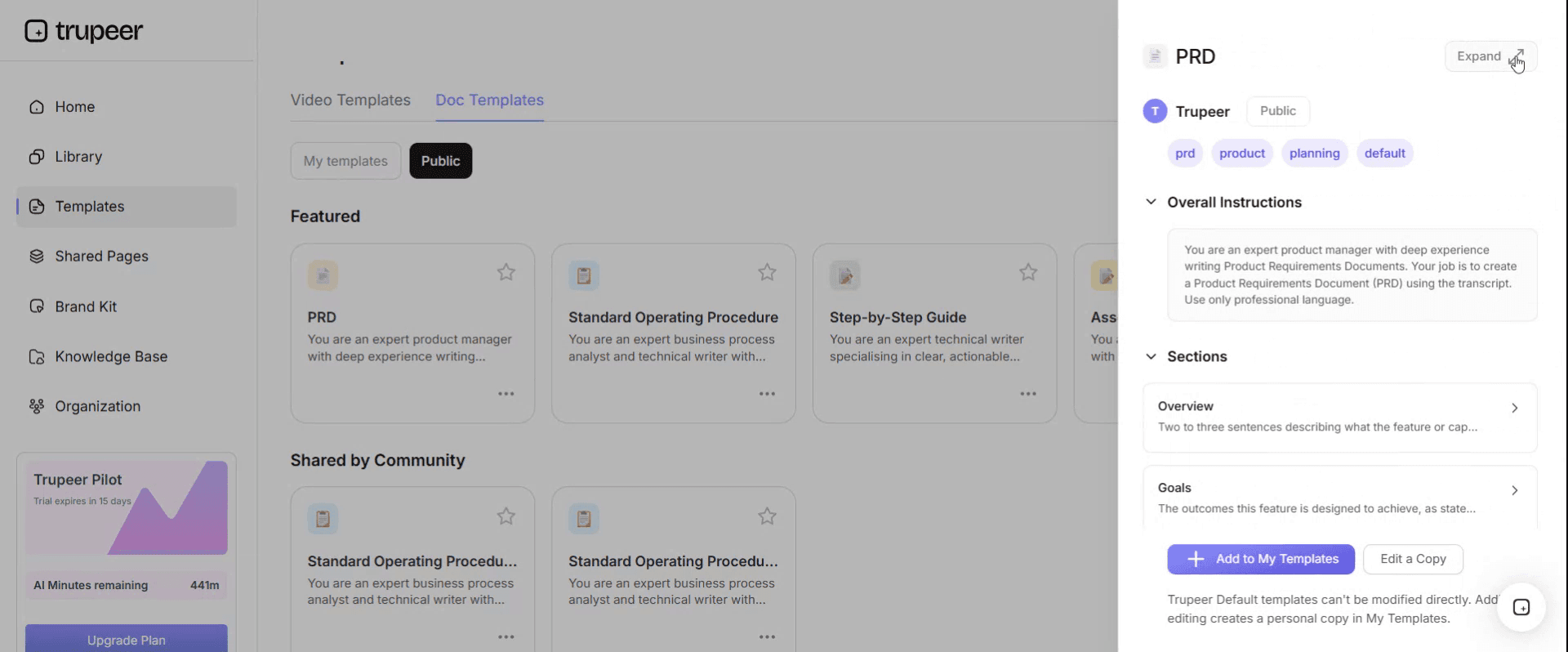
Step 4: Edit the Template
Click on Edit to start modifying the selected template.
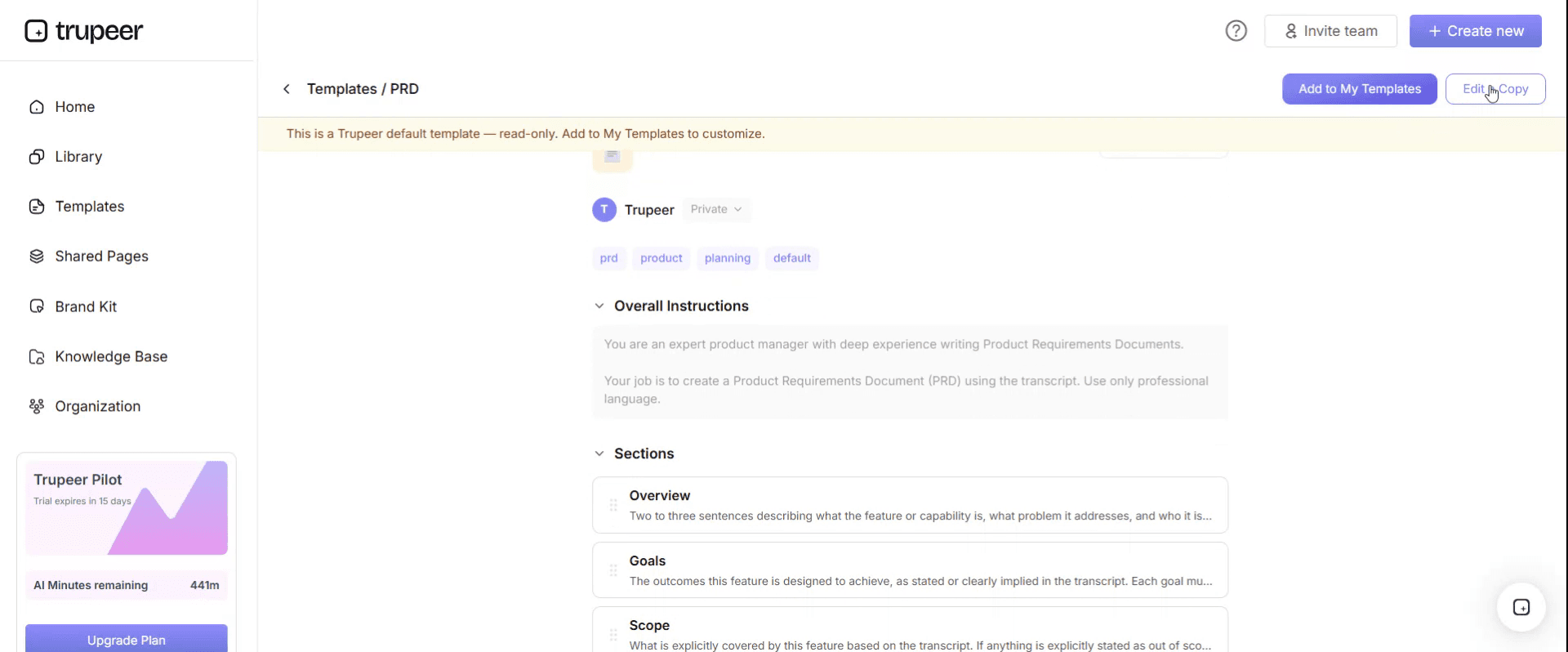
Within the editor, you can:
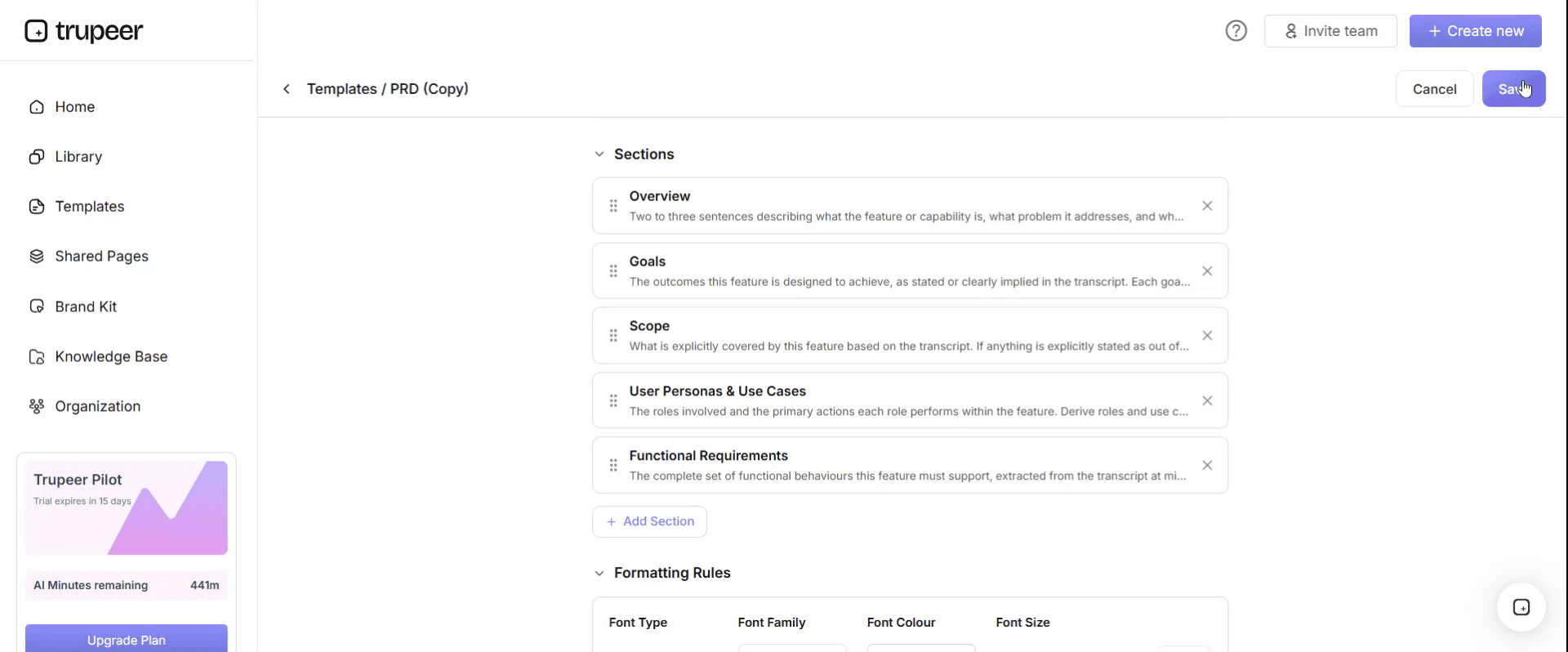
Add new sections
Define or update formatting rules
Add a logo and adjust its position and related settings
Step 5: Save Your Customized Template
After making all necessary changes, click Save to store the updated template as your own.
Step 6: Preview and Fine-Tune the Template
When you want to see how your customized template looks, open the Preview.
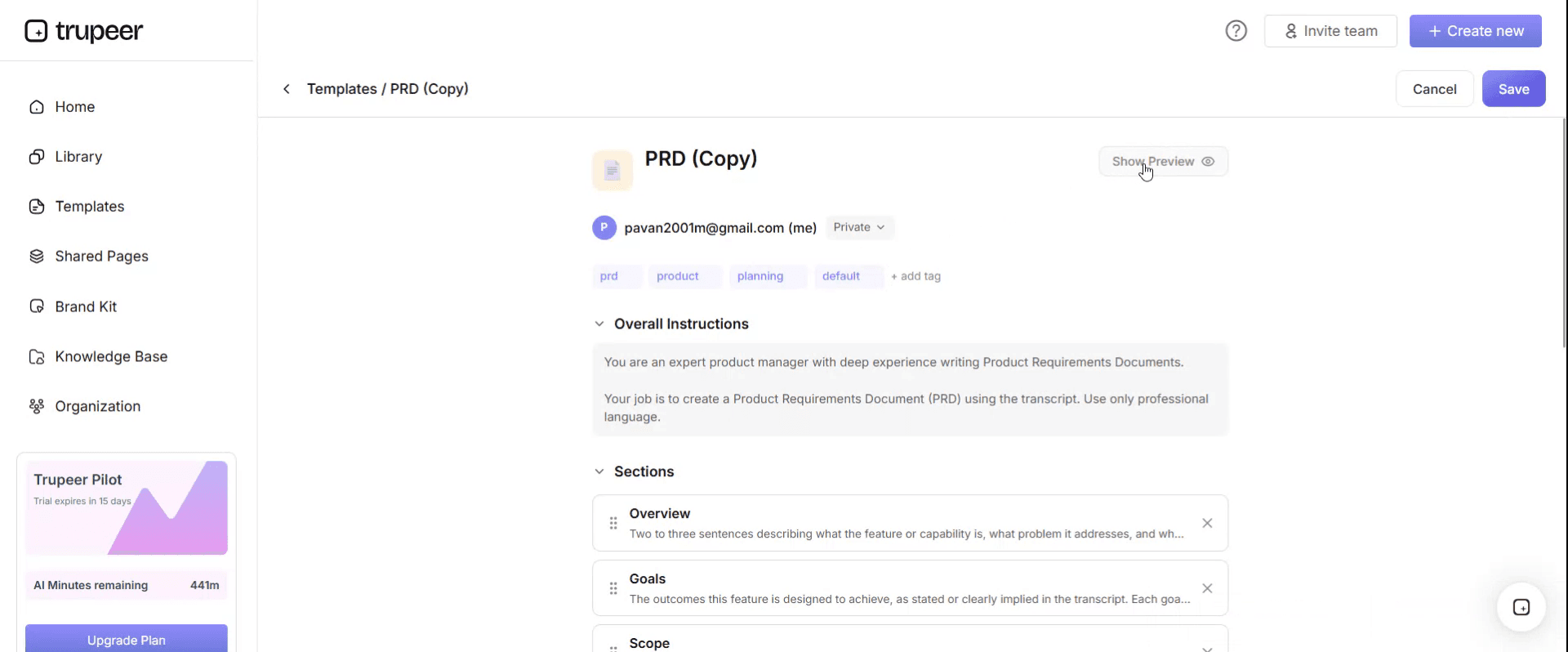
From the preview screen, you can continue to make adjustments directly if needed, ensuring the template appears exactly as you want.
With an SOP manual template you can:
Save hours on writing: Skip the blank page with a structure built for SOP manuals.
Standardize across teams: Use the same SOP format across every department.
Stay on-brand: Apply your logo, fonts and colors using Trupeer's brand kit.
Train every employee: Pair each SOP with a video walkthrough.
Stay audit-ready: Built-in sections for version control and compliance references.
Reach global teams: Translate the SOP manual into 65+ languages with one click.
Your manual has a maximum size
Here is the arithmetic, and it takes ten minutes.
Count the procedures in your manual. Estimate the time to review one properly, which means reading it, checking it against what the person doing the work actually does, and updating it. In most organisations this is sixty to ninety minutes rather than the ten people assume, because the checking is the slow part and the checking is the point.
Multiply. That is the annual cost of keeping your manual current on a yearly cycle.
Now find the time actually available. Not the time somebody thinks they should spend, the time that exists in a real person's week alongside their other work.
For most organisations the second number is a fraction of the first, and the consequence is not that reviews take longer. It is that the manual sits on a review cycle of three or four years, which means at any moment the majority of it describes how things used to be done.
That produces the failure that matters. Not one wrong procedure, which is recoverable, but a collection nobody trusts, which is not.
The response is uncomfortable and it works. Cut the manual to the size you can maintain.
Prioritise on two axes. What does it cost if this procedure is performed wrong, and how often is it performed by someone who needs it written down. High on both, keep and maintain. Low on both, archive. The middle is a judgement, and the honest default is to archive, because an unmaintained procedure is worse than an absent one: absence prompts somebody to ask, while a wrong document prompts them to act.
Archive rather than delete, with a note saying it is unmaintained and when it was last known good. That distinction matters to auditors and it makes the cut politically possible.
What belongs in an SOP manual and what does not
Four tests for each candidate procedure.
Is it performed by more than one person, or by different people over time? A task only ever done by one person who is not leaving does not need an SOP. It needs a handover document when they do leave.
Does getting it wrong cost something? Money, safety, compliance, reputation or rework. If nothing happens, the procedure is documentation for its own sake.
Is it stable enough to document? A process that changes monthly will have a permanently wrong procedure. Fix the process first or accept that this one is a live document with a named owner watching it.
Is it actually a procedure? Sequential steps performed the same way each time. If the answer depends on judgement at every step, you need guidance, a decision framework or training, not an SOP, and forcing it into procedure format produces something nobody follows.
Failing any of the four is a reason to leave it out. Most manuals that have grown past their maintenance capacity did so by including everything that could be written down rather than everything that should be.
What an SOP manual template must contain
At the manual level, seven components. The individual procedures sit beneath.
Component | What it does |
|---|---|
Register | Every procedure with number, title, owner, last reviewed date, next review date and status. The spine of the manual. |
Numbering scheme | Stable identifiers that do not change when procedures are added or reordered. |
Scope statement | What this manual covers and what it does not, so people know when to look elsewhere. |
Ownership model | Who owns the manual, who owns each procedure, and what owning one means in practice. |
Review cycle | How often each procedure is reviewed, and what triggers an unscheduled review. |
Change control | How a procedure is changed, who approves, and how people are told. |
Index | By task and by the words people actually use, not only by procedure title. |
The last reviewed date is the field that carries the most weight and it should be visible on every procedure rather than only in the register. A reader deciding whether to trust a document looks for it, and a procedure with no date is assumed old, correctly.
Free SOP manual template: the structure to copy
Filled with a real example rather than placeholders. The organisation is a financial advice firm.
Copy from here.
Manual scope. Covers operational procedures for client administration, compliance monitoring and internal reporting. Does not cover advice methodology, which sits in the advice framework, or IT administration, which is held by the IT provider.
Ownership. Manual owned by the Operations Director. Each procedure has a named owner who is the person accountable for it being correct, normally the manager of the team that performs it. Owning a procedure means reviewing it on schedule and updating it within ten working days of any change to the process.
Numbering. Two part. Function code, then sequence. OPS-014, CMP-006, RPT-003. Numbers are never reused and never reordered. A retired procedure keeps its number and is marked withdrawn.
Register. The spine. Held as a spreadsheet.
Number | Title | Owner | Last reviewed | Next due | Status |
|---|---|---|---|---|---|
OPS-011 | Opening a new client account | H Pereira | 12 Mar | 12 Mar next year | Current |
OPS-014 | Processing a withdrawal request | H Pereira | 4 Feb | 4 Feb next year | Current |
CMP-006 | Recording a client complaint | D Ansah | 27 Jan | 27 Jul | Current, six month cycle |
RPT-003 | Producing the monthly valuation run | S Kowalczyk | 19 Nov | 19 Nov next year | Under revision |
OPS-022 | Archiving closed client files | H Pereira | 3 Sep two years ago | Withdrawn | Archived, unmaintained |
Review cycle. Annual by default. Six monthly for anything with a regulatory dimension. Unscheduled review triggered by any change to the system used, any change to the people performing it, any complaint or error arising from the procedure, and any change to applicable regulation.
Change control. Changes proposed by anyone, approved by the procedure owner, and by the Operations Director where the change affects a control. Every change increments the version and is noted in a change line at the foot of the procedure. Affected staff are told by their manager, not by email alone.
Each procedure contains. Number and title. Owner. Version and last reviewed date, in the footer of every page. Purpose in one sentence. When to use it. Who may perform it. The steps, one action each, which is where a step-by-step standard operating procedure template Word layout is the right starting point. What the result should look like. What to do if it does not work. Links to any form or system used.
Index. Maintained by task and by common terms. The procedure titled "Processing a withdrawal request" is indexed under withdrawal, drawdown, taking money out and closing an account, because those are the four things people actually search for.
Copy to here.
SOP manual example: one of twelve
Kirkstall Financial Services, a financial advice firm of about two hundred and thirty people, had an SOP manual containing a hundred and forty seven procedures, built up over six years on a shared drive.
It was, by any reasonable description, a thorough manual. Nobody had been lazy. Procedures had been written whenever somebody identified a gap.
A compliance review tested it in the most direct way available. The reviewer selected twelve procedures at random and asked the relevant staff to perform each one by following the document.
One of the twelve was fully correct.
Four described systems that had been replaced. Three named individuals who had left the firm, in two cases as the only route to an approval. Two referenced a form that no longer existed. And for two, staff could not establish which version was current, because copies with different dates existed in different folders.
The arithmetic afterwards explained all of it.
A proper review of one procedure, meaning reading it and then watching somebody perform it, took about ninety minutes. A hundred and forty seven procedures on an annual cycle is around two hundred and twenty hours a year.
The firm had one person allocated at roughly a fifth of their time to documentation, which is about three hundred and seventy hours a year for everything, including writing new procedures, handling change requests and supporting audits.
The annual cycle had never been achievable. Nobody had done the sum, so nobody knew that the manual had been growing past its maintenance capacity since around year two.
The response was to cut it. Every procedure was scored on what it cost if performed wrong and how often somebody needed it written down. Forty one were kept. The other hundred and six were archived rather than deleted, each marked unmaintained with the date it was last known to be correct.
Forty one procedures at ninety minutes is about sixty two hours a year, which fits comfortably inside the available time and leaves room for new ones.
Eighteen months later a second sample of twelve found eleven correct. Views of the manual on the intranet had roughly tripled, which nobody had targeted and which follows directly, because people use a document set they trust and route around one they do not.
Nothing was added. The manual got smaller and considerably more useful.
How to build an SOP manual in six steps
Build the register before writing anything. Even if it lists procedures that do not exist yet, the register is what turns a folder into a manual.
Do the capacity arithmetic. Procedures times review time against hours available. Do this before deciding what to document, not after.
Score candidates on consequence and frequency. Document the top of that list until you reach your capacity, then stop.
Agree the numbering and never change it. Stable identifiers are what let people refer to procedures in conversation, in training and in audit responses.
Name an owner for each one. A person, and say explicitly what owning it requires of them.
Set the review cycle and put it in calendars. A review date in a register that nobody is reminded of is a date that passes.
Step two is the one that changes what gets built. Most manuals are scoped by ambition and maintained by whoever has time, which is how a hundred and forty seven procedures happen.
Numbering, versioning and ownership
Three mechanical decisions that determine whether a manual survives.
Numbering. Use a stable identifier with a function prefix and a sequence. Never renumber, never reuse a retired number, and do not encode anything that changes, such as a department name that will be reorganised. The number is how people refer to a procedure for years.
Versioning. Increment on every substantive change, with a change line at the foot of the procedure saying what changed and when. Trivial corrections do not need a version. A change to a step always does, because somebody may have been trained on the old one.
Ownership. One named person per procedure, and the owner should be close to the work rather than senior. The manager who watches the task performed weekly will notice it has changed. A director will not.
Two failure patterns are worth naming. Ownership assigned to a role that gets vacated leaves orphaned procedures nobody notices, so check the register against the staff list annually. And a manual owned entirely by one documentation person makes that person a bottleneck and removes any incentive for the teams doing the work to keep their own procedures honest.
SOP manual, SOP or work instruction?
Three levels, and the confusion between them produces documents at the wrong altitude.
An SOP manual is the collection: the register, the numbering, the ownership and the set of procedures.
A standard operating procedure is one process, end to end, usually spanning roles, answering how this process runs and who does what.
A work instruction is one task within a procedure, in detail, for the person performing it. The work instructions template covers that level.
The common error is writing task detail into an SOP, which produces a forty page document that is too long to read as an overview and too general to follow as instructions. Keep the SOP at the level of who does what in what order, and put the detail underneath.
SOP manual variants
The structure holds and the obligations change substantially.
General business SOP manual. The example above. Register, ownership, annual review.
Regulated SOP manuals. Pharmaceutical, medical device, food safety, clinical and financial services environments have defined requirements for procedure control, including approval, distribution, training records and retention. Version control is not good practice in these settings, it is a requirement, and an uncontrolled copy in circulation is a finding. Anything in this category should be built to the applicable standard with qualified input, and nothing on this page substitutes for that.
ISO 9001 aligned manuals. Add documented information control, internal audit and management review obligations. The register becomes the document control record.
Restaurant, hospitality and retail. High staff turnover means procedures are read by genuine newcomers rather than as a refresher, so they need more context and fewer assumptions than a manual for a stable team.
Manufacturing and warehouse. Procedures sit above detailed work instructions and safety documentation, and the boundary between the three needs stating explicitly or all three get written into one document.
Small business manuals. The capacity arithmetic bites hardest here, because the reviewer is usually the owner. Ten well maintained procedures beat sixty neglected ones by a wide margin.
What a free SOP manual template cannot fix
A manual larger than your capacity. No template creates review time. The arithmetic makes the gap visible, and the only responses are more capacity, fewer procedures, or cheaper reviews.
Procedures for unstable processes. A process changing monthly cannot have a stable procedure. Either stabilise it or accept a live document with a watchful owner.
A template that only covers one procedure. Every free SOP manual template Word free download I have seen is a single procedure with a cover page, so plan to build the register yourself.
A register nobody updates. The register is the manual's control, and an out of date register is worse than none because it reports currency that does not exist.
Documents describing intentions. Procedures written from how the process should work rather than how it does work will be quietly ignored by the people doing it, and you will not find out until an audit.
Show the procedure rather than describing it
The whole argument on this page rests on one number: the cost of keeping a procedure current. Lower that number and every constraint above relaxes.
That cost is dominated by two things, and neither is writing. It is watching someone perform the task to see what actually happens, and it is recapturing the screenshots when the system changes. Together those are most of the ninety minutes.
Trupeer AI collapses both. Somebody performs the task once while recording, and the output is a written step by step procedure with screenshots already captured, annotated and placed, alongside a video, in your own branding. The recording is the review, because it shows what the person actually does rather than what they say they do, and the document is a by product of it rather than a separate exercise.
Record it. Brand it. Translate it. Trupeer it.
The consequence for a manual is arithmetic rather than aesthetics. At ninety minutes per review, Kirkstall could maintain about forty procedures. At a fraction of that, the ceiling moves, which means fewer processes left undocumented because there was no capacity to keep them current.
Two further points. Re-recording after a system change is faster than editing, which is what makes an unscheduled review realistic rather than aspirational. And where teams operate across languages, the same recording produces the same procedure in each, so one manual covers every site instead of several that drift apart.
The material sits in your knowledge base and doubles as training for new starters, which is the other job an SOP manual is quietly asked to do. Consistency across your documents is a matter of setting the brand kit once, and setup is covered in the document template setup guide.
Frequently Asked Questions
Is there a free SOP manual template Word version?
Word suits the individual procedures, which are prose plus numbered steps and get reviewed and approved. Build the free SOP manual template Word file with the procedure number, owner, version and last reviewed date in the page footer so they appear on every page.
Do not try to hold the whole manual as one Word document. A hundred procedures in one file is unmanageable, unsearchable at the level people need, and impossible to version individually. One document per procedure, with a register holding them together.
Is there a free SOP manual template Word doc version?
Yes, and a free SOP manual template Word doc file is the same as a Word file under an older extension.
The choice that matters is not the format but whether you also build the register. A folder of well written procedure documents with no register is not a manual, because nobody can answer which procedures exist, which are current and who owns them.
Is there a free SOP manual template Word free download?
Widely available, and almost all of them are a template for a single procedure with a cover page. That is useful and it is not a manual.
If you use a free SOP manual template Word free download, add two things. A register held separately, and a footer carrying the owner and last reviewed date. Those two additions are the difference between a set of documents and a manual you can maintain.
Is there a free SOP manual template Excel version?
Excel is the right tool for the register, which is the most important part of the manual. A free SOP manual template Excel file should hold one row per procedure with number, title, owner, last reviewed date, next due date and status.
It is also where you do the capacity arithmetic. Count the rows, multiply by your review time, and compare against the hours available. That calculation in a spreadsheet is more useful than any document template on this page.
Is there a free SOP manual template PDF?
PDF suits issued and controlled copies, particularly where an auditor may ask what was in force on a given date. Export a free SOP manual template PDF per procedure at approval, with the version and date on every page.
Keep the editable source. Procedures change, and a manual you can only reissue by rebuilding is a manual that will not be reissued.
Is there a Standard Operating Procedure template Word PDF pairing?
Most publishers offer both, and the pairing means the Word file is for writing and revision while the PDF is the issued version. A Standard Operating Procedure template Word PDF set is a reasonable working arrangement.
In regulated environments the distinction is more than convenience. The issued PDF is the controlled copy, the Word file is the draft, and having people work from an uncontrolled draft is a common audit finding.
Is there a step-by-step standard operating procedure template Word version?
Yes, and the step structure is the easy part. A step-by-step standard operating procedure template Word layout gives you numbered steps with one action each, which is correct.
Two additions are worth making. A line beside each step saying what the person should see, so they can tell whether it worked. And a note of who may perform the procedure, since a perfectly written procedure followed by somebody not authorised to do it is still a problem.
Is there a free SOP manual template free download worth using?
The procedure structure takes twenty minutes to build and every published version is broadly the same, so a free SOP manual template free download saves little.
What none of them contains is the part that decides whether your manual survives: the register, the ownership model, the review cycle and the honest calculation of how many procedures you can actually keep current. Those four take an afternoon and matter more than the template.


