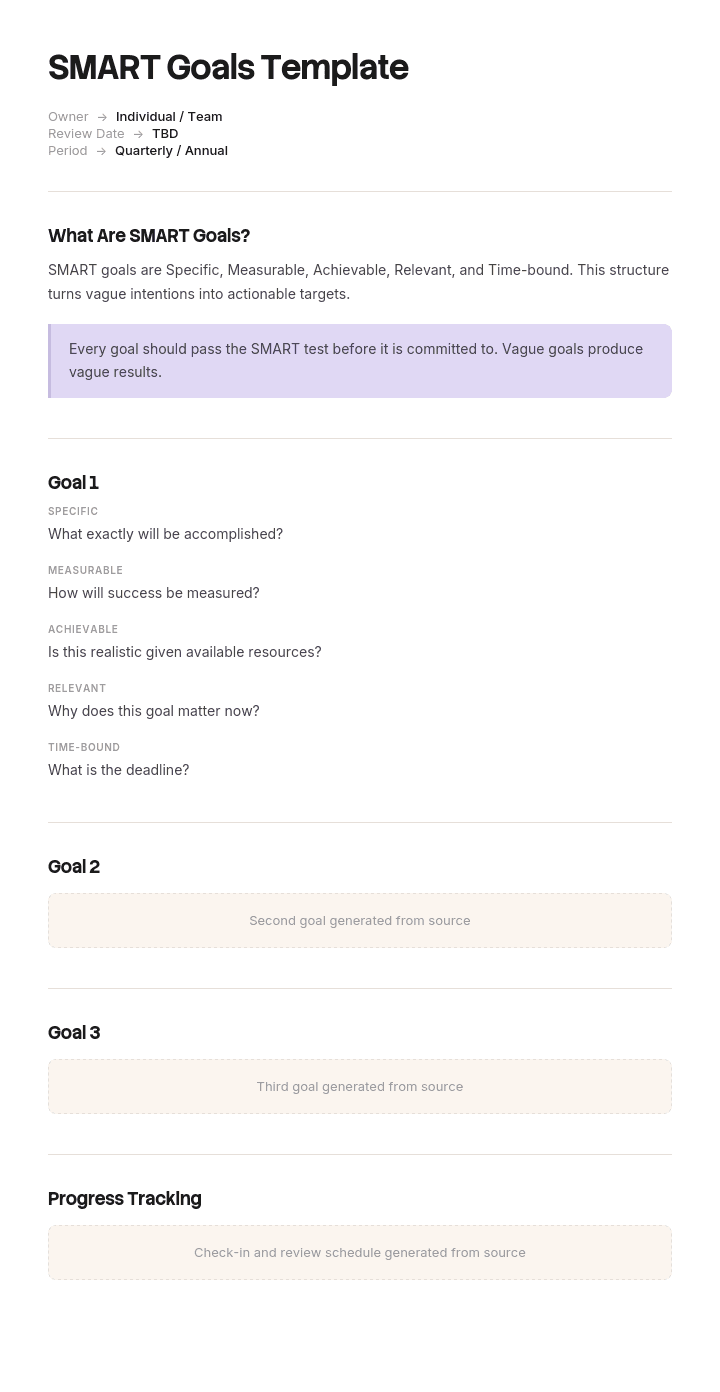
Use this template
The difference between hitting goals and missing them often comes down to how the goal is set. With Trupeer, you can save hours on goal-setting by starting with a free SMART goals template, customizing it with your brand identity, and turning goal documents into video summaries that align teams behind every objective.
What is a free SMART goals template?
A free SMART goals template is a reusable structure for writing objectives that are specific, measurable, achievable, relevant and time bound.
The framework is close to universal and the templates are close to identical: five boxes, one per letter, and a place to write the finished goal. That takes two minutes to reproduce and it is not where the difficulty is.
The difficulty is that three of the five letters can be checked mechanically and two cannot. Specific, measurable and time bound are verifiable by reading the sentence. Achievable and relevant are judgements, so they get asserted rather than evidenced, and a goal can pass every visible test while being unreachable and pointed at nothing.
The template is not the goal. What decides whether a set of goals is any good is whether anybody was required to show their working on the two letters that permit assertion.
Format follows use. A free SMART goals template Word file suits individual goal setting and appraisal documents, and any editable SMART goals template needs room to record progress through the year rather than only at the start. A goal setting template Excel free download suits tracking many goals across a team, which is where most organisations end up. A free SMART goals template PDF or a goal setting template free download PDF is the signed or agreed version, printed and filed.
What SMART stands for
Five criteria, and it is worth knowing that two of them have changed meaning since the framework was published.
Specific. What exactly will be different, stated so that two people would agree on whether it happened.
Measurable. The number, and where the number comes from.
Achievable. That it can actually be done, with the resources and time available.
Relevant. That it matters, and specifically that it serves something above it.
Time bound. By when, as a date.
In the original 1981 formulation by George Doran, the A stood for assignable, meaning who will do it, and the R stood for realistic. Assignable has since been replaced by achievable in almost every version in circulation, which is how ownership quietly dropped out of the framework. Most templates now have no field for who owns the goal, which is worth adding back.
How to customize this template in Trupeer
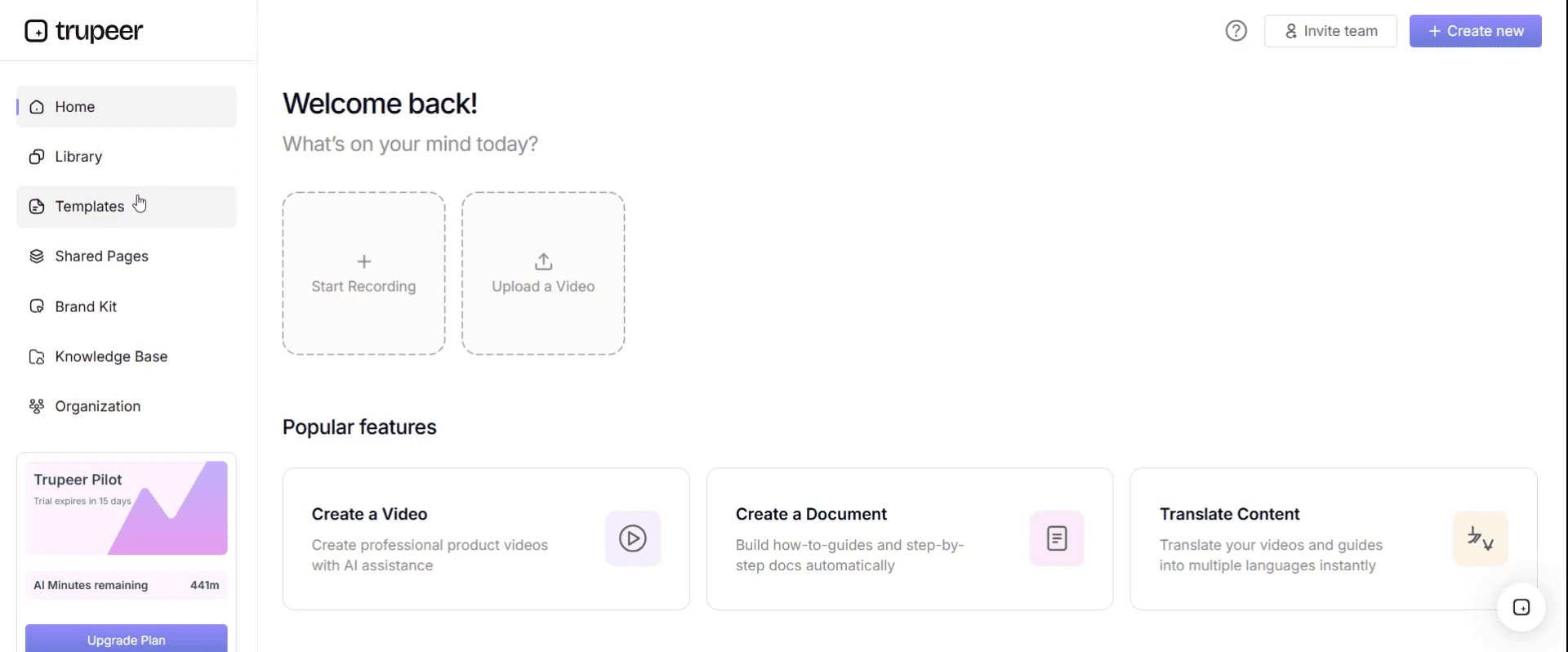
Step 1: Open the Templates Section
Go to the Templates section from the main navigation.
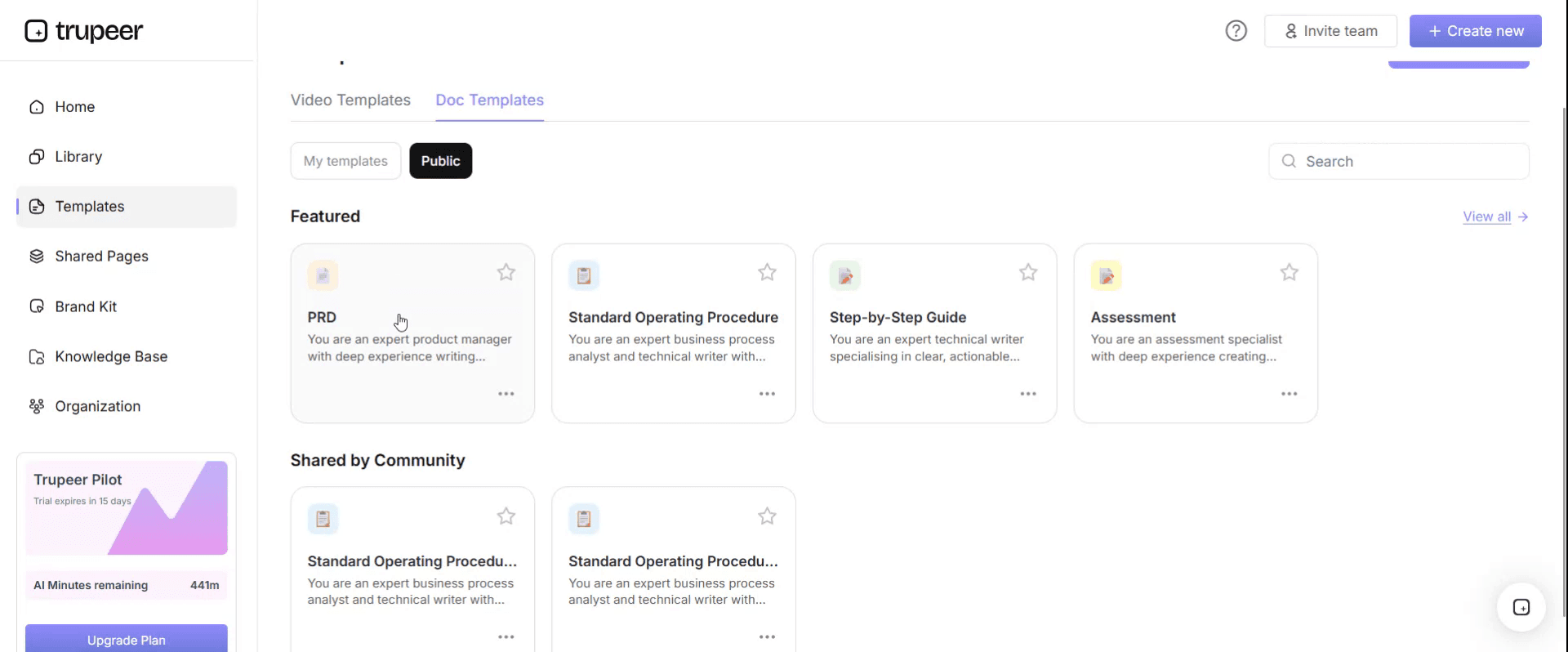
Step 2: Select and Open a Template
Click on any template you want to work with to open it.
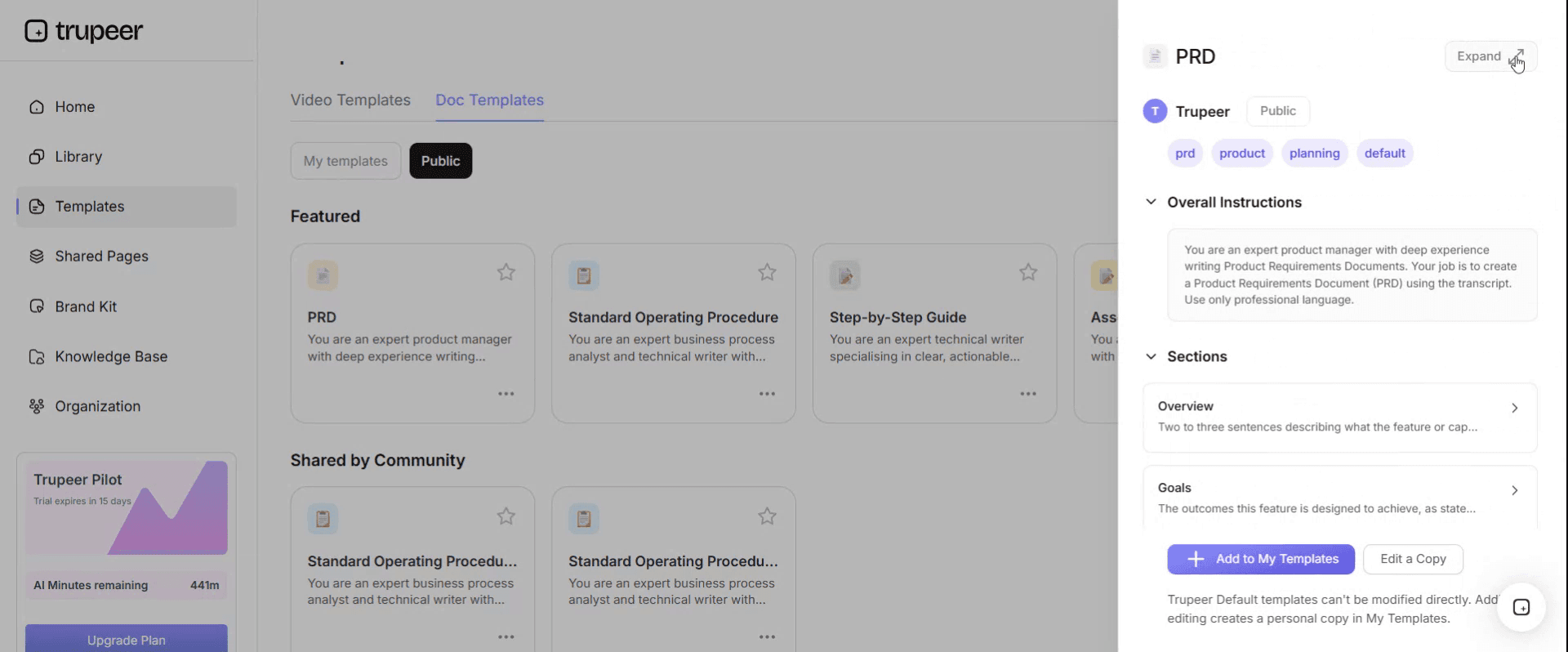
Step 3: Expand the Template View
If needed, expand the template view to see the full layout and details clearly.
Step 4: Edit the Template
Click on Edit to start modifying the selected template.
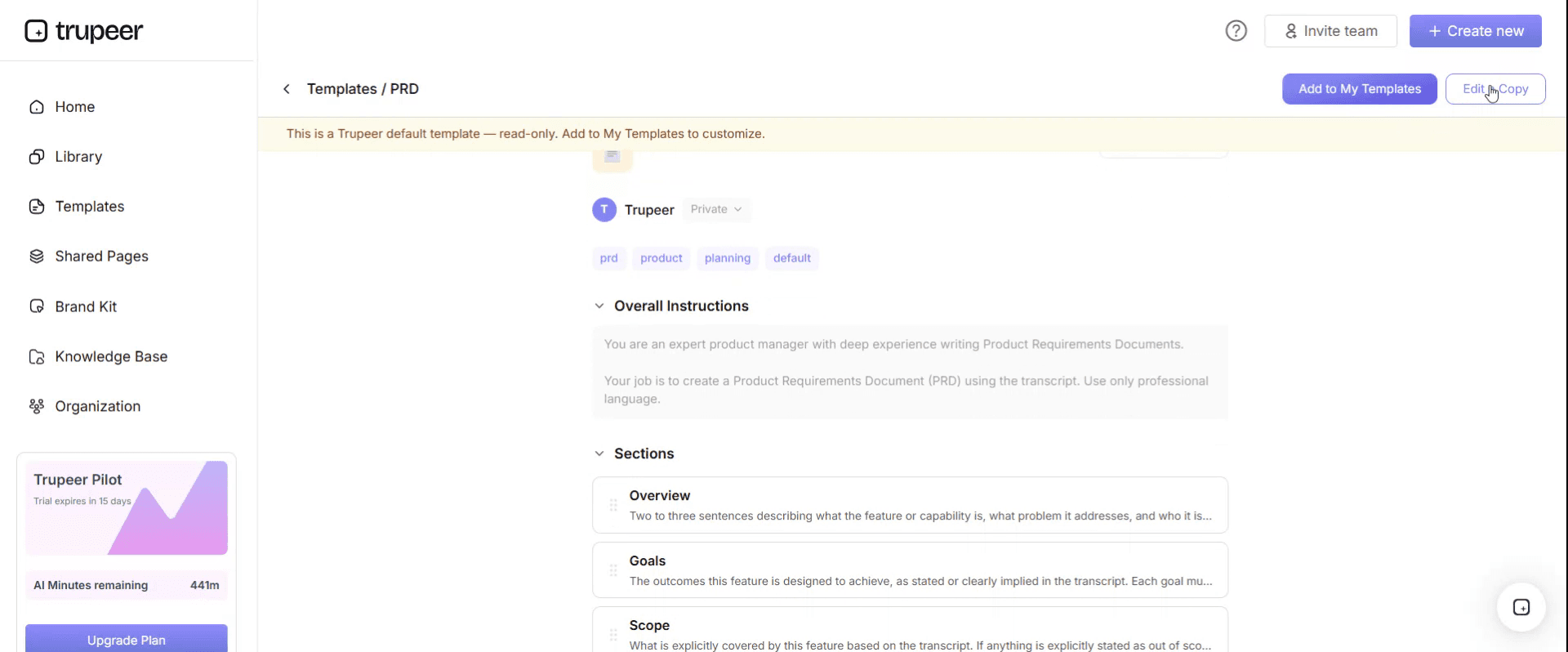
Within the editor, you can:
Add new sections
Define or update formatting rules
Add a logo and adjust its position and related settings
Step 5: Save Your Customized Template
After making all necessary changes, click Save to store the updated template as your own.
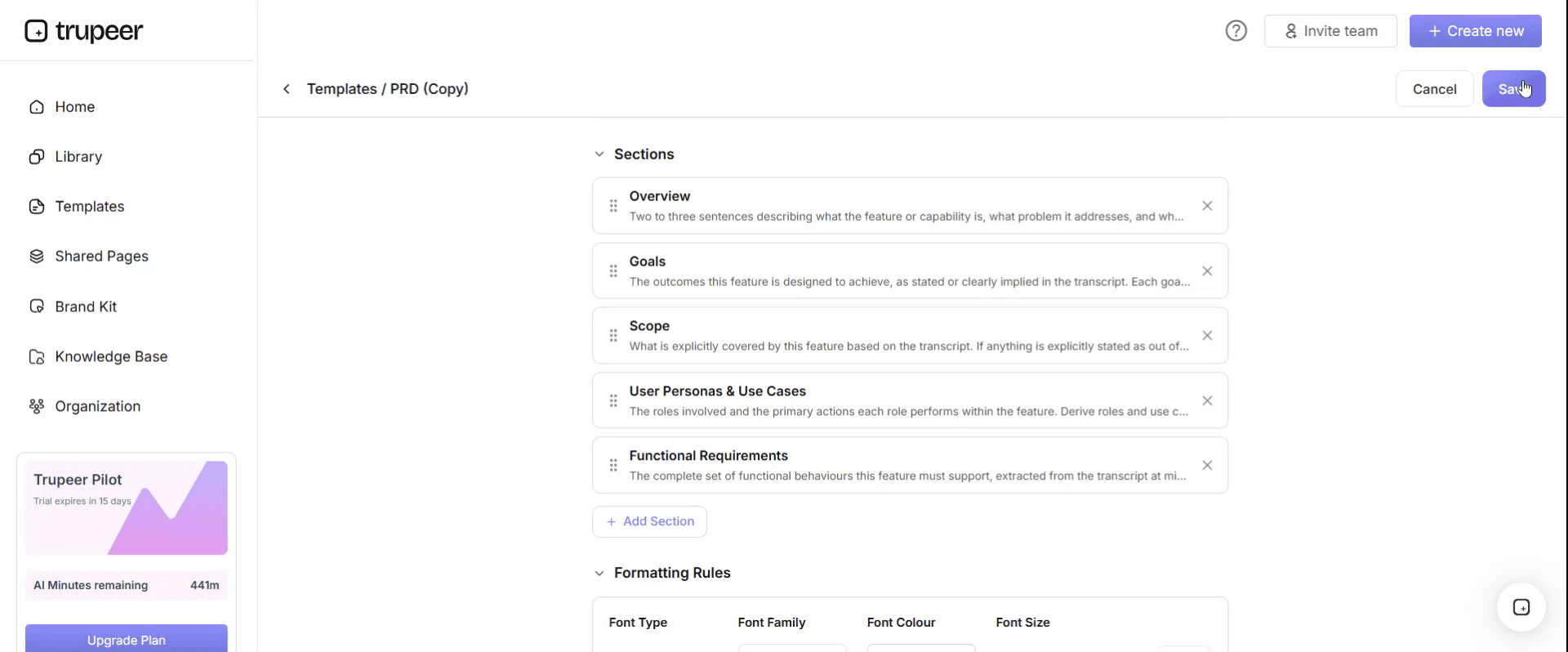
Step 6: Preview and Fine-Tune the Template
When you want to see how your customized template looks, open the Preview.
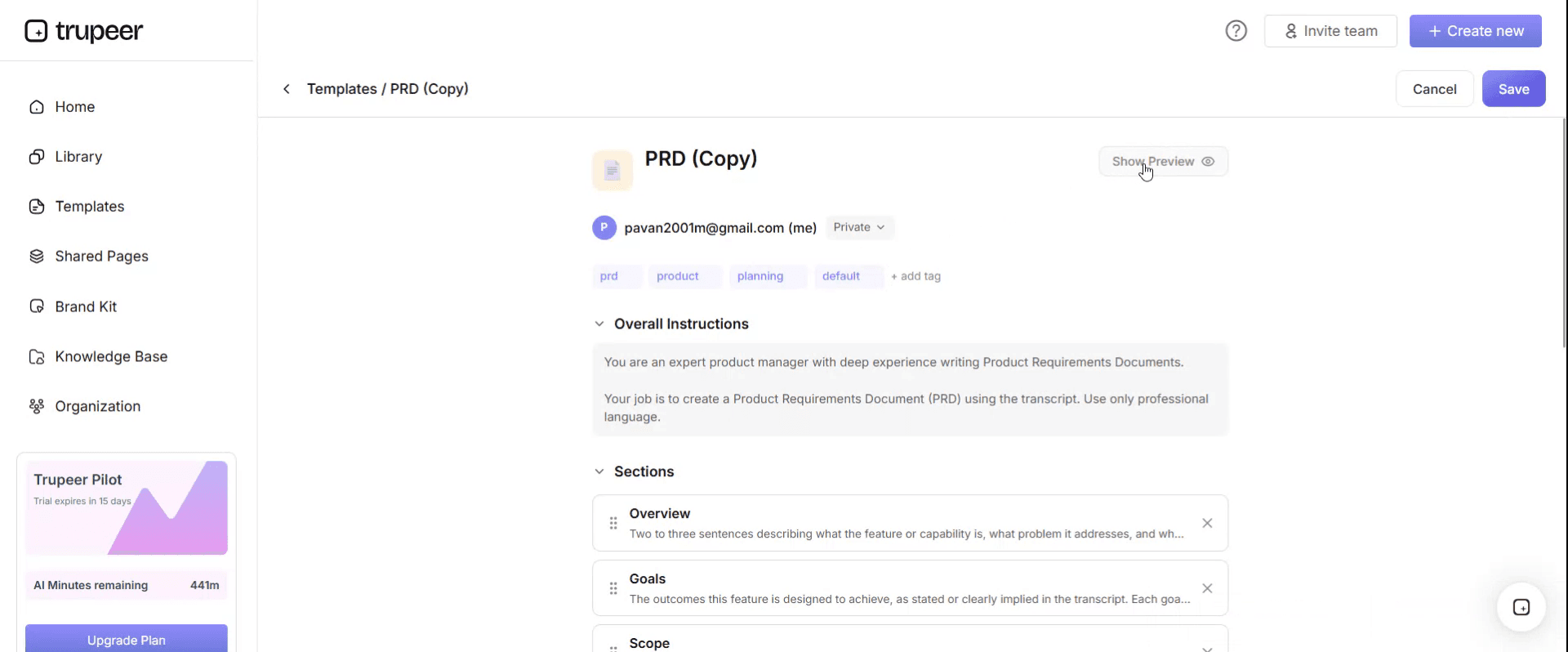
From the preview screen, you can continue to make adjustments directly if needed, ensuring the template appears exactly as you want.
With a SMART goals template you can:
Save hours on goal-setting: Skip the blank page with a proven structure.
Set clearer goals: The SMART framework forces clarity on every goal.
Stay on-brand: Apply your logo, fonts and colors using Trupeer's brand kit.
Align teams faster: Convert goal docs into video summaries everyone can absorb.
Standardize across teams: Use the same template for company, team and individual goals.
Reach global teams: Translate goals into 65+ languages with one click.
The two letters that get faked
Take any set of organisational goals and read them for achievability.
You will find goals that are impeccably specific, precisely measurable and firmly dated, and that nobody has any reason to believe are possible. Increase retention from eighty four percent to ninety four by December. Reduce time to hire by half. Grow the region forty percent.
Each satisfies three letters completely. Each is checkable, dated, and unambiguous. And in each case, if you ask what evidence makes the number achievable, there frequently is none. The figure was chosen because it sounded ambitious, or because it was a round number, or because it was what somebody wanted.
Relevant is faked differently and more quietly. A goal is declared relevant because it is obviously a good thing. Improving retention is good. Reducing cost is good. Nobody asks which higher objective it serves or what happens to that objective if this goal is missed, so goals accumulate that are individually sensible and collectively unfocused, and occasionally that pull against each other.
The correction is to require working on both, in the template, as mandatory fields.
For achievable, require evidence. One of three kinds. A comparable, meaning somebody has done this, here or elsewhere, and here is what they achieved. A calculation, meaning here is the arithmetic that gets us from where we are to the number. Or a rate, meaning we have been improving at this pace and this target extends it by a stated amount. If none of the three can be produced, the number is an aspiration, which is a legitimate thing to have and should not be written into someone's objectives as though it were a plan.
For relevant, require linkage. Which higher goal does this serve, and what happens to that higher goal if this one is missed. The second half is the useful one. If the honest answer is that nothing much happens, the goal may not be worth anyone's year.
Two extra boxes. They take ten minutes per goal and they are the whole exercise.
What a SMART goals template must contain
Eight components. Three of them are absent from most published templates.
Component | What it does |
|---|---|
The goal, in one sentence | Written last, once the boxes below are complete. |
Owner | One named person. Restores the assignable meaning the framework originally had. |
Measure and source | The number, and specifically where it comes from and who produces it. |
Baseline | Where you are now. A goal with no starting point cannot be assessed for achievability. |
Evidence it is achievable | Comparable, calculation or rate. Mandatory. |
What breaks if it is missed | The linkage that makes relevant meaningful. Mandatory. |
Date, and check dates | The deadline, plus the interim dates when progress is actually looked at. |
What this goal is not | Explicit boundary, which prevents the goal expanding to cover everything adjacent. |
The check dates row matters more than it appears. A goal with a December deadline and no interim review is discovered to be failing in November, when nothing can be done. Two or three check dates convert a goal from a judgement at the end into something manageable during.
Free SMART goals template: the structure to copy
Filled with a real example rather than placeholders. The organisation is a commercial cleaning company.
Copy from here.
Goal. Written last.
Improve contract retention from 84 percent to 89 percent by 31 December, excluding contracts identified as loss making.
Owner. Regional Manager, named.
Measure and source. Contracts renewed as a percentage of contracts due for renewal in the calendar year. Produced monthly by finance from the contract register. Excludes contracts terminated by us.
Baseline. 84 percent this year. 88 percent was the best figure achieved in the last six years. Sector benchmark reported at 87 percent.
Evidence it is achievable. A rate and a comparable. Our northern region moved from 83 to 88 percent over two years by introducing quarterly client reviews, which we have not yet done here. Applying the same intervention to twenty eight renewals due next year, and assuming a similar effect at two thirds strength given the shorter run in, produces 88 to 90 percent. Five points is at the achievable end of that range rather than the middle.
What breaks if it is missed. Regional revenue plan assumes 89 percent. At 84 percent the region is roughly four hundred thousand pounds short, which the new business target cannot absorb without additional sales headcount that is not budgeted.
Date and check dates. 31 December. Checked at 31 March, 30 June and 30 September against renewals completed to date, not against a straight line projection.
What this goal is not. Not a goal to retain every contract. Twenty two contracts are currently loss making and are excluded from both numerator and denominator. Retaining those does not count towards this goal and is not desired.
Copy to here.
The exclusion in the last box is the part that was missing from the original version of this goal, and the reason is below.
SMART goals example: ninety four percent because it sounded ambitious
Braithwood Group, a commercial cleaning company of about six hundred staff running a hundred and forty contracts, ran an annual objective setting exercise. Every manager wrote SMART goals, reviewed by their director, tied to bonus.
One regional manager's goal read: increase contract retention from eighty four percent to ninety four percent by 31 December.
It was flawless on three letters. Specific, measurable from an existing report, and dated. It was signed off in about four minutes.
Nobody asked what made ninety four percent achievable. The sector benchmark was around eighty seven. The company's own best year in six was eighty eight. The ten point jump had been arrived at because the managing director liked round numbers and ninety four sounded more ambitious than ninety.
Nobody asked what retention was actually for either. It was self evidently a good thing.
Twenty two of the hundred and forty contracts were loss making, several substantially. Retaining those destroyed value rather than creating it, and nothing in the goal distinguished between them and the profitable ones.
The regional manager, measured and paid on a single retention number, did what the goal asked. He renewed nine loss making contracts at flat prices, because losing them would have cost him percentage points he could not afford.
Retention reached eighty nine percent, which was a genuine improvement and the best figure the company had ever recorded. He missed his bonus by five points and left the following spring.
The nine renewals locked in around three hundred and ten thousand pounds of negative margin across two years.
Two boxes were added to the goal template afterwards. Evidence it is achievable, and what breaks if it is missed. Both mandatory, neither accepting a blank.
The following year's sixty two goals were reviewed against them before sign off. Nineteen had no achievability evidence of any kind. Eleven had no answer to what breaks if it is missed, including three that were quietly dropped once the question was asked and nobody could answer it.
The retention goal was rewritten at eighty nine percent with loss making contracts excluded, which is the version in the template above.
The framework had not failed. Three of its five letters had been applied rigorously and two had been treated as boxes to fill in.
SMART goal examples you can adapt
Four, showing the difference between a goal that passes inspection and one that has been thought about. The second version in each pair is the one with evidence and linkage.
Sales. Weak: increase revenue by thirty percent by year end. Better: increase revenue from the existing customer base from two point one to two point five million by 31 December, on the basis that the same cross sell motion delivered fourteen percent growth in the pilot region over nine months, applied across four regions.
Customer support. Weak: improve customer satisfaction. Better: raise first contact resolution from sixty one to seventy percent by 30 September, measured from the ticket system, on the basis that the four highest volume ticket types account for half of repeat contacts and all four now have documented resolutions.
Recruitment. Weak: reduce time to hire. Better: reduce median days from application to offer from thirty one to eighteen by 30 June, achieved by removing the scheduling delay that accounts for eleven of the thirty one days.
Personal development. Weak: become better at presenting. Better: present at three internal sessions of thirty minutes or more before 31 December, with written feedback collected each time against the same four criteria.
The pattern is the same in each. The weak version states a direction. The better version states a number, where it comes from, and what makes it reachable.
How to write a SMART goal in six steps
Write the baseline first. Where you are now, with the source of that figure. Goals set without a baseline cannot be assessed for achievability by anyone.
Name the owner. One person, restoring the assignable meaning the original framework had.
Find the evidence before choosing the number. Comparable, calculation or rate. Choosing the target first and looking for justification afterwards produces the ninety four percent problem.
Write what breaks if it is missed. If nothing does, reconsider whether this belongs in anyone's objectives.
Set check dates, not just a deadline. Two or three, at points where you could still act.
Write the goal sentence last. Once the boxes are done, the sentence writes itself, and it will be considerably more specific than one written first.
Step three is the one that gets inverted almost everywhere. Targets are usually chosen and then dressed in SMART formatting, which is how a framework designed to test goals became a way of formatting them.
Measurable is not the same as measured
A goal can name a number that nobody ever produces.
Three questions settle it, and they belong in the template rather than in a conversation. Where does the number come from, meaning which report or system. Who produces it, by name or role. And how often will it actually be looked at.
The third exposes the most goals. A number available monthly but reviewed annually is functionally an annual number, which means eleven opportunities to act were available and unused.
Two related traps are worth naming. A measure that requires manual collection by the person being assessed on it will be collected optimistically and eventually not at all. And a measure with no existing source, where somebody says the reporting can be built, frequently means the goal will be assessed by impression, because the reporting is nobody's priority once the goal setting session ends.
If a measure does not exist today, either build it first or choose a different measure.
SMART goals template variants
The structure holds and the emphasis moves with who is setting the goal.
Employee and appraisal goals. Ownership and check dates matter most, and the boundary box prevents a goal from silently expanding across a review period. Where goals are tied to pay, the achievability evidence is also a fairness question, since an unreachable target attached to a bonus is a reduction in pay dressed as an incentive.
Business and departmental goals. Linkage is the critical letter. Every departmental goal should name the organisational objective it serves, and if several departments name the same one, check they are not pulling in different directions to reach it.
Project goals. Usually better expressed as deliverables with dates than as SMART goals, and the sequencing belongs in the project schedule rather than in a goals document.
Personal goals. The achievability evidence is usually a rate, meaning what you have managed before. The most common failure is setting a target based on your best week rather than your median one.
Student goals. Covered below, since the intent behind that search is different from the rest.
Team goals. Need one owner even when the work is shared. A goal owned by a team is reliably owned by nobody, and this is the most common single fault in goal documents.
SMART goals for students
A different use with a different purpose. In a classroom or a study context, the point of a SMART goal is usually to teach planning rather than to manage performance, so the framework is being used as an instrument of learning.
Three adaptations help. Shorten the horizon considerably, because a term is a long time and a fortnight is checkable. Make the measure something the student controls directly, such as pages read or practice questions completed, rather than an outcome such as a grade, which depends on factors outside their effort. And keep the evidence box, in simplified form, because asking a student what makes them think this is achievable is genuinely the most useful question in the whole exercise.
A free SMART goals template for students should have fewer boxes than a workplace one and larger spaces to write in. The two extra fields argued for above still apply, phrased as what makes you think you can do this, and why does this matter to you.
What a free SMART goals template cannot fix
Targets handed down without evidence. If a number arrives from above with no working, the template will document that rather than solve it. No free SMART goals template free download changes where a target came from. It does at least make the absence visible, which is sometimes enough to start a conversation.
Goals that conflict. Two well written goals can pull against each other, as retention and margin did at Braithwood. Only reading them together catches this, and most organisations review goals individually with each person.
Measuring what is easy rather than what matters. SMART pressures you towards measurable things, and the most important outcomes are often the least measurable. Be alert to a goal set where it is, rather than where the value is.
A goal nobody revisits. No editable SMART goals template will make anyone look at it in June. The check dates have to go in a calendar, not just in the document.
Show the change rather than describing it
Most goals worth setting require somebody to do something differently, and that is where they quietly fail.
Braithwood's better version of the retention goal depended on quarterly client reviews being run consistently across a region, by managers who had never run one. The goal was sound. What was missing was any means of showing thirty managers what a good client review actually looks like, and a written procedure for a conversation is a poor substitute for seeing one.
Trupeer AI closes that gap. Somebody who does the thing well records it once, and the output is a written walkthrough with screenshots already captured and placed, alongside a video, in your own branding. The goal states the target. The recording shows the behaviour the target depends on.
Record it. Brand it. Translate it. Trupeer it.
Two points follow. The evidence box in the template above frequently cites something that worked elsewhere in the organisation, and a recording is how that elsewhere becomes transferable rather than anecdotal. And where teams span several languages, the same recording produces the same guidance in each, so a goal set centrally is pursued the same way everywhere.
The material sits in your knowledge base and doubles as training. Task level detail belongs in the work instructions underneath. Consistency across your documents is a matter of setting the brand kit once, and setup is covered in the document template setup guide.
Frequently Asked Questions
Is there a free SMART goals template Word version?
Word suits individual goal setting, appraisal documents and anything that gets agreed between two people. Build the free SMART goals template Word file with one page per goal and the eight components as headed sections.
Add the two fields most templates lack: evidence it is achievable, and what breaks if it is missed. Make them impossible to skip by putting them above the goal sentence rather than below it, since whatever appears first receives the most thought.
Is there a free SMART goals template free download worth using?
The five boxes take two minutes to draw, so a free SMART goals template free download is saving very little, and essentially all of them are the same five boxes.
Judge any of them on one question. Does it ask for evidence behind the achievable letter? None that I have seen does. Adding that field is the difference between a template that formats goals and one that tests them.
Is there an editable SMART goals template?
Most published ones are editable, and the more useful question is whether the file can be revised through a year rather than completed once. An editable SMART goals template needs room for the check date entries, because a goal document that cannot record progress becomes a historical artefact by March.
Keep one file per person or per team for the year rather than one per goal. Goals get compared with each other far more often than people expect, and conflicts between them only appear when they are read together.
Is there a free SMART goals template PDF?
PDF suits the agreed version. Once a goal has been discussed and signed off, a free SMART goals template PDF with the date and both names is the reference copy, which matters where goals are linked to pay.
Keep the editable source for the check dates. A goal you cannot update is a goal that will be assessed from memory at the end of the year.
Where can I find a goal setting template free download PDF?
Widely available, and public sector and educational institutions publish better ones than commercial template sites, because theirs were designed to be completed rather than downloaded.
A goal setting template free download PDF will typically give you the five letters and a space for each. Print it, and add the two extra boxes by hand if necessary. The physical act of having to write evidence into a blank space works better than a field somebody can leave empty on screen.
Is there a goal setting template Excel version?
Excel is the right tool once you have more than a handful of goals. A goal setting template Excel file lets you hold one goal per row with columns for owner, baseline, target, measure source, check dates and status, and lets you sort by owner or by date.
This is also the format in which conflicting goals become visible, since sorting a whole department's goals by measure occasionally reveals two people incentivised in opposite directions.
Where can I get a goal setting template Excel free download?
Many are available and most are trackers rather than goal setting instruments, meaning they record targets and progress without asking anything about whether the target is reachable.
That is a reasonable division of labour. Use a goal setting template Excel free download for tracking, and do the actual goal setting in a document where there is room to write the evidence and the linkage. Then transfer the finished goals into the tracker.
Is there a free SMART goals template for students?
Yes, and it should be a different document from a workplace one. A free SMART goals template for students works best with a shorter horizon, a measure the student controls directly such as practice completed rather than a grade achieved, and fewer boxes with more room to write in each.
Keep the achievability question in simplified form. Asking a student what makes them think they can do this is the single most useful part of the exercise, and it is the question adults skip too.