Trupeer Blog
Summarise

Imagine your enterprise has a vast repository of training videos and SOPs that your team has painstakingly developed over the years. However, accessing the right information quickly is often a challenge, leading to inefficiencies and frustration among employees. The solution? Integrating your video knowledge base with AI agents using MCP (Model Context Protocol). This setup allows for smooth querying of your video library, enabling rapid retrieval of the precise content needed. According to a recent study, enterprises that have adopted AI-driven knowledge management systems report a
30% increase in operational efficiency
. This approach is not for every organization, but for those looking to optimize knowledge access, it's a powerful tool. If you're responsible for managing or disseminating knowledge across your organization, this guide will walk you through the benefits and setup process of integrating your video knowledge base with AI through MCP. For inspiration on effective knowledge management, check out some of the best knowledge base examples to see what's possible.
Why does integrating your video knowledge base with AI agents via MCP matter?
Organizations today are grappling with a mountain of digital content. As video becomes a preferred method for communication and learning, the challenge of managing, retrieving, and effectively using these assets grows. Without a system in place to quickly access the right video content, teams can waste valuable time searching or even recreating materials that already exist. This inefficiency not only drains resources but can also lead to inconsistent knowledge dissemination. For departments such as customer support or technical training, where precise information is critical, the ability to instantly access relevant video content can significantly impact performance.
Using MCP to integrate AI agents with your video knowledge base transforms how information is accessed. It allows AI agents to query and retrieve specific video segments based on context, enhancing how teams can solve problems and answer questions. For instance, a customer success workflow can benefit immensely from this integration, as agents can provide more accurate and timely responses to client queries by accessing the most relevant video tutorials and FAQs directly. The ability to use AI for these tasks not only improves response times but also ensures that the information provided is consistent and up-to-date. For enterprises aiming to use the power of their video content, integrating with AI agents via MCP is a strategic move.
What are the benefits of integrating your video knowledge base with AI agents via MCP?
Integrating AI agents with your video knowledge base through MCP brings substantial advantages to your organization.
Enhanced Accessibility. With MCP, AI agents can quickly locate and retrieve video content, reducing the time spent searching manually. This translates to faster access to information when it matters most.
Improved Consistency. By using an AI-powered video tool, organizations ensure that the information accessed by different teams remains consistent, minimizing the risk of miscommunication.
Scalable Knowledge Sharing. As your organization grows, so does your repository of video content. MCP integration allows for scalable knowledge sharing, where AI agents handle increased content volume without additional strain on human resources.
Real-time Updates. AI agents integrated with MCP can ensure your knowledge base includes the latest information by automatically accessing updated video content, leading to more reliable data dissemination.
Cost Efficiency. Automating the process of querying video content reduces the need for manual intervention, thus cutting down labor costs associated with knowledge management tasks.
Enhanced User Experience. Employees and clients alike benefit from a smooth user experience as they receive precise video content in a timely manner, improving satisfaction and engagement.
When SOPs come into the same conversation, a Scribe alternatives comparison helps clarify the scope.
Which Trupeer features help you integrate your video knowledge base with AI agents via MCP?
Trupeer offers a solid suite of features designed to facilitate the integration of your video knowledge base with AI agents through MCP.
AI-searchable knowledge base
Trupeer's AI-searchable knowledge base is a cornerstone feature for MCP integration. This capability indexes every video recording with timestamp-level deep links, allowing AI agents to pinpoint specific segments quickly. This integration ensures that users can retrieve exact information from extensive video libraries without handling through entire videos. It enables teams to find the answers they need with minimal effort, ultimately enhancing productivity and decision-making processes.
Auto-updating documentation
Trupeer's auto-generated documentation feature is vital for keeping knowledge current. As video content evolves, this feature automatically updates the associated documentation. This ensures that any AI agent querying the knowledge base has access to the latest information. By maintaining up-to-date records, organizations can ensure consistency and reliability in the information disseminated, reducing the risk of outdated or incorrect data being used.
Automatic SOP generation
With Trupeer's knowledge base generator tool, automatic SOP generation from video recordings becomes straightforward. This feature allows for the rapid conversion of video content into structured, exportable SOPs, which can then be queried by AI agents. By turning video content into easily accessible procedures, organizations simplify knowledge sharing and ensure that all team members have access to clear, actionable instructions.
Embeddable video widgets
Trupeer provides embeddable video widgets for in-app guidance, a feature that's particularly useful for integrating with AI agents. These widgets can be inserted into different applications, allowing AI agents to access and display video content within the context of the user's workflow. This means that users can get instant access to relevant video segments without leaving their current application, enhancing usability and immediacy of information delivery.
Viewer engagement analytics
The viewer engagement analytics feature in Trupeer offers insights into how users interact with video content. This data helps refine AI agent interactions by identifying which parts of the videos are most valuable or where users may drop off. By using these insights, organizations can optimize their video content strategy and improve the overall effectiveness of their knowledge base. AI agents can use this data to prioritize content that has the highest engagement, ensuring users receive the most impactful information.
How do you integrate your video knowledge base with AI agents via MCP step by step with Trupeer?
Step 1: Capture your video content
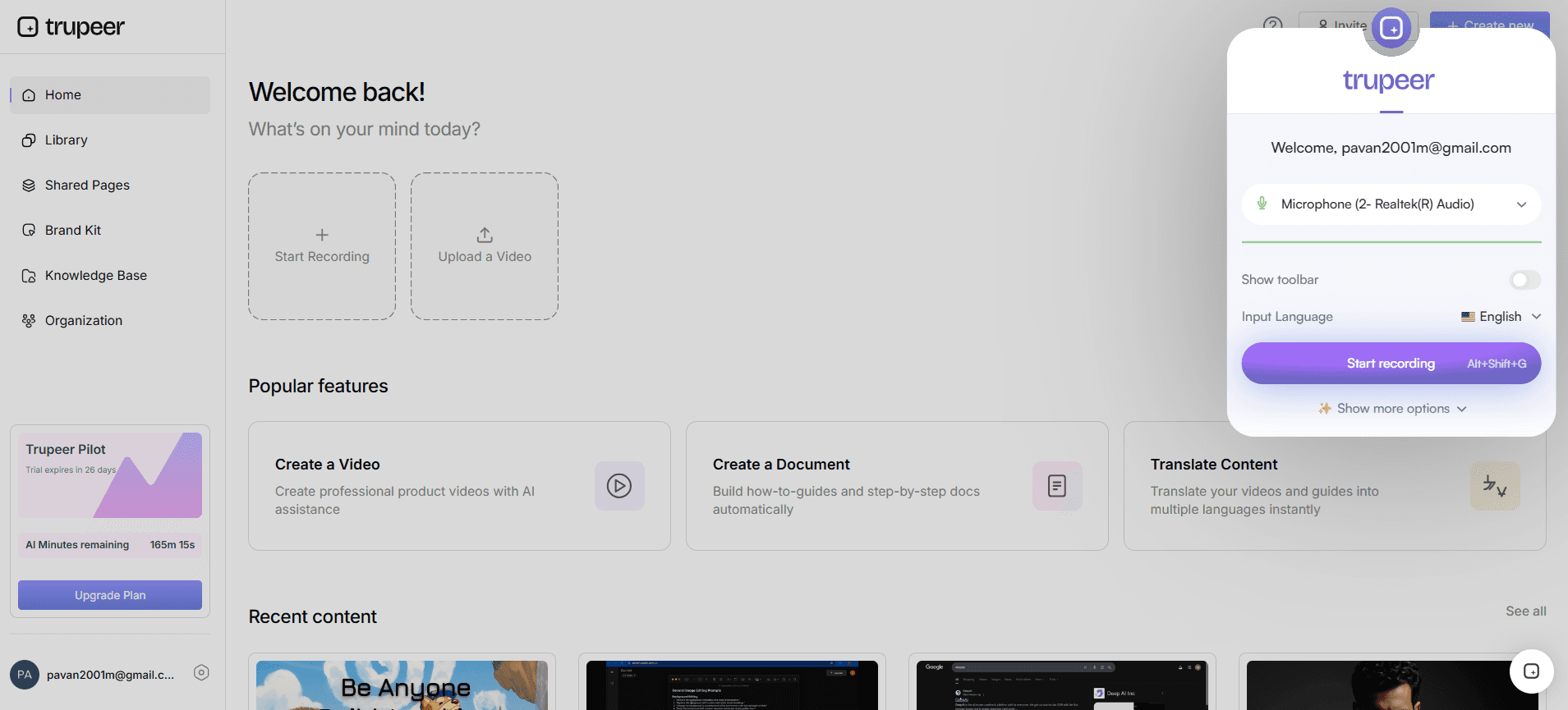
Begin by using Trupeer’s AI screen recording with auto-zoom and click detection. This feature captures your screen activity with precision, automatically focusing on areas of interest, which minimizes distractions. To start, access Trupeer’s browser-based recorder, which requires no installation, and click the record button. The AI will handle zooming and highlight clicks, producing a detailed recording. This step should take about 10-15 minutes, depending on the length of your session. If you encounter technical issues, such as a browser crash, simply restart the recording process, Trupeer saves your progress automatically to prevent data loss.
Step 2: Enhance your recordings
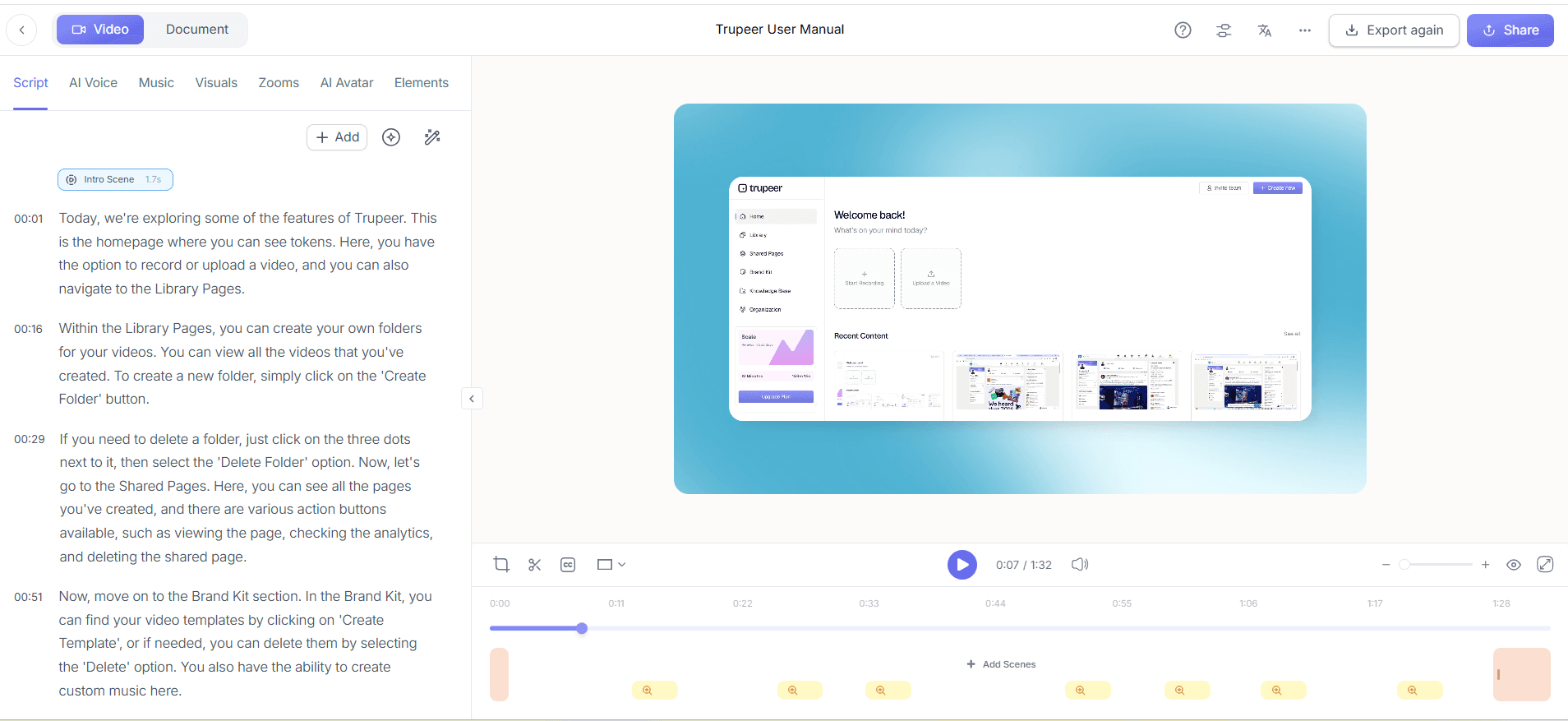
After capturing, enhance your videos using Trupeer's automatic filler-word removal. This feature cleans up your recordings by eliminating unnecessary words and pauses. To apply this, navigate to the editing dashboard and select the “Remove Filler Words” option. This process is quick, taking only a few minutes for a typical 10-minute video. The result is a more concise and professional-looking video. If your video includes specialized terminology, review the edited video to ensure that no essential content was inadvertently removed.
Step 3: Generate automatic SOPs
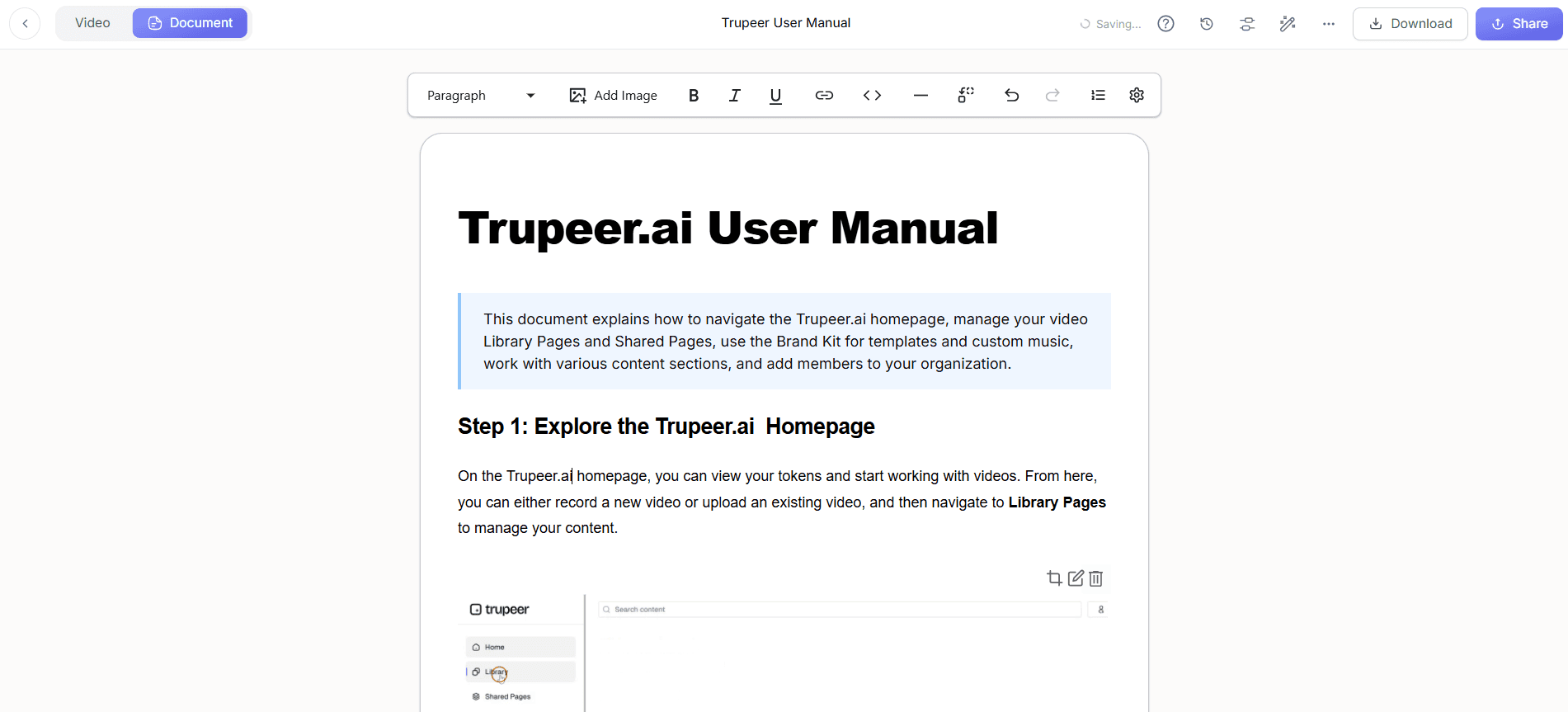
Use Trupeer to transform your videos into structured SOPs effortlessly. On the Trupeer platform, select your recorded video and click on “Generate SOP.” The system will process the video and produce an edit-ready document. This document includes step-by-step instructions extracted from the video content. The generation process typically takes about 5 minutes. If your video contains complex workflows, consider manually reviewing the SOP to ensure clarity and accuracy before distribution.
Step 4: Translate and localize content
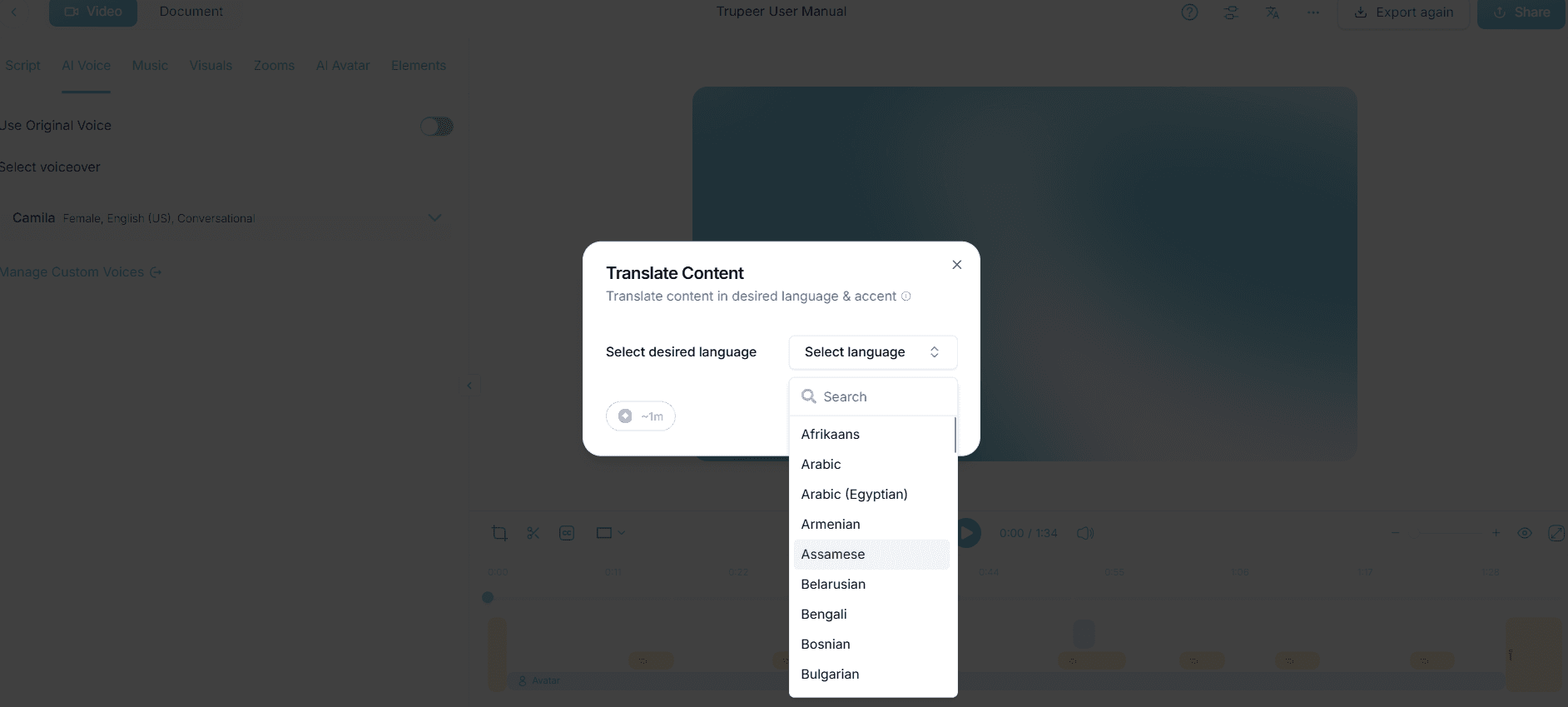
Localization is vital for global teams, and Trupeer simplifies this with AI translation into 40+ languages. Choose the “Translate” option from your video’s settings, select the target language, and enable lip-sync for a natural look. The translation process will take 10-20 minutes depending on video length. This feature is particularly useful for reaching non-English speaking audiences. If your content uses idiomatic expressions, you might need to review translations to ensure they convey the intended meaning accurately.
Step 5: Host on a custom-domain with SSO
Securely host your video knowledge base on a custom domain with Trupeer’s SSO integration. This step involves setting up your domain through the hosting settings on the Trupeer dashboard. Enable SSO to allow users smooth access using their existing credentials. The configuration process is straightforward, typically completed within an hour. Ensure you consult your IT department for domain setup and SSO authentication to align with your organization’s security protocols. Teams weighing tools often start with a Loom alternatives comparison before standardizing on a workflow.
Step 6: Enable AI integration with MCP
Finally, integrate your knowledge base with AI agents via MCP. Access the AI integration settings in Trupeer, and enable MCP by linking your AI agents. This setup allows them to query your video library directly. Depending on the complexity of your AI setup, this may take 30-60 minutes. Once operational, AI agents can deliver precise video content to users on demand. Test the integration by running sample queries to ensure that the AI correctly accesses and retrieves the relevant video segments.
What tips help you integrate your video knowledge base with AI agents via MCP?
Successfully integrating AI agents with your video knowledge base using MCP requires strategic planning and execution. Here are some practical tips to guide your efforts.
Plan your content structure. Organize videos logically to facilitate easier AI querying. A well-structured library enhances accessibility.
Standardize video formats. Use consistent formats for all videos to simplify AI processing and ensure uniform quality across your library.
use analytics. Regularly review viewer engagement analytics to identify which videos are most effective and adjust content strategy accordingly.
Regularly update content. Keep your video content updated to reflect the latest information and practices. This ensures AI queries return accurate results.
Train your AI agents. Continuously refine AI agent capabilities to improve their ability to interpret and respond to queries accurately.
use internal resources. Collaborate with IT and content teams to optimize integration processes. Familiarity with tools like internal knowledge base wiki software can be invaluable.
Test regularly. Conduct frequent tests to ensure that AI integrations function smoothly and deliver the expected outcomes.
Teams ship this workflow end-to-end using Trupeer's AI video platform, which turns raw recordings into polished output without an editor.
Frequently asked questions
How does MCP enhance video knowledge base integration with AI agents?
MCP enables AI agents to query video knowledge bases directly and efficiently. By integrating MCP, AI agents can interpret context within queries and retrieve specific video segments, thus enhancing the speed and accuracy of information retrieval. This capability is crucial for sectors requiring rapid access to precise data, such as customer support and technical training. With MCP, users benefit from simplified workflows and reduced time spent searching for video content, allowing for more productive and informed decision-making.
What are the technical requirements for MCP integration?
Integrating MCP with your video knowledge base requires compatible AI agents and a platform like Trupeer that supports MCP. Ensure your AI agents are capable of context-based querying and that your hosting infrastructure can accommodate the integration. also, having a reliable internet connection and sufficient server resources is important to handle the increased data traffic during AI queries. Consulting with your IT department can help ensure that all technical prerequisites are met for a smooth integration process.
Can MCP integration handle large video libraries?
Yes, MCP integration is designed to handle large video libraries efficiently. Trupeer’s platform ensures scalable access and retrieval, even as your library grows. The AI agents, through MCP, can quickly index and access extensive video content without significant latency, allowing users to find necessary information swiftly. However, performance can depend on your server capabilities and network infrastructure. Regularly assessing and optimizing these components will help maintain best performance as your video library expands.
Does Trupeer support AI translation for video content?
Yes, Trupeer supports AI translation into over 40 languages, making it a versatile video translation platform. This feature is crucial for organizations operating in multilingual environments, as it ensures that video content is accessible to a global audience. The translation process includes lip-sync, providing a natural viewing experience. This capability not only broadens reach but also enhances communication effectiveness across diverse language groups, ensuring that all users receive the intended message accurately.
What security measures are in place for MCP integration?
Trupeer implements solid security measures to protect data during MCP integration. These include encryption for data in transit and at rest, role-based access controls, and secure authentication protocols. When deploying MCP, it’s essential to ensure that your AI agents and supporting infrastructure comply with security best practices. Regular security audits and monitoring can help detect and address potential vulnerabilities, safeguarding your organization’s information assets and maintaining trust with users.
How should you document processes so an AI agent can actually use them?
AI agents need structured, machine-readable documentation not scattered PDFs. Trupeer AI generates clean, structured guides from your recordings and can connect your knowledge base to AI agents via MCP, so your documented processes become something an agent can search and act on.
How can AI agents execute the SOPs you document?
For an agent to execute a process, the guide must be structured and reachable. With Trupeer's AI documentation tools, guides are captured from recordings and kept ready for AI to consume.
Related Blogs