Trupeer Blog
요약
"How good are our processes?" is one of the hardest questions an operations or finance leader can answer. Compared with what? Last year, another site, a competitor, an industry standard or SAP's best practices? Without a clear baseline and a consistent way of measuring, improvement efforts turn into opinions, and transformation business cases rest on guesswork.
Process benchmarking gives you that baseline and that comparison. This guide explains what process benchmarking is, why documented processes are the foundation, and how two widely used frameworks fit in: SAP Activate, which structures SAP implementations around fit-to-standard, and Six Sigma, which brings a disciplined, data-driven improvement method. You'll also find an eight-step approach to process benchmarking, example metrics and the mistakes to avoid.
What is process benchmarking?
Process benchmarking is the practice of measuring how a process performs and comparing it with a reference point, such as another team, another organisation, an industry standard or a best-practice model, to find gaps and improvement opportunities. It looks at outcomes, such as cost, time and quality, and at how the process is performed, so you understand why performance differs, not just by how much.
What are the types of process benchmarking?
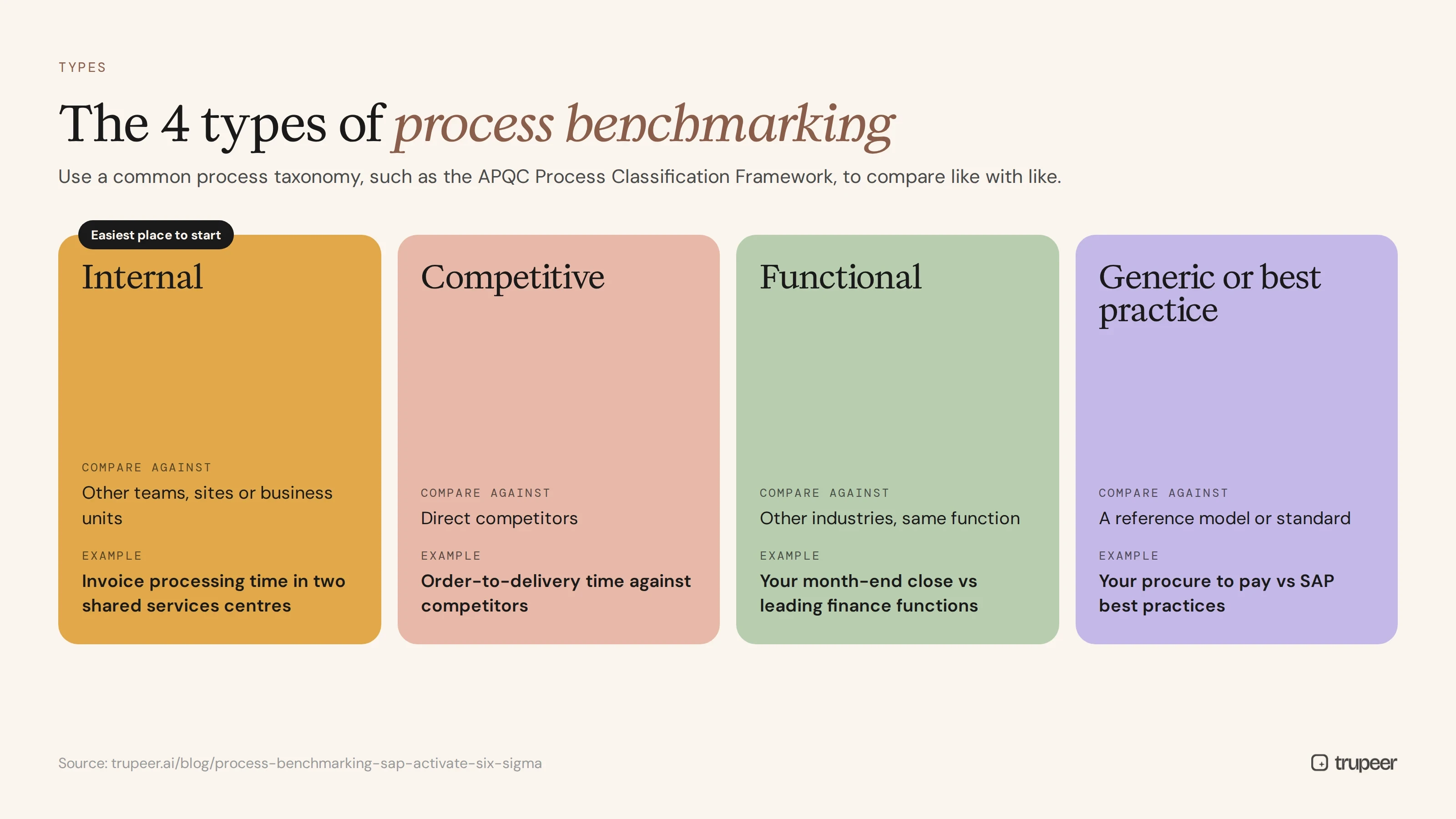
Type | What you compare against | Example |
|---|---|---|
Internal | Other teams, sites or business units in your organisation | Invoice processing time in two shared services centres |
Competitive | Direct competitors | Order-to-delivery time against competitors in your market |
Functional | Organisations in other industries performing the same function | Your month-end close against leading finance functions in any sector |
Generic or best practice | A reference model or standard | Your procure to pay process against SAP best practices or a process framework |
Internal benchmarking is usually the easiest place to start, because the data is accessible and processes are comparable. Many organisations use a common process taxonomy, such as the APQC Process Classification Framework, so they compare like with like.
Why is documentation the baseline for process benchmarking?
You can't benchmark a process you haven't defined. Before any comparison makes sense, you need to know:
What the process includes, from its start to its end, and which steps sit inside it.
How it's actually performed today, including exceptions, workarounds and manual steps outside the system.
Who does what, so differences in performance can be traced to roles, handoffs or tools.
Where the data comes from, so metrics are measured the same way everywhere.
Documented processes make benchmarking credible. They let you compare like with like, explain why one team outperforms another and turn the best way of working into the standard. Recording how work is done is the fastest way to build that baseline; see SAP S/4HANA transformation: document as-is processes first.
How does process benchmarking fit with SAP Activate?
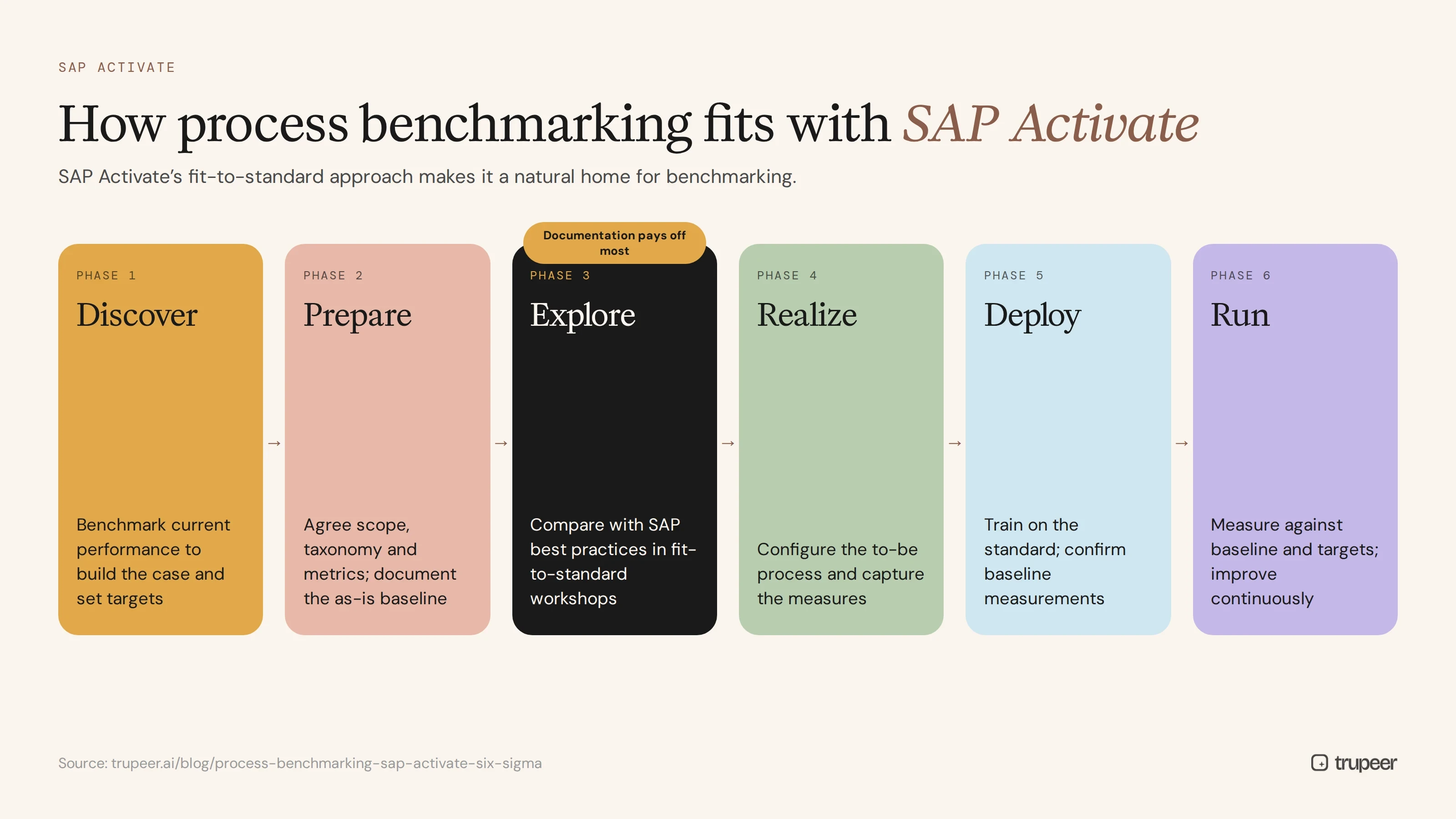
SAP Activate is SAP's implementation methodology, organised into the phases Discover, Prepare, Explore, Realize, Deploy and Run. It promotes a fit-to-standard approach: comparing your requirements with SAP's preconfigured best practices and adopting the standard wherever possible. That makes SAP Activate a natural home for process benchmarking.
SAP Activate phase | How process benchmarking fits |
|---|---|
Discover | Benchmark current process performance to build the case for change and set targets |
Prepare | Agree the process scope, taxonomy and metrics; document the as-is baseline |
Explore | Compare your documented processes with SAP best practices in fit-to-standard workshops; record gaps |
Realize | Configure the to-be process and capture the measures you'll track |
Deploy | Train users on the standard process and confirm baseline measurements before go-live |
Run | Measure performance against the baseline and targets; feed results into continuous improvement |
The fit-to-standard workshops in the Explore phase are where documentation pays off most. When the current process is recorded and documented, teams can see exactly where they differ from the standard and whether that difference adds value or is simply habit. For the requirements side, see ERP requirements gathering from process recordings.
How does process benchmarking fit with Six Sigma?
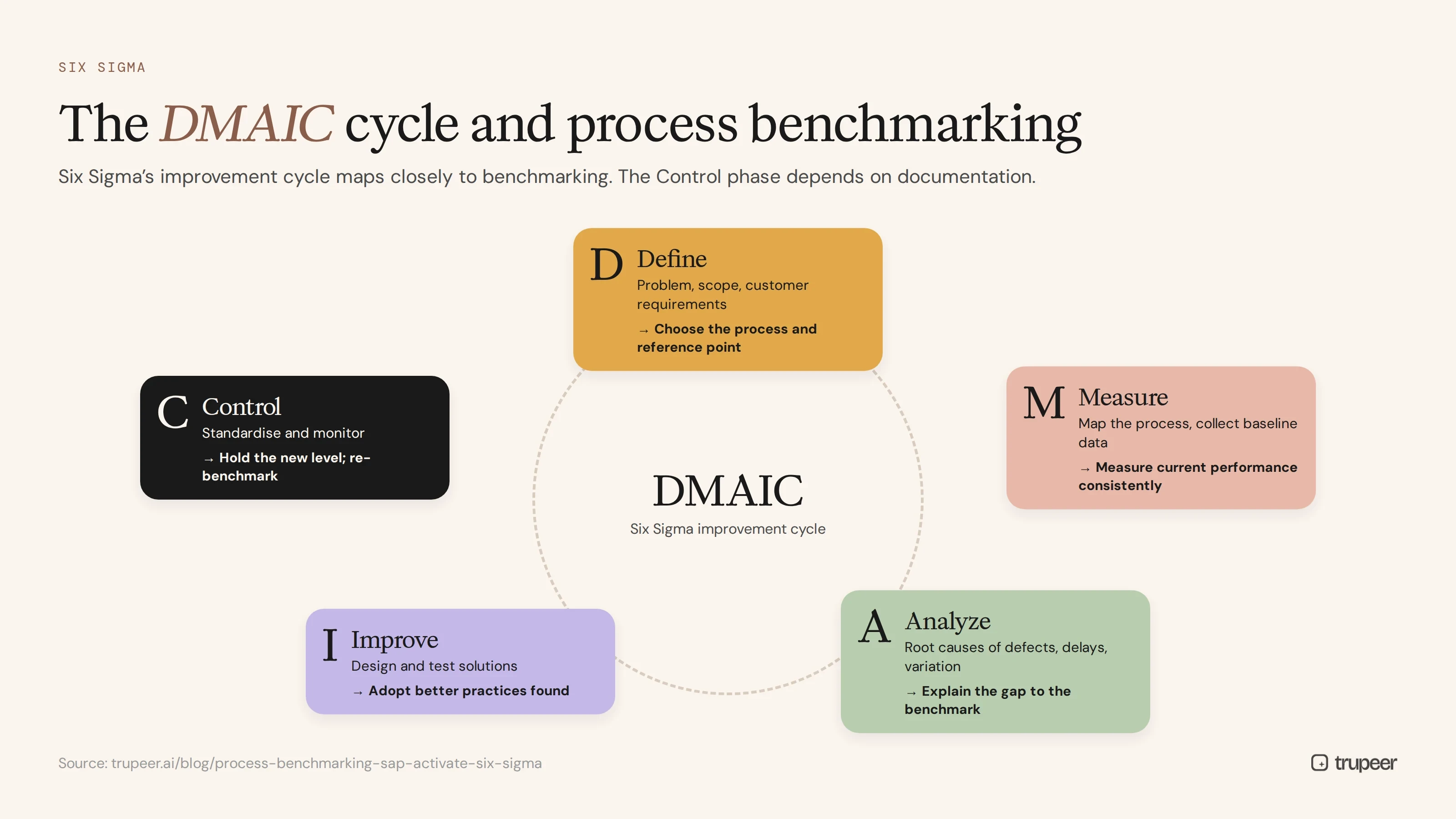
Six Sigma is a data-driven improvement method that aims to reduce variation and defects. Its core improvement cycle, DMAIC, maps closely to process benchmarking:
DMAIC phase | What happens | Benchmarking role |
|---|---|---|
Define | Define the problem, scope, customer requirements and the process boundaries | Choose the process and reference point to benchmark |
Measure | Map the process and collect baseline data | Measure current performance consistently |
Analyze | Find root causes of defects, delays and variation | Explain the gap between your process and the benchmark |
Improve | Design and test solutions | Adopt better practices found through benchmarking |
Control | Standardise the improved process and monitor it | Keep performance at the new level and re-benchmark |
Six Sigma also brings useful measures for benchmarking, such as defects per million opportunities, first-pass yield, cycle time and process capability. And its Control phase depends on documentation: the improved process has to be written down, trained and monitored, or it drifts back. A process control plan template helps structure that step.
How do SAP Activate and Six Sigma work together?
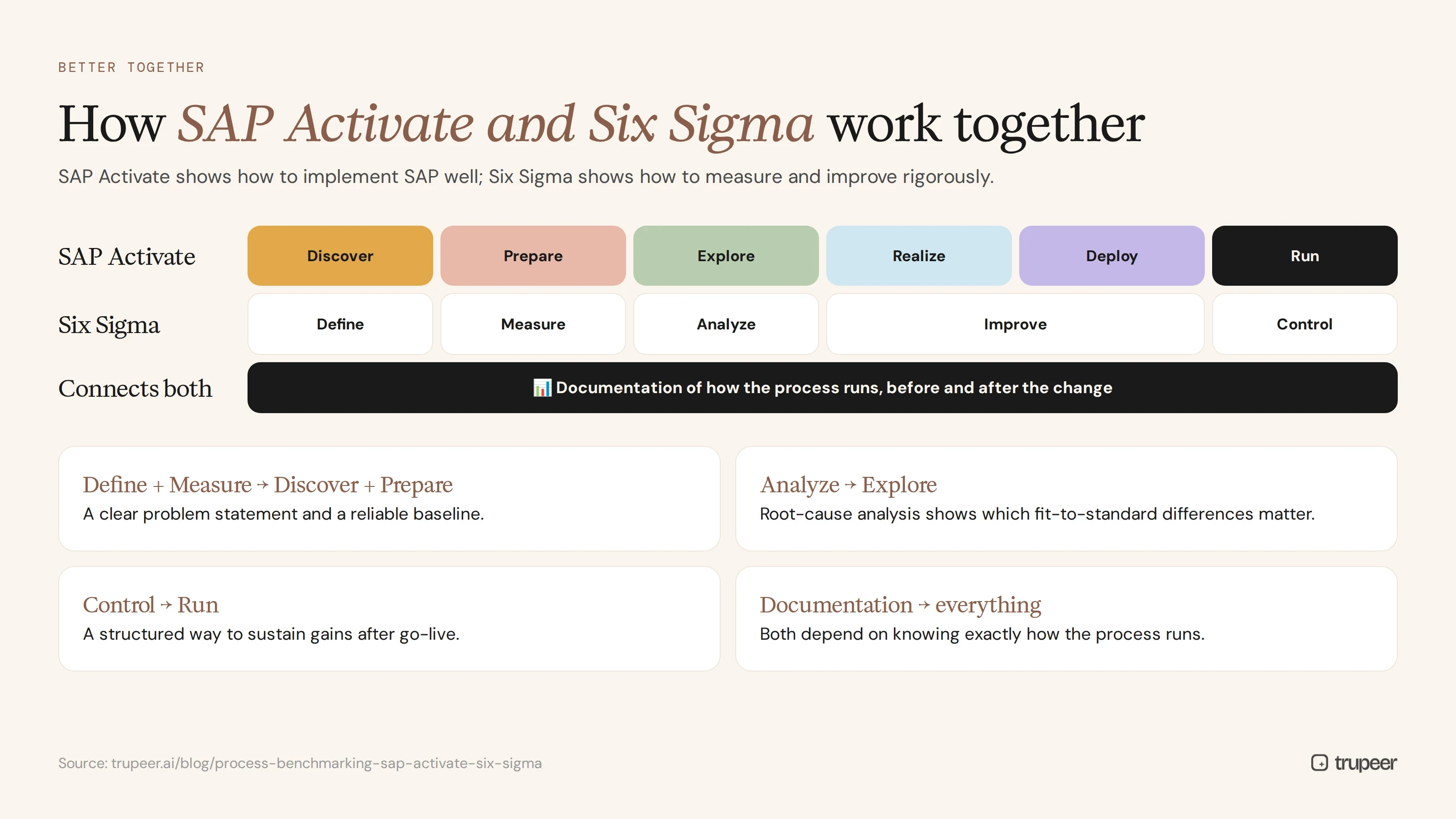
SAP Activate tells you how to implement SAP well; Six Sigma tells you how to measure and improve processes rigorously. Used together:
Six Sigma's Define and Measure phases strengthen SAP Activate's Discover and Prepare phases with a clear problem statement and a reliable baseline.
Fit-to-standard workshops become better informed when root-cause analysis has shown which differences matter.
Six Sigma's Control phase gives SAP Activate's Run phase a structured way to sustain gains after go-live.
Documentation connects both, because both frameworks depend on knowing exactly how the process runs before and after the change.
Should you start with internal or external process benchmarking?
Start internally in most cases. Internal process benchmarking compares teams, sites or entities that use the same systems, policies and data definitions, so differences point directly to how work is done. It's also faster, because the data is yours and the people are available to explain what they do.
External benchmarking is valuable once your own processes are documented and measured consistently. It shows whether your best internal performance is good by wider standards, and it's useful for setting ambitious targets in a business case. When you use external benchmarks, check how each measure was defined and adjust for differences in scale, complexity and regulation before drawing conclusions.
How do you benchmark processes across shared services sites?
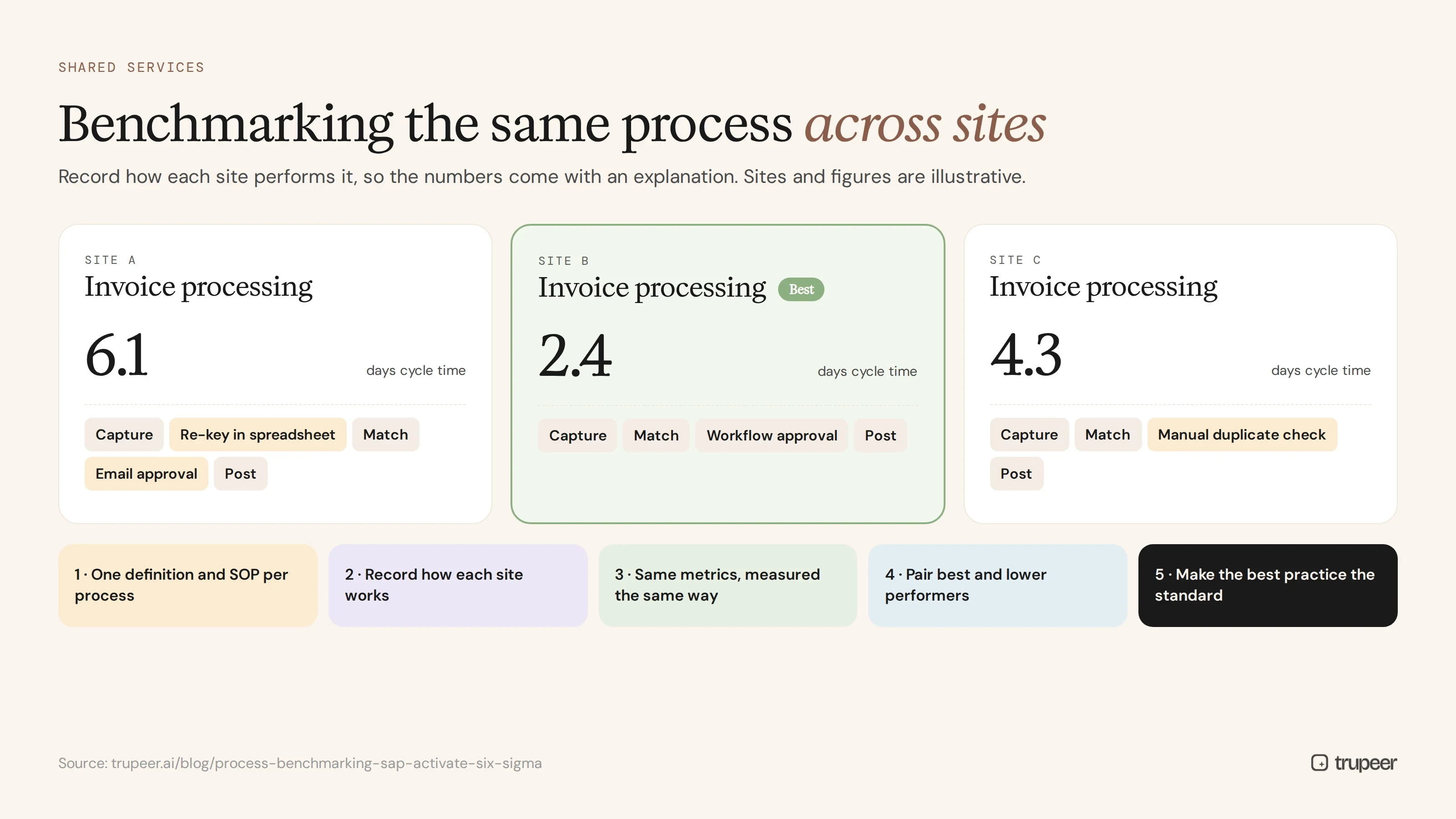
Shared services and global business services organisations are well suited to process benchmarking, because the same process often runs in several centres. To do it well:
Use one process definition and one SOP per process, with documented local variants where regulation requires them.
Record how each site actually performs the process, so differences in steps, tools and handoffs are visible.
Measure the same metrics the same way at every site.
Pair high-performing and lower-performing sites to understand what the best performers do differently.
Turn the best practice into the standard, then train every site on it.
For the documentation side of running shared services at scale, see shared services SOP documentation at scale.
Who should run process benchmarking?
Process benchmarking works best as a partnership. A process excellence or continuous improvement team, often with Six Sigma skills, designs the method and runs the analysis. Process owners own the results and the improvements in their area. Finance or operations analysts supply and validate the data, and the people who do the work explain the reasons behind the numbers. Capture each improvement initiative in a process improvement plan template, with owners, targets and dates, so benchmarking leads to action rather than a report.
How do you run process benchmarking, step by step?
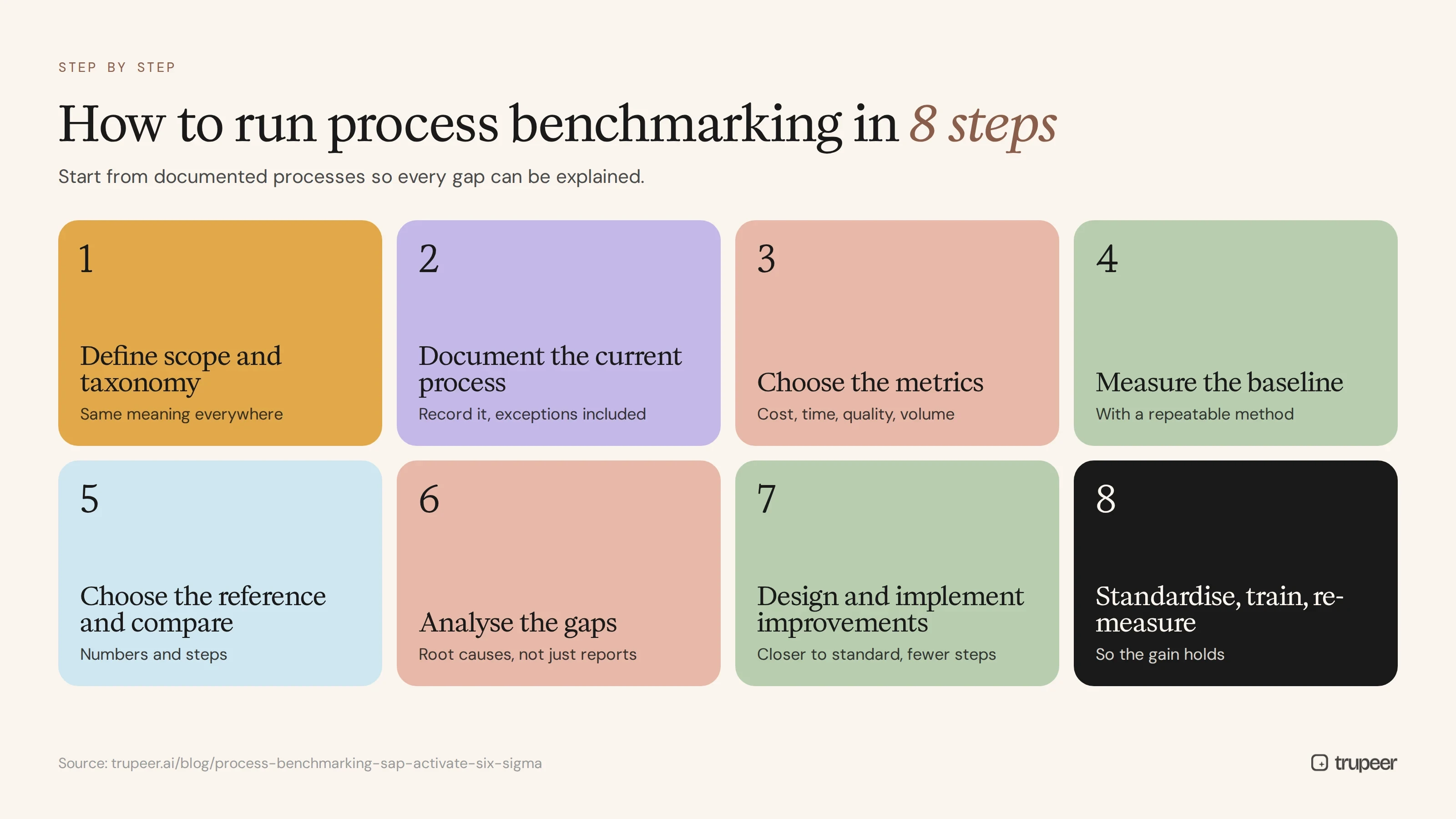
Step 1: Define scope and taxonomy
Choose the processes to benchmark and define their boundaries using a common taxonomy, so every team means the same thing by "invoice processing" or "month-end close".
Step 2: Document the current process
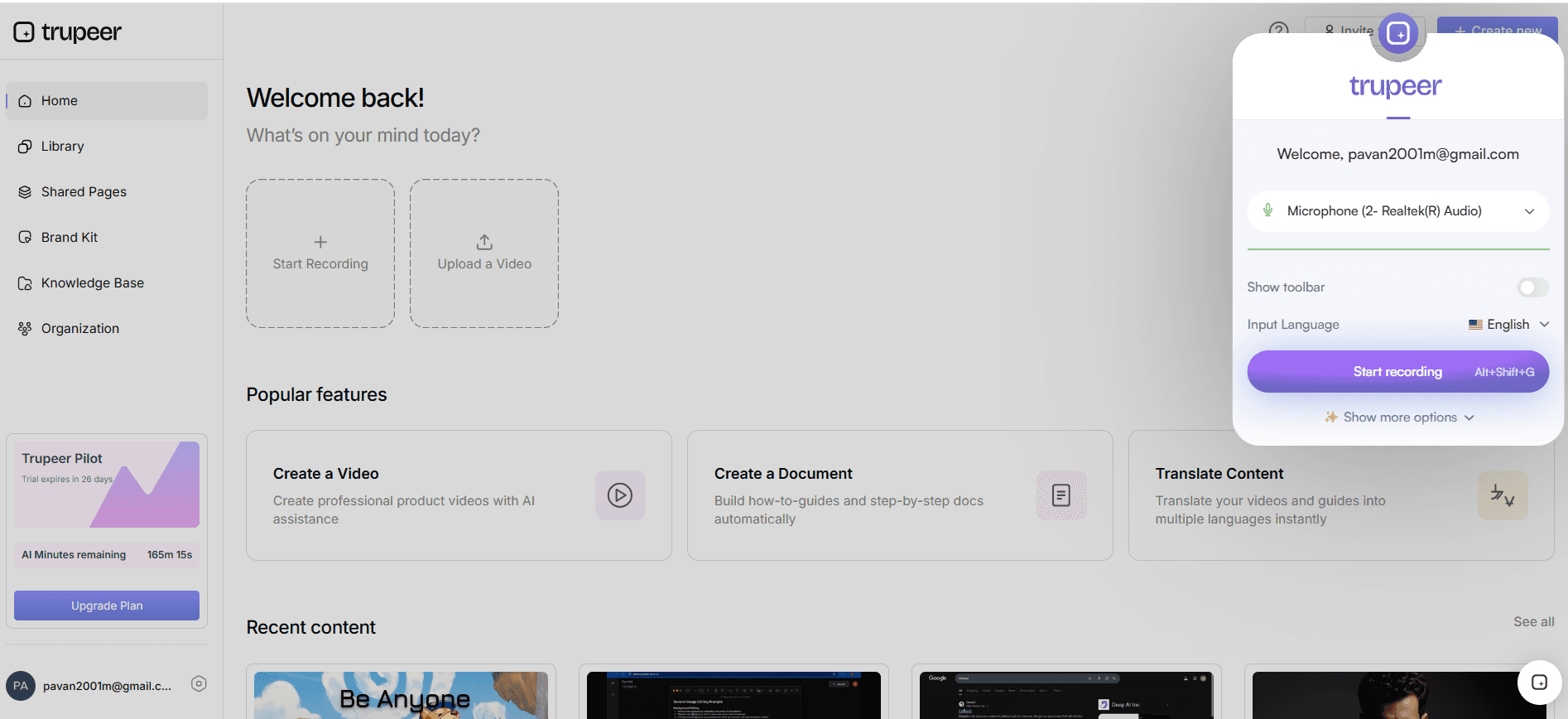
Record experienced team members performing each process with Trupeer's AI screen recorder, including exceptions and manual steps, and turn the recordings into step-by-step process documents.
Step 3: Choose the metrics
Pick a small set of measures for each process, covering cost, time, quality and volume, and define exactly how each is calculated.
Step 4: Measure the baseline
Collect data for each metric from systems and, where needed, from observation or sampling. Document the measurement method so it can be repeated.
Step 5: Choose the reference point and compare
Compare against internal peers, external benchmarks or a best-practice model, such as SAP's standard process. Look at both the numbers and the process steps behind them.
Step 6: Analyse the gaps
Use root-cause analysis to explain the gaps: extra steps, rework, handoffs, missing automation or unclear rules. Documented processes make these visible.
Step 7: Design and implement improvements
Adopt the better practices you've found, whether that's moving closer to SAP standard, removing steps or automating tasks; see how to identify automation opportunities in documented processes.
Step 8: Standardise, train and re-measure
Update the process documentation, train teams on the new standard and measure again to confirm the improvement holds.
Example process benchmarking metrics
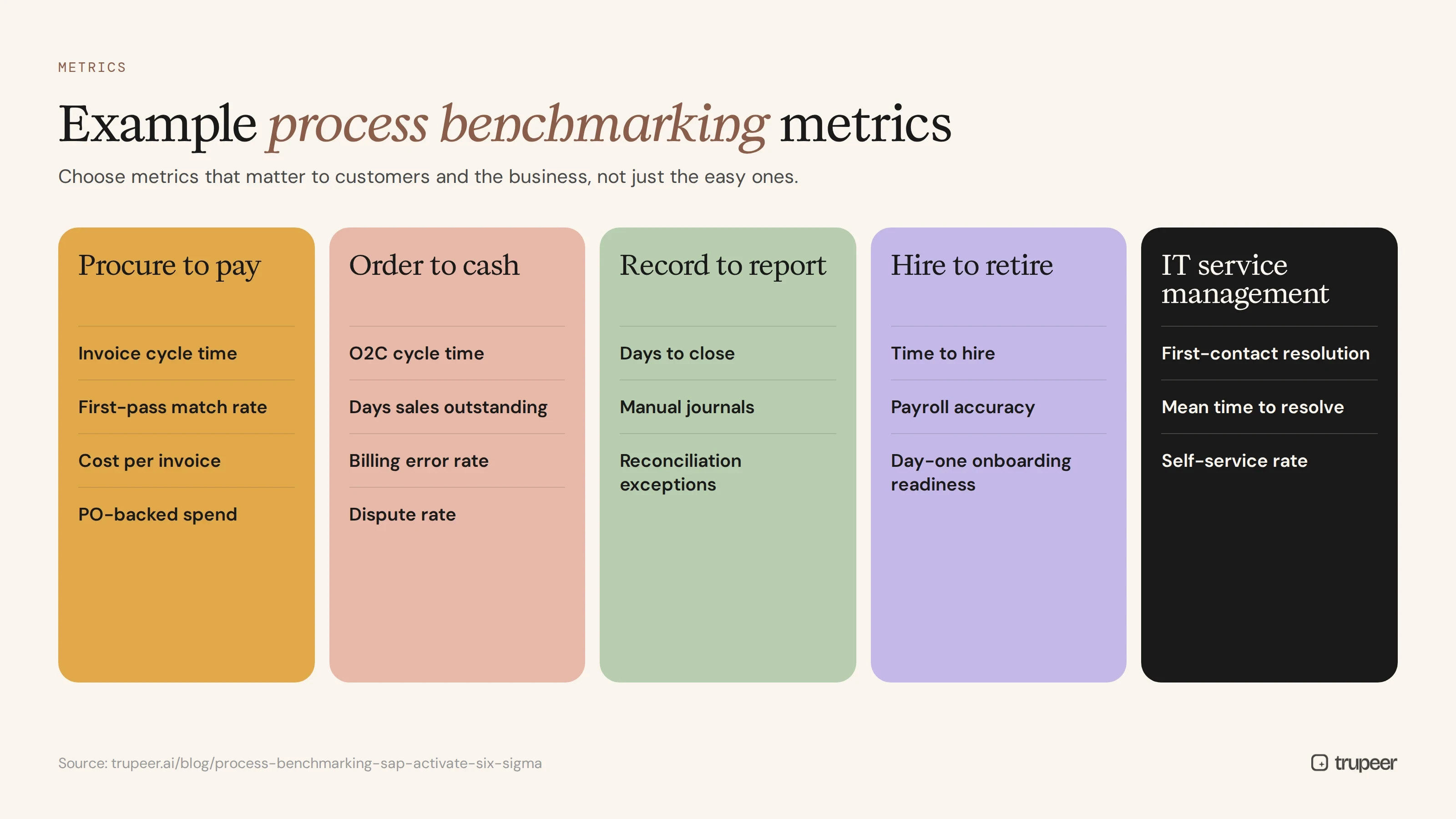
Process | Example metrics |
|---|---|
Procure to pay | Invoice cycle time, first-pass match rate, cost per invoice, share of PO-backed spend |
Order to cash | Order-to-cash cycle time, days sales outstanding, billing error rate, dispute rate |
Record to report | Days to close, number of manual journals, reconciliation exceptions |
Hire to retire | Time to hire, payroll accuracy, onboarding readiness on day one |
IT service management | First-contact resolution, mean time to resolve, self-service rate |
Choose metrics that matter to customers and the business, not just those that are easy to measure. For one of these processes mapped end to end, see the procure to pay process flow.
Common process benchmarking mistakes
Comparing different processes because boundaries and definitions weren't agreed.
Benchmarking numbers without understanding the process behind them.
Using external benchmarks blindly, without adjusting for scale, complexity or regulation.
Skipping the as-is documentation, so gaps can't be explained.
Treating benchmarking as a one-off instead of a regular cycle.
Not updating documentation and training after improvements, so gains fade.
Process benchmarking checklist
Processes in scope are defined using a common taxonomy.
Each process is documented as it's actually performed today.
Metrics are chosen and defined, with a repeatable measurement method.
A baseline is measured for every metric.
Reference points are agreed: internal, external or best practice.
Gaps are analysed for root causes, not just reported.
Improvements are standardised, documented and trained.
Performance is re-measured on a regular schedule.
For a broader view of tools that support this work, see our guide to process mapping tools.
How Trupeer gives you a benchmarking baseline you can trust
Process benchmarking depends on knowing exactly how each process runs today, and that's where Trupeer fits:
Benchmarking need | How Trupeer helps |
|---|---|
A documented as-is baseline | Teams record each process once, and Trupeer turns it into a step-by-step document with screenshots and video |
Comparing sites and teams | Recordings from each site show exactly where steps, tools and handoffs differ |
Explaining performance gaps | Narrated recordings capture the reasons behind each step, not just the clicks |
Standardising the best practice | The best-performing way of working becomes the SOP and training video for every site |
Sustaining the gains (Six Sigma Control) | Guides live in one searchable library and are updated by editing, so the standard doesn't drift |
Genpact used recorded process sessions to build more than 500 training collaterals across 20 workstreams in five languages, in 3 months instead of 12, which shows how quickly a documented baseline and a trained standard can be built at scale. Read the Genpact customer story.
If your benchmarking effort keeps stalling at "we don't really know how this process runs", Trupeer turns that into a documented baseline in days.
Frequently asked questions
What is process benchmarking?
Process benchmarking is measuring how a process performs and comparing it with a reference point, such as another team, another organisation or a best-practice model, to find gaps and improvement opportunities.
What are the types of process benchmarking?
Internal, competitive, functional and generic or best-practice benchmarking.
How does SAP Activate support process benchmarking?
SAP Activate's fit-to-standard approach compares your processes with SAP's best practices, especially in the Explore phase, and its Run phase supports measuring performance after go-live.
How does Six Sigma relate to process benchmarking?
Six Sigma's DMAIC cycle (Define, Measure, Analyze, Improve, Control) provides a structured, data-driven way to measure a baseline, analyse gaps, improve and sustain results.
Why is documentation important for benchmarking?
Because you can only compare processes reliably when you know their boundaries, steps, roles and data sources, and documentation lets you explain why performance differs.
What metrics are used in process benchmarking?
Typical metrics cover cost, time, quality and volume, such as cycle time, cost per transaction, error rates, first-pass yield and days to close.
How often should you benchmark processes?
Regularly, for example annually, and after significant changes such as a system implementation or reorganisation.
How does Trupeer help with process benchmarking?
Trupeer turns recordings of real work into step-by-step process documentation, giving you a reliable as-is baseline to benchmark against, and helps standardise and train the improved process afterwards.
Benchmark from a baseline you trust
Process benchmarking only works when you know exactly how your processes run today. Document them first, measure consistently and use frameworks like SAP Activate and Six Sigma to turn the gaps into lasting improvement. Learn more about Trupeer AI.