Trupeer Blog
Summarise
Imagine you're managing a team responsible for producing critical enterprise documentation. The stakes are high, as accuracy and compliance are non-negotiable. You need to design a process that not only ensures thorough review but also keeps your operations agile. This isn't a small challenge, especially in industries like healthcare and finance where documentation errors can lead to costly penalties. One mistake could mean tens of thousands of dollars in fines or lost revenue. To navigate this, you need a sophisticated AI documentation generator that can simplify your workflow without compromising on quality.
This is where a multi-level reviewer and approval workflow comes into play. By implementing such a system, you can ensure that every piece of documentation is meticulously vetted by relevant experts before it reaches its final approval stage. This process isn't just about catching errors, though. It's about optimizing your team's productivity, meeting compliance standards, and ultimately safeguarding your organization's reputation. we'll explore how to construct an efficient multi-level workflow that meets all these needs.
Why does a multi-level reviewer and approval workflow for documentation matter?
In many industries, the stakes for documentation accuracy are incredibly high. Errors or omissions can lead to substantial legal and financial setbacks. The healthcare industry, for instance, faces potential fines in excess of $50,000 for non-compliance issues related to documentation. In financial services, inaccurate reporting can mean millions in fines and damaged trust. For these reasons, a stringent operations workflow is crucial.
Implementing a multi-level reviewer and approval workflow addresses these challenges by introducing multiple layers of scrutiny. Each layer adds a level of expertise and perspective, ensuring that the final document is not only accurate but also aligned with regulatory requirements. This layered approach doesn't just prevent errors; it also enhances the overall quality of the documentation. Each stakeholder involved in the process, from content creators to compliance officers, plays a critical role in refining the document, contributing their unique insights and expertise.
What are the benefits of a multi-level reviewer and approval workflow?
Establishing a multi-level reviewer and approval workflow offers several key advantages that directly impact the efficiency and reliability of your documentation process.
Increased accuracy and compliance. By incorporating multiple review stages, documents are scrutinized from various angles, significantly reducing the chance of errors and ensuring compliance with industry standards.
Faster turnaround times. With a structured workflow, each reviewer knows their role and the timeline, which leads to quicker approvals and reduces bottlenecks.
Enhanced collaboration. A well-defined workflow builds better communication among team members, allowing for the integration of diverse insights and expertise.
Improved accountability. Each reviewer is responsible for their part of the process, making it easier to track where changes are made and who approved them.
Cost efficiency. By minimizing errors and reducing the need for rework, a multi-level workflow saves time and resources, ultimately lowering operational costs.
Optimized resource allocation. Teams can focus on their core tasks without getting bogged down by inefficient processes, allowing them to deliver higher-quality work with existing resources.
Utilization of advanced tools. using a best documentation software enhances your team's capabilities for better output.
Teams weighing tools often start with a Loom alternatives comparison before standardizing on a workflow.
Which Trupeer features help you set up a multi-level reviewer and approval workflow?
Trupeer offers a suite of features that are specifically designed to simplify the documentation process, ensuring that your multi-level workflow is both efficient and effective.
Automatic SOP generation from any recording
Trupeer's ability to automatically generate Standard Operating Procedures (SOPs) from any recording is a big shift for documentation workflows. This feature allows your team to create comprehensive SOPs directly from video content, saving hours of manual transcription. The generated documents are edit-ready and can be exported in multiple formats such as MP4, HTML, PDF, and SCORM. This flexibility is crucial for teams that need to maintain consistency across various platforms and formats. With auto-generated documentation, your team can focus on refining content rather than starting from scratch.
Collaborative review and approval workflows
Trupeer's collaborative review and approval workflows are designed to facilitate smooth collaboration among your team members. These workflows allow multiple reviewers to provide feedback and approval in a structured manner, ensuring that every document is thoroughly vetted before final approval. This feature also includes version tracking, so you can easily see changes and updates made at each stage of the review process. By simplifying collaboration, Trupeer helps eliminate bottlenecks and ensures timely completion of documentation.
AI-searchable knowledge base
With Trupeer's AI-searchable knowledge base, your documentation becomes easily accessible and searchable. This feature indexes every recording with timestamp-level deep links, allowing team members to quickly find and reference specific parts of a document. The searchable knowledge base is invaluable for teams that need to access and update documentation frequently, as it significantly reduces the time spent searching for information. This feature enhances overall productivity and ensures that your team always has the most up-to-date information at their fingertips.
Auto-updating documentation tied to the underlying recording
Trupeer offers auto-updating documentation that is directly linked to the original recording. This means any updates or changes made to the recording are automatically reflected in the documentation, ensuring that it remains accurate and current. This feature is particularly useful for teams that operate in fast-paced environments where information changes rapidly. By eliminating the need for manual updates, Trupeer helps maintain the integrity of your documentation while reducing administrative overhead.
AI voiceover in 65+ natural voices
Trupeer's AI voiceover capability offers over 65+ natural voice options, allowing you to add professional-quality narration to your documentation. This feature is particularly useful when creating video-based SOPs or training materials that require clear and engaging audio. The adjustable pace and tone options let you tailor the voiceover to suit your audience's preferences, enhancing the overall impact of your documentation. By integrating this feature into your workflow, you can produce high-quality multimedia documents that are both informative and engaging.
These Trupeer features are designed to enhance the efficiency and effectiveness of your multi-level reviewer and approval workflow, ensuring that your documentation process is both simplified and solid.
How do you set up a multi-level reviewer and approval workflow for documentation step by step with Trupeer?
Step 1: Capture Initial Content
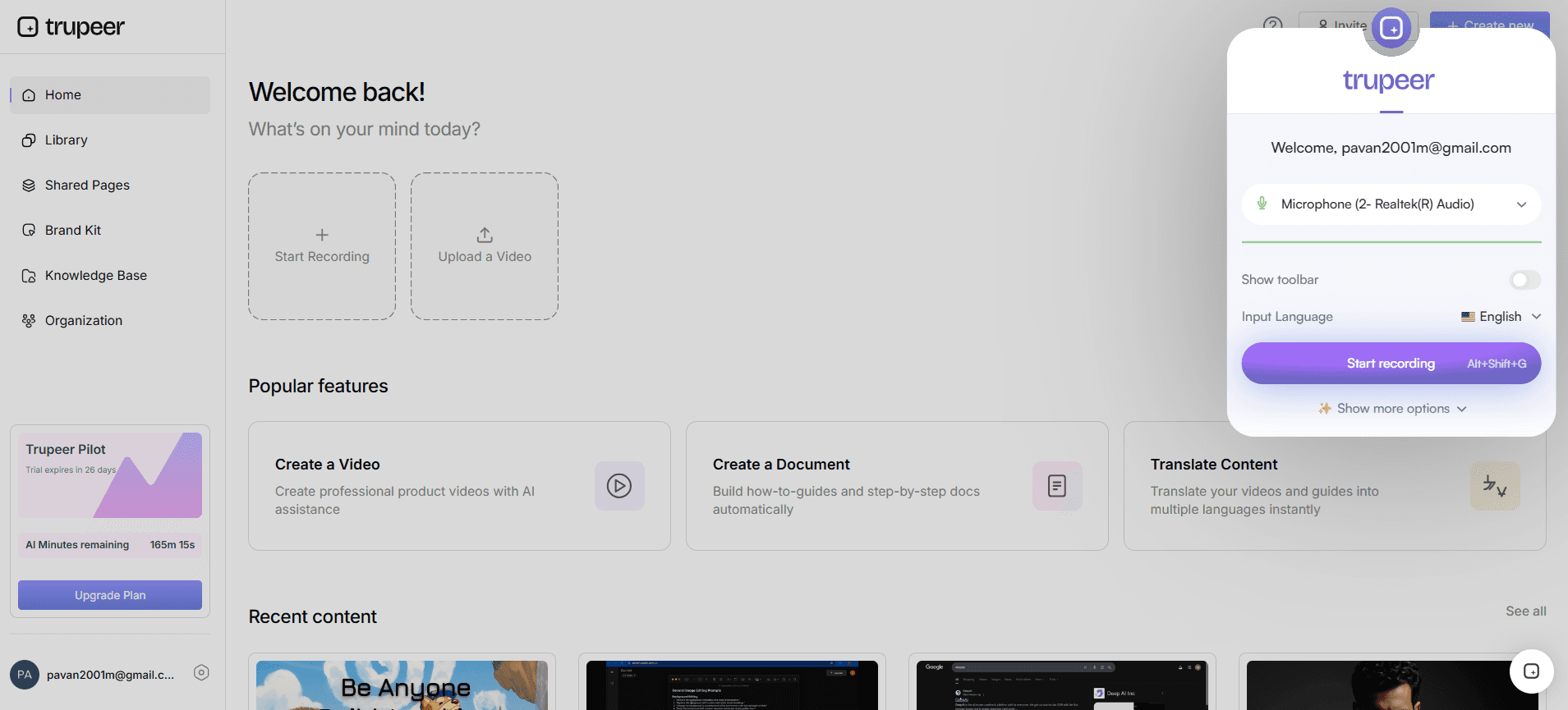
Begin by using Trupeer's browser-based recorder to capture your initial content. This feature requires no installation, making it accessible to all team members. Simply navigate to the Trupeer website, click "Start Recording," and select the screen or application you wish to capture. During the recording, Trupeer's AI screen recording will automatically detect clicks and zoom into areas of interest, ensuring that important details are highlighted. The recording is saved in the cloud, allowing easy access for subsequent editing. This step typically takes 10-15 minutes, depending on the complexity of the content.
Step 2: Edit and Enhance the Recording
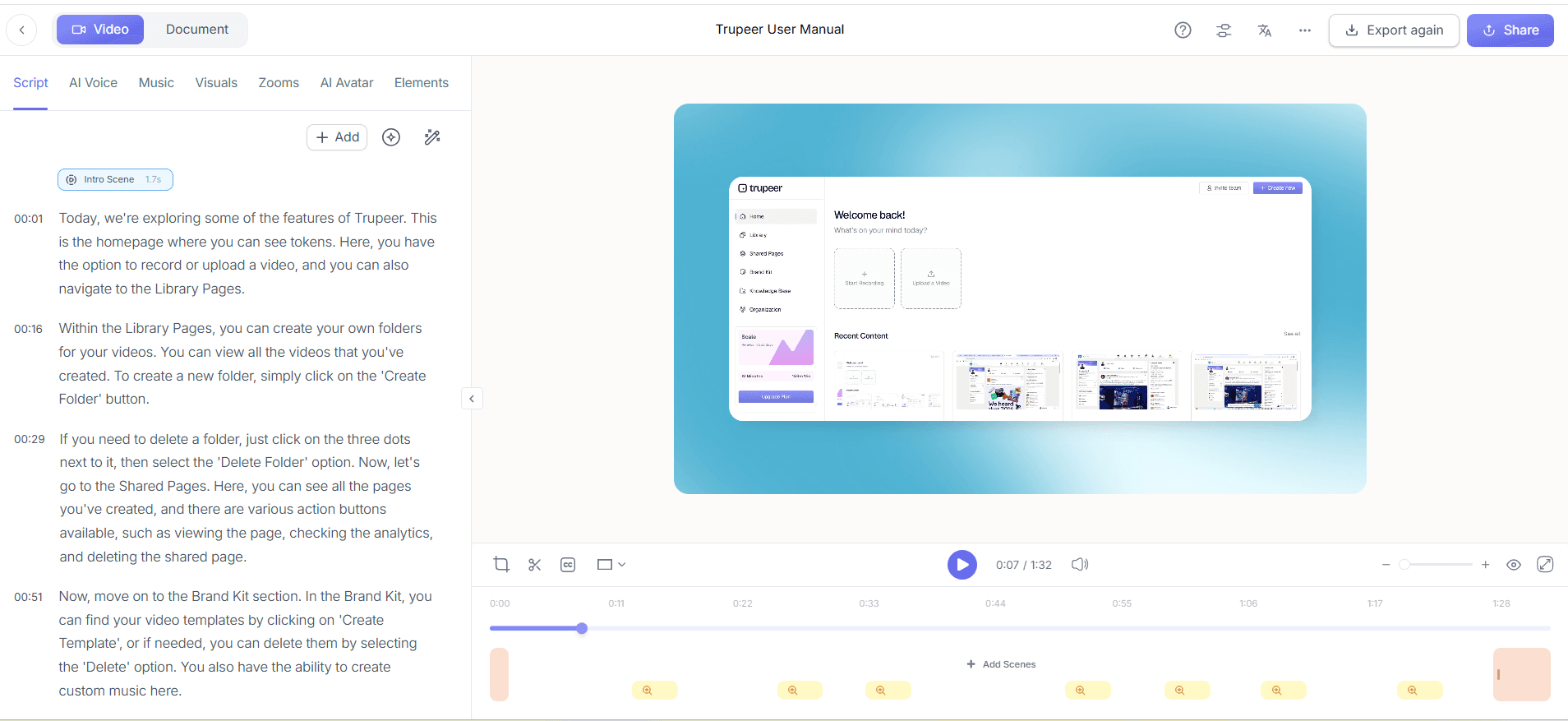
Once your recording is complete, proceed to the editing stage. Trupeer offers a suite of AI-driven enhancements, including automatic filler-word removal and AI voiceover options. You can select from over 65+ natural voices to narrate the content, adjusting the pace and tone to suit your audience. This editing process is intuitive; simply click on the "Edit" button next to your recording, and Trupeer will guide you through the enhancement options. Editing typically takes 15-30 minutes, allowing for a polished final product.
Step 3: Generate and Review the SOP
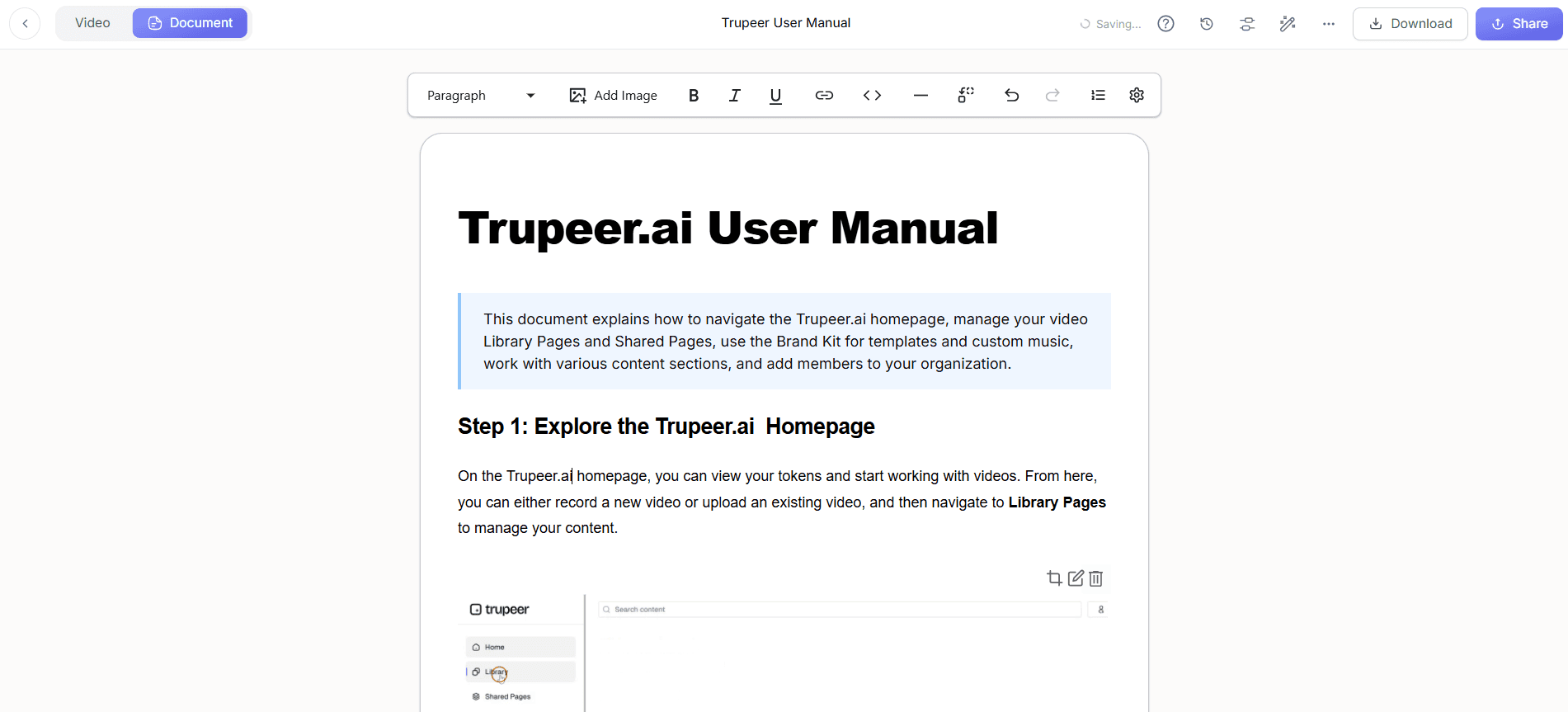
With your video content ready, it's time to generate the SOP. Trupeer's automatic SOP generation feature allows you to convert your recording into a text-based document. Click "Generate SOP" from the options menu. Trupeer will produce an edit-ready document that can be exported in multiple formats such as HTML and PDF. Once generated, assign reviewers by clicking "Add Reviewer" and selecting from your team. Each reviewer will receive a notification to begin their review, ensuring a simplified feedback loop. This step usually takes about 20 minutes to set up, with review times varying based on team schedules. Teams ship this workflow end-to-end using Trupeer's AI video platform, which turns raw recordings into polished output without an editor.
Step 4: Implement Collaborative Review Workflows
After assigning reviewers, Trupeer's collaborative review workflows facilitate efficient feedback collection. Reviewers annotate the document directly, highlighting areas that require attention or modification. Each annotation is timestamped and attributed, maintaining clear accountability. To manage this process, navigate to the "Review" tab and monitor progress in real-time. You can set deadlines and send reminders to ensure timely completion. This step keeps everyone aligned and typically spans a few days, depending on the document's complexity and team availability.
Step 5: Final Approval and Documentation Update
Once all feedback is incorporated, the document moves to the final approval stage. Use Trupeer's approval workflow to assign a final approver who will review the document for overall coherence and compliance. Upon approval, any changes made in the recording are automatically updated in the documentation, thanks to Trupeer's auto-updating feature. This ensures the document remains accurate and aligned with the latest content. The final approval process generally takes one day, ensuring a swift transition from draft to final document.
Step 6: Publish and Distribute
With final approval granted, it's time to publish and distribute the documentation. Trupeer allows you to export the document in various formats, such as MP4 for video or PDF for text, catering to different audience needs. Click "Export" and select the desired format to complete this step. also, Trupeer's workflow documentation tool lets you host the document on a custom domain with SSO, ensuring secure and convenient access. This final step takes approximately 10 minutes, after which your documentation is ready for distribution. This is exactly where queue and approval workflow video becomes useful — and it's the kind of content Trupeer can generate directly from a simple screen recording.
What tips help you set up a multi-level reviewer and approval workflow for documentation?
Implementing a multi-level reviewer and approval workflow requires strategic planning and execution. Here are some tips to help optimize your process and ensure success:
Define roles clearly. Ensure each team member knows their responsibilities to prevent overlaps and missed deadlines.
Set realistic timelines. Allocate sufficient time for each stage of the review process to accommodate thorough feedback.
use technology. Use a workflow documentation software to simplify processes and reduce manual errors.
Encourage open communication. build an environment where team members feel comfortable sharing feedback and suggestions.
Regularly review the process. Continuously evaluate and refine your workflow to enhance efficiency and effectiveness.
Standardize document formats. Use consistent templates to maintain uniformity across all documents.
use AI tools. Explore Scribe alternatives for SOPs to automate repetitive tasks and enhance productivity.
Frequently asked questions
How do you ensure all reviewers have provided feedback?
To ensure all reviewers have provided feedback, use Trupeer's collaborative review workflows which track progress and send reminders. Each reviewer can annotate and comment directly on the document, with their inputs logged and timestamped. This feature allows you to monitor who has completed their review and who still needs to contribute. By checking the "Review" tab, you can easily identify pending feedback, ensuring no review stage is overlooked. This systematic approach maintains accountability and ensures comprehensive review coverage.
What happens if a reviewer disagrees with proposed changes?
If a reviewer disagrees with proposed changes, Trupeer's platform facilitates discussion through annotated comments. Each annotation is visible to all reviewers, allowing for open dialogue about contentious points. Reviewers can communicate through comments, providing justifications or alternative suggestions. This collaborative environment encourages consensus-building, ensuring that all perspectives are considered. Once an agreement is reached, the document can proceed to the next stage in the workflow, maintaining a constructive and inclusive review process.
Why is using AI tools important in documentation workflows?
AI tools are crucial in documentation workflows because they significantly enhance efficiency and accuracy. Trupeer's AI features, such as automatic SOP generation and AI voiceover, reduce manual effort and speed up the process. AI-driven capabilities ensure that key tasks, like transcription and translation, are performed with precision, minimizing human error. also, AI tools allow for real-time updates and smooth collaboration, making workflows more agile and responsive to changes. Incorporating AI technology ultimately leads to higher-quality documentation and more simplified operations.
Can Trupeer integrate with existing documentation systems?
Yes, Trupeer can integrate with existing documentation systems. Its flexible architecture allows for smooth integration with various platforms, ensuring that your current systems can benefit from Trupeer's advanced features. This integration capability means that you can incorporate AI-driven enhancements, collaborative workflows, and real-time updates without overhauling your existing processes. This compatibility maximizes the utility of both Trupeer and your legacy systems, creating a cohesive and efficient documentation environment.
Does Trupeer support multilingual documentation needs?
Yes, Trupeer supports multilingual documentation needs through its AI translation and dubbing features. With capabilities to translate into over 40 languages and provide lip-sync dubbing, Trupeer ensures that your documentation is accessible to a global audience. This feature is particularly beneficial for organizations operating in diverse markets, as it allows them to maintain consistency across different languages. By using Trupeer's video translation platform, you can produce documentation that meets the linguistic and cultural needs of your audience, enhancing communication and compliance on a global scale.