Use este modelo
You can't transfer what you haven't found. With Trupeer, you can save weeks on knowledge transfer planning by starting with a free knowledge transfer gap analysis template, customizing it with your brand guidelines, and closing each gap with a recorded walkthrough from the person who knows the work.
What is a knowledge transfer gap analysis?
A knowledge transfer gap analysis compares the knowledge a team needs to run its processes with the knowledge that's actually documented, and lists every gap between the two. It's usually done before or at the start of a transition, outsourcing deal, GCC setup or system rollout, so knowledge transfer focuses on what's missing instead of re-covering what's already written down.
This template does it in a specific way:
Start from a standard process reference, a complete list of the processes the team should be able to run.
Map your existing documentation against that reference.
List every gap, such as missing, outdated or incomplete documentation, or knowledge held by only one person.
Rank the gaps by how many documents depend on each one, so you fix the gaps that undermine the most other documentation first.
The result is a gap register: a prioritized list of what to capture, from whom and by when. It's also called a knowledge gap assessment, documentation gap analysis or KT gap register.
Why rank gaps by dependent documents?
Most gap analyses rank gaps by gut feel, or by how critical the process sounds. That misses how documentation actually works. Processes depend on each other, and so do the documents that describe them.
Take a missing SOP for vendor master data maintenance. On its own, it looks like one gap. But the SOPs for invoice processing, payment runs, supplier onboarding and month-end accruals may all assume someone already knows how vendor records are set up. If that knowledge is missing, every one of those documents is weaker than it looks.
Counting dependent documents turns that into a number. A gap with twelve dependent documents is a bigger risk than a gap with one, even if both processes seem equally important. Fixing it first strengthens all twelve.
When do you need a knowledge transfer gap analysis?
Before an outsourcing or BPO transition, to scope knowledge transfer and set realistic timelines.
In a vendor-to-vendor transition, to see what the incumbent's documentation really covers.
When setting up a GCC or GBS center, to know what must be captured before work moves.
Before a system rollout, to find process knowledge that isn't in the current documentation.
When key people are leaving, to find what only they know.
After an acquisition, to compare two organizations' process documentation.
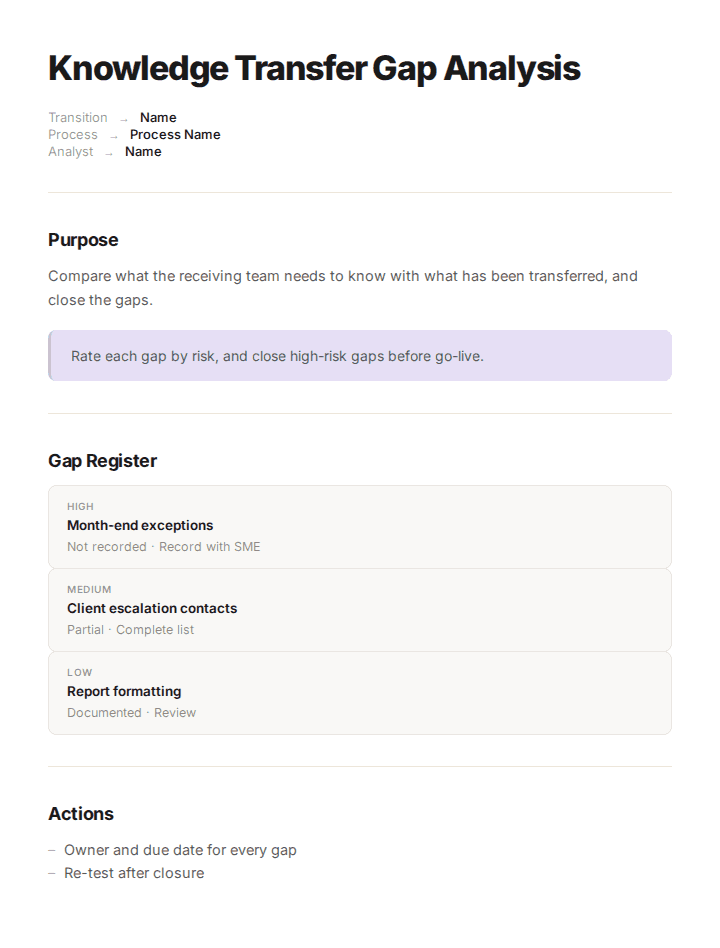
Preview the knowledge transfer gap analysis template
The template opens with the analysis scope and the process reference you're measuring against. The documentation inventory lists every existing SOP, desk manual, job aid and training asset, mapped to reference processes. The gap register is the core: one row per gap, with gap type, dependent document count, criticality, knowledge holder, owner, action and status. A short summary shows gaps by type and the top gaps by priority score.
How to customize this template in Trupeer
Step 1: Open the Templates Section
Go to the Templates section from the main navigation.

Step 2: Select and Open a Template
Click on any template you want to work with to open it.
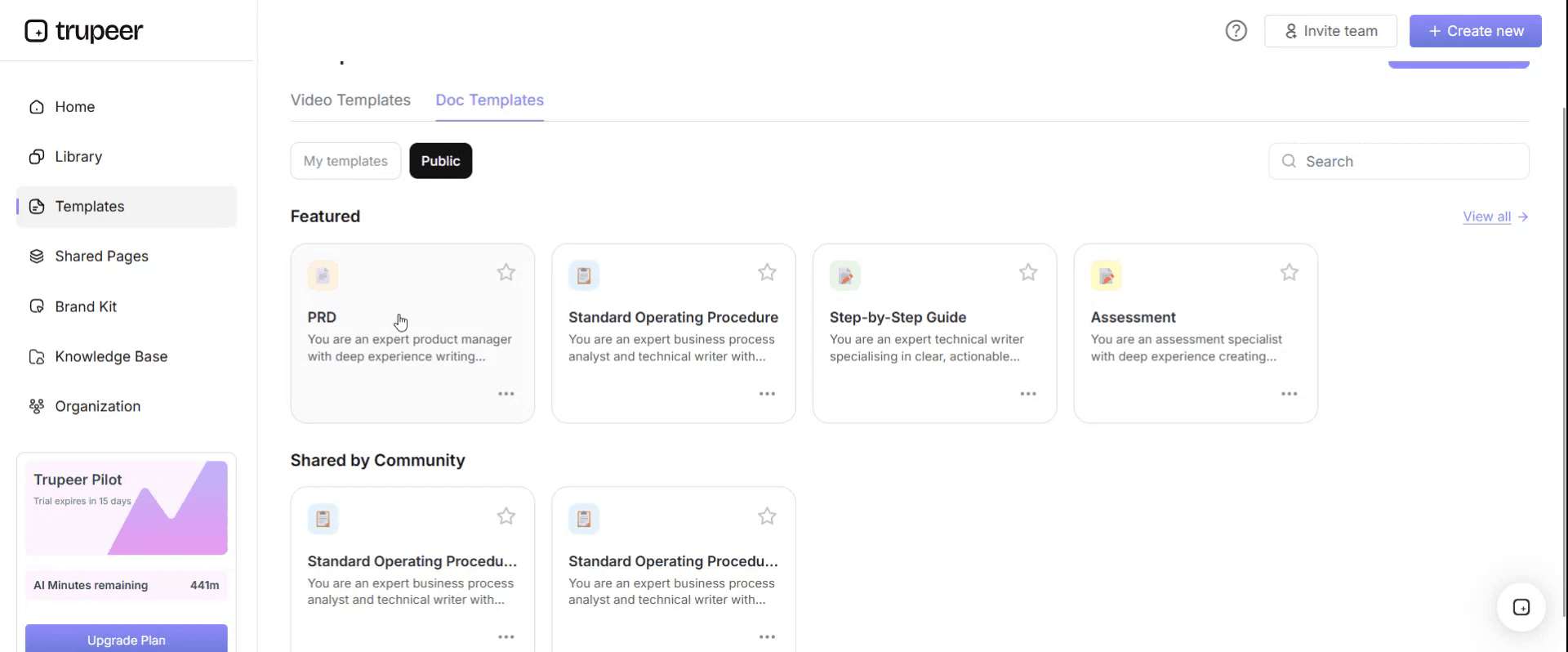
Step 3: Expand the Template View
If needed, expand the template view to see the full layout and details clearly.

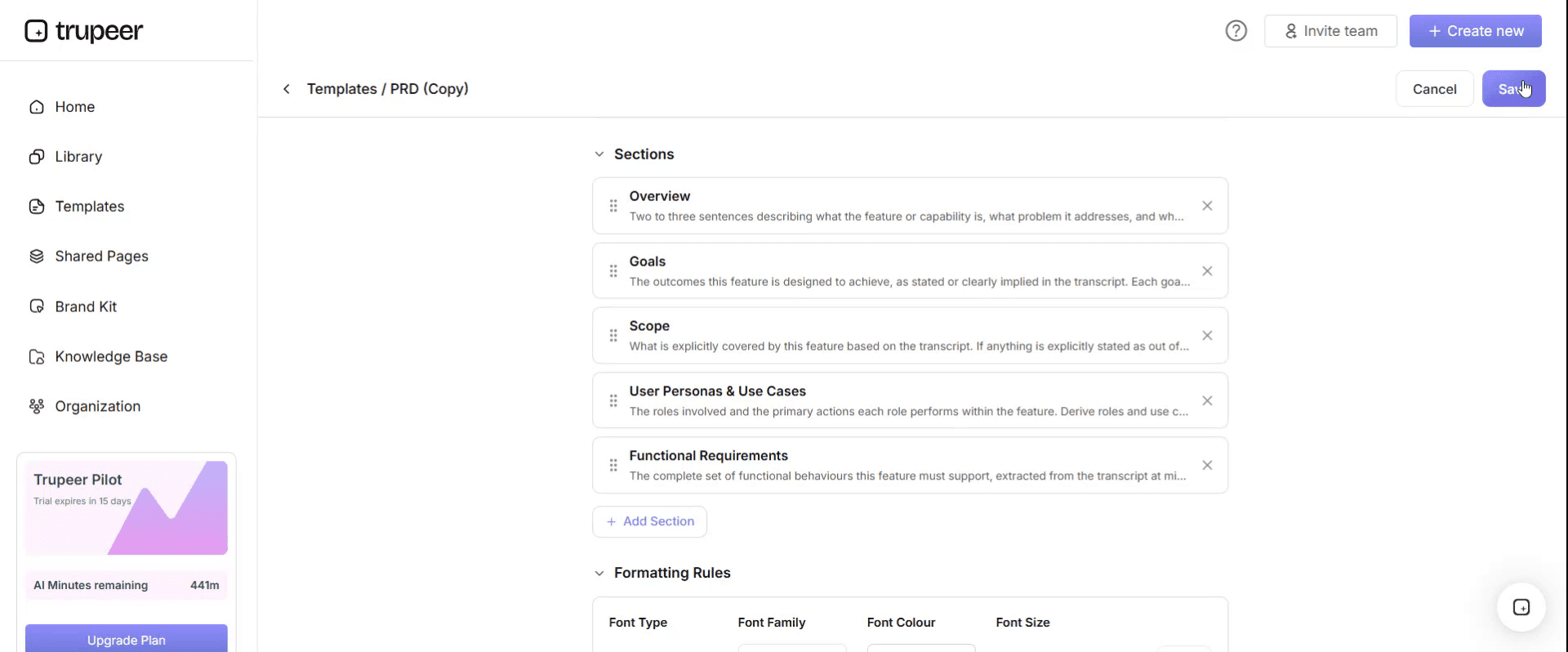
Step 4: Edit the Template
Click on Edit to start modifying the selected template.

Within the editor, you can:
Add new sections
Define or update formatting rules
Add a logo and adjust its position and related settings
Step 5: Save Your Customized Template
After making all necessary changes, click Save to store the updated template as your own.
Step 6: Preview and Fine-Tune the Template
When you want to see how your customized template looks, open the Preview.

From the preview screen, you can continue to make adjustments directly if needed, ensuring the template appears exactly as you want.
With a knowledge transfer gap analysis template you can:
Scope knowledge transfer accurately: Know exactly what needs capturing before KT starts.
Fix the gaps that matter most first: Dependency ranking shows which gaps weaken the most documentation.
Find single points of failure: See which processes live only in one person's head.
Stay on-brand: Apply your logo, fonts and colors with Trupeer's brand kit.
Close gaps from recordings: Record the knowledge holder doing the work and generate the missing SOP.
Track progress: Watch the gap register shrink wave by wave.
What a knowledge transfer gap analysis template must contain
Scope: the function, processes and teams being analyzed.
Process reference: the standard list of processes the team should be able to run.
Documentation inventory: every existing document, mapped to the reference.
Gap register: each gap with its type, dependencies, criticality, owner and action.
Scoring method: how gaps are prioritized.
Summary: gaps by type, top-priority gaps and progress over time.
Revision history: each time the analysis is re-run.
Choosing a standard process reference
The process reference is the yardstick for the whole analysis. Without one, you can only find gaps in the documents you already know about. Options include:
An industry process framework, such as the APQC Process Classification Framework, which lists processes for functions like finance, HR and procurement.
Your own process taxonomy, if your organization already maintains a Level 1 to Level 4 process hierarchy.
The scope schedule of an outsourcing contract, which lists the processes the provider will deliver.
A system's standard process model, such as the business processes an ERP is configured to support.
Use the most detailed level you can. Gaps usually hide at Level 4, the individual task, rather than at the process level.
Free knowledge transfer gap analysis template: the structure to copy
Copy the structure below into your own spreadsheet or document, or sign up to download it from Trupeer.
1. Scope. Function: [e.g. finance operations]. Processes in scope: [list or reference]. Teams: [sending and receiving teams]. Analysis owner: [name]. Date: [date].
2. Process reference. Reference used: [framework or taxonomy]. Level of detail: [e.g. Level 3 or Level 4].
3. Documentation inventory.
Document | Type | Reference process | Last updated | Owner | Depends on |
|---|---|---|---|---|---|
[Title] | [SOP, desk manual, job aid, video] | [Process ID] | [Date] | [Name] | [Processes or documents it assumes] |
4. Gap register.
Gap ID | Reference process | Gap type | Dependent documents | Criticality | Knowledge holder | Owner | Action | Due | Status |
|---|---|---|---|---|---|---|---|---|---|
G-01 | [Process] | [Missing / Outdated / Incomplete / Single source / Unverified] | [Count] | [High / Medium / Low] | [Name] | [Name] | [Record and document] | [Date] | [Open] |
5. Gap types.
Gap type | Meaning |
|---|---|
Missing | No documentation exists for the process |
Outdated | Documentation exists but no longer matches how the work is done |
Incomplete | Documentation covers the standard path but not exceptions or rules |
Single source | Knowledge is held by one person and not documented |
Unverified | Documentation exists but hasn't been checked by an SME |
6. Scoring. Priority score = dependent documents × criticality weight (High 3, Medium 2, Low 1). Add 2 if the gap is single source and the knowledge holder is at risk of leaving.
7. Summary. Total gaps by type, top ten gaps by priority score, gaps closed since the last run.
8. Revision history. Run date, author, gaps opened, gaps closed.
How to count dependent documents
The dependency count is what makes this method different, so it's worth doing carefully. A document depends on a process when the reader needs that process's knowledge to follow the document correctly.
Look for three kinds of dependency in each document:
Explicit references: the document links to, names or says "see" another process.
Assumed inputs: the document starts from something another process produces, such as "once the vendor is set up" or "using the approved requisition."
Shared rules: the document relies on business rules, thresholds or codes defined in another process.
Then count them for each gap:
Count direct dependents. How many documents in the inventory depend on the process with the gap?
Decide whether to count indirect dependents. If document B depends on A, and C depends on B, a gap in A affects C too. For a first pass, count direct dependents only; for critical processes, add the indirect ones.
Record which documents they are, not only the number, so you know what to update once the gap is closed.
Two practical tips. First, ask SMEs which processes they'd need to explain before anyone could follow a given SOP; that surfaces dependencies no document states. Second, don't overthink the precision. The goal is to separate gaps with one or two dependents from gaps with ten or twenty, and rough counts do that well.
How to run a knowledge transfer gap analysis in seven steps
Agree the scope and the process reference with the transition lead and process owners.
Build the documentation inventory. Collect every SOP, desk manual, job aid, KEDB entry and training video, and map each to a reference process.
Record dependencies. For each document, note which other processes or documents it assumes the reader already knows.
Find the gaps. For every reference process, check whether documentation exists, is current, covers exceptions and has been verified, and whether the knowledge sits with only one person.
Count dependent documents for each gap. Count how many documents in the inventory depend on the process with the gap.
Score and rank. Apply the scoring method and sort the gap register by priority.
Assign actions and re-run. Give each gap an owner, a knowledge holder and a due date, then re-run the analysis at the end of each KT wave.
Knowledge transfer gap analysis example
Here's the template filled in for an illustrative example. A logistics company, Kestrel Logistics, is moving procure-to-pay processes to its new GCC. Its reference is a Level 4 process list for procure-to-pay, and its inventory has 46 existing documents.
Gap ID | Reference process | Gap type | Dependent documents | Criticality | Priority score |
|---|---|---|---|---|---|
G-03 | Vendor master data maintenance | Single source | 12 | High | 38 |
G-07 | Three-way match exception handling | Incomplete | 8 | High | 24 |
G-01 | Purchase requisition approval routing | Outdated | 6 | Medium | 12 |
G-11 | Foreign currency invoice posting | Missing | 3 | Medium | 6 |
G-14 | Duplicate invoice check | Unverified | 2 | Low | 2 |
What the ranking changed. The team had planned to start with foreign currency invoices, because they caused the most visible errors. The dependency count showed that vendor master data maintenance, held by one analyst who was due to retire, sat underneath twelve other documents. It was recorded and documented first, and five of the twelve dependent SOPs needed corrections once the real process was captured. The details in this example are illustrative; replace them with your own analysis.
Close each gap with a recording
The fastest way to close a gap is to capture the person who knows the work while they do it:
Record the knowledge holder performing the process in the live system with Trupeer's AI screen recorder, explaining each step and the exceptions.
Generate the missing documentation. Upload the recording, and Trupeer turns it into a step-by-step SOP with screenshots, plus a narrated video, using the SOP creator.
Review and approve with the SME and process owner.
Update dependent documents that assumed the missing knowledge.
Publish everything in a searchable knowledge base, and use translation for teams in other locations.
Mark the gap closed in the register.
The same recording-first approach works at scale. Genpact recorded existing MS Teams process design sessions and SME walkthroughs, uploaded them to Trupeer and got back SOPs and demo videos in five languages: more than 500 training collaterals for 140,000 employees in 40 countries, delivered in 3 months instead of 12. Read the Genpact customer story.
Run the gap analysis automatically on your estate
A manual gap analysis means reading and mapping every document by hand, which is slow when your documentation estate runs to hundreds or thousands of files. Trupeer can run the analysis for you: connect your existing documentation, choose a process reference, and get a gap register ranked by how many documents depend on each gap. Sign up to download the template and run it on your estate.
Gap analysis variants
Vendor-to-vendor transition gap analysis
Use the contract scope schedule as the reference, and compare it with the documentation the incumbent provides. Gaps of the "single source" type often sit with the incumbent's staff. See our guide to vendor-to-vendor transition knowledge transfer.
GCC setup gap analysis
Run the analysis before the KT window opens, so the GCC hires and KT calendar match the real amount of capture needed. See our guide to GCC setup knowledge transfer.
Retirement and attrition gap analysis
Filter the reference to the processes a departing person runs, and focus on single-source gaps. See our guide to knowledge retention before SME attrition.
IT and AMS gap analysis
Include known errors and runbooks in the inventory, and use the application's support catalog as the reference. The KEDB template covers the known error records.
Government and public sector gap analysis
Add statutory requirements and records rules to the reference, since a missing procedure can also be a compliance gap.
Knowledge transfer gap analysis vs training needs assessment
Analysis | What it finds | Output |
|---|---|---|
Knowledge transfer gap analysis | Missing or weak documentation of how work is done | Gap register and capture plan |
Training needs assessment | Skills people lack | Training plan |
Process documentation audit | Quality of existing documents | Document fixes |
KT plan | How knowledge will be transferred | Sessions and calendar |
A gap analysis usually comes first: it tells you what to document, and the training needs assessment template tells you who to train on it. See also the knowledge transfer SOP template and process documentation template.
Knowledge transfer gap analysis checklist
Scope and process reference are agreed.
Every existing document is in the inventory and mapped to a reference process.
Dependencies are recorded for each document.
Every reference process has been checked for all five gap types.
Each gap has a dependent document count and a priority score.
Single-source gaps are flagged with the knowledge holder's name.
Each gap has an owner, an action and a due date.
The analysis is scheduled to re-run after each KT wave.
Common mistakes to avoid
Analyzing only the documents you have. Without a process reference, the biggest gaps stay invisible.
Stopping at the process level. Most gaps are in individual tasks and exceptions.
Treating every gap as equal. Rank by dependencies and criticality, or you'll fix easy gaps first.
Ignoring single-source knowledge. If only one person knows it, it's a gap even if nothing looks missing.
Running it once. Re-run after each wave to confirm gaps are actually closed.
Download the free knowledge transfer gap analysis template
Sign up to download the template, apply your brand kit, close each gap with a recording and share the register with your transition team. Sign up to download the free knowledge transfer gap analysis template.
Frequently Asked Questions
What is a knowledge transfer gap analysis?
It's a review that compares the knowledge needed to run a set of processes with what's actually documented, and lists every gap, so knowledge transfer can focus on what's missing.
How do you do a knowledge gap analysis?
Agree a process reference, inventory your existing documentation, map it to the reference, identify missing, outdated, incomplete, single-source and unverified knowledge, then rank the gaps and assign actions.
What is a standard process reference?
A complete list of the processes a team should be able to run, such as an industry framework like the APQC Process Classification Framework, your own process taxonomy or an outsourcing contract's scope schedule.
Why rank gaps by dependent documents?
Because documents rely on each other. A gap that many other documents depend on weakens all of them, so fixing it first improves the most documentation at once.
What are the types of knowledge gaps?
This template uses five: missing, outdated, incomplete, single source and unverified.
When should a knowledge transfer gap analysis be done?
Before or at the start of a transition, outsourcing deal, GCC setup, system rollout or a key person's departure, and again after each knowledge transfer wave.
What is the difference between a gap analysis and a training needs assessment?
A knowledge transfer gap analysis finds missing or weak documentation of how work is done. A training needs assessment finds skills people lack. The first tells you what to document; the second tells you who to train.
How do you close a knowledge gap?
Record the person who knows the process doing the real work, generate an SOP and video from the recording, have it reviewed and approved, update any dependent documents and mark the gap closed.
What is a knowledge transfer gap analysis example?
It's the template filled in for a real or illustrative transition. The procure-to-pay example on this page shows five gaps ranked by priority score, with dependent document counts.
Is there a knowledge transfer gap analysis template in Excel?
Excel suits the inventory and gap register, because you'll want to sort and filter by priority score. Sign up to download the template, or copy the structure above.
Is there a knowledge transfer gap analysis template in Word?
Word works well for the scope, method and summary sections you share with stakeholders. Keep the gap register in a spreadsheet.
Is there a knowledge transfer gap analysis template in PDF?
PDF suits a snapshot of the analysis for a steering committee or client. Keep the working register editable.
Is there a knowledge transfer gap analysis template in Google Sheets?
Yes. Copy the structure above into Google Sheets, or sign up to download it from Trupeer. Google Sheets is useful when several teams update the register.

